
Market Overview
| Study Period | 2020 - 2031 |
|---|---|
| Forecast Data Period | 2026 - 2031 |
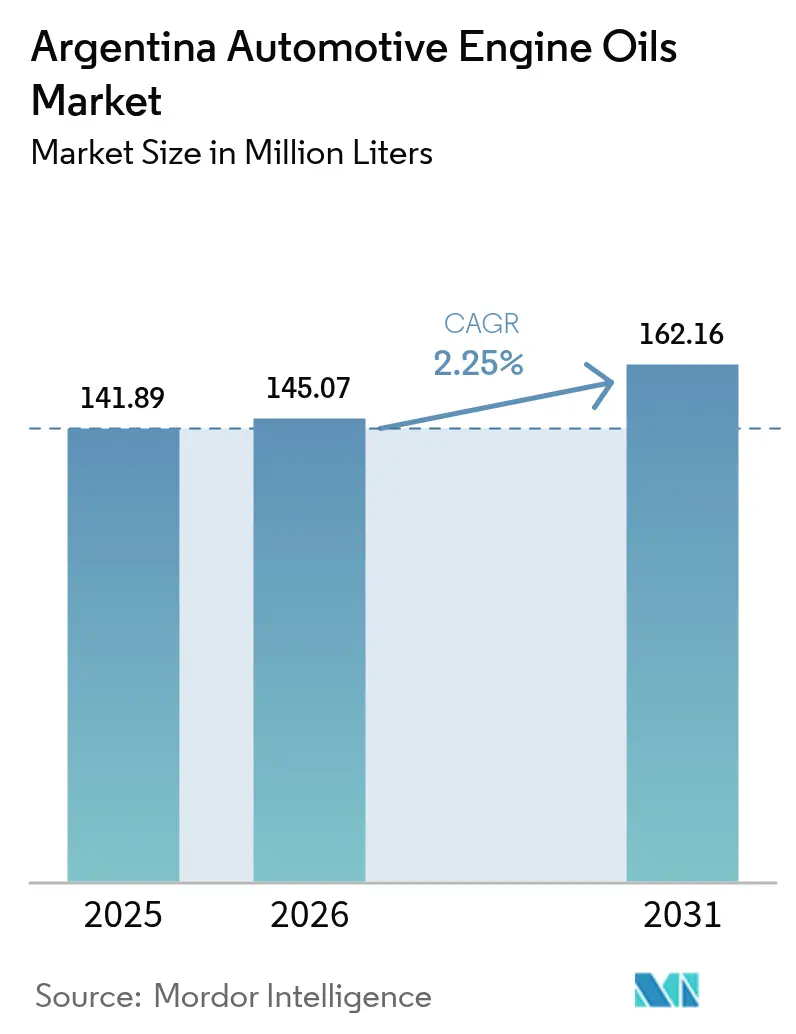
| Base Year Market Size (2025) | 141.89 Million Liters |
| Market Volume (2026) | 145.07 Million Liters |
| Market Volume (2031) | 162.16 Million Liters |
| Growth Rate (2026 - 2031) | 2.25 % |
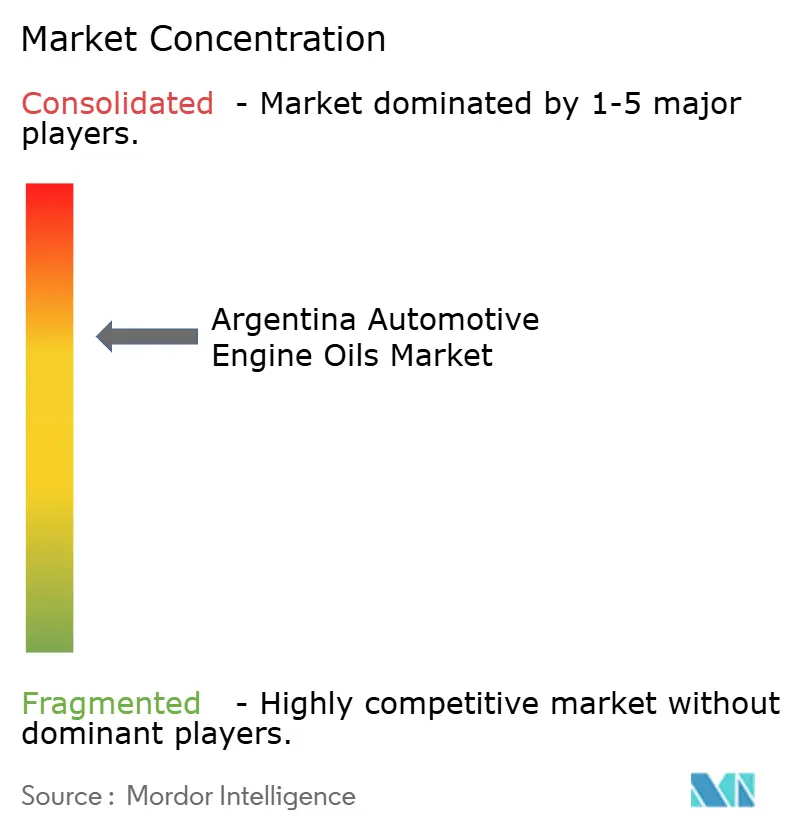
| Market Concentration | Medium |
Major Players *Disclaimer: Major Players sorted in no particular order Image © Mordor Intelligence. Reuse requires attribution under CC BY 4.0. | |
Argentina Automotive Engine Oils Market Analysis by Mordor Intelligence
The Argentina Automotive Engine Oils Market size was valued at 141.89 Million Liters in 2025 and estimated to grow from 145.07 Million Liters in 2026 to reach 162.16 Million Liters by 2031, at a CAGR of 2.25% during the forecast period (2026-2031). This growth reflects the post-reform rebound in light-vehicle output, persistent aftermarket demand from an aging 15.55 million-unit vehicle parc, and incremental shifts toward low-SAPs synthetics that comply with tightening emissions rules[1]Instituto Nacional de Estadística y Censos, “Indicadores de Producción Industrial,” indec.gob.ar. Continued peso volatility, import-offset quotas, and the DJAI licensing system shape procurement strategies, boosting the competitive advantage of integrated domestic blenders that can ensure uninterrupted supply. At the same time, modest electric-vehicle penetration, currently at just 1,555 units, keeps lubricant demand firmly anchored in internal-combustion platforms. Fleet digitization, exemplified by connected-vehicle offerings from Scania and YPF’s Ruta system, is lengthening drain intervals yet raising viscosity and oxidation-stability requirements, creating opportunities for premium synthetic and semi-synthetic formulations.
Key Report Takeaways
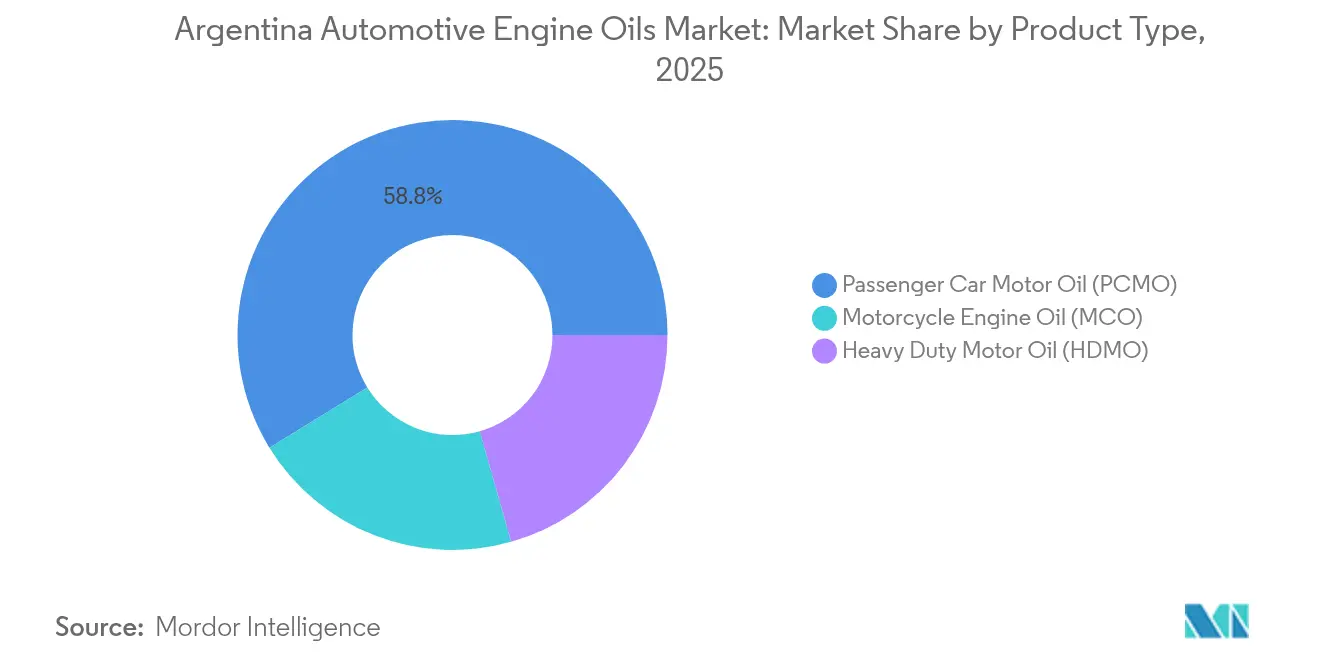
- By product type, Passenger Car Motor Oil held 58.78% of the Argentina Automotive Engine Oils market share in 2025, whereas Motorcycle Engine Oil is projected to grow the fastest at a 2.32% CAGR to 2031.
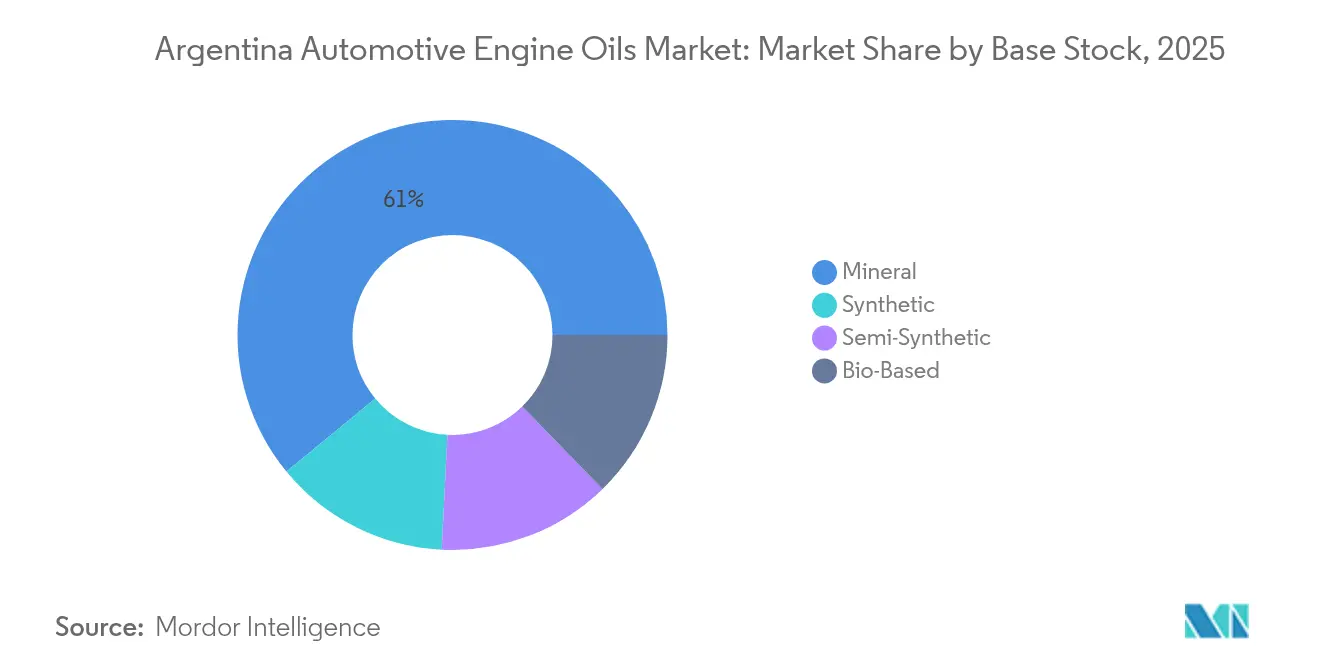
- By base stock, mineral oils commanded 60.95% of the Argentina Automotive Engine Oils market size in 2025, while synthetic oils are poised for the highest growth at a 2.55% CAGR through 2031.
Note: Market size and forecast figures in this report are generated using Mordor Intelligence’s proprietary estimation framework, updated with the latest available data and insights as of 2026.
Argentina Automotive Engine Oils Market Trends and Insights
Drivers Impact Analysis*
| Driver | (~) % Impact on CAGR Forecast | Geographic Relevance | Impact Timeline |
|---|---|---|---|
| Rapid rebound of light-vehicle production post-2024 FX reform | +0.8% | National, with concentration in Buenos Aires, Córdoba automotive corridors | Short term (≤ 2 years) |
| Aging vehicle parc (>13 yrs) sustaining aftermarket demand | +0.6% | National, with higher impact in interior provinces | Long term (≥ 4 years) |
| Tightening fuel-sulphur & emissions rules favoring low-SAPs synthetics | +0.4% | National, with early adoption in Buenos Aires metropolitan area | Medium term (2-4 years) |
| OEM factory-fill contracts localizing to comply with import-offset quotas | +0.3% | National, concentrated in automotive manufacturing hubs | Medium term (2-4 years) |
| Fleet digitalization driving high-mileage long-drain oils | +0.2% | National, with early gains in Buenos Aires, Rosario, Córdoba commercial corridors | Long term (≥ 4 years) |
| Source: Mordor Intelligence | |||
Rapid Rebound of Light-Vehicle Production Post-2024 FX Reform
Automotive output surged 23.2% y-o-y in January 2025 after Argentina unified its exchange rates, restoring manufacturer access to imported components and re-energizing OEM production targets. The resulting upswing in factory-fill demand injects new volumes into the Argentina Automotive Engine Oils market, especially for API-SP and ACEA A5/B5 formulations required by Toyota, Ford, and General Motors. Assemblers now forecast double-digit output gains for 2025; however, this incremental volume must coexist with the aftermarket’s 15:1 dominance, straining domestic blending capacity and favoring players such as YPF that own upstream base-oil assets. The episode highlights how macroeconomic policy shifts can abruptly realign lubricant demand patterns, challenging supply chains that are calibrated to steady aftermarket cycles.
Aging Vehicle Parc Sustaining Aftermarket Demand
With an average vehicle age of 14.3 years and 80% of units older than 10 years, Argentina’s fleet anchors stable lubricant off-take well beyond new-car sales cycles. Professional service centers perform 95% of oil changes, institutionalizing repeat demand through programs like YPF Boxes, which bundle products and services. Mandatory annual inspections for vehicles over three years old further institutionalize maintenance, ensuring the Argentina Automotive Engine Oils market remains resilient even in economic downturns. Cost-sensitive owners favor 15W-40 mineral grades, yet the gradual shift to semi-synthetics in urban regions signals a slow evolution of viscosity and performance preferences.
Tightening Fuel-Sulfur & Emissions Rules Favoring Low-SAPs Synthetics
Joint Resolution 01/2016 introduced Euro III heavy-duty limits and diesel fuel sulfur reductions to 30-50 ppm, compelling fleets to adopt low-SAP oils that protect DPFs and SCR systems[2]Secretaría de Energía, “Resolución Conjunta 01/2016,” argentina.gob.ar. Alignment with ACEA E8 and API CK-4 sequences is increasing oxidation stability and biodiesel compatibility requirements, particularly relevant under Argentina’s 5% biodiesel blend mandate. The regulation accelerates demand for Group II+ and Group III-based synthetics despite their 40-60% price premium, positioning premium suppliers for share gains in the Argentina Automotive Engine Oils market.
OEM Factory-Fill Contracts Localizing to Comply with Import-Offset Quotas
Import-offset rules oblige automakers to match every USD of imports with exports, incentivizing domestic sourcing of factory-fill lubricants. YPF has secured agreements with Suzuki, Volkswagen, Ford, and Chevrolet by leveraging its 244,000 m³/year Group I base-oil stream and multi-site blending capacity. Localization reduces DJAI-related delays, stabilizes production schedules, and embeds lubricant suppliers deeper into OEM value chains. The strategy, however, requires sustained investment in laboratory capabilities and additive technologies to meet global OEM specifications, thereby generating a technology-capability race among local blenders.
Restraints Impact Analysis*
| Restraint | (~) % Impact on CAGR Forecast | Geographic Relevance | Impact Timeline |
|---|---|---|---|
| Peso volatility inflating imported base-oil costs | -0.5% | National, with higher impact on import-dependent blenders | Short term (≤ 2 years) |
| EV & hybrid uptake in urban taxi fleets | -0.2% | Buenos Aires, Rosario, Córdoba metropolitan areas | Medium term (2-4 years) |
| DJAI-style import licensing uncertainty | -0.3% | National, affecting all import-dependent market participants | Short term (≤ 2 years) |
| Source: Mordor Intelligence | |||
Peso Volatility Inflating Imported Base-Oil Costs
Monthly 2.2% increases in refined-product prices during February 2025 reveal how currency swings feed straight into input costs for blenders reliant on imported Group II+ base stocks and additive packages. Independent players must either absorb margin hits or pass on costs, eroding their price competitiveness against YPF and Shell, which possess integrated or global supply chains. Elevated working-capital needs, with letters of credit often tying up funds for 180 days, limit investment capacity and slow premium-product launches, marginally dampening the Argentina Automotive Engine Oils market.
EV & Hybrid Uptake in Urban Taxi Fleets
Buenos Aires has earmarked 50,000 tariff-free EV and hybrid slots through 2026, specifically targeting taxi and ride-hailing fleets. Although EVs numbered only 1,555 units in 2024, high annual mileage in taxi operations magnifies lubricant displacement per vehicle, posing a focused threat to future demand. Limited charging infrastructure and power-grid constraints confine the phenomenon to metropolitan areas, mitigating its nationwide impact but creating pockets of volume loss in a market otherwise buffered by an aging combustion fleet.
*Our forecasts treat driver/restraint impacts as directional, not additive. The impact forecasts reflect baseline growth, mix effects, and variable interactions.
Segment Analysis
By Product Type: PCMO Dominates Through Fleet Demographics
Passenger Car Motor Oil (PCMO) accounted for 58.78% of the Argentina Automotive Engine Oils market size in 2025, mirroring an 11.2 million-unit passenger-car parc that dwarfs commercial and two-wheeler counts. Increasing OEM demand for API SP and ACEA A5/B5 synthetics is nudging urban consumers toward semi-synthetic 5W-30 grades, though 15W-40 mineral oils remain prevalent in interior provinces due to price sensitivity.
The PCMO segment is also the primary arena for brand competition, with YPF, Shell, and TotalEnergies vying through loyalty programs and bundled services. Marketing pivots on drain interval guarantees and fuel economy claims validated by OEM co-branding. Digital booking apps for YPF Boxes and Shell Helix centers make oil change transactions traceable, enabling data-driven promotions that cement stickiness in the Argentina Automotive Engine Oils market.
Motorcycle Engine Oil (MCO) is growing the fastest, at a 2.32% CAGR, fueled by rising two-wheeler registrations in congestion-prone urban areas and surging last-mile delivery services. Air-cooled engines and wet-clutch systems require JASO-MA2-compliant oils, opening a value window for semi-synthetic 10W-40 grades. Domestic assemblers such as Bajaj and Honda stimulate factory-fill volumes and endorse branded oils at authorized workshops, reinforcing aftermarket pull-through.



By Base Stock: Mineral Oils Maintain Cost-Driven Dominance
Mineral formulations retained 60.95% of the Argentina Automotive Engine Oils market share in 2025, secured by YPF’s captive Group I output and cost-advantaged supply chain. The product continues to dominate rural and value-conscious consumer segments, where price outweighs considerations of drain interval or emissions. Merchandise bundling with fuel purchases at YPF and Shell stations further entrenches mineral grades in mainstream channels.
Synthetics, however, represent the growth frontier, posting a projected 2.55% CAGR as Euro III heavy-duty mandates, extended-drain targets, and OEM specifications converge. Import reliance for Group III base oils introduces currency-driven volatility; however, partnerships between TotalEnergies and Quimiguay on re-refined stocks could help temper cost hurdles over time. Semi-synthetics bridge the gap, blending domestic Group I with imported Group II+ cuts to balance performance with affordability, and are increasingly marketed as “transition” products for fleets upgrading to ACEA E8 or API CK-4 specifications.
Geography Analysis
The Buenos Aires metropolitan area commands a major portion of the Argentina Automotive Engine Oils market, nourished by dense vehicle ownership and proximity to OEM assembly plants such as Toyota’s Zárate and Ford’s Pacheco complexes. Elevated purchasing power and stricter emissions enforcement favor rapid uptake of low-SAPs synthetics, enabling premium pricing strategies.
Córdoba and Rosario corridors form the secondary demand belt, together lifting the combined urban share to nearly 69.70%. These provinces host production clusters for Renault, Volkswagen, and Fiat, driving steady OEM factory-fill volumes and facilitating lubricant supply through established logistics nodes. Service-center footprints are broad, allowing brands like Shell and TotalEnergies to pilot telematics-linked drain programs that upsell high-performance oils.
Interior provinces display divergent dynamics. Agricultural regions in Santa Fe and Entre Ríos align lubricant cycles with planting and harvest seasons, resulting in a spike in demand for 15W-40 heavy-duty mineral oils in tractors and harvesters. Patagonian climates, with temperature swings from -15°C to 40°C, stimulate niche demand for full synthetics capable of cold-start protection. Distribution to these remote areas rewards firms with robust reseller networks, reinforcing the strategic weight of channel management in the Argentina automotive engine oils market.
Regulatory Landscape
Argentina regulates fuels and lubricants through the Secretaría de Energía, including registration obligations for companies involved in producing, blending, or commercializing lubricants, greases, and additives under the national hydrocarbons framework and related registries (Registro de Empresas Petroleras). This registration and oversight environment affects operating eligibility for domestic blenders and importers supplying automotive engine oils.
For technical conformity, IRAM (Instituto Argentino de Normalización y Certificación) acts as the official standards body, and lubricant-related norms (for example, IRAM 6581:2022) support standardization of quality and testing practices. The Organismo Argentino de Acreditación (OAA) accredits certification bodies and testing laboratories. Product acceptance in practice typically relies on aligning national requirements with internationally used test methods such as ASTM, alongside OEM specification compliance for modern engine oil sequences.
Value Chain Analysis
The value chain begins with base oils and additive packages. Argentina has domestic output for paraffinic base stocks, but it remains structurally import-reliant for higher-quality synthetic base oils and additives. This import dependence, together with the administrative import frictions described in the report context, increases the value of inventory planning and tends to favor players with integrated supply or strong global procurement. Domestic blending and finishing is anchored by operators such as YPF (with captive Group I availability in the report context), Pan American Energy (lubricant blending and distribution in Campana supporting the Castrol business), TotalEnergies (a 50,000 tons/year lubricants and grease facility in La Tablada with ISO 14001, ISO 9001, and IATF 16949 certifications), and FUCHS Argentina (production and R&D in El Talar, Buenos Aires).
On the downstream side, distribution relies on fuel-station networks, professional service centers, and OEM or factory-fill channels centered around the Buenos Aires, Cordoba, and Rosario automotive corridors, then extending via resellers into interior provinces. Recent competitive activity shows how participants add nodes or partnerships to reach demand centers: Vibra Energia announced plans to enter Argentina with Lubrax via a local office and distribution network (with stated longer-term intent for local production), and Andes SA activated investment plans linked to its Rosario plant and a distribution partner in Neuquen to better serve demand connected to Vaca Muerta-related operations. Regulatory and industrial policy shifts also affect sourcing economics, as Decree 49/2025 adjusted Local Added Value (LAV) calculations for the automotive industry and reinforced localization incentives across the broader automotive supply ecosystem that consumes engine oils through OEM and aftermarket channels.
Competitive Landscape
The Argentina Automotive Engine Oils Market is concentrated.YPF leverages vertical integration, funneling Group I base oils from La Plata into over 380 YPF service sites, a model that secures both supply and point-of-sale dominance. Shell counters by leveraging global R&D and recently clinched a USD 12 million annual factory-fill contract with Toyota, underpinning its Helix Ultra positioning. Competitive fault lines, therefore, extend beyond price or brand equity to encompass technology depth, supply chain resilience, and ESG alignment—key axes shaping future share capture in the Argentine automotive engine oil market.
Argentina Automotive Engine Oils Industry Leaders
TotalEnergies
YPF
BP p.l.c.
Shell plc
Exxon Mobil Corporation
- *Disclaimer: Major Players sorted in no particular order

Market Opportunities and Future Outlook
One opportunity is premiumization tied to modern specifications and operating severity, particularly in high-mileage fleets and heavy-duty cycles linked to oil and gas logistics. In the report context, YPF product moves into premium heavy-duty and specialty use cases (for example, EXTRAVIDA-branded offerings positioned for demanding operations) provide an observable signal of commercialization around higher-performance engine oil requirements. At the same time, aftermarket demand supported by professional service-center penetration creates routes for upselling synthetic and semi-synthetic grades.
There is also room to expand localized supply and compliance-enabling services. The January 2025 YPF and Chevron Products Company agreement, positioning YPF as exclusive distributor of NEXBASE base oils in Argentina, indicates how securing higher-quality base oil streams can help expand the addressable synthetic engine oil mix despite import exposure. Industry bodies such as Camara Argentina de Lubricantes (CAL) and Asociacion Argentina de Tribologia (AAT) provide coordination points for best practices and technical capability building, which supports differentiation through product validation, used-oil analysis services, and workshop programs. On the demand side, ADEFA reporting and the concentration of OEM production in core corridors keep factory-fill and first-fill partnerships relevant, as shown by YPF's multi-year first-fill agreement with Grupo Corven covering motorcycles and selected commercial vehicle brands and linking lubricant selection more tightly to vehicle platforms and authorized service pathways.
Recent Industry Developments
- April 2026: Argentina reported lubricants consumption of about 18,500 cubic metres (16,400 tonnes), extending a four-month run of demand growth. The trend increased focus on supply readiness and working-capital management for blenders and distributors, especially for higher-spec engine oil grades that depend on imported base stocks and additive packages.
- November 2025: YPF launched ELAION AURO, a premium 100% synthetic engine oil line positioned around its Constant Evolution Technology (TEC) messaging. The launch reinforced premiumization efforts in PCMO and added competitive pressure on international brands that differentiate through OEM claims and drain-interval performance.
- November 2024: YPF signed a three-year agreement with Grupo Corven to supply YPF ROD (motorcycle) and EXTRAVIDA (heavy-duty) lubricants as first-fill for Corven-linked vehicle brands, effective from 2025. The deal strengthened OEM-linked pull-through into the aftermarket via authorized workshop networks and expanded YPF's embedded position in two-wheelers and select commercial applications.


Research Methodology Framework and Report Scope
Market Definition and Coverage
For this report, the market is defined as automotive engine oils sold and used within Argentina for lubricating internal combustion engines across on-road vehicles, captured in volume terms (liters) across the study period.
Scope exclusions: It excludes non-engine automotive lubricants such as transmission fluids, gear oils, brake fluids, greases, and coolants.
Segmentation Overview
- By Product Type
- Passenger Car Motor Oil (PCMO)
- 0W-XX
- 5W-XX
- 10W-XX
- 15W-XX
- Monogrades
- Other Grades
- Heavy Duty Motor Oil (HDMO)
- 0W-XX
- 5W-XX
- 10W-XX
- 15W-XX
- Monogrades
- Other Grades
- Motorcycle Engine Oil (MCO)
- 0W-XX
- 5W-XX
- 10W-XX
- 15W-XX
- Monogrades
- Other Grades
- Passenger Car Motor Oil (PCMO)
- By Base Stock
- Mineral
- Synthetic
- Semi-Synthetic
- Bio-Based
Data Sources, Market Sizing, and Validation
Desk Research
We start by building the demand environment using public, checkable datasets that show how many vehicles are running in the country and how intensively they are used. Sources such as Argentina national statistics publications, customs and trade statistics, energy and fuels reporting, and vehicle registration series help us frame the operating fleet and its likely oil consumption patterns.
We then bring in supporting evidence from OEM guidance and lubricant technical standards, peer reviewed lubrication and tribology literature, and association publications that discuss drain intervals, viscosity migration, and base oil trends. Company filings, investor decks, and reputable press are also reviewed to understand local blending, import dependence, and channel shifts. Where available, subscription data focused on shipment-level import/export records and another focused on company financials and news are used to validate directional movements. These sources are illustrative and not exhaustive, and many other references were used to collect, cross-check, and clarify the data.
Primary Interviews and Surveys
Primary interviews and surveys were run with a mix of lubricant marketers, blenders, distributors, workshops, and fleet-maintenance stakeholders to pressure-test secondary assumptions and fill gaps that public data does not show well. The interviews clarified typical oil change intervals by vehicle type, how customers perceive shifts between mineral and synthetic, and how pricing and availability influence purchasing behavior across major Argentine demand centers.
Distribution of primary research fieldwork respondents
| Company type | Respondent position |
|---|---|
| Top tier: 38% | CXOs: 14% |
| Mid tier: 46% | Functional/Unit leaders: 29% |
| Smaller Players: 16% | Managers: 57% |
Market-Sizing & Forecasting
Sizing is built mainly through a top-down demand pool assessment where the vehicle parc and annual usage are translated into engine oil consumption, then adjusted for service behavior in Argentina. The model relies on inputs that can be explained and checked, including the in-operation vehicle parc split by passenger cars, commercial vehicles, and motorcycles, average annual kilometers, typical sump capacity ranges, drain intervals (which can extend with better oils), and the mix shift between mineral, semi-synthetic, and synthetic.
To keep totals realistic, we corroborate results with selective bottom-up approximations, such as rolling up a sample of supplier and distributor volumes, and testing implied liters-per-vehicle against workshop and fleet feedback. Where direct visibility is weaker, such as informal channels and rural workshop demand, gaps are handled through conservative penetration factors that are validated through interviews. Forecasts use scenario analysis supported by primary inputs on macro drivers, new vehicle sales direction, aging fleet dynamics, and expected changes in maintenance practices, applied to the demand variables year by year.
Data Validation & Update Cycle
We run cross-checks that compare model outputs against independent signals, such as import volumes for base oils and finished lubricants, changes in vehicle stock, and visible shifts in synthetic adoption discussed by industry participants. When a jump looks unusual, the assumptions are revisited and the relevant respondents are re-contacted to understand whether it reflects a true market change or a timing and reporting effect.
Before sign-off, the file goes through multi-step analyst reviews so the calculations, units, and conversion logic are consistent across the time series. Reports are refreshed annually, and interim updates are done when material events occur that can shift demand, supply, or pricing. Right before delivery, an updated check is completed so clients receive the latest view aligned to current information.
Mordor Intelligence's Argentina Automotive Engine Oils Market Sizing Compared With Other Published Estimates
Published numbers for Argentina automotive engine oils can differ across sources because each one makes different choices on the unit of measure, the channels counted, and how consumption is reconstructed from vehicle use. In practice, differences also show up when one study leans more on list pricing, while another leans more on workshop behavior and drain-interval realities.
The table shows a clear spread, and in Mordor Intelligence's model the market is sized in volume (liters) with consumption built from the in-operation parc, service intervals, and product-type mix, rather than converting from value using assumed prices. Another common gap is whether figures fold engine oils into broader automotive lubricants, or whether they include adjacent industrial or off-road uses that are not tied to on-road vehicle maintenance cycles.
Benchmark comparison
| Source | Market Size | Gaps in Research Methodology |
|---|---|---|
| Mordor Intelligence | USD 141.89 M (2025) | |
| Industry Association A | USD 155.40 M (2025) | Often reported as a broader lubricant consumption total and then filtered down using fixed shares, which can overstate engine oils when transmission and hydraulic fluids trend differently. |
| Trade Journal B | USD 128.60 M (2025) | Commonly derived from import-led supply visibility and partial formal-channel tracking, which can miss locally blended volumes and smaller aftermarket routes that still contribute to total liters sold. |
Overall, the differences come down to what is counted and how it is reconstructed, especially around unit choice, channel coverage, and how drain intervals and synthetic mix are treated over time. By keeping the model tied to vehicle-use variables and then validating with channel checks, the sizing remains easy to follow and repeat when new fleet or trade data becomes available.


Key Questions Answered in the Report
What is the current volume of the Argentina Automotive Engine Oils market?
The market totals 145.07 million liters in 2026 and is projected to reach 162.16 million liters by 2031.
How fast is demand expected to grow?
Volume is set to expand at a 2.25% CAGR during 2026-2031.
Which product type dominates consumption?
Passenger Car Motor Oil leads with a 58.78% share of 2025 volume.
Why are synthetics gaining traction?
Tightening Euro III emissions rules and longer drain-interval targets are pushing fleets and OEMs toward low-SAPs synthetic oils.
How do import-offset quotas influence lubricant sourcing?
They incentivize automakers to source factory-fill oils locally, favoring domestic blenders like YPF that meet technical and content requirements.
Page last updated on:





