
Area-Scan Industrial Camera Market Size and Share
Market Overview
| Study Period | 2020 - 2031 |
|---|---|
| Market Size (2026) | USD 10.95 Billion |
| Market Size (2031) | USD 16.51 Billion |
| Growth Rate (2026 - 2031) | 8.56 % |
| Fastest Growing Market | Asia-Pacific |
| Largest Market | Asia-Pacific |
| Market Concentration | Medium |
Major Players *Disclaimer: Major Players sorted in no particular order Image © Mordor Intelligence. Reuse requires attribution under CC BY 4.0. | |
Area-Scan Industrial Camera Market Analysis by Mordor Intelligence
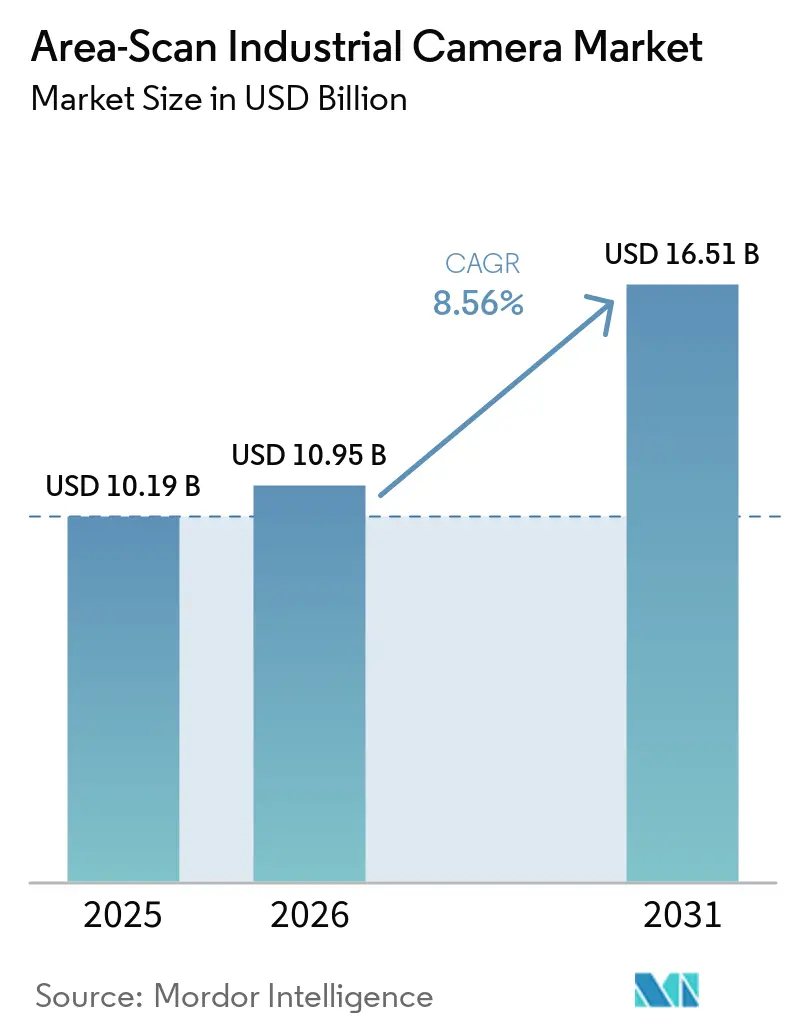
The area-scan industrial camera market size is expected to grow from USD 10.19 billion in 2025 to USD 10.95 billion in 2026, and is forecast to reach USD 16.51 billion by 2031, at an 8.56% CAGR over 2026-2031. Factory automation is expanding the use of vision systems for positioning, verification, and inspection. Higher-resolution imaging and edge AI processing are moving cameras into real-time process control. This supports demand in semiconductor, automotive, and logistics production settings. Suppliers are responding with wider interface options, software support, and products designed for demanding inspection environments. Sensor supply concentration and future interface changes could influence purchasing decisions across the area-scan industrial camera market.
Key Report Takeaways
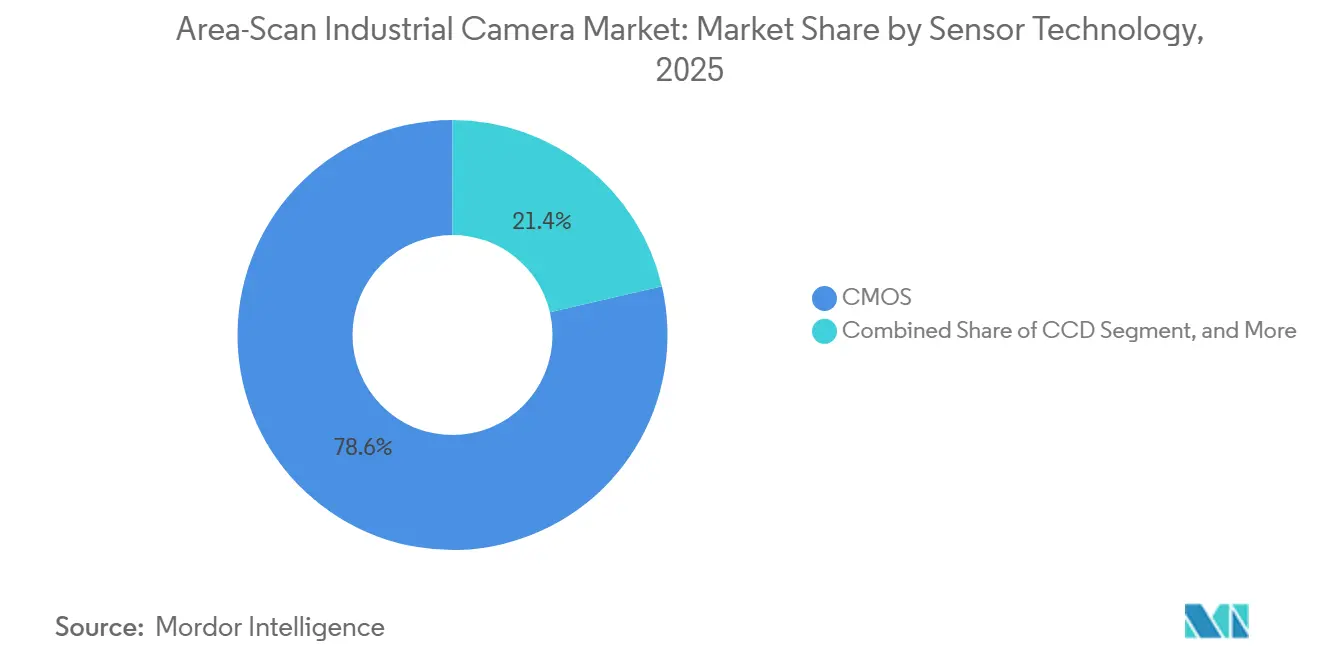
- By sensor technology, CMOS held 78.64% of the area-scan industrial camera market share in 2025, while other sensor technologies are projected to expand at a 9.16% CAGR through 2031.
- By resolution, below-5-megapixel cameras accounted for 44.21% of revenue in 2025, while the above-12-megapixel tier is projected to expand at a 9.18% CAGR through 2031.
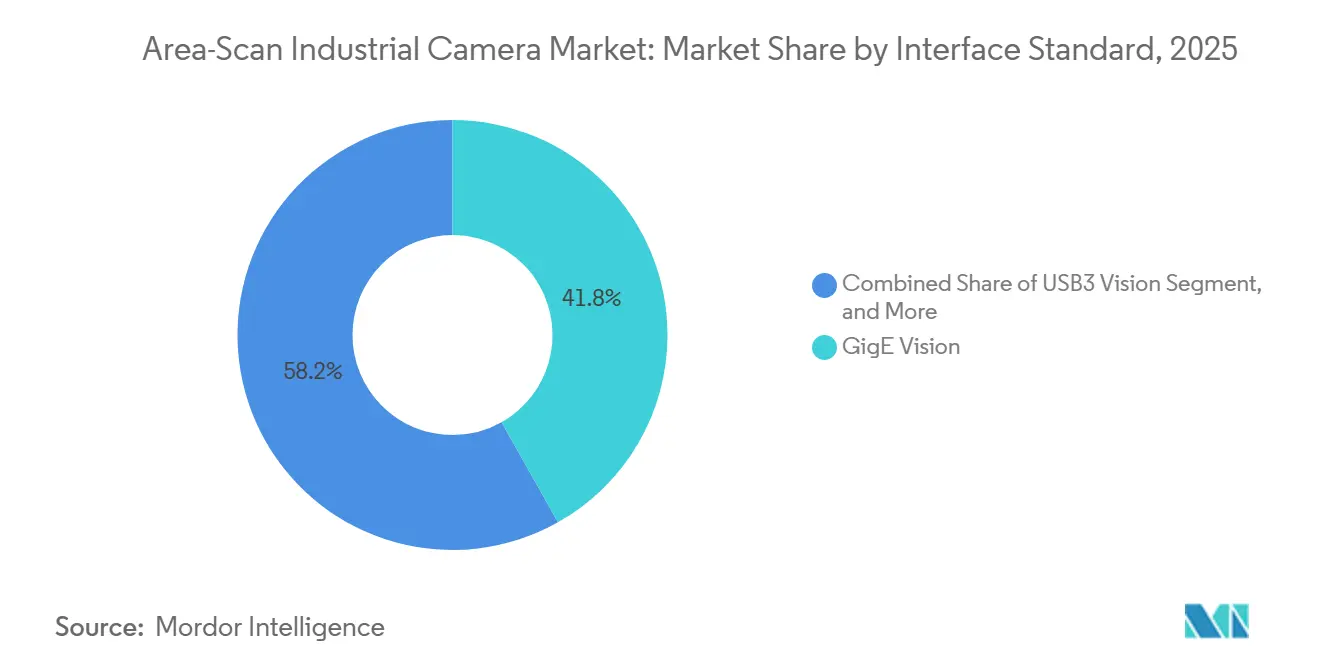
- By interface standard, GigE Vision accounted for 41.84% of revenue in 2025, while CoaXPress is projected to expand at a 9.54% CAGR through 2031.
- By end-user industry, electronics and semiconductor manufacturers accounted for 28.42% of revenue in 2025, while automotive and EV battery applications are projected to expand at a 10.14% CAGR through 2031.
- By geography, Asia-Pacific accounted for 43.77% of revenue in 2025 and is projected to grow at a 9.58% CAGR through 2031.
Note: Market size and forecast figures in this report are generated using Mordor Intelligence’s proprietary estimation framework, updated with the latest available data and insights as of January 2026.
Global Area-Scan Industrial Camera Market Trends and Insights
Drivers Impact Analysis*
| Driver | (~) % Impact on CAGR Forecast | Geographic Relevance | Impact Timeline |
|---|---|---|---|
| Expansion of Automated Quality Inspection | +2.0% | Global | Short term (≤ 2 years) |
| Semiconductor and Electronics Manufacturing Expansion | +1.8% | Asia-Pacific core, spillover to North America | Medium term (2-4 years) |
| Rising Adoption of AI-Enabled Machine Vision | +1.5% | Global | Medium term (2-4 years) |
| Demand for Higher Resolution and Faster Image Acquisition | +0.8% | Global | Short term (≤ 2 years) |
| Zero-Defect Manufacturing Requirements | +0.6% | Global, concentrated in Asia-Pacific and Europe | Medium term (2-4 years) |
| Camera-Level Processing for Reduced Inspection Latency | +0.4% | North America and Asia-Pacific core | Long term (≥ 4 years) |
| Source: Mordor Intelligence | |||
Expansion of Automated Quality Inspection
Factory automation is increasing the installed base of area-scan cameras across production lines. Manual inspection creates cost, consistency, and safety concerns in high-throughput facilities. The global operational stock of industrial robots reached 4,664,000 units at the end of 2024, up 9% from the prior year.[1]International Federation of Robotics, “Global Robot Demand in Factories Doubles Over 10 Years,” International Federation of Robotics, ifr.org Asia-Pacific accounted for 74% of new robot deployments in 2024, and electronics represented 24% of installations. Vision software is raising expectations for dynamic range and frame rate, which can make older cameras a constraint before planned replacement dates. In August 2026, AAEON demonstrated a wafer inspection system that combined an industrial camera with an NVIDIA Jetson Orin NX edge module. These integrated systems can support recurring upgrade demand in fabs and logistics facilities within the area-scan industrial camera market.
Semiconductor and Electronics Manufacturing Expansion
New semiconductor capacity requires imaging systems for wafer inspection, die sorting, and advanced packaging metrology. TSMC announced in March 2025 that its planned US investment would reach USD 165 billion, including 3 fabrication plants and 2 advanced packaging facilities. The projects add demand for equipment used during increasingly precise production stages. Samsung Electronics' Taylor, Texas, facility reached EUV first-light production in 2026 and was preparing a second fab at the site. TSMC is using NVIDIA Metropolis and the NVIDIA TAO Toolkit for vision AI in defect classification. These tools reduce the need for repeated labeling and retraining as process conditions change. Fab ramp schedules, therefore, remain important for suppliers serving the area-scan industrial camera market.
Rising Adoption of AI-Enabled Machine Vision
AI-enabled machine vision allows area-scan cameras to support defect detection closer to the production line. Edge processing can reduce the need to send every image to centralized computing resources. A 2025 peer-reviewed study reported 98.5% defect-detection accuracy for an EV battery inspection system at a line speed of 30 meters per minute. The study also reported 190-millisecond inference latency, a 67% lower defect rate, and 81% lower quality-control costs than the stated rule-based approach. Embedded inference processors are making this type of workload more practical near the camera. Procurement teams increasingly consider open software development kits, GenICam-compliant firmware, and engineering support alongside optics and sensor price. This favors suppliers that can link hardware performance with software integration in the area-scan industrial camera market.
Demand for Higher Resolution and Faster Image Acquisition
Semiconductor fabs and EV battery lines require detailed images without slowing production. This is increasing interest in cameras that combine high pixel counts with rapid acquisition. Allied Vision launched its FXO CXP series in May 2026 with a 24.6-megapixel model at 192 frames per second and a 12.4-megapixel model at 339 frames per second. The series uses 4 CoaXPress-12 lanes that deliver up to 50 Gbit/s. Emergent Vision Technologies began shipping a 68-megapixel camera at 138 frames per second over a QSFP28 100GigE interface in June 2026. These launches show that high-resolution, high-speed configurations are becoming production options rather than narrow technical demonstrations. The area-scan industrial camera market can benefit as existing inspection cells need more capable image acquisition.
Restraints Impact Analysis*
| Restraint | (~) % Impact on CAGR Forecast | Geographic Relevance | Impact Timeline |
|---|---|---|---|
| High System-Integration and Application-Engineering Costs | -1.3% | Global, acute in South America, Middle East and Africa, and emerging Asia-Pacific | Short term (≤ 2 years) |
| Shortage of Machine-Vision Integration Skills | -0.9% | Global, critical in North America and Europe | Medium term (2-4 years) |
| Sensor and Interface Obsolescence Risk | -0.4% | Global | Long term (≥ 4 years) |
| Data-Rate, Storage, and Thermal Constraints in Multi-Camera Systems | -0.3% | Asia-Pacific core, North America | Medium term (2-4 years) |
| Source: Mordor Intelligence | |||
High System-Integration and Application-Engineering Costs
Complex inspection projects can require substantially more spending on integration than on camera hardware. Installation work includes lenses, lighting, calibration, software recipes, and classified reference-image libraries. These tasks need application knowledge that many mid-sized manufacturers do not maintain in-house. Food, beverage, packaging, and logistics operators are particularly exposed to this cost structure. Pharmaceutical and medical device projects can require additional validation under FDA 21 CFR Part 11 and EU Annex 11 requirements. Vendors that provide factory-calibrated systems and pre-validated software recipes can reduce work on-site at the customer. This approach can improve adoption in price-sensitive parts of the area-scan industrial camera market.
Shortage of Machine-Vision Integration Skills
Machine vision projects require skills in optics, AI algorithms, and industrial network integration. This combination can delay deployments even where capital budgets are available. A Zebra Technologies study found that 65% of EU warehouse decision-makers planned to adopt machine vision, but many lacked a clear implementation roadmap. The stated skills gap limited progress from adoption intent to the deployment of systems. The Association for Advancing Automation has noted that industry-academic collaboration is improving, although shortages are expected to persist in the medium term. Pre-trained models, mature software development kits, and turnkey designs can lower the need for specialized labor. Such offerings may help camera suppliers reach customers who cannot assemble large internal vision teams.
*Our forecasts treat driver/restraint impacts as directional, not additive. The impact forecasts reflect baseline growth, mix effects, and variable interactions.
Segment Analysis
By Sensor Technology: CMOS Leads as Alternative Sensors Address Specialized Imaging Needs
CMOS held 78.64% of the area-scan industrial camera market share in 2025. Continuous improvement in global-shutter designs has supported this position. CMOS cameras offer a broad mix of cost, speed, and image performance for industrial users. Sony Pregius S back-side illuminated sensors support high dynamic range and low read noise at elevated frame rates. CCD sensors remain relevant where low-light sensitivity and limited fixed-pattern noise are especially important. These applications include UV photomask inspection, certain scientific metrology workflows, and niche astronomical imaging. Major sensor producers have moved production capacity toward CMOS, reducing the commercial position of CCD products.[2]Basler AG, “CMOS Sensors in Machine Vision,” Basler Learning Portal, baslerweb.com The other sensor technologies category is projected to expand at a 9.16% CAGR through 2031. It includes short-wave infrared and extended near-infrared sensors for EV battery moisture analysis and semiconductor wafer metrology. These sensors can image through material layers or dielectric films that standard silicon-based CMOS systems cannot inspect effectively.
The area-scan industrial camera market size for CMOS products continues to reflect distinct needs within the technology. Rolling-shutter cameras serve cost-sensitive automation uses where motion distortion is manageable. Global-shutter cameras are necessary for moving parts that require distortion-free images. This makes global-shutter products important in mid-speed and high-speed inspection cells. Semiconductor and EV battery defect classifiers also require consistent pixel-level image quality. The product mix is therefore moving toward global-shutter configurations with higher average selling prices. Suppliers with stronger sensor relationships can benefit as this mix changes. IDS expanded its uEye FA IP69K-rated range in July 2026 with Sony STARVIS 2 rolling-shutter sensors from 2 to 12.5 megapixels. The launch addressed harsh environments while adding near-infrared sensitivity and high dynamic range. Food and pharmaceutical applications can use these capabilities where washdown resistance and image quality both matter.



By Resolution: High-Megapixel Products Support More Demanding Inspection Tasks
The above-12-megapixel tier is projected to expand at a 9.18% CAGR through 2031. Semiconductor fabs, display producers, and EV battery plants require detailed images at full line throughput. These settings require cameras capable of identifying micron-scale defects across large inspection areas. Vieworks introduced the VPS-245MX2 in March 2026 with 245-megapixel resolution and thermoelectric Peltier cooling. The camera targeted flat-panel display, PCB, and semiconductor component inspection. Cooling can help maintain sensor stability during sustained, high-resolution operation. Higher-resolution configurations also require matching interface bandwidth, storage capacity, and processing capability. The area-scan industrial camera market responds to this need through products designed for more demanding inspection systems. High-resolution cameras can support precise imaging where lower-pixel-count systems cannot deliver adequate coverage or defect detail.
Below-5-megapixel cameras accounted for 44.21% of the area-scan industrial camera market size in 2025. Their position reflects a large installed base in food, beverage, packaging, and logistics inspection. Many of these applications do not require the resolution used in semiconductor manufacturing. The 5-12-megapixel tier is widely used in automotive body inspection, pharmaceutical blister-pack verification, and assembly guidance. It balances image detail with processing load in cost-optimized multi-camera systems. Product selection, therefore, depends on the inspection task and the available system infrastructure. Higher resolution does not replace lower-resolution models across every application. Instead, it adds a premium option where detailed defect capture supports the production requirement. This creates different replacement patterns across the resolution spectrum. Suppliers need portfolios that cover standard inspection demand alongside high-resolution deployments.
By Interface Standard: GigE Vision Remains Widely Used While CoaXPress Gains Ground
GigE Vision held 41.84% of the area-scan industrial camera market share in 2025. Its installed position reflects compatibility with Ethernet networks already used across many factories. Power over Ethernet can also remove the need for separate camera power supplies. This supports cost-sensitive deployments with straightforward network architecture. CoaXPress is projected to expand at an 9.54% CAGR through 2031. It addresses the data requirements of high-megapixel sensors in semiconductor, display, and EV battery inspection. A CoaXPress v3.0 specification targeting 25 Gbps per link was in development in early 2026. CoaXPress-over-Fiber is expected to extend the current 35-meter coaxial reach to potentially several miles on single-mode fiber. This could support larger factory layouts that are difficult to serve through copper cabling alone. The choice of interface is becoming more important as pixel counts and throughput requirements increase.
Allied Vision's May 2026 FXO CXP series used 4 CoaXPress-12 connections in a 50 x 50-millimeter fanless body. The design shows how higher-bandwidth connections can support compact inspection arrays. GenICam provides a shared interoperability framework across GigE Vision, USB3 Vision, and CoaXPress platforms. This can reduce software integration work in multi-vendor systems. USB3 Vision remains useful for electronics assembly and logistics applications that use standard PC ports. Camera Link continues to lose some high-bandwidth, short-distance applications to CoaXPress. Other options include 10GigE, 25GigE, and GMSL variants. These standards serve specialized uses in scientific imaging, embedded robotics, and continuous-web inspection. The area-scan industrial camera industry benefits when vendors provide interfaces that match both existing factory networks and future performance needs.
By End-User Industry: Semiconductor Demand Is Strong While EV Battery Inspection Expands
Electronics and semiconductor manufacturers held 28.42% of the area-scan industrial camera market share in 2025. Advanced chip production uses imaging across wafer inspection, die sorting, wire-bond verification, and packaging metrology. Each fabrication plant requires a large set of tools that depend on precise inspection. TSMC's planned USD 165 billion investment in the US included 3 fabrication plants and 2 advanced packaging facilities. This adds a direct demand signal for equipment used in advanced manufacturing. TSMC's use of vision AI also shows the importance of automated defect classification in fabs. Electronics demand also has a reinforcing effect, as fabs produce chips used in later AI systems. Camera suppliers can benefit when inspection requirements rise with semiconductor process complexity. The area-scan industrial camera market remains closely tied to fab investment and equipment ramp schedules.
Automotive and EV battery applications are projected to expand at an 10.14% CAGR through 2031. Electrode coating, electrolyte filling, tab welding, and pack assembly all require quality checks. High-frame-rate area-scan cameras can inspect these processes at production-line speed. A peer-reviewed battery inspection study reported 98.5% defect-detection accuracy at 30 meters per minute. Food and beverage producers use cameras for contamination detection, labels, and fill-level inspection. Pharmaceutical and healthcare facilities use them for blister packs, syringe integrity, and vial labels. Logistics operations are adding cameras to mobile robots and conveyor sortation systems. Packaging and printing users apply vision systems to print-defect detection and registration control. Aerospace and defense customers need reliable imaging platforms for structural inspection and component traceability. These end uses give the area-scan industrial camera market a mix of high-volume and specialized demand.
Geography Analysis
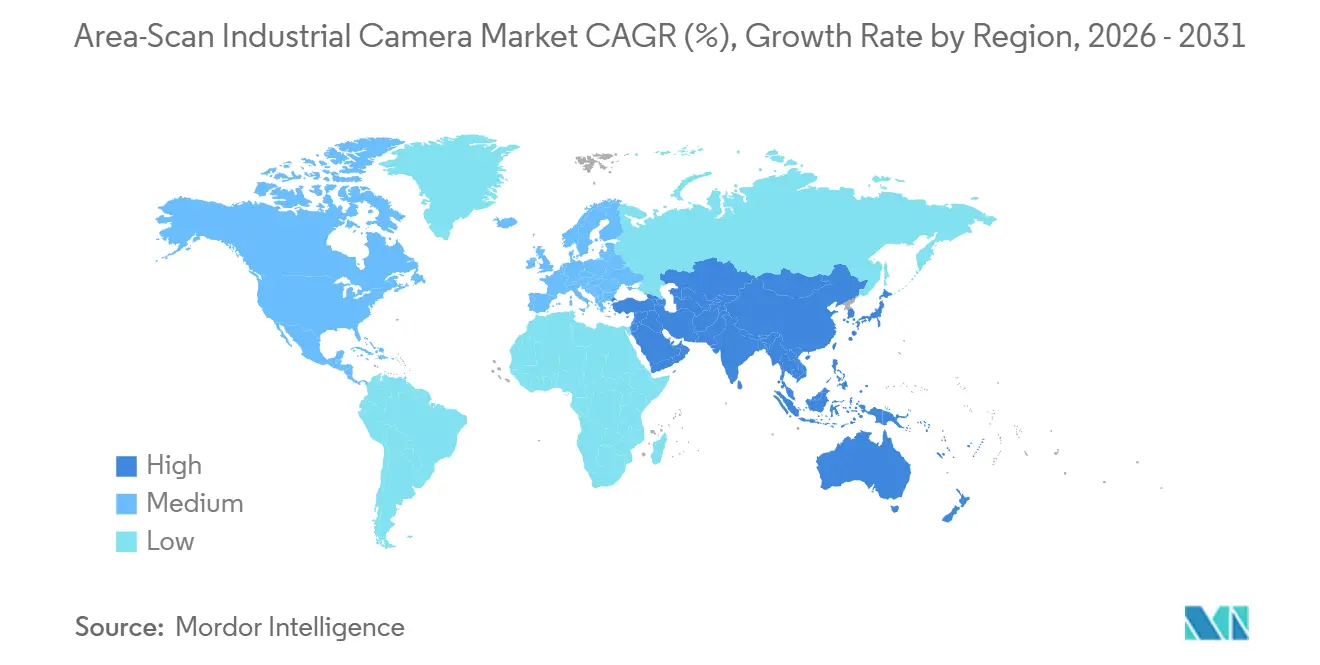
Asia-Pacific held 43.77% of the area-scan industrial camera market share in 2025 and is projected to expand at a 9.58% CAGR through 2031. China provides a large capacity for electronics assembly in the region. South Korea has intensive semiconductor and flat-panel fabrication activity. Taiwan supports demand through circuit board and advanced packaging supply chains. South Korea's demand is concentrated around Samsung and SK Hynix memory and logic fabrication facilities. Taiwan is an important integration hub for semiconductor equipment and circuit-board production. India is also expanding from a smaller base through industrial modernization under the Production-Linked Incentive scheme. These production centers make Asia-Pacific the leading demand region for the area-scan industrial camera market.
North America and Europe are the second- and third-largest regional markets. In North America, proposed funding for the CHIPS and Science Act exceeded USD 32 billion across 16 states in 2026.[3]U.S. Department of Commerce, “Semiconductor Industry,” CHIPS for America, commerce.gov New facilities from TSMC and Samsung are adding demand for precision inspection equipment. US industrial robot installations increased by 11% to 38,000 units in 2025. Food-sector robot adoption increased 30%, broadening demand beyond semiconductor applications. Germany anchors Europe through its automotive supply chain and machine vision manufacturing base. Basler reported that orders increased 59% year over year and revenue increased 36% in its H1 2026 interim report. The EU AI Act is also affecting procurement timelines, with buyers seeking certified and explainable inspection software.
South America, the Middle East, and Africa form the smallest geographic tier in the area-scan industrial camera market. Brazil supports demand through automotive assembly and agri-food processing. Saudi Arabia and the UAE are adding early machine vision installations in chemicals, food manufacturing, and defense production. South Africa and Egypt show demand from pharmaceutical and food-processing operations that need export-compliance capabilities. Hardware prices and industrial network infrastructure can lower the barriers to entry for basic systems. Local systems-integration capability remains important for complex installations. Global suppliers also need regional support networks to service multi-camera deployments. These factors will shape the longer-term opportunity across the smaller regional markets.

Competitive Landscape
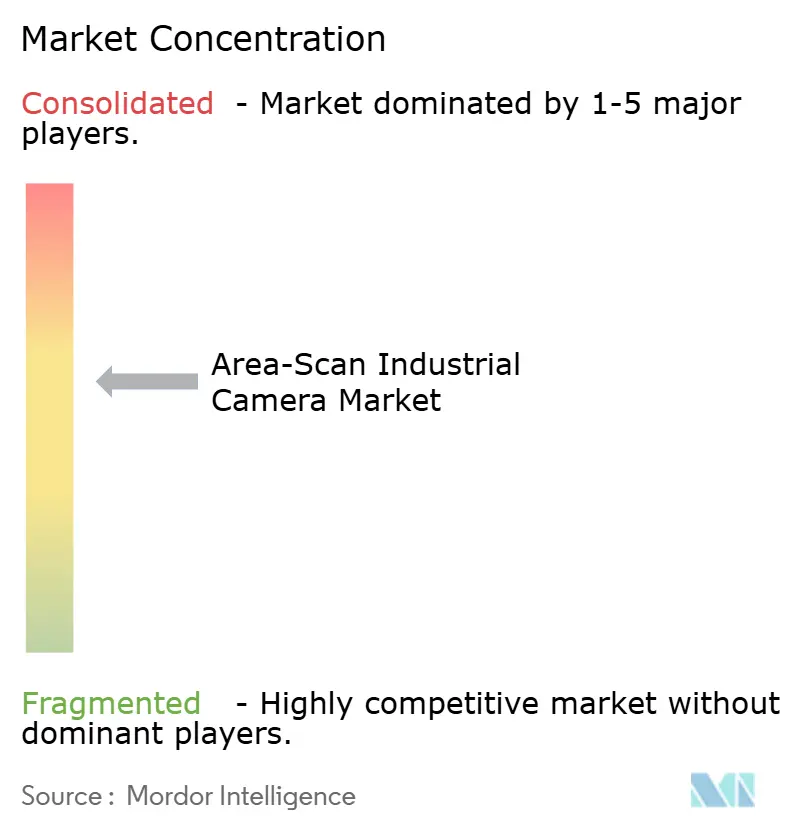
The area-scan industrial camera market is moderately concentrated. European specialists, especially German and Swiss suppliers, hold strong positions in high-resolution and high-speed products. Canadian and US vendors also compete in high-bandwidth GigE Vision and 100GigE platforms. TKH Group consolidated Allied Vision Technologies, Chromasens, Mikrotron, NET, and SVS-Vistek under the Allied Vision brand in January 2026. The combined business offers integrated 2D machine vision hardware and software. It also combines product capabilities across CoaXPress, GigE Vision, and USB3 Vision. This gives systems integrators a broader single-source option for multi-camera projects. The consolidation reflects the value of scale and portfolio depth in serving complex customer requirements.
Basler's H1 2026 report showed that China accounted for 29% of group sales, up from 25% in the prior year. The company identified strong competition in China and the Asia-Pacific region. Basler also reported that an earthquake in Japan's Kumamoto region constrained sensor supply for Q3 2026. This shows how a disruption in a concentrated sensor supply base can affect multi-camera inspection projects. Supplier differentiation increasingly depends on embedded inference, interface bandwidth, and sensor relationships. LUCID Vision Labs received a Gold Award in the 2026 Vision Systems Design Innovators Awards for its Atlas25 camera with RDMA streaming and direct fiber connectivity. The product illustrates the value of reducing CPU load during high-volume image acquisition. Camera buyers are therefore assessing both hardware performance and integration efficiency.
Chinese suppliers, including Hikrobot and Zhejiang Huaray Technology, are gaining traction in the domestic market. Their international expansion into semiconductor-qualified supply chains requires detailed provenance records and long-term availability commitments. Allied Vision's FXO CXP launch is an example of competition through compact, high-bandwidth product design. Emergent Vision Technologies' June 2026 shipment of 100GigE cameras is another example of competition through high-resolution and high-speed imaging. Suppliers also see opportunities in battery-pack inspection, semiconductor chamber sensing, and Ethernet camera systems that transfer images with lower CPU overhead. These applications remain less served by standard product families. The area-scan industrial camera market rewards suppliers that can align sensor access, software support, interface choice, and long-term product availability. The competitive environment remains active, with no single dominant supplier.
Area-Scan Industrial Camera Industry Leaders
Basler AG
Allied Vision Technologies GmbH
IDS Imaging Development Systems GmbH
JAI A/S
LUCID Vision Labs, Inc.
- *Disclaimer: Major Players sorted in no particular order

Recent Industry Developments
- August 2026: LUCID Vision Labs launched the Triton TRI055N, a 5.0-megapixel GigE Vision camera featuring onsemi's AR0521 BSI CMOS sensor at 2592 x 1944 resolution and 22.1 frames per second with a 69.2-dB dynamic range. The addition extended LUCID's Triton GigE family with a compact, low-power option targeting cost-sensitive industrial automation and robotic guidance applications across a broad range of assembly and verification use cases.
- July 2026: Basler AG introduced the Stereo mini 3D camera for robotics and logistics, co-developed with Orbbec Inc. and integrating with Basler's pylon SDK for seamless multi-camera workflows on autonomous mobile robots and automated guided vehicles. The product addressed a large underserved installation base in warehouse logistics where reliable 3D depth capture at a cost-effective price point had previously required custom engineering.
- June 2026: Emergent Vision Technologies began shipping the ZENITH HZ-65000-SB, 68 megapixels at 138 frames per second, and HZ-25000-SBS, 26 megapixels at 423 frames per second, over QSFP28 100GigE interface, with RDMA and NVIDIA GPUDirect support enabling real-time AI inference on ultra-high-resolution image streams. Both cameras are based on Sony Pregius S IMX928 and IMX947 back-side illuminated sensors announced in September 2025.
- May 2026: Allied Vision launched the FXO CXP series with 4-channel CoaXPress-12 interface delivering up to 50 Gbit/s in a 50 x 50-millimeter fanless passive-cooled body, integrating Sony Pregius S BSI global-shutter sensors among the first commercially available cameras to do so. The 24.6-megapixel model at 192 frames per second and 12.4-megapixel model at 339 frames per second target semiconductor optical inspection, 3D laser triangulation, and automotive metrology.


Global Area-Scan Industrial Camera Market Report Scope
The Area-Scan Industrial Camera Market comprises digital imaging cameras designed to capture two-dimensional images of stationary or discrete objects, components, and scenes in industrial, manufacturing, inspection, and automation environments. Area-scan industrial cameras capture images using a rectangular array of pixels in a single exposure or sequence of exposures and are used for automated visual inspection, measurement, identification, quality control, and machine vision applications.
The Area-Scan Industrial Camera Market Report is Segmented by Sensor Technology (CMOS, CCD, and Other Sensor Technologies), Resolution (Below 5 Megapixels, 5–12 Megapixels, and Above 12 Megapixels), Interface Standard (GigE Vision, USB3 Vision, Camera Link, CoaXPress, and Other Interface Standards), End-User Industry (Electronics and Semiconductor, Automotive and EV Battery, Food and Beverage, Pharmaceuticals and Healthcare, Logistics and Warehousing, Packaging and Printing, Aerospace and Defense, and Other End-User Industries), and Geography (North America, South America, Europe, Asia-Pacific, Middle East, and Africa). The Market Forecasts are Provided in Terms of Value (USD).
| CMOS |
| CCD |
| Other Sensor Technologies |
| Below 5 Megapixels |
| 5–12 Megapixels |
| Above 12 Megapixels |
| GigE Vision |
| USB3 Vision |
| Camera Link |
| CoaXPress |
| Other Interface Standards |
| Electronics and Semiconductor |
| Automotive and EV Battery |
| Food and Beverage |
| Pharmaceuticals and Healthcare |
| Logistics and Warehousing |
| Packaging and Printing |
| Aerospace and Defense |
| Other End-User Industries |
| North America | United States |
| Canada | |
| Mexico | |
| South America | Brazil |
| Argentina | |
| Rest of South America | |
| Europe | Germany |
| United Kingdom | |
| France | |
| Italy | |
| Rest of Europe | |
| Asia-Pacific | China |
| Japan | |
| South Korea | |
| Taiwan | |
| India | |
| Rest of Asia-Pacific | |
| Middle East | Turkey |
| Saudi Arabia | |
| United Arab Emirates | |
| Rest of Middle East | |
| Africa | South Africa |
| Egypt |
| By Sensor Technology | CMOS | |
| CCD | ||
| Other Sensor Technologies | ||
| By Resolution | Below 5 Megapixels | |
| 5–12 Megapixels | ||
| Above 12 Megapixels | ||
| By Interface Standard | GigE Vision | |
| USB3 Vision | ||
| Camera Link | ||
| CoaXPress | ||
| Other Interface Standards | ||
| By End-User Industry | Electronics and Semiconductor | |
| Automotive and EV Battery | ||
| Food and Beverage | ||
| Pharmaceuticals and Healthcare | ||
| Logistics and Warehousing | ||
| Packaging and Printing | ||
| Aerospace and Defense | ||
| Other End-User Industries | ||
| By Geography | North America | United States |
| Canada | ||
| Mexico | ||
| South America | Brazil | |
| Argentina | ||
| Rest of South America | ||
| Europe | Germany | |
| United Kingdom | ||
| France | ||
| Italy | ||
| Rest of Europe | ||
| Asia-Pacific | China | |
| Japan | ||
| South Korea | ||
| Taiwan | ||
| India | ||
| Rest of Asia-Pacific | ||
| Middle East | Turkey | |
| Saudi Arabia | ||
| United Arab Emirates | ||
| Rest of Middle East | ||
| Africa | South Africa | |
| Egypt | ||


Key Questions Answered in the Report
What is the area-scan industrial camera market size?
The area-scan industrial camera market size is USD 10.95 billion in 2026 and is forecast to reach USD 16.51 billion by 2031 at an 8.56% CAGR.
What is driving demand for area-scan cameras?
Factory automation, semiconductor capacity additions, AI-enabled inspection, and higher-resolution imaging needs are supporting demand.
Which sensor technology leads area-scan camera adoption?
CMOS led with 78.64% of revenue in 2025, supported by broad use across industrial inspection applications.
Which interface is expanding fastest for industrial cameras?
CoaXPress is projected to expand at an 9.54% CAGR through 2031, supported by high-bandwidth inspection uses.
Which end-user applications are expanding fastest?
Automotive and EV battery applications are projected to expand at an 10.14% CAGR through 2031.
Which region leads demand for area-scan cameras?
Asia-Pacific led with 43.77% of revenue in 2025 and is projected to expand at a 9.58% CAGR through 2031.
Page last updated on:


 Your data is secure and never sold or shared.


