
Architectural Metal Coatings Market Size and Share
Market Overview
| Study Period | 2021 - 2031 |
|---|---|
| Market Size (2026) | USD 6.34 Billion |
| Market Size (2031) | USD 8.52 Billion |
| Growth Rate (2026 - 2031) | 6.08 % |
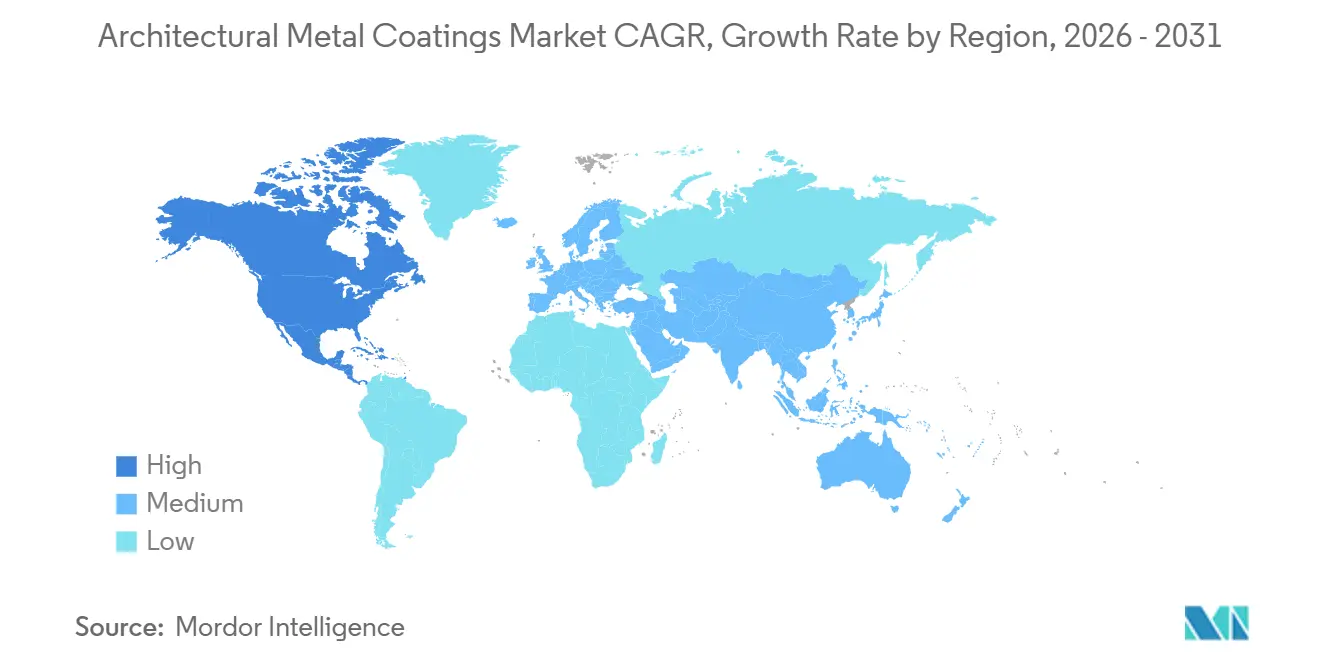
| Fastest Growing Market | North America |
| Largest Market | Asia-Pacific |
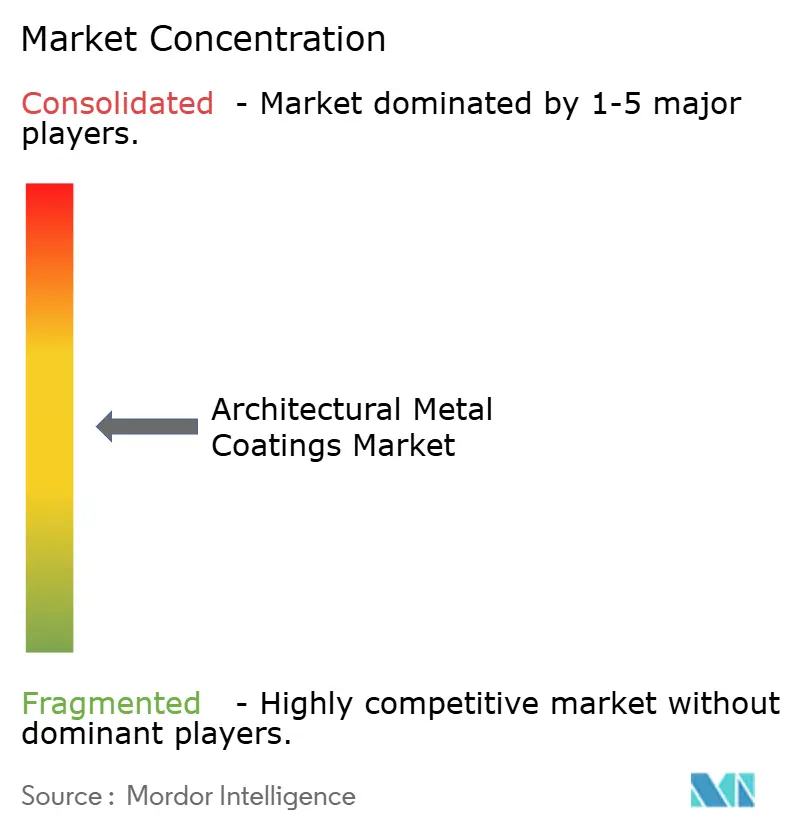
| Market Concentration | Medium |
Major Players *Disclaimer: Major Players sorted in no particular order Image © Mordor Intelligence. Reuse requires attribution under CC BY 4.0. | |
Architectural Metal Coatings Market Analysis by Mordor Intelligence
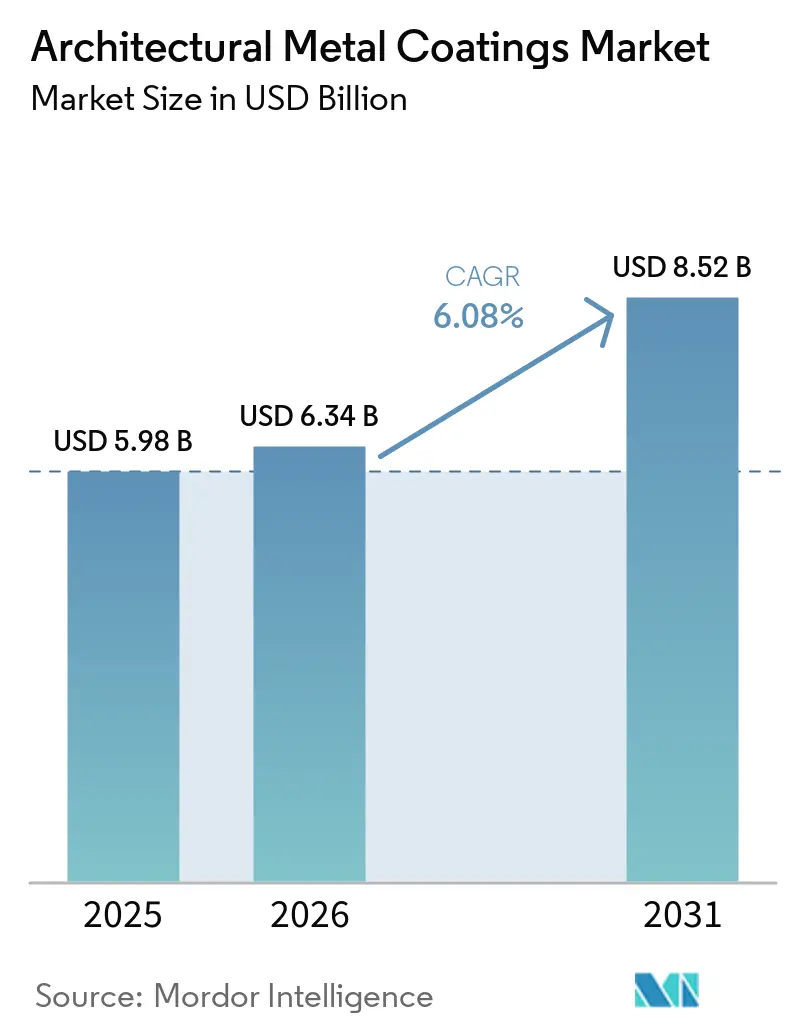
The Architectural Metal Coatings Market size was valued at USD 5.98 billion in 2025 and is estimated to grow from USD 6.34 billion in 2026 to reach USD 8.52 billion by 2031, at a CAGR of 6.08% during the forecast period (2026-2031). The architectural metal coatings market is supported by renovation activity because much of the building stock expected in 2050 already exists today. Developers increasingly assess facade systems through lifecycle cost, thermal performance, and required documentation, rather than initial material cost alone. Commercial construction, public infrastructure renewal, and tighter requirements for energy performance are sustaining demand across major regions. Suppliers are responding with lower-emission chemistries, environmental product documentation, and digital color tools that support repair work. Supply constraints for polyvinylidene fluoride (PVDF) inputs may limit availability of premium finishes through 2027, while capacity additions are intended to ease supply over time.
Key Report Takeaways
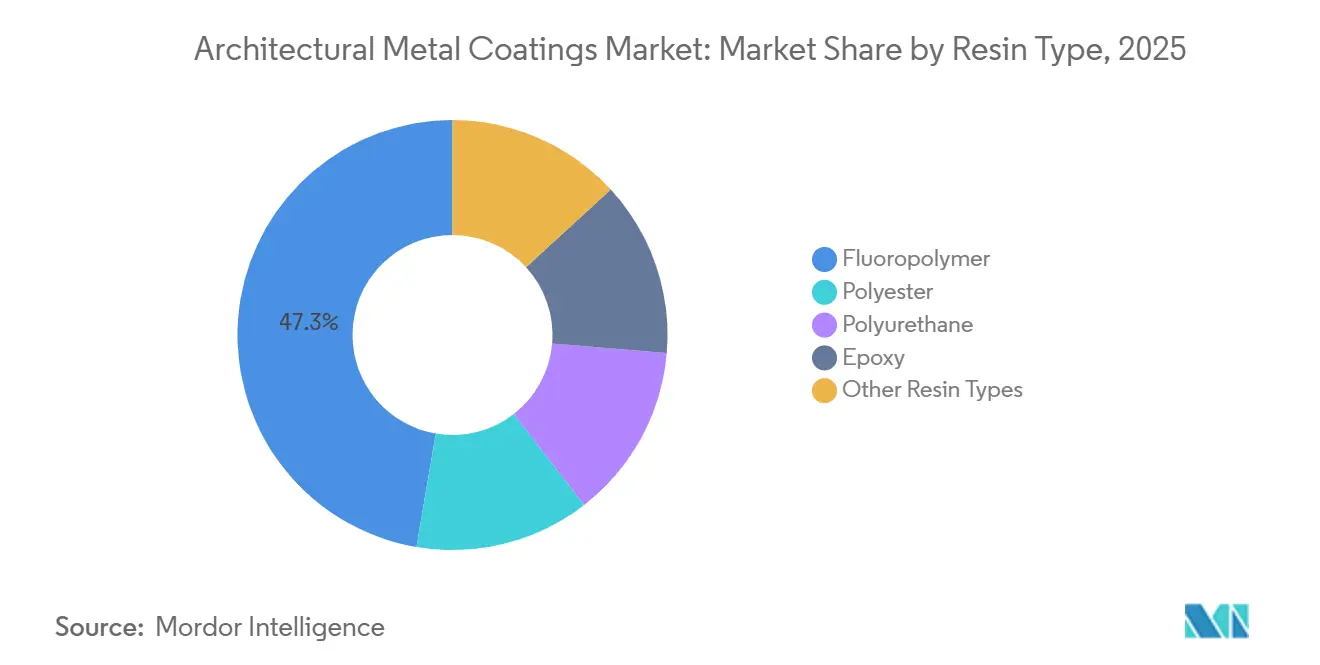
- By resin type, fluoropolymer held 47.32% of the architectural metal coatings market share in 2025, while polyurethane is projected to advance at a 6.74% CAGR through 2031.
- By application, roofing and cladding held 35.06% of the architectural metal coatings market share in 2025, while window frames and doors are projected to advance at a 6.98% CAGR through 2031.
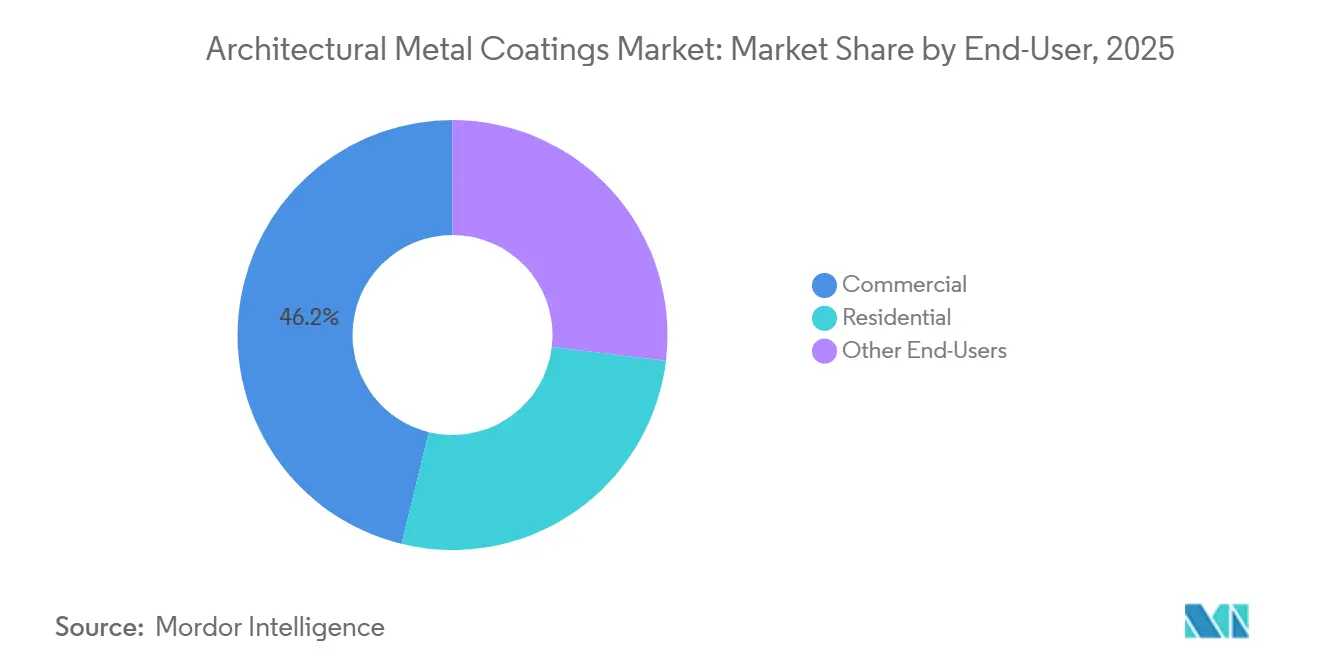
- By end-user, commercial held 46.18% of the architectural metal coatings market share in 2025 and is projected to advance at a 7.35% CAGR through 2031.
- By geography, Asia-Pacific held 41.05% of the architectural metal coatings market share in 2025 and is projected to advance at a 7.03% CAGR through 2031.
Note: Market size and forecast figures in this report are generated using Mordor Intelligence’s proprietary estimation framework, updated with the latest available data and insights as of January 2026.
Global Architectural Metal Coatings Market Trends and Insights
Drivers Impact Analysis*
| Driver | (~) % Impact on CAGR Forecast | Geographic Relevance | Impact Timeline |
|---|---|---|---|
| Urbanization and Metal-Building-Envelope Expansion | +1.8% | Global; APAC-led, with secondary concentration in MEA and South America | Long term (≥ 4 years) |
| Expansion of Commercial Construction and Infrastructure Renovation | +1.5% | Global; Asia-Pacific, North America, and Western Europe as primary demand centres | Medium term (2-4 years) |
| Sustainable and Energy-Efficient Construction Standards | +1.2% | EU and North America (regulatory core); China, India, and Japan (active adoption) | Medium term (2-4 years) |
| Low-Energy, Low-VOC and Bio-Based Coating Adoption | +0.9% | EU and North America (regulation-led); India and Southeast Asia (emerging uptake) | Medium term (2-4 years) |
| Digital Color Matching and Field-Repair Economics | +0.5% | North America and EU (early adoption); spillover to APAC and South America | Short term (≤ 2 years) |
| Source: Mordor Intelligence | |||
Urbanization and Metal-Building-Envelope Expansion
The architectural metal coatings market benefits when steel and aluminum envelopes become a preferred design choice for new buildings. Metal systems can meet project timing, structural weight, and lifecycle budget requirements across warehouses, logistics parks, data centers, and technology campuses. China’s urban renewal program supports recurring demand for coil-applied and extrusion-applied finishes on curtain-wall geometries. Akzo Nobel N.V. deployed its American Architectural Manufacturers Association (AAMA) 2605-certified TRINAR SC Series after long-term testing at a commercial project in Dongying Economic Development Zone. Sichuan Province issued DB51/T 3266-2025 for energy-saving coatings on steel surfaces, reflecting the role of subnational technical requirements. The architectural metal coatings market can therefore retain a renovation-led demand base when new construction activity weakens.
Expansion of Commercial Construction and Infrastructure Renovation
The architectural metal coatings market receives recurring demand from commercial construction and infrastructure renovation projects. The American Society of Civil Engineers gave U.S. bridges, roads, and water systems grades of C or below in its 2025 report card. That deferred maintenance burden supports demand for durable epoxy primers and polyurethane topcoats on exposed metal assets. India’s Smart Cities Mission had completed 94% of 8,067 projects worth INR 1.51 lakh crore (approximately USD 17.8 billion) as of May 2025[1]Government of India, “10 Years of Smart Cities Mission,” Press Information Bureau, pib.gov.in. Such contracts also require color-matched field repair systems, which can add sales beyond the initial coating supply. Digital color matching supports repeat work across multi-building portfolios and can make supplier changes more difficult.
Sustainable and Energy-Efficient Construction Standards
The architectural metal coatings market is affected by building rules that raise performance requirements for facades and window systems. The European Commission adopted updated European Union Ecolabel criteria in December 2025 through Commission Decision 2025/2607[2]European Commission, “Commission Decision 2025/2607 of 17 December 2025 Establishing the EU Ecolabel Criteria for Decorative Paints, Varnishes, and Related Products,” European Union Ecolabel, eu-ecolabel.de. The criteria require verified limits and life-cycle environmental information for coatings seeking Ecolabel approval. Green Seal updated its GS-11 standard in April 2026, including requirements for paints, coatings, stains, and sealers. These requirements increase the value of systems with established testing and documentation. They also place smaller applicators under greater pressure to maintain qualification across several jurisdictions.
Low-Energy, Low-VOC and Bio-Based Coating Adoption
The architectural metal coatings market is adopting formulations designed to reduce volatile organic compound (VOC) emissions and curing energy. Akzo Nobel N.V. launched its Interpon D2525 Futura 2026-2029 architectural powder coating collection in April 2026. The collection incorporated Low-E curing technology and bio-attributed raw materials across products manufactured in Europe, the Middle East, and Africa. Waterborne and bio-based systems can shorten dry-to-recoat cycles in occupied renovation projects. This may lower disruption and labor requirements while helping building owners meet environmental specifications.
Restraints Impact Analysis*
| Restraint | (~) % Impact on CAGR Forecast | Geographic Relevance | Impact Timeline |
|---|---|---|---|
| High Formulation and Application Costs for Advanced Systems | -1.0% | Global; most pronounced in APAC renovation and MEA price-sensitive markets | Long term (≥ 4 years) |
| Regulatory Complexity and Certification Costs | -0.8% | North America and EU (primary regulatory burden); spillover to APAC export producers | Medium term (2-4 years) |
| PVDF Raw-Material and Color-Matching Constraints in Renovation | -0.6% | Global; most acute in China and APAC markets dependent on domestic R142b supply | Short to medium term (≤ 4 years) |
| Source: Mordor Intelligence | |||
Regulatory Complexity and Certification Costs
The architectural metal coatings market faces longer compliance processes as standards and product requirements change. Updated AAMA 2603, AAMA 2604, and AAMA 2605 editions require applicators to reassess pretreatment and primer chemistry. This work can require requalification before a supplier returns to specification lists for high-value projects. The American Coatings Association has also identified potential effects from perfluoroalkyl and polyfluoroalkyl substances (PFAS) regulation on coating technologies. The associated development work can be costly and may not create immediate revenue. Complex rules can also favor large formulators that already maintain testing, regulatory, and documentation resources.
High Formulation and Application Costs for Advanced Systems
The architectural metal coatings market serves projects where advanced systems can present higher installed costs than basic alternatives. Liquid coating systems can carry higher material, energy, labor, and waste-handling costs than powder coating systems. Building owners in cost-sensitive renovation projects may therefore choose lower-cost coating specifications with shorter maintenance cycles. High-solids, 2-component polyurethane systems also require controlled mixing ratios and careful pot-life management. PVDF supply limitations add a second constraint because R142b availability affects premium fluoropolymer coating production. Arkema started a 15% capacity expansion at Calvert City, Kentucky, in June 2026, while its Changshu expansion is planned for 2028.
*Our forecasts treat driver/restraint impacts as directional, not additive. The impact forecasts reflect baseline growth, mix effects, and variable interactions.
Segment Analysis
By Resin Type: Fluoropolymer Retention Meets Polyurethane Acceleration
Fluoropolymer held 47.32% of the architectural metal coatings market size in 2025 because commercial facades, curtain walls, and roofing often require long weatherability warranties. These systems are specified where color retention and gloss retention remain important throughout extended service periods. Polyester coatings serve roofing and cladding projects where lower initial costs influence material selection. Polyurethane is projected to advance at a 6.74% CAGR through 2031 as renovation work shifts toward waterborne 2-component systems. The architectural metal coatings industry uses these systems when a project requires lower VOC emissions and durable protection. Epoxy coatings remain important as corrosion-inhibiting primers for galvanized and Galvalume steel in coastal environments.
PVDF supply availability is becoming an important specification consideration for fluoropolymer systems. R142b output adjustments in northern China during early 2026 shifted procurement decisions toward supply security. This may affect the availability and pricing of architectural-grade resin for premium coating lines. Arkema’s Calvert City expansion began operating in June 2026 and has added capacity for North American formulators. The company also announced a 20% Kynar PVDF capacity expansion at Changshu, China, for commissioning in 2028. These investments address demand from coatings, lithium-ion batteries, and semiconductor applications. The architectural metal coatings industry may see a gradual resin mix adjustment as polyurethane systems gain acceptance in renovation projects.



By Application: Roofing and Cladding Anchors Demand, While Window Frames and Doors Accelerate
Roofing and cladding held 35.06% of the architectural metal coatings market size in 2025 because they form the exterior weather barrier on commercial and industrial metal buildings. Replacement demand includes pre-painted, coil-coated products installed during earlier construction cycles. Wall panels and facades use textured fluoropolymer finishes on insulated metal-panel systems in commercial projects. Curtain walls and storefronts remain relevant in central business districts and transportation infrastructure. The architectural metal coatings market, therefore, depends on both large exterior systems and smaller specification-based uses.
Window frames and doors are projected to advance at a 6.98% CAGR through 2031 as energy rules increase demand for thermally improved aluminum framing. Coated profiles can be paired with thermal-break technology in public, residential, and light-commercial projects. The European Commission’s Ecolabel criteria reinforce the importance of verified environmental information for qualifying products. Existing fenestration replacement work also requires new frames to match the surrounding weathered facade panels. That need supports specialized digital color matching and field-repair services. Suppliers with established matching platforms can support restoration projects where visual consistency is necessary. The architectural metal coatings market benefits when thermal upgrades and facade repair take place together.
By End-User: Commercial Leads in Both Scale and Growth Rate
Commercial held 46.18% of the architectural metal coatings market size in 2025 and is projected to advance at a 7.35% CAGR through 2031. Airports, data campuses, retail centers, hospitals, and Class A office towers commonly specify durable coating systems for exposed facades and roofing. These projects often require long warranties and product documentation. Commercial construction activity in the Asia-Pacific and the Middle East supports new coating demand. Renovation activity in North America and Europe supports replacement demand and can raise required coating performance. Nippon Paint displayed smart manufacturing and energy-saving coating solutions at ARCHIDEX 2026 in Kuala Lumpur. The company positioned its 26 Association of Southeast Asian Nations (ASEAN) manufacturing facilities to serve commercial construction procurement.
Residential projects generally select coatings according to initial cost and expected maintenance requirements. Pre-painted metal roofing in mid-premium residential developments is gradually lifting specification levels in parts of the Asia-Pacific. Smart Cities investment in India supports metal-clad public buildings, transit hubs, and institutional facilities. Gulf Cooperation Council megaprojects are also active demand sources for this end-user group. The architectural metal coatings market serves these customers through coil coatings, extrusion coatings, primers, and repair systems. These needs favor suppliers able to meet both initial application and later maintenance requirements.
Geography Analysis
Asia-Pacific held 41.05% of the market revenue in 2025, reflecting demand across China, India, Japan, South Korea, Vietnam, Indonesia, and Malaysia, where the architectural metal coatings market benefits from urban renewal and new building activity. China supports urban renewal projects using high-performance finishes. Akzo Nobel N.V.’s TRINAR SC Series delivered self-cleaning performance in long-term testing at Dongying Economic Development Zone. India’s Smart Cities Mission had completed 94% of 8,067 projects by May 2025. This work includes public buildings, transit assets, and facilities that use metal cladding and coated components. Japan and South Korea maintain technically demanding fluoropolymer specifications for exposed building surfaces.
Southeast Asian economies are adding industrial buildings, logistics facilities, and commercial space. Jotun announced a bonded metallics facility in Malaysia for opening in 2026, following the completion of its Dubai facility in 2024. Beckers Group inaugurated a renewable polyester resin plant in Nagpur through its Berger-Becker Coatings joint venture in May 2026. The plant began commercial production in the 3rd quarter of 2026 with an initial 9,000 metric tons of annual capacity. It uses recycled polyethylene terephthalate (PET) and bio-based feedstocks. Local manufacturing can improve supply access for regional formulators and customers. Both local production and continuing additions to the regional building stock consequently support the architectural metal coatings market.
North America is projected to advance at a 7.03% CAGR through 2031, supported by commercial construction and a replacement cycle for pre-painted metal roofing. Sun Belt metropolitan areas support new commercial projects that use durable roof and wall systems, which strengthen the architectural metal coatings market. PPG Industries, Inc. introduced BUILDING RENEWAL NEVERFADE Exterior Coatings with Kynar Aquatec PVDF resin in June 2026. The system carries a 15-year warranty and meets Association for Materials Protection and Performance (AMPP) SSPC (The Society for Protective Coatings) Paint 47 requirements. Europe remains focused on the renovation of aging commercial facades in Germany, France, and the Benelux region. The European Union Ecolabel is reshaping product qualification across the region. South America gains demand from commercial construction and logistics infrastructure, while the Middle East and Africa remain supported by Gulf commercial and infrastructure projects.

Competitive Landscape
The architectural metal coatings market is moderately concentrated, with the top five players including PPG Industries, Inc., The Sherwin-Williams Company, Akzo Nobel N.V., Axalta Coating Systems LLC, and Nippon Paint Holdings Co., Ltd. These companies compete through broad distribution, application capability, product qualification, and access to key resin technologies. Suppliers increasingly use Environmental Product Declarations aligned with EN 15804 A2 to meet public-sector procurement requirements. Jotun reported more than 200 current Environmental Product Declarations verified under EN 15804 A2. Large suppliers can use these documents to support bids where embodied-carbon reporting is required. Smaller competitors may face higher costs when creating equivalent documentation and maintaining coverage across regions.
Akzo Nobel N.V. and Axalta Coating Systems LLC announced a definitive all-stock merger of equals on November 18, 2025. Arkema started its 15% PVDF capacity expansion in Kentucky in June 2026, which expands resin availability for North American formulators. The company also announced its 20% China capacity expansion, targeting 2028 commissioning. These steps show how access to fluoropolymer inputs remains part of the supplier strategy.
TIGER Coatings GmbH & Co. KG is expanding fluoroethylene vinyl ether powder coatings for projects that need AAMA 2605-tier performance without liquid-line investment. Kansai Paint Co., Ltd. has positioned architectural differentiation above commodity competition and is focusing on margins rather than growth. Alcea S.p.A. operates in premium European architectural powder coatings, while NOROO Paint & Coatings serves Korea’s commercial coil-coating supply chain. RPM International Inc. uses its Carboline and Tremco brands in institutional and commercial projects. Tnemec competes in specification-grade protection for U.S. institutional and infrastructure metal surfaces. The architectural metal coatings market also rewards suppliers that can provide technical service, color matching, and warranty support after installation. This competitive approach aligns with the growing importance of renovation and maintenance activity.
Architectural Metal Coatings Industry Leaders
PPG Industries, Inc.
The Sherwin-Williams Company
Akzo Nobel N.V.
Axalta Coating Systems LLC
Nippon Paint Holdings Co., Ltd.
- *Disclaimer: Major Players sorted in no particular order

Recent Industry Developments
- June 2026: Arkema started up a 15% Kynar PVDF capacity expansion at Calvert City, Kentucky, following a USD 20 million investment. The additional capacity strengthens the supply of architectural-grade fluoropolymers for North American metal coating formulators, supporting demand for durable architectural metal coatings.
- April 2026: Akzo Nobel N.V. launched the Interpon D2525 Futura 2026–2029 architectural powder-coating collection. The collection uses Low Energy (Low-E) curing technology and bio-attributed raw materials, supporting demand for sustainable, energy-efficient architectural metal coatings.


Global Architectural Metal Coatings Market Report Scope
Architectural metal coatings are protective and decorative coatings applied to metal surfaces used in building structures and architectural components. They enhance surface durability and appearance while providing resistance to weathering, corrosion, and environmental exposure.
The Architectural Metal Coatings Market is segmented by resin type, application, end-user, and geography. By resin type, the market is segmented into fluoropolymer, polyester, polyurethane, epoxy, and other resin types. By application, the market is segmented into roofing and cladding, wall panels and facades, curtain walls and storefronts, window frames and doors, and other applications. By end-user, the market is segmented into commercial, residential, and other end-users. The report also covers the market size and forecasts for architectural metal coatings in 16 countries across major regions. For each segment, the market sizing and forecasts have been done on the basis of value (USD).
| Fluoropolymer |
| Polyester |
| Polyurethane |
| Epoxy |
| Other Resin Types |
| Roofing and Cladding |
| Wall Panels and Facades |
| Curtain Walls and Storefronts |
| Window Frames and Doors |
| Other Applications |
| Commercial |
| Residential |
| Other End-Users |
| Asia-Pacific | China |
| India | |
| Japan | |
| South Korea | |
| ASEAN Countries | |
| Rest of Asia-Pacific | |
| North America | United States |
| Canada | |
| Mexico | |
| Europe | Germany |
| United Kingdom | |
| France | |
| Italy | |
| NORDIC Countries | |
| Russia | |
| Rest of Europe | |
| South America | Brazil |
| Argentina | |
| Rest of South America | |
| Middle East and Africa | Saudi Arabia |
| South Africa | |
| Rest of Middle East and Africa |
| By Resin Type | Fluoropolymer | |
| Polyester | ||
| Polyurethane | ||
| Epoxy | ||
| Other Resin Types | ||
| By Application | Roofing and Cladding | |
| Wall Panels and Facades | ||
| Curtain Walls and Storefronts | ||
| Window Frames and Doors | ||
| Other Applications | ||
| By End-User | Commercial | |
| Residential | ||
| Other End-Users | ||
| By Geography | Asia-Pacific | China |
| India | ||
| Japan | ||
| South Korea | ||
| ASEAN Countries | ||
| Rest of Asia-Pacific | ||
| North America | United States | |
| Canada | ||
| Mexico | ||
| Europe | Germany | |
| United Kingdom | ||
| France | ||
| Italy | ||
| NORDIC Countries | ||
| Russia | ||
| Rest of Europe | ||
| South America | Brazil | |
| Argentina | ||
| Rest of South America | ||
| Middle East and Africa | Saudi Arabia | |
| South Africa | ||
| Rest of Middle East and Africa | ||


Key Questions Answered in the Report
What is the size of the architectural metal coatings market?
The architectural metal coatings market stands at USD 6.34 billion in 2026 and is projected to reach USD 8.52 billion by 2031.
What is driving demand for architectural metal coatings?
Commercial construction, public infrastructure renovation, building-envelope upgrades, and environmental product requirements are supporting demand.
Which resin type led the market share in 2025?
Fluoropolymer led with a 47.32% share in 2025.
Which application is expected to grow fastest through 2031?
Window frames and doors are projected to advance at a 6.98% CAGR through 2031, supported by thermal performance requirements.
Page last updated on:





