
Arabica Coffee Market Size and Share
Market Overview
| Study Period | 2027 - 2032 |
|---|---|
| Market Size (2027) | USD 110.76 Billion |
| Market Size (2032) | USD 146.44 Billion |
| Growth Rate (2027 - 2032) | 5.74 % |
| Fastest Growing Market | Asia-Pacific |
| Largest Market | Europe |
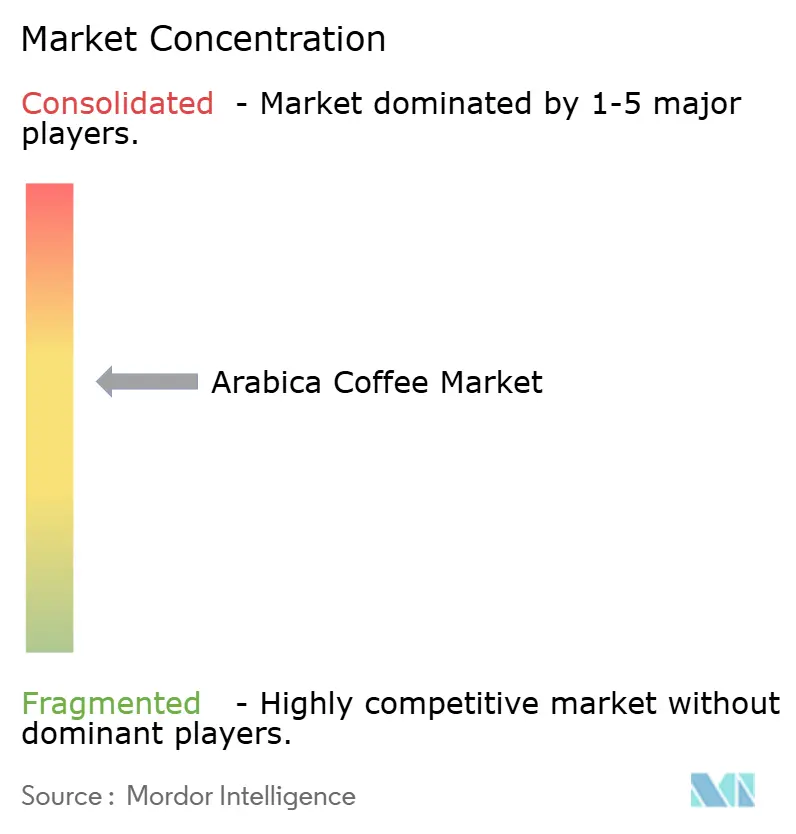
| Market Concentration | Medium |
Major Players *Disclaimer: Major Players sorted in no particular order Image © Mordor Intelligence. Reuse requires attribution under CC BY 4.0. | |
Arabica Coffee Market Analysis by Mordor Intelligence
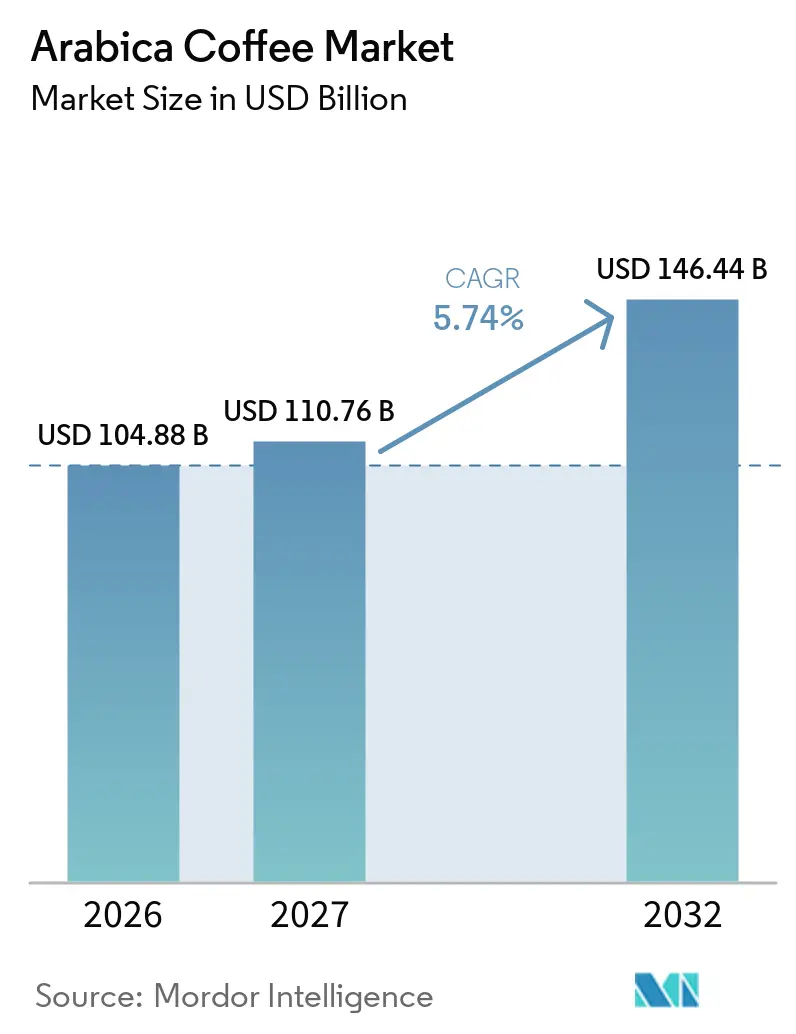
The Arabica coffee market was valued at USD 104.88 billion in 2026 and is estimated to grow from USD 110.76 billion in 2027 to USD 146.44 billion by 2032, at a CAGR of 5.74% during the forecast period (2027–2032). The Arabica coffee market is driven by rising demand for premium, single-origin and sustainably sourced coffee, alongside the expansion of specialty cafés and premium at-home brewing. Ground coffee held the largest product share at 34.02% in 2026, while coffee pods and capsules are projected to grow fastest at 7.55%. Conventional coffee dominated by nature with a 92.56% share, while off-trade channels accounted for 74.21% of distribution. Europe remained the largest regional market with a 35.36% share, whereas Asia-Pacific is expected to record the fastest growth at 7.27%. However, climate-related crop disruptions, pest and disease risks, and Arabica bean price volatility continue to challenge production and supply.
Key Report Takeaways
- By product type, ground coffee accounted for a 34.02% share of the Arabica coffee market size in 2026, while coffee pods and capsules are projected to grow fastest at a CAGR of 7.55% during 2027–2032, influencing the Arabica coffee market share.
- By nature, conventional Arabica coffee dominated with a 92.56% share of the Arabica coffee market size in 2026, while organic Arabica coffee is projected to grow at a CAGR of 6.68% during the forecast period, creating opportunities to expand its Arabica coffee market share.
- By distribution channel, off-trade accounted for a 74.21% share of the Arabica coffee market size in 2026 and is projected to grow at a CAGR of 7.80% during 2027–2032, supporting its contribution to the Arabica coffee market share.
- By geography, Europe led the Arabica coffee market with a 35.36% share of the Arabica coffee market size in 2026, while Asia-Pacific is projected to record the fastest growth at a CAGR of 7.27% during 2027–2032, potentially increasing its Arabica coffee market share.
Note: Market numbers in this report are based on Mordor Intelligence's proprietary estimation framework, which combines nine months of actuals with Q4 projections for base year 2026.
Market Trends and Insights
Drivers Impact Analysis of Arabica Coffee Market*
| DRIVER | (~) % IMPACT ON CAGR FORECAST | GEOGRAPHIC RELEVANCE | IMPACT TIMELINE |
|---|---|---|---|
| Growing consumer preference for high-quality and single-origin coffee | +0.9% | Global, particularly Europe and North America, where premium and origin-specific coffee demand is established | Medium term (2–4 years) |
| Expansion of specialty coffee shops and café culture | +0.8% | Global, particularly North America, Europe and Asia-Pacific, supported by expanding specialty café networks and coffee consumption | Medium term (2–4 years) |
| Increasing demand for sustainably and ethically sourced Arabica coffee | +0.7% | Global, particularly Europe and North America, where traceability and responsible sourcing requirements influence premium coffee procurement | Long term (More than 4 years) |
| Growing popularity of home brewing and premium at-home coffee consumption | +0.6% | Global, particularly North America, Europe and urban markets across Asia-Pacific | Short term (Less than 2 years) |
| Product innovation across convenient Arabica coffee formats | +0.5% | Global, particularly North America, Europe and Asia-Pacific, driven by demand for capsules, pods and convenient coffee formats | Medium term (2–4 years) |
| Source: Mordor Intelligence | |||
Growing consumer preference for high-quality and single-origin coffee
Consumer preference for high-quality and origin-specific coffee is supporting demand for premium Arabica beans, particularly in European specialty coffee markets. The Netherlands Enterprise Agency's CBI identifies Arabica as the dominant bean in Europe's high-end and upper-end coffee segments, where consumers increasingly value distinctive flavour profiles, traceable origins and quality credentials. Single-origin and single-estate offerings allow producers and roasters to differentiate products through geographical identity, cultivation practices and processing methods, supporting premium positioning across the Arabica value chain.[1]
Expansion of specialty coffee shops and café culture
The expansion of specialty cafés and independent roasters is creating additional consumption occasions for premium Arabica coffee. India's Coffee Board identifies the growth of domestic specialty café chains and roasters, including Blue Tokai, Araku and Subko, as part of the country's evolving coffee market. Its coffee consumption study also highlights the potential for out-of-home consumption to expand, providing opportunities for cafés to introduce consumers to premium Arabica varieties, distinctive brewing methods and origin-specific beverages.[2]
Increasing demand for sustainably and ethically sourced Arabica coffee
Sustainability, ethical sourcing and supply-chain transparency are becoming important considerations in premium Arabica procurement. The CBI reports that European specialty coffee buyers increasingly value traceability and information about coffee origins, farming practices and processing methods. It also identifies growing interest among younger consumers in sustainably produced and ethically sourced coffee.[3] These requirements encourage Arabica producers and exporters to strengthen responsible cultivation practices, certification and supply-chain documentation to meet buyer expectations.
Growing popularity of home brewing and premium at-home coffee consumption
Home brewing is creating opportunities for premium Arabica products as consumers increasingly explore coffee preparation beyond cafés. The Coffee Board of India's consumption study identifies both at-home and out-of-home consumption as established parts of the domestic coffee market. Its official coffee magazine also describes the emergence of home brewing spaces and consumer experimentation with bean selection, grind size, water temperature and brewing techniques. This trend supports demand for whole-bean and ground Arabica coffee, alongside equipment suited to household preparation.
Product innovation across convenient Arabica coffee formats
Product and preparation innovation is broadening the ways consumers access and consume coffee. The International Coffee Organization identifies coffee pods, modern coffee machines and new product formats as developments responding to demand for convenience, changing consumer preferences and faster preparation.[4]These innovations create opportunities for Arabica-based offerings across single-serve formats, capsules and ready-to-drink beverages, allowing coffee companies to extend premium bean varieties into additional consumption occasions.
Market Restraints of Arabica Coffee Market*
| RESTRAINT | (~) % IMPACT ON CAGR FORECAST | GEOGRAPHIC RELEVANCE | IMPACT TIMELINE |
|---|---|---|---|
| Climate change and adverse weather conditions affecting Arabica cultivation | −0.9% | Global, particularly Brazil, Colombia, Ethiopia and other major Arabica-producing regions exposed to changing temperatures, drought and irregular rainfall | Long term (More than 4 years) |
| High susceptibility of Arabica crops to pests and diseases | −0.7% | Global, particularly Latin America, East Africa and Asia-Pacific Arabica-growing regions | Medium term (2–4 years) |
| Volatility in global Arabica coffee bean prices | −0.8% | Global, affecting producing countries, coffee processors, roasters and import-dependent markets | Short term (Less than 2 years) |
| High production and certification costs for premium-quality Arabica coffee | −0.6% | Global, particularly smallholder-producing regions and markets with stringent sustainability and certification requirements | Medium term (2–4 years) |
| Source: Mordor Intelligence | |||
Climate change and adverse weather conditions affecting Arabica cultivation
Arabica coffee cultivation is highly sensitive to changes in temperature and rainfall, making production vulnerable to droughts, heat waves and irregular precipitation. The International Coffee Organization (ICO) notes that rising temperatures can reduce Arabica yields and affect bean quality by accelerating fruit maturation. A 2024 study assessing 36 coffee-growing locations in Brazil also found that increasing temperatures and water deficits could cause substantial yield losses under future climate scenarios. These conditions increase production uncertainty, complicate farm planning and create risks for the consistency of global Arabica supply.
High susceptibility of Arabica crops to pests and diseases
Arabica coffee production faces persistent risks from pests and diseases that can damage plants, reduce bean quality and increase cultivation costs. India's Coffee Board identifies white stem borer as a serious pest of Arabica coffee, alongside coffee berry borer, coffee leaf rust and root diseases that can cause crop losses. The ICO has also highlighted coffee leaf rust, coffee berry disease and stem borer infestations as major production challenges, particularly for smallholder growers. Managing these threats requires regular crop monitoring, pruning, shade management and timely pest-control measures, increasing operational costs and affecting farm profitability.
*Our forecasts treat driver/restraint impacts as directional, not additive. The impact forecasts reflect baseline growth, mix effects, and variable interactions.
Arabica Coffee Market Segment Analysis
By Product Type:
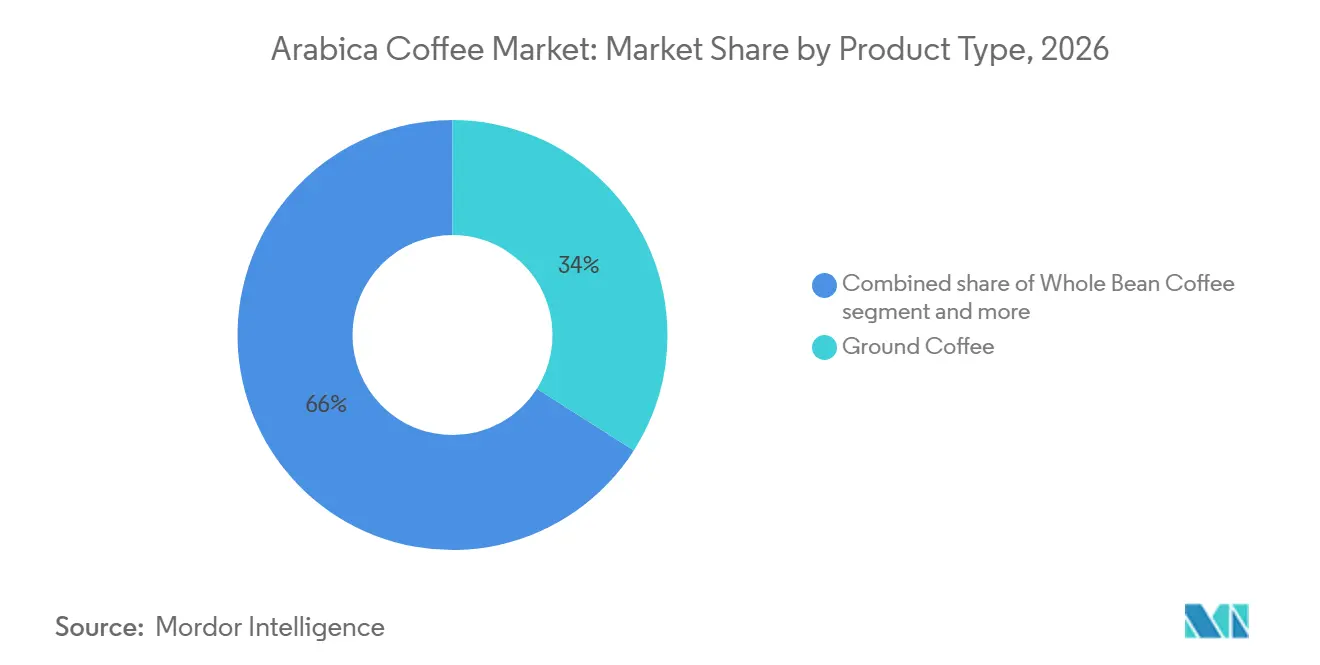
Ground Coffee Leads While Coffee Pods and Capsules Expand FasterIn 2026, ground coffee accounted for an estimated 34.02% of the Arabica Coffee Market, making it the leading product type. Its position reflects the established use of ground coffee in household brewing and food-service applications, supported by its compatibility with common brewing methods. Meanwhile, coffee pods and capsules are projected to record the fastest growth, at an estimated CAGR of 7.55% through 2032. These formats offer convenience, portion control and consistent preparation, making them suitable for consumers seeking premium coffee experiences with less preparation effort.
Whole-bean coffee remains relevant among consumers who prefer freshly ground coffee and greater control over brewing. Instant coffee serves convenience-oriented consumption occasions, while ready-to-drink (RTD) products provide portable, ready-to-consume options. Across product types, manufacturers need to balance Arabica coffee quality, flavour consistency, convenience and affordability to reach different consumer groups.

By Nature:
Conventional Arabica Coffee Dominates While Organic Coffee Grows FasterIn 2026, conventional Arabica coffee accounted for an estimated 92.56% of the Arabica Coffee Market, making it the dominant segment by nature. Its leading position reflects the broad availability of conventionally cultivated beans across retail, food-service and packaged coffee channels. Meanwhile, organic Arabica coffee is projected to grow at an estimated CAGR of 6.68% through 2032. Demand for organic products is supported by consumer interest in certified production practices, responsible sourcing and greater transparency across coffee supply chains.
Organic Arabica coffee provides opportunities for producers and brands to differentiate their offerings through recognised certification and sourcing credentials. However, maintaining certification, traceability and consistent quality can increase production and procurement requirements. Both segments will depend on reliable bean sourcing, quality control and competitive pricing to serve their respective consumer bases.
By Distribution Channel:
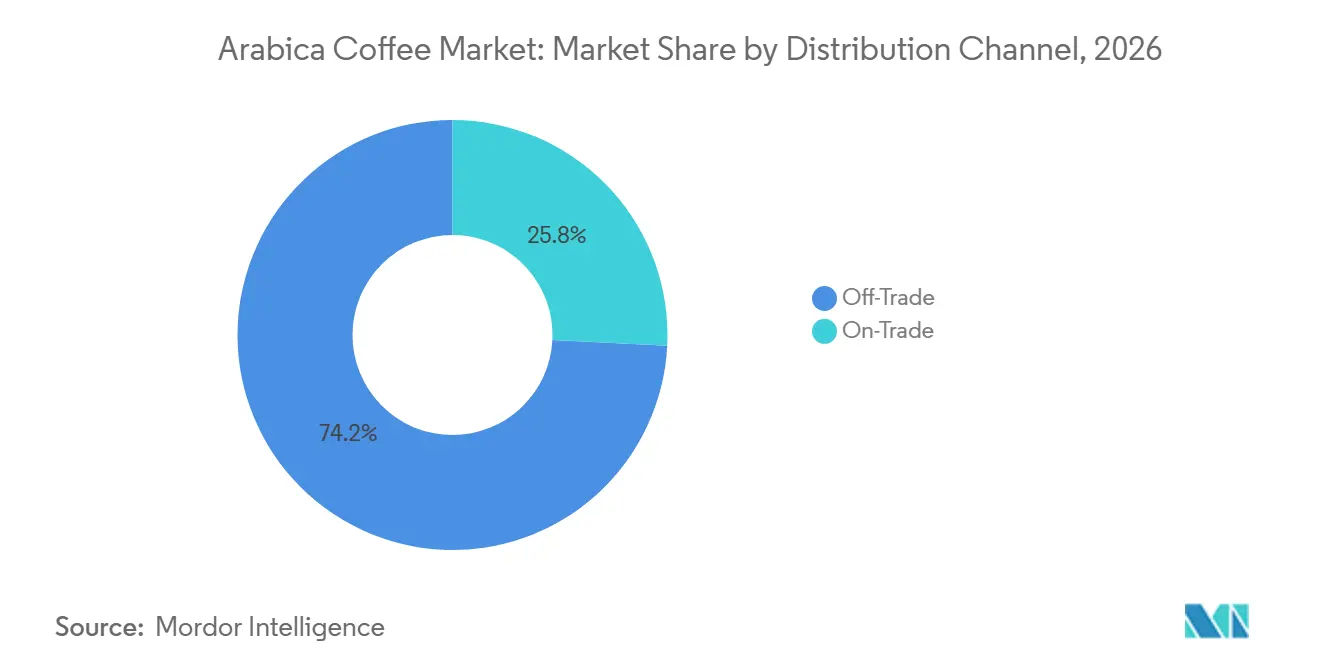
Off-Trade Leads and Records the Fastest GrowthIn 2026, off-trade channels accounted for an estimated 74.21% of the Arabica Coffee Market, making them the leading distribution channel. Supermarkets and hypermarkets, convenience stores, specialty retailers and online platforms provide consumers with access to packaged Arabica coffee across different price points and product formats. Off-trade distribution is also projected to record the fastest growth, at an estimated CAGR of 7.80% through 2032, supported by the availability of whole-bean, ground, instant and capsule products for at-home consumption.
Online retail provides an additional route for specialty coffee brands to reach consumers through product discovery, subscription services and direct-to-consumer sales. Specialty retailers also support demand for premium and origin-specific coffee through curated product selections. On-trade channels, including cafés, restaurants and coffee shops, remain important for consumers seeking freshly prepared beverages and specialty coffee experiences. The ability to maintain product availability, distribution efficiency and consistent quality will remain important across both channels.
Geography Analysis
Europe Arabica Coffee Market
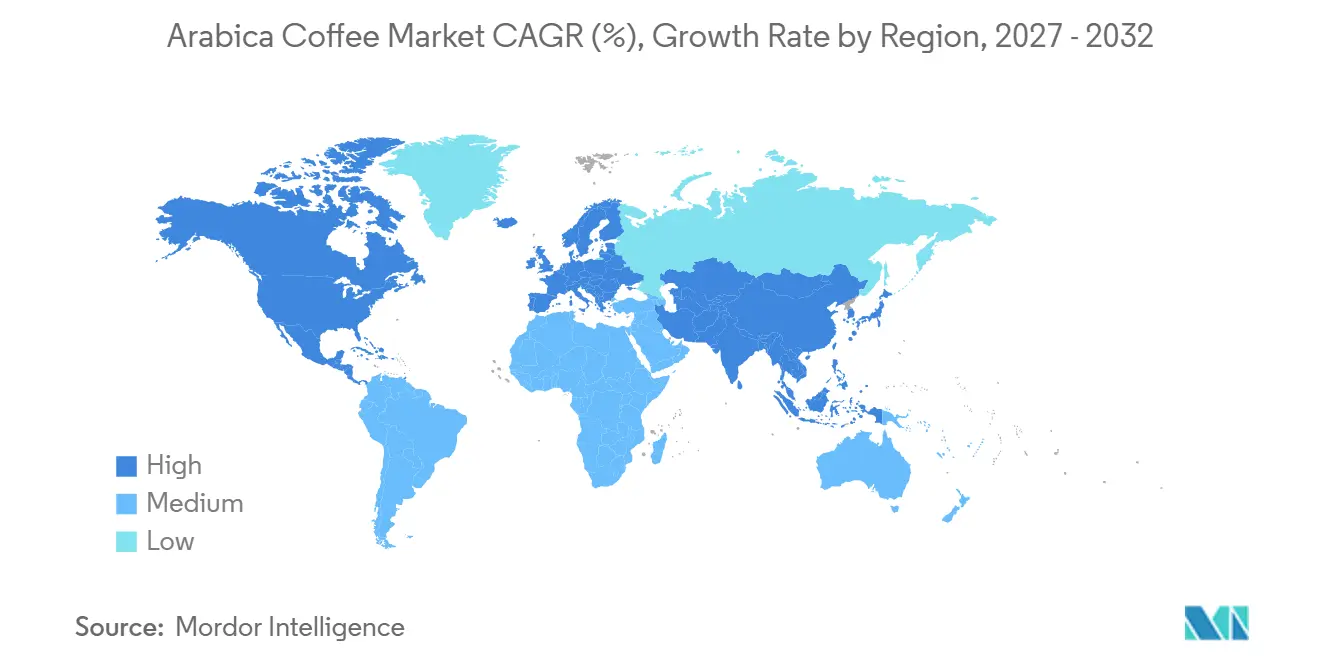
Europe accounted for an estimated 35.36% of the Arabica Coffee Market in 2026, making it the largest regional market. The region has an established coffee culture and developed retail and food-service networks, supporting demand for roasted, ground, and specialty coffee. Arabica beans are particularly relevant to premium and specialty coffee offerings, where buyers place importance on flavour profiles, origin information, quality consistency, and traceability. These market characteristics create opportunities for suppliers and roasters offering differentiated Arabica products.
Asia-Pacific Arabica Coffee Market
Asia-Pacific is projected to be the fastest-growing regional market, with an estimated CAGR of 7.27% over 2027–2032. Growth opportunities are supported by expanding café culture, rising interest in specialty coffee, and the development of premium coffee retail and food-service channels in markets such as China, India, Japan, South Korea, and Australia. The region also includes important Arabica-producing countries, including Indonesia and India, which contribute to regional sourcing and processing activity. However, market development varies across countries according to coffee-drinking habits, purchasing power, and the maturity of specialty coffee channels.
North America Arabica Coffee Market
North America represents an established market for Arabica coffee, supported by specialty coffee consumption, premium retail offerings, and a developed café and food-service sector. The United States is an important destination for coffee-producing countries, while Canada and Mexico contribute to regional demand through retail and out-of-home consumption. Specialty roasters and branded coffee chains create opportunities for single-origin, organic, and premium Arabica products. However, import dependence exposes the region to fluctuations in international bean prices, shipping costs, and supply availability.
Competitive Landscape
The Arabica Coffee Market includes multinational coffee companies, specialty coffee brands, coffee roasters, traders, and regional producers competing through product quality, sourcing networks, brand positioning, product innovation, and distribution reach. Companies participate at different stages of the value chain, including coffee cultivation and trading, bean sourcing, roasting, processing, packaging, and branded beverage sales. Large companies such as Nestlé, JDE Peet’s, Starbucks, and Lavazza benefit from established brands and broad distribution networks, while specialist companies such as illycaffè focus on premium coffee positioning and quality differentiation. Coffee traders and sourcing businesses, including Volcafe, Louis Dreyfus Company, and Sucafina, play an important role in connecting producing regions with roasters and other buyers.
Competitive strategies in the Arabica Coffee Market focus on strengthening origin-based sourcing, expanding premium and specialty coffee portfolios, improving traceability, and developing convenient product formats. For example, Volcafe sources Arabica and Robusta coffee across multiple origins and operates across procurement, processing, quality control, risk management, and logistics. Sucafina sources coffee from a broad range of producing countries and offers options ranging from larger commercial lots to microlots, alongside certified coffee offerings. These approaches help supply-chain participants serve roasters and buyers with different quality, origin, and sourcing requirements.
Sourcing and distribution remain important competitive considerations. Companies with established relationships across coffee-producing regions can strengthen access to green Arabica beans, while traceability systems and quality-control processes help address buyer requirements. Volcafe, for instance, describes its use of supplier and farm-level traceability for selected responsibly sourced coffees, while Sucafina highlights quality assessment and certified coffee sourcing. At the branded-product level, companies such as Nestlé, Starbucks, JDE Peet’s, Lavazza, Tchibo, and illycaffè compete through product portfolios, brand recognition, and retail or food-service access. However, the presence of diversified beverage and equipment companies in the competitive landscape does not necessarily indicate that all their coffee-related activities are specific to Arabica. Climate-related supply disruptions, bean-price volatility, quality consistency, and certification requirements can affect sourcing costs and availability. These factors make reliable procurement, product differentiation, traceability, and distribution reach important areas of competition.
Arabica Coffee Industry Leaders
-
Nestlé
-
Lavazza
-
Keurig Dr Pepper
-
JDE Peet's
-
The J. M. Smucker Company
- *Disclaimer: Major Players sorted in no particular order
Arabica Coffee Market Companies Covered in this Report
- Nestlé S.A.
- Starbucks Corporation
- JDE Peet's N.V.
- Luigi Lavazza S.p.A.
- Tchibo GmbH
- Keurig Dr Pepper Inc.
- The J. M. Smucker Company
- Tata Consumer Products Limited
- UCC Ueshima Coffee Co.
- Volcafe Ltd.
- Louis Dreyfus Company
- Sucafina S.A.
- illycaffè S.p.A.
- The Coca-Cola Company
- Balanoor Plantations and Industries Ltd.
- Aspinwall and Company Limited
- Allana Sons Limited
- Indcaffe
- Kaapi Royale
- Greenland Organic Farm Pvt. Ltd.
Recent Industry Developments in Arabica Coffee Market
- October 2026: Coffee Island introduced The Origin Box in collaboration with The Coorg Coffee Club, featuring five limited-edition coffees sourced from five family-owned farms in Coorg, India. The collection includes specialty Arabica alongside Canephora and Excelsa varieties, highlighting distinct origins, micro-lot sourcing, and specialised processing methods.
- October 2026: NESCAFÉ partnered with Doi Tung to launch NESCAFÉ ROASTERY DRIP COFFEE, its first premium drip coffee, made from 100% Thai Arabica beans cultivated in Nan and Chiang Rai. The limited-edition product used honey and washed processing methods and was released in a 10,000-box micro-batch for International Coffee Day.
- September 2026: Hoang Anh Gia Lai International Investment Joint Stock Company (HGI), part of HAGL Group, announced a five-year partnership with China's MQ Coffee to develop coffee-growing areas and supply HAGL Arabica green beans to the Chinese market. The agreement covers sourcing, bean evaluation, roasting, distribution, and market development, with an expected sales target of approximately 1,000 metric tons for the 2026–2027 crop year.
- May 2026: Starbucks announced a proposed three-year farmer-support initiative with the Integrated Tribal Development Foundation to advance sustainable Arabica production in Northern Thailand. The programme focuses on farmer training, agronomic guidance, improved farm management, and post-harvest practices across Chiang Mai, Chiang Rai, and Mae Hong Son.
Global Arabica Coffee Market Report Scope
For this study, the Arabica Coffee Market is defined as the sales value of commercially traded coffee products made from Arabica coffee beans (Coffea arabica). The market covers whole-bean coffee, ground coffee, instant coffee, coffee pods and capsules, and ready-to-drink (RTD) coffee products. It is segmented by nature into conventional and organic Arabica coffee, and by distribution channel into off-trade and on-trade. Off-trade includes supermarkets and hypermarkets, convenience stores, specialty retailers, online retail, and other off-trade channels, while on-trade covers coffee consumption through cafés, restaurants, hotels, and other food-service establishments. The market is analyzed across North America, Europe, Asia-Pacific, South America, and the Middle East and Africa, with country-level coverage as specified in the report. Market sizing and forecasts are presented in value terms (USD) across the defined product types, nature categories, distribution channels, and geographies.
Segmentation Overview
| Whole Bean |
| Ground Coffee |
| Instant Coffee |
| Coffee Pods and Capsules |
| Ready-to-Drink (RTD) |
| Conventional |
| Organic |
| Off-Trade | Supermarkets/Hypermarkets |
| Convenience Stores | |
| Specialty Retailers | |
| Online Retail | |
| Other Off-Trade Channels | |
| On-Trade |
| North America | United States |
| Canada | |
| Mexico | |
| Rest of North America | |
| Europe | United Kingdom |
| Germany | |
| France | |
| Italy | |
| Spain | |
| Sweden | |
| Belgium | |
| Poland | |
| Netherlands | |
| Rest of Europe | |
| Asia-Pacific | China |
| Japan | |
| India | |
| Thailand | |
| Singapore | |
| Indonesia | |
| South Korea | |
| Australia | |
| Rest of Asia-Pacific | |
| South America | Brazil |
| Argentina | |
| Colombia | |
| Peru | |
| Chile | |
| Rest of South America | |
| Middle East and Africa | South Africa |
| Saudi Arabia | |
| United Arab Emirates | |
| Nigeria | |
| Egypt | |
| Morocco | |
| Turkey | |
| Rest of Middle East and Africa |
| By Product Type | Whole Bean | |
| Ground Coffee | ||
| Instant Coffee | ||
| Coffee Pods and Capsules | ||
| Ready-to-Drink (RTD) | ||
| By Nature | Conventional | |
| Organic | ||
| By Distribution Channel | Off-Trade | Supermarkets/Hypermarkets |
| Convenience Stores | ||
| Specialty Retailers | ||
| Online Retail | ||
| Other Off-Trade Channels | ||
| On-Trade | ||
| By Geography | North America | United States |
| Canada | ||
| Mexico | ||
| Rest of North America | ||
| Europe | United Kingdom | |
| Germany | ||
| France | ||
| Italy | ||
| Spain | ||
| Sweden | ||
| Belgium | ||
| Poland | ||
| Netherlands | ||
| Rest of Europe | ||
| Asia-Pacific | China | |
| Japan | ||
| India | ||
| Thailand | ||
| Singapore | ||
| Indonesia | ||
| South Korea | ||
| Australia | ||
| Rest of Asia-Pacific | ||
| South America | Brazil | |
| Argentina | ||
| Colombia | ||
| Peru | ||
| Chile | ||
| Rest of South America | ||
| Middle East and Africa | South Africa | |
| Saudi Arabia | ||
| United Arab Emirates | ||
| Nigeria | ||
| Egypt | ||
| Morocco | ||
| Turkey | ||
| Rest of Middle East and Africa | ||
Key Questions Answered in the Report
What is the estimated size of the Arabica Coffee Market in 2026?
The Arabica Coffee Market is estimated at USD 104.88 billion in 2026.
What is the projected size of the Arabica Coffee Market by 2032?
The market is projected to reach USD 146.44 billion by 2032, growing at a CAGR of 5.74% during 2027–2032.
Which product type holds the largest share of the Arabica Coffee Market?
Ground coffee holds the largest share, accounting for an estimated 34.02% of the market in 2026.
Which region is expected to grow fastest in the Arabica Coffee Market?
Asia-Pacific is projected to be the fastest-growing region, registering an estimated CAGR of 7.27% during 2027–2032.