
Market Overview
| Study Period | 2020 - 2031 |
|---|---|
| Forecast Data Period | 2026 - 2031 |
| Base Year Market Size (2025) | USD 4.44 Billion |
| Market Size (2026) | USD 5.26 Billion |
| Market Size (2031) | USD 12.31 Billion |
| Growth Rate (2026 - 2031) | 18.55 % |
| Market Concentration | Medium |
Major Players *Disclaimer: Major Players sorted in no particular order Image © Mordor Intelligence. Reuse requires attribution under CC BY 4.0. | |
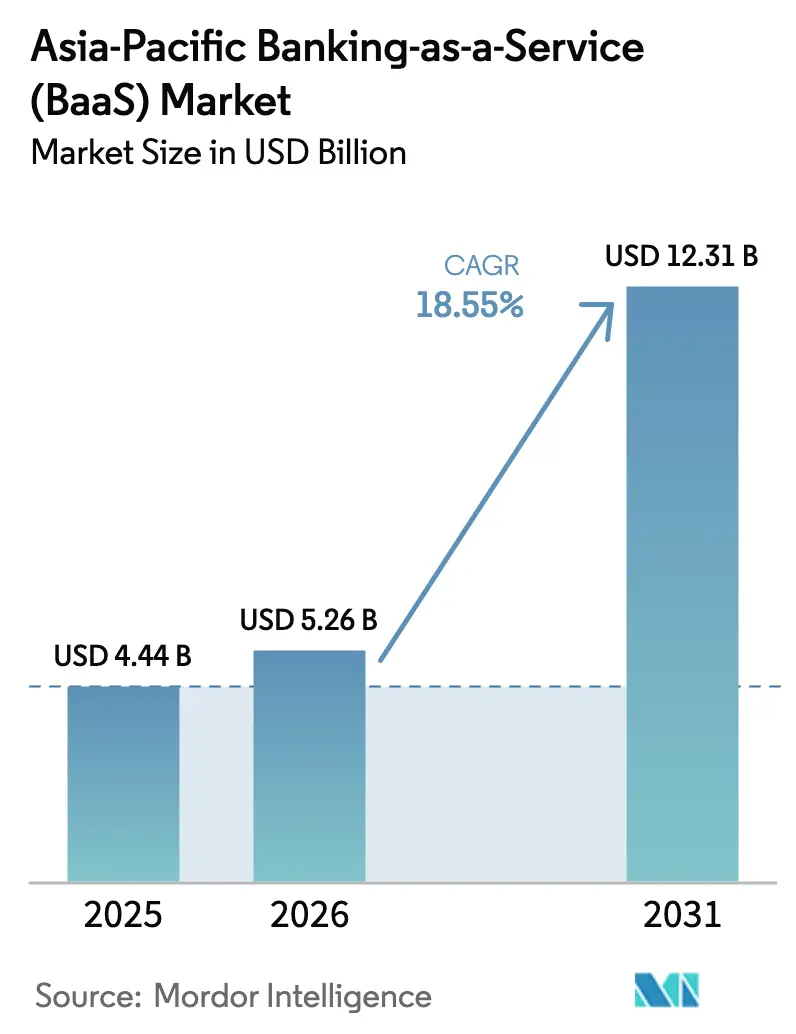
Asia-Pacific Banking-as-a-Service (BaaS) Market Analysis by Mordor Intelligence
The Asia-Pacific Banking as a Service market size in 2026 is estimated at USD 5.26 billion, growing from 2025 value of USD 4.44 billion with 2031 projections showing USD 12.31 billion, growing at 18.55% CAGR over 2026-2031. This market size reflects the region’s rapid shift toward API-driven financial infrastructure, where traditional banks increasingly monetize core systems through white-label services and fintech platforms embed banking functions directly into customer workflows. The confluence of proactive open-banking regulation, the surge in real-time payment rails, and the spread of low-code development tools is restructuring financial service delivery models at speed. Incumbent institutions are responding by building API marketplaces, while tier-2 and tier-3 banks turn balance sheets into revenue-generating BaaS channels. Fintech demand for embedded payments, KYC automation, and digital lending modules continues to outpace expectations, creating positive network effects that compound existing growth drivers. As a result, strategic partnerships between banks, infrastructure vendors, and hyperscale cloud providers are becoming the centerpiece of the Banking as a Service market rather than isolated corporate initiatives.
Key Report Takeaways
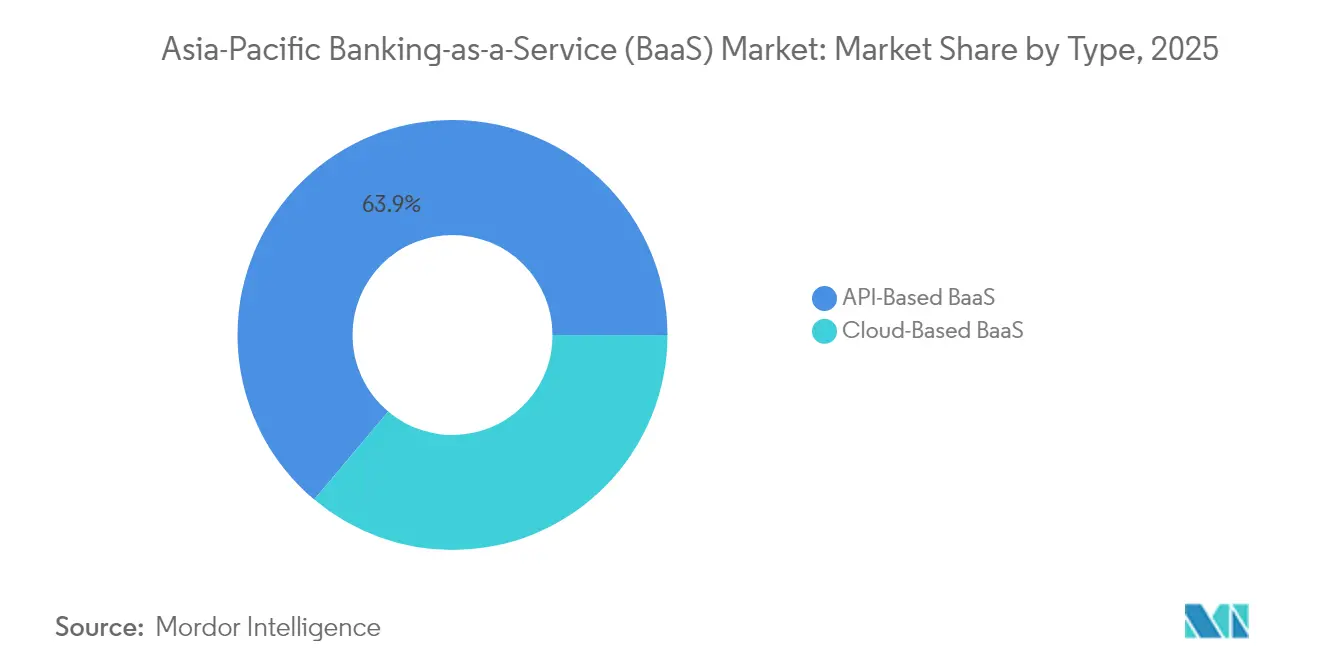
- By type, the API-based segment commanded 63.88% of the Asia-Pacific Banking as a Service market share in 2025; the cloud-based segment is projected to advance at 22.95% CAGR to 2031.
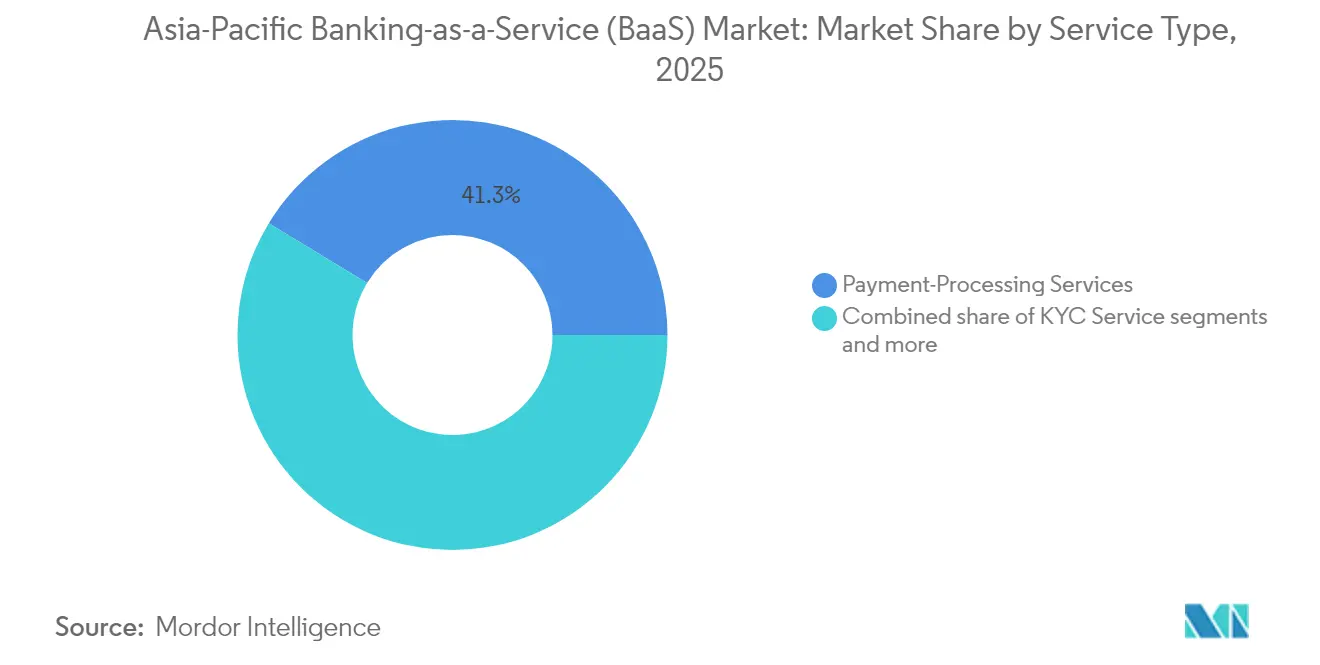
- By service type, payment-processing services led with 41.30% of the Asia-Pacific Banking as a Service market share in 2025, whereas KYC services are on track for a 25.35% CAGR through 2031.
- By enterprise size, large enterprises accounted for 54.60% of the Asia-Pacific Banking as a Service market share in 2025, yet SMEs represent the fastest-growing cohort at 19.05% CAGR to 2031.
- By geography, China held a 31.85% of the Asia-Pacific Banking as a Service market share in 2025, while India is forecast to expand at a 20.85% CAGR through 2031.
Note: Market size and forecast figures in this report are generated using Mordor Intelligence’s proprietary estimation framework, updated with the latest available data and insights as of 2026.
Asia-Pacific Banking-as-a-Service (BaaS) Market Trends and Insights
Drivers Impact Analysis*
| Driver | (~) % Impact on CAGR Forecast | Geographic Relevance | Impact Timeline |
|---|---|---|---|
| Accelerating open-banking & regulatory support | +3.2% | India, Singapore, Australia, Philippines | Medium term (2-4 years) |
| Embedded-finance demand from e-commerce & super-apps | +4.1% | China, Southeast Asia, India | Short term (≤ 2 years) |
| Expansion of real-time payment rails | +3.8% | India, Singapore, Thailand, Malaysia | Short term (≤ 2 years) |
| Cloud-infrastructure cost reduction | +2.9% | Pan-regional | Long term (≥ 4 years) |
| Tier-2/3 banks monetizing balance sheets | +2.4% | India, Indonesia, Philippines, Vietnam | Medium term (2-4 years) |
| Low-/no-code toolkits for SME integrations | +2.1% | Urban APAC markets | Short term (≤ 2 years) |
| Source: Mordor Intelligence | |||
Accelerating Open-Banking & Regulatory Support Across APAC
Regulators across APAC increasingly require banks to expose standardized APIs, turning former compliance obligations into commercial opportunities for BaaS vendors. India’s Account Aggregator framework processed 1.2 billion data requests in 2024, proving that mandated interoperability can scale securely[1]Reserve Bank of India, “Account Aggregator Framework – Implementation Guidelines,” RBI Press Release, rbi.org.in. . Singapore’s Monetary Authority updated third-party risk guidelines the same year, giving banks a formal playbook for partnering with fintechs. Australia expanded its Consumer Data Right beyond banking into energy and telecom, widening the addressable footprint for API-linked financial products. The Philippines and Malaysia launched open-finance roadmaps that echo European PSD2 objectives but adapt to local unbanked populations. As legal certainty rises, early-mover banks that already monetize APIs are enjoying recurring fee income, while late adopters risk customer attrition to digital-first competitors. The broader policy consensus now frames BaaS as an engine of financial inclusion rather than a threat to banking stability.
Rapid Rise of Embedded-Finance Demand from E-Commerce & Super-Apps
E-commerce giants and super-apps are embedding credit, insurance, and wealth products natively, forcing high-volume, low-latency API stacks into the spotlight. Grab’s financial arm processed USD 8.2 billion in transaction value during 2024 through BaaS partnerships, proving the model’s commercial viability. GCash, Alipay, and ShopeePay use the same approach to extend customer lifetime value beyond payments alone. Platform operators favor BaaS because it eliminates banking license complexity yet unlocks revenue-share economics that can exceed core marketplace margins. As cross-border shopping rises, super-apps also need multicurrency wallets and risk engines, further stimulating demand for regional payment orchestration APIs. The virtuous circle—more users, more data, more tailored products—cements embedded finance as the dominant distribution model in consumer segments across the Asia-Pacific Banking as a Service market.
Surge in Real-Time Payment Rails (UPI, PayNow, PromptPay)
Real-time payment systems are a catalyst for transaction-heavy BaaS services. India’s UPI handled 14.44 billion transactions worth USD 200 billion in December 2024 alone, stretching incumbent switch infrastructure and creating monetization room for API-native processors[2]National Payments Corporation of India, “UPI Product Statistics December 2024,” npci.org.in. . Singapore’s PayNow and Thailand’s PromptPay connect via Project Nexus, giving fintechs a regional instant-transfer backbone without bilateral clearing agreements. BaaS players capitalize by bundling settlement, FX, and compliance features around these RTP rails, effectively offering a one-stop gateway. Banks leverage external APIs for overflow capacity during festival peaks, offloading both operational risk and cost. Consequently, payment-processing remains the lead revenue driver across the Asia-Pacific Banking as a Service market even as margins compress, because scale volumes more than offset fee pressure.
Cloud-Infrastructure Expansion Lowering BaaS Deployment Costs
Hyperscaler investments in Jakarta, Kuala Lumpur, and Seoul remove latency bottlenecks and satisfy data-sovereignty rules, enabling cloud-native BaaS entrants to launch without owning physical data centers[3]Google Cloud, “Google Cloud Expands in Indonesia with New Jakarta Region,” cloud.google.com. . AWS, Google Cloud, and Azure now certify specialized financial-services regions with hardware security modules and regulatory attestations, lowering time-to-market by months. According to Infosys, cloud-based banking cores cut operating costs by 30-40% versus on-premise stacks. Smaller banks that struggled with capital expense are adopting “banking-in-a-box” solutions hosted in the region, democratizing access to sophisticated treasury, KYC, and ledger services. The cost deflation also fuels price competition, allowing BaaS providers to tier pricing for SMEs without sacrificing gross margin. Long-term, cloud ubiquity is expected to keep the Asia-Pacific Banking as a Service market on its high-growth trajectory even if topline API fees trend lower.
Restraints Impact Analysis*
| Restraint | (~) % Impact on CAGR Forecast | Geographic Relevance | Impact Timeline |
|---|---|---|---|
| Heightened regulatory scrutiny & third-party risk oversight | -2.8% | Singapore, Australia, India, Japan | Medium term (2-4 years) |
| Rising cybersecurity & data-localization compliance costs | -2.1% | China, India, pan-regional | Long term (≥ 4 years) |
| Legacy core-bank systems limiting API performance | -1.9% | Regional banks across Southeast Asia and Japan | Medium term (2–4 years) |
| Volatile VC funding constraining fintech client pipeline | -1.6% | APAC-wide, with pronounced impact in early-stage hubs like Singapore and Bengaluru | Short term (≤ 2 years) |
| Source: Mordor Intelligence | |||
Heightened Regulatory Scrutiny & Third-Party-Risk Oversight
Supervisors from Singapore’s MAS to Australia’s APRA now hold banks accountable for vendor resiliency, demanding deep audits of BaaS partners [4]\Monetary Authority of Singapore, “Guidelines on Technology Risk Management,” mas.gov.sg. . New frameworks require real-time visibility into uptime, penetration testing, and sub-processor chains, raising onboarding costs and lengthening procurement cycles. Japanese regulators proposed similar guidelines in late 2024, emphasizing board-level responsibility for outsourced IT. These measures protect consumers but introduce friction that may deter smaller institutions from adopting third-party cores. Compliance workloads often duplicate between bank and provider, eroding the time-to-profit advantage that once defined BaaS value. Over the medium term, intensified oversight will likely consolidate the Asia-Pacific Banking as a Service market around vendors with mature governance processes, thereby cooling headline CAGR by an estimated 2.8%.
Rising Cybersecurity & Data-Localization Compliance Costs
APAC jurisdictions are tightening data-residency and breach-notification rules, escalating capex for multi-region BaaS architectures. India’s Digital Personal Data Protection Act and China’s Cybersecurity Law force providers to establish local instances, sacrificing economies of scale. PwC’s 2024 survey reports 69% of financial-services executives boosting cyber outlays by over 10% YoY, with API security the fastest-expanding line item. Smaller vendors lacking global SOC teams face an uneven burden, driving M&A as a survival strategy. Deployment delays of 6-12 months are common where security assessments are mandatory before launch. While these costs strengthen consumer trust, they also slow rollouts and compress margins, subtracting roughly 2.1% from forecast CAGR across the Asia-Pacific Banking as a Service market.
*Our forecasts treat driver/restraint impacts as directional, not additive. The impact forecasts reflect baseline growth, mix effects, and variable interactions.
Segment Analysis
By Type: API-Based Dominance Drives Enterprise Adoption
API-based platforms captured 63.88% of the Asia-Pacific Banking as a Service market share in 2025, underscoring the value enterprises place on granular control and direct system-to-system integration. Large organizations favor endpoint modularity, which lets them mesh banking functions with existing ERP, treasury, and risk engines while preserving data sovereignty. In contrast, cloud-based platforms are winning digital-native customers at a 22.95% CAGR, leveraging pre-configured cores to compress product-launch cycles. DBS Bank’s marketplace alone lists more than 200 APIs, accounting for USD 25 million in annual revenue and validating demand for high-touch integration. The dichotomy mirrors broader IT adoption curves: incumbents retrofit API layers onto legacy systems, while challenger banks and fintechs jump straight to multitenant clouds. Temenos Banking Cloud logged 40% growth in new sign-ups during 2024, driven mainly by mid-market banks seeking turnkey BaaS entry. Regulators tend to prefer API-first models for their transparency, yet they now accept cloud equivalents provided robust audit trails exist. Consequently, the coexistence of both architectures will persist, ensuring that the Banking as a Service market retains multiple growth avenues rather than a single-technology path.



By Service Type: Payment Processing Leads While KYC Automation Surges
Payment-processing accounted for 41.30% market revenue in 2025 and remains the core monetization layer for most BaaS vendors. Transaction volume elasticity allows providers to price aggressively while cross-selling higher-margin services like FX conversion and settlement optimization. However, compliance automation is rising fastest, with the KYC category tracking a 25.35% CAGR as fintechs scale across borders. Brankas recorded a 180% spike in KYC API calls during 2024, reflecting this trend. Digital banking APIs covering account creation and ledger maintenance hold a meaningful share, buoyed by public-sector financial-inclusion campaigns in India and Indonesia. Customer-support APIs remain a niche but are gaining as enterprises realize that unified service experiences reduce churn. Emerging subsectors—credit scoring, fraud analytics, and tokenized-asset custody—sit in the “others” bucket but show promise as standalone lines once regulatory clarity improves. Collectively, the breadth of service demand signals that the Asia-Pacific Banking as a Service market is evolving from single-function gateways to full-stack financial infrastructure providers.
By Enterprise Size: SME Growth Accelerates Through Low-Code Integration
Large enterprises retained 54.60% of the Banking as a Service market size in 2025, driven by complex multi-region integrations and substantial transaction flow. Their projects often span digital-bank launches, supply-chain financing, and real-time treasury, locking in high average-contract values. Nonetheless, SMEs are the growth engine at 19.05% CAGR thanks to low-/no-code tools that reduce technical barriers to entry. Stripe’s simplified onboarding funnels empowered thousands of small sellers to embed split-payment and working-capital features during 2024, highlighting latent demand. SME adoption also benefits from subscription pricing that aligns with variable cash flow, unlike capex-heavy legacy solutions. Regulatory sandboxes in Singapore and Malaysia further ease experimentation by granting temporary exemptions from full licensing. Over the forecast horizon, SME penetration will likely raise competitive intensity, prompting vendors to differentiate on customer success, localized documentation, and vertical templates rather than pure API count. Despite this fragmentation, large-enterprise contracts will continue to anchor revenue stability for the Banking as a Service market.
Geography Analysis
China held 31.85% of the Asia-Pacific Banking as a Service market revenue in 2025, leveraging a mature super-app ecosystem and regulatory sandboxes that legitimize bank-fintech experimentation. Ant Group’s developer tools monetize Alipay’s payment rails while extending reach to provincial banks that lack digital muscle. Yet growth is moderating as new cybersecurity checks lengthen release cycles and data-interchange rules tighten. Domestic BaaS vendors are responding by exporting expertise to Belt-and-Road partner nations, sustaining regional influence even as home-market acceleration cools. India stands out as the fastest-growing territory, advancing at a 20.85% CAGR to 2031 amid exploding UPI volume and the Account Aggregator model that standardizes data portability. ICICI Bank’s 600-plus APIs show how incumbents pivot from branch expansion to platform distribution, unlocking USD 15 million in API fees while widening rural reach. The government's push for financial inclusion under the Jan Dhan Yojana keeps addressable demand high, and the recent Digital Personal Data Protection rules provide clear guardrails on localization without stifling innovation. These dynamics place India at the strategic center of the Banking as a Service market going forward.
Southeast Asia collectively offers the largest white-space opportunity. Singapore acts as a regional hub, providing regulatory clarity and cloud infrastructure, while neighbors such as Indonesia and Vietnam chase mobile-first consumers. The ASEAN Payment Connectivity initiative sets standardized cross-border API guidelines that lower technical friction. Malaysia’s DuitNow and Thailand’s PromptPay interoperability further underscore the role of real-time rails in catalyzing BaaS uptake. Australia and Japan remain important but slower-moving: their high-income demographics support premium BaaS use cases, yet conservative risk postures temper near-term velocity. Across the bloc, regional heterogeneity guarantees that the Asia-Pacific Banking as a Service market will evolve in staggered waves rather than a single uniform surge.
Regulatory Landscape
Regulatory frameworks across Asia-Pacific are tightening around open banking, third-party risk, and operational resilience, which affects how BaaS partnerships are structured and supervised. In 2026, the Monetary Authority of Singapore (MAS) proposed Guidelines on Third-Party Risk Management to supersede earlier outsourcing guidance and extend oversight across a broader set of third-party services. This raises due diligence and monitoring requirements for banks and their BaaS vendors. Separately, Hong Kong continued to advance account-data-sharing infrastructure via the Interbank Account Data Sharing (IADS) program, reinforcing regulatory support for standardized data exchange that underpins API-driven financial services.
Regulators are also adding rulesets that influence tokenized and digital-asset-adjacent BaaS capabilities. MAS issued a 2026 consultation on prudential treatment of cryptoassets on permissionless blockchains, clarifying how banks may hold and manage such exposures. The Hong Kong Monetary Authority (HKMA) emphasized 2026 priorities that include implementing international third-party risk standards and deepening supervisory engagement on cloud adoption. While these steps raise compliance costs for smaller providers, they also create clearer pathways for bank-fintech collaboration where governance, auditability, and data controls are built into the BaaS stack.
Value Chain Analysis
The Asia-Pacific BaaS value chain begins with regulated balance-sheet and licensing capacity (banks and, where applicable, e-money or stored-value facility licensees) and extends through core-banking and ledger technology providers, API middleware and orchestration layers, and risk, identity, and compliance tooling (KYC/AML, fraud, and data-sharing consent utilities). Distribution and demand are led by fintechs and non-financial platforms (e-commerce, super-apps, and SaaS providers) that embed payments, onboarding, and credit into their customer workflows. Real-time payment rails such as India’s UPI, Singapore’s PayNow, and Thailand’s PromptPay also function as high-throughput transaction backbones.
Value capture is concentrated in payment processing (41.30% of market revenue in 2025) and is expanding into compliance automation and cross-border settlement modules as platforms scale across jurisdictions. The chain is constrained by third-party risk requirements, cloud and data-localization controls, and integration complexity with legacy bank cores. This pushes vendors toward standardized API catalogs, pre-certified cloud deployments, and partnerships with domestic scheme operators and banks to access local clearing. As a result, differentiation increasingly comes from reliability, audit-ready controls, and the ability to package multi-rail payments, KYC, and treasury services into reusable modules for enterprises and SMEs.
Competitive Landscape
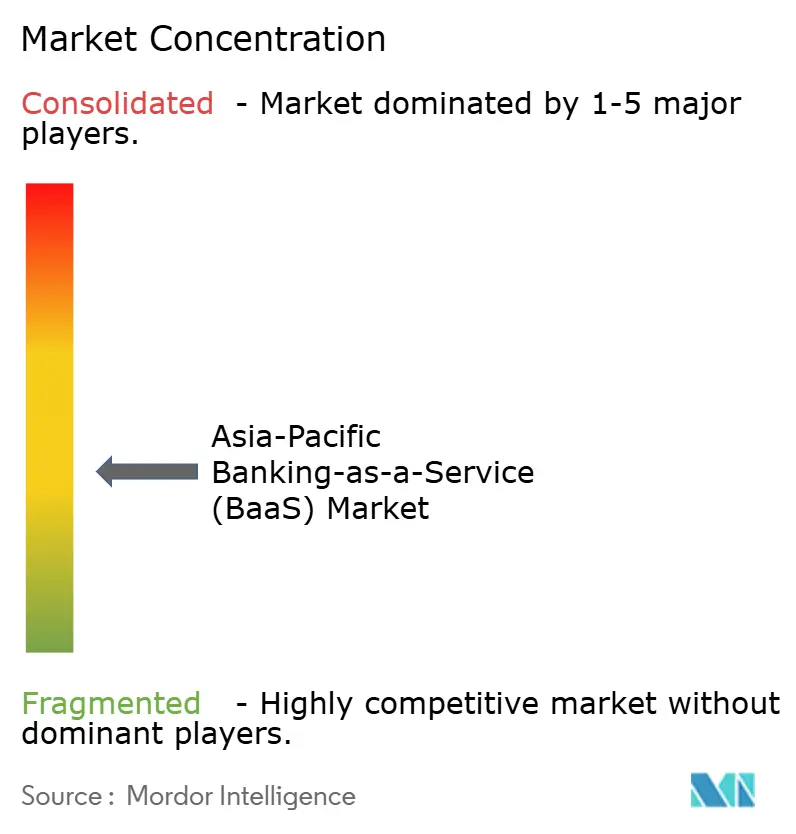
The Asia-Pacific Banking as a Service (BaaS) market remains moderately fragmented, with the top five providers commanding a sizeable, though not overwhelming, portion of total industry revenue. Stripe leads the segment, with Ant Group and Airwallex close behind, each building on unique strengths. These major players distinguish themselves through wide-ranging API offerings, broad geographic footprints, and strong compliance frameworks that position them as preferred partners for multinational clients. In contrast, mid-sized firms are carving out their own space by specializing in underserved niches, such as cross-border disbursements, Islamic finance solutions, or SME invoicing tools. This mix of scale and specialization is shaping a dynamic, competitive environment across the region.
Strategic activity in 2024 highlighted the differing approaches among key players. Stripe’s acquisition of Bridge for USD 1.1 billion expanded its capabilities into stablecoin settlements, indicating a clear shift toward digital asset rails favored by global exporters. Airwallex focused on deepening its relationships with regional acquiring banks to enhance onshore licensing coverage and regulatory alignment. Ant Group introduced a high-volume AI risk engine that processes over a billion decisions daily, with exceptionally low fraud losses, demonstrating its emphasis on performance at scale. Meanwhile, traditional banks are staying in the game through partnerships—exemplified by HSBC’s collaboration with Ant International on tokenized deposit trials aimed at corporate treasury functions.
As competition intensifies, enterprise clients are placing increasing weight on technical certifications and service-level guarantees. Achievements such as ISO 27001, PCI-DSS, and SOC 2 compliance are becoming minimum requirements, while guaranteed uptimes and system responsiveness are emerging as new differentiators. Providers able to demonstrate ultra-low latency, geographic redundancy, and five-nines availability are winning higher-value contracts. At the same time, smaller players are pursuing vertical integration by embedding their services within sector-specific software like POS systems or logistics ERP platforms. These trends suggest that while the market will remain competitive, rising compliance costs and client expectations will gradually drive consolidation among providers.
Asia-Pacific Banking-as-a-Service (BaaS) Industry Leaders
Stripe
Ant Group (Alipay)
Airwallex
GrabFin
Rapyd
- *Disclaimer: Major Players sorted in no particular order

Market Opportunities and Future Outlook
Opportunities are concentrating around compliance-by-design BaaS and cross-border interoperability as regulators formalize data sharing and third-party oversight. India’s Account Aggregator ecosystem demonstrated scalability with 1.2 billion data requests in 2024, supporting growth in consented data-access APIs and downstream modules such as automated affordability checks and KYC reuse across products. In parallel, instant-payment connectivity initiatives, including MAS-led Project Nexus (blueprint completed in 2024), create whitespace for multi-rail orchestration layers that bundle routing, FX, settlement, and monitoring for regional merchants and platforms operating across Singapore, Malaysia, Thailand, and India.
A second opportunity cluster is forming around AI-enabled operations and onboarding, supported by modernization programs at large payment and BaaS infrastructure providers. In May 2026, 2C2P (by Antom) selected AWS as the infrastructure foundation for its Southeast Asian payments platform and incorporated Amazon Bedrock to automate merchant integration, signaling a shift toward faster partner onboarding and standardized integrations at scale. On the policy side, Bank Negara Malaysia’s preparation of the Financial Sector Blueprint 2027-2030 to advance digital banking and open finance (with implementation slated for 2027) points to a pipeline of ecosystem build-out where banks, BaaS providers, and software platforms can productize open-finance-enabled payment and identity services for SMEs and underbanked segments.
Recent Industry Developments
- July 2026: Stripe began piloting a beta version of its Treasury platform in Australia, targeting startup founders with local business accounts, corporate virtual cards, and treasury tools. This expands Stripe’s BaaS-adjacent footprint from payments into account and cash-management capabilities, increasing competitive pressure on regional providers offering embedded banking features.
- May 2026: Ant International partnered with KASIKORNBANK (KBank) to develop integrated financial infrastructure for real-time 24/7 cross-border USD transactions, leveraging Kinexys by J.P. Morgan blockchain technology. The collaboration highlights how banks and BaaS-enablers are using tokenization-linked rails to improve corporate liquidity and settlement workflows across Asia-Pacific corridors.
- December 2024: HSBC partnered with Ant International to launch tokenized deposits for institutional clients across Asia-Pacific, enabling programmable money transfers through smart contracts to automate treasury operations. This partnership pointed to growing enterprise demand for programmable settlement capabilities delivered through bank-fintech platforms rather than standalone, in-house builds.


Research Methodology Framework and Report Scope
Market Definition and Coverage
For this study, the APAC banking as a service market is defined as revenue earned from API-led and cloud-led platforms that let nonbank brands and digital banks offer regulated banking products through licensed banking infrastructure.
Scope exclusions: We exclude pure open banking data aggregation tools and standalone consulting or system-integration fees that are not priced as ongoing BaaS platform or service revenue.
Segmentation Overview
- By Type
- API-Based BaaS
- Cloud-Based BaaS
- By Service Type
- Payment-Processing Services
- Digital Banking Services
- KYC Service
- Customer Support Services
- Others
- By Enterprise Size
- SMEs
- Large Enterprises
- By Geography
- India
- China
- Japan
- Australia
- South Korea
- South East Asia
- Singapore
- Malaysia
- Thailand
- Indonesia
- Vietnam
- Philippines
- Rest of Asia-Pacific
Data Sources, Market Sizing, and Validation
Desk Research
We first mapped the market boundaries and demand signals by reviewing public regulation and payments infrastructure material across APAC. Common reference points included central bank and regulator portals for open banking and digital banking rules, Bank for International Settlements publications, IMF financial access datasets, and World Bank Global Findex indicators, which help frame adoption and eligibility by country.
Revenue logic was then checked using public company filings, investor decks, and product disclosures, supported by reputable business press coverage on banking partnerships and embedded finance launches. Where needed, we used paid subscriptions for company financials and intelligence, patent databases, and a news and financials platform to track product releases and time major contract wins. The desk sources listed here are illustrative, and we also reviewed other public and paid sources for data collection, validation, and clarification.
Primary Interviews and Surveys
Primary interviews and short surveys were used to pressure test desk assumptions, especially where pricing is not transparent and where a single platform can be packaged differently for bank partners and fintech clients. We spoke with executives and managers from banks, BaaS platform teams, fintech product owners, and compliance specialists across key APAC markets, so we could align the revenue model with actual contracting patterns, usage volumes, and KYC intensity.
Distribution of primary research fieldwork respondents
| Company type | Respondent position |
|---|---|
| Top tier: 36% | CXOs: 13% |
| Mid tier: 43% | Functional/Unit leaders: 35% |
| Smaller Players: 21% | Managers: 52% |
Market-Sizing & Forecasting
Our market sizing starts from a top-down build where country-level fintech and digital banking activity is reconstructed into an addressable BaaS demand pool, then filtered by the share of programs that rely on bank sponsored APIs and cloud delivered cores. To keep the totals realistic, we corroborate with selective bottom-up checks, such as sampled price-per-API call or per-account fees multiplied by active accounts, plus channel checks on how many live programs are in market.
Key model inputs include active digital banking users, real-time payments penetration, the number of embedded finance launches, KYC and onboarding intensity, and average commercial pricing ranges for payment processing and account services. Where a variable is missing for a smaller market, we proxy it using peer country ratios and then adjust it after expert feedback.
Forecasts rely mainly on scenario analysis, since regulatory timing and bank partnership pipelines can shift adoption quickly. We set a base case using expected open banking rule rollouts and cloud migration pace, then stress it with upside and downside paths validated during interviews.
Data Validation & Update Cycle
Final numbers are validated by cross-checking the model against independent signals, such as digital payment volumes, new digital bank licensing activity, and disclosed partnership announcements. When outputs drift too far from these signals, assumptions are revisited and respondents are re-contacted to confirm whether the variance is driven by timing, pricing, or scope mismatches.
Each report goes through a multi-step analyst review where formulas, conversion rates, and currency assumptions are checked before sign-off. We refresh the report annually, and material events like major regulatory changes or large partnership launches trigger interim updates. Immediately before delivery, a final review pass is completed so clients receive the most current view.
Mordor Intelligence's APAC Banking As A Service Market Size Measured Against Other Published Estimates
Published market sizes for APAC banking as a service can look far apart because the market is still new, and the boundary between BaaS, open banking, and general fintech infrastructure is not always treated the same. Differences also come from whether a source counts only platform and service revenue, or also includes adjacent software and project work around a BaaS implementation.
By tracking API-based usage drivers and refreshing currency conversions at consistent points in time, Mordor Intelligence keeps the market total aligned to recurring platform and service revenue, which reduces noise from one-time integration fees and broader embedded finance rollups.
Benchmark comparison
| Source | Market Size | Gaps in Research Methodology |
|---|---|---|
| Mordor Intelligence | USD 4.44 B (2025) | |
| Trade Journal A | USD 5.30 B (2026) | Often cites a single forward year and rounds values, which can blur whether the number reflects a true market size or a near-term projection based on a few large launches. |
| Regional Consultancy B | USD 145.54 B (2024) | Likely uses a much wider definition that mixes BaaS with broader digital banking or fintech revenues, and may include lending books, insurance, or general banking income not earned as BaaS platform or service fees. |
The comparison shows that the biggest spread comes from scope and the year being quoted, not small modeling tweaks. When revenue is limited to BaaS platform and service monetization in APAC and tied back to practical demand indicators, the estimate becomes easier to replicate and to use for planning.


Key Questions Answered in the Report
What is the current value of the Banking as a Service market in Asia-Pacific?
The market is valued at USD 5.26 billion in 2026, with an 18.55% CAGR forecast toward USD 12.31 billion by 2031.
Which country is growing fastest in adopting Banking as a Service solutions?
India is the fastest-growing territory, projected to advance at a 20.85% CAGR through 2031 due to UPI adoption and open-banking regulation.
Which segment contributes the largest revenue within Banking as a Service platform?
Payment-processing services lead with 41.30% share, driven by high transaction volumes and demand for real-time settlement.
What major driver will shape Banking as a Service growth over the next two years?
Rising embedded-finance demand from e-commerce and super-apps is expected to add about 4.1% points to the market’s CAGR in the short term.
Which deployment model is preferred by large enterprises?
Large enterprises favor API-based platforms for granular control, accounting for 63.88% of market revenue in 2025.
Page last updated on:


 Your data is secure and never sold or shared.


