
Anti-Tank Missiles Market Size and Share
Market Overview
| Study Period | 2020 - 2032 |
|---|---|
| Market Size (2027) | USD 3.26 Billion |
| Market Size (2032) | USD 4.47 Billion |
| Growth Rate (2027 - 2032) | 6.52 % |
| Fastest Growing Market | Asia-Pacific |
| Largest Market | North America |
| Market Concentration | Medium |
Major Players *Disclaimer: Major Players sorted in no particular order Image © Mordor Intelligence. Reuse requires attribution under CC BY 4.0. | |
Anti-Tank Missiles Market Analysis by Mordor Intelligence
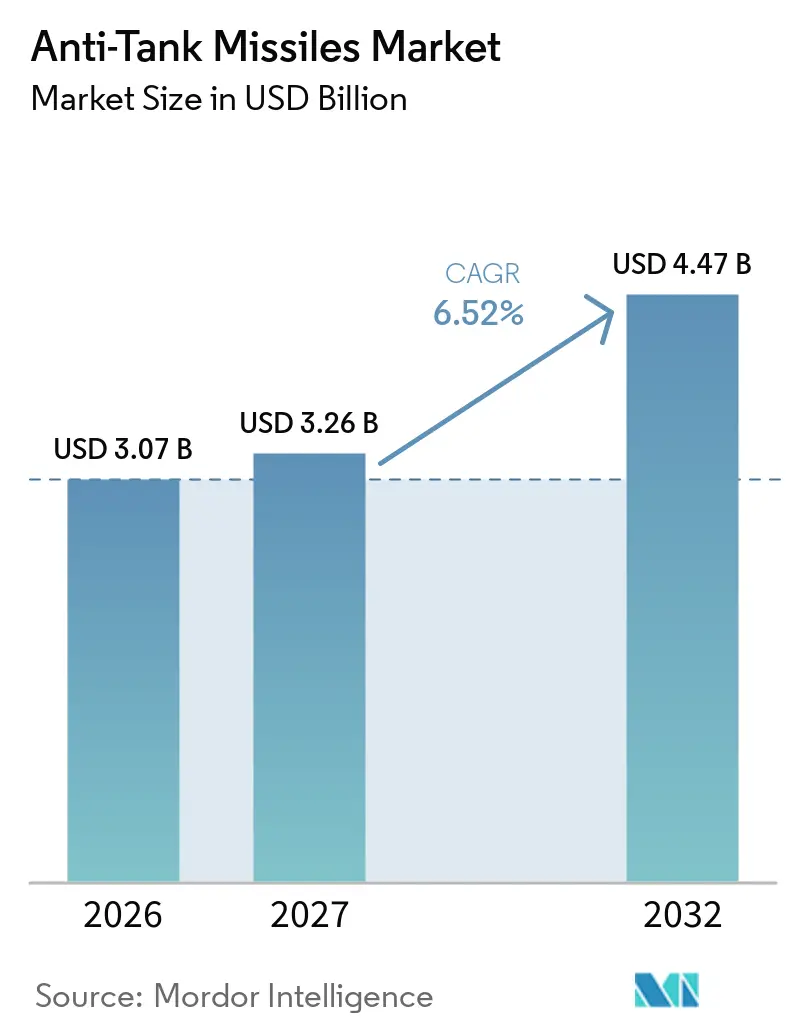
The anti-tank missiles market size was valued at USD 3.07 billion in 2026 and is forecast to grow from USD 3.26 billion in 2027 to reach USD 4.47 billion by 2032, at a 6.52% CAGR during the forecast period (2027-2032). Vehicle systems remain central to armored doctrine, while airborne systems are in greater demand as helicopter and drone programs expand. Demand is moving toward missiles that engage targets at a distance and operate against protected vehicles. NATO Budgets, replenishment, and production programs improve supplier order visibility. The anti-tank missiles market also faces higher development costs as active protection systems raise the performance standard for new weapons.
Key Report Takeaways
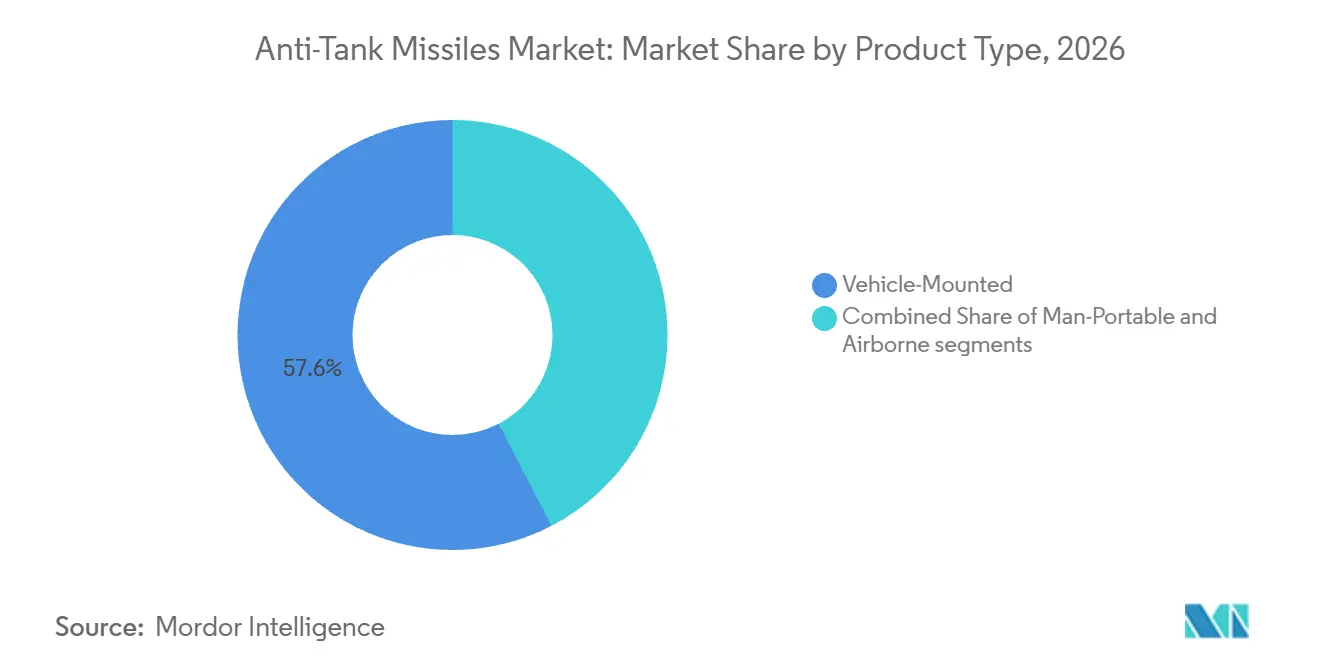
- By product type, vehicle-mounted held a 57.62% share of the anti-tank missiles market in 2026, while airborne anti-tank missiles are forecast to grow at a 7.86% CAGR through 2032.
- By guidance type, laser-guided held a 28.54% share of the anti-tank missiles market in 2026, while dual-mode and multi-mode are forecast to grow at a 9.81% CAGR through 2032.
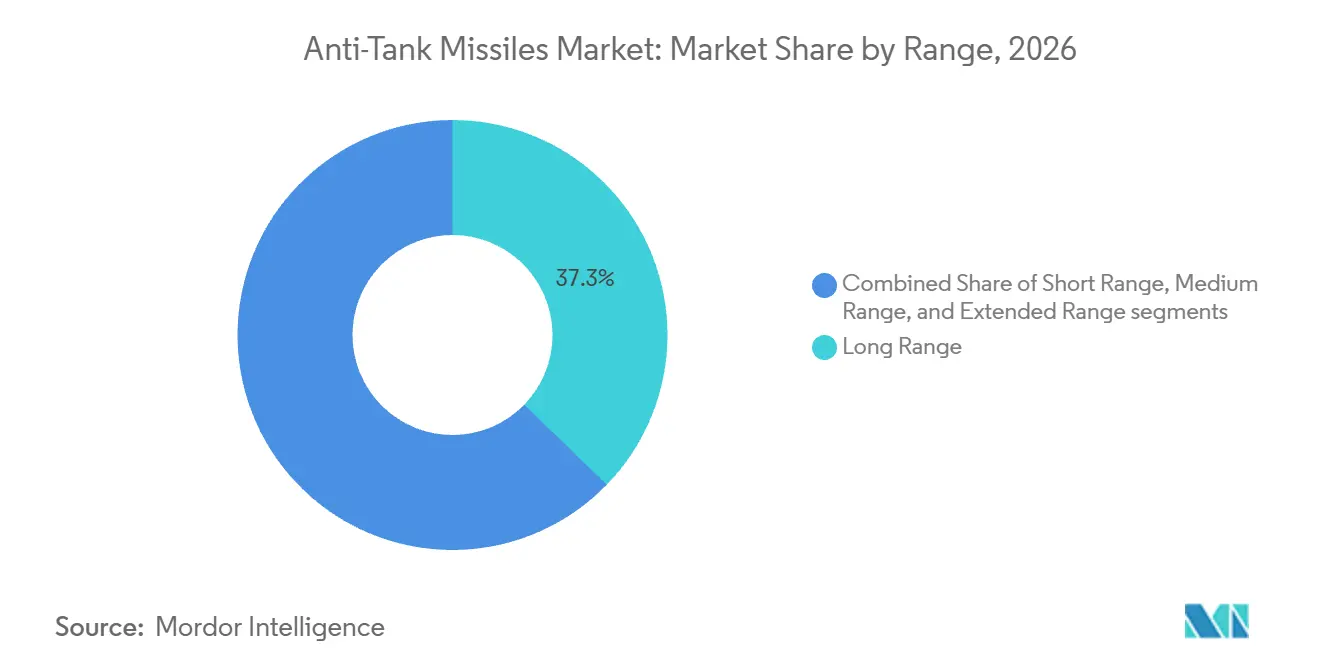
- By range, long-range held a 37.26% share of the anti-tank missiles market in 2026, while extended-range is forecast to grow at an 8.15% CAGR through 2032.
- By end user, army and land forces held a 73.89% share of the anti-tank missiles market in 2026, while naval forces are forecast to grow at an 8.85% CAGR through 2032.
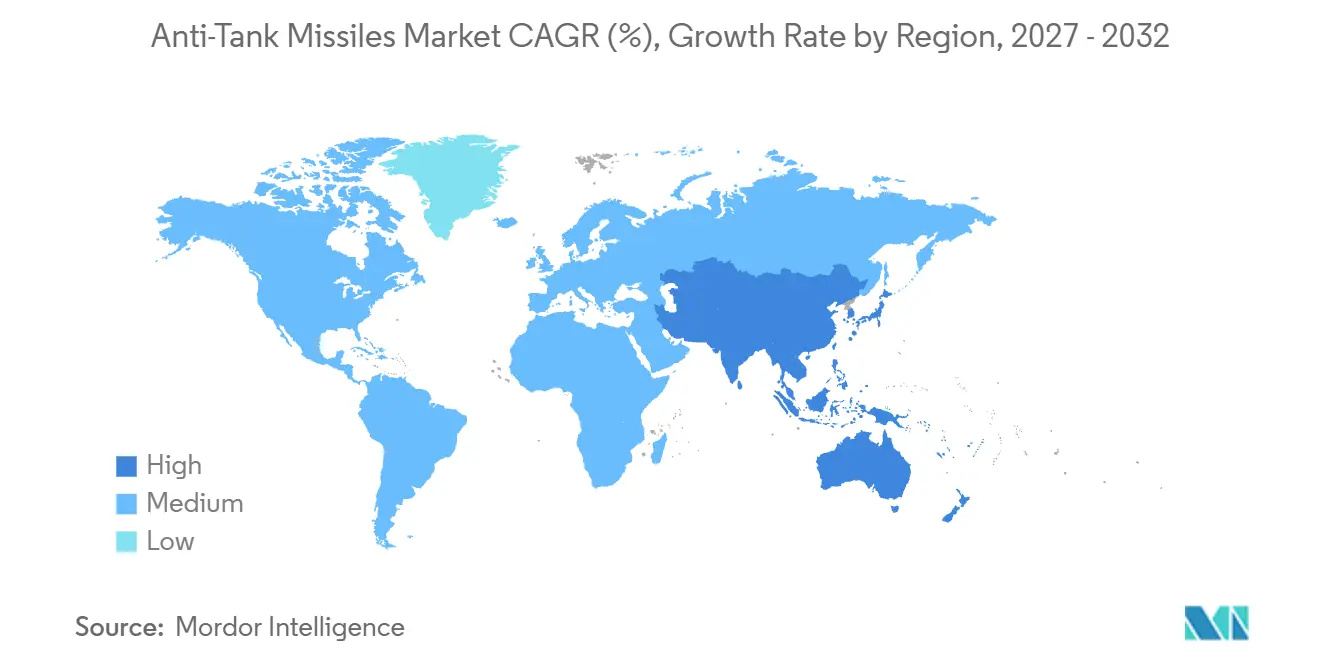
- By geography, North America held a 34.25% share of the anti-tank missiles market in 2026, while Asia-Pacific is forecast to grow at a 9.21% CAGR through 2032.
Note: Market numbers in this report are based on Mordor Intelligence's proprietary estimation framework, which combines nine months of actuals with Q4 projections for base year 2026.
Market Trends and Insights
Drivers Impact Analysis of Anti-Tank Missiles Market*
| Driver | (~) % Impact on CAGR Forecast | Geographic Relevance | Impact Timeline |
|---|---|---|---|
| Defense modernization and stock replenishment | +2.00% | Global, strongest in North America and Europe | Short term (≤ 2 years) |
| Regional conflicts and armor threat perception | +1.30% | Europe and the Middle East | Short term (≤ 2 years) |
| Precision, networked targeting, and reduced crew exposure | +1.00% | Global | Medium term (2-4 years) |
| Active-protection-system evasion arms race | +0.70% | North America, Europe, and Israel | Medium term (2-4 years) |
| Indigenous production and technology-transfer programs | +0.60% | Asia-Pacific, including India, South Korea, and Turkey | Long term (≥ 4 years) |
| Growing demand for multi-platform anti-tank missile integration | +0.60% | Global | Medium term (2-4 years) |
| Source: Mordor Intelligence | |||
Defense Modernization and Stock Replenishment
NATO members agreed in 2025 to invest 5% of GDP in defense spending by 2035, extending procurement planning.[1] The US Army requested USD 329.20 million for Javelin in FY2026, compared with USD 223.87 million enacted in FY2025. The request supports missile purchases. The FY2026 request assigned USD 11.73 million to TOW-2 procurement for engineering services, signaling a transition from older wire-guided systems. NATO requirements concentrate the anti-tank missiles market around systems with qualification records. Suppliers with approved systems can plan output more clearly over several years.
Regional Conflicts and Armor Threat Perception
Armored warfare in Eastern Europe has reinforced the value of fire-and-forget weapons against modern tanks and changed procurement priorities across Europe. Poland received US approval in September 2025 for 2,506 FGM-148F Javelin missiles and 253 Lightweight Command Launch Units, at an estimated value of USD 780 million.[2] The transaction shows that eastern NATO members are moving from planning toward funded anti-armor capability. It also supports a broader supply base because export orders can be produced alongside US requirements. The anti-tank missiles market benefits when force planners treat anti-armor systems as part of deterrence rather than as a reserve capability. This demand pattern keeps procurement focused on systems that can be fielded, trained, and sustained with allied formations.
Precision, Networked Targeting, and Reduced Crew Exposure
Third-generation weapons are becoming more important because lock-on-before-launch reduces the time crews must remain exposed during engagement. India completed field evaluation trials of the Nag Mk 2 and its NAMICA version-2 carrier in January 2025, clearing the complete system for Indian Army induction. The program supports a shift toward imaging infrared guidance and fire-and-forget engagement. The UAV-launched, helicopter-launched, and vehicle-launched precision strikes are part of a shared targeting architecture. This direction favors compact weapons because payload limits matter for unmanned aircraft. The anti-tank missiles market therefore has demand for advanced seekers and data links, even though different forces will select systems that match their budgets and platforms.
Active Protection System Evasion Competition
Hard-kill active protection systems are changing missile requirements when buyers define specifications. RAFAEL stated in May 2025 that Trophy met US Army Modular Active Protection System Framework 2.0 requirements. The Journal of the Korea Institute of Military Science and Technology reported reaction times ranging from 322 to 4,083 milliseconds. Developers are using dual-mode seekers and varied terminal approaches to reduce interception risk. The anti-tank missiles market therefore rewards firms with mature seeker and guidance programs, rather than firms competing only on basic missile design.
Restraints Impact Analysis of Anti-Tank Missiles Market*
| Restraint | (~) % Impact on CAGR Forecast | Geographic Relevance | Impact Timeline |
|---|---|---|---|
| High development, procurement, and sustainment costs | -0.70% | Global, most acute in South America and South and Southeast Asia | Medium term (2-4 years) |
| Active protection systems and electronic countermeasures | -0.50% | North America, Europe, Russia, and China | Medium term (2-4 years) |
| Production surge bottlenecks and qualification lead times | -0.40% | North America and Europe | Short term (≤ 2 years) |
| Stringent export controls and technology transfer restrictions | -0.30% | Asia-Pacific and the Middle East | Long term (≥ 4 years) |
| Source: Mordor Intelligence | |||
High Development, Procurement, and Sustainment Costs
High unit prices and wider program costs limit the number of buyers that can replace entire anti-armor inventories at once. Buyers also have to balance these purchases against the needs of air defense, artillery, and logistics. Licensed production can spread spending across domestic manufacturing runs and may be more acceptable than large direct purchases. India signed a Letter of Offer and Acceptance for the Javelin in August 2026 after a long procurement process, underscoring how commercial terms and technology transfer can delay decisions. The anti-tank missiles market remains accessible to middle-income buyers, but financing and industrial participation can determine the timing and scale of orders.
Active Protection Systems and Electronic Countermeasures
Active protection systems and electronic countermeasures create a technical challenge for established second-generation missile inventories. The layered protection systems could counter incoming threats within 10 m of a vehicle's hull. This capability makes legacy guidance methods less suitable against protected targets. New weapons may require dual-mode seekers, top-attack profiles, or stronger resistance to electronic interference. Such changes cannot always be added to existing inventories through an upgrade. Procurement teams must therefore assess missile performance together with the target protection systems likely to be encountered. The anti-tank missiles market does not lose its military role because of these defenses, but suppliers must invest more to keep systems relevant against modern armored vehicles.
*Our forecasts treat driver/restraint impacts as directional, not additive. The impact forecasts reflect baseline growth, mix effects, and variable interactions.
Anti-Tank Missiles Market Segment Analysis
By Product Type:
Vehicle-Mounted Systems Support Established Demand While Airborne Systems ExpandVehicle-mounted systems accounted for 57.62% of the anti-tank missiles market share in 2026. Their position reflects the need for armored formations to carry direct-fire anti-armor capability without relying only on aircraft or artillery. These weapons are integrated with infantry fighting vehicles and other ground platforms that are already part of force modernization plans. Vehicle integration also links missile demand to longer platform procurement cycles. Man-portable systems remain important for dismounted troops that need a stand-off option against armored threats. They face more pressure in short-range missions where drone-launched precision weapons can offer another way to attack vehicles. The market continues to depend on vehicle-mounted demand, as ground forces need organic firepower that can accompany maneuver units during operations.
Airborne systems are projected to grow at a 7.86% CAGR through 2032. Helicopter and unmanned aircraft programs are creating a wider base of launch platforms for these weapons. These platforms allow forces to engage armored targets beyond the immediate range of ground formations. Their use can also support operations where terrain limits a ground vehicle's line of sight. Airborne integration places greater emphasis on weight, seeker performance, and compatibility with helicopter and unmanned systems. It can also reduce exposure for personnel operating from forward ground positions during missile engagement in combat. As aircraft fleets are renewed, missile selection is increasingly part of the platform design process. This creates a longer planning cycle for suppliers that secure integration positions early.

By Guidance Type:
Laser Guidance Maintains Scale While Dual-Mode Systems Gain MomentumLaser-guided systems accounted for 28.54% of 2026 revenue in the anti-tank missiles market. Established training systems, proven qualification histories, and lower unit costs support continued use of this guidance type. Laser guidance also remains suitable for several vehicle, gun-tube, and helicopter applications in contested terrain. However, wire-guided systems are declining as armies move toward systems that give crews greater separation from the target. The US Army FY2026 budget request reduced TOW-2 procurement to USD 11.73 million, primarily for engineering services. Infrared and radio-frequency, or data-link, guidance retain roles where fire-and-forget performance or beyond-line-of-sight operation is effectively required.
Dual-mode and multi-mode systems are forecast to grow at a 9.81% CAGR through 2032. Their appeal comes from combining guidance channels to sustain accuracy in disrupted environments and against protected targets. The system adds a dual-channel seeker option to the wider competitive field. Buyers are paying closer attention to sensor fusion because a single guidance method may not be sufficient in environments with active protection or electronic interference. The anti-tank missiles market is shifting from standalone optics toward integrated seeker, software, and data-link design.
By Range:
Long-Range Systems Lead While Extended-Range Systems Address Standoff RequirementsLong-range systems accounted for 37.26% of revenue in 2026, making them the largest range category in the anti-tank missiles market. They generally cover engagement distances of 4 to 8 km and meet core army and air force requirements. These systems are useful when forces need to engage vehicles before entering the most dangerous part of the battlefield during maneuver. Long-range weapons can also support operations against targets that are concealed or protected by terrain. Short-range and medium-range products remain relevant to infantry formations and operations in dense terrain. Still, procurement attention is moving toward weapons that give crews more distance from the target. The established demand base keeps long-range systems important while force planners consider how to defeat active protection systems.
Extended-range systems are forecast to grow at an 8.15% CAGR through 2032. Their growth reflects a preference for engagement beyond the practical response area of vehicle-mounted defenses. Longer reach can expand the role of anti-tank missiles in mounted, airborne, and coastal operations in complex terrain. These designs often require semi-active laser or operator-assisted terminal guidance to maintain target control at longer ranges. The anti-tank missile industry is also placing more value on data links that support engagements beyond direct line of sight. This creates demand for specialist suppliers of seekers, communications links, and launch integration.
By End User:
Army Demand Remains Largest While Naval Forces Show Faster GrowthArmy and land forces held 73.89% of 2026 end-user demand in the anti-tank missiles market. This leading position follows the scale of armored formations, infantry units, and ground platforms that require anti-armor weapons. India signed a November 2025 contract with Bharat Dynamics Limited for INVAR laser-guided anti-tank missiles under the Buy Indian category.[3] The purchase was intended to strengthen T-90 tank firepower. Land forces also buy missiles for vehicle-mounted and dismounted roles, making demand less dependent on a single platform. Air forces provide steady orders for helicopter weapons, but their replacement cycles are generally slower. The anti-tank missiles market therefore remains driven by ground-force modernization and replenishment.
Naval forces are projected to grow at an 8.85% CAGR through 2032. Coastal defense doctrine is driving demand for mobile anti-armor systems capable of operating in amphibious and littoral settings. In April 2025, China tested an HJ-10 system mounted on an amphibious platform, equipped with 12 ready-to-fire missiles and a range of 10 km. These applications blur the line between land- and maritime-end-user categories. The anti-tank missiles market can benefit from this overlap, as suppliers can develop common products for multiple operating environments.
Geography Analysis
North America held 34.25% of the anti-tank missiles market share in 2026. The region is supported by the US, which is both a major domestic user and a leading Foreign Military Sales supplier. The FY2026 US Army budget allocated USD 329.20 million for Javelin and USD 84.67 million for the Joint Air-to-Ground Missile. North America also benefits from established launch-unit, training, and sustainment infrastructure. These factors make the region an important supply base as well as a source of demand.
Europe has several national programs advancing simultaneously, supporting near-term contracting activity. NATO capability targets and defense production planning are encouraging members to improve readiness and available stocks. European buyers often seek systems that meet alliance interoperability requirements and can be supported through regional production arrangements. This preference can limit the set of eligible suppliers. It also provides greater visibility to companies that already have qualified systems and local industrial partners. Production capacity and delivery schedules now matter alongside technical performance in procurement decisions. The anti-tank missiles market in Europe remains shaped by demand for interoperable weapons that can be supplied at scale.
Asia-Pacific is forecast to grow at a 9.21% CAGR through 2032, the fastest regional rate in the anti-tank missiles market. India is advancing local programs while also acquiring foreign-origin capabilities to meet near-term needs. South Korea, Japan, and Australia also contribute to regional demand through modernization and domestic capability programs. Their procurement decisions support demand across vehicle, airborne, and precision-guidance applications. The Middle Eastern states maintain advanced inventories, while Israel continues to invest in anti-armor research and development. South America remains a smaller contributor because fiscal constraints can delay large procurement programs.
Competitive Landscape
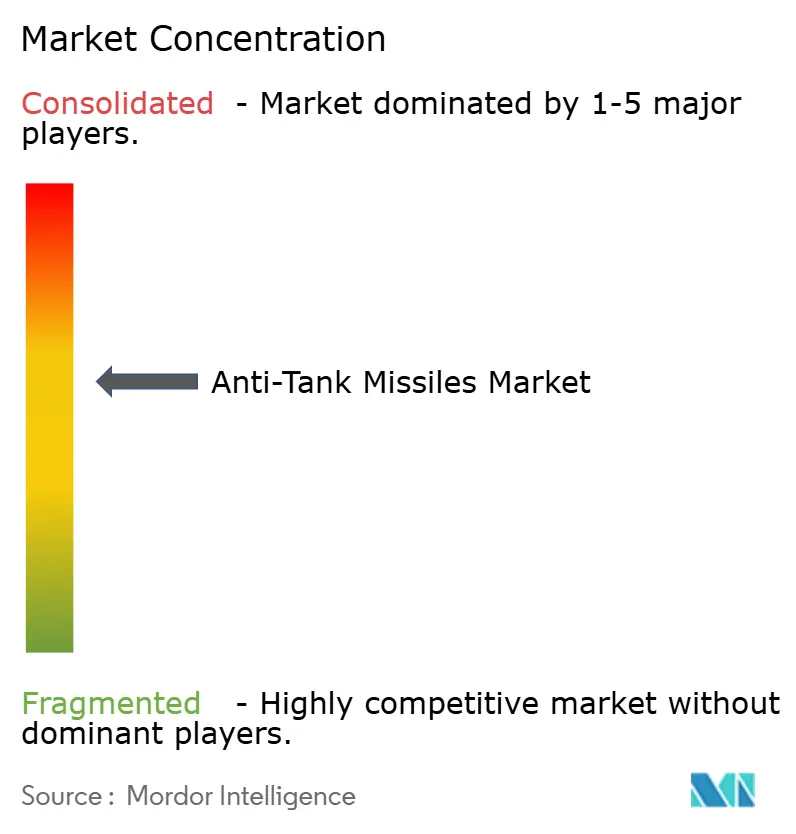
The anti-tank missiles market is moderately concentrated among suppliers with qualified systems, production capacity, and access to allied customers. The Javelin Joint Venture (RTX Corporation and Lockheed Martin Corporation), RAFAEL Advanced Defense Systems Ltd., MBDA, and Saab AB hold important positions in NATO-related programs. The Javelin Joint Venture secured a follow-on production contract with a ceiling of USD 900.50 million in September 2025 for missiles, equipment, and services. Qualification data, installed launchers, and Foreign Military Sales demand strengthen its position. RAFAEL's Spike family spans several versions and platforms, offering a broad product range. Long-standing support arrangements also influence buyer confidence after a missile purchase. Incumbents must invest in defeating active-protection systems and obtaining cross-platform certification to protect their position.
RAFAEL Advanced Defense Systems Ltd. continues to develop its active protection portfolio, and the Trophy system reached US Army Framework 2.0 compliance in May 2025. This move raises the capability challenge missile suppliers must address. Bharat Dynamics Limited is building its anti-tank portfolio around INVAR, Helina, Dhruvastra, and drone-launched products, with support from Indian procurement. The anti-tank missiles market also includes South Korean and Turkish suppliers that use domestic programs to establish export credibility. These producers are trying to combine local production, system integration, and lower-cost options. Their progress can widen the supplier base in markets where buyers seek industrial participation. Domestic orders help these companies gain manufacturing experience before competing for export contracts.
Competition is shaped by requirements that are difficult to meet together, including interoperability, advanced seekers, active-protection-system performance, and platform integration. These requirements favor companies with long test histories and substantial engineering resources. The anti-tank missiles market offers opportunities for new suppliers, especially in countries that prioritize local assembly or technology transfer. Suppliers must balance the need for high performance with buyers' affordability limits. Extended-range systems with strong protection against active defenses remain a challenging area for development in service. Successful firms will need credible test results and scalable production rather than only a new weapon design. This competitive structure supports moderate concentration while leaving room for state-backed emerging producers.
Anti-Tank Missiles Industry Leaders
-
Lockheed Martin Corporation
-
RTX Corporation
-
MBDA
-
Saab AB
-
RAFAEL Advanced Defense Systems Ltd.
- *Disclaimer: Major Players sorted in no particular order
Anti-Tank Missiles Market Companies Covered in this Report
- RAFAEL Advanced Defense Systems Ltd.
- Lockheed Martin Corporation
- RTX Corporation
- MBDA
- Saab AB
- Bharat Dynamics Limited
- Rheinmetall AG
- Israel Aerospace Industries Ltd.
- Roketsan A.S.
- LIG Nex1 Co., Ltd.
- Hanwha Aerospace Co., Ltd.
- NORINCO Group
- KBP Instrument Design Bureau
- Denel Dynamics (Denel SOC Ltd.)
- Diehl Defence GmbH and Co. KG (Diehl Group)
- Thales Group
Recent Industry Developments in Anti-Tank Missiles Market
- August 2026: Tata Advanced Systems Limited and the Javelin Joint Venture (JJV), a partnership between RTX Corporation and Lockheed Martin Corporation, signed a memorandum of understanding (MoU) to co-produce the Javelin All Up Round (AUR) in India. Under this MoU, Tata Advanced Systems Limited and the JJV will explore establishing a final assembly and integration facility for the Javelin AUR, as well as component production capabilities in India.
- July 2026: Lithuania's Armed Forces expanded their arsenal with a new batch of Spike LR2 anti-tank guided missiles, procured under a contract signed between Lithuania's Ministry of National Defense and German company EuroSpike GmbH. The latest delivery is valued at more than EUR 3 million (USD 3.36 million), bringing the total value of Spike LR2 missiles received by the Lithuanian military to more than EUR 11.5 million (USD 12.88 million).
- November 2025: The Indian MoD signed a contract with Bharat Dynamics Limited (BDL) for the procurement of INVAR Anti-tank Missiles at a total cost of INR 2,095.70 crore (USD 236 million) under the 'Buy (Indian)' category. The procurement of INVAR Anti-tank Missiles enhances the firepower and lethality of the T-90 tank, the mainstay of the Indian Army's armored regiments.
Global Anti-Tank Missiles Market Report Scope
The anti-tank missiles market comprises guided missile systems designed to detect, engage, and neutralize armored targets, including main battle tanks, infantry fighting vehicles, armored personnel carriers, and fortified positions, in military combat operations. The scope includes anti-tank missiles and associated launch and guidance systems supplied for new military acquisitions, stockpile replenishment, platform integration, and modernization programs across army, air force, and naval operations.
The anti-tank missiles market is segmented by product type, guidance type, range, end user, and geography. By product type, the market is segmented into man-portable, vehicle-mounted, and airborne anti-tank missiles. By guidance type, the market is segmented into wire-guided, laser-guided, infrared-guided, radio-frequency and datalink-guided, dual-mode and multi-mode guidance, and others. By range, the market is segmented into short range, medium range, long range, and extended range. By end user, the market is segmented into army and land forces, air forces, and naval forces. The report also covers the market sizes and forecasts for the anti-tank missiles market in major countries across different regions. For each segment, the market size is provided in terms of value (USD).
Segmentation Overview
| Man-Portable |
| Vehicle-Mounted |
| Airborne |
| Wire-Guided |
| Laser-Guided |
| Infrared-Guided |
| Radio-Frequency and Datalink-Guided |
| Dual-Mode and Multi-Mode Guidance |
| Others |
| Short Range |
| Medium Range |
| Long Range |
| Extended Range |
| Army and Land Forces |
| Air Forces |
| Naval Forces |
| North America | United States | |
| Canada | ||
| Mexico | ||
| Europe | United Kingdom | |
| France | ||
| Germany | ||
| Italy | ||
| Russia | ||
| Rest of Europe | ||
| Asia-Pacific | China | |
| India | ||
| Japan | ||
| South Korea | ||
| Australia | ||
| Rest of Asia-Pacific | ||
| South America | Brazil | |
| Argentina | ||
| Rest of South America | ||
| Middle East and Africa | Middle East | Saudi Arabia |
| United Arab Emirates | ||
| Israel | ||
| Rest of Middle East | ||
| Africa | South Africa | |
| Egypt | ||
| Rest of Africa | ||
| By Product Type | Man-Portable | ||
| Vehicle-Mounted | |||
| Airborne | |||
| By Guidance Type | Wire-Guided | ||
| Laser-Guided | |||
| Infrared-Guided | |||
| Radio-Frequency and Datalink-Guided | |||
| Dual-Mode and Multi-Mode Guidance | |||
| Others | |||
| By Range | Short Range | ||
| Medium Range | |||
| Long Range | |||
| Extended Range | |||
| By End User | Army and Land Forces | ||
| Air Forces | |||
| Naval Forces | |||
| By Geography | North America | United States | |
| Canada | |||
| Mexico | |||
| Europe | United Kingdom | ||
| France | |||
| Germany | |||
| Italy | |||
| Russia | |||
| Rest of Europe | |||
| Asia-Pacific | China | ||
| India | |||
| Japan | |||
| South Korea | |||
| Australia | |||
| Rest of Asia-Pacific | |||
| South America | Brazil | ||
| Argentina | |||
| Rest of South America | |||
| Middle East and Africa | Middle East | Saudi Arabia | |
| United Arab Emirates | |||
| Israel | |||
| Rest of Middle East | |||
| Africa | South Africa | ||
| Egypt | |||
| Rest of Africa | |||
Key Questions Answered in the Report
What is the projected value of anti-tank missiles in 2032?
The anti-tank missiles market is projected to reach USD 4.47 billion by 2032, growing at a 6.52% CAGR from 2027.
Which product type has the largest anti-tank missile demand?
Vehicle-mounted systems lead with 57.62% share in 2026 because armored formations need direct-fire capability integrated with ground platforms.
Which end user has the largest requirement for anti-tank missiles?
Army and land forces account for 73.89% of 2026 demand, reflecting their large vehicle-mounted and man-portable requirements across armored and infantry formations.
Why are extended-range anti-tank weapons gaining demand?
Extended-range systems are forecast to grow at an 8.15% CAGR because forces seek greater distance from armored targets and their defenses. These systems also support mounted, airborne, and coastal operations.
Which guidance technology is growing fastest?
Dual-mode and multi-mode guidance is forecast to grow at a 9.81% CAGR through 2032 as forces seek stronger performance against protected targets and disrupted operating conditions.
Which region has the highest growth forecast?
Asia-Pacific is forecast to grow at a 9.21% CAGR through 2032, supported by modernization and domestic programs in India, South Korea, Japan, and Australia.