
Ampoule Inspection Systems Market Size and Share
Market Overview
| Study Period | 2020 - 2031 |
|---|---|
| Market Size (2026) | USD 390.72 Million |
| Market Size (2031) | USD 543.51 Million |
| Growth Rate (2026 - 2031) | 6.82 % |
| Fastest Growing Market | Asia-Pacific |
| Largest Market | Europe |
| Market Concentration | Medium |
Major Players
*Disclaimer: Major Players sorted in no particular order Image © Mordor Intelligence. Reuse requires attribution under CC BY 4.0. |
|
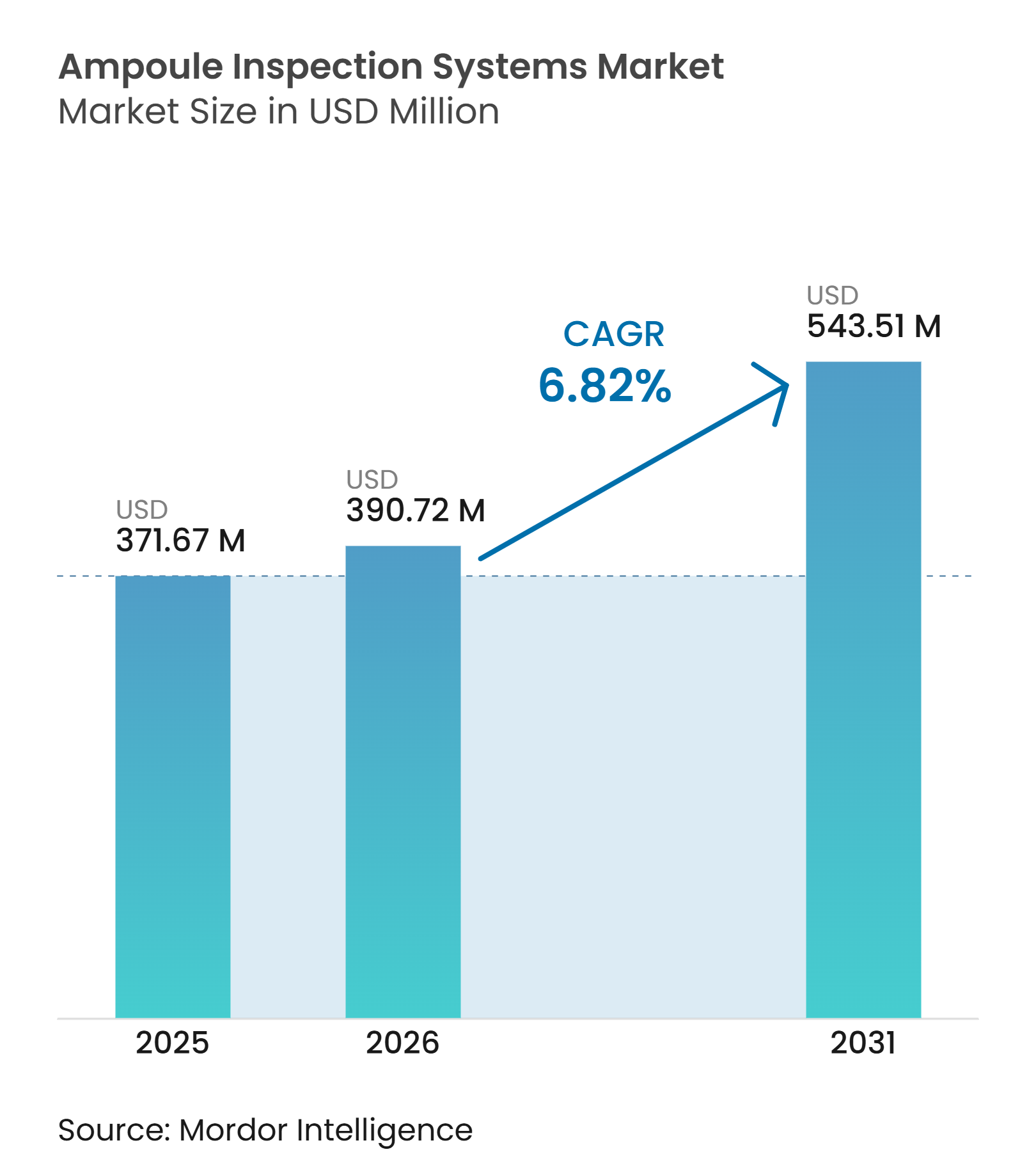
Ampoule Inspection Systems Market Analysis by Mordor Intelligence
The Ampoule Inspection Systems Market size is expected to increase from USD 371.67 million in 2025 to USD 390.72 million in 2026 and reach USD 543.51 million by 2031, expanding at a CAGR of 6.82% over 2026-2031. Investment in sterile fill-finish capacity supports demand because each new line needs qualified inspection equipment before commercial production. Regulatory expectations for container-closure integrity testing are also shifting procurement toward systems that combine visual inspection with deterministic testing. CDMOs are making more equipment decisions during facility design because sponsor clients assess quality readiness before awarding commercial work. Software capability is becoming more important in the Ampoule Inspection Systems Market, especially for recipe management, audit trails, cybersecurity, and integrated inspection data. High qualification costs and limited defect libraries for artificial intelligence slow adoption by smaller operators, even as large manufacturers and CDMOs increase investment.
Key Report Takeaways
- By inspection technology, vision-based systems held 43.21% of the Ampoule Inspection Systems Market share in 2025, while High-Voltage Leak Detection systems are projected to expand at a 7.14% CAGR through 2031.
- By automation level, fully automated systems held 68.79% revenue share in 2025 and are projected to expand at a 7.23% CAGR through 2031.
- By inspection stage, post-filling inspection held 63.78% revenue share in 2025, while final or pre-packaging inspection is projected to expand at a 7.41% CAGR through 2031.
- By end user, pharmaceutical manufacturers held 68.95% revenue share in 2025, while CMOs and CDMOs are projected to expand at a 7.52% CAGR through 2031.
- By geography, Europe held 32.76% of revenue in 2025, while Asia-Pacific is projected to expand at a 7.66% CAGR through 2031.
Note: Market size and forecast figures in this report are generated using Mordor Intelligence’s proprietary estimation framework, updated with the latest available data and insights as of January 2026.
Market Trends and Insights
Drivers Impact Analysis of Ampoule Inspection Systems Market*
| Driver | (~) % Impact on CAGR Forecast | Geographic Relevance | Impact Timeline |
|---|---|---|---|
| Expansion of Sterile Injectable Manufacturing | +1.7% | Global, with concentration in North America, Europe, and Asia-Pacific | Medium term (2-4 years) |
| Stricter Inspection and Container-Closure Integrity Expectations | +1.5% | Global, EU leads enforcement through Annex 1, United States follows through USP <1207> | Short term (≤ 2 years) |
| Shift Toward Fully Automated High-Throughput Inspection | +1.2% | North America and Europe, with rapid adoption in Asia-Pacific | Medium term (2-4 years) |
| Integration of Artificial Intelligence and Deep-Learning Vision | +0.9% | Global, with innovation clusters in Europe and Asia-Pacific | Long term (≥ 4 years) |
| Growth of Blow-Fill-Seal Ampoule Production | +0.7% | Global, Asia-Pacific and Europe lead new capacity additions | Medium term (2-4 years) |
| Retrofit Demand from Multi-Format Fill-Finish Lines | +0.5% | North America and Europe | Short term (≤ 2 years) |
| Source: Mordor Intelligence | |||
Expansion of Sterile Injectable Manufacturing
Sterile injectable capacity additions are creating direct demand for inspection systems at new fill-finish lines. Curia opened an expanded campus in Albuquerque in September 2026, featuring isolated filling lines with automated visual inspection and packaging technologies. PCI Pharma Services announced significant investments at its San Diego and Bedford campuses in April 2026, including sterile fill-finish capacity.[1] These investments place inspection decisions earlier in the facility planning process across the Ampoule Inspection Systems Market. This favors suppliers that can support equipment specification, qualification planning, and line integration before production starts. The Ampoule Inspection Systems Market benefits because inspection capability is now considered part of the core sterile manufacturing design.
Stricter Inspection and Container-Closure Integrity Expectations
EU GMP Annex 1 requires comprehensive integrity testing for fusion-sealed containers, including glass and plastic ampoules and blow-fill-seal units. The revised ECA Visual Inspection Working Group position paper distinguishes fusion-sealed containers from mechanically closed systems and clarifies the differing testing expectations.[2] The U.S. Food and Drug Administration published draft guidance on container closure systems in August 2026 that proposes a risk-based framework for quality assessment and control. These requirements make visual inspection alone insufficient for integrity assessment on fusion-sealed containers. High-Voltage Leak Detection becomes a necessary companion technology for ampoule lines operating under EU oversight. This compliance shift broadens the opportunity for integrated visual inspection and container-closure integrity testing platforms in the Ampoule Inspection Systems Market.
Shift Toward Fully Automated High-Throughput Inspection
Fully automated systems accounted for the majority of revenue and are projected to expand steadily during the forecast period. A recent ECA Visual Inspection Group survey found that most respondents still used manual visual inspection, while about half had deployed automated visual inspection systems. The same survey found that a majority of automated systems had to demonstrate performance equal to or better than manual inspection. Automated equipment provides consistent detection performance and electronic audit trails during multi-shift production in the Ampoule Inspection Systems Market. Manual inspection remains the reference method under pharmacopeial practice, so qualified human inspection continues to support validation. Syntegon launched its AIM platform with visual inspection and integrated container-closure integrity testing at high production throughputs.
Integration of Artificial Intelligence and Deep-Learning Vision
Artificial intelligence has limited current deployment in parenteral inspection, but manufacturers are preparing for wider use. An ECA member survey found that some respondents planned to adopt artificial intelligence in the near term. Deep-learning models can handle variable defect patterns that are difficult to manage with fixed rules. Their use also requires representative defect datasets, drift monitoring, controlled model versions, and documented change control. A scientific study reported high detection accuracy for YOLO-based surface defect detection in a multi-parameter transparent-container inspection platform. Brevetti CEA recently acquired Brevetti AI, illustrating how equipment suppliers are bringing artificial intelligence capabilities into their product portfolios. The Ampoule Inspection Systems Market will favor suppliers that can validate software and hardware as one controlled system.
Restraints Impact Analysis of Ampoule Inspection Systems Market*
| Restraint | (~) % Impact on CAGR Forecast | Geographic Relevance | Impact Timeline |
|---|---|---|---|
| High Validation and Format-Changeover Costs | -1.3% | Global, most acute for multi-product CDMO facilities in North America and Europe | Medium term (2-4 years) |
| Limited Availability of Ampoule-Specific Defect Libraries | -0.8% | Global | Long term (≥ 4 years) |
| Glass Breakage and Product-Handling Risk During High-Speed Inspection | -0.6% | Global | Short term (≤ 2 years) |
| Skilled-Service Constraints for Complex Inspection and CCIT Systems | -0.5% | Asia-Pacific and emerging markets | Long term (≥ 4 years) |
| Source: Mordor Intelligence | |||
High Validation and Format-Changeover Costs
Validation costs remain a significant constraint for facilities running multiple products in small batches across the Ampoule Inspection Systems Market. A validation-practices study found that a notable share of pharmaceutical manufacturers reported substantial validation costs as a portion of the total project budget. The study also reported that failed performance qualification cycles affected a considerable share of runs and added high costs for each repeat cycle. Ampoule lines require documented requalification when camera settings, lighting, transport parameters, or recipes change for a new diameter or fill volume. The burden is greatest for CDMOs and contract packaging organizations that operate numerous formats. Modular machines with automatic height adjustment and unified recipe management can reduce the work, but standardized format-agnostic validation frameworks are not yet established across jurisdictions.
Limited Availability of Ampoule-Specific Defect Libraries
Artificial intelligence models need defect examples that match the container geometry, fill color, lighting conditions, and defect patterns of each product. Manufacturers cannot readily pool these samples because contamination profiles are product-specific and traceability controls limit sharing. Each new format can therefore require a new defect library and extend automated qualification. A recent scientific study stated that original captured images alone were insufficient for deep-learning training when ampoule surface-defect samples were limited. The researchers used data augmentation and manipulated test ampoules to increase available training material. This requirement is especially difficult for smaller manufacturers and contract packaging organizations in the Ampoule Inspection Systems Market that lack the production volume to build statistically representative defect populations.
*Our forecasts treat driver/restraint impacts as directional, not additive. The impact forecasts reflect baseline growth, mix effects, and variable interactions.
Ampoule Inspection Systems Market Segment Analysis
By Inspection Technology:
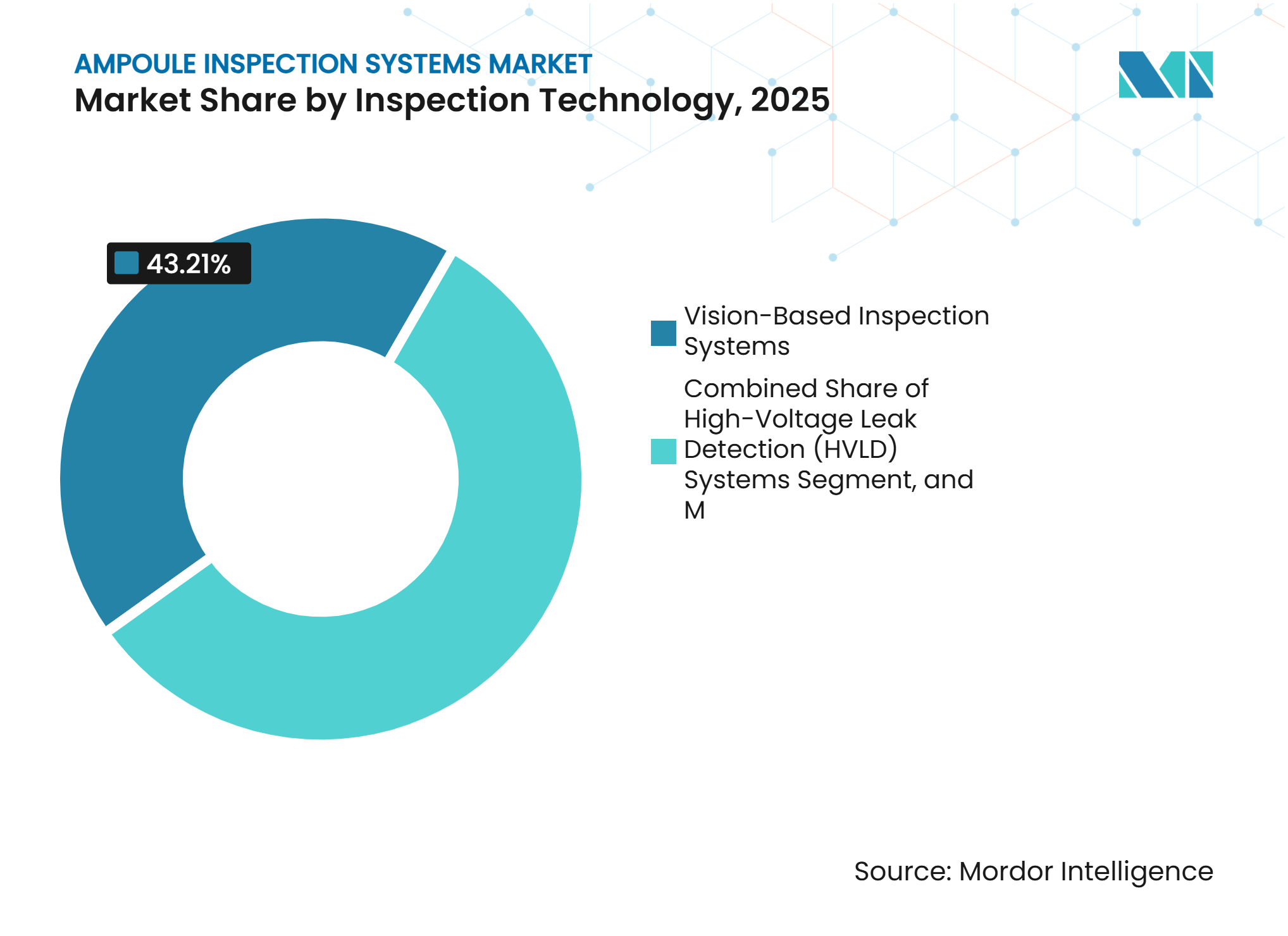
Vision Systems Lead While HVLD Raises the Compliance BaselineVision-based systems held 43.21% revenue share in 2025, the largest position within the Ampoule Inspection Systems Market. These systems inspect particulate contamination, cosmetic defects, fill level, and closure features during high-speed processing. Their installed base and accepted role in visual quality assessment have made them the common choice for many new lines. Suppliers are adding deep-learning modules and multi-camera arrangements that capture 12 or more images from different angles. High-Voltage Leak Detection systems are projected to expand at a 7.14% CAGR through 2031, reflecting the need for deterministic integrity testing on fusion-sealed containers.
Visual inspection cannot independently meet the integrity-testing expectation for fusion-sealed ampoules under Annex 1. Integrated platforms in the Ampoule Inspection Systems Market can perform visual inspection and HVLD at the same line speed, reducing the need for a separate testing footprint. Syntegon’s AIM9 combines visual inspection, container-closure integrity testing, optional HVLD, and headspace gas analysis in one modular platform.[3] Laser-based systems serve specialized uses, including headspace analysis for lyophilized products and nitrogen-filled ampoules. The Ampoule Inspection Systems industry is placing more value on secure software, audit-ready data, and integrated controls as inspection equipment becomes more connected.



By Automation Level:
Fully Automated Systems Combine Scale and DocumentationFully automated systems accounted for 68.79% of revenue in 2025 and are projected to expand at a 7.23% CAGR through 2031. This segment leads because high-speed lines require consistent inspection performance across extended operating periods. Automated machines reduce fatigue-related variability and create electronic audit trails needed for controlled production records. Their larger share in the Ampoule Inspection Systems Market reflects the combined importance of throughput and documentation. Semi-automated systems have a smaller role when commercial line speeds and compliance needs rise together.
Körber introduced its ALVA adaptive fully automatic inspection machine in May 2026 for high-mix, low-volume applications, including clinical trials, personalized therapies, and ATMP manufacturing. This expands the addressable role of automation in the Ampoule Inspection Systems Market for applications traditionally served by semi-automated equipment. Semi-automated systems remain relevant for batch-release reinspection and laboratory workflows. Manual and benchtop systems support method development, development-stage programs, and lower-volume facilities. A 2025 publication identified incremental learning as a possible way to incorporate new defect examples without retraining an entire inspection model.
By Inspection Stage:
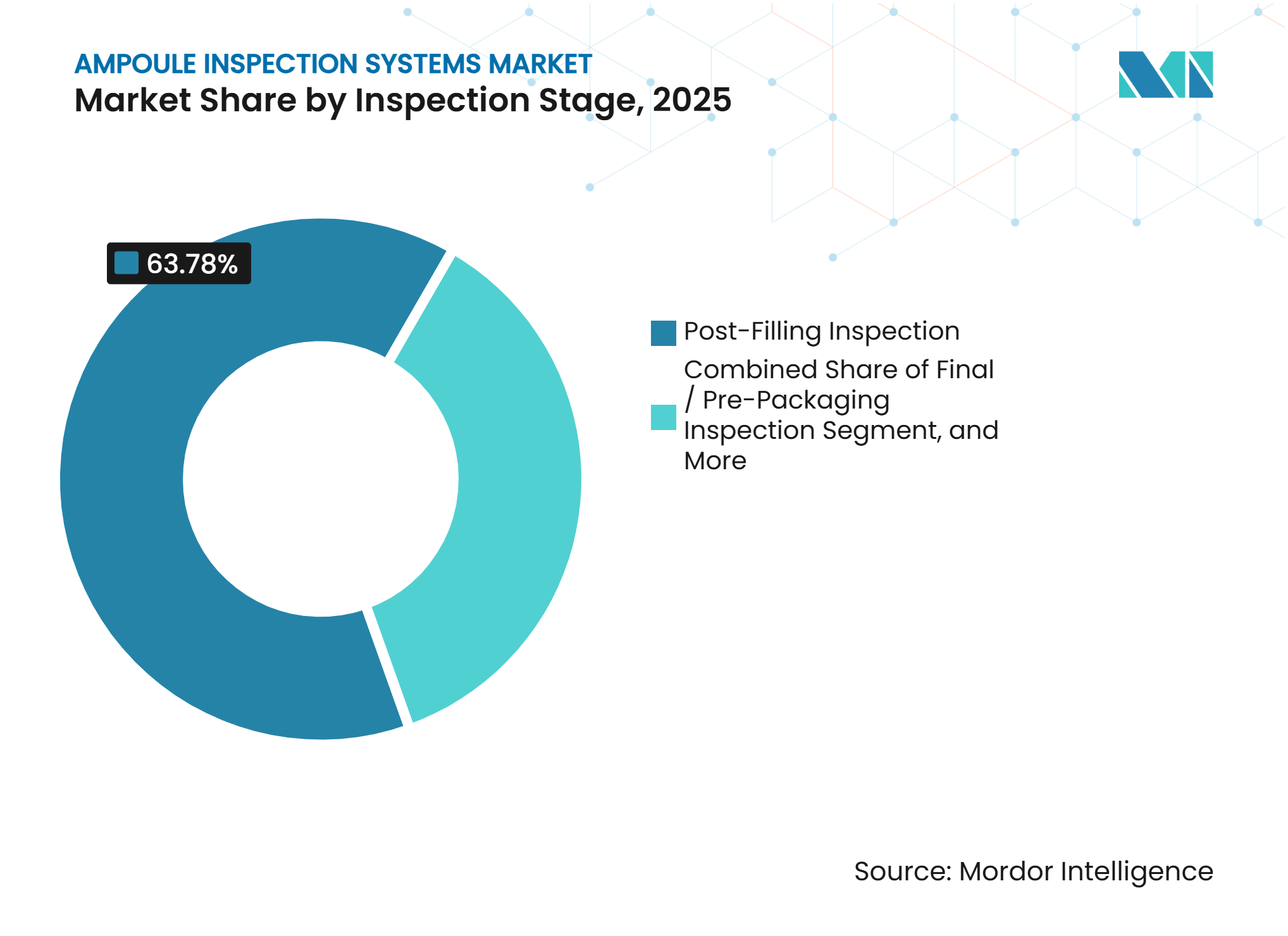
Post-Filling Leads as Final-Line Integration IncreasesPost-filling inspection held 63.78% revenue share in 2025, making it the largest inspection-stage segment of the Ampoule Inspection Systems Market. Filled and sealed ampoules are examined at this point for particles, fill volume, seal integrity, and cosmetic defects. A failed unit at this stage includes the value of upstream manufacturing inputs. This makes the stage a core quality gate regardless of facility size or product type. Final or pre-packaging inspection is projected to expand at a 7.41% CAGR through 2031.
The final or pre-packaging stage is gaining importance in the Ampoule Inspection Systems Market because track-and-trace and secondary packaging controls are becoming more integrated with inspection records. Antares Vision Group presented its INSPECTA software at Interpack 2026 as a unified interface for inspection capabilities and data management. Pre-filling and empty-ampoule inspection remain smaller in revenue, but they matter for high-value biologics and gene therapies. A 2025 scientific platform combined residual-stress, dimensional, and surface-defect measurements, delivering high dimensional accuracy and strong defect-detection performance. This approach can identify internal glass stress before filling and reduce the likelihood of downstream breakage.

By End User:
Pharmaceutical Manufacturers Lead While CDMOs Add New DemandPharmaceutical manufacturers held 68.95% revenue share in 2025, supported by established inspection lines for defined product-container combinations. These companies can manage extensive qualification programs and maintain dedicated quality teams. Their installed base supports demand for upgrades, software refreshes, and service in the Ampoule Inspection Systems Market. CMOs and CDMOs are projected to expand at a 7.52% CAGR through 2031. Their faster pace follows new sterile capacity projects and the added inspection complexity of multi-client operations.
PCI Pharma Services committed substantial investment to expansion across U.S. campuses in April, including a high-speed isolator filling line in San Diego and a vial and lyophilization line in Bedford. CDMOs must manage separate inspection recipes, batch records, and cross-contamination controls for each client program. Contract packaging and testing organizations support reinspection, incoming material checks, and method development in the Ampoule Inspection Systems Market. Catalent launched its Qai enterprise artificial intelligence quality management tool in June across its global manufacturing network. This makes data compatibility an additional purchasing consideration for inspection equipment buyers.
Geography Analysis
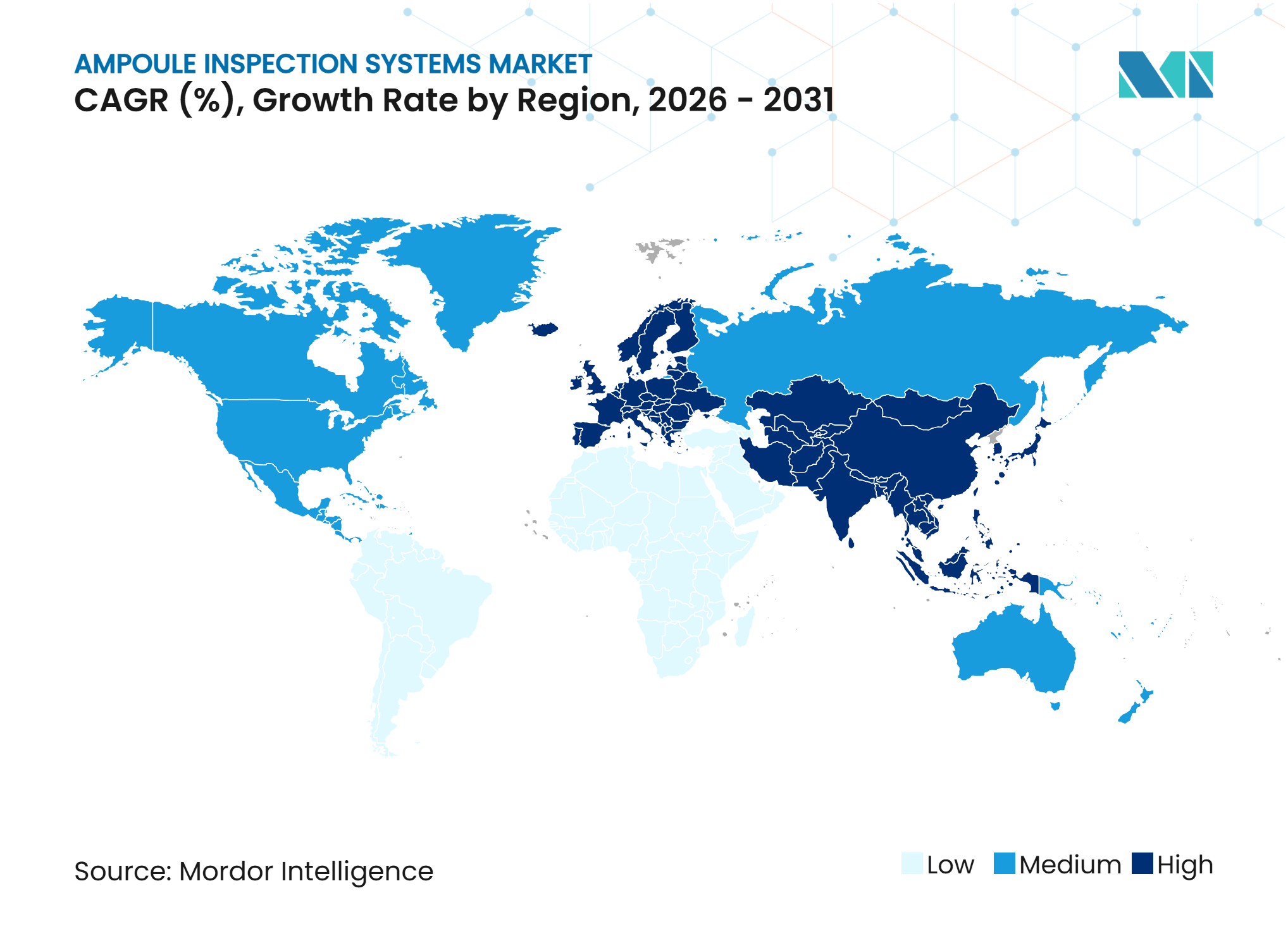
Europe held 32.76% of revenue in 2025, the largest regional position in the Ampoule Inspection Systems Market. The region combines a concentration of inspection equipment suppliers with strict sterile-manufacturing requirements. Germany and Italy host several companies with established platforms for ampoules and other parenteral containers. EU GMP Annex 1 has created a need for compliant inspection and integrity-testing capabilities. Aenova expanded sterile fill-finish capacity at its Latina site in Italy, adding a new isolator-based line with substantial annual production capacity.
Asia-Pacific is projected to expand at a 7.66% CAGR through 2031, the fastest regional rate in the Ampoule Inspection Systems Market. Capacity additions, export plans, and domestic demand for injectable therapies support equipment purchases across the region. Facilities that supply European markets need an inspection infrastructure that satisfies Annex 1 expectations. This encourages adoption of fully automated systems with integrated container-closure integrity testing instead of semi-automated configurations. Research teams in China are developing artificial intelligence-based inspection methods aligned with packaging-defect evaluation requirements.
North America remains an important demand center, supported by sterile manufacturing expansion and quality expectations for final-container inspection. PCI Pharma Services’ April 2026 expansion program adds high-speed sterile capacity in the United States. South America is a smaller developing opportunity centered on pharmaceutical production in Brazil and generic injectable production in Argentina. The Middle East and Africa remain at an earlier adoption stage, where inspection investment is primarily linked to export-market qualification. These regions look to EU and U.S. quality frameworks when making procurement choices.
Competitive Landscape
Market Concentration
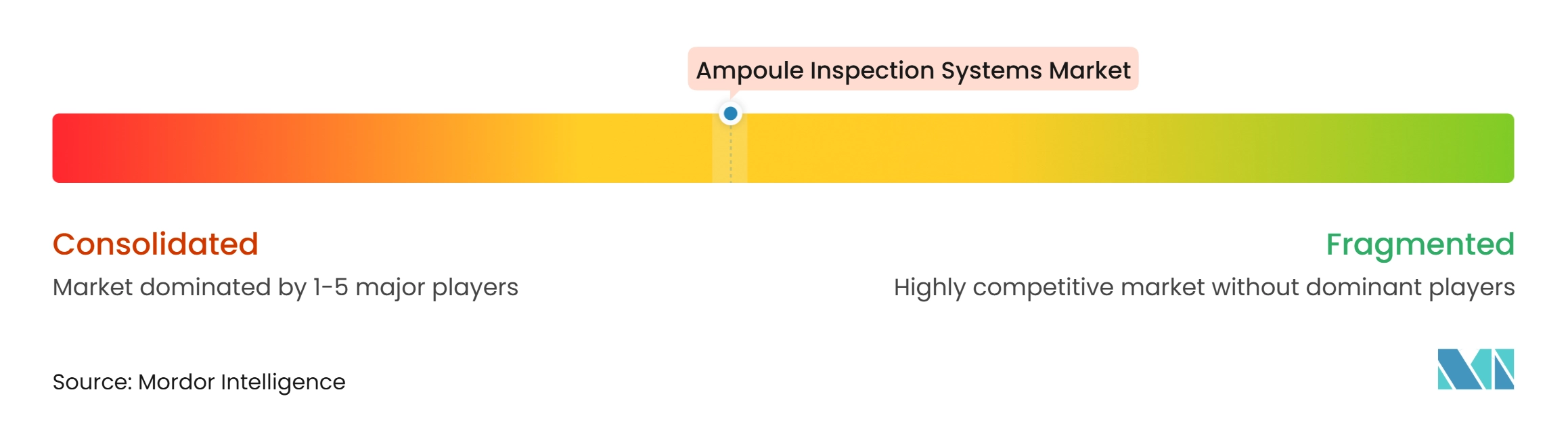
The Ampoule Inspection Systems Market has moderate concentration in the fully automated, high-speed tier. European original equipment manufacturers, especially those based in Germany and Italy, hold established positions through validated platforms, regulatory experience, and installed bases. Their customer relationships support recurring revenue from qualification services, maintenance, and software updates. Switching a validated inspection system during a product lifecycle is technically difficult and commercially disruptive. The mid-market is more fragmented, with regional specialists, machine-vision integrators, and HVLD-focused suppliers competing on flexibility, delivery time, and local service.
Leading companies are investing in artificial intelligence and modular equipment architecture. Brevetti CEA completed its acquisition of Brevetti AI in August 2025, adding proprietary deep-learning capability to its inspection portfolio. Syntegon launched AIM9 in February 2026 as a modular platform that supports ampoules, vials, syringes, and cartridges with integrated inspection technologies. Körber introduced ALVA in May 2026 for high-mix, low-volume pharmaceutical applications with automated changeovers. Antares Vision Group presented INSPECTA in May 2026 to bring inspection functions into a single software interface.
An AI-native HVLD interpretation layer that distinguishes micro-leak signatures from electrical noise remains a product gap. Quality management and cybersecurity requirements are also shaping design choices for networked equipment. Suppliers with integrated software and audit-ready data controls may have an advantage over hardware-only providers. The Ampoule Inspection Systems industry competes on validated performance, data capability, and long-term service support as much as machine speed.
Ampoule Inspection Systems Industry Leaders
-
Körber AG
-
Antares Vision Group
-
Stevanato Group S.p.A.
-
Syntegon Technology GmbH
-
Mettler-Toledo International Inc.
- *Disclaimer: Major Players sorted in no particular order
Ampoule Inspection Systems Market Companies Covered in this Report
- ACG
- Anritsu Corporation
- Antares Vision Group
- Brevetti CEA SpA
- Cognex Corporation
- CMP Phar.ma
- HEUFT SYSTEMTECHNIK GmbH
- Ishida Co., Ltd.
- Jekson Vision
- Keyence Corporation
- Korber AG
- Mettler-Toledo International Inc.
- Minebea Intec GmbH
- Omron Corporation
- OPTEL Group
- Robert Bosch GmbH
- Syntegon Technology GmbH
- Teledyne Technologies Incorporated
- Thermo Fisher Scientific Inc.
- WIPOTEC-OCS GmbH
Recent Industry Developments in Ampoule Inspection Systems Market
- September 2026: Syntegon presented OpaqView, a new inspection technology for opaque injectables, at the PDA Visual Inspection Forum 2026 in Dublin, using specialized cameras, advanced illumination, and software functions to detect particles in products that conventional visual inspection cannot reliably inspect, now available across all Syntegon automated inspection platforms after feasibility testing with multiple customer products.
- April 2026: Antares Vision Group debuted a new automatic visual inspection and leak detection system for prefilled syringes at Interphex NYC 2026, along with the Easy TB manual visual inspection unit for small-batch inspection of containers up to 100 mL including ampoules, with tool-free format changes achievable in under 1 minute.
- March 2026: Syntegon detailed the cocreation model underpinning the AIM9 platform, confirming that ongoing enhancements include AI integration, EU Cybersecurity Act compliance updates for software, and upgraded camera inspection systems to ensure platform future-readiness across regulatory cycles.
- February 2026: Syntegon launched the AIM9 high-speed inspection platform, combining automated visual inspection with container-closure leak detection. The platform supports throughput of up to 600 containers/minute and uses area-scan and line-scan cameras, with deep-learning-based defect classification.
Global Ampoule Inspection Systems Market Report Scope
The Ampoule Inspection Systems Market covers automated and semi-automated machines that visually and physically inspect glass ampoules used for injectable pharmaceuticals and biologics, detecting defects such as particulates, cracks, fill-level errors, seal issues, and cosmetic flaws to ensure product safety and regulatory compliance.
The Ampoule Inspection Systems Market Report is Segmented by Inspection Technology (Vision-Based Inspection Systems, High-Voltage Leak Detection (HVLD) Systems, Laser-Based Inspection Systems, Combination / Multimodal Inspection Systems, and Other Inspection Technologies), Automation Level (Fully Automated, Semi-Automated, and Manual/Benchtop), Inspection Stage (Pre-Filling, Post-Filling, and Final / Pre-Packaging), End-User (Pharma Manufacturers, CMOs/CDMOs, Contract Packaging/Testing, and Other End-Users), and Geography (North America, South America, Europe, Asia-Pacific, MEA). The Market Forecasts are Provided in Terms of Value (USD).
Segmentation Overview
| Vision-Based Inspection Systems |
| High-Voltage Leak Detection (HVLD) Systems |
| Laser-Based Inspection Systems |
| Combination / Multimodal Inspection Systems |
| Other Inspection Technologies |
| Fully Automated Systems |
| Semi-Automated Systems |
| Manual and Benchtop Systems |
| Pre-Filling / Empty Ampoule Inspection |
| Post-Filling Inspection |
| Final / Pre-Packaging Inspection |
| Pharmaceutical Manufacturers |
| CMOs / CDMOs |
| Contract Packaging / Testing Organizations |
| Other End-Users |
| North America | United States | |
| Canada | ||
| Mexico | ||
| South America | Brazil | |
| Argentina | ||
| Rest of South America | ||
| Europe | Germany | |
| United Kingdom | ||
| France | ||
| Italy | ||
| Spain | ||
| Rest of Europe | ||
| Asia-Pacific | China | |
| Japan | ||
| India | ||
| South Korea | ||
| ASEAN | ||
| Rest of Asia-Pacific | ||
| Middle East and Africa | Middle East | Saudi Arabia |
| Turkey | ||
| United Arab Emirates | ||
| Rest of the Middle East | ||
| Africa | South Africa | |
| Nigeria | ||
| Rest of Africa | ||
| By Inspection Technology | Vision-Based Inspection Systems | ||
| High-Voltage Leak Detection (HVLD) Systems | |||
| Laser-Based Inspection Systems | |||
| Combination / Multimodal Inspection Systems | |||
| Other Inspection Technologies | |||
| By Automation Level | Fully Automated Systems | ||
| Semi-Automated Systems | |||
| Manual and Benchtop Systems | |||
| By Inspection Stage | Pre-Filling / Empty Ampoule Inspection | ||
| Post-Filling Inspection | |||
| Final / Pre-Packaging Inspection | |||
| By End-User | Pharmaceutical Manufacturers | ||
| CMOs / CDMOs | |||
| Contract Packaging / Testing Organizations | |||
| Other End-Users | |||
| By Geography | North America | United States | |
| Canada | |||
| Mexico | |||
| South America | Brazil | ||
| Argentina | |||
| Rest of South America | |||
| Europe | Germany | ||
| United Kingdom | |||
| France | |||
| Italy | |||
| Spain | |||
| Rest of Europe | |||
| Asia-Pacific | China | ||
| Japan | |||
| India | |||
| South Korea | |||
| ASEAN | |||
| Rest of Asia-Pacific | |||
| Middle East and Africa | Middle East | Saudi Arabia | |
| Turkey | |||
| United Arab Emirates | |||
| Rest of the Middle East | |||
| Africa | South Africa | ||
| Nigeria | |||
| Rest of Africa | |||
Key Questions Answered in the Report
What is the ampoule inspection systems market size?
The market size is expected to increase from USD 390.72 million in 2026 to USD 543.51 million by 2031, at a CAGR of 6.82%.
Which inspection technology leads ampoule inspection?
Vision-based systems led with 43.21% revenue share in 2025 because they can assess particles, cosmetic defects, and fill levels at high line speeds.
Why is HVLD gaining adoption for ampoule lines?
HVLD is projected to expand at a 7.14% CAGR through 2031 because fusion-sealed containers require deterministic integrity testing under EU GMP Annex 1.
Which end users are increasing equipment purchases most quickly?
CMOs and CDMOs are projected to expand at a 7.52% CAGR through 2031 as sterile manufacturing is increasingly outsourced across multi-client facilities.
Which region is advancing most quickly?
Asia-Pacific is projected to expand at a 7.66% CAGR through 2031, supported by new capacity, export requirements, and adoption of automated inspection.
What limits wider artificial intelligence adoption in ampoule inspection?
Product-specific defect libraries, model validation, drift monitoring, and controlled software changes make artificial intelligence deployment difficult for smaller operators.