
Americas Polypropylene (PP) Films Market Size and Share
Market Overview
| Study Period | 2020 - 2031 |
|---|---|
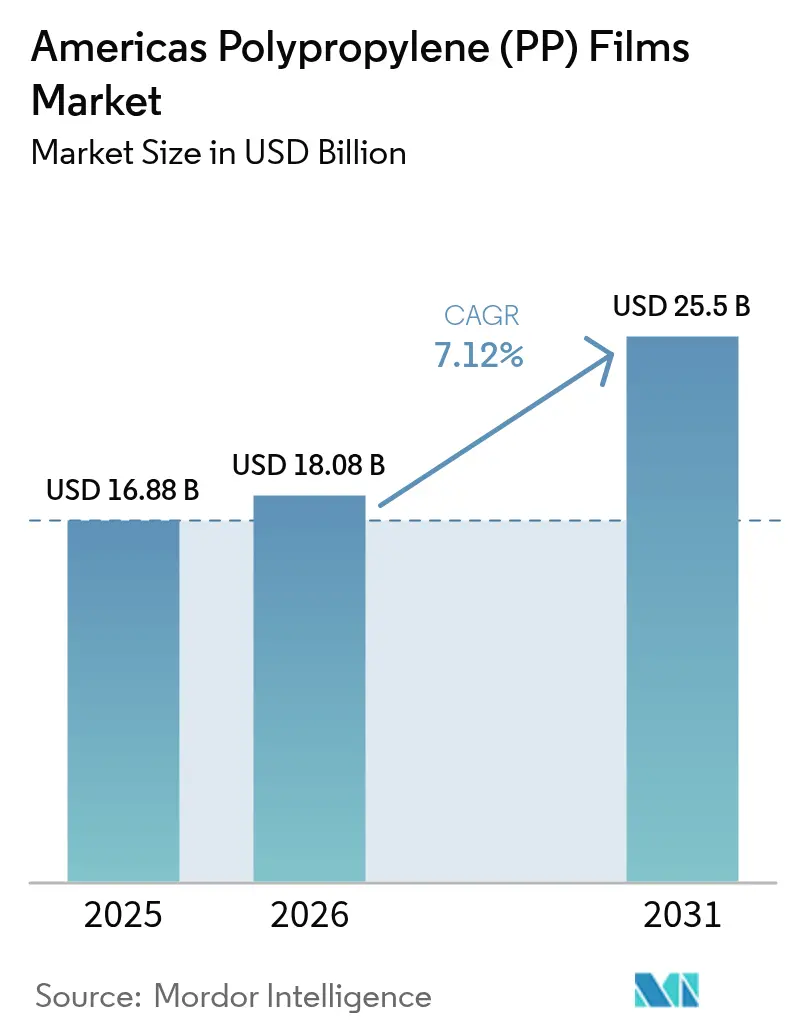
| Base Year Market Size (2025) | USD 16.88 Billion |
| Market Size (2026) | USD 18.08 Billion |
| Market Size (2031) | USD 25.5 Billion |
| Growth Rate (2026 - 2031) | 7.12 % |
| Fastest Growing Market | South America |
| Largest Market | North America |
Major Players *Disclaimer: Major Players sorted in no particular order Image © Mordor Intelligence. Reuse requires attribution under CC BY 4.0. | |
Americas Polypropylene (PP) Films Market Analysis by Mordor Intelligence
The Americas polypropylene films market size is expected to grow from USD 16.88 billion in 2025 to USD 18.08 billion in 2026 and is forecast to reach USD 25.5 billion by 2031 at 7.12% CAGR over 2026-2031. This growth stems from a decisive shift toward mono-material flexible packaging that protects products, preserves recycling compatibility, and meets increasingly stringent state sustainability requirements. Demand also rises as North American meal-kit and grocery e-commerce channels adopt high-barrier pouches that weigh less than rigid formats, cutting last-mile freight costs. Film producers are investing in silicon-oxide and aluminum-oxide barrier coatings that match the performance of polyethylene terephthalate at a lower resin expense, while pharmaceutical blister-pack converters are replacing polyvinyl chloride to meet phthalate-free mandates. Competitive intensity is elevated because integrated petrochemical firms are now backward-integrating into film production, narrowing margins for traditional converters and reinforcing the need for product differentiation through coatings, downgauging, and recycled-content certifications.
Key Report Takeaways
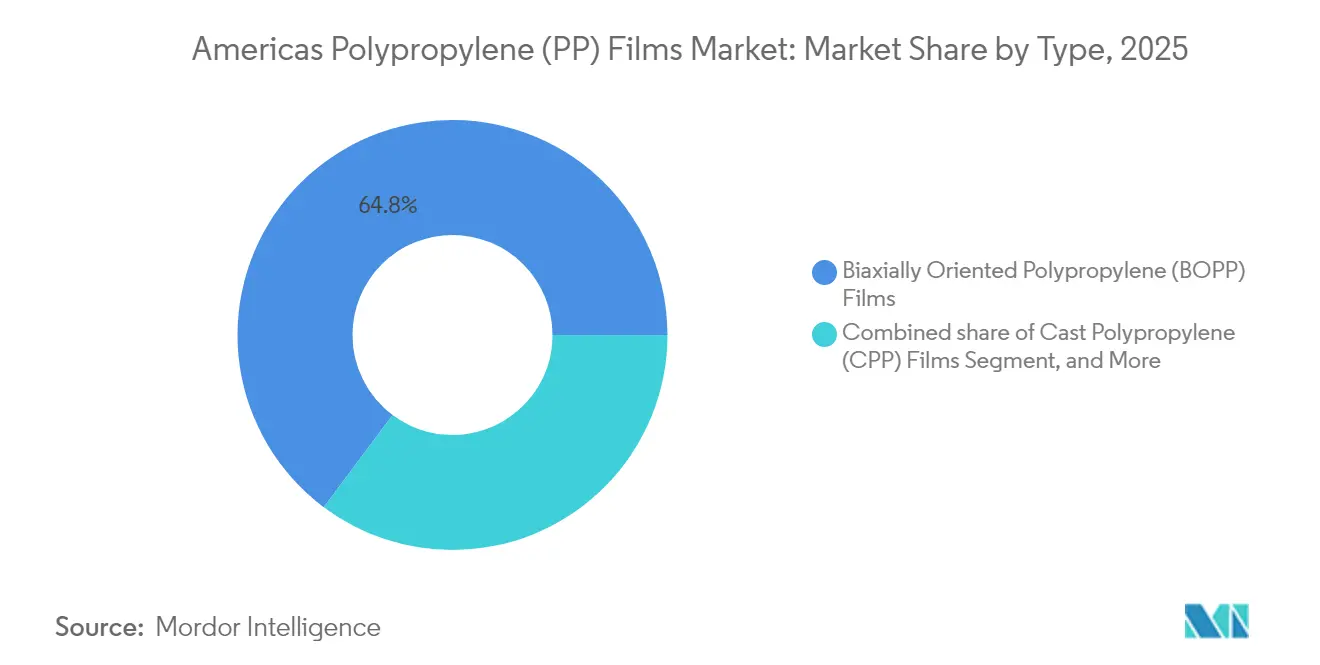
- By type, biaxially oriented polypropylene commanded 64.78% of volume in 2025, while cast polypropylene is expanding at an 8.18% CAGR through 2031.
- By thickness, the 20-40 micron range held 52.05% share in 2025; films below 20 microns are advancing at a 9.05% CAGR.
- By application, packaging accounted for a 67.65% slice in 2025, whereas laminated structures are forecast to grow at an 8.32% CAGR.
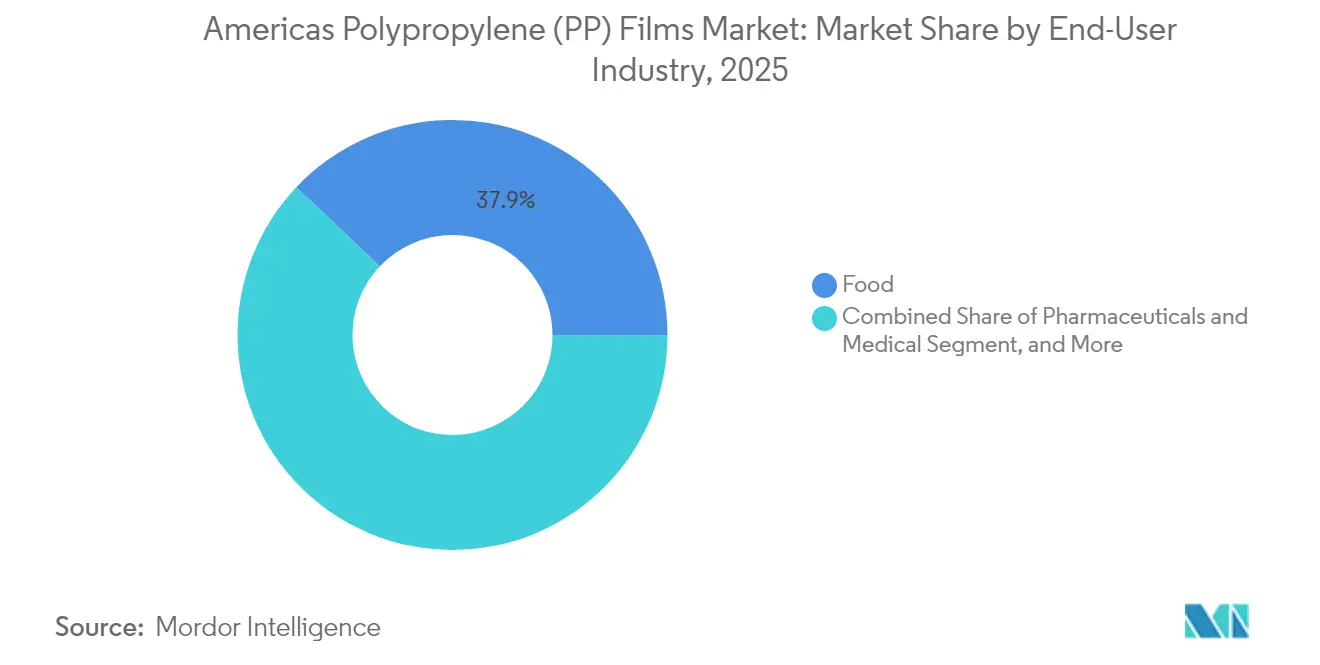
- By end-user, food consumption represented 37.94% of demand in 2025; pharmaceuticals and medical uses are rising at an 7.95% CAGR.
- By geography, North America captured 77.88% regional share in 2025; South America is projected to post an 8.01% CAGR to 2031.
Note: Market size and forecast figures in this report are generated using Mordor Intelligence’s proprietary estimation framework, updated with the latest available data and insights as of 2026.
Market Trends and Insights
Drivers Impact Analysis of Americas Polypropylene (PP) Films Market*
| Driver | (~) % Impact on CAGR Forecast | Geographic Relevance | Impact Timeline |
|---|---|---|---|
| Rapid Shift Toward Mono-Material Flexible Packaging Solutions | +1.8% | North America, with early adoption in Brazil and Argentina | Medium term (2-4 years) |
| Expansion of E-commerce Fresh Food Delivery Networks | +1.5% | North America urban corridors, expanding to São Paulo and Mexico City | Short term (≤ 2 years) |
| Increased Demand for High-Barrier Films in Sustainable Packaging | +1.4% | Global, with regulatory acceleration in California and Northeast U.S. | Medium term (2-4 years) |
| Replacement of PVC and PET with Polypropylene Films in Pharmaceutical Blister Packs | +1.2% | North America and Brazil pharmaceutical hubs | Long term (≥ 4 years) |
| Investment in Advanced Biaxially Oriented Lines by Latin American Converters | +0.9% | Brazil, Argentina, Chile, with spillover to Andean markets | Long term (≥ 4 years) |
| Rising Adoption of Recyclable Transparent Wraps by Quick-Service Restaurants | +0.7% | North America, concentrated in U.S. metropolitan statistical areas | Short term (≤ 2 years) |
| Source: Mordor Intelligence | |||
Rapid Shift Toward Mono-Material Flexible Packaging Solutions
Brand owners are collapsing multilayer laminates into single-polymer formats to meet design-for-recycling targets and avoid extended producer responsibility fees. Coveris and Borealis commercialized a mono-polypropylene pet-food pouch in 2024 that eliminates polyethylene tie layers and still passes drop-test protocols. [1]Coveris, “Launch of Mono-Material Pet-Food Pouches,” coveris.com Borouge and Siegwerk have released a compatible ink-adhesive system that delivers peel strengths of above 2 N per 15 mm while preserving the purity of the recycling stream. Fraunhofer research shows that laminates retain 85% of their tensile strength after three mechanical cycles, compared to 60% for polyethylene terephthalate blends. California regulations, effective in 2024, require 25% post-consumer content in single-use packaging by 2032, accelerating the adoption of these mono-structures. Together, these advances make the Americas polypropylene films market a preferred platform for closed-loop packaging programs.
Expansion of E-commerce Fresh Food Delivery Networks
Meal-kit and online grocery services are scaling cold-chain hubs that favor lightweight, puncture-resistant pouches. Metallized cast polypropylene delivers moisture barriers below 1 g m⁻² day⁻¹, crucial for condensation control in refrigerated cross-docks.[2]MDPI Coatings Journal, “Barrier Coating Advances on BOPP Films,” mdpi.com Flexible packs reduce shipping weight by 40% and cube utilization by 25%, trimming courier costs in dense cities. UFlex brought an 18,000 tpa line online in Mexico in H2 FY 2025 to supply U.S. fulfillment centers with rapid-turnaround custom prints. Reclosable zippers and fitment spouts laminated onto mono-material webs add consumer convenience without compromising recyclability. As subscription grocery penetration climbs, that functionality propels incremental square-meter demand in the Americas polypropylene films market.
Increased Demand for High-Barrier Films in Sustainable Packaging
Silicon-oxide and aluminum-oxide vapor deposition on biaxially oriented polypropylene reduces oxygen transmission by 65-fold, extending the shelf life of coffee and dried fruit by up to nine months. Aluminum-oxide coatings push OTR below 0.5 cc m⁻² day⁻¹, meeting stringent pharmaceutical blister specs. Fraunhofer’s ORMOCER hybrids add scratch resistance without impeding melt reprocessing, addressing converter concerns about line scuffing. California’s Circular Economy Act imposes a USD 0.25 per kg penalty on non-recyclable packs, making coated polypropylene more cost-effective than polyethylene terephthalate or polyvinyl chloride. These material gains safeguard the Americas polypropylene films market as brand owners balance barrier, weight, and recyclability objectives.
Replacement of PVC and PET with Polypropylene Films in Pharmaceutical Blister Packs
Amcor’s 2024 mono-polypropylene blister meets U.S. Pharmacopeia Class VI and outperforms polyvinyl chloride on moisture ingress, an advantage for hygroscopic drugs. TekniPlex’s dead-fold formulation yields crisp creases for push-through dispensing without delamination. SÜDPACK eliminated aluminum lidding by integrating a peelable sealant, cutting pack weight 30% and enabling stream-pure recycling. Health Canada guidance issued in 2024 on extractables testing tilts procurement toward inert polypropylene webs. These breakthroughs underpin a long-run CAGR lift for the Americas polypropylene films market as drug makers roll out phthalate-free unit doses.
Restraints Impact Analysis of Americas Polypropylene (PP) Films Market*
| Restraint | (~) % Impact on CAGR Forecast | Geographic Relevance | Impact Timeline |
|---|---|---|---|
| Volatile Propylene Feedstock Prices Linked to Shale Gas Dynamics | -1.3% | North America, with spillover to Latin American import-dependent markets | Short term (≤ 2 years) |
| Stringent Single-Use Plastic Regulations in Major U.S. States | -0.9% | California, Colorado, Maine, with adoption pending in New York and Washington | Medium term (2-4 years) |
| Supply Chain Disruptions from Regional Plant Outages | -0.6% | U.S. Gulf Coast, with cascading effects across North America | Short term (≤ 2 years) |
| Competition from Emerging Bio-Based and Biodegradable Film Alternatives | -0.5% | North America and Brazil, concentrated in food-service and agricultural applications | Long term (≥ 4 years) |
| Source: Mordor Intelligence | |||
Volatile Propylene Feedstock Prices Linked to Shale Gas Dynamics
Henry Hub spot prices fell to USD 2.27 per MMBtu in 2024 but spiked 15% during unplanned Gulf Coast outages, sending propylene references higher and squeezing converters locked into fixed-price film contracts. [3]U.S. Energy Information Administration, “Natural Gas and Propylene Price Dynamics 2024,” eia.gov INEOS declared force majeure in early 2024 after a compressor failure, while Winter Storm Enzo temporarily idled steam crackers in January 2025. Latin American extruders reliant on U.S. chemical exports paid import premiums that compressed spreads. Because resin accounts for 55-65% of finished-film cost, volatility discourages capital-intensive barrier-coating upgrades and can slow the Americas polypropylene films market in the short term.
Stringent Single-Use Plastic Regulations in Major U.S. States
California’s SB 54 rules, implemented in 2024, impose recycling-rate thresholds and escalating post-consumer content mandates, with fees up to USD 0.50 kg⁻¹ for non-recyclable packs. Colorado and Maine adopted similar extended-producer-responsibility laws, while New York and Washington draft comparable bills. Quick-service restaurants must redesign wrappers or absorb higher stewardship costs, cutting film order volumes until compliant designs are validated. Prohibitions on per- and polyfluoroalkyl substances further complicate coating chemistries. These overlapping state rules tighten margins for small converters and temper the Americas polypropylene films market growth outlook during the medium term.
*Our forecasts treat driver/restraint impacts as directional, not additive. The impact forecasts reflect baseline growth, mix effects, and variable interactions.
Americas Polypropylene (PP) Films Market Segment Analysis
By Type:
BOPP Strength Sustains, CPP Accelerates in PharmaBiaxially oriented grades retained 64.78% of 2025 volume, anchoring the Americas polypropylene films market with strong tensile strength and high gloss that suit snack, label, and tape applications. Producers stretch molten sheet in both machine and transverse directions, boosting modulus above 3 GPa and enabling 15 micron downgauging without puncture compromise. Converters overlay silicon-oxide to meet sub-1 cc m⁻² day⁻¹ oxygen targets for roasted coffee, displacing polyethylene terephthalate structures. Cast polypropylene is projected to grow at an 8.18% CAGR as pharmaceutical blister lines transition from polyvinyl chloride to comply with extractables rules and as aseptic pouches demand stronger seal integrity. Brazilian converters ordered wide-cast lines in 2024 to serve Mercosur drug makers, underscoring CPP’s rising strategic weight in the Americas polypropylene films market.
Rapid output additions in Mexico, Argentina, and the United States ease historic CPP shortfalls, yet BOPP remains the scale workhorse for labels, overwraps, and transparent snacks. Vitopel’s metallized BOPP capacity jump in 2024 lowered lead times for moisture-sensitive coffee bags, while North American converters qualified 30% recycled-content BOPP to meet brand sustainability targets. Niche oriented grades, such as capacitor films and holographic overlays, enjoy premium margins thanks to tight thickness tolerance and dielectric purity, but they combined represent less than 2% of Americas polypropylene films market share.



By Thickness:
Sub-20 Micron Films Lead Downgauging DriveFilms under 20 microns post a 9.05% CAGR because high-stiffness biaxial orientation enables brand owners to reduce resin mass while maintaining puncture resistance. Barrier-coated 12-micron webs deliver the same oxygen protection as 40-micron uncoated films, unlocking 40% material savings. The 20-40 micron slot held 52.05% share in 2025, favored for pharmaceutical blister thermoforming, heavy-duty industrial wraps, and form-fill-seal pouches that need caliper for seal integrity. Many blister lines are calibrated for 25-micron webs, and retrofitting for thinner gauges requires new heater plates and cooling racks that converters often defer.
Above 40 microns, polypropylene competes with oriented polyethylene for stiff freezer bags and with polyethylene terephthalate for transparent retort lids. Growth here is muted, yet the Americas polypropylene films market size for thick gauges holds steady because construction wraps and synthetic paper labels value tear and moisture resistance over weight. The anticipated migration of coffee and snack packs to 15-micron coated webs will continue to put pressure on mid-gauge output, prompting producers to invest in ultra-thin tenter frames and high-output winding systems.
By End-User Industry:
Food Dominates While Pharmaceuticals Gain MomentumFood processors absorbed 37.94% of 2025 demand, relying on gloss finish, printability, and moisture barrier for snacks, bakery wraps, and produce bags. Shelf-life extension tactics, such as nitrogen flushing, pair well with low-oxygen-transmission biaxially oriented films. Yet growth moderates as paper-based laminates attract dry cereal and powdered beverage applications looking for perceived eco-friendliness over oxygen performance. Pharmaceuticals and medical packaging are projected to register an 7.95% CAGR, driven by mono-material blister innovations that meet Health Canada and U.S. FDA guidelines on extractables while enhancing senior-friendly push-through strength. Drug makers adopt unit-dose formats for antibiotics and antihistamines, amplifying square-meter use even when pill count stays flat.
Beverage label converters seek shrink-sleeve and in-mold formats that conform to the curves of aluminum cans and polyethylene terephthalate bottles, while ensuring sortability at material recovery facilities. Industrial tapes, stretch wraps, and release liners exhibit stable but cyclical demand tied to construction starts and light-vehicle production. Personal-care sachets face regulatory risk in coastal U.S. states exploring single-use bans, yet multi-use refill pouches often employ high-barrier cast polypropylene, preserving some offset demand inside the Americas polypropylene films industry.
By Application:
Packaging Holds Pole Position, Laminations SurgePackaging represented 67.65% of 2025 consumption, encompassing form-fill-seal snack webs, stand-up pouches, and produce wraps. Downgauging to 15-micron coated films and the rise of reclosable formats sustain volume despite resin savings. Laminations are expected to rise at an 8.32% CAGR because converters overlay silicon oxide or aluminum oxide on polypropylene, replacing polyethylene terephthalate in retort pouches and aseptic drink cartons while preserving a mono-material status. Label and tape markets tap polypropylene’s print clarity and dielectric properties for consumer goods, logistics tracking, and electrical insulation.
Specialty graphics, holographic gift wraps, and book-cover overlays account for modest but high-margin niches, fetching prices three to five times the rates of commodity film. Capacitor dielectrics, synthetic paper, and agricultural mulch use thicker, highly oriented films tailored for electrical strength or ultraviolet resistance. The Americas polypropylene films market size in laminated structures is poised for above-trend expansion as barrier-coating adoption deepens and as converters reply to extended producer responsibility mandates by shifting away from multi-polymer stacks.
Geography Analysis
North America Polypropylene (PP) Films Market
North America secured 77.88% of 2025 revenue, buoyed by dense food-processing clusters, a robust pharmaceutical pipeline, and widespread e-commerce fulfillment networks. Integrated feedstock supply from Gulf Coast crackers into Midwestern and Southeastern film extrusion hubs stabilizes logistics and enables lean inventories. California’s 2024 stewardship-fee framework accelerates mono-material redesigns, prompting converters to qualify recyclable coatings ahead of 2030 content thresholds. Canada’s dairy and bakery sectors sustain steady demand, while Mexico’s near-shoring boom channels automotive and medical packaging orders to polypropylene film plants certified under Good Manufacturing Practice standards.
South America Polypropylene (PP) Films Market
South America yields an 8.01% CAGR between 2026 and 2031, outperforming the region, as Brazil and Argentina add biaxially oriented and cast lines. Vitopel’s 2024 metallizer startup raised output 40%, winning snack-food and coffee-roaster contracts that need shiny oxygen barriers. Argentina’s blister-pack market moves toward mono-polypropylene to harmonize with Mercosur rules favoring phthalate-free materials. Chile, although smaller, increases seafood-pouch uptake, leveraging polypropylene’s low temperature crack resistance for frozen salmon exports.
The Americas Polypropylene (PP) Films Market
Mexico’s role as a duty-free platform under the United States-Mexico-Canada Agreement intensifies, with multinational consumer-goods firms relocating packaging operations from Asia to cut lead times and tariff exposure. Rest-of-South-America markets such as Colombia and Peru show moderate uptake tied to urban retail expansion but face currency-driven resin-cost swings because they import U.S. propylene. Overall, growing intra-Americas trade and fresh foreign direct investment maintain a diversified demand base for the Americas polypropylene films market.
Regulatory Landscape
In the United States, polypropylene used in food-contact packaging is covered under the US FDA framework for indirect food additives, with polypropylene authorized under 21 CFR 177.1520 (olefin polymers). This compliance baseline supports continued use of BOPP and CPP in snacks, bakery products, and other packaged foods, where converters also manage additive and stabilizer selections consistent with applicable FDA clearances.
In Canada, Environment and Climate Change Canada is implementing the Federal Plastics Registry under CEPA, requiring producers to report quantities of plastic packaging (including PP) placed on the Canadian market. Initial reporting is tied to 2024 data due in 2025, with annual submissions following thereafter. In Mexico, the third phase of the NOM-051-SCFI/SSA1-2010 nutrition labeling requirements began on January 1, 2026, adding compliance and artwork change cycles for converters supplying prepackaged food brands. These changes can shift print-laminate demand patterns and increase changeover frequency in PP film-based structures.
Value Chain Analysis
The value chain starts with propylene monomer production and polymerization into PP resin, followed by film manufacturing through biaxial orientation (BOPP, typically using tenter-frame processes with sequential MDO and TDO) or flat-die extrusion for CPP. Film makers then move into surface treatment and upgrading steps such as metallization and barrier or functional coatings, while downstream converters handle printing, lamination, slitting, and pouch or overwrap formation for food, pharmaceutical, industrial, and other end users.
Across the Americas, supply reliability and cost depend heavily on resin sourcing logistics and proximity to North American feedstock systems, with distribution often supported by rail and cross-border trucking into Mexican manufacturing clusters. Differentiation increasingly concentrates at the converter and specialty-film stages, particularly coated BOPP, high-barrier mono-material laminations, and recycled-content verified structures. Regional manufacturing participants such as Inteplast Group, Profol Americas, Copol International, and ViAM Films illustrate how film production and, in some cases, upgraded offerings align with brand-owner sustainability requirements.
Competitive Landscape
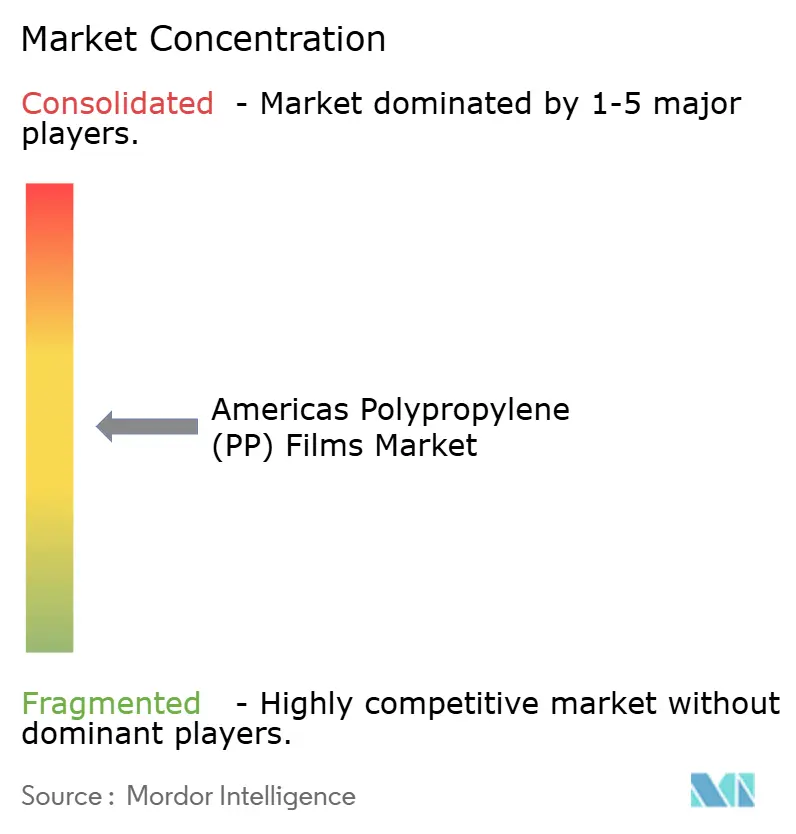
Integrated propylene suppliers, such as Braskem and INEOS, exploit feedstock leverage to price aggressively during oversupply cycles, challenging stand-alone film extruders. Taghleef Industries coordinates global asset loads to cover regional outages, while Jindal Films Americas channels corporate research resources into dielectric and holographic grades that carry premium margins. Inteplast Group’s 2024 ISCC PLUS certification across three U.S. plants allows mass-balance crediting of bio-attributed feedstocks, meeting brand sustainability pledges and differentiating bids.
Niche converters focus on ultra-thin gauges below 12 microns or complex barrier laminations where expertise and capital barriers shelter margins. Private-equity activity intensifies, as Industrial Opportunity Partners acquired specialty converter Transcendia in May 2024, funding expansion into capacitor film and holography segments. Latin American players add wide tenter frames and metallizers to capture value in snack and coffee exports, while North American plants integrate plasma treater upgrades to improve ink adhesion on recycled-content substrates. With regulatory pressure favoring mono-material designs, coating and metallization capabilities become decisive competitive weapons in the Americas polypropylene films industry.
Americas Polypropylene (PP) Films Industry Leaders
Altopro S.A. de C.V.
Oben Holding Group S.A.
Taghleef Industries LLC
Toray Plastics (America), Inc.
Inteplast Group Corporation
- *Disclaimer: Major Players sorted in no particular order
Americas Polypropylene (PP) Films Market Companies Covered in this Report
- Taghleef Industries LLC
- Toray Plastics (America), Inc.
- Jindal Films Americas LLC
- Oben Holding Group S.A.
- Cosmo Films Ltd.
- Inteplast Group Corporation
- Amcor plc
- CCL Industries Inc. (Innovia Films)
- Uflex Limited
- Sigma Plastics Group
- Vitopel Group
- Profol Inc.
- Treofan Americas
- Altopro S.A. de C.V.
- Copol International Ltd.
- Poligal S.A.
- Cheever Specialty Paper and Film
- Polibak Plastic Film Industry Inc.
Read Analysis of Americas Polypropylene (PP) Films Companies

Market Opportunities and Future Outlook
A whitespace is emerging around scalable BOPP capacity additions in South America, paired with barrier and sustainability upgrades that preserve mono-material recyclability. In June 2026, Oben Group signed an agreement for a 12-meter BOPP line in Brazil with about 94,000 metric tons of annual capacity, increasing local supply options for snack, coffee, and export-oriented packaging where metallization and high-barrier performance are buying criteria.
Recycled-content and circular PP pathways are becoming more practical for high-performance PP films, supporting opportunities for film makers and converters that can qualify PCR or bio-circular feedstocks while meeting food and pharma requirements. In June 2026, PureCycle Technologies and Innovia Films reported successful production and trial evaluation of a white, cavitated BOPP film with more than 40% PCR content using PureFive Choice resin, and in February 2026, PureCycle and Toppan partnered to develop recycled-PP solutions for flexible films and thermoforming, including a snack bar wrapper with over 30% recycled content. On the converting side, PPC Flex completed the acquisition of SUDPACKs United States operations in January 2026, expanding its flexible film and pouch manufacturing footprint, while suppliers such as Braskem America introduced bio-circular polypropylene under the WENEW portfolio for packaging applications to broaden inputs for mass-balance or circular-content product lines.
Recent Industry Developments in Americas Polypropylene (PP) Films Market
- June 2026: Oben Group signed an agreement for a new 12-meter BOPP film production line for Brazil with around 94,000 metric tons of annual capacity. The investment expands large-scale regional output for packaging film applications and improves local access to high-volume, high-efficiency biaxial orientation capability. It also strengthens South American supply options for converters serving snack and coffee brands that specify metallized or upgraded BOPP structures.
- January 2026: Taghleef Industries completed the acquisition of Treofan, a specialist in BOPP films previously owned by the Jindal conglomerate. The deal adds assets and know-how in higher value BOPP segments, supporting broader product coverage and supply continuity for brand owners and converters buying specialty OPP films. Integration also reinforces competitive pressure on independent producers that lack scale or differentiated surface and barrier capabilities.
- October 2024: Vitopel installed a Bobst Expert K5 metallizer, increasing metallized BOPP capacity by 40% for snack-food and coffee customers in Brazil and Argentina. The upgrade improves lead times and supports higher-barrier, shelf-life-driven packaging formats that rely on metallized PP webs. It also increases local capability for export-oriented brands that require consistent barrier performance and print-ready substrates.


Americas Polypropylene (PP) Films Market Report Scope and Research Methodology
Market Definition and Coverage
For this study, the market covers the value of polypropylene films sold and used across the Americas, where demand is tied to film consumption in packaging and related converting uses. The sizing reflects PP film grades commonly supplied as BOPP, CPP, and other PP film formats.
Scope exclusions: We exclude non-PP films (such as PE, PET, and PVC) and count only PP film value, not the value of packaged goods or downstream converting services.
Segments Covered in This Report
- By Type
- Biaxially Oriented Polypropylene (BOPP) Films
- Cast Polypropylene (CPP) Films
- Shrink Polypropylene (SPP) Films
- Other Types
- By Thickness
- Below 20 Microns
- 20 - 40 Microns
- Above 40 Microns
- By End-User Industry
- Food
- Beverage
- Pharmaceuticals and Medical
- Industrial
- Personal Care and Cosmetics
- Other End-User Industries
- By Application
- Packaging
- Labelling and Tapes
- Laminations
- Graphics and Overlays
- Other Applications
- By Geography
- North America
- United States
- Canada
- Mexico
- South America
- Brazil
- Argentina
- Chile
- Rest of South America
- North America
Data Sources, Market Sizing, and Validation
Desk Research
Desk research started with mapping the PP film supply chain and the demand pool in the Americas, so that the same product boundary is followed from resin conversion through film shipments to end-use pull. We relied on public and official sources such as USITC DataWeb, UN Comtrade, the US Census Bureau, and national statistics releases from Canada, Mexico, and key South American countries to sense-check trade flows and packaging activity.
To avoid building the model on a single data stream, we also reviewed sources such as association publications on flexible packaging and plastics, peer-reviewed polymer and packaging journals for performance trends (for example barrier and downgauging), and company filings and investor presentations for capacity additions and utilization commentary. Where needed, we referenced paid subscriptions for company financials and intelligence, patent databases, and shipment-level import/export databases to fill gaps on plant footprints and product positioning. The sources listed above are illustrative, and many other public and subscription sources were also used to collect data, validate assumptions, and clarify scope.
Primary Interviews and Surveys
Primary work focused on validating what drives PP film demand by application and how pricing moves with resin costs, film thickness mix, and barrier requirements. We spoke with a mix of film producers, converters, packaging buyers, and distribution participants across the Americas so that model assumptions were checked against procurement cycles and capacity realities. When inputs looked inconsistent across sources, respondents were re-contacted to confirm whether the changes came from mix shifts, contract resets, or temporary inventory swings.
Distribution of primary research fieldwork respondents
| Company type | Respondent position |
|---|---|
| Top tier: 29% | CXOs: 13% |
| Mid tier: 57% | Functional/Unit leaders: 38% |
| Smaller Players: 14% | Managers: 49% |
Market-Sizing & Forecasting
The core sizing logic uses a top-down build that reconstructs PP film demand from packaging activity and film conversion needs across the Americas, then allocates value using typical price bands by film type and thickness. The model was then cross-checked with selective bottom-up approximations, such as rolling up supplier revenue cues where disclosures exist and using sampled price times volume checks for key applications. Totals were adjusted only when multiple signals pointed in the same direction.
Inputs used in the market model included indicators such as flexible packaging demand momentum, the mix of BOPP versus CPP versus specialty PP films, thickness mix shifts (below 20 microns, 20 to 40 microns, and above 40 microns), resin price direction and pass-through timing, and trade flows for films and related packaging materials. Where a data point was missing for a country or application, we used proxy indicators like packaging production trends and import dependence to close the gap, followed by interviews to confirm that the proxy matched local buying patterns.
For forecasting, scenario analysis was applied so the outlook could reflect different paths for resin costs, downgauging speed, and demand from food and consumer packaging. The final growth path was selected after checking that the implied volume and price movement stayed realistic to the capacity and procurement feedback gathered during primary discussions.
Data Validation & Update Cycle
Validation was done in layers, where the model outputs were checked against independent demand signals like packaging activity trends, trade direction, and known capacity moves before a final number was signed off. If a country-level result moved too sharply versus its historical pattern, the assumptions were revisited and the supporting sources were rechecked, followed by another round of targeted expert follow-ups when required.
Each estimate goes through stepwise analyst reviews that focus on unit consistency, price and mix logic, and whether the regional split matches the known market structure across North and South America. Reports are refreshed annually, and interim updates are made when material events occur, such as major capacity additions, trade disruptions, or sustained resin price shocks. Before delivery, a final pass is completed so clients receive the most current view that still stays consistent with the documented scope and assumptions.
Mordor Intelligence's Americas Polypropylene Pp Films Market Size Compared Against Other Published Estimates
Published market sizes for PP films in the Americas can vary more than buyers expect, even when the topic sounds the same. The main reasons usually come down to how film categories are grouped, whether values are counted at film sales or downstream packaging value, and how pricing is translated into USD across different base years.
By tracking thickness mix, resin-linked pricing resets, and trade-flow sanity checks, Mordor Intelligence keeps the 2025 value tied to PP film sales in the Americas, instead of mixing in non-PP packaging films or the value of converting and packaging operations, which can inflate totals.
Benchmark comparison
| Source | Market Size | Gaps in Research Methodology |
|---|---|---|
| Mordor Intelligence | USD 16.88 B (2025) | |
| Trade Journal A | USD 25.50 B (2031) | This number is presented as a forecast end-year value, so it is not directly comparable to a current-year estimate unless the same year is aligned and the same PP film-only scope is maintained. |
| Industry Portal B | USD 135.00 B (2025) | The figure likely uses a much wider scope (for example, broader packaging materials or packaging value), and it is not clear how PP film-only boundaries, price assumptions, and currency timing were validated. |
The table points to year mismatch and scope expansion as the biggest drivers of spread, rather than small modeling differences. When the unit of measure stays at PP film value and the year is matched, the total remains traceable to repeatable inputs like thickness mix, resin pass-through timing, and end-use packaging pull.


Key Questions Answered in the Report
How large is polypropylene film demand in the Americas in 2026?
The Americas polypropylene films market size is USD 18.08 billion in 2026 and is forecast to grow at a 7.12% CAGR over 2026-2031.
Which film type leads regional consumption?
Biaxially oriented polypropylene accounts for 64.78% of 2025 volume because its high stiffness and clarity suit snacks, labels, and tapes.
What segment delivers the fastest growth to 2031?
Cast polypropylene films expand at an 8.18% CAGR through 2031, propelled by pharmaceutical blister-pack substitution of PVC and polyethylene terephthalate.
Why are thin-gauge films gaining share?
Sub-20 micron webs cut resin weight by up to 40% while barrier coatings maintain shelf life, enabling logistics savings for e-commerce fresh food shipments.
How will U.S. state regulations influence demand?
California, Colorado, and Maine stewardship fees, active from 2024, accelerate adoption of recyclable mono-material packs but raise compliance costs for non-conforming films, moderating short-term growth.
Which region in the Americas is growing fastest?
South America is expected to post an 8.01% CAGR through 2031 as Brazil and Argentina add new biaxially oriented and cast lines to serve food and pharmaceutical exporters.
Page last updated on:


 Your data is secure and never sold or shared.


