
Aluminum Brazing Market Size and Share
Market Overview
| Study Period | 2022 - 2032 |
|---|---|
| Market Size (2027) | USD 2.26 Billion |
| Market Size (2032) | USD 2.89 Billion |
| Growth Rate (2027 - 2032) | 5.06 % |
| Fastest Growing Market | Asia-Pacific |
| Largest Market | Asia-Pacific |
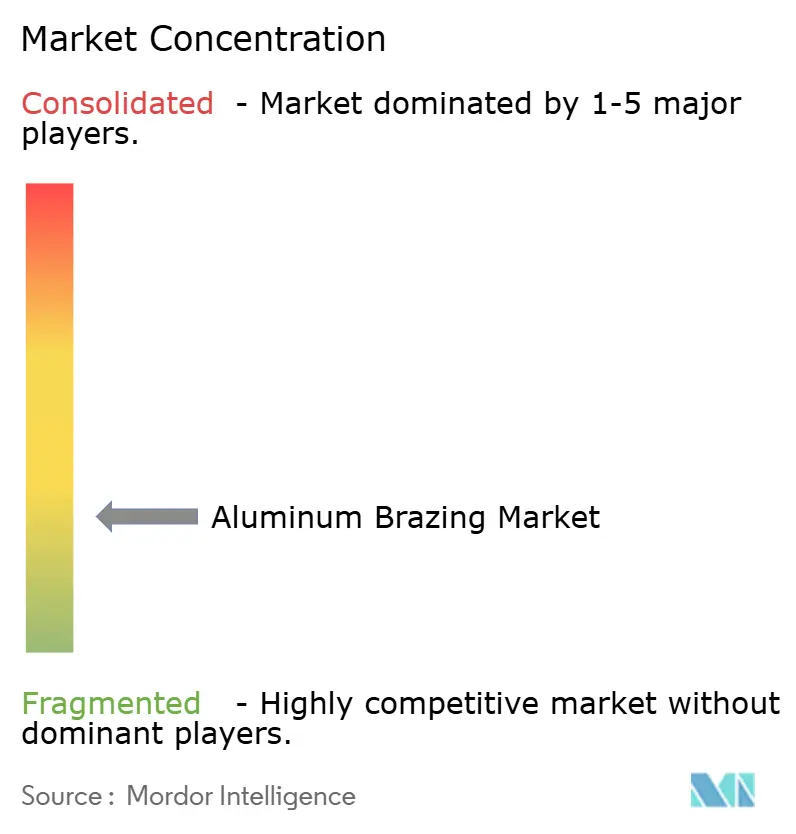
| Market Concentration | Low |
Major Players *Disclaimer: Major Players sorted in no particular order Image © Mordor Intelligence. Reuse requires attribution under CC BY 4.0. | |
Aluminum Brazing Market Analysis by Mordor Intelligence
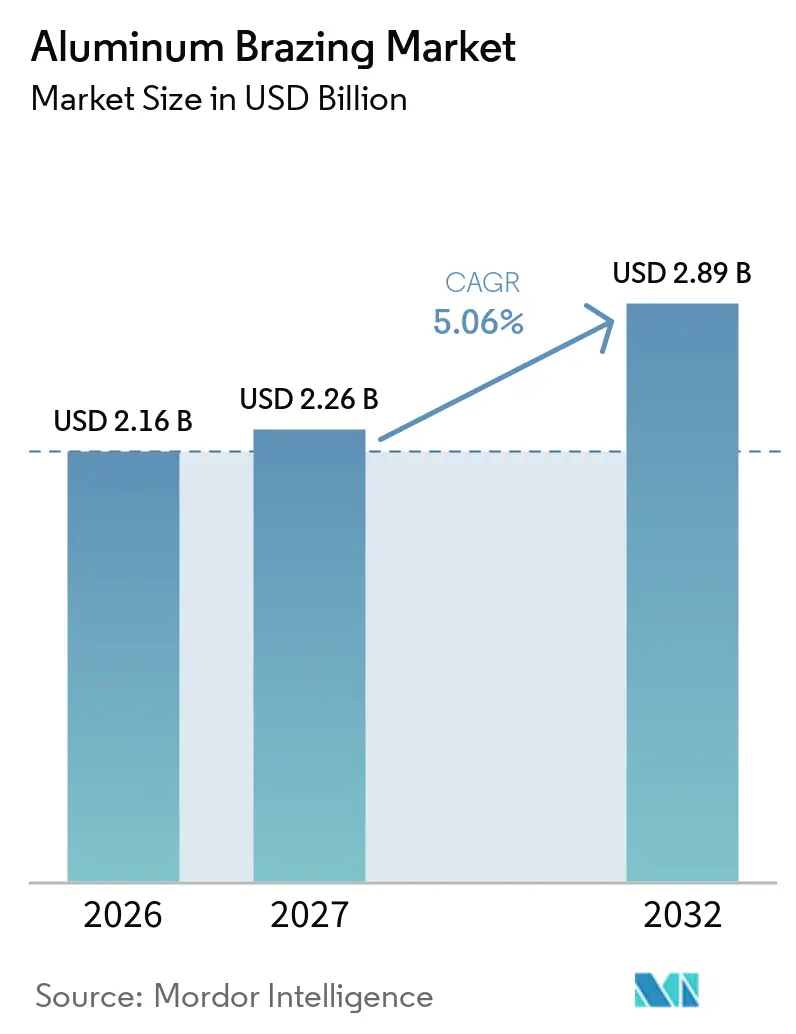
The Aluminum brazing market size was valued at USD 2.16 billion in 2026 and is estimated to grow from USD 2.26 billion in 2027 to USD 2.89 billion by 2032, at a CAGR of 5.06% during the forecast period (2027-2032). The aluminum brazing market supports thermal management, refrigeration, aerospace, and high-power electronics applications where manufacturers require lower weight, reliable heat transfer, and controlled unit costs. Brazed assemblies form high-strength, leak-proof joints at furnace temperatures between 580°C and 620°C, supporting their use in EV battery cold plates, Heating, Ventilation, Air Conditioning, and Refrigeration (HVACR) microchannel heat exchangers, and power electronics packaging. Demand is spread across several end uses, so lower activity in one application can be partly offset by demand from another. This breadth encourages producers to develop materials, production capacity, and qualification programs that serve multiple customer groups. The aluminum brazing market is shaped by both the output requirements of automotive and HVACR production and the qualification needs of aerospace and electronic assemblies.
Key Report Takeaways
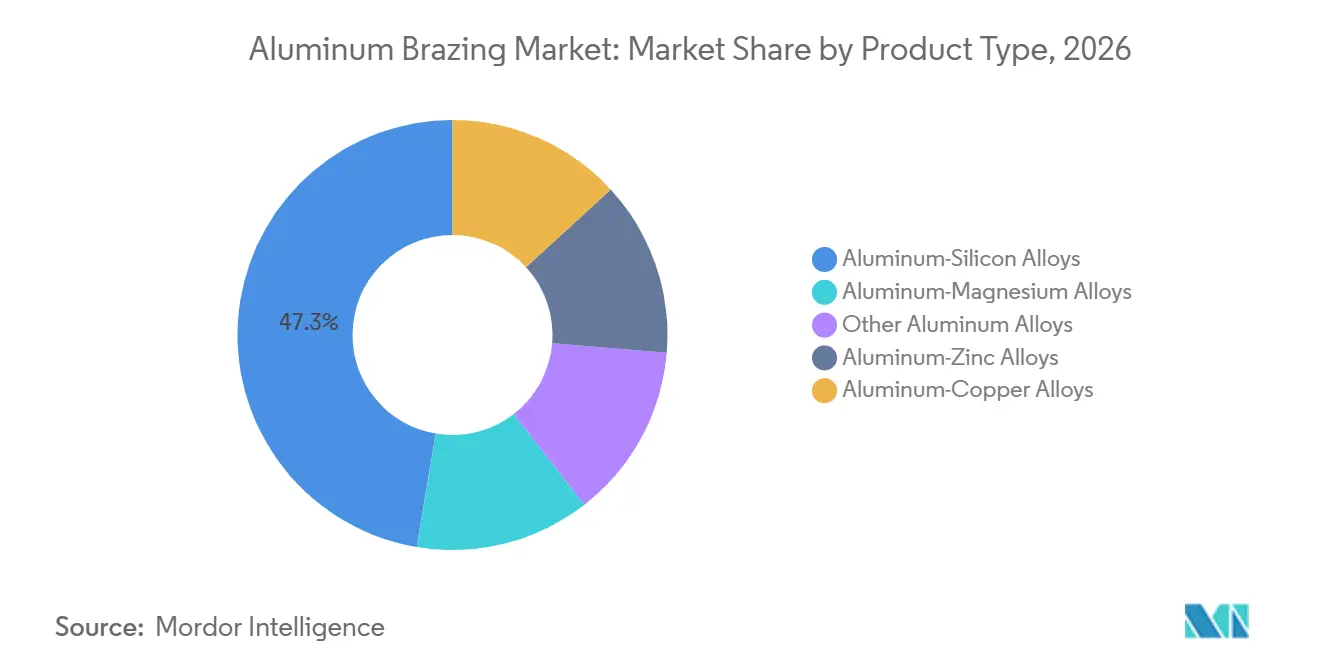
- By product type, Aluminum-Silicon alloys held 47.34% market share in 2026, while Aluminum-Copper alloys are forecast to record the highest CAGR of 5.84% through 2032.
- By product form, Sheets held 41.68% market share in 2026, while Paste is forecast to record the highest CAGR of 5.97% through 2032.
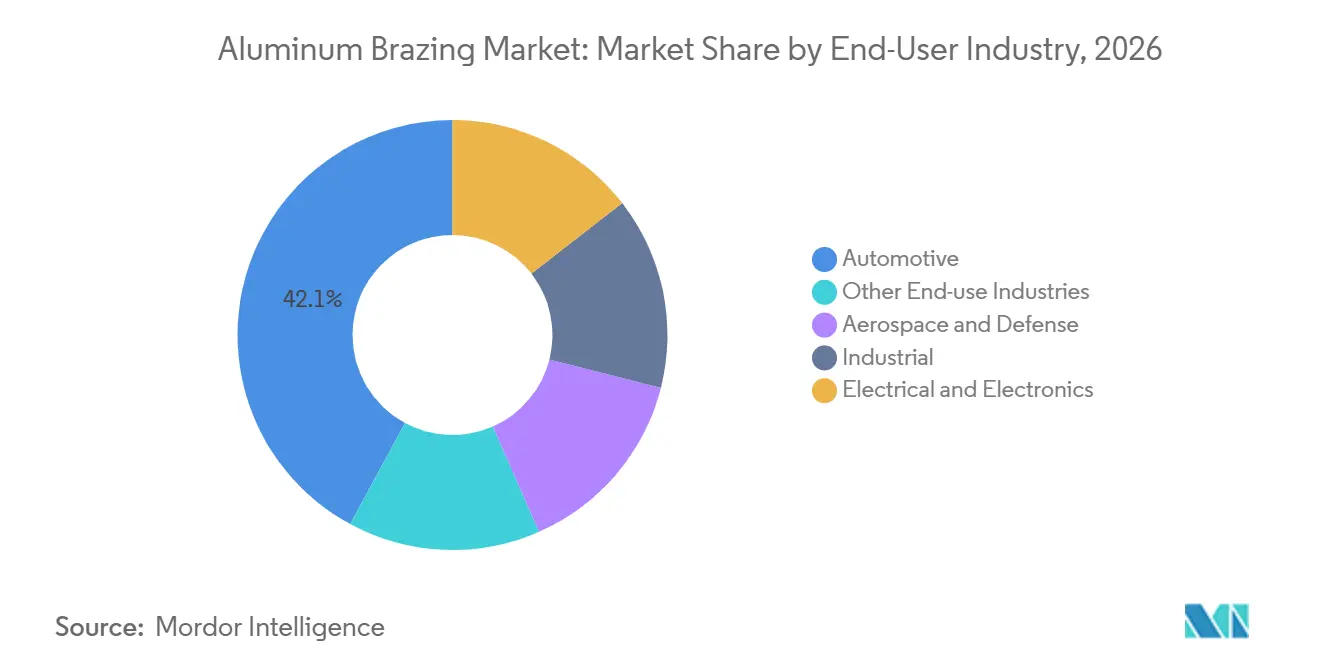
- By end-user industry, Automotive held 42.11% market share in 2026, while Electrical and Electronics is forecast to record the highest CAGR of 6.14% through 2032.
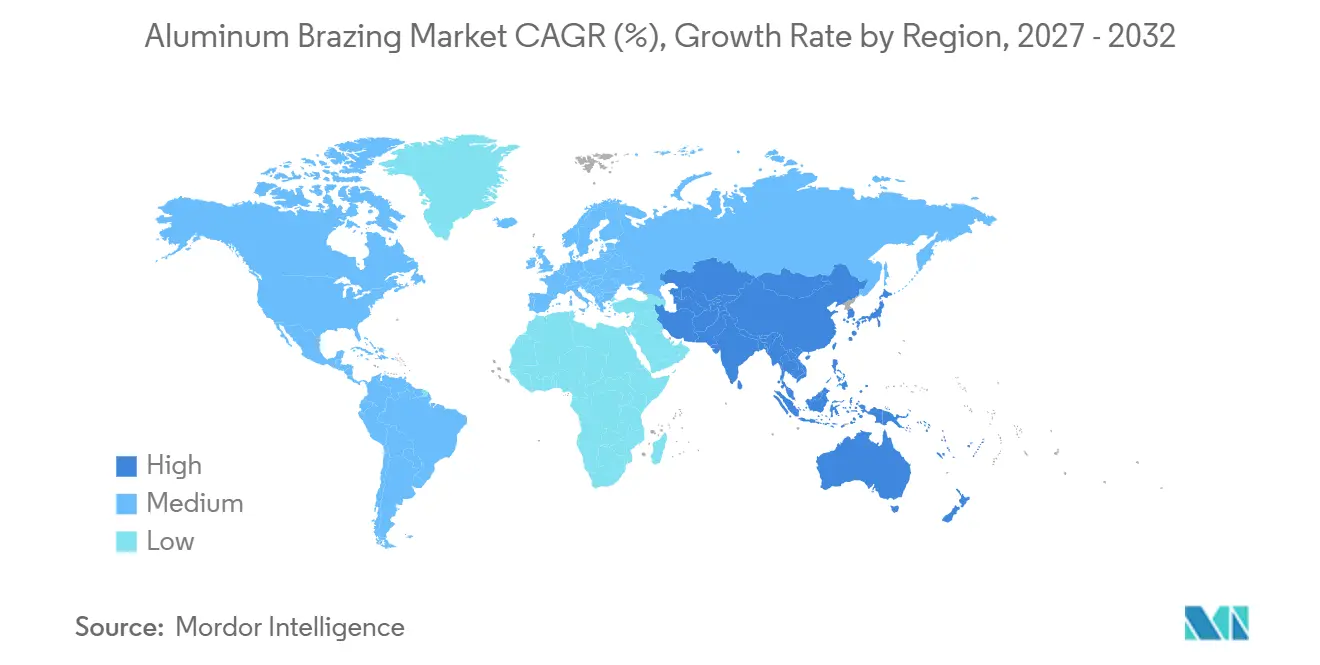
- By geography, Asia-Pacific held 38.45% market share in 2026 and is forecast to record the highest CAGR of 6.02% through 2032.
Note: Market numbers in this report are based on Mordor Intelligence's proprietary estimation framework, which combines nine months of actuals with Q4 projections for base year 2026.
Market Trends and Insights
Drivers Impact Analysis of Aluminum Brazing Market*
| Drivers | (~) % Impact on CAGR Forecast | Geographic Relevance | Impact Timeline |
|---|---|---|---|
| Electric Vehicle Battery and Power-Electronics Thermal Management | +1.4% | APAC core, with spillover to North America and Europe | Medium term (2-4 years) |
| Lightweighting and Fuel-Efficiency Requirements | +1.0% | Global | Long term (≥ 4 years) |
| Expansion of Heating, Ventilation, Air Conditioning, and Refrigeration (HVACR) and Microchannel Heat Exchangers | +0.9% | APAC and North America | Medium term (2-4 years) |
| Aerospace Demand for High-Integrity Lightweight Joints | +0.5% | North America and Europe, with a growing contribution from Japan | Long term (≥ 4 years) |
| Automation and High-Volume Controlled Atmosphere Brazing | +0.4% | Asia-Pacific (APAC) dominant, expanding to Mexico and Eastern Europe | Short term (≤ 2 years) |
| Source: Mordor Intelligence | |||
Electric Vehicle Battery and Power-Electronics Thermal Management
Electric vehicle (EV) production has increased demand in the aluminum brazing market beyond a simple increase in component counts. Battery cold plates require brazed aluminum structures that remain reliable through repeated thermal cycles while providing thermal conductivity of 120–180 W/m·K. A 2025 SAE International study found that artificially aged AA6 alloys improved yield strength by 128.7% and thermal conductivity by 10% compared with conventional AA3003 brazing sheet. These results place greater emphasis on core-alloy selection for cold plates and push material specifications further upstream in the supply chain. Power modules using gallium nitride and silicon carbide also require thermally reliable joints for inverters, onboard chargers, and traction systems. The aluminum brazing market benefits because active metal brazing substrates must withstand power cycling, vibration, and elevated operating temperatures in these applications.
Lightweighting and Fuel-Efficiency Requirements
The aluminum brazing market links vehicle lightweighting with thermal management requirements that are difficult to meet through alternative joining approaches. Vehicle manufacturers have moved from copper-brass designs toward all-aluminum heat exchangers to reduce mass and consolidate production processes. Norsk Hydro ASA stated in September 2025 that replacing copper with aluminum in heating, ventilation, air conditioning, and refrigeration (HVACR) and automotive systems requires a redesign from round copper tubes to multi-port aluminum microchannel extrusions. Once manufacturers complete that redesign, they rarely return to the previous material system. This creates ongoing demand for brazing materials across the life of a vehicle platform or HVACR product design. EU Euro 7 and U.S. Corporate Average Fuel Economy standards for 2026 reinforce the need to reduce vehicle weight over the forecast period.
Expansion of HVACR and Microchannel Heat Exchangers
The aluminum brazing market benefits as microchannel heat exchangers gain ground in commercial refrigeration, rooftop HVAC units, and precision process cooling. These systems use aluminum furnace brazing and offer lower refrigerant charge, lower air-side pressure drop, and a smaller equipment footprint than traditional fin-and-tube designs. Those features align with refrigerant transitions under European F-gas requirements and the U.S. EPA American Innovation and Manufacturing (AIM) Act. Kaltra introduced microchannel heat exchangers with axially graded tube-port sizes in April 2025, allowing the hydraulic diameter to vary along the airflow direction to improve two-phase refrigerant distribution without mechanical flow controls[1]. Research published by the Japan Society of Mechanical Engineers in 2025 found that all-aluminum microchannel coil systems can reduce refrigerant use and improve air-conditioner efficiency. The same study identified fatigue at brazed fin-to-tube joints as an engineering constraint, which maintains the need for advanced brazing materials in the HVACR supply chain.
Aerospace Demand for High-Integrity Lightweight Joints
Commercial aerospace activity and next-generation defense programs support the aluminum brazing market through demand for high-integrity, vacuum-brazed aluminum assemblies. Aerospace applications require strict quality control because structural frames and flight heat exchangers need joint tensile strength above 50,000 psi and full process traceability. These requirements raise the barrier to entry and favor suppliers with established certifications, documented processes, and aerospace-grade material capabilities. UACJ announced in May 2025 that it would invest JPY 11 billion (~USD 0.06 billion) in a thick-plate quenching facility at Fukui Works. The facility is planned to begin operations in FY2027 H2 and double annual capacity to 10,000 tons, supporting expected aerospace material demand. Certification requirements, including Nadcap-related approvals, further strengthen the position of suppliers that already meet aerospace qualification standards.
Restraints Impact Analysis of Aluminum Brazing Market*
| Restraints | (~) % Impact on CAGR Forecast | Geographic Relevance | Impact Timeline |
|---|---|---|---|
| Aluminum Oxide Barrier and Tight Process-Control Requirements | -0.5% | Global, acute in emerging APAC and MEA hubs | Medium term (2-4 years) |
| Raw-Material Price Volatility and Margin Exposure | -0.4% | Global, most pronounced in North America and Europe | Short term (≤ 2 years) |
| Coolant, Vibration, and Thermal-Cycling Durability Qualification | -0.3% | Global, most critical in EV programs in APAC and North America | Medium term (2-4 years) |
| Source: Mordor Intelligence | |||
Aluminum Oxide Barrier and Tight Process-Control Requirements
Aluminum's native oxide layer reforms quickly after surface preparation and remains a core challenge in brazing operations. Controlled-atmosphere brazing (CAB) requires careful management of oxide removal, nitrogen purity, furnace leaks, and flux performance before the filler metal can flow reliably. Oxygen levels in CAB furnace atmospheres must remain below 30 ppm to support consistent joint formation. This requirement adds monitoring, process-control, and infrastructure costs for manufacturers. Flux-free methods may reduce certain flux-related constraints, but they require investment in new equipment and lengthy qualification cycles before they can be widely adopted. These factors limit near-term expansion in lower-technology manufacturing hubs and make process expertise a significant entry requirement in the aluminum brazing market.
Raw-Material Price Volatility and Margin Exposure
Aluminum and silicon cost movements can pressure margins across the aluminum brazing market, especially where braze-alloy supply contracts do not provide stable pricing. Gränges reported that U.S. import tariffs reshaped scrap flows and affected Q3 2025 operating profit through higher aluminum scrap premiums[2]. Silicon-price variability can add a second source of cost pressure for silicon-rich filler alloys. Smaller producers without long-term supply agreements face greater exposure than integrated companies. This can limit smaller suppliers' ability to grow and invest in innovation compared to established material producers.
*Our forecasts treat driver/restraint impacts as directional, not additive. The impact forecasts reflect baseline growth, mix effects, and variable interactions.
Aluminum Brazing Market Segment Analysis
By Product Type:
Aluminum-Silicon Alloys Account for the Largest ShareAluminum-Silicon alloys held a 47.34% share of the aluminum brazing market in 2026. Silicon lowers the alloy's solidus temperature below that of the aluminum base metal, enabling filler flow and leak-tight joints without eroding the base metal. This property is important for automotive radiators, condensers, EV battery cold plates, and other heat-transfer assemblies. Aluminum-Zinc alloys serve a different role, providing sacrificial corrosion protection for external heat-exchanger surfaces exposed to road salt or industrial atmospheres. The zinc layer corrodes before the underlying core, protecting the base material. Aluminum-Magnesium alloys are used where post-braze tensile properties are more important than thermal-cycle performance, although their sensitivity to atmospheric moisture complicates the control of Controlled Atmosphere Brazing (CAB).
Other aluminum alloy systems, including hybrid quaternary compositions for aerospace, address niche applications with demanding specifications and higher prices. Aluminum-Copper alloys are projected to be the fastest-growing product type in the aluminum brazing market, with a 5.84% CAGR through 2032. Their electrical conductivity supports EV battery tab-to-busbar connections and power-semiconductor packaging, where heat transfer influences energy density and thermal derating. A 2025 study of Al-Si-Ge filler metals for vacuum brazing of 6061 aluminum found that higher silicon content reduced filler liquation and void formation at brazed interfaces. This finding is relevant to the tighter performance requirements for electronics-grade joints. Multi-element systems combining aluminum, silicon, copper, and magnesium are also becoming more relevant as automotive and electronics specifications develop.

By Product Form:
Sheets Remain Central, While Paste ExpandsSheets held a 41.68% share of the aluminum brazing market in 2026, as CAB-based automotive and Heating, Ventilation, Air Conditioning, and Refrigeration (HVACR) systems rely heavily on flat braze-clad material. Manufacturers form these sheets into radiators, condensers, heat-exchanger cores, and EV cooling plates at an industrial scale. Their multi-layer structure combines a core alloy with lower-melting filler cladding on one or both sides, which can reduce the need for separate flux-application steps in some CAB configurations and improve process consistency. A 2025 SAE study found that modified AA6xxx brazing-sheet cores increased post-braze yield strength by up to 128.7% compared with AA3003. Wires and rods remain relevant for torch and induction brazing in field repair, small-batch aerospace fabrication, and HVACR service work.
Paste is projected to record the highest growth among product forms, at a 5.97% CAGR through 2032. It enables precise placement of material on geometries where sheet or wire cannot be positioned effectively, including EV battery cold-plate manifolds, 3D-printed aluminum heat exchangers, and compact power-module substrates. Lincoln Electric reported that HVAC applications accounted for 40% of its brazing segment revenue in Q1 FY2026, underscoring the importance of paste-form flux and alloy combinations for installation and repair work. Robotic paste dispensing is also being adopted for EV module assembly. This trend reduces the historical production-cost advantage of sheet in some mid-scale applications and expands the role of paste in the aluminum brazing market.
By End-User Industry:
Automotive Leads, While Electrical and Electronics Grow FastestAutomotive accounted for 42.11% of the aluminum brazing market in 2026. The segment uses CAB to assemble radiators, condensers, evaporators, charge-air coolers, and EV battery thermal-management plates. EV platforms require more brazed material than internal-combustion vehicles because battery systems need dedicated liquid-cooling circuits across large, flat plate assemblies, and each additional brazed connection increases material consumption beyond that of a conventional powertrain. Aerospace and defense remain smaller in scale but involve high-value specifications and multiyear supply contracts. Industrial equipment, including oil-and-gas heat exchangers, chemical-processing coolers, and power-generation heat-recovery systems, provides a stable demand base that is less dynamic than the automotive market.
Electrical and electronics is projected to grow at a 6.14% CAGR through 2032, the highest rate among end-user segments in the aluminum brazing market. Active metal brazing supports ceramic-to-metal substrate bonding for gallium nitride power modules and silicon carbide inverters used in industrial drives, renewable-energy converters, and traction applications. A 2025 IEEE study reported a power-loop inductance of 1.2 nH and thermal resistance of 0.31 K/W for a hybrid PCB-on-AMB gallium-nitride half-bridge module. Requirements under IPC-A-610, JEDEC reliability standards, and AEC-Q100 qualification frameworks increase the importance of material purity and void control, directing demand toward suppliers that can demonstrate testing and qualification performance. The faster growth of electrical and electronics reflects its earlier transition from wire bonding and solder-based assembly to higher-reliability brazed structures.
Geography Analysis
APAC Aluminum Brazing Market
Asia-Pacific held 38.45% of the aluminum brazing market share in 2026 and is expected to expand at a 6.02% CAGR through 2032. China, Japan, South Korea, and ASEAN countries combine large EV and HVACR (Heating, Ventilation, Air Conditioning, and Refrigeration) manufacturing bases with extensive heat-exchanger production. Chinese producers have built automation advantages through long-term investment in CAB technology. Regional EV adoption is also progressing earlier and faster than in many Western markets. Gränges reported an 88% year-over-year increase in Asia output in Q3 2025, driven largely by EV-related customer wins and the Shandong facility ramp-up. The company reported an Asia run rate of 50,000 tons per quarter. Japan contributes to advanced materials development through UACJ's investment in Fukui and its broader work on brazing-sheet compositions.
The Americas Aluminum Brazing Market
North America is the second-largest regional market within the aluminum brazing market. Automotive manufacturing in the US Midwest, a large HVACR installation base, and EV investments support regional demand. Novelis is commissioning a rolling and recycling facility in Bay Minette, Alabama, following a USD 2.3 billion investment. The project began commissioning in H2 2026 and targets automotive, industrial, and specialty customers. Mexico is also developing as a nearshoring hub for Asian-owned heat-exchanger suppliers serving North American vehicle manufacturers, including operations supported by CAB furnace installations in Monterrey. South America remains a smaller market, with Brazil and Argentina tied largely to local vehicle assembly activity.
EMEA Aluminum Brazing Market
Europe remains an important part of the aluminum brazing market, with stable output from Germany's automotive base but weaker near-term demand in HVACR-oriented markets. Gränges identified a European HVAC slowdown in its Q4 2025 reporting, while its European operations recorded 17% year-over-year output growth in Q3 2025. This pattern indicates shared gains despite a weaker regional market. European vehicle manufacturers continue to develop EV-specific thermal management platforms. The Deutscher Verband für Schweißen und verwandte Verfahren (DVS)-organized Aluminum Brazing 2025 congress in Düsseldorf highlighted ongoing work on assembly and leak-testing solutions for HVACR heat exchangers. Demand in the Middle East and Africa is centered on imported HVACR systems and industrial heat exchangers, keeping the region more dependent on external material supply and technology development.
Competitive Landscape
The aluminum brazing market is fragmented. Norsk Hydro and Novelis compete through low-carbon and high-recycled-content aluminum offerings as vehicle producers place greater weight on sustainability requirements. Novelis reported USD 17.1 billion in net sales for the fiscal year 2025. Its USD 2.3 billion investment in Bay Minette is adding material capacity for automotive, industrial, and specialty customers.
UACJ is strengthening its position by investing in aerospace-grade plate capacity and developing advanced brazing sheets. Its Fukui quenching project is designed to support a broader supply base for aerospace applications, with a planned start in FY2027 H2. Solvay's NOCOLOK products remain a process-critical family of fluxes for controlled-atmosphere brazing (CAB) operations. The position of these suppliers reflects the importance of verified process knowledge, material traceability, and qualification history. Aerospace specialists and custom-alloy providers also compete through application support rather than price alone. Their customer relationships are supported by detailed process data and the time required to complete new qualifications. The aluminum brazing market, therefore, rewards companies that can combine stable supply with engineering support and validated manufacturing performance.
Opportunities in the aluminum brazing market exist in flux-free pastes for electronics assembly and robotic paste formulations for EV battery module production. Conventional fluoroaluminate fluxes may raise cleanliness concerns in certain semiconductor packaging applications. Induction brazing and transient liquid-phase bonding are being evaluated for targeted ceramic-to-metal assemblies, as they can reduce thermal exposure and improve throughput. A 2025 review in the Journal of the European Ceramic Society described these approaches as useful for joining asymmetric ceramic-to-metal structures. New vehicle architectures, which may change on 3-4 year cycles, shorten the time available for material qualification. Suppliers that qualify new alloy systems early can compete for emerging programs before established suppliers complete their own validation work. The aluminum brazing market remains competitive because scale benefits coexist with application-specific requirements, supporting specialist suppliers.
Aluminum Brazing Industry Leaders
-
Lucas Milhaupt LLC
-
Solvay
-
Lincoln Electric
-
Prince & Izant Company
-
Sunkwang AMPA Co., Ltd.
- *Disclaimer: Major Players sorted in no particular order
Aluminum Brazing Market Companies Covered in this Report
- AIMTEK, Inc.
- Gränges
- Johnson Matthey
- Lincoln Electric
- Lucas Milhaupt LLC
- Morgan Advanced Materials
- Nihon Superior Co., Ltd.
- Norsk Hydro ASA
- Novelis Inc.
- Prince & Izant Company
- Solstice Advanced Materials Inc.
- Solvay
- Sunkwang AMPA Co., Ltd.
- UACJ Corporation
- VBC Group
Recent Industry Developments in Aluminum Brazing Market
- October 2026: Novelis commissioned its USD 2.3 billion greenfield rolling and recycling plant in Bay Minette, Alabama. The facility serves automotive, industrial, and specialty customers and addresses domestic gaps in aluminum brazing sheet supply.
- May 2026: UACJ confirmed JPY 23 billion (~USD 0.14 billion) in total capital investment across its aerospace and defense materials programs. This included JPY 12 billion (~USD 0.07 billion) for a ring-material facility and JPY 11 billion (~USD 0.06 billion) for the Fukui Works thick-plate quenching facility. The quenching facility is planned to begin operations in FY2027 H2 and increase annual capacity to 10,000 tons of aluminum brazing sheet.
Global Aluminum Brazing Market Report Scope
Aluminum brazing is a metal-joining process that connects aluminum components by melting a filler metal (typically an aluminum-silicon alloy) at temperatures above 450°C (842°F), while keeping the base aluminum parts solid. The process is widely used in industries such as automotive, aerospace, and HVAC, where strong, lightweight, and corrosion-resistant joints are required.
The aluminum brazing market is segmented by product type, product form, end-user industry, and geography. By product type, the market is segmented into aluminum-silicon alloys, aluminum-zinc alloys, aluminum-copper alloys, aluminum-magnesium alloys, and other aluminum alloys. By product form, the market is segmented into sheets, paste, wires, rods, and other product forms. By end-user industry, the market is segmented into automotive, aerospace and defense, industrial, electrical and electronics, and other end-use industries. The report also covers market sizes and forecasts for aluminum brazing across 16 countries in major regions. The market sizes and forecasts are provided in terms of value (USD).
Segmentation Overview
| Aluminum-Silicon Alloys |
| Aluminum-Zinc Alloys |
| Aluminum-Copper Alloys |
| Aluminum-Magnesium Alloys |
| Other Aluminum Alloys |
| Sheets |
| Paste |
| Wires |
| Rods |
| Other Product Forms |
| Automotive |
| Aerospace and Defense |
| Industrial |
| Electrical and Electronics |
| Other End-use Industries |
| Asia-Pacific | China |
| India | |
| Japan | |
| South Korea | |
| ASEAN Countries | |
| Rest of Asia-Pacific | |
| North America | United States |
| Canada | |
| Mexico | |
| Europe | Germany |
| United Kingdom | |
| France | |
| Italy | |
| NORDIC Countries | |
| Russia | |
| Rest of Europe | |
| South America | Brazil |
| Argentina | |
| Rest of South America | |
| Middle East and Africa | Saudi Arabia |
| South Africa | |
| Rest of Middle East and Africa |
| By Product Type | Aluminum-Silicon Alloys | |
| Aluminum-Zinc Alloys | ||
| Aluminum-Copper Alloys | ||
| Aluminum-Magnesium Alloys | ||
| Other Aluminum Alloys | ||
| By Product Form | Sheets | |
| Paste | ||
| Wires | ||
| Rods | ||
| Other Product Forms | ||
| By End-User Industry | Automotive | |
| Aerospace and Defense | ||
| Industrial | ||
| Electrical and Electronics | ||
| Other End-use Industries | ||
| By Geography | Asia-Pacific | China |
| India | ||
| Japan | ||
| South Korea | ||
| ASEAN Countries | ||
| Rest of Asia-Pacific | ||
| North America | United States | |
| Canada | ||
| Mexico | ||
| Europe | Germany | |
| United Kingdom | ||
| France | ||
| Italy | ||
| NORDIC Countries | ||
| Russia | ||
| Rest of Europe | ||
| South America | Brazil | |
| Argentina | ||
| Rest of South America | ||
| Middle East and Africa | Saudi Arabia | |
| South Africa | ||
| Rest of Middle East and Africa | ||
Key Questions Answered in the Report
What is current market size of Aluminum Brazing Market?
The Aluminum brazing market size was valued at USD 2.16 billion in 2026 and is estimated to grow from USD 2.26 billion in 2027 to USD 2.89 billion by 2032, at a CAGR of 5.06% during the forecast period (2027-2032).
Which end-user application is expanding fastest?
Electrical and Electronics is projected to expand at a 6.14% CAGR through 2032, led by gallium nitride and silicon carbide power-module applications.
Which region leads the aluminum brazing demand?
Asia-Pacific leads with a 38.45% revenue share in 2026 and is projected to grow at a 6.02% CAGR through 2032.
Why are quality qualifications important in aerospace brazing?
Aerospace joints require high tensile strength, traceability, and established process controls, which makes certification and qualification important supplier differentiators.