
Airborne Telemetry Market Size and Share
Market Overview
| Study Period | 2020 - 2032 |
|---|---|
| Market Size (2027) | USD 1.10 Billion |
| Market Size (2032) | USD 1.54 Billion |
| Growth Rate (2027 - 2032) | 6.96 % |
| Fastest Growing Market | Asia-Pacific |
| Largest Market | North America |
| Market Concentration | Medium |
Major Players *Disclaimer: Major Players sorted in no particular order Image © Mordor Intelligence. Reuse requires attribution under CC BY 4.0. | |
Airborne Telemetry Market Analysis by Mordor Intelligence
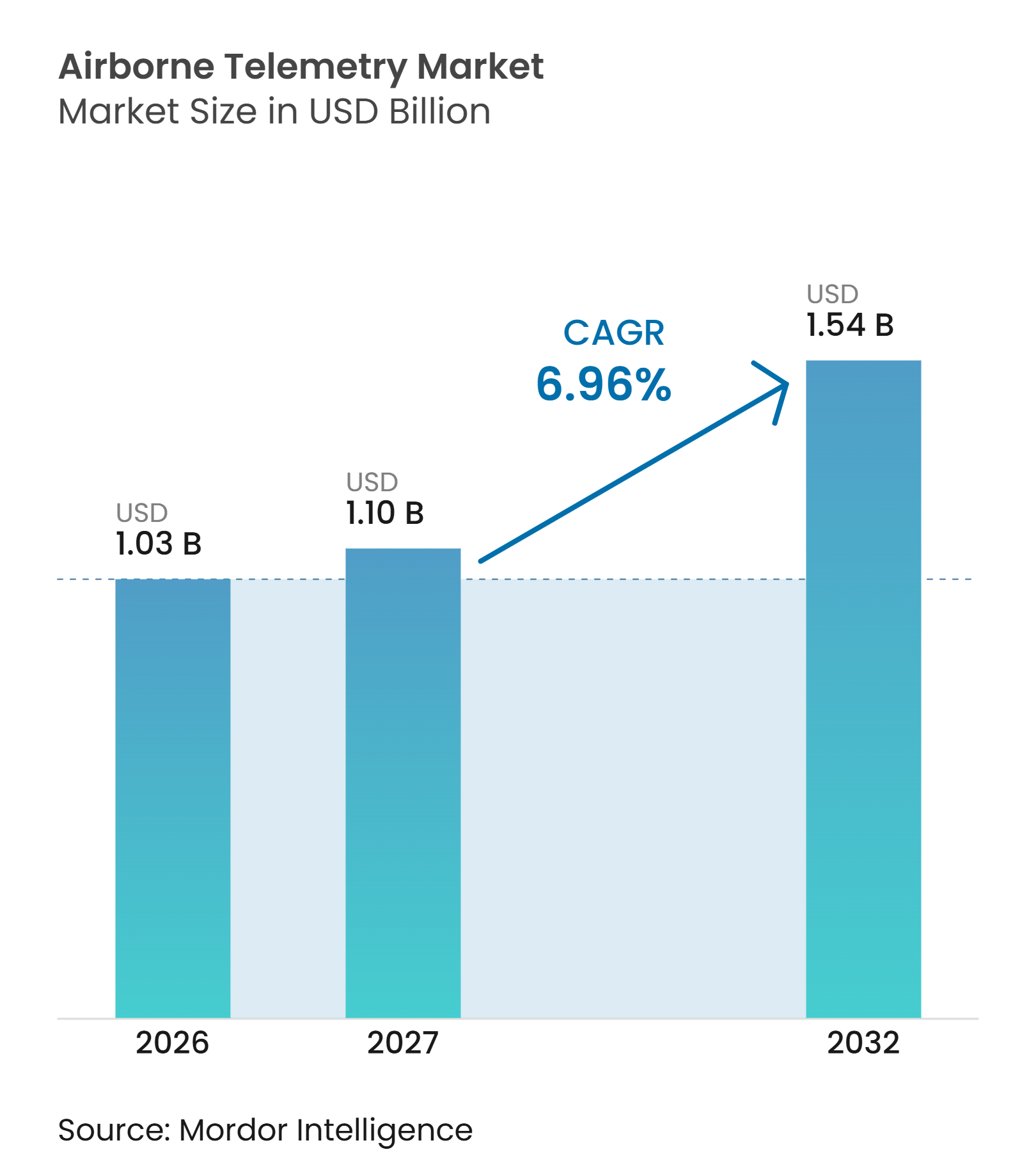
The airborne telemetry market size was valued at USD 1.03 billion in 2026 and is forecast to grow from USD 1.10 billion in 2027 to reach USD 1.54 billion by 2032, at a 6.96% CAGR during the forecast period (2027-2032). Defense agencies are increasing flight-test activity for advanced aircraft, hypersonic vehicles, and unmanned systems. This creates recurring demand for equipment that collects, transmits, and analyzes flight data. North American range modernization and wider platform development in Asia-Pacific support the airborne telemetry market. Suppliers are responding by combining radio frequency links, satellite connectivity, and onboard processing. Procurement increasingly favors certified vendors that can support equipment through long testing cycles. These requirements also reinforce demand for proven integration support.
Key Report Takeaways
-
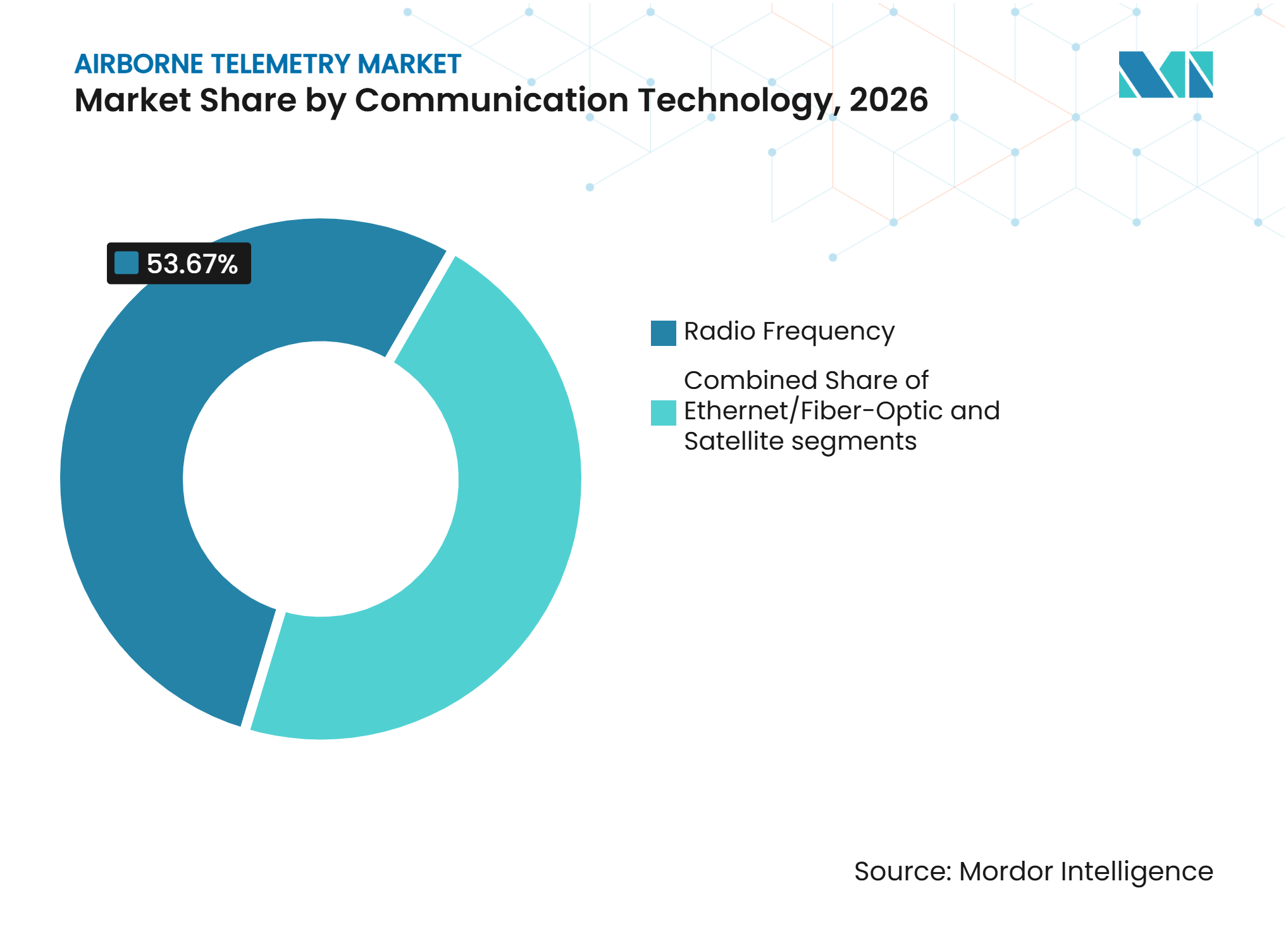
By communication technology, radio frequency held 53.67% of the airborne telemetry market share in 2026, while satellite is forecast to grow at an 8.21% CAGR through 2032.
-
By component, transmitters and sensors held 30.11% of the airborne telemetry market share in 2026, while software and data analytics platforms are forecast to grow at an 8.52% CAGR through 2032.
-
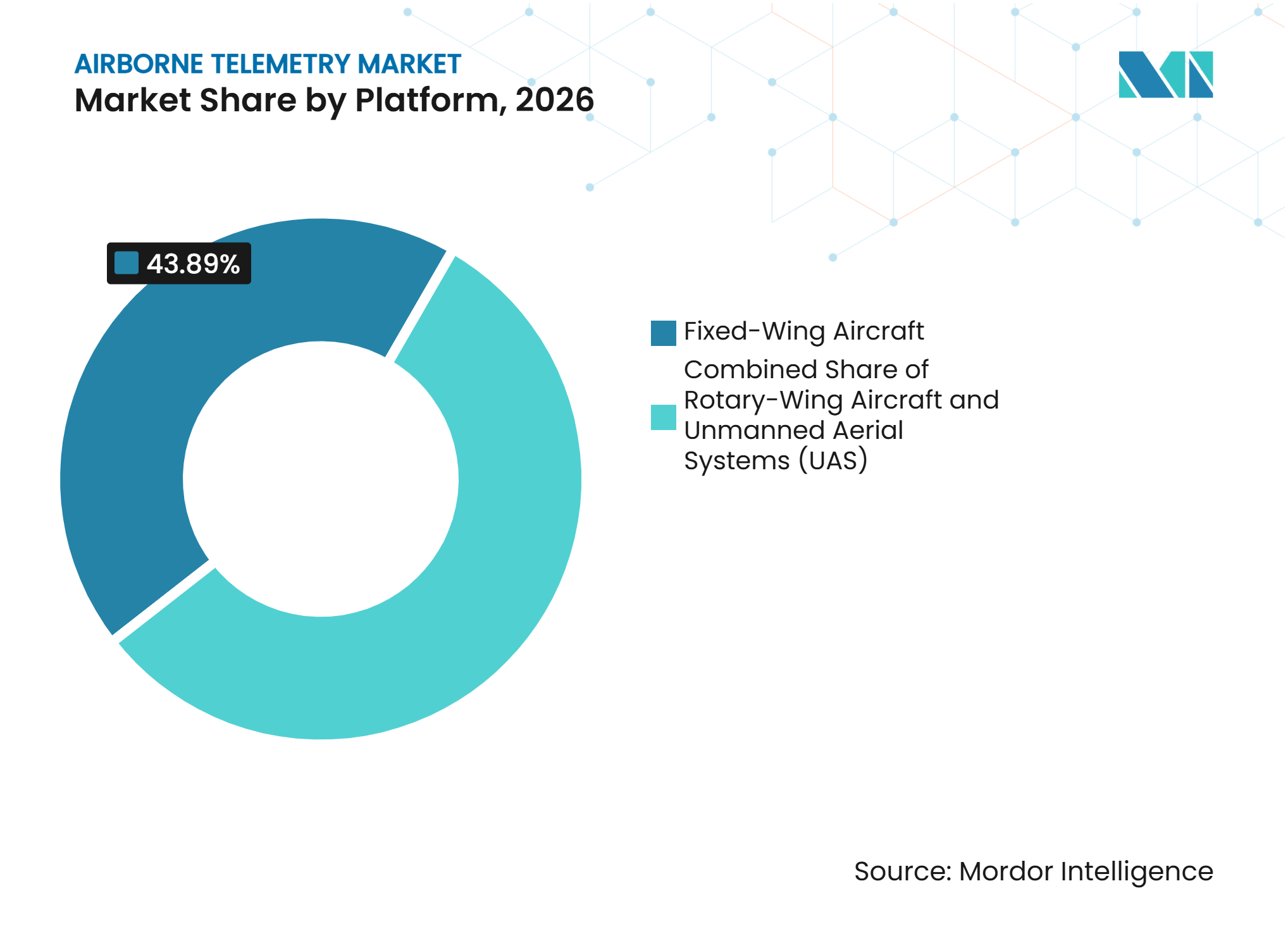
By platform, fixed-wing aircraft held 43.89% of the airborne telemetry market share in 2026, while unmanned aerial systems (UAS) are forecast to grow at a 9.76% CAGR through 2032.
-
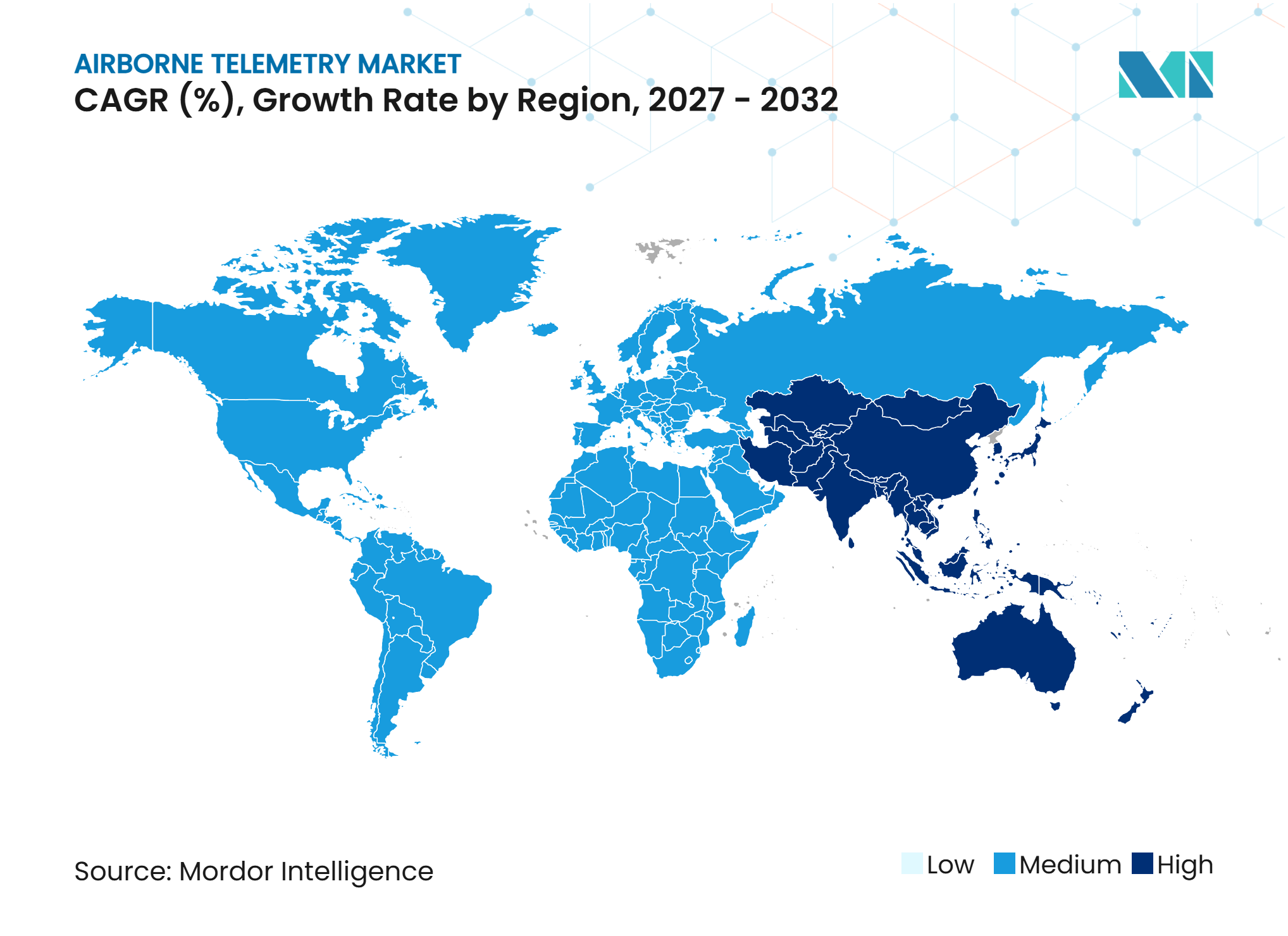
By geography, North America held 35.87% of the airborne telemetry market share in 2026, while Asia-Pacific is forecast to grow at an 8.42% CAGR through 2032.
Note: Market numbers in this report are based on Mordor Intelligence's proprietary estimation framework, which combines nine months of actuals with Q4 projections for base year 2026.
Market Trends and Insights
Drivers Impact Analysis of Airborne Telemetry Market*
| Driver | (~) % Impact on CAGR Forecast | Geographic Relevance | Impact Timeline |
|---|---|---|---|
| Defense flight-test instrumentation sustainment | +2.00% | North America, United Kingdom, Australia | Short term (≤ 2 years) |
| Hypersonic and reusable launch vehicle test programs | +1.80% | North America, Australia, United Kingdom | Medium term (2-4 years) |
| Airborne ISR modernization | +1.50% | North America, Europe, Asia-Pacific | Medium term (2-4 years) |
| UAS fleet proliferation and autonomous operations | +1.20% | Global | Medium term (2-4 years) |
| Wireless rotorcraft instrumentation replacing slip-ring architectures | +0.80% | North America, Europe | Short term (≤ 2 years) |
| Edge processing for high-rate sensor and video streams | +0.60% | Global | Long term (≥ 4 years) |
| Source: Mordor Intelligence | |||
Defense Flight-Test Instrumentation Sustainment
Government customers are replacing aging flight-test equipment with common pools that serve several aircraft programs. This approach concentrates demand in long-running contracts and favors suppliers already qualified by military ranges. Curtiss-Wright received a USD 50.00 million contract from Naval Air Systems Command in March 2025 for high-speed data acquisition systems supporting the F-35, F-18, CH-53K, E-2D, and C-130 through January 2030.[1] It also received a USD 80 million award from the US Air Force in June 2025 for data acquisition technology through March 2030. The airborne telemetry market benefits because pooled contracts cover transmitters, transponders, recorders, gateways, and analysis software. Range standards administered by the DoD's Test Resource Management Center also reinforce the value of existing qualifications.
Hypersonic and Reusable Launch Vehicle Test Programs
Hypersonic flight tests require reliable data collection from high-speed vehicles operating far from ground stations. Arcfield received a USD 70 million, five-year contract in November 2025 to provide flight-data telemetry, secure communications, and test-architecture work for US Army hypersonic tests.[2] The MACH-TB 2.0 program also uses uncrewed aircraft as airborne relay nodes, extending collection coverage across Pacific test corridors. Georgia Tech Research Institute delivered an adaptive phased-array system in 2025 capable of tracking 24 telemetry streams simultaneously. These programs favor resilient links, airborne relays, and high-capacity processing. They also make multi-year test schedules an important source of demand for the airborne telemetry market.
Airborne ISR Modernization
Modern ISR programs are raising requirements for continuous, high-bandwidth connectivity. Honeywell selected its JetWave X system in May 2025 for the US Army ARES demonstrator upgrade, supporting connections across Inmarsat Global Xpress, ViaSat-3, and future Ka-band networks. The system can provide download speeds of up to 200 Mbps, supporting real-time transfer of data from demanding sensor payloads. Modern platforms need primary, alternate, contingency, and emergency communications when operating in contested areas. This requirement shifts procurement toward systems that can switch between radio frequency and satellite networks. It also creates an opportunity for the airborne telemetry market to supply embedded connectivity as part of broader aircraft upgrades.
UAS Fleet Proliferation and Autonomous Operations
Unmanned aircraft increase demand for telemetry because their operations depend on continuous data exchange and reliable aircraft visibility. The Federal Aviation Administration reported more than 860,000 registered drones in the US in August 2024. Its May 2025 Drone Integration Concept of Operations describes electronic conspicuity requirements for beyond-visual-line-of-sight activity. These requirements place structured reporting and tracking at the center of commercial approvals. In South Korea, the LOWUS wingman prototype is intended for crewed-uncrewed combined flight testing by 2027. Greater adoption of autonomous platforms will expand the airborne telemetry market across defense and civil use cases.
Restraints Impact Analysis of Airborne Telemetry Market*
| Restraint | (~) % Impact on CAGR Forecast | Geographic Relevance | Impact Timeline |
|---|---|---|---|
| Spectrum congestion and range coordination delays | -0.40% | North America, Europe | Short term (≤ 2 years) |
| Export controls and cyber-sovereignty requirements | -0.30% | Global | Medium term (2-4 years) |
| Flight range qualification and re-flight cost exposure | -0.20% | North America, Europe | Short term (≤ 2 years) |
| Platform specific SWaP and thermal constraints | -0.10% | Global | Long term (≥ 4 years) |
| Source: Mordor Intelligence | |||
Spectrum Congestion and Range Coordination Delays
Spectrum availability can delay flight tests because telemetry links rely on limited aeronautical mobile allocations. L-, S-, and C-band users face pressure from high-altitude platforms, direct-to-cell services, and mobile broadband proposals. US spectrum policy also requires an auction of frequencies in the 3,980 to 4,200 MHz band by July 2027. Range operators are adopting C-band and network-based backups where possible. These adaptations add integration work, qualification requirements, and scheduling risk for suppliers in the airborne telemetry market. They can also delay the availability of test windows.
Export Controls and Cyber-Sovereignty Requirements
Export controls create longer procurement cycles for telemetry equipment used in military programs. The 2025 Defense Export Handbook states that relevant telemetry, tracking, and control equipment can fall under the US Munitions List. The US Air Force Test Center also sought secure telemetry units in 2025 that required cybersecurity and environmental qualification. Buyers increasingly require local control of sensitive flight data and compliance with national security rules. These requirements raise adaptation costs and complicate cross-border support. Suppliers in the airborne telemetry market must therefore pair technical performance with export, cybersecurity, and data-residency compliance.
*Our forecasts treat driver/restraint impacts as directional, not additive. The impact forecasts reflect baseline growth, mix effects, and variable interactions.
Airborne Telemetry Market Segment Analysis
By Communication Technology:
Radio Frequency Retains Its Installed BaseRadio frequency held 53.67% of the airborne telemetry market share in 2026 because many defense ranges are built around established L-, S-, and C-band systems. Existing instrumentation pools use these links for routine flight-test collection and range coordination. Curtiss-Wright’s 2025 NAVAIR contract included radio frequency transmitters and C-band transponders. The Air Force award also covered radio frequency, network, recording, gateway, and software equipment. Ethernet and fiber-optic connections remain useful in large aircraft, where high internal data rates are required. Their use is more limited on tactical platforms because new wiring can be intrusive and difficult to qualify. This preserves radio frequency demand for many test missions.
Satellite communication is projected to grow at an 8.21% CAGR through 2032 as long-endurance aircraft operate BLOS. The airborne telemetry market size for satellite systems rises with hypersonic testing, oceanic ranges, and high-altitude ISR missions. Honeywell’s JetWave X supports multi-network connectivity across commercial and government Ka-band capacity.[3] Airborne relay vehicles provide another option when test articles move beyond fixed ground infrastructure. Satellite systems do not replace radio frequency in every mission. Instead, they extend coverage where range geometry, distance, or contested conditions limit the use of traditional links. They are particularly relevant where land-based collection cannot reach.



By Component:
Sensors Keep Volume While Software Gains ValueTransmitters and sensors accounted for 30.11% of the airborne telemetry market share in 2026, as every instrumented aircraft requires multiple collection points. Flight-test pools need data acquisition units, transmitters, antennas, gateways, and transponders across multiple platforms. Curtiss-Wright’s NAVAIR award illustrates this broad hardware requirement. Antennas and modulators also benefit from replacing analog tracking systems with digital arrays. Georgia Tech Research Institute’s 500-element adaptive array can collect 24 telemetry streams at once. Ground receiving equipment has steadier demand for refreshes because ranges remain dependent on physical collection infrastructure.
Software and data analytics platforms are forecast to grow at an 8.52% CAGR through 2032 as aircraft sensor counts and data rates rise. The market size is expanding as users need to fuse data, identify anomalies, and distribute results during missions. DDC-I and Klepsydra demonstrated certified edge-processing support in 2025. Software enables faster decision-making without eliminating the need for secure storage and post-flight analysis. This gives established hardware providers a reason to add recurring analysis tools to their portfolios. It also supports more immediate review of mission data.
By Platform:
Fixed-Wing Programs Provide the Largest Installed BaseFixed-wing aircraft held 43.89% of the airborne telemetry market share in 2026, supported by large defense test programs and complex sensor payloads. These aircraft require transmitters, encoders, radio-frequency links, and ground receivers to evaluate their performance. The NAVAIR contract covered the F-35, F-18, E-2D, C-130, and CH-53K, showing the scale of instrumented fleets. Long development cycles make these programs dependable users of telemetry equipment. Rotary-wing aircraft form a smaller but stable category. Wireless rotor instrumentation offers a route to lower maintenance and faster testing for helicopter programs. These platforms therefore sustain a large installed base of equipment over time.
UAS is projected to grow at a 9.76% CAGR through 2032, the strongest platform rate in the airborne telemetry market. Commercial operations need electronic conspicuity, tracking, and data links when they move beyond visual line of sight. Defense programs also use uncrewed aircraft as sensor platforms and relay nodes for long-distance missions. South Korea’s LOWUS program aims for crewed-uncrewed flight testing by 2027. Smaller platforms remain limited by SWaP and thermal requirements. Those limits support demand for lighter transmitters, compact antennas, and onboard processing rather than conventional large avionics units. These needs favor specialized compact designs.

Geography Analysis
North America: Test Infrastructure Supports Sustained Procurement
North America held 35.87% of the airborne telemetry market share in 2026, supported by extensive test ranges and large defense aircraft programs today. The US Air Force Test Center reports USD 3.10 billion in annual operations and maintenance funding, USD 1 billion in annual research, development, test, and evaluation funding, and USD 31 billion in facilities across 35 locations. NAVAIR’s China Lake Range Control Complex reopened in September 2025 after a USD 242 million rebuild. These projects reinforce demand for collection, tracking, and support. Spectrum rules remain a compliance factor because commercial uses can constrain tests. Suppliers with established US range qualifications retain a position in the airborne telemetry market.
Asia-Pacific: Unmanned Systems and Domestic Capability Drive Expansion
Asia-Pacific is forecast to grow at an 8.42% CAGR through 2032, making it the fastest-growing region in the airborne telemetry market. South Korea’s LOWUS prototype and its planned crewed-uncrewed testing show how new aircraft programs can create telemetry demand. AeroVironment and Korean Air also signed a 2025 memorandum on medium UAS integration, local production, and joint research. China’s GTAC Airborne delivered an airworthiness-certified multimode broadband data link in March 2025. Domestic programs are increasing the need for local hardware, resilient links, and certified software. National control of sensitive data will shape sourcing decisions across the region.
Europe, Middle East, and Other Regions: Modernization Extends Demand
Europe benefits from active development of the Eurofighter, Rafale, and FCAS, while allied procurement links Australia to North American supply chains. The airborne telemetry market size in these regions is driven more by aircraft upgrades than by new platform purchases alone. Middle Eastern demand is centered on Saudi Arabia and the UAE, where national air capabilities need ISR and satellite-enabled hardware. South America remains centered on Brazil’s aerospace base and its defense platforms. Africa has a smaller installed base, with South Africa representing its most established defense-grade endpoint. Export rules and local data requirements influence each region differently. These factors make trusted support networks and certification readiness important competitive strengths for suppliers across these varied markets.
Competitive Landscape
Market Concentration
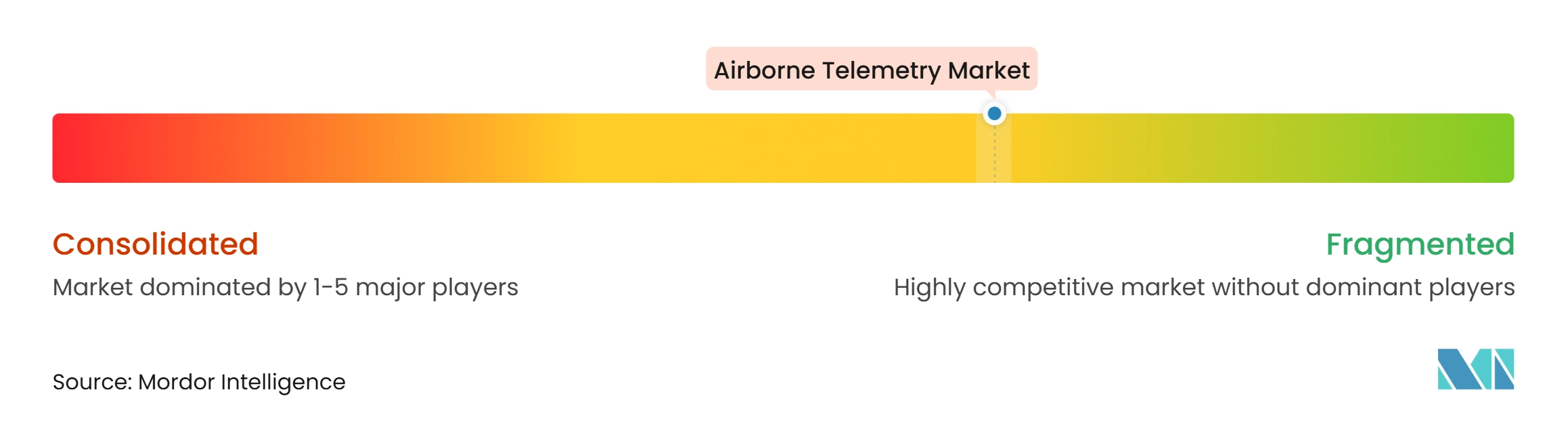
The airborne telemetry market is moderately fragmented because specialist suppliers and major defense contractors address different parts of the value chain. Curtiss-Wright Corporation and L3Harris Technologies, Inc., compete through long-standing flight-test qualifications and large contract vehicles. Curtiss-Wright’s 2025 Air Force award covered both acquisition hardware and IADS data analysis software. This combination can create recurring demand for software after the initial equipment sale. Honeywell Aerospace competes through multi-network satellite connectivity for ISR aircraft. Certified suppliers can defend their position because range requalification can be costly and time-consuming. This supports durable customer relationships and service work for incumbent suppliers globally.
Kratos Defense & Security Solutions, Inc. agreed to acquire Orbit Technologies for USD 356.30 million in November 2025, combining its test-vehicle and microwave capabilities with Orbit’s satellite communications systems. The transaction expands its ability to offer systems that connect airborne equipment, satellite links, and ground infrastructure. Thales Group and other defense primes can embed communications and intelligence functions inside compact payloads. This places pressure on stand-alone component suppliers. Competitive success depends on interoperability, security, and the ability to support a full testing workflow. It also favors suppliers with proven integration capabilities.
Opportunities remain in edge software and open satellite terminals capable of operating across commercial and government networks. The 2025 DDC-I and Klepsydra integration indicates that certified edge processing is becoming available for airborne systems. Vendors also need aerospace-quality systems and controlled supply chains to meet defense procurement requirements. The airborne telemetry market rewards suppliers that can meet AS9100 expectations and export-control obligations. Large primes bring integration capabilities, while specialists offer deep-range expertise.
Airborne Telemetry Industry Leaders
-
L3Harris Technologies, Inc.
-
Safran SA
-
Curtiss-Wright Corporation
-
BAE Systems plc
-
Honeywell Aerospace Inc.
- *Disclaimer: Major Players sorted in no particular order
Airborne Telemetry Market Companies Covered in this Report
- L3Harris Technologies, Inc.
- Safran SA
- Curtiss-Wright Corporation
- BAE Systems plc
- Honeywell Aerospace Inc.
- RTX Corporation
- Leonardo S.p.A.
- AstroNova, Inc.
- Kratos Defense & Security Solutions, Inc.
- AEVEX Corp.
- Teledyne Technologies Incorporated
- Quasonix, LLC
- Systems Engineering & Management Company (SEMCO)
Recent Industry Developments in Airborne Telemetry Market
- August 2026: Safran SA announced a five-year, USD 45.2 million indefinite delivery/indefinite quantity (IDIQ) contract to support the US Air Force Test Center (AFTC) at Edwards Air Force Base (AFB), California. The contract covers the delivery of Safran DSI's airborne and ground data recorders and components, technical engineering support, system upgrades and enhancements, and repair services, supporting the data-recording infrastructure that underpins the Air Force's aircraft and systems testing mission.
- September 2026: AEVEX Corp. announced it has been selected for a contract valued at up to USD 92.2 million over three years to support the DoD Test Resource Management Center (TRMC) SkyRange program. Under the contract, AEVEX Corp. will provide airborne range integration and engineering services; flight operations support across Western US and Pacific test corridors; airborne telemetry relay and resilient communications architecture support; payload and mission systems integration; and distributed range networking, instrumentation, and mission data support.
- March 2025: Curtiss-Wright's Defense Solutions Division has been awarded an approximately USD 50 million firm-fixed-price IDIQ contract by Naval Air Systems Command. The contract covers the supply of high-speed data acquisition systems hardware and associated repair services in support of the Naval Air Systems Command Special Flight Test Instrumentation Pool. It includes Curtiss-Wright's full line of flight-test instrumentation products, such as data acquisition units, network switches, data recorders, network gateways, Ethernet radios, RF transmitters, C-Band transponders, and high-speed cameras for fixed-wing and rotary military aircraft.
Global Airborne Telemetry Market Report Scope
The airborne telemetry market comprises specialized communication and data acquisition systems designed to collect, process, transmit, and receive real-time flight, performance, and mission-critical data from airborne platforms to ground-based monitoring and control stations. The market focuses on airborne telemetry equipment and associated ground receiving infrastructure, excluding standalone aircraft communication, navigation, and surveillance systems not specifically designed for telemetry applications.
The airborne telemetry market is segmented by communication technology, component, platform, and geography. By communication technology, the market is segmented into radio frequency, ethernet/fiber-optic, and satellite. By component, the market is segmented into transmitters and sensors; antennas and modulators; software and data analytics platforms; signal processing units; and ground receiving equipment. By platform, the market is segmented into fixed-wing aircraft, rotary-wing aircraft, and unmanned aerial systems (UAS). The report also covers the market sizes and forecasts for the airborne telemetry market in major countries across different regions. For each segment, the market size is provided in terms of value (USD).
Segmentation Overview
| Radio Frequency |
| Ethernet/Fiber-Optic |
| Satellite |
| Transmitters and Sensors |
| Antennas and Modulators |
| Software and Data Analytics Platforms |
| Signal Processing Units |
| Ground Receiving Equipment |
| Fixed-Wing Aircraft |
| Rotary-Wing Aircraft |
| Unmanned Aerial Systems (UAS) |
| North America | United States | |
| Canada | ||
| Mexico | ||
| Europe | United Kingdom | |
| France | ||
| Germany | ||
| Italy | ||
| Russia | ||
| Rest of Europe | ||
| Asia-Pacific | China | |
| India | ||
| Japan | ||
| South Korea | ||
| Australia | ||
| Rest of Asia-Pacific | ||
| South America | Brazil | |
| Rest of South America | ||
| Middle East and Africa | Middle East | Saudi Arabia |
| United Arab Emirates | ||
| Rest of Middle East | ||
| Africa | South Africa | |
| Rest of Africa | ||
| By Communication Technology | Radio Frequency | ||
| Ethernet/Fiber-Optic | |||
| Satellite | |||
| By Component | Transmitters and Sensors | ||
| Antennas and Modulators | |||
| Software and Data Analytics Platforms | |||
| Signal Processing Units | |||
| Ground Receiving Equipment | |||
| By Platform | Fixed-Wing Aircraft | ||
| Rotary-Wing Aircraft | |||
| Unmanned Aerial Systems (UAS) | |||
| By Geography | North America | United States | |
| Canada | |||
| Mexico | |||
| Europe | United Kingdom | ||
| France | |||
| Germany | |||
| Italy | |||
| Russia | |||
| Rest of Europe | |||
| Asia-Pacific | China | ||
| India | |||
| Japan | |||
| South Korea | |||
| Australia | |||
| Rest of Asia-Pacific | |||
| South America | Brazil | ||
| Rest of South America | |||
| Middle East and Africa | Middle East | Saudi Arabia | |
| United Arab Emirates | |||
| Rest of Middle East | |||
| Africa | South Africa | ||
| Rest of Africa | |||
Key Questions Answered in the Report
What is the projected value of airborne telemetry in 2032?
The airborne telemetry market is forecast to reach USD 1.54 billion by 2032, growing at a 6.96% CAGR from 2027.
Which communication technology leads airborne telemetry?
Radio frequency leads with 53.67% share in 2026 because defense test ranges use established radio frequency infrastructure.
Which airborne telemetry platform is growing fastest?
Unmanned Aerial Systems (UAS) is projected to grow at a 9.76% CAGR through 2032, supported by military programs and civil beyond-visual-line-of-sight operations.
Why is satellite connectivity becoming more important for aircraft telemetry?
Satellite connectivity supports long-endurance and BLOS missions where fixed ground stations cannot provide continuous coverage.
What limits the adoption of airborne telemetry equipment?
Spectrum congestion, export controls, cybersecurity requirements, and qualification costs can delay deployments.
Which region is expanding fastest for airborne telemetry?
Asia-Pacific is expected to grow at an 8.42% CAGR through 2032, led by domestic UAS and defense modernization programs.