
Air Cooled Heat Exchanger Market Size and Share
Market Overview
| Study Period | 2022 - 2032 |
|---|---|
| Market Size (2027) | USD 4.69 Billion |
| Market Size (2032) | USD 6.12 Billion |
| Growth Rate (2026 - 2032) | 5.45 % |
| Fastest Growing Market | Asia-Pacific |
| Largest Market | Asia-Pacific |
| Market Concentration | Low |
Major Players *Disclaimer: Major Players sorted in no particular order Image © Mordor Intelligence. Reuse requires attribution under CC BY 4.0. | |
Air Cooled Heat Exchanger Market Analysis by Mordor Intelligence
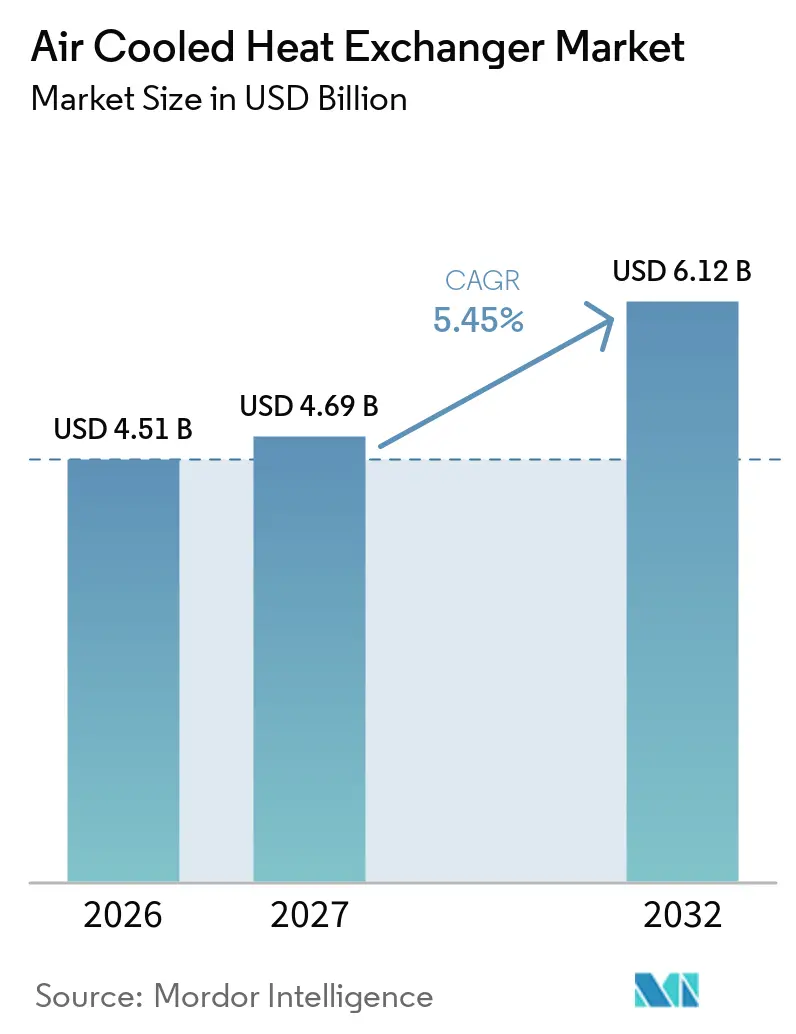
The Air Cooled Heat Exchanger Market size is expected to increase from USD 4.51 billion in 2026 to USD 4.69 billion in 2027 and reach USD 6.12 billion by 2032, growing at a CAGR of 5.45% over 2027-2032. The Global Air Cooled Heat Exchanger Market is gaining support from industrial operators that need to reduce their reliance on freshwater for cooling. Industry represented nearly 40% of global final energy consumption in 2025, making thermal efficiency an important operating issue for energy-intensive sites.[1] Demand now comes from oil and gas, liquefied natural gas (LNG), data centers, hydrogen, and carbon capture projects, rather than relying mainly on refinery investment. This broader base creates opportunities for suppliers that can serve both process cooling and digital infrastructure. It also places more emphasis on equipment performance during very hot weather, project timing, and the availability of specialized materials.
Key Report Takeaways
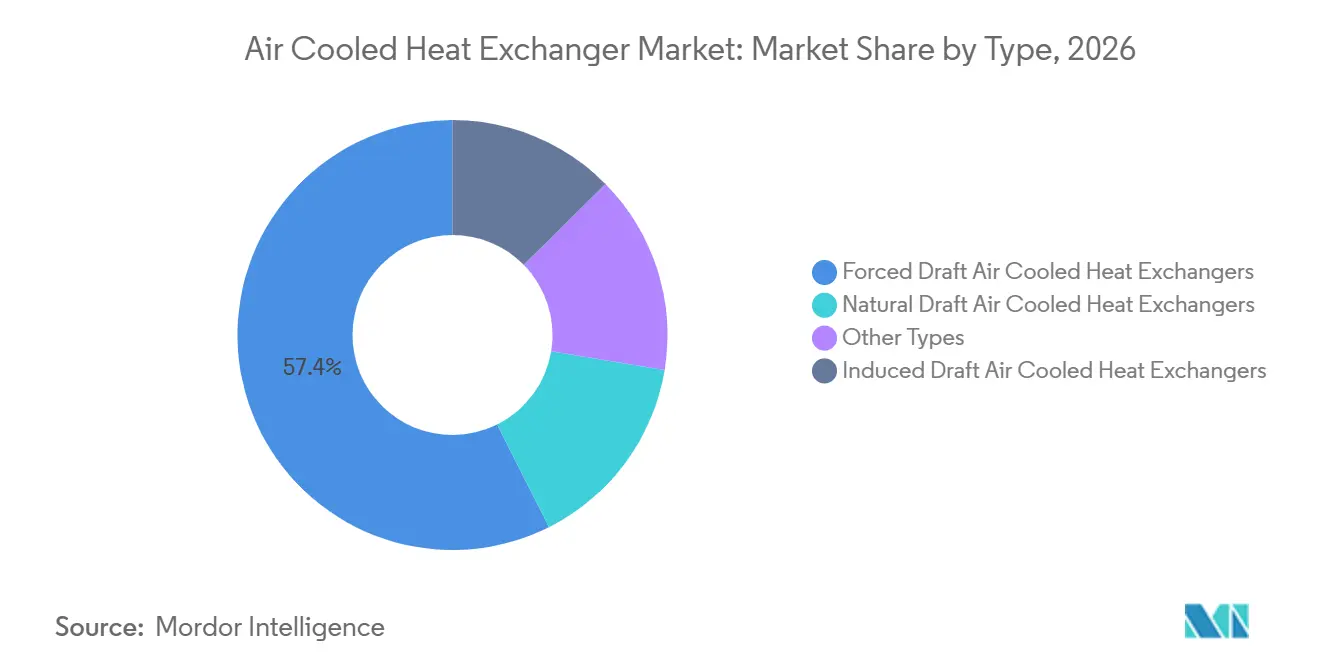
- By type, Forced Draft held 57.4% of the Global Air Cooled Heat Exchanger Market share in 2026, while Induced Draft is projected to grow at a 5.8% CAGR through 2032.
- By material, Carbon Steel held 32.7% share in 2026, while Stainless Steel is projected to grow at a 5.9% CAGR through 2032.
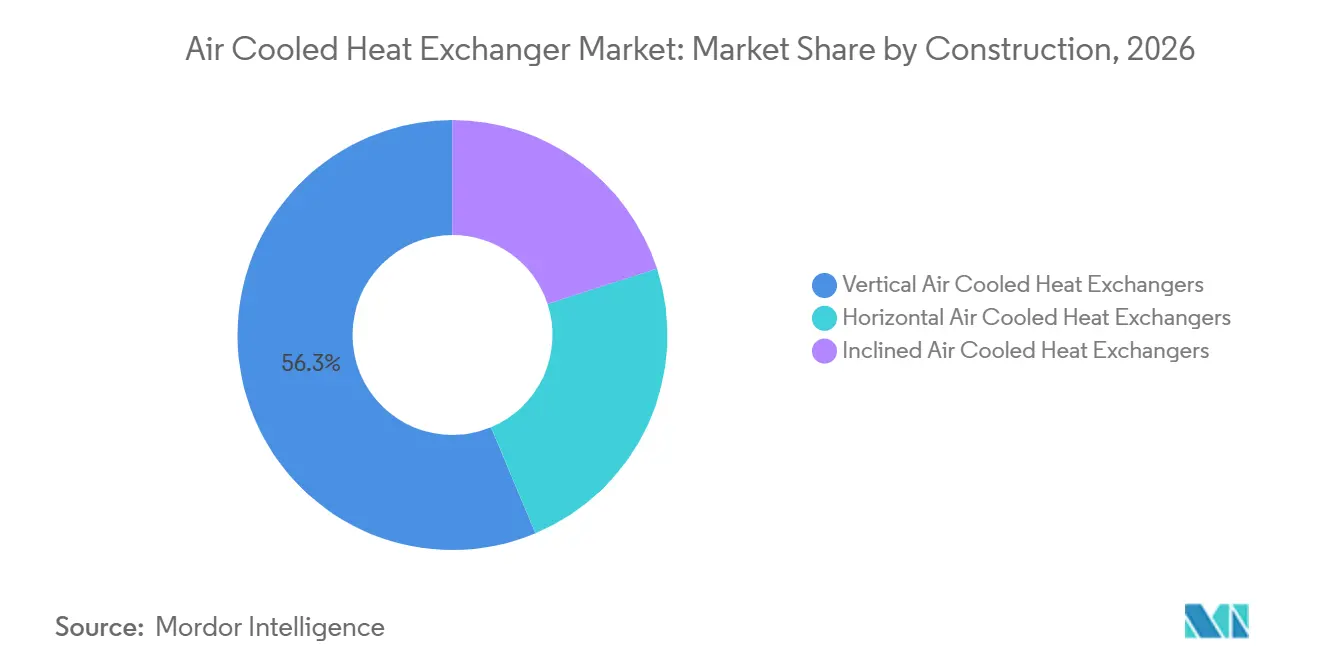
- By construction, Vertical configurations held 56.3% share in 2026, while Horizontal configurations are projected to grow at a 6.1% CAGR through 2032.
- By end-use industry, Oil and Gas held 47.1% share in 2026, while Data Centers are projected to grow at a 7.2% CAGR through 2032.
- By geography, Asia-Pacific held 34.8% share in 2026 and is projected to grow at a 6.3% CAGR through 2032.
Note: Market numbers in this report are based on Mordor Intelligence's proprietary estimation framework, which combines nine months of actuals with Q4 projections for base year 2026.
Market Trends and Insights
Drivers Impact Analysis of Air Cooled Heat Exchanger Market*
| Driver | (~) % Impact on CAGR Forecast | Geographic Relevance | Impact Timeline |
|---|---|---|---|
| Water Conservation and Cooling-Water Constraints | +1.1% | Global, concentrated in MENA, South Asia, and water-stressed Western U.S. | Short term (≤ 2 years) |
| Industrial Capacity Expansion in Chemicals, Refining, and Power | +0.9% | Asia-Pacific core, with spillover to Middle East and Africa and North America | Medium term (2-4 years) |
| Data Center and AI Infrastructure Heat-Rejection Demand | +1.3% | North America, Europe, and Asia-Pacific hyperscale corridors | Short term (≤ 2 years) |
| Energy Efficiency, Emissions, and Environmental Compliance | +0.8% | European Union, Germany, and jurisdictions with binding efficiency mandates | Medium term (2-4 years) |
| Modular Cooling for LNG, Hydrogen, and Carbon Capture | +0.7% | North American LNG export corridor and European hydrogen hubs | Medium term (2-4 years) |
| Lifecycle Digitalization and Predictive Maintenance | +0.4% | Global, led by process operators in North America and Europe | Long term (≥ 4 years) |
| Source: Mordor Intelligence | |||
Water Conservation and Cooling-Water Availability Constraints
Freshwater scarcity is changing industrial cooling from a design preference into an operating requirement in many locations. The global air cooled heat exchanger market benefits where groundwater rules and limited water supply make cooling towers harder to permit or operate. Data center operators are expanding the global air cooled heat exchanger market by selecting cooling approaches that can lower exposure to water availability constraints. New refineries and petrochemical complexes in Saudi Arabia, the United Arab Emirates, and parts of India are therefore favoring air-side cooling. Existing facilities are also evaluating partial conversions from cooling towers, which creates a retrofit opportunity beyond new construction. This work can require changes to pipework, structures, controls, and maintenance procedures before an existing site can reduce cooling-water use.
Data Center and AI Infrastructure Heat-Rejection Demand
Higher AI compute density is increasing heat loads and raising demand for cooling systems that reduce water use. Kelvion secured a contract exceeding USD 40 million for GigaBay Air Fin Coolers and coolant distribution units for the first 200+ MW phase of a U.S. AI data center in 2025.[2] Modine reported that data center cooling increased from 12% to 25% of net sales in fiscal 2025, alongside a USD 100 million capacity investment across 4 North American sites.[3] The global air cooled heat exchanger market is consequently drawing production capacity toward modular dry cooling equipment. Germany also requires data centers above 300 kW commissioned after July 2026 to reuse at least 15% of waste heat, which links cooling equipment selection to compliance. Equipment providers in the global air cooled heat exchanger market must therefore coordinate dry cooling, coolant distribution, fan controls, and heat-reuse interfaces when serving high-density installations.
Industrial Capacity Expansion in Chemicals, Refining, and Power
Refinery and petrochemical additions in China, India, and ASEAN countries are sustaining demand for process-duty equipment. The global air cooled heat exchanger market also receives demand from combined-cycle gas turbine plants and waste-to-energy facilities that require cooling for steam condensers and auxiliary systems. These projects are especially relevant in highly water-constrained industrial areas, where air-side equipment can avoid the water requirements of conventional cooling systems. The U.S. Environmental Protection Agency reconsidered Hazardous Organic National Emission Standards for Hazardous Air Pollutants (NESHAP) requirements for heat-exchange systems at chemical plants in March 2025.[4] The policy process has increased attention to equipment planning among chemical producers, even though projects continue to proceed. It also encourages global air cooled heat exchanger market operators to consider maintainability and operating integrity when defining replacement and expansion scopes.
High-Density Modular Cooling for LNG, Hydrogen, and Carbon Capture
Liquefied Natural Gas (LNG) construction produces large individual orders for air cooled heat exchangers and related cryogenic equipment. Chart Industries was selected in October 2025 to supply air cooled heat exchangers, brazed aluminum heat exchangers, and cold boxes for Sempra Infrastructure’s Port Arthur LNG Phase 2 project in Texas. The global air cooled heat exchanger market can benefit when suppliers combine cooling equipment with a wider process package. Hydrogen and carbon capture projects also require tighter material selection and pressure ratings because of their operating conditions. Digital monitoring can support these installations by tracking fouling, vibration, and declining thermal performance, which supports lifecycle service contracts. This approach can strengthen the global air cooled heat exchanger market by improving visibility over maintenance needs and giving plant teams more data for equipment planning.
Restraints Impact Analysis of Air Cooled Heat Exchanger Market*
| Restraint | (~) % Impact on CAGR Forecast | Geographic Relevance | Impact Timeline |
|---|---|---|---|
| High Initial Capital and Site-Integration Costs | -0.7% | Global, most acute in retrofit-heavy North American and European installations | Short term (≤ 2 years) |
| Reduced Thermal Performance in High-Ambient Conditions | -0.6% | MENA, South Asia, Mediterranean, and arid zones globally | Medium term (2-4 years) |
| Project-Cycle Exposure to Investment Decisions and Gas Prices | -0.4% | Global, concentrated in LNG-dependent Asia-Pacific and North America | Medium term (2-4 years) |
| Noise, Cybersecurity, and Data-Governance Requirements | -0.3% | Europe, North America, and smart-city-adjacent industrial zones | Long term (≥ 4 years) |
| Source: Mordor Intelligence | |||
High Initial Capital and Site-Integration Costs
Air cooled heat exchangers can cost 1.5 to 2.5 times more than an equivalent cooling-tower system on a first-cost basis. The cost gap becomes larger where duplex stainless steel, titanium, nickel alloys, or other specialized materials are needed. Brownfield projects can also require structural steel modifications and piping changes to fit fin-fan cooler bays. These changes can raise total installed costs by 30% to 50% above the equipment purchase price. Smaller plants face many of the same engineering mobilization costs as larger sites, which can limit adoption where financing is constrained. Procurement decisions across the global air cooled heat exchanger market must therefore weigh water savings, reliability needs, space limits, and long-term maintenance against the first installed cost.
Reduced Thermal Performance in High-Ambient Conditions
Air-side cooling cannot bring process outlet temperatures close to dry-bulb ambient conditions beyond a practical 5°C to 10°C difference in many duties. Sites where summer temperatures exceed 45°C can therefore require larger equipment, lower feed rates, adiabatic pre-cooling, or temporary wet-surface augmentation. The International Energy Agency identifies longer and hotter summers as a factor increasing cooling-related energy demand. This issue is relevant in the Arabian Gulf, northwest India, the Sahel, and Mediterranean locations. The global air cooled heat exchanger market also remains exposed to delayed LNG and petrochemical investment decisions, while connected equipment introduces requirements for noise control, cybersecurity, and data governance. These factors increase the importance of site-specific design conditions and careful evaluation of control-system responsibilities across the global air cooled heat exchanger market.
*Our forecasts treat driver/restraint impacts as directional, not additive. The impact forecasts reflect baseline growth, mix effects, and variable interactions.
Air Cooled Heat Exchanger Market Segment Analysis
By Type:
Forced Draft Leads, While Induced Draft Gains on PerformanceForced Draft held 57.4% of 2026 revenue, which makes it the largest configuration in the global air cooled heat exchanger market. Its established position reflects use in refineries, gas processing plants, compression stations, and LNG refrigerant service. Lower fan-drive energy requirements and simpler mechanical access support its continued use in these applications. Induced Draft is forecast to grow at a 5.8% CAGR through 2032 as engineers place more value on stable performance in hot locations. The design places the fan above the bundle, helping reduce recirculation of hot discharge air.
Induced Draft designs can also reduce noise because the bundle shields the fan. This combination is relevant to data centers and hydrogen projects, where thermal stability and acoustic control can outweigh initial equipment costs. Kelvion’s GigaBay Air Fin Coolers use an induced draft configuration for high-density AI data center service. EVAPCO launched the eco-Air Titan in 2025 for data centers, power generation, battery plants, and industrial processing. Natural Draft and other designs remain suited to large steam condensers and very large petrochemical facilities where fan operating costs must be minimized.

By Material:
Carbon Steel Remains the Mainstream Option, While Stainless Steel AcceleratesCarbon Steel held 32.7% of 2026 revenue and remains the workhorse material for general refinery and gas-processing duties. It remains suitable where streams are relatively clean, operating temperatures are moderate, and cost sensitivity is high. Stainless Steel is projected to grow at a 5.9% CAGR through 2032 as chemical, pharmaceutical, carbon capture, and hydrogen services expand. These services may involve corrosive or high-purity fluids that need greater corrosion resistance. The global air cooled heat exchanger market therefore has a growing need for materials chosen for service conditions rather than only initial cost.
Duplex Stainless Steel serves offshore and coastal installations where chloride stress-corrosion cracking can limit the use of austenitic grades. It also has a role in sour gas applications that must meet National Association of Corrosion Engineers (NACE) MR0175 and ISO 15156 material requirements. Aluminum remains widely used for fins because of its thermal conductivity and favorable weight-to-performance ratio. Thermofin opened a 23,000 m² factory in Pinghu, China, in September 2025 to serve large projects including data centers, stadiums, and food processing sites. Nickel alloys and titanium retain specialized positions in pharmaceutical, seawater, and sour hydrocarbon duties.
By Construction:
Vertical Systems Lead, While Horizontal Systems Benefit From Data Center DesignVertical configurations held 56.3% of 2026 revenue, reflecting their common use in oil and gas process plants. Their orientation fits established structural bays, plot plans, and maintenance routines at many refinery and gas facilities. Horizontal configurations are forecast to grow at a 6.1% CAGR through 2032, which is above the overall rate. Low-profile horizontal arrays fit data center buildings and can enable staged capacity additions without major structural changes. This construction preference supports the global air cooled heat exchanger market as hyperscale facilities add cooling capacity in phases.
Kelvion expanded manufacturing capacity in Tulsa, Oklahoma, to support large dry cooler production for North American data center customers. Inclined designs, including A-frame and V-frame systems, retain a stable role in steam condensing and combined-cycle gas turbine auxiliary cooling. Their geometry can help reduce recirculation risk in constrained plant layouts. SPG Dry Cooling supplies BoxAir, Hexacool, and W-Style systems for this part of the Global Air Cooled Heat Exchanger industry. Each orientation therefore remains tied to a different mix of plant layout, maintenance needs, and cooling duty.
By End-Use Industry:
Oil and Gas Holds the Largest Base, While Data Centers Grow FastestOil and Gas held 47.1% of 2026 revenue, supported by the concentration of cooling duties in refineries, compression stations, and LNG trains. SNT Energy reported that air cooler revenue represented 89.3% of its third-quarter 2025 sales, supported by export contracts for North American LNG projects. The segment continues to provide the largest installed base for the global air cooled heat exchanger market. Data Centers are forecast to grow at a 7.2% CAGR through 2032. Their demand is changing product development and manufacturing priorities among established suppliers.
Modine’s fiscal 2025 results showed the effect of this shift, as data center cooling rose from 12% to 25% of net sales. Chemical and Petrochemical, Power Generation, Heating, Ventilation, and Air Conditioning (HVAC) and Refrigeration, Food and Beverage, Pharmaceutical, and Metals and Manufacturing form the next group of end uses. Food and Beverage cooling is supported by equipment conversions toward natural refrigerants such as carbon dioxide and ammonia. Pharmaceutical and metals applications carry high per-unit value because they require specific material grades and cleanliness standards. Eurovent certification to EN 327, EN 328, and EN 1048 can assist procurement teams evaluating applicable equipment.
Geography Analysis
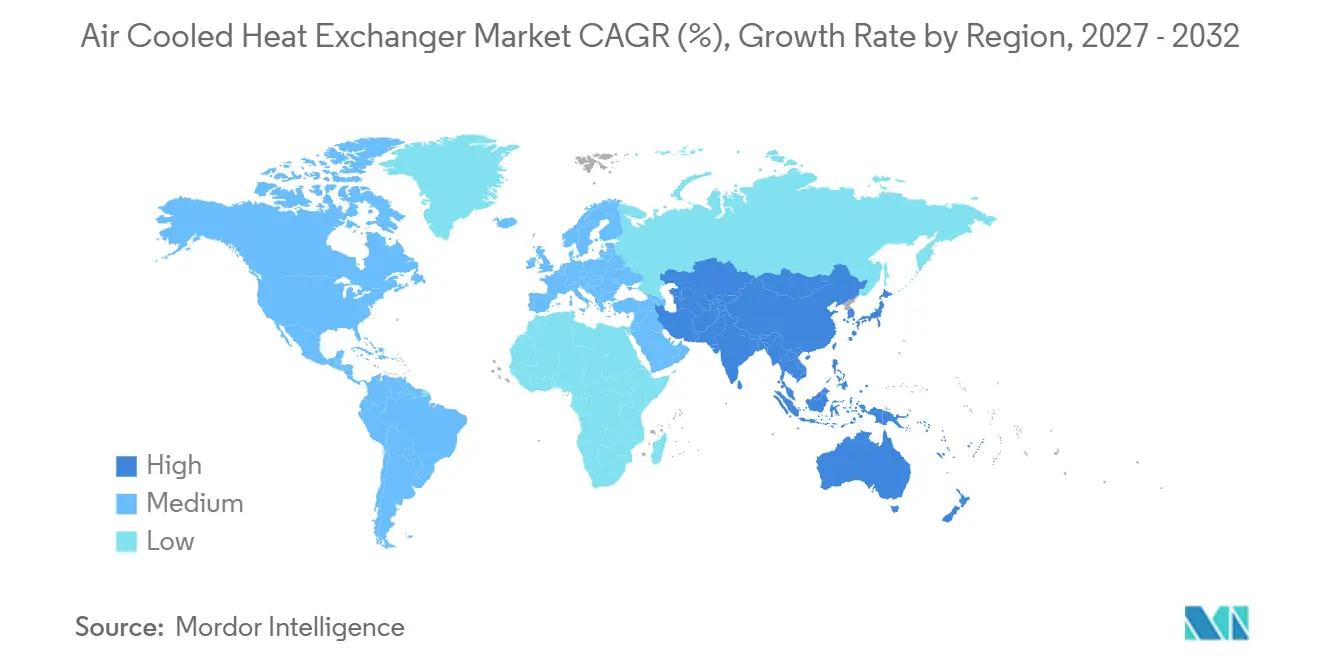
Asia-Pacific held 34.8% of 2026 revenue and is forecast to grow at a 6.3% CAGR through 2032. This combination makes the region the largest and fastest-growing part of the global air cooled heat exchanger market. China is directing investment toward integrated refining and chemical complexes in Shandong, Zhejiang, and Guangdong. India is expanding downstream capacity through public-sector oil company projects under the National Infrastructure Pipeline. Malaysia, Indonesia, and Thailand add demand from LNG regasification and petrochemical investment.
The Middle East and Africa remain important because arid conditions make air-side cooling operationally necessary across much of the hydrocarbon base. Saudi Arabia and the United Arab Emirates provide demand through Aramco and Abu Dhabi National Oil Company (ADNOC) expansion programs, while Egypt and Oman add refining and downstream projects. North America is the second-largest revenue contributor and a major center for data center and LNG procurement. Chart’s Port Arthur LNG Phase 2 award shows the scale of Gulf Coast project demand. The global air cooled heat exchanger market also gains from European energy-efficiency requirements, including the October 11, 2025, deadline for national transposition of the Energy Efficiency Directive.
Germany is an important European location for high-efficiency dry coolers and air cooled condensers used in data centers. Local production gives companies such as Kelvion and ENEXIO a position in this demand base. South America remains a smaller but expanding region led by Brazil’s refinery and pre-salt gas-processing investment. Argentina’s Vaca Muerta development and Colombia’s midstream projects add project-based requirements. Limits on freshwater withdrawal in Brazilian environmental licensing are gradually strengthening the case for air-side cooling at new sites.
Competitive Landscape
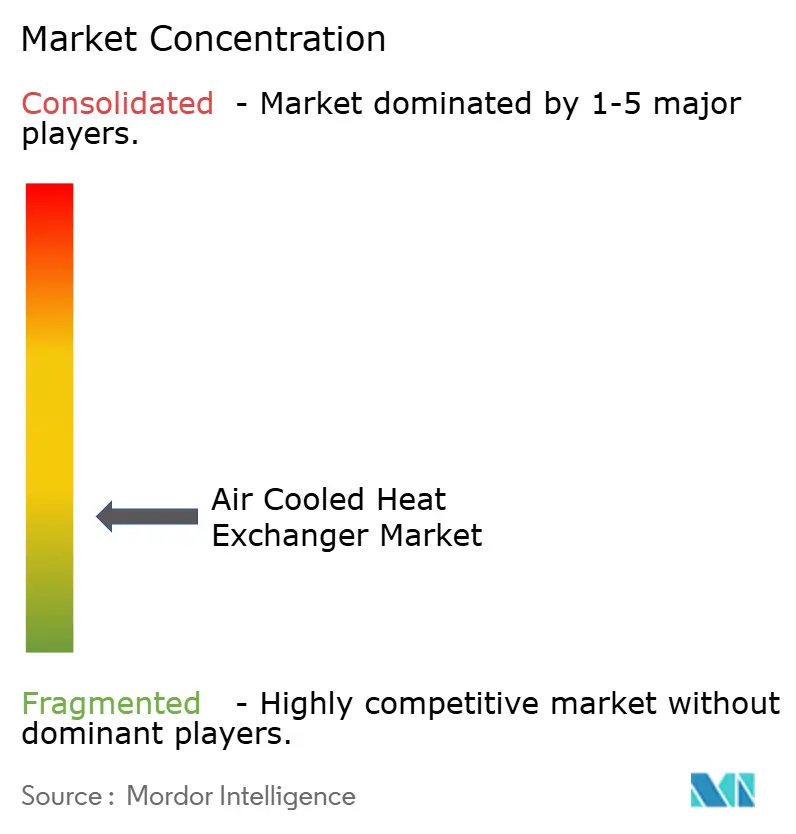
The global air cooled heat exchanger market is fragmented industry for standard fabrication. Large engineering groups compete for LNG and data center orders where technical qualifications, production capacity, and project execution are important. Regional fabricators compete more directly on price and delivery time for standard refinery and chemical work. Baker Hughes completed the USD 13.6 billion acquisition of Chart Industries on July 16, 2026, creating a combined supplier of cooling, LNG process, rotating, and digital monitoring equipment. Chart became Baker Hughes’ third reporting segment and recorded USD 4.3 billion of fiscal 2025 revenue.
Apollo completed its acquisition of Kelvion in January 2026, and SLB announced an agreement in August 2026 to acquire Kelvion for USD 4.1 billion, subject to approvals. These transactions reflect the value placed on data center cooling and energy infrastructure capabilities. Modine, LU-VE, and EVAPCO are expanding manufacturing capacity across North America, Europe, and Asia to serve hyperscale customers. SNT Energy is using its Saudi Aramco Corporate Procurement Agreement and LNG project record to deepen its oil and gas position. Suppliers that integrate monitoring for fouling, vibration, and thermal performance can create service revenue alongside equipment sales.
EVAPCO’s eco-Air Titan uses large-diameter fans and stainless-steel tubing that meet American Society of Mechanical Engineers (ASME) B31.5 requirements. Eurovent’s testing framework for heat exchangers includes acoustic performance under EN 13487:2019, which makes certification useful in regulated European procurement. The global air cooled heat exchanger market therefore rewards technical documentation and recognized performance testing as well as manufacturing scale. Alfa Laval, Baker Hughes, Kelvion, Modine, EVAPCO, LU-VE, SNT Energy, SPG Dry Cooling, and other producers address different parts of the application range.
Air Cooled Heat Exchanger Industry Leaders
-
Alfa Laval AB
-
Chart Industries, Inc.
-
Kelvion Holding GmbH
-
SPX Technologies, Inc.
-
Thermax Limited
- *Disclaimer: Major Players sorted in no particular order
Air Cooled Heat Exchanger Market Companies Covered in this Report
- Alfa Laval AB
- API Heat Transfer, Inc.
- Armstrong International, Inc.
- Baker Hughes Company
- BGR Energy Systems Limited
- Chart Industries, Inc.
- ENEXIO Management GmbH
- EVAPCO, Inc.
- Exchanger Industries Limited
- Güntner GmbH & Co. KG
- Kawasaki Heavy Industries, Ltd.
- Kelvion Holding GmbH
- KNM Group Berhad
- LU-VE S.p.A.
- Modine Manufacturing Company
- SNT Energy Co., Ltd.
- SPG Dry Cooling
- SPX Technologies, Inc.
- Thermax Limited
- Thermofin GmbH
Recent Industry Developments in Air Cooled Heat Exchanger Market
- October 2026: Chart Industries was awarded a contract by Bechtel Energy Inc. to supply air cooled heat exchangers, brazed aluminum heat exchangers, and cold boxes for Sempra Infrastructure's Port Arthur LNG Phase 2 project in Jefferson County, Texas, building on Chart's prior Phase 1 supply role and reinforcing its position as a preferred air cooled heat exchanger supplier to the Gulf Coast LNG export corridor.
- August 2026: SLB (formerly Schlumberger) announced an agreement to acquire Kelvion from Apollo-managed funds and Triton for approximately USD 4.1 billion (USD 3.4 billion cash plus approximately USD 700 million of assumed debt), aiming to embed Kelvion's thermal management platform, now operating across data centers, hydrogen, carbon capture, and energy transition markets, into SLB's industrial technology portfolio. The transaction is subject to regulatory approvals and is expected to close in the first half of 2027.
- July 2026: Baker Hughes completed its acquisition of Chart Industries on July 16, 2026, pursuant to the July 2025 Merger Agreement, establishing Chart as Baker Hughes' third operating segment. The combined entity targets USD 325 million in annualized cost synergies by year three and serves customers across gas infrastructure, data centers, carbon capture, nuclear, and geothermal sectors.
- October 2025: SNT Energy Co., Ltd. signed an air cooler supply contract with Bechtel Energy Inc. valued at KRW 341.6 billion (approximately USD 246 million) for a North American LNG project, with a supply period extending to March 2027, adding to the company's growing North American backlog across multiple LNG facilities.
Global Air Cooled Heat Exchanger Market Report Scope
An air-cooled heat exchanger (ACHE), also known as an air cooler, fin-fan cooler, or air fin cooler, is an industrial device that cools or condenses process fluids (such as water, oil, gas, or chemicals) using ambient air instead of water.
The air cooled heat exchanger market is segmented into type, material, construction, end-use industry, and geography. By type, the market is divided into forced draft air cooled, heat exchangers, induced draft air cooled heat exchangers, natural draft air cooled heat exchangers, and other types. By material, the market is divided into carbon steel, stainless steel, duplex stainless steel, aluminum, nickel and nickel alloys, titanium, and other materials. By construction, the market is segmented into horizontal air cooled heat exchangers, vertical air cooled heat exchangers, and inclined air cooled heat exchangers. By end use industry, the market is segregated into oil and gas, chemical and petrochemical, power generation, HVAC and refrigeration, data centers, food and beverage, pharmaceutical, metals and manufacturing, and other industries. The report also covers the market size and forecasts for the global air cooled heat exchanger market across 26 countries in key regions. For each segment, the market sizing and forecasts have been provided on the basis of value (USD).
Segmentation Overview
| Forced Draft Air Cooled Heat Exchangers |
| Induced Draft Air Cooled Heat Exchangers |
| Natural Draft Air Cooled Heat Exchangers |
| Other Types |
| Carbon Steel |
| Stainless Steel |
| Duplex Stainless Steel |
| Aluminum |
| Nickel and Nickel Alloys |
| Titanium |
| Other Materials |
| Horizontal Air Cooled Heat Exchangers |
| Vertical Air Cooled Heat Exchangers |
| Inclined Air Cooled Heat Exchangers |
| Oil and Gas |
| Chemical and Petrochemical |
| Power Generation |
| HVAC and Refrigeration |
| Data Centers |
| Food and Beverage |
| Pharmaceutical |
| Metals and Manufacturing |
| Other Industries |
| North America | United States |
| Canada | |
| Mexico | |
| Europe | Germany |
| France | |
| Italy | |
| Spain | |
| United Kingdom | |
| Netherlands | |
| Norway | |
| Russia | |
| Rest of Europe | |
| Asia-Pacific | China |
| India | |
| Japan | |
| Australia | |
| Indonesia | |
| Malaysia | |
| Thailand | |
| Rest of Asia-Pacific | |
| South America | Brazil |
| Argentina | |
| Colombia | |
| Rest of South America | |
| Middle East and Africa | Saudi Arabia |
| United Arab Emirates | |
| Egypt | |
| Oman | |
| Nigeria | |
| Rest of Middle East and Africa |
| By Type | Forced Draft Air Cooled Heat Exchangers | |
| Induced Draft Air Cooled Heat Exchangers | ||
| Natural Draft Air Cooled Heat Exchangers | ||
| Other Types | ||
| By Material | Carbon Steel | |
| Stainless Steel | ||
| Duplex Stainless Steel | ||
| Aluminum | ||
| Nickel and Nickel Alloys | ||
| Titanium | ||
| Other Materials | ||
| By Construction | Horizontal Air Cooled Heat Exchangers | |
| Vertical Air Cooled Heat Exchangers | ||
| Inclined Air Cooled Heat Exchangers | ||
| By End-Use Industry | Oil and Gas | |
| Chemical and Petrochemical | ||
| Power Generation | ||
| HVAC and Refrigeration | ||
| Data Centers | ||
| Food and Beverage | ||
| Pharmaceutical | ||
| Metals and Manufacturing | ||
| Other Industries | ||
| By Geography | North America | United States |
| Canada | ||
| Mexico | ||
| Europe | Germany | |
| France | ||
| Italy | ||
| Spain | ||
| United Kingdom | ||
| Netherlands | ||
| Norway | ||
| Russia | ||
| Rest of Europe | ||
| Asia-Pacific | China | |
| India | ||
| Japan | ||
| Australia | ||
| Indonesia | ||
| Malaysia | ||
| Thailand | ||
| Rest of Asia-Pacific | ||
| South America | Brazil | |
| Argentina | ||
| Colombia | ||
| Rest of South America | ||
| Middle East and Africa | Saudi Arabia | |
| United Arab Emirates | ||
| Egypt | ||
| Oman | ||
| Nigeria | ||
| Rest of Middle East and Africa | ||
Key Questions Answered in the Report
What is the projected value of the Global Air Cooled Heat Exchanger Market by 2032?
The Global Air Cooled Heat Exchanger Market is projected to reach USD 6.12 billion by 2032, from USD 4.69 billion in 2027, with a 5.45% CAGR expected over the forecast period.
What is driving demand for air cooled heat exchangers?
Water constraints, refinery and LNG investment, data center cooling, hydrogen projects, and energy-efficiency requirements support demand, while retrofit activity adds demand beyond new-build installations.
Which type of air cooled heat exchanger has the largest share?
Forced Draft units held 57.4% of revenue in 2026, supported by their broad use in refinery, gas-processing, and LNG service, where straightforward access and fan energy use remain important.
Which end-use application is growing fastest?
Data Centers are projected to grow at a 7.2% CAGR through 2032 as AI workloads raise heat-rejection requirements and operators seek systems that support water and heat-reuse objectives.
Which region leads demand and growth?
Asia-Pacific held 34.8% of revenue in 2026 and is projected to grow at a 6.3% CAGR through 2032, supported by continuing refining, petrochemical, LNG, and data center investment across several major economies.
What are the main limitations of air cooled heat exchangers?
High initial and integration costs, lower efficiency during extreme heat, project-cycle risk, and connected-system requirements are key limitations that must be assessed for each site and duty, particularly where operating temperatures, site space, or retrofit conditions are demanding.