
Agentic AI Managed Services Market Size and Share
Market Overview
| Study Period | 2020 - 2031 |
|---|---|
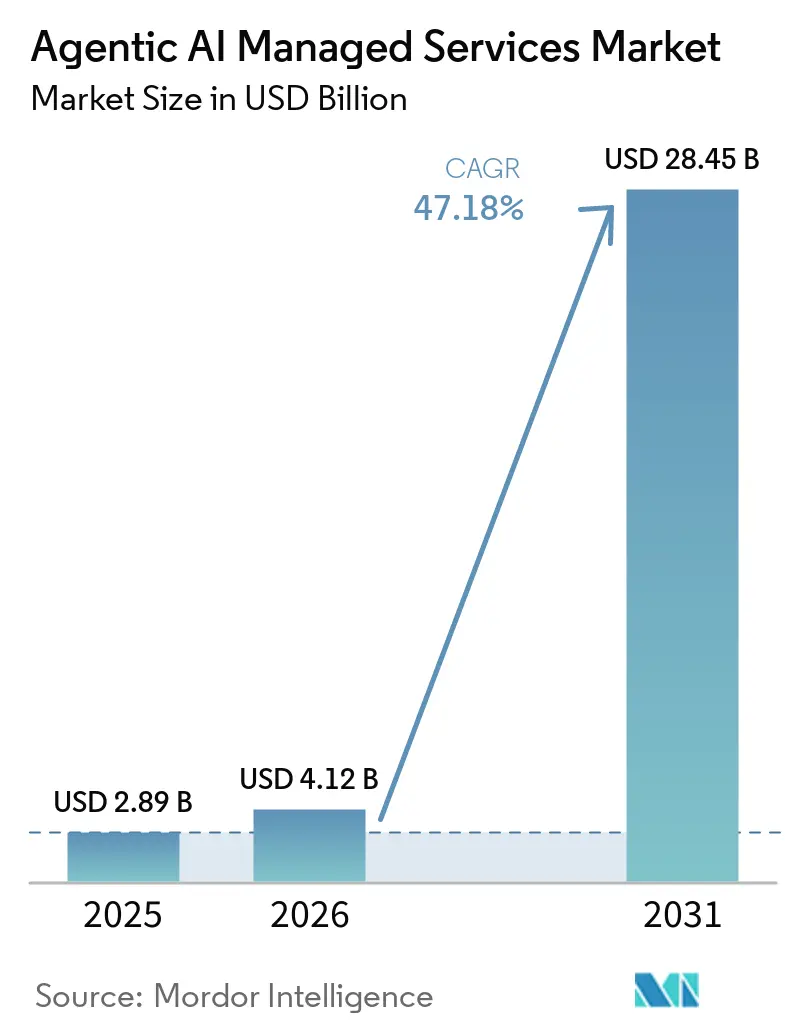
| Market Size (2026) | USD 4.12 Billion |
| Market Size (2031) | USD 28.45 Billion |
| Growth Rate (2026 - 2031) | 47.18 % |
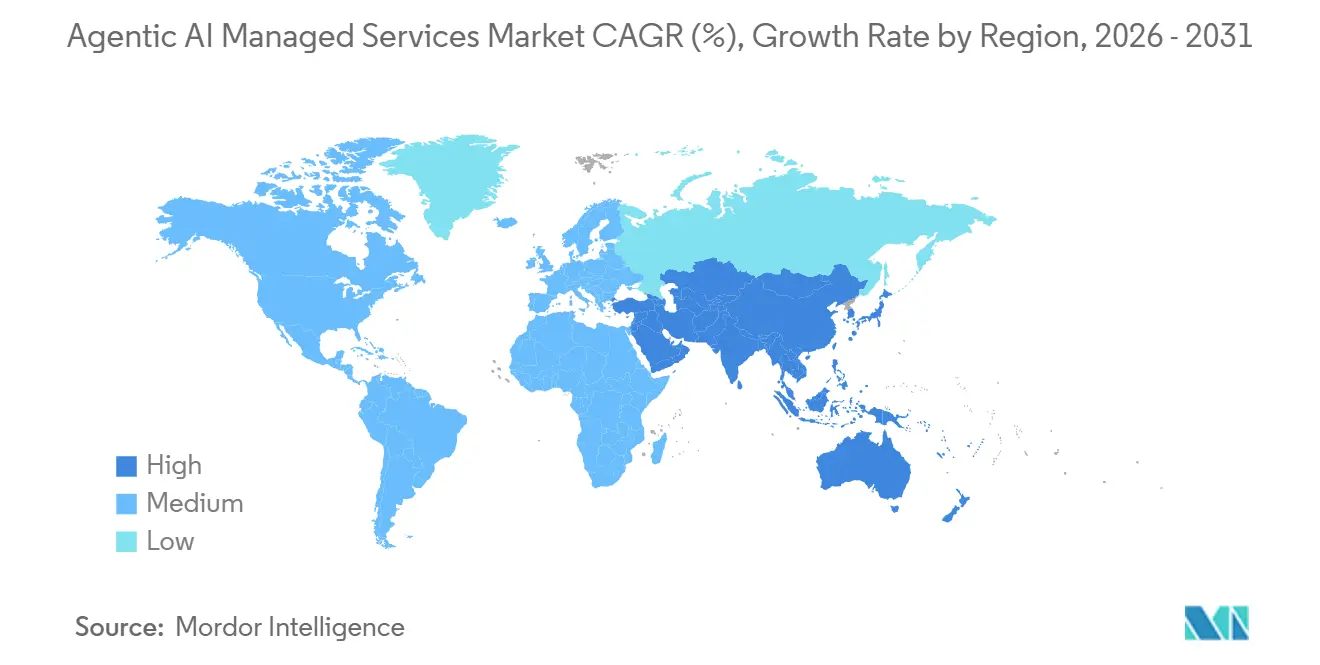
| Fastest Growing Market | Asia-Pacific |
| Largest Market | North America |
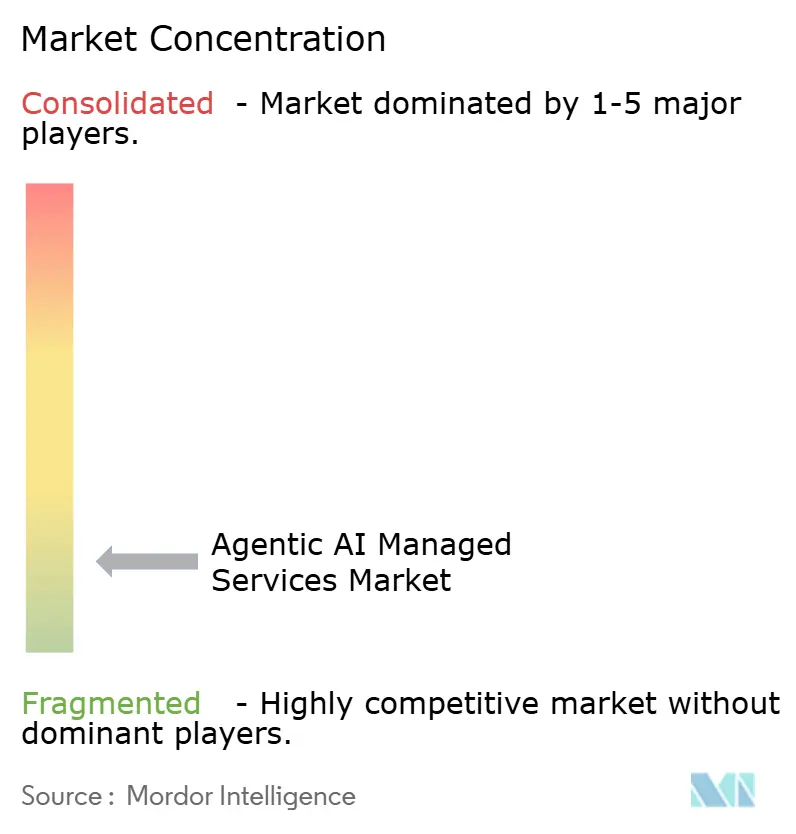
| Market Concentration | Low |
Major Players *Disclaimer: Major Players sorted in no particular order Image © Mordor Intelligence. Reuse requires attribution under CC BY 4.0. | |
Agentic AI Managed Services Market Analysis by Mordor Intelligence
The agentic AI managed services market size is projected to expand from USD 2.89 billion in 2025 to USD 4.12 billion in 2026, and to USD 28.45 billion by 2031, registering a CAGR of 47.18% between 2026 and 2031. The agentic AI managed services market is moving from limited pilots toward operating models that support autonomous workflows across core functions. Enterprises increasingly need outside support because agent deployment, monitoring, version control, and governance require capabilities that many internal teams do not yet have. Cloud-managed runtimes are shortening implementation work and are making production deployment more practical for a wider set of organizations. Providers are therefore competing to combine integration, operational oversight, security controls, and industry-specific process knowledge in a single service relationship. The strongest opportunities in the agentic AI managed services market are tied to regulated workflows, where reliable oversight and documented accountability are as important as automation performance.
Key Report Takeaways
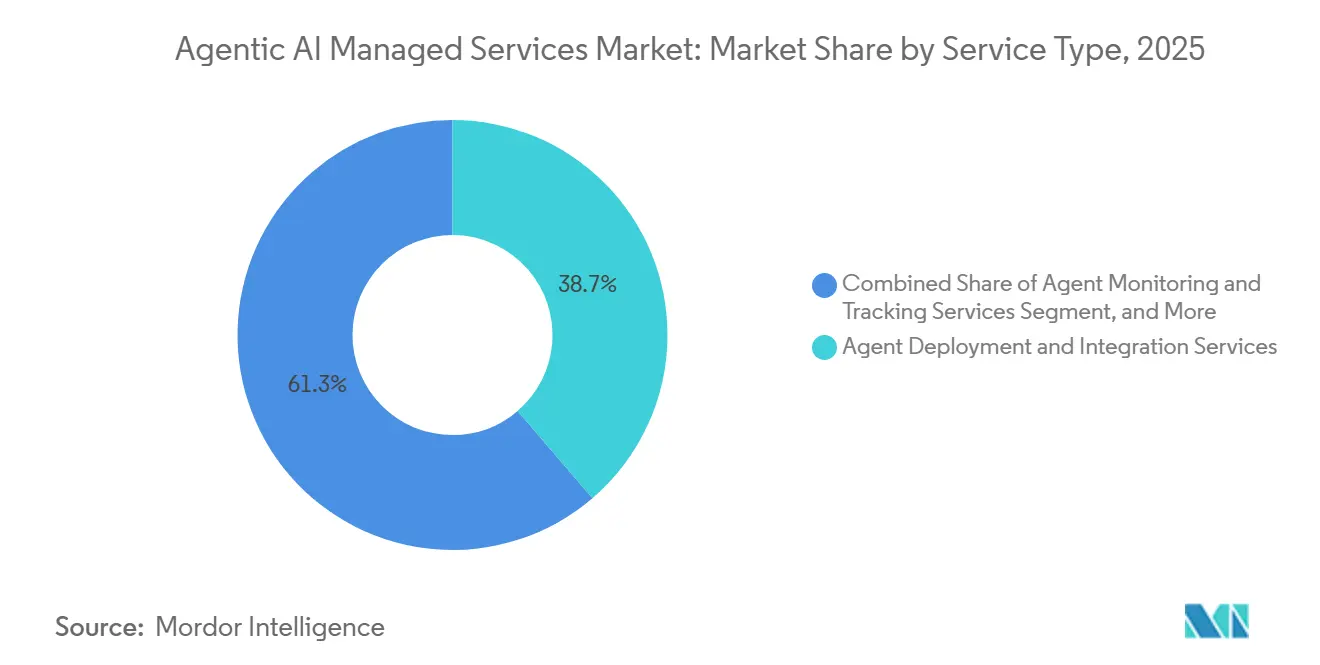
- By service type, Agent Deployment and Integration Services held 38.72% of the agentic AI managed services market in 2025, while Agent Governance and Compliance Services is projected to expand at a 48.16% CAGR through 2031.
- By deployment model, cloud deployment accounted for 66.38% in 2025 and is projected to expand at a 47.58% CAGR through 2031 in the agentic AI managed services market.
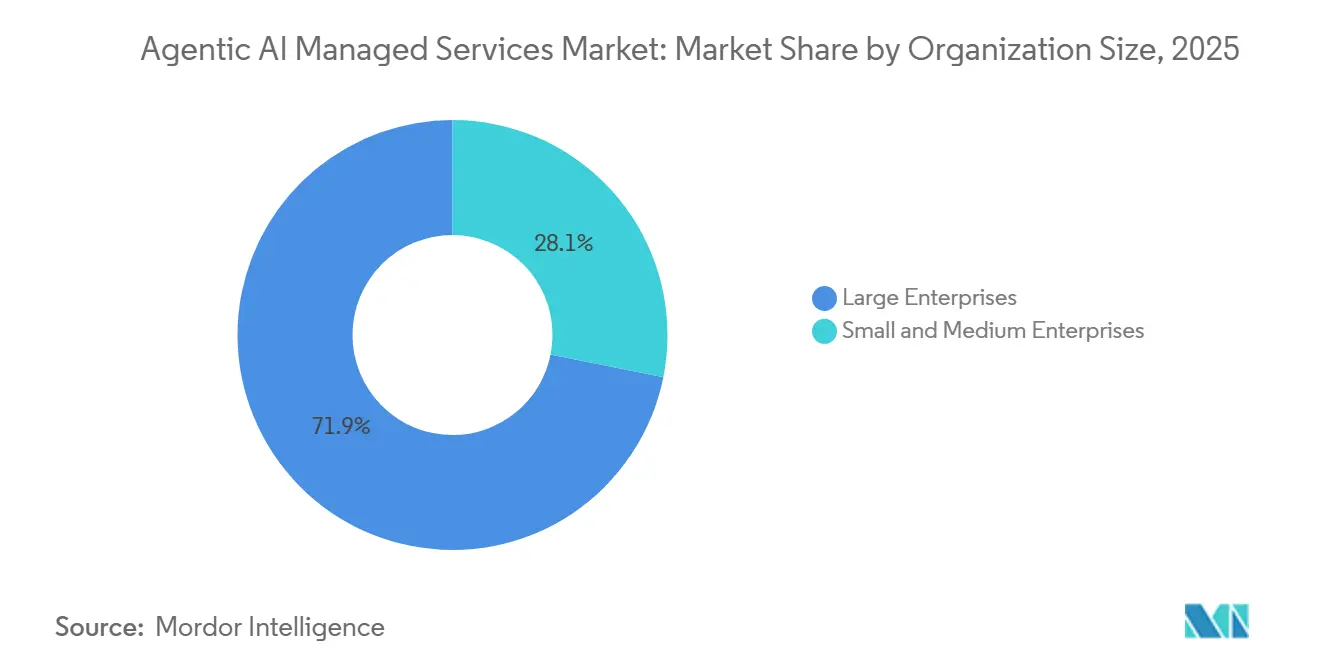
- By organization size, large enterprises held 71.86% in 2025, while small and medium enterprises are projected to expand at a 47.53% CAGR through 2031 in the agentic AI managed services market.
- By end-user industry, BFSI accounted for 26.43% in 2025, while healthcare and life sciences is projected to expand at a 49.12% CAGR through 2031.
- By geography, North America held 38.73% of the global market in 2025, while Asia-Pacific is projected to expand at a 48.19% CAGR through 2031.
Note: Market size and forecast figures in this report are generated using Mordor Intelligence’s proprietary estimation framework, updated with the latest available data and insights as of January 2026.
Market Trends and Insights
Drivers Impact Analysis of Agentic AI Managed Services Market*
| Driver | (~) % Impact on CAGR Forecast | Geographic Relevance | Impact Timeline |
|---|---|---|---|
| Demand for Autonomous End-to-End Workflows | +13.5% | Global, with North America and Europe advanced and Asia-Pacific scaling | Short term (≤ 2 years) |
| Need for Agent Monitoring and Observability | +9.8% | North America, United Kingdom, and core Asia-Pacific markets | Medium term (2-4 years) |
| Expansion of Multi-Agent Orchestration | +8.6% | Global, with North America leading and Asia-Pacific scaling | Medium term (2-4 years) |
| Cloud-Native AI Infrastructure and Managed Runtimes | +6.7% | Global, with North America and Asia-Pacific dominant | Short term (≤ 2 years) |
| Agentic Services for Legacy-System Modernization | +4.2% | North America, Europe, and Japan | Long term (≥ 4 years) |
| Shortage of AgentOps and Governance Talent | +3.1% | Global, with shortages most acute in Asia-Pacific and Europe | Short term (≤ 2 years) |
| Source: Mordor Intelligence | |||
Enterprise Demand for Autonomous End-to-End Workflow Execution
Demand for full-process automation is driving the agentic AI managed services market more strongly than demand for task-level support. Organizations are shifting their focus from isolated assistants to agents capable of completing connected actions across finance, operations, customer service, and technology functions. This transition creates a need for providers that can integrate agents with enterprise resource planning, customer relationship management, and IT service management systems. Legacy integration work, variable AI operating costs, and digital labor economics make these programs difficult to run with a small internal team. Deployment and integration contracts are consequently shifting toward continuing operations arrangements rather than one-time implementation work. Consumption and outcome-based pricing also align the provider's work with the value that a customer expects from an automated workflow.
Production Need for Agent Monitoring and Observability
The agentic AI managed services market depends on reliable production monitoring because autonomous systems can fail in ways that traditional application tools may not detect. A production agent can follow an unsuitable prompt path, use a tool incorrectly, or consume tokens at an unexpected rate without creating a conventional system error. Arize AI raised USD 70 million in February 2025 to expand evaluation and observability tools for large language models and AI agents in enterprise environments.[1] Monitoring providers are addressing this gap through tracing, evaluation, budget controls, regression checks, and escalation rules. Managed service providers can package those activities with human review procedures, which support a more complete operating model for customers. The evaluation layer is becoming important before production as enterprises test how agents respond to unusual or high-risk conditions.
Expansion of Multi-Agent Orchestration Across Enterprise Systems
The agentic AI managed services market is also shaped by deployments in which specialized agents hand work to one another across several systems. Microsoft Foundry Agent Service supports multi-agent workflows through visual and YAML-based orchestration, providing organizations with a governed approach to designing and monitoring multi-step processes. IBM watsonx Orchestrate provides a central layer that routes work to the appropriate agent or tool in real time. These arrangements require clear rules for trust, communications, permissions, and escalation when a process cannot continue. The management task becomes more demanding as each additional agent introduces another point of dependency. Providers that manage orchestration over time can support longer engagements because process changes and system updates require continuing attention.
Cloud-Native AI Infrastructure and Managed Runtime Adoption
Cloud-native runtimes reduce the infrastructure work that can delay agent deployment in the agentic AI managed services market. Google Cloud's Vertex AI Agent Engine provides managed support for agent context, scaling, security, evaluation, and monitoring, reducing the need to rebuild these capabilities when a prototype moves into production. AWS guidance describes swarm, graph, and hierarchical coordination patterns for enterprise multi-agent deployments. Such services allow customers to focus more of their effort on process design and data controls. They also make it easier for managed service providers to standardize repeatable operating procedures across client environments. Cloud platforms do not remove governance requirements, but they make secure scaling and operational monitoring more accessible.
Restraints Impact Analysis of Agentic AI Managed Services Market*
| Restraint | (~) % Impact on CAGR Forecast | Geographic Relevance | Impact Timeline |
|---|---|---|---|
| Unclear Accountability for Autonomous Decisions | -5.8% | Global, most acute in the European Union under Article 50 requirements effective August 2026 | Medium term (2-4 years) |
| Data Privacy, Security, and Regulatory Exposure | -4.6% | European Union, Asia-Pacific, and North America | Long term (≥ 4 years) |
| Unstable Behavior After Model and Tool Updates | -3.2% | Global | Short term (≤ 2 years) |
| Cost Leakage and Unpredictable Agent Usage | -2.1% | North America and early Asia-Pacific adopters | Short term (≤ 2 years) |
| Source: Mordor Intelligence | |||
Unclear Accountability for Autonomous Decisions
Autonomous decisions in financial, operational, and customer-facing processes create accountability questions that can slow the agentic AI managed services market. A provider must be able to show how an agent reached an action, what data and tools it used, and when a human could intervene. Article 50 transparency obligations took effect on August 2, 2026, increasing the need for documented agent provenance in relevant European deployments.[2] The issue is more difficult for multi-agent systems because responsibility must be traced across several connected actions. Customers in BFSI and healthcare are less likely to approve deployments if a vendor cannot provide a reliable decision trail. This places a premium on audit records, human escalation procedures, and clear responsibility across the provider and customer teams.
Data Privacy, Security, and Regulatory Exposure
Agentic systems often need access to customer records, financial ledgers, clinical notes, and other sensitive stores to complete useful work. That access increases the impact of a misconfiguration, a prompt injection attempt, or a poorly scoped tool permission. The Cloud Security Alliance reported that 92% of surveyed organizations were concerned about the security implications of AI agents, while many identified gaps in comprehensive AI security governance. Cross-border processing can create further review requirements when data moves across jurisdictions. Providers are responding with zero-trust agent identities and permissions that are limited to specific actions. Security reviews may lengthen procurement timelines, especially when an agent will act on sensitive information or within a regulated process.
*Our forecasts treat driver/restraint impacts as directional, not additive. The impact forecasts reflect baseline growth, mix effects, and variable interactions.
Agentic AI Managed Services Market Segment Analysis
By Service Type:
Deployment Leads While Governance Scales RapidlyAgent Deployment and Integration Services held 38.72% of the agentic AI managed services market share in 2025. This position reflects the immediate priority of connecting agents with established enterprise resource planning, customer relationship management, and IT service management platforms. Customers often need support to move an agent from design into a live process without interrupting existing operations. Monitoring and observability services serve organizations that have passed initial implementation and now need more stable daily operations. Versioning and lifecycle management services address the need to control changes across prompts, models, tools, and agent configurations. Other services, including cost optimization and service-level agreement management, address concerns about token usage and performance commitments.
Agent Governance and Compliance Services is projected to expand at a 48.16% CAGR through 2031. The higher rate reflects the need to place controls around autonomous actions before they affect regulated or customer-facing processes. Governance work is increasingly considered earlier in a deployment cycle because a later control failure can require a costly rollback. Pre-production testing is also becoming more important when a customer needs evidence that an agent behaves properly under unusual conditions. Providers that include governance and compliance capabilities in a deployment agreement can address these concerns before a full workflow is released. Within the agentic AI managed services industry, this approach can improve continuity by reducing the risk that customers discover material control gaps after deployment.

By Deployment Model:
Cloud Dominates Scale and SpeedCloud deployment accounted for 66.38% of the agentic AI managed services market size in 2025 and is projected to expand at a 47.58% CAGR through 2031. Its position is supported by elastic infrastructure, integrated monitoring tools, managed identity controls, and shorter implementation cycles. AWS Bedrock AgentCore, Google Cloud Vertex AI Agent Engine, and Microsoft Foundry Agent Service provide managed environments that influence how providers design and operate services. Cloud platforms enable a provider to offer repeatable processes without having to build the same foundational infrastructure for each client. Ongoing migration of business applications to cloud environments supports this model. The limited availability of on-premises alternatives with comparable capabilities also favors cloud adoption.
On-premises environments remain relevant where data sovereignty, air-gapped security, or strict latency needs limit cloud use. Financial market infrastructure operators, defense contractors, and national government agencies are important demand groups for these deployments. These organizations can require premium service arrangements because maintaining a production-grade agent environment without hyperscale infrastructure is operationally complex. Interoperability standards such as Agent2Agent and Model Context Protocol are becoming a useful technical baseline for providers serving these customers. A provider must manage connections among models, tools, and data sources without weakening the customer's security posture. This preserves a focused role for on-premises services even as cloud-based delivery remains the main deployment model.
By Organization Size:
Large Enterprises Lead While SMEs ExpandLarge enterprises held 71.86% of the agentic AI managed services market in 2025. Their scale, established relationships with automation suppliers, mature governance structures, and data environments make it easier to support complex managed contracts. Large organizations also operate cross-functional workflows where multi-agent orchestration can have the widest operational reach. Automation Anywhere introduced Autonomous IT and Autonomous Finance solutions in May 2026 with Accenture, using process intelligence across 22 industries to address enterprise IT and finance functions. BFSI, IT and telecommunications, manufacturing, government, and professional services all contribute to this demand. These buyers generally have the budget and governance resources to move from separate proofs of concept to broader operating programs.
Small and medium enterprises are projected to expand at a 47.53% CAGR through 2031. Managed delivery makes agent capabilities available to organizations that cannot maintain dedicated AgentOps and governance teams. Standardized monthly operations pricing can make the service model easier to adopt than a large internal technology program. Smaller businesses can also benefit as vertical software suppliers embed agent functions into managed offerings that are tailored to their processes. The accessible customer base can therefore extend beyond organizations with substantial existing AI infrastructure. This changes the role of a provider from a specialist implementation partner to an ongoing operator of a practical business capability.
By End-User Industry:
BFSI Anchors Demand as Healthcare AdvancesBFSI accounted for 26.43% of the agentic AI managed services market share in 2025. The sector's position reflects its long history of enterprise automation and the volume of repeatable, rules-based work across risk, reporting, reconciliation, and operations. Fiserv launched agentOS in May 2026 as an operating system for agentic AI in banking, including a marketplace for agents serving risk management, regulatory reporting, deposit operations, and back-office reconciliation. Broadridge stated that its May 2026 institutional deployment across capital markets and wealth operations could offer clients up to 30% Day 1 operational cost reduction. These workflows need strong auditability because a faulty decision can have regulatory and customer consequences. Managed providers that combine integration with clear controls are better suited to this requirement.
Healthcare and life sciences are projected to expand at a 49.12% CAGR through 2031. Administrative workload, workforce constraints, revenue cycle tasks, and prior authorization create a broad set of potential agent-supported processes. Amazon Web Services launched Amazon Connect Health in March 2026 with 5 HIPAA-eligible agentic AI agents for patient engagement and point-of-care workflows. Healthcare customers require continuing human oversight and infrastructure that meets sector-specific requirements. This supports services that can supervise agents over time rather than simply deploy them. IT and telecommunications, retail and e-commerce, manufacturing, professional services, and public-sector users form the next tier of demand, while government programs can take longer to approve but offer substantial potential in document processing and citizen service routing.
Geography Analysis
North America Agentic AI Managed Services Market
North America held 38.73% of the agentic AI managed services market in 2025. The region combines dense hyperscaler infrastructure with numerous BFSI organizations running agents in production. It also has a wide base of observability, governance, and enterprise automation suppliers. Citi's Arc platform, HSBC's Google Cloud banking collaboration, and Broadridge's production work illustrate the level of financial services activity in the region. Arize AI, Patronus AI, and Automation Anywhere represent part of the supplier base supporting this demand. The agentic AI managed services market, therefore, benefits from an established technology ecosystem and a customer base capable of funding complex deployments.
APAC Agentic AI Managed Services Market
Asia-Pacific is projected to expand at a 48.19% CAGR through 2031. India's technology services capacity, Singapore's role in financial technology, and faster enterprise AI adoption in Japan, South Korea, and Singapore support the regional outlook. DBS Group introduced an agentic AI assistant for 350,000 corporate clients in Singapore in July 2026 and planned to extend it to 100,000 additional users in Hong Kong by September 2026. The scale of this rollout indicates that financial services organizations in the region are moving toward broad operational use. Providers with delivery capabilities in India can support regional customers while adapting services to local data, language, and regulatory conditions. This combination makes Asia-Pacific a central expansion area for the agentic AI managed services market.
EMEA and South America Agentic AI Managed Services Market
Europe is the second-largest regional market, with the United Kingdom, Germany, and France representing high-value enterprise buyers. Germany's security-oriented adoption of managed services supports demand for governance-enabled AI services, particularly where deployment requires formal control structures. The EU AI Act provides an additional reason for customers to seek transparent operating procedures and documentation for autonomous agents. Santander and Mastercard completed Europe's first live end-to-end payment executed by an AI agent in a regulated banking framework in March 2026. The Middle East is emerging through government and financial services programs in the United Arab Emirates and Saudi Arabia. Africa remains early-stage, with South Africa and Nigeria serving as early centers for financial technology and telecommunications use cases, while South America is gaining traction through financial technology and IT outsourcing channels that serve international clients.
Competitive Landscape
The agentic AI managed services market is fragmented among hyperscaler runtimes, enterprise automation platforms, and specialist observability and governance providers. Competition is evolving through partnerships and platform integrations rather than through numerous formal acquisitions. ServiceNow opened its action system to external AI agents in 2026, including agents built on Anthropic Claude, Microsoft Copilot, and custom frameworks.[3] This strategy positions ServiceNow as a governance and execution layer for organizations that use multiple agent frameworks. UiPath competes through orchestration capabilities, while Automation Anywhere focuses on pre-built, sector-specific solutions and enterprise deployment controls. Specialist providers such as Arize, WhyLabs, Galileo, and Humanloop seek to remain relevant regardless of the automation platform the customer selects.
Providers are pursuing various approaches to streamline the path from agent design to managed production. UiPath launched Maestro Case in June 2026 to support dynamic, long-running processes within governed orchestration workflows, including insurance claims and compliance reviews. Automation Anywhere launched EnterpriseClaw in May 2026 with Cisco, NVIDIA, Okta, and OpenAI to support agents across cloud, desktop, on-premises, and secured enterprise networks under central control. Cognizant expanded its Neuro AI Multi-Agent Accelerator in June 2026 to include interoperability with ServiceNow AI agents. These moves show that customers want a service layer that can operate across several agent environments. They also indicate that platform interoperability is becoming a practical competitive requirement.
Agent versioning and lifecycle management remain areas without a clear category leader. This leaves room for automation platform vendors and enterprise software providers to strengthen their offerings through product development or acquisition. Compliance with Article 50 transparency requirements can distinguish providers in regulated European deployments. Emerging suppliers, including Glean, Dust, Relevance AI, and Lyzr AI, offer lighter integration models for knowledge-worker use cases. Their approach competes with larger orchestration platforms on total cost of ownership and implementation effort. The agentic AI managed services market is likely to retain multiple provider types because customers need both foundational infrastructure and specialized control capabilities.
Agentic AI Managed Services Industry Leaders
-
UiPath, Inc.
-
ServiceNow, Inc.
-
Pegasystems Inc.
-
Automation Anywhere, Inc.
-
Celonis SE
- *Disclaimer: Major Players sorted in no particular order
Agentic AI Managed Services Market Companies Covered in this Report
- UiPath, Inc.
- Automation Anywhere, Inc.
- Pegasystems Inc.
- Appian Corporation
- Celonis SE
- ServiceNow, Inc.
- SS&C Technologies Holdings, Inc.
- Amelia US LLC
- Aisera, Inc.
- Moveworks, Inc.
- Kore.ai, Inc.
- Cognigy GmbH
- Yellow.ai, Inc.
- Haptik Infotech Private Limited
- Relevance AI Pty Ltd
- Lyzr AI Private Limited
- LangChain, Inc.
- Arize, Inc.
- WhyLabs, Inc.
- Humanloop, Inc.
- Patronus AI, Inc.
- Braintrust Data, Inc.
- Galileo Technologies, Inc.
- Dust, Inc.
- Glean Technologies, Inc.
Recent Industry Developments in Agentic AI Managed Services Market
- July 2026: DBS Group rolled out an agentic AI assistant to 350,000 corporate clients in Singapore, with plans to extend to 100,000 additional users in Hong Kong by September 2026, one of Asia-Pacific's largest production agentic banking deployments.
- June 2026: Patronus AI raised USD 50 million in a Series B round led by Greenfield Partners, with participation from Lightspeed Venture Partners, Datadog, and Samsung, to develop Digital World Models, large-scale simulation environments for AI agent training and evaluation, following 15-fold revenue growth in the prior year.
- June 2026: UiPath launched Maestro Case, an AI-native agentic case management capability enabling enterprises to manage dynamic, long-running cases within governed orchestration workflows, extending coverage to exception-heavy processes such as insurance claims and compliance reviews.
- June 2026: Cognizant expanded its Neuro AI Multi-Agent Accelerator to include ServiceNow AI Agent interoperability, enabling enterprises to orchestrate ServiceNow agents alongside custom-built and third-party agent platforms within a single governance layer.
Global Agentic AI Managed Services Market Report Scope
The Agentic AI Managed Services Market encompasses managed services for deploying, integrating, monitoring, governing, maintaining, and optimizing autonomous and semi-autonomous AI agents across enterprise environments. These services enable organizations to manage the end-to-end lifecycle of agentic AI systems, including implementation, integration with existing IT infrastructure and business applications, performance monitoring, observability, version control, lifecycle management, governance, security, and regulatory compliance.
The Agentic AI Managed Services Market Report is Segmented by Service Type (Agent Deployment and Integration Services, Agent Monitoring and Observability Services, Agent Versioning and Lifecycle Management Services, Agent Governance and Compliance Services, and Other Service Types), Deployment Model (Cloud, and On-Premises), Organization Size (Large Enterprises, and Small and Medium Enterprises), End-User Industry (Banking, Financial Services, and Insurance, IT and Telecommunications, Healthcare and Life Sciences, Retail and E-Commerce, Manufacturing, Government and Public Sector, Professional Services, and Other End-User Industries), and Geography (North America, South America, Europe, Asia-Pacific, and Middle East and Africa). The Market Forecasts are Provided in Terms of Value (USD).
| Agent Deployment and Integration Services |
| Agent Monitoring and Tracking Services |
| Agent Versioning and Lifecycle Management Services |
| Agent Governance and Compliance Services |
| Other Service Types |
| Cloud |
| On-Premises |
| Large Enterprises |
| Small and Medium Enterprises |
| Banking, Financial Services, and Insurance |
| Information Technology and Telecommunications |
| Healthcare and Life Sciences |
| Retail and E-Commerce |
| Manufacturing |
| Government and Public Sector |
| Professional Services |
| Energy and Utilities |
| Transportation and Logistics |
| Media and Entertainment |
| Other End-User Industries |
| North America | United States |
| Canada | |
| Mexico | |
| South America | Brazil |
| Argentina | |
| Rest of South America | |
| Europe | United Kingdom |
| Germany | |
| France | |
| Italy | |
| Spain | |
| Russia | |
| Rest of Europe | |
| Asia-Pacific | China |
| India | |
| Japan | |
| South Korea | |
| Singapore | |
| Australia | |
| Rest of Asia-Pacific | |
| Middle East | United Arab Emirates |
| Saudi Arabia | |
| Turkey | |
| Rest of Middle East | |
| Africa | South Africa |
| Nigeria | |
| Egypt | |
| Rest of Africa |
| By Service Type | Agent Deployment and Integration Services | |
| Agent Monitoring and Tracking Services | ||
| Agent Versioning and Lifecycle Management Services | ||
| Agent Governance and Compliance Services | ||
| Other Service Types | ||
| By Deployment Model | Cloud | |
| On-Premises | ||
| By Organization Size | Large Enterprises | |
| Small and Medium Enterprises | ||
| By End-User Industry | Banking, Financial Services, and Insurance | |
| Information Technology and Telecommunications | ||
| Healthcare and Life Sciences | ||
| Retail and E-Commerce | ||
| Manufacturing | ||
| Government and Public Sector | ||
| Professional Services | ||
| Energy and Utilities | ||
| Transportation and Logistics | ||
| Media and Entertainment | ||
| Other End-User Industries | ||
| By Geography | North America | United States |
| Canada | ||
| Mexico | ||
| South America | Brazil | |
| Argentina | ||
| Rest of South America | ||
| Europe | United Kingdom | |
| Germany | ||
| France | ||
| Italy | ||
| Spain | ||
| Russia | ||
| Rest of Europe | ||
| Asia-Pacific | China | |
| India | ||
| Japan | ||
| South Korea | ||
| Singapore | ||
| Australia | ||
| Rest of Asia-Pacific | ||
| Middle East | United Arab Emirates | |
| Saudi Arabia | ||
| Turkey | ||
| Rest of Middle East | ||
| Africa | South Africa | |
| Nigeria | ||
| Egypt | ||
| Rest of Africa | ||
Key Questions Answered in the Report
What is the size of the agentic AI managed services market?
The market was USD 4.12 billion in 2026 and is projected to reach USD 28.45 billion by 2031 at a 47.18% CAGR.
Which service type held the largest share in 2025?
Agent Deployment and Integration Services held 38.72% of the market in 2025.
Which delivery model is most used for managed agent services?
Cloud deployment accounted for 66.38% in 2025 and is projected to expand at a 47.58% CAGR through 2031.
Why are companies using managed services for autonomous agents?
Providers help organizations integrate, monitor, govern, secure, and operate agents across business systems.
Which customer group is expected to expand fastest?
Small and medium enterprises are projected to expand at a 47.53% CAGR through 2031 as managed services reduce the need for dedicated internal teams.
Which end-user field is expected to expand fastest?
Healthcare and life sciences is projected to expand at a 49.12% CAGR through 2031, supported by administrative and clinical workflow needs.