
Africa Packaged Chia Seeds Market Size and Share
Market Overview
| Study Period | 2021 - 2031 |
|---|---|
| Forecast Data Period | 2026 - 2031 |
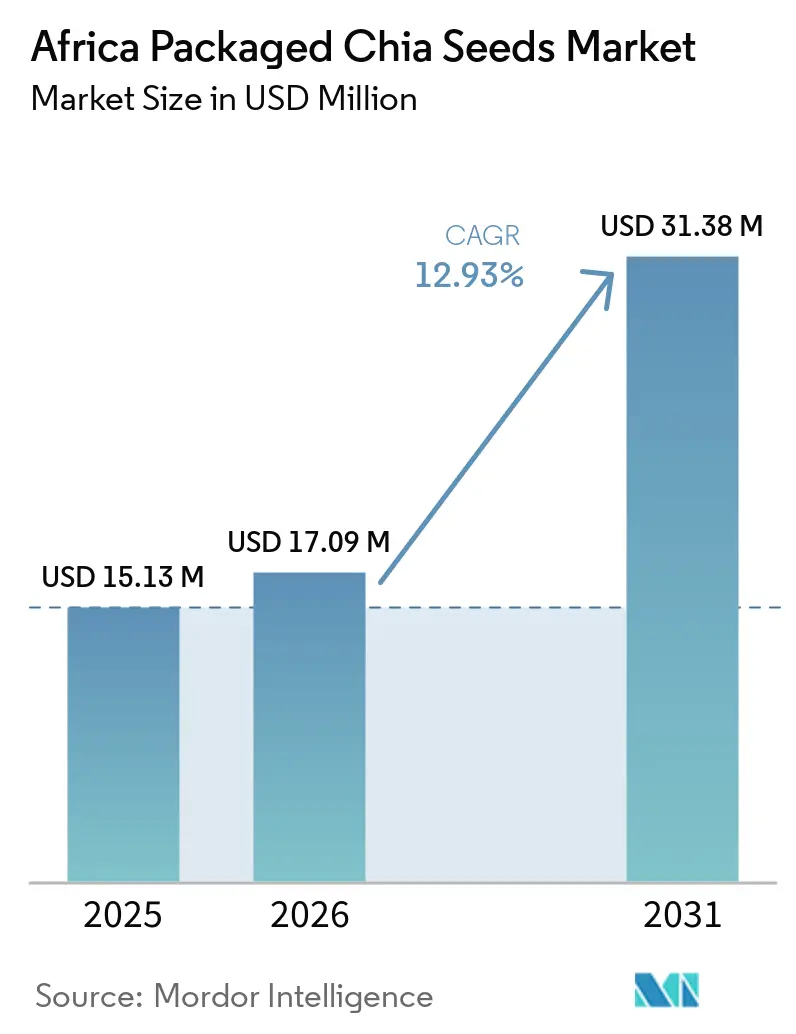
| Base Year Market Size (2025) | USD 15.13 Million |
| Market Size (2026) | USD 17.09 Million |
| Market Size (2031) | USD 31.38 Million |
| Growth Rate (2026 - 2031) | 12.93 % |
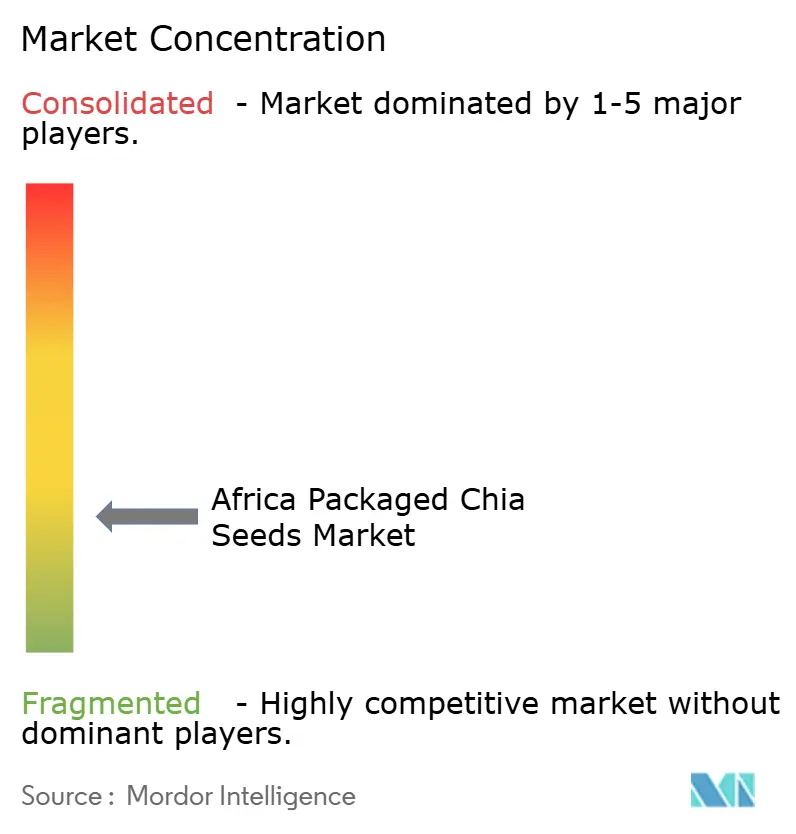
| Market Concentration | Low |
Major Players *Disclaimer: Major Players sorted in no particular order Image © Mordor Intelligence. Reuse requires attribution under CC BY 4.0. | |
Africa Packaged Chia Seeds Market Analysis by Mordor Intelligence
The Africa packaged chia seeds market was valued at USD 15.13 million in 2025, estimated to reach USD 17.09 million in 2026, and is forecast to reach USD 31.38 million by 2031, registering a CAGR of 12.92% during 2026–2031. The market is growing as chia seeds gain recognition as a nutrient-dense food ingredient suitable for everyday diets. Their nutritional profile, which includes dietary fiber, plant-based protein, omega-3 fatty acids, minerals, and antioxidants, supports their positioning within health-oriented food consumption. Growing consumer interest in naturally nutritious and minimally processed foods is driving the incorporation of seeds and other nutrient-rich ingredients into regular diets.
Key Report Takeaways
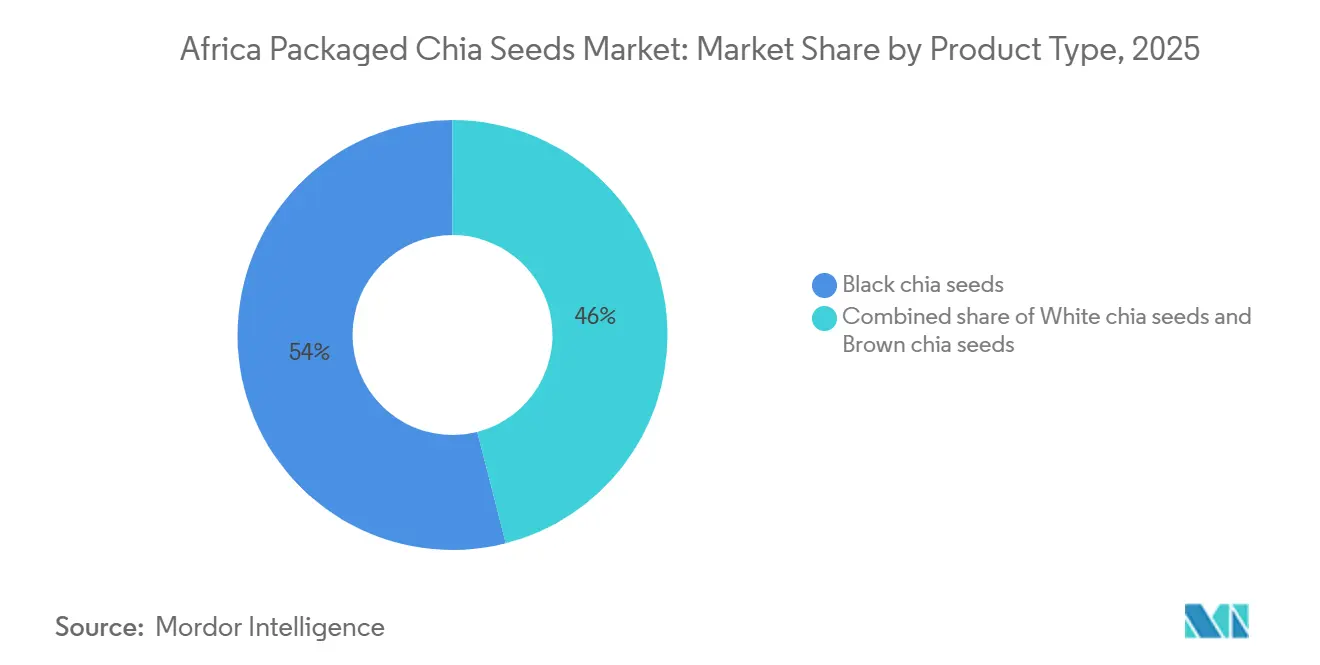
- By product type, black chia seeds held 53.98% of the Africa packaged chia seeds market share in 2025, while white chia seeds are forecast to grow at a 13.65% CAGR through 2031.
- By nature, conventional chia seeds held 88.67% of the Africa packaged chia seeds market share in 2025, while organic chia seeds are forecast to grow at a 14.08% CAGR through 2031.
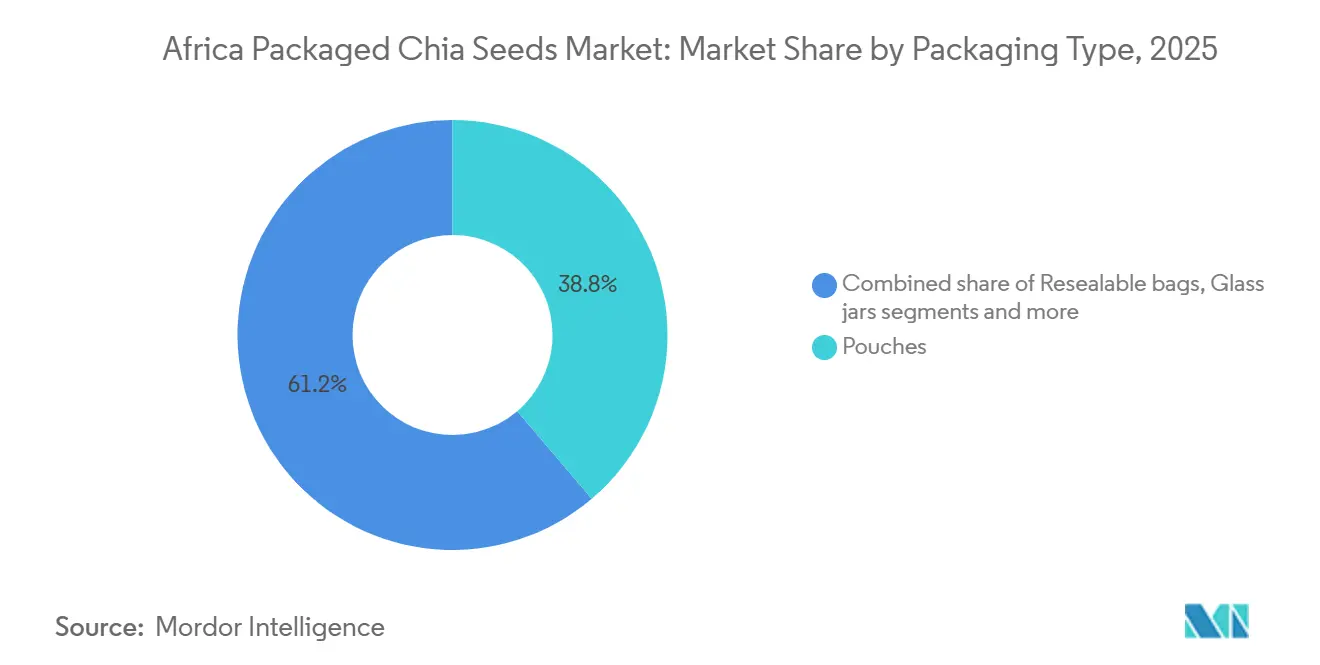
- By packaging type, pouches held 38.78% of the Africa packaged chia seeds market in 2025, while resealable bags are forecast to grow at a 14.34% CAGR through 2031.
- By distribution channel, supermarkets and hypermarkets held 43.35% of the Africa packaged chia seeds market in 2025, while online retail stores are forecast to grow at a 15.23% CAGR through 2031.
- By geography, South Africa held 32.32% of the Africa packaged chia seeds market in 2025, while Nigeria is forecast to grow at a 14.87% CAGR through 2031.
Note: Market size and forecast figures in this report are generated using Mordor Intelligence’s proprietary estimation framework, updated with the latest available data and insights as of January 2026.
Africa Packaged Chia Seeds Market Trends and Insights
Drivers Impact Analysis*
| Driver | (~) % Impact on CAGR Forecast | Geographic Relevance | Impact Timeline |
|---|---|---|---|
| Rising health and wellness consumption | +3.2% | South Africa, Kenya, Egypt, Nigeria (urban centers) | Medium term (2-4 years) |
| Expansion of plant-based and flexitarian diets | +2.5% | South Africa, Egypt, Kenya | Medium term (2-4 years) |
| Growth of convenience-oriented food consumption | +1.6% | South Africa, Nigeria, Egypt | Short term (≤ 2 years) |
| Growing demand for omega-3-rich plant foods | +2.1% | South Africa, Nigeria, Kenya | Medium term (2-4 years) |
| African-origin chia traceability and sustainability premiums | +1.0% | Uganda, Kenya, Tanzania (production); South Africa, Morocco (consumer) | Long term (≥ 4 years) |
| Expansion of modern retail and online grocery channels | 2.0% | Nigeria, Kenya, Egypt, Morocco | Short term (≤ 2 years) |
| Source: Mordor Intelligence | |||
Rising Health and Wellness Consumption
Rising health and wellness awareness is driving the market as consumers increasingly prioritize nutrient-dense, minimally processed, and naturally derived foods in their everyday diets. Chia seeds align well with this shift due to their high dietary fiber content, plant-based protein, calcium, magnesium, phosphorus, antioxidants, and other micronutrients, giving them a broad nutritional profile that extends beyond a single health attribute. Their small serving size allows consumers to incorporate them easily into regular dietary routines without requiring significant changes to existing eating habits. Growing interest in balanced nutrition, digestive wellness, plant-based diets, and nutrient-rich food ingredients is also increasing the relevance of chia seeds among health-conscious consumers. The availability of chia seeds in convenient, shelf-stable packaged formats further simplifies storage and regular consumption, while package labeling allows consumers to identify nutritional and ingredient information more easily.
Expansion of Plant-Based and Flexitarian Diets
The expansion of plant-based and flexitarian diets is supporting the African packaged chia seeds market by broadening consumer demand for plant-derived food ingredients. According to The Vegan Society's 2025 report, 30% of consumers in Kenya identified as flexitarian[1]. This sizeable flexitarian consumer base indicates growing acceptance of diets that incorporate more plant-based foods while allowing occasional consumption of animal products. This creates a wider potential consumer base for packaged chia seeds, as chia can be incorporated into plant-forward diets without requiring consumers to follow a strictly vegan or vegetarian lifestyle. The growing adoption of flexible plant-based eating therefore supports demand for convenient packaged plant ingredients such as chia seeds across the African market.
Growth of Convenience-Oriented Food Consumption
The growth of convenience-oriented food consumption is driving the Africa packaged chia seeds market, as consumers increasingly prefer food ingredients that are ready to use, require minimal preparation, and are easy to store and handle. Packaged chia seeds meet these requirements, as they can be consumed directly from the pack without cooking, portioned according to individual needs, and stored for repeated use. Their compact packaging makes them easy to carry and store at home, while resealable formats help maintain usability between consumption occasions. Unlike ingredients that require soaking, cooking, grinding, or other preparation steps, chia seeds can be incorporated into daily diets with relatively little preparation.
Growing Demand for Omega-3-Rich Plant Foods
Growing demand for omega-3-rich plant foods is supporting the Africa packaged chia seeds market, as consumers increasingly seek plant-based sources of essential fatty acids for everyday diets. Chia seeds are well positioned within this trend, as they provide alpha-linolenic acid (ALA), a plant-based omega-3 fatty acid, alongside fiber and other nutrients. The growing use of omega-3 positioning by packaged food brands is also increasing consumer awareness of chia seeds as a plant-based nutritional ingredient. For instance, Anchor Health in South Africa offers Premium Chia Seeds, positioning them as a natural superfood rich in fiber and a plant-based source of omega-3 fatty acids. Such product positioning reinforces the nutritional value of packaged chia seeds and supports their adoption among consumers seeking convenient plant-based sources of omega-3.
Restraints Impact Analysis*
| Restraint | (~) % Impact on CAGR Forecast | Geographic Relevance | Impact Timeline |
|---|---|---|---|
| Limited consumer awareness outside urban hubs | -1.5% | Sub-Saharan Africa peri-urban and rural regions; Nigeria, Kenya, Morocco secondary cities | Medium term (2-4 years) |
| Competition from quinoa, flaxseed and hemp | -1.2% | South Africa, Egypt, Morocco (established health-food retail) | Short term (≤ 2 years) |
| Import dependence and currency-linked retail price volatility | -1.8% | South Africa, Nigeria, Egypt, Morocco (import-dependent markets) | Short term (≤ 2 years) |
| Supply-chain and logistics challenges | -1.3% | Nigeria, Kenya, Morocco (infrastructure-constrained markets) | Medium term (2-4 years) |
| Source: Mordor Intelligence | |||
Limited Consumer Awareness Outside Urban Hubs
Limited consumer awareness outside major urban centers restrains the Africa packaged chia seeds market by restricting product familiarity in less-developed retail markets. Compared with more familiar seeds and grains, chia seeds remain a relatively specialized food ingredient. Consumers with limited exposure may be unaware of their nutritional attributes, preparation methods, and potential uses in everyday foods. This lower awareness reduces trial and repeat purchases, particularly where packaged chia seeds have limited in-store visibility and fewer opportunities for product education. Limited consumer familiarity also makes it more difficult for brands to communicate product benefits and differentiate chia seeds from other commonly available seeds.
Competition From Quinoa, Flaxseed and Hemp
Competition from quinoa, flaxseed, and hemp restrains the Africa packaged chia seeds market by offering consumers alternative plant-based seeds and grains that serve similar nutritional and dietary roles. Flaxseed competes closely with chia seeds, as both are positioned as plant-based sources of omega-3 fatty acids and dietary fiber. Hemp seeds attract consumers seeking plant-based protein and nutrient-dense food ingredients. Quinoa competes within health-oriented diets as a nutrient-rich plant-based ingredient used in meals, salads, breakfast foods, and other applications. The availability of these alternatives gives consumers greater choice when selecting functional plant-based ingredients, and retailers can allocate shelf space across several competing products. This competitive environment may limit the rate at which packaged chia seeds gain consumer adoption and could require brands to strengthen product differentiation through nutritional positioning, packaging, and product formats.
*Our forecasts treat driver/restraint impacts as directional, not additive. The impact forecasts reflect baseline growth, mix effects, and variable interactions.
Segment Analysis
By Product Type: Black Chia Dominates, White Chia Gaining Nutritional Credibility
Black chia seeds accounted for 53.98% of the Africa packaged chia seeds market in 2025. This share is supported by the segment's established product identity, nutritional positioning, visual distinctiveness, and suitability for standardized packaged retail formats. Black chia seeds are a clearly differentiated seed type within the packaged chia category, allowing consumers to recognize and select the product without ambiguity. Their naturally dark seed coat provides a consistent visual characteristic across packaged products. The segment also benefits from its positioning as a nutrient-dense whole seed, with fiber, protein, and omega-3 fatty acids supporting its perceived nutritional value and making it attractive as a simple, minimally processed food.
White chia seeds are the fastest-growing product type in the Africa packaged chia seeds market, registering a CAGR of 13.65% during 2026–2031. The segment is driven by variant differentiation, visual distinctiveness, premium presentation, and portfolio diversification. The naturally pale appearance of white chia seeds provides a clearly differentiated product identity within the packaged chia category, allowing manufacturers to introduce an alternative seed variant while remaining within the same product category. This distinctive appearance also supports cleaner, more premium-oriented packaging presentation, while the relative novelty of white chia creates additional consumer choice and encourages diversification of packaged chia seed SKUs.

By Nature: Conventional Still Rules, Organic Rewriting the Premium Segment
Conventional chia seeds held an 88.67% share of the market in 2025, supported by their established availability, broad product acceptance, and standardized production characteristics. The conventional segment benefits from a well-established supply structure, allowing packaged products to be offered in consistent specifications across different pack sizes and retail formats. Its mainstream positioning makes conventional chia seeds easier for consumers to identify and purchase without requiring specific certification or product attributes. In addition, conventional products generally provide manufacturers with greater flexibility in sourcing and formulation, supporting their continued dominance within the natural segment.
Organic chia seeds are the fastest-growing segment in the Africa packaged chia seeds market, with a CAGR of 14.08% during 2026–2031. The segment's growth is supported by the expansion of organic agricultural production and the strengthening of organic sourcing infrastructure across Africa. According to the International Federation of Organic Agriculture Movements (IFOAM), Africa had nearly 1.4 million organic producers in 2024, including approximately 404,250 in Uganda and 203,260 in Ethiopia[2]. This growing organic producer base supports the availability of organically produced chia raw materials and strengthens sourcing and traceability for packaged organic chia products. As organic supply networks become more established, packaged food producers can expand organic chia offerings with clearer certification and sourcing credentials.
By Packaging Type: Pouches Lead, Resealable Bags Redefining Freshness Expectations
Pouches accounted for 38.78% of the Africa packaged chia seeds market in 2025, supported by their lightweight structure, efficient use of packaging material, easy handling, and suitability for multiple pack sizes. Pouches can be produced in flexible formats that are convenient to transport, store, display, and stack, while their relatively compact structure supports efficient shelf utilization. Their flexibility also allows manufacturers to offer chia seeds in different pack sizes without requiring rigid containers, making pouches a practical format for packaged seed products. These characteristics support the continued dominance of pouches within the packaging segment.
Resealable bags are the fastest-growing packaging segment in the Africa packaged chia seeds market, with a CAGR of 14.34% during 2026–2031. Their growth is driven by repeated-use convenience and improved product protection after opening. The resealable closure allows consumers to open and close the package multiple times while keeping the remaining chia seeds contained, making the format particularly suitable for products that are consumed gradually rather than in a single use. The format also provides greater control over handling and storage between uses, while its flexible construction maintains the space-saving benefits of pouch-style packaging. These practical usability advantages are supporting the rapid adoption of resealable bags for packaged chia seeds.
By Distribution Channel: Supermarkets Anchor, Online Retail Accelerating Fastest
Supermarkets and hypermarkets held 43.35% of the Africa packaged chia seeds market in 2025, supported by their broad packaged-food assortments, organized shelf space, and ability to offer consumers multiple chia seed pack sizes and product variants within a single shopping environment. The expansion of modern grocery retail further strengthens the availability and visibility of packaged chia seeds through dedicated health-food, organic-food, and grocery sections. For example, in November 2025, Walmart opened its first own-name store in Johannesburg, expanding the presence of large-format international grocery retail in South Africa. Such developments increase the number of organized retail points where packaged chia seeds can be displayed and purchased, supporting the channel's dominant share.
Online retail stores are the fastest-growing distribution channel in the Africa packaged chia seeds market, with a CAGR of 15.23% during 2026–2031. The channel is expanding through greater product discoverability, wider assortment availability, convenient home delivery, and easier price and product comparison. Online platforms can accommodate multiple brands, pack sizes, product types, and organic variants without the physical shelf-space constraints of conventional stores. Digital product listings also allow consumers to access detailed information such as pack size, ingredients, certifications, and product specifications before purchasing. These characteristics make online retail particularly suitable for a specialized packaged product such as chia seeds, supporting its rapid growth.
Geography Analysis
South Africa accounted for 32.32% of the Africa packaged chia seeds market in 2025, supported by its relatively developed modern grocery infrastructure, broad availability of packaged health-oriented foods, and established organized retail environment. Packaged chia seed products are accessible through supermarkets, hypermarkets, specialty retailers, and digital commerce platforms, supporting wider product visibility and distribution. The expansion of modern grocery retail further strengthens the availability of packaged chia seeds through organized retail channels, while growing consumer interest in convenient, packaged food formats supports continued demand.
Nigeria is projected to be the fastest-growing geography in the Africa packaged chia seeds market, with a CAGR of 14.87% during 2026–2031. The growth is supported by strong urbanization and expanding urban consumer markets, which increase the concentration of consumers within locations served by organized retail and digital commerce. According to the World Bank, Nigeria's urban population accounted for 63.78% of the total population in 2025, creating a large urban consumer base for packaged food products[3]. Increasing urban concentration can support the expansion of modern retail distribution, greater product availability, and wider adoption of packaged chia seeds, contributing to Nigeria's faster market growth.
Kenya, Egypt, and Morocco represent other important markets for packaged chia seeds across Africa, supported by their developing organized retail structures and expanding availability of packaged and health-oriented food products. Kenya benefits from the development of modern grocery and digital retail channels, while Egypt's large consumer market and expanding packaged food distribution network support product accessibility. Morocco is supported by its increasingly diversified modern retail environment and growing availability of specialty and health-oriented packaged foods. Together, these markets contribute to the geographical expansion of packaged chia seeds beyond the South African and Nigerian markets.
Competitive Landscape
The Africa packaged chia seeds market is fragmented, with competition distributed across regional manufacturers, processors, organic food companies, and consumer packaged food brands. Key players in the market include Nature's Choice (Pty) Ltd., Godson Group, Zahra Food Industries Ltd., Soaring Free Superfoods, and KitchenHut (Pty) Ltd. Competition is influenced by differences in sourcing capabilities, processing capacity, product quality, organic certification, packaging formats, and retail reach. The fragmented structure allows both established health food companies and smaller regional manufacturers to participate in the market, particularly through specialized chia seed and superfood portfolios.
Competitive intensity is increasingly shaped by companies' ability to control multiple stages of the chia seed value chain, from farmgate procurement and raw material sourcing to cleaning, processing, quality control, packaging, and branded distribution. Companies with stronger upstream sourcing relationships can improve raw material availability, traceability, and consistency, while integrated processing and packaging capabilities enable greater control over product specifications and pack formats. Organic certification, product differentiation, resealable packaging, and multiple pack sizes are also becoming important competitive factors as manufacturers seek to strengthen their positioning within the packaged segment.
The competitive landscape reflects regional specialization across Africa, with organic chia supply and processing concentrated in East Africa and downstream branded distribution developing across Southern, West, and North Africa. Manufacturers are expanding their reach through supermarkets, health food stores, specialty retailers, and online channels, enabling packaged chia products to reach a broader consumer base. Companies with established retail relationships and branded portfolios can strengthen market penetration, while those combining farmgate procurement, processing, organic certification, consumer packaging, and multi-channel distribution can improve their ability to compete across different African markets.
Africa Packaged Chia Seeds Industry Leaders
-
Nature’s Choice (Pty) Ltd.
-
Godson Group
-
Zahra Food Industries Ltd
-
Soaring Free Superfoods
-
KitchenHut (Pty) Ltd
- *Disclaimer: Major Players sorted in no particular order
Recent Industry Developments
- July 2026: Pick n Pay launched an AI shopping assistant that allows customers to order groceries via voice, text, and photographs, marking a significant development in digital commerce in Africa's most developed retail market.
- February 2025: Talia Group Limited (Uganda) announced a plan to purchase over 5,000 metric tons of chia seeds from farmers in the Acholi Subregion. The company is shifting to a cooperative sourcing model to meet international organic standards.
Africa Packaged Chia Seeds Market Report Scope
Chia seeds are derived from the Salvia hispanica plant and are small, nutrient-dense seeds containing dietary fiber, plant-based protein, omega-3 fatty acids, minerals, and other nutritional components. The Africa packaged chia seeds market is segmented by product type, nature, packaging type, and distribution channel. Based on product type, the market is segmented into white chia seeds, black chia seeds, and brown chia seeds. Based on nature, the market is segmented into organic chia seeds and conventional chia seeds. Based on packaging type, the market is segmented into pouches, resealable bags, glass jars, plastic containers/bottles, and others. Based on distribution channel, the market is segmented into supermarkets/hypermarkets, convenience and grocery stores, online retail stores, and other distribution channels. Based on geography, the market is segmented into South Africa, Nigeria, Egypt, Kenya, Morocco, and the rest of Africa. For each segment, the market sizing and forecast have been done based on the value (in USD million).
| White chia seeds |
| Black chia seeds |
| Brown chia seeds |
| Organic chia seeds |
| Conventional chia seeds |
| Pouches |
| Resealable bags |
| Glass jars |
| Plastic containers/bottles |
| Others |
| Supermarkets/Hypermarkets |
| Convenience and Grocery Stores |
| Online Retail Stores |
| Other Distribution Channels |
| South Africa |
| Nigeria |
| Egypt |
| Kenya |
| Morocco |
| Rest of Africa |
| By Product Type | White chia seeds |
| Black chia seeds | |
| Brown chia seeds | |
| By Nature | Organic chia seeds |
| Conventional chia seeds | |
| By Packaging Type | Pouches |
| Resealable bags | |
| Glass jars | |
| Plastic containers/bottles | |
| Others | |
| By Distribution Channel | Supermarkets/Hypermarkets |
| Convenience and Grocery Stores | |
| Online Retail Stores | |
| Other Distribution Channels | |
| By Geography | South Africa |
| Nigeria | |
| Egypt | |
| Kenya | |
| Morocco | |
| Rest of Africa |
Key Questions Answered in the Report
What is driving demand for packaged chia seeds in Africa?
Urban demand for nutrient-dense foods, plant-based eating, organized retail, and digital grocery services are supporting growth.
How large is the Africa packaged chia seeds sector?
It is estimated at USD 17.09 million in 2026 and is forecast to reach USD 31.38 million by 2031 at a 12.93% CAGR.
Which product type leads sales in Africa?
Black chia seeds led with 53.98% share in 2025, supported by established supply and broad retail availability.
Which sales channel is expanding fastest?
Online retail stores are projected to grow at a 15.23% CAGR through 2031 as digital grocery access expands.