
Africa Feed Probiotics Market Size and Share
Market Overview
| Study Period | 2021 - 2031 |
|---|---|
| Forecast Data Period | 2026 - 2031 |
| Base Year Market Size (2025) | USD 140 Million |
| Market Size (2026) | USD 150 Million |
| Market Size (2031) | USD 208 Million |
| Growth Rate (2026 - 2031) | 6.76 % |
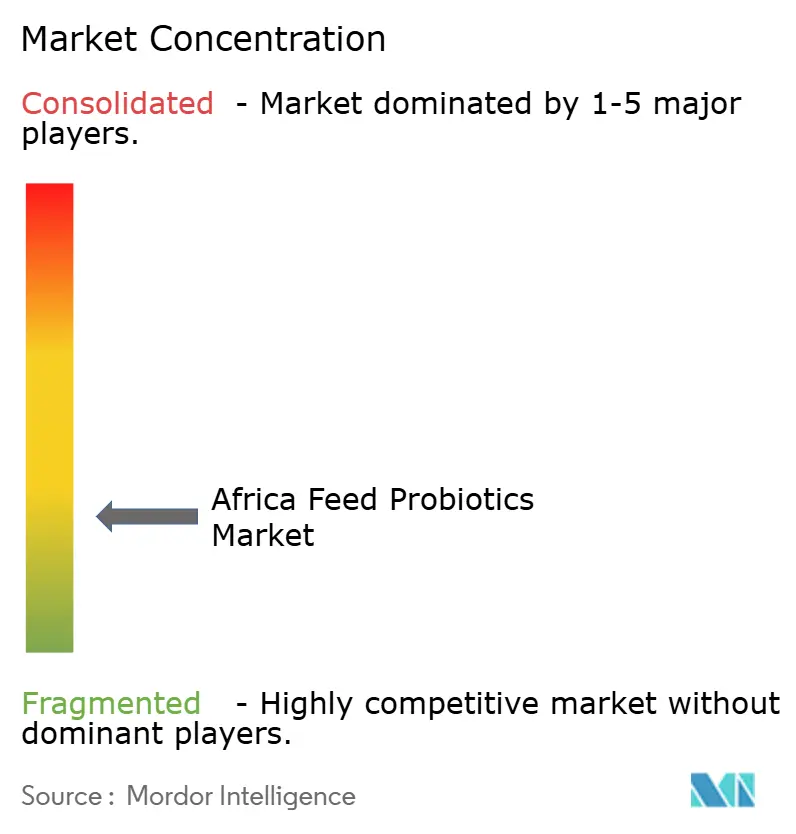
| Market Concentration | Low |
Major Players *Disclaimer: Major Players sorted in no particular order Image © Mordor Intelligence. Reuse requires attribution under CC BY 4.0. | |
Africa Feed Probiotics Market Analysis by Mordor Intelligence
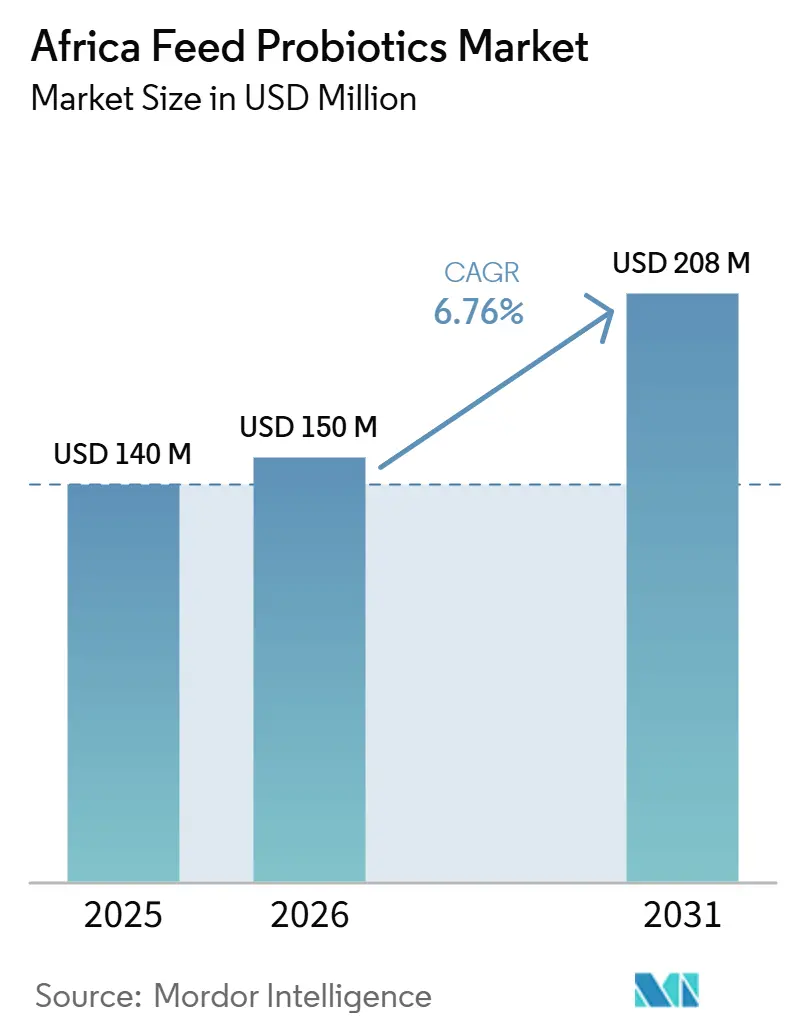
The Africa feed probiotics market was valued at USD 140.00 million in 2025 and is projected to grow from USD 150.00 million in 2026 to USD 208.00 million by 2031, growing at a CAGR of 6.76% during 2026-2031. The market enters this period with a strong commercial foundation, supported by increasing awareness of animal health and nutrition, rising demand for high-quality livestock products, and a gradual shift toward antibiotic-free feed solutions. This indicates that microbial feed ingredients had progressed beyond trial usage prior to the onset of the current growth cycle. Commercial feed mill expansions and new premix capacity in countries such as Egypt are making probiotic inclusion more practical at scale, thereby improving reach into the organized livestock production system. At the same time, the Africa feed probiotics market remains fragmented, while the rest of the market is distributed across regional distributors, specialty blenders, and emerging local suppliers. The main limit to broader adoption remains the cost gap between large commercial operators and smallholders, especially where feed inflation and weak farm data systems make it harder to prove probiotic payback over short production cycles.
Key Report Takeaways
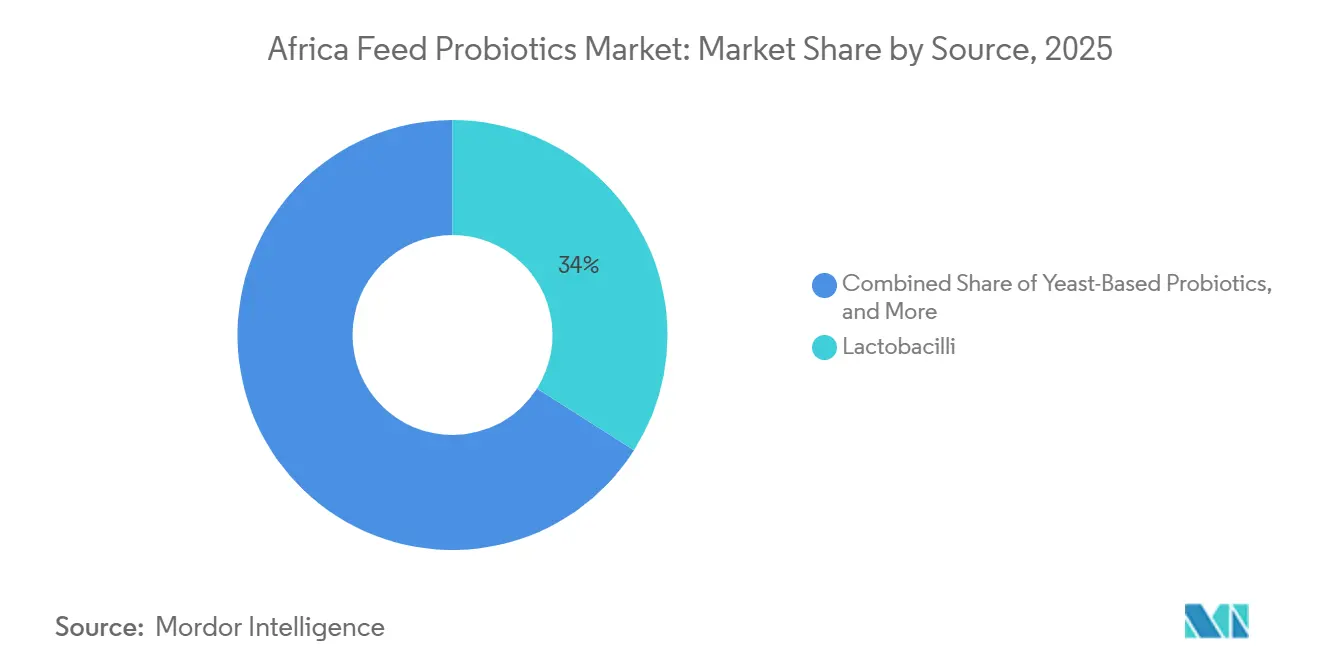
- By sub additive, lactobacilli hold the largest share, 34.0% of the Africa feed probiotics market share, in 2025, while other probiotics are the fastest-growing segment, projected to expand at 8.5% CAGR through 2026 to 2031.
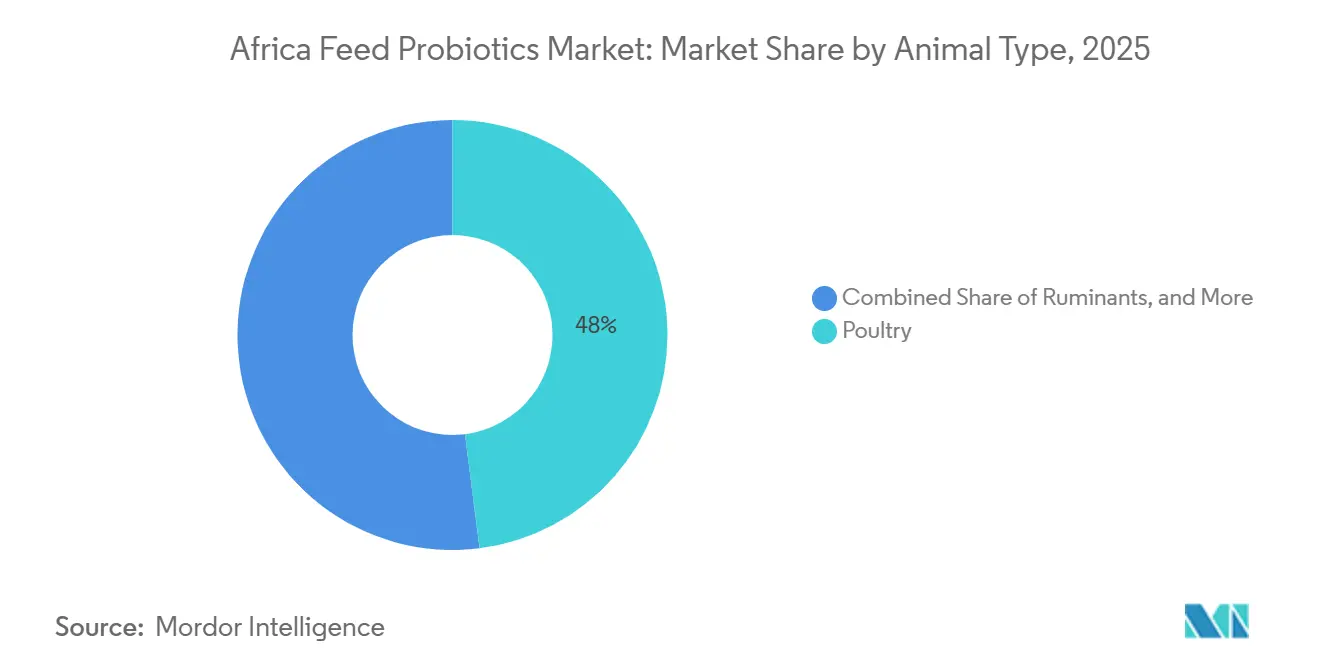
- By animal type, poultry accounted for the largest share of the Africa feed probiotics market size in 2025, at 48.0%, while aquaculture is the fastest-growing animal type, projected to expand at a 8.3% CAGR through 2026 to 2031.
- By geography, South Africa held the largest share of the Africa feed probiotics market in 2025, at 44.0%, while Kenya is the fastest-growing country, projected to expand at a CAGR of 7.6% through 2026 to 2031.
Note: Market size and forecast figures in this report are generated using Mordor Intelligence’s proprietary estimation framework, updated with the latest available data and insights as of January 2026.
Africa Feed Probiotics Market Trends and Insights
Drivers Impact Analysis*
| Driver | (~) % Impact on CAGR Forecast | Geographic Relevance | Impact Timeline |
|---|---|---|---|
| Rising antimicrobial-free livestock production | +2.0% | Global, with highest enforcement intensity in Kenya, Namibia, South Africa, Ethiopia, and Tanzania | Short term (≤ 2 years) |
| Poultry and aquaculture scale-up in Africa | +1.5% | Egypt, Kenya, Nigeria, and Sub-Saharan Africa broadly | Short term (≤ 2 years) |
| Heat-stable and encapsulated strain adoption | +1.0% | Sub-Saharan Africa broadly, with high relevance in Nigeria, Ghana, and East Africa | Medium term (2-4 years) |
| Rising feed mill incorporation of functional additives | +0.8% | South Africa, Egypt, Nigeria, and Kenya | Medium term (2-4 years) |
| Fragmented cold-chain and storage constraints favor dry formats | +0.5% | Sub-Saharan Africa broadly, especially landlocked and interior markets | Long term (≥ 4 years) |
| Low on-farm diagnostic coverage creates demand for preventive gut health solutions | +0.4% | East Africa and West Africa, especially rural smallholder clusters | Long term (≥ 4 years) |
| Source: Mordor Intelligence | |||
Rising Antimicrobial-Free Livestock Production
The policy shift away from antibiotic growth promoters is advancing across Africa, though progress remains uneven from one country to another. A 2025 review indexed in PubMed Central (PMC) found that only 8 of 31 African countries surveyed had explicit laws against the use of antibiotic growth promoters, while 17 had some form of prescription control for antibiotics in livestock systems. This uneven pattern is not slowing demand in the Africa feed probiotics market, as producers in stricter markets are reformulating sooner, while producers in less regulated markets still face pressure from buyers who prefer antibiotic-free production systems. Kenya’s antimicrobial resistance framework already covers livestock and fisheries, and Ethiopia launched its Fourth National Action Plan on Antimicrobial Resistance (AMR) 2026-2030 in November 2025, which keeps livestock antibiotic stewardship high on the policy agenda. The commercial case for probiotics is strengthened by peer-reviewed work showing that probiotic use can support weight gain, nutrient use, and disease resilience across poultry, swine, cattle, and aquaculture species
Poultry and Aquaculture Scale-Up in Africa
Poultry represents the largest demand segment in the Africa feed probiotics market, primarily driven by its association with commercial feed usage. In South Africa, the poultry industry is substantial enough to sustain regular additive use, with the broiler industry consuming approximately 4 million metric tons of feed in 2025, according to FAOSTAT. Feed costs account for 70% of total production expenses in this sector. Aquaculture is the fastest-growing animal segment, underscoring the importance of probiotics in species where factors such as stocking density and water-quality stressors impact survival rates and feed conversion efficiency. In 2025, the Food and Agriculture Organization (FAO)’s Blue Transformation roadmap emphasizes sustainable aquaculture expansion in Sub-Saharan Africa as a key focus for sector development, supporting the adoption of microbiome-based feed solutions in tilapia and African catfish farming systems. Additionally, WorldFish advanced this initiative in late 2025 through its Fish for Africa Innovation Hub and Scaling Aquaculture (FASA) program, which aims to scale sustainable aquafeed practices to benefit 5,000 smallholder fish farmers across Sub-Saharan Africa[1]Source: Food and Agriculture Organization, “Sustainable Aquaculture in Action: Blue Transformation,” FAO, fao.org.
Heat-Stable and Encapsulated Strain Adoption
The Africa feed probiotics market is favoring heat-stable and encapsulated formats because product survival during pelleting, storage, and distribution remains a practical issue in African feed systems. Conventional Lactobacillus-based products can lose viability at standard feed mill temperatures, while cold-chain disruption can reduce microbial counts by 60% to 80% during transport. Bacillus strains are gaining ground because their spore-forming structure offers a clear handling advantage under these conditions, and Kemin has marketed ENTEROSURE in Sub-Saharan Africa on precisely that heat-stable and pH-stable positioning. A 2025 study in Animal Bioscience showed that microencapsulated Lactobacillus plantarum MB001 performed better than non-encapsulated preparations under tropical broiler conditions, supporting encapsulation as a viable approach for strains with lower native heat tolerance. This is important for the Africa feed probiotics market because strain format now matters almost as much as strain identity when suppliers try to move from controlled trials to repeat purchases in field conditions.
Rising Feed Mill Incorporation of Functional Additives
Centralized feed production is becoming more important in the Africa feed probiotics market because it allows probiotics to be dosed consistently across large animal populations. Large feed mills and premix plants can more easily incorporate probiotic inclusion into existing formulation systems than fragmented on-farm mixing operations. DSM-Firmenich opened a 10,000-sq-meter animal nutrition and health plant in Sadat City, Egypt, in September 2024 with an annual capacity of 10,000 metric tons, adding regional infrastructure for vitamins, minerals, and feed additives. As feed production becomes more formalized, suppliers in the Africa feed probiotics market gain a more efficient route to scale, technical validation, and repeat business with integrators that purchase based on formulation standards rather than one-off treatment needs.
Restraints Impact Analysis*
| Restraint | (~) % Impact on CAGR Forecast | Geographic Relevance | Impact Timeline |
|---|---|---|---|
| Strain performance variability across tropical farm conditions | -1.0% | Sub-Saharan Africa broadly, with high intensity in West Africa and East Africa | Short term (≤ 2 years) |
| Limited local fermentation and blending capacity | -0.9% | East Africa and West Africa smallholder clusters | Short term (≤ 2 years) |
| Regulatory fragmentation and registration delays | -0.8% | Most of Sub-Saharan Africa except South Africa and Egypt | Medium term (2-4 years) |
| High price sensitivity among smallholder producers | -0.7% | Pan-African, with highest intensity in West Africa and Central Africa | Medium term (2-4 years) |
| Source: Mordor Intelligence | |||
Strain Performance Variability Across Tropical Farm Conditions
A key restraint for the Africa feed probiotics market is the gap between laboratory and field performance under tropical conditions. High pelleting temperatures, long transport routes, and inconsistent storage can weaken viable counts before the product reaches the farm, especially for strains that are not spore-forming or encapsulated. This creates a credibility issue because farmers judge product value by visible short-cycle results rather than by microbiological specifications on a label. The need for better strain protection is clear from the 2025 Animal Bioscience study, which showed microencapsulation improved performance under tropical broiler conditions compared with non-encapsulated preparations. Until more products consistently match African feed mill and logistics conditions, repeat purchase rates in the Africa feed probiotics market can remain uneven outside the best-managed commercial systems.
High Price Sensitivity Among Smallholder Producers
Smallholder affordability remains a major restraint on the African feed probiotics market, as feed already accounts for most of the production cost in poultry systems. In Kenya, feed accounted for 82% of broiler meat production costs in 2025, and the United States Department of Agriculture report showed that feed costs rose by 37% between 2020 and 2025[2]Source: USDA Foreign Agricultural Service, “Poultry and Products Situation, Kenya, 2025,” USDA GAIN Report, apps.fas.usda.gov. Against this backdrop, probiotics that cost 1.5 to 2 times as much as antibiotic growth promoters are a difficult sell when farmers focus on immediate cash outflow rather than whole-cycle biological returns. The value proposition is real, but it depends on better feed conversion and fewer disease losses over time, and proving the payback is hard when farms keep limited production records.
*Our forecasts treat driver/restraint impacts as directional, not additive. The impact forecasts reflect baseline growth, mix effects, and variable interactions.
Segment Analysis
By Sub Additive: Lactobacilli Anchor the Market, Bacillus Formats Gain Share
Lactobacilli captured 34.0% of the Africa feed probiotics market share in 2025, making them the leading sub-additive type in the current market structure. Their lead comes from broad clinical validation across livestock species, especially in dairy cattle and sow feeding programs where gut stability has a direct production impact. Enterococcus retained niche importance in calf and piglet starter feeds, while Bifidobacteria, Pediococcus, and Streptococcus stayed smaller because they face narrower species fit or more demanding stability requirements under African feed-processing conditions. The Africa probiotics feed market, therefore, still relies on established strain families that balance scientific familiarity with practical use in warm-climate distribution systems.
Other Probiotics is projected to grow at 8.5% CAGR through 2031, supported by Bacillus subtilis, Bacillus licheniformis, multi-strain consortia, and encapsulated blend formats that are better suited to hot-climate handling and pelleting. A 2025 study cited in Frontiers in Veterinary Science also indicated that locally isolated lactic acid bacteria can perform better than imported reference strains in African livestock environments, supporting the longer-term value of Africa-specific strain development. The sub additive mix is gradually moving toward multi-strain and multi-function products that combine gut stabilization, pathogen control, and digestive support in a single formulation. That shift should keep widening the role of heat-tolerant and operationally simpler formats inside the Africa feed probiotics market over the forecast period



By Animal Type: Poultry Leads While Aquaculture Expands Fastest
Poultry was to account for the largest share of the Africa feed probiotics market size in 2025, at 48.0%. This leadership reflects how closely poultry production is tied to commercial compound feed, where probiotic inclusion can be managed at scale and linked to feed efficiency targets. In South Africa, the broiler sector’s feed use is large enough to make additive decisions financially material at the formulation level, which supports routine use among major commercial operators. Poultry also faces constant pressure on conversion rates, gut health, and disease losses, which keeps probiotics relevant even as antibiotic substitution remains gradual. This makes poultry the anchor demand segment for the Africa feed probiotics market at present.
Aquaculture is projected to be the fastest-growing segment, with a 8.3% CAGR from 2026 to 2031. FAO’s Blue Transformation agenda supports that trajectory by encouraging sustainable aquaculture growth in Sub-Saharan Africa, especially in species such as tilapia and African catfish. East African feed quality frameworks are also becoming more formal in aquaculture, providing a clearer pathway for approved feed inputs in fish production systems. Ruminants remain the third-largest segment, while swine and other species offer smaller but still meaningful openings where commercial operations are becoming more organized.
Geography Analysis
South Africa is anticipated to hold the largest share of the Africa feed probiotics market in 2025, at 44.0%. Its position reflects the continent’s most developed industrial feed manufacturing base, a high concentration of large poultry integrators, and the strongest additive distribution infrastructure in Africa. According to United States Department of Agriculture, the country’s broiler industry consumes around 4 million tons of compound feed each year, and feed accounts for 70% of production cost, so feed efficiency additives matter directly to producer margins. South Africa also provides a more consistent market-entry environment for multinational suppliers than many neighboring countries do, which supports deeper product portfolios and more stable premium demand.
Kenya is projected to be the fastest-growing country, with a projected CAGR of 7.6% from 2026 to 2031. The country combines rising formalization in poultry, expanding aquaculture activity, and active regulatory movement on antimicrobial use in livestock. Kenya’s Veterinary Medicines Directorate has also been tightening oversight around antibiotic use, which improves the long-term opportunity for probiotic alternatives in commercial poultry systems. Even so, the Kenyan growth story still depends on how quickly organized feed channels can expand beyond larger farms into cost-sensitive mid-tier and smallholder production zones.
Egypt is becoming more important as a manufacturing and supply hub after dsm-firmenich opened its 10,000-sq-meter, 10,000 metric tons-capacity plant in Sadat City in September 2024. That facility serves Egypt, the Middle East, Southern Europe, and Africa, which lowers supply complexity for North African and export-oriented feed customers. The rest of Africa, including Nigeria, Ethiopia, Tanzania, Uganda, Ghana, and Ivory Coast, still represents the largest long-run expansion space because probiotic penetration is lower and formal feed infrastructure is still building. Ethiopia’s AMR action plan, Nigeria’s state-level feed subsidy support, and ongoing aquaculture development initiatives across Sub-Saharan Africa all point to stronger policy and investment support across these emerging markets over time.
Competitive Landscape
The Africa probiotics feed market was fragmented in 2025, with the top five companies accounting for a significant share, and the remaining share split among regional distributors, specialty additive firms, and smaller local suppliers. DSM-Firmenich AG, Evonik Industries AG, ADM, Novonesis, and Alltech form the leading group, but none of them dominates the market on its own. Competition is shaped mainly by strain portfolio depth, technical service strength, and the ability to maintain product viability through African logistics conditions. Kemin stands out through its Africa-focused ENTEROSURE Bacillus platform, which is marketed directly on the basis of its heat stability and pathogen control under Sub-Saharan operating conditions. Lallemand Animal Nutrition and the Micalis Institute launched LabCom Biofilm1Health in October 2024, which shows that major suppliers are still investing in proprietary microorganism development rather than relying on standard commodity formulations[3]Source: Lallemand Animal Nutrition, “Lallemand Animal Nutrition and Micalis Institute Launch Joint Lab Biofilm1Health,” Lallemand Animal Nutrition, lallemandanimalnutrition.com.
Openings remain clear in aquaculture, ruminant productivity, and data-linked probiotic programs, where product depth is still thinner than in mainstream poultry applications. Aquaculture-specific products for tilapia and African catfish are especially important because that end market is expanding faster than the rest of the species mix. Suppliers that combine performance evidence, formulation support, and practical channel coverage are likely to gain share faster than suppliers that compete only on price in the Africa feed probiotics market. This leaves the market open to both global incumbents and agile mid-tier firms that can support emerging customers in Kenya, Nigeria, and other still-developing feed ecosystems.
An important competitive differentiator is the increasing focus on locally adapted probiotic solutions. Livestock producers in Africa are progressively seeking products tested and validated under regional farming conditions, such as high ambient temperatures, inconsistent feed quality, and disease pressures unique to local production systems. Companies conducting regional trials, collaborating with local feed mills, and offering country-specific technical support programs are better positioned to gain customer trust and drive adoption. Consequently, suppliers that consistently demonstrate reliable performance in African production environments are likely to enhance their market presence and create entry barriers for less-established competitors.
Africa Feed Probiotics Industry Leaders
Evonik Industries AG
ADM
Novonesis
Alltech Inc.
DSM-Firmenich AG
- *Disclaimer: Major Players sorted in no particular order

Recent Industry Developments
- June 2025: Novonesis completed the acquisition of dsm-firmenich's share of the Feed Enzyme Alliance for USD 1.5 billion, gaining full control of sales and distribution for animal feed enzymes and positioning itself to cross-sell probiotics and enzymes to feed customers across Africa and globally. This acquisition marks the most significant competitive consolidation in the African animal biosolutions market in recent years.
- November 2025: Evonik Industries AG has introduced an improved formulation of its Ecobiol Bacillus CECT 5940 probiotic for poultry nutrition, achieving 46% faster outgrowth than earlier competitor products. This enhanced gut colonization speed improves early-life feed efficiency metrics in broilers during the crucial first days post-hatch in globally including Africa.
- January 2025: Lagos State Government, Nigeria, launched a 25% feed subsidy program for poultry and fish farmers in Nigeria's largest economic hub, indirectly expanding the addressable market for feed additive suppliers, including probiotic manufacturers, by reducing total input costs.


Africa Feed Probiotics Market Report Scope
Feed probiotics are preparations containing beneficial live microorganisms, such as bacteria or yeasts, added to animal feed to improve the balance of microorganisms in the digestive tract. This enhances animal health, digestion, nutrient utilization, growth performance, and disease resistance. The Africa feed probiotics market report is segmented by sub additive (bifidobacteria, enterococcus, lactobacilli, pediococcus, streptococcus, and other probiotics), by animal (aquaculture, poultry, ruminants, swine, and other animal types), and by geography (Egypt, Kenya, South Africa, and the Rest of Africa). The market forecasts are provided in terms of Value (USD) and Volume (Metric Tons).
| Bifidobacteria |
| Enterococcus |
| Lactobacilli |
| Pediococcus |
| Streptococcus |
| Other Probiotics |
| Aquaculture | Fish |
| Shrimp | |
| Other Aquaculture Species | |
| Poultry | Broiler |
| Layer | |
| Other Poultry Birds | |
| Ruminants | Beef Cattle |
| Dairy Cattle | |
| Other Ruminants | |
| Swine | |
| Other Animals |
| Egypt |
| Kenya |
| South Africa |
| Rest of Africa |
| By Sub Additive | Bifidobacteria | |
| Enterococcus | ||
| Lactobacilli | ||
| Pediococcus | ||
| Streptococcus | ||
| Other Probiotics | ||
| By Animal | Aquaculture | Fish |
| Shrimp | ||
| Other Aquaculture Species | ||
| Poultry | Broiler | |
| Layer | ||
| Other Poultry Birds | ||
| Ruminants | Beef Cattle | |
| Dairy Cattle | ||
| Other Ruminants | ||
| Swine | ||
| Other Animals | ||
| By Geography | Egypt | |
| Kenya | ||
| South Africa | ||
| Rest of Africa | ||


Key Questions Answered in the Report
What is the projected value of Africa feed probiotics by 2031?
The Africa probiotics market for the feed industry is projected to reach USD 208 .00 million by 2031.
Which animal category drives the largest demand across Africa?
Poultry is the largest animal type segment, accounting for 48.0% of revenue in 2025, as it is closely tied to organized compound feed use and strict feed efficiency targets.
Which country leads revenue generation across the region?
South Africa leads the region with 44.0% revenue share in 2025, supported by its advanced feed manufacturing base, large poultry integrators, and established additive distribution channels.
Which country is projected to grow the fastest through 2031?
Kenya is forecast to grow the fastest, at a 7.6% CAGR through 2031, supported by poultry formalization, rising aquaculture activity, and tighter oversight of antimicrobials.
Page last updated on:





