
Acrylic Sheets Market Size and Share
Market Overview
| Study Period | 2021 - 2031 |
|---|---|
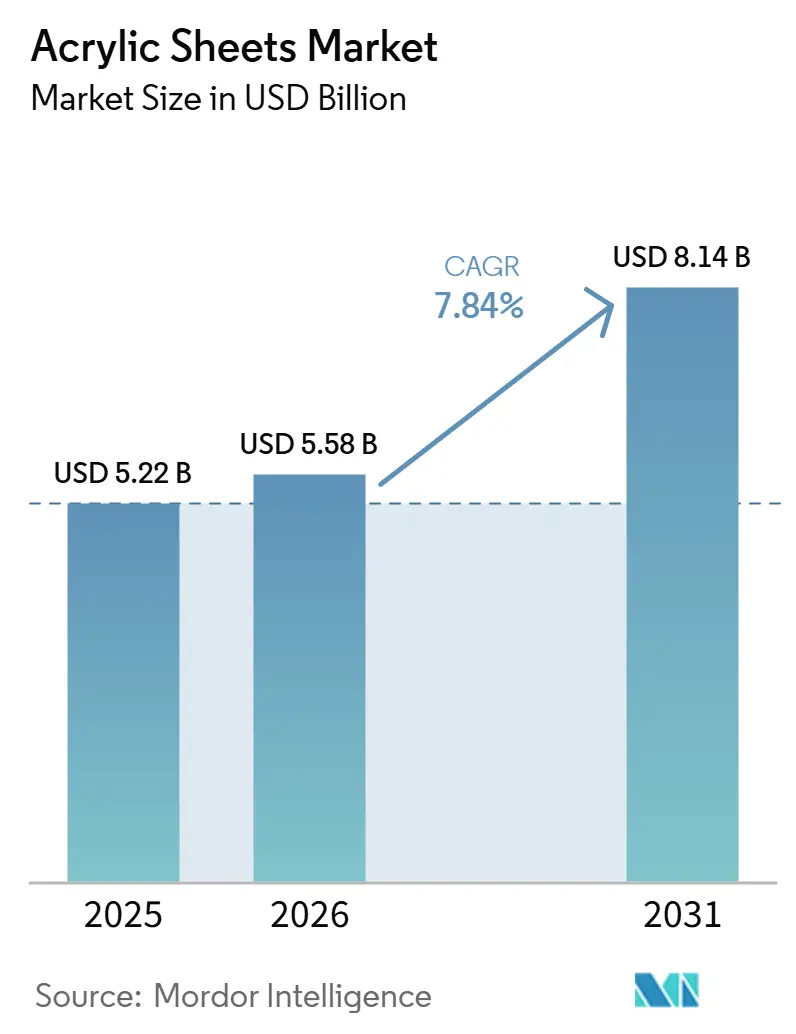
| Market Size (2026) | USD 5.58 Billion |
| Market Size (2031) | USD 8.14 Billion |
| Growth Rate (2026 - 2031) | 7.84 % |
| Fastest Growing Market | Asia-Pacific |
| Largest Market | Asia-Pacific |
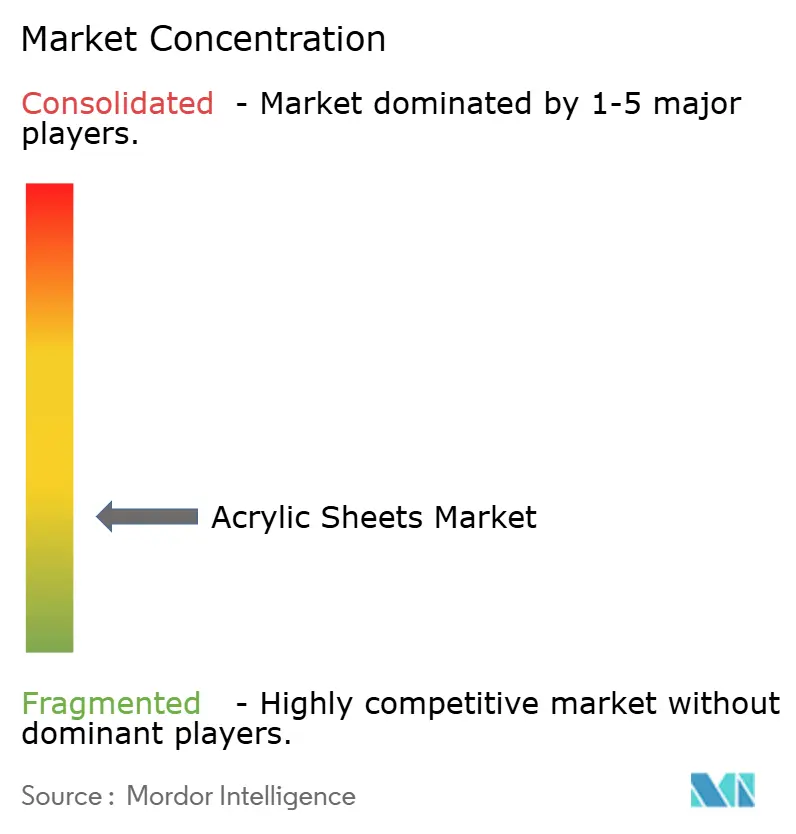
| Market Concentration | Low |
Major Players *Disclaimer: Major Players sorted in no particular order Image © Mordor Intelligence. Reuse requires attribution under CC BY 4.0. | |
Acrylic Sheets Market Analysis by Mordor Intelligence
The Acrylic Sheets Market was valued at USD 5.22 billion in 2025 and is estimated to grow from USD 5.58 billion in 2026 to reach USD 8.14 billion by 2031, at a CAGR of 7.84% during the forecast period (2026–2031). Demand is supported using polymethyl methacrylate (PMMA) as a transparent and lighter alternative to conventional glass in construction, vehicles, retail installations, and electronics. PMMA can transmit 92% of visible light and weighs nearly half as much as equivalent glass, which supports its use where clarity and lower weight are both required. Construction activity, electric vehicle programs, and LED-based retail displays are the main sources of demand. Producers are responding with application-specific grades, including UV-resistant, mar-resistant, and recycled-content materials. Cost pressure from methyl methacrylate (MMA) remains important because it can affect converter margins and pricing across the acrylic sheets market.
Key Report Takeaways
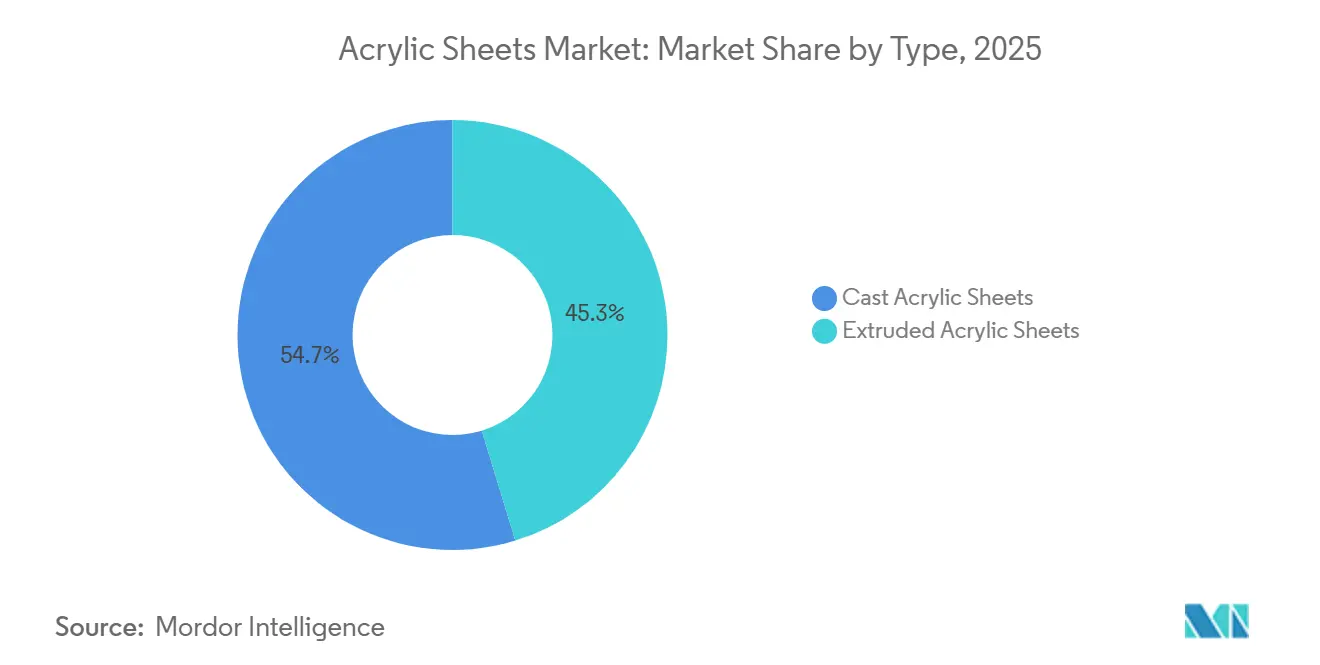
- By type, cast acrylic sheets held 54.72% of the acrylic sheets market share in 2025, while extruded sheets are forecast to grow at an 8.2% CAGR through 2031.
- By application, signage and display held 31.45% of the acrylic sheets market size in 2025, while automotive and transportation is forecast to grow at an 8.57% CAGR through 2031.
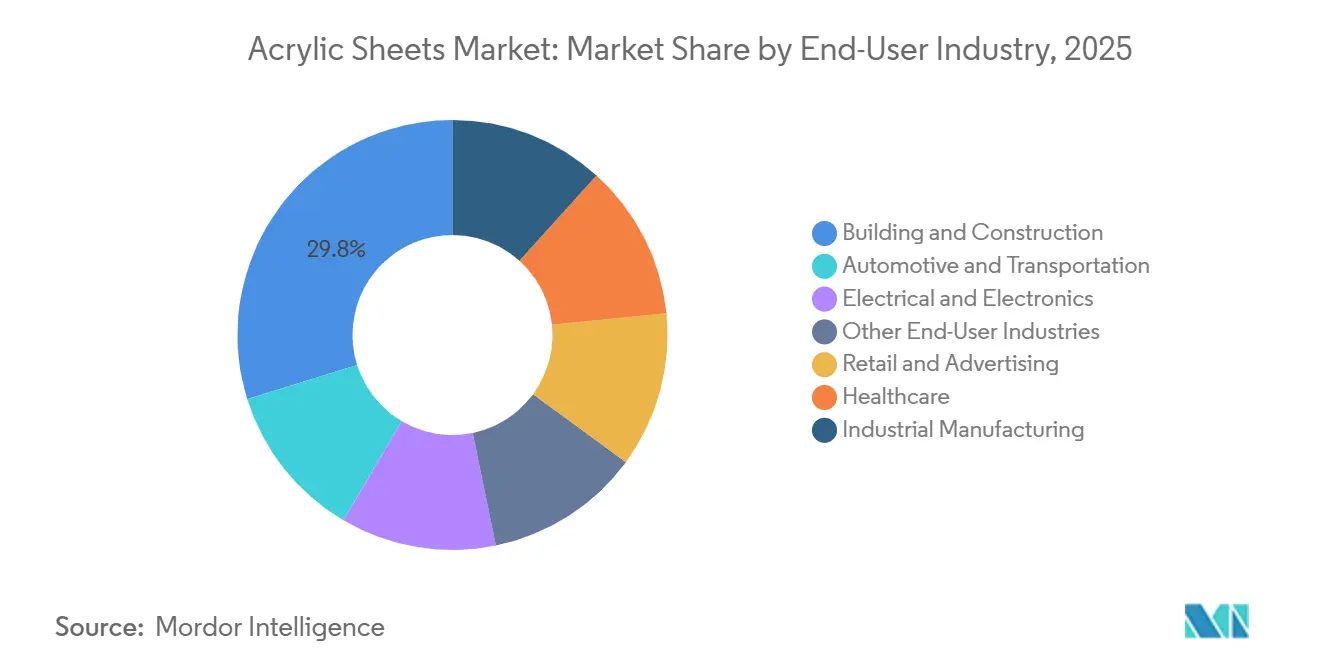
- By end-user industry, building and construction held 29.83% of the acrylic sheets market share in 2025, while electrical and electronics is forecast to grow at an 8.73% CAGR through 2031.
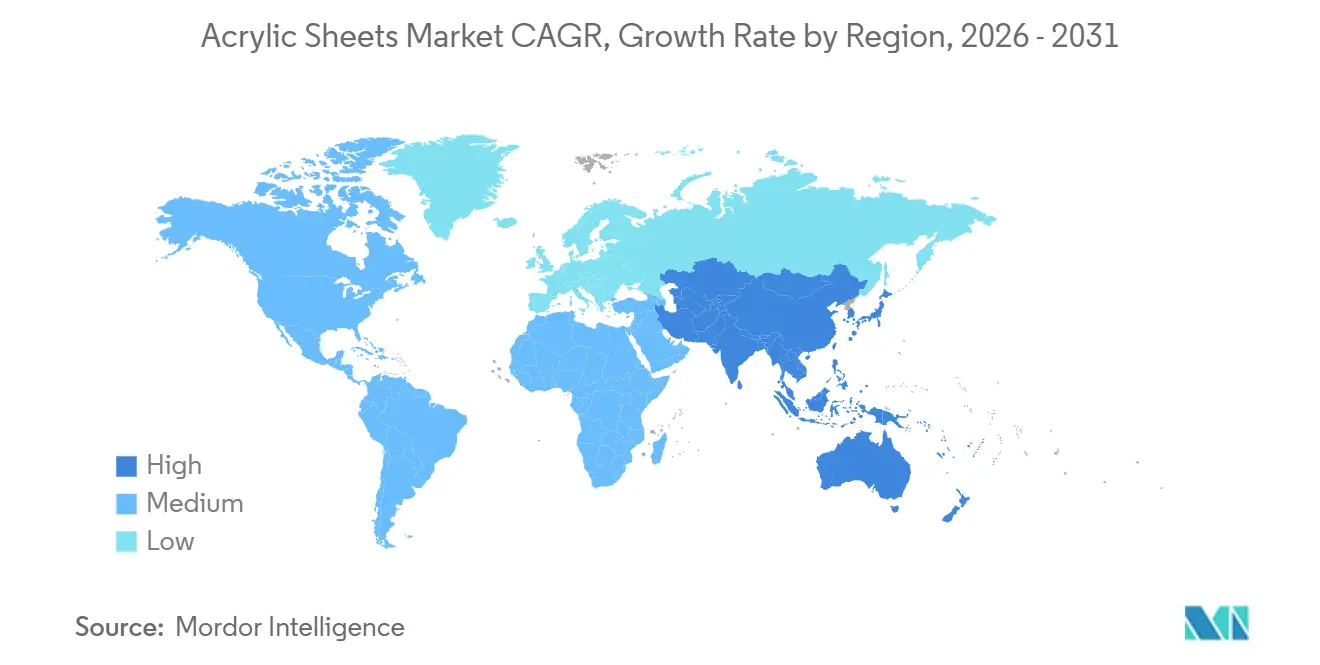
- By geography, Asia-Pacific held 44.26% of the acrylic sheets market share in 2025 and is forecast to grow at an 8.53% CAGR through 2031.
Note: Market size and forecast figures in this report are generated using Mordor Intelligence’s proprietary estimation framework, updated with the latest available data and insights as of January 2026.
Market Trends and Insights
Drivers Impact Analysis of Acrylic Sheets Market*
| Driver | (~) % Impact on CAGR Forecast | Geographic Relevance | Impact Timeline |
|---|---|---|---|
| Rising Demand for Lightweight and High-Transparency Alternatives to Glass | +1.8% | Global; concentrated in North America and Europe due to EV and building energy codes | Medium term (2-4 years) |
| Increasing Adoption of Acrylic Sheets in Signage, Displays, and Advertising Applications | +1.5% | Global; especially strong in Asia-Pacific retail and commercial markets and North America | Short term (≤2 years) |
| Expanding Demand from Automotive and Transportation Industries for Lightweight Components | +1.4% | North America, Europe, and East Asia (Japan, South Korea); spill-over to China's EV market | Medium term (2-4 years) |
| Increasing Preference for UV-Resistant and Weather-Resistant Acrylic Sheets in Outdoor Applications | +1.2% | North America and Europe core; growing in Middle East and Southeast Asia | Long term (≥4 years) |
| Growing Adoption of Cost-Effective Extruded Acrylic Sheets for Industrial Fabrication | +1.0% | APAC core, with early gains spreading to MEA and South America as industrial capacity expands | Medium term (2-4 years) |
| Source: Mordor Intelligence | |||
Rising Demand for Lightweight and High-Transparency Alternatives to Glass
PMMA combines 92% optical transmittance with a density near half that of float glass. This combination supports building and vehicle designs that require lower component weight and clear visibility. Electric vehicle engineers are qualifying PMMA for side glazing, rear glazing, lighting, and interior components. In March 2025, Magna Lighting selected ACRYLITE Optical HT for 50 cm front light guides in the Lancia Ypsilon electric model. The material was designed for high heat deflection and optical performance in automotive lighting. As vehicles use PMMA in additional lighting and glazing functions, the material content per platform can rise beyond the traditional 2 kg to 8 kg range.
Increasing Adoption of Acrylic Sheets in Signage, Displays, and Advertising Applications
Signage and display demand is moving beyond basic brand identification toward LED installations that are also designed for visual content. Retail and hospitality projects increasingly require even illumination, stable color, and layered visual effects. Those requirements favor acrylic grades with defined diffusion behavior and extended outdoor performance. PLEXIGLAS products for visual communication include diffusion options for light-guide panels, channel letters, poster boxes, and retail fixtures. The shift toward higher specifications separates premium signage sheet from standard display stock. It also gives greater value to suppliers that can provide formulation and application support in the acrylic sheets market.
Expanding Demand from Automotive and Transportation Industries for Lightweight Components
Automotive adoption is extending from headlamps and trim to components that require lighter designs and recycled content. Electric vehicle architectures can use PMMA in door visors, instrument cluster covers, panoramic roof elements, and precision light guides. Mitsubishi Chemical Corporation and Honda Motor Co., Ltd. developed recycled PMMA for door visors used on the Honda N-ONE e: mini EV in September 2025[1]Mitsubishi Chemical Corporation, “Joint Development of Recycled PMMA for Honda N-ONE e: Door Visors,” Joint Press Release with Honda Motor Co., Ltd., September 2025, m-chemical.co.jp.. The project represented the first automotive use of recycled acrylic resin in door visors in the supplied material. The EU End-of-Life Vehicles Regulation is described as requiring 15% recycled plastic content in new vehicles 6 years after enactment and 25% within 10 years. These requirements can increase the relevance of recycled PMMA qualifications in vehicle supply programs.
Increasing Preference for UV-Resistant and Weather-Resistant Acrylic Sheets in Outdoor Applications
Outdoor uses now include facade systems, decking, furniture, and recreational enclosures alongside conventional glazing. These uses require stable color and surface quality over long service periods and varied weather conditions. On March 2, 2026, Röhm launched ACRYLITE SunResist, a PMMA capstock molding compound that blocks UV light up to 400 nm. The material supports thin co-extruded protective layers and can work with existing co-extrusion lines. Capstock construction can pair a lower-cost substrate with a high-performance acrylic surface layer. This approach can widen outdoor use of the acrylic sheets market in the Middle East and Southeast Asia.
Restraints Impact Analysis of Acrylic Sheets Market*
| Restraint | (~) % Impact on CAGR Forecast | Geographic Relevance | Impact Timeline |
|---|---|---|---|
| Volatility in Methyl Methacrylate (MMA) and Other Raw Material Prices | -1.2% | Global; acute sensitivity in Asia (largest MMA trading hub) and North America | Short term (≤2 years) |
| Limited Scratch Resistance and Surface Durability Compared to Alternative Materials | -0.8% | Global | Long term (≥4 years) |
| Challenges Associated with Recycling and End-of-Life Waste Management | -0.6% | Europe and North America | Long term (≥4 years) |
| Source: Mordor Intelligence | |||
Volatility in Methyl Methacrylate and Other Raw Material Prices
MMA is the primary feedstock for PMMA sheet production, so its price directly affects manufacturing costs. Röhm announced a global price adjustment for selected PMMA grades in April 2025 because of tariff-related increases in raw material and goods costs. The company also announced a European price increase of up to EUR 0.08/kg for PLEXIGLAS and PLEXIMID molding compounds effective in April 2026. Smaller converters without long-term feedstock contracts can find these changes difficult to pass through in tender-based sales. Cast sheet production uses more MMA per unit volume and has longer production cycles than extrusion. This difference can increase working-capital exposure for cast sheet producers when inputs rise.
Limited Scratch Resistance and Surface Durability Compared to Alternative Materials
PMMA has a surface hardness near Mohs 4, compared with Mohs 5.5 for glass. This can limit use in high-contact automotive interiors, public protective glazing, and point-of-sale fixtures. Polycarbonate and tempered glass maintain an advantage where impact resistance and abrasion resistance are central requirements. ACRYLITE Optical mar-resistant sheet uses an abrasion-resistant hard coat for automotive instrument panels, displays, and museum cases. Coated grades address the technical issue but can reduce the price advantage over alternative materials. Surface treatment capability, therefore, matters for access to higher-value uses in the acrylic sheets market.
*Our forecasts treat driver/restraint impacts as directional, not additive. The impact forecasts reflect baseline growth, mix effects, and variable interactions.
Acrylic Sheets Market Segment Analysis
By Type:
Cast Acrylic Sheets Lead Premium Uses, While Extruded Sheets Gain MomentumCast acrylic sheets held 54.72% of the acrylic sheets market share in 2025. They are used in architectural glazing, aquariums, optical displays, and marine components where consistent optical quality is required. Cell-cast and continuous-cast processes can provide greater molecular-weight uniformity across a sheet. They also allow thickness customization, particularly for formats above 20 mm. These qualities keep cast products relevant in specialty applications even where lower-cost alternatives are available.
Extruded sheets are projected to grow at an 8.22% CAGR between 2026 and 2031. Their cost structure suits high-volume display, glazing, enclosure, and thermoforming work. Mitsubishi Chemical offers ACRYLITE MR200W, a continuous-cast sheet with an in-line hard coat for automotive uses. Product development is narrowing the boundary between standard sheet formats and surface-enhanced grades. Extrusion is likely to gain volume in commodity uses, while cast sheet maintains a role in applications that require customized thickness and verified optical quality.


By Application:
Signage Leads Revenue While Automotive Grows FasterSignage and display accounted for 31.45% of the acrylic sheets market size in 2025. Retail, hospitality, and corporate sites use LED-backlit and edge-lit installations that depend on controlled light diffusion. Acrylic sheet is used in channel letters, light-guide panels, poster boxes, and other illuminated fixtures. Architecture and interior design form the next major application group, using sheets in skylights, decorative partitions, and facade accents. The design flexibility and weatherability of PMMA support nonstructural glazing in commercial projects.
Automotive and transportation is expected to record an 8.57% CAGR through 2031. Vehicle programs use PMMA in door visors, panoramic roof elements, lighting, and instrument-related components. Röhm’s ACRYLITE Optical HT was specified for the Lancia Ypsilon EV light guides in 2025. Electronics also use PMMA in backlight covers, instrument diffusers, and display protective glazing. Signage grades prioritize diffusion and color performance, while automotive grades require thermal resistance and greater surface durability.
By End-User Industry:
Construction Holds Revenue While Electronics Expands FastestBuilding and construction held 29.83% of 2025 revenue in the acrylic sheets market. Commercial facades, residential skylights, greenhouse panels, and sound barriers support its broad base of demand. Acrylic offers clear light transmission and lower weight for nonstructural glazing applications. The sector also uses acrylic in interior partitions and decorative elements. Construction demand remains linked to project activity across major Asian markets.
Electrical and electronics is forecast to expand at an 8.73% CAGR through 2031. The segment uses PMMA in display covers, diffusers, panels, enclosures, and insulating applications. The segment uses thin, optically precise PMMA components in display formats, protective covers, and high-brightness panels. PMMA is also suited to insulation applications because the supplied product material reports volume resistivity above 10¹⁴ Ω·m under IEC 60093 testing[2]International Electrotechnical Commission, “IEC 60093 Methods of Test for Volume Resistivity and Surface Resistivity of Solid Electrical Insulating Materials,” International Electrotechnical Commission, iec.ch.. Industrial manufacturing uses acrylic in machine guards, protective covers, and cleanroom barriers. Healthcare uses remain more specialized, including sterile barriers, instrument housings, and clear medical-device components.

Geography Analysis
APAC Acrylic Sheets Market
Asia-Pacific held 44.26% of the acrylic sheets market share in 2025 and is forecast to grow at an 8.53% CAGR through 2031. The region combines a large PMMA production base with strong construction, retail, and display demand. China provides integrated capacity from MMA production through finished sheet fabrication and export. India, Vietnam, and Indonesia add demand from urban construction, retail expansion, and commercial signage. Japan and South Korea account for a greater share of premium architectural and original equipment manufacturer (OEM) uses.
Thailand, North America and Europe Acrylic Sheets Market
Mitsubishi Chemical’s SHINKOLITE brand displayed skylight systems, facade louvers, and interior railings at Architect’25 in Thailand. North America and Europe are important markets for premium application development, regulatory compliance, and sustainability documentation. Röhm’s Bay City, Texas facility reached full four-reactor MMA production in April 2026, increasing regional feedstock availability for downstream users. The facility uses C2-based LiMA technology and supports regional supply chains for PMMA applications. Arkema’s CARAT project in France is expected to improve energy efficiency by 25% and reduce carbon intensity by 20% in acrylic acid production.
South America and MEA Acrylic Sheets Market
South America, and Middle-East and Africa represent a smaller share of the acrylic sheets market. Brazil and Argentina mainly use sheets in construction and signage, with commodity supply often imported from Asia. Saudi Arabia and South Africa are key locations for Middle-East and Africa demand. Saudi Arabia’s Vision 2030 construction projects support demand for glazing and facade uses. Limited regional manufacturing increases dependence on imports and can expose projects to supply disruptions.

Competitive Landscape
The acrylic sheets market is highly fragmented, with integrated PMMA producers competing alongside regional manufacturers. Röhm and Mitsubishi Chemical lead premium portfolios through PLEXIGLAS, ACRYLITE, and SHINKOLITE brands. Their positions reflect MMA technology, product brands, technical support, and application development. Regional producers, especially in China, compete strongly in cost-sensitive commodity grades. Palram Industries Ltd., Plazit-Polygal Group, and Asia Poly Industrial Sdn Bhd. serve regional applications such as greenhouse glazing, agricultural films, and construction.
Local logistics and service response can be more important than global brand scale in those applications. Differentiation is increasingly tied to application co-development rather than basic sheet specifications. Röhm’s selection for automotive lighting in the Lancia Ypsilon EV demonstrates how qualified material can become part of a vehicle platform. Röhm also introduced ACRYLITE SunResist in 2026 for co-extruded outdoor applications. Mitsubishi Chemical and Honda’s recycled PMMA door visor project shows the importance of recycled-content capability for vehicle materials.
Chemical recycling is another area of competition in the acrylic sheets market. Trinseo reported rMMA purity above 99% and a product carbon footprint at least 70% lower than virgin MMA for its R-Life work. Röhm announced an industrial-scale chemical recycling process at Worms, Germany, in March 2026.
Acrylic Sheets Industry Leaders
Evonik Industries AG
Mitsubishi Chemical Corporation
Plaskolite
Trinseo
SABIC
- *Disclaimer: Major Players sorted in no particular order
Acrylic Sheets Market Companies Covered in this Report
- 3A Composites GmbH
- Acrilex Inc.
- Asia Poly Industrial Sdn. Bhd.
- Chi Mei Corporation
- Evonik Industries AG
- Gevacril S.r.l.
- Guangzhou Alands Plastic Co., Ltd.
- Madico, Inc.
- Mitsubishi Chemical Corporation
- Palram Industries Ltd.
- Perspex South Africa (Pty) Ltd.
- Plaskolite
- Plazit-Polygal Group
- Ray Chung Acrylic Enterprise Co., Ltd.
- Röhm GmbH
- SABIC
- Spartech LLC
- Trinseo

Recent Industry Developments in Acrylic Sheets Market
- June 2026: Röhm GmbH officially opened its Bay City, Texas MMA plant at full industrial scale using the proprietary LiMA technology. The plant reduces United States import dependence for downstream acrylic sheet fabricators and strengthens regional supply chains for automotive, construction, electronics, and medical PMMA applications.
- February 2026: Royale Touche expanded its premium interior surfaces portfolio to include solid acrylic co-extruded sheets. These materials are designed for modern modular kitchens and high-end cabinetry, offering durability, high-gloss aesthetics, and precision manufacturing for interior applications.


Global Acrylic Sheets Market Report Scope
An acrylic sheet is a transparent, lightweight, and shatter-resistant thermoplastic panel made from polymethyl methacrylate (PMMA). It is softer, more lightweight, and more cost-effective than glass, making it suitable for large-scale applications such as signage, picture frames, and protective barriers.
The acrylic sheets market is segmented by type, application, end-user industry, and geography. By type, the market is segmented into cast acrylic sheets and extruded acrylic sheets. By application, the market is segmented into signage and display, architecture and interior design, automotive and transportation, electronics, and other applications. By end-user industry, the market is segmented into building and construction, automotive and transportation, electrical and electronics, retail and advertising, healthcare, industrial manufacturing, and other end-user industries. The report also covers the market size and forecasts for acrylic sheets in 16 countries across major regions. For each segment, the market sizing and forecasts have been done on the basis of value (USD).
| Cast Acrylic Sheets |
| Extruded Acrylic Sheets |
| Signage and Display |
| Architecture and Interior Design |
| Automotive and Transportation |
| Electronics |
| Other Applications |
| Building and Construction |
| Automotive and Transportation |
| Electrical and Electronics |
| Retail and Advertising |
| Healthcare |
| Industrial Manufacturing |
| Other End-User Industries |
| Asia-Pacific | China |
| India | |
| Japan | |
| South Korea | |
| Rest of Asia-Pacific | |
| North America | United States |
| Canada | |
| Mexico | |
| Europe | Germany |
| United Kingdom | |
| France | |
| Italy | |
| Russia | |
| Rest of Europe | |
| South America | Brazil |
| Argentina | |
| Rest of South America | |
| Middle-East and Africa | Saudi Arabia |
| South Africa | |
| Rest of Middle-East and Africa |
| By Type | Cast Acrylic Sheets | |
| Extruded Acrylic Sheets | ||
| By Application | Signage and Display | |
| Architecture and Interior Design | ||
| Automotive and Transportation | ||
| Electronics | ||
| Other Applications | ||
| By End-User Industry | Building and Construction | |
| Automotive and Transportation | ||
| Electrical and Electronics | ||
| Retail and Advertising | ||
| Healthcare | ||
| Industrial Manufacturing | ||
| Other End-User Industries | ||
| By Geography | Asia-Pacific | China |
| India | ||
| Japan | ||
| South Korea | ||
| Rest of Asia-Pacific | ||
| North America | United States | |
| Canada | ||
| Mexico | ||
| Europe | Germany | |
| United Kingdom | ||
| France | ||
| Italy | ||
| Russia | ||
| Rest of Europe | ||
| South America | Brazil | |
| Argentina | ||
| Rest of South America | ||
| Middle-East and Africa | Saudi Arabia | |
| South Africa | ||
| Rest of Middle-East and Africa | ||


Key Questions Answered in the Report
What is the size of the acrylic sheets market?
The acrylic sheets market stands at USD 5.58 billion in 2026 and is forecast to reach USD 8.14 billion by 2031.
Which acrylic sheet type held the largest share in 2025?
Cast acrylic sheets held 54.72% of the revenue in 2025. Their position is supported by premium optical applications, customized thicknesses, architectural glazing, and thick format uses.
Which application is expected to grow fastest through 2031?
Automotive and transportation is forecast to grow at an 8.57% CAGR through 2031 as electric vehicle lighting, door visors, glazing elements, and related components support this outlook.
Which end-user industry is forecast to grow fastest through 2031?
Electrical and electronics is forecast to expand at an 8.73% CAGR through 2031. The segment uses PMMA in display covers, diffusers, panels, enclosures, and insulating applications.
Page last updated on:





