
Middle East Polyethylene Market Size and Share
Market Overview
| Study Period | 2020 - 2031 |
|---|---|
| Forecast Data Period | 2026 - 2031 |
| Base Year Market Size (2025) | USD 13.23 Billion |
| Market Size (2026) | USD 13.77 Billion |
| Market Size (2031) | USD 16.79 Billion |
| Growth Rate (2026 - 2031) | 4.06 % |
| Market Concentration | Medium |
Major Players *Disclaimer: Major Players sorted in no particular order Image © Mordor Intelligence. Reuse requires attribution under CC BY 4.0. | |
Middle East Polyethylene Market Analysis by Mordor Intelligence
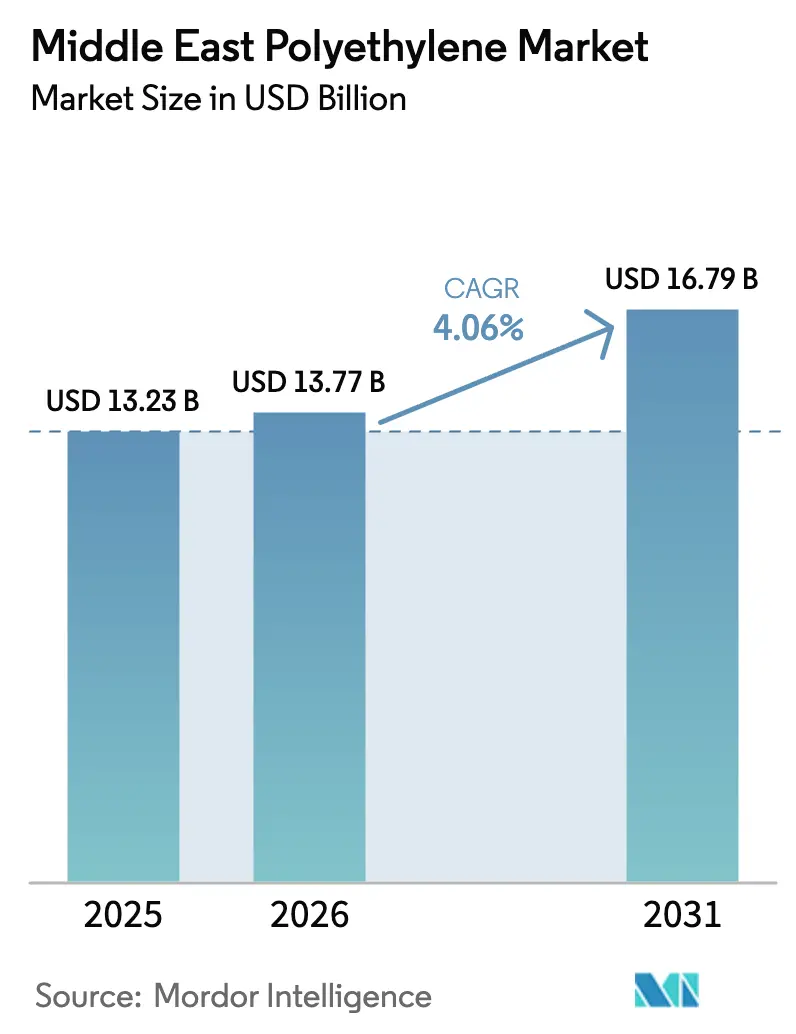
The Middle East Polyethylene Market size was valued at USD 13.23 billion in 2025 and estimated to grow from USD 13.77 billion in 2026 to reach USD 16.79 billion by 2031, at a CAGR of 4.06% during the forecast period (2026-2031). Maturing regional supply, strong state-backed investments, and resilient packaging demand keep growth on a steady trajectory. Saudi Arabia, anchored by SABIC’s 4.01 million-tonne annual output, remains the largest producer and exporter, while the United Arab Emirates delivers the fastest capacity expansion as Borouge’s fourth phase at Ruwais comes onstream. Petrochemical diversification strategies under Saudi Arabia’s National Industrial Strategy and the UAE’s AED 294 billion program aim to reinforce regional self-sufficiency, mitigate feedstock risk, and open up export opportunities to Africa and South Asia. Infrastructure megaprojects—including district cooling networks, desalination pipelines, and renewable-energy interconnectors—add a countercyclical cushion for pipe and cable-grade consumption. Consolidation moves, such as ADNOC’s planned merger of Borouge, Borealis, and Nova Chemicals, signal a tightening of pricing discipline and greater bargaining power with converters.
Key Report Takeaways
- By product type, high-density polyethylene led with 40.92% of the 2025 Middle East polyethylene market share, whereas linear low-density polyethylene is forecast to advance at a 5.05% CAGR through 2031.
- By application, films and sheets accounted for 46.05% of the Middle East polyethylene market size in 2025, and wires and cables are projected to grow at a 5.12% CAGR to 2031.
- By end-user, packaging captured a 58.02% revenue share in 2025; the electrical and electronics sector is the fastest-growing demand center, tracking a 4.99% CAGR through 2031.
- By geography, Saudi Arabia held 39.35% of the 2025 market share, while the United Arab Emirates recorded the highest regional CAGR of 4.84% from 2025 to 2031.
Note: Market size and forecast figures in this report are generated using Mordor Intelligence’s proprietary estimation framework, updated with the latest available data and insights as of 2026.
Market Trends and Insights
Drivers Impact Analysis of Middle East Polyethylene Market*
| Driver | (~) % Impact on CAGR Forecast | Geographic Relevance | Impact Timeline |
|---|---|---|---|
| Packaging demand growth in FMCG and e-commerce | +1.2% | Saudi Arabia, UAE, Qatar, spillover to Egypt and Jordan | Medium term (2-4 years) |
| Automotive and electronics uptake for replacement parts | +0.8% | UAE free zones, Saudi Arabia industrial clusters | Medium term (2-4 years) |
| State-led GCC petrochemical diversification | +1.5% | Saudi Arabia, UAE, Qatar, Kuwait | Long term (≥ 4 years) |
| Surge in PE pipe demand for district cooling networks | +0.9% | Saudi Arabia, UAE, Qatar | Short term (≤ 2 years) |
| Mandatory recyclate-content rules | +0.6% | Saudi Arabia, UAE, pilot projects in Oman | Long term (≥ 4 years) |
| Source: Mordor Intelligence | |||
Expansion of Rigid and Flexible Packaging Demand in FMCG and E-Commerce
The regional flexible-packaging market reached USD 10 billion in 2024, with Saudi Arabia leading adoption of recyclable mono-material films that simplify post-consumer sorting under SASO’s 2021 regulations[1]. Fast-growing e-commerce platforms such as Amazon.ae and Noon rely on polyethylene mailers, bubble wrap, and air pillows, driving annual protective packaging growth into the high teens. Brand owners shifting to linear low-density polyethylene films meet recyclability targets and benefit from downgauging that cuts material use by up to 15%. These dynamics underpin LLDPE’s 5.12% CAGR outlook while cementing films as the single largest application throughout the forecast window.
Industrial Uptake for Automotive and E&E Replacement Parts
Electric-vehicle assembly zones in Abu Dhabi, Dubai, and Saudi Arabia’s NEOM project specify polyethylene grades for battery housings, cable insulation, and under-hood components. Borouge’s 100,000 tpa cross-linked polyethylene unit at Ruwais supplies specialty compounds for subsea power cables that link expanding solar farms to national grids. Data-center construction tied to sovereign artificial-intelligence programs accelerates consumption of flame-retardant HDPE conduits, supporting a 5.08% CAGR in the electrical and electronics segment.
State-Led Diversification into Petrochemicals Across GCC
Saudi Arabia earmarked USD 600 billion for manufacturing, aiming to lift plastics production to 115.7 million tonnes by 2035[2]. The UAE’s Ta’ziz hub awarded AED 7.34 billion in EPC contracts for a chemicals port, storage, and pipelines that will export 4.7 million tonnes of methanol, ammonia, and polyolefins by 2028. Qatar’s 1.68 million-tonne HDPE line at Ras Laffan is expected to come online in 2026, with swing capability to serve either Asia or Europe. Meanwhile, Iran aims to roll out an 8.6 million-tonne capacity under its Seventh National Development Plan, despite a 42% gas shortage, as reported by NPC.IR. These investments deepen the Middle East polyethylene market’s export reach and intensify inter-regional competition.
Surge in PE Pipe Demand for District Cooling and Water-Saving Networks
Saudi Arabia’s district cooling capacity is slated to exceed 1.5 million refrigeration tonnes by 2030, with polyethylene pipes chosen for their corrosion resistance and trenchless installation advantages. Abu Dhabi and Dubai mandate HDPE conduits for new commercial districts, while precision irrigation mandates a 30% reduction in agricultural water use when polyethylene drip lines replace flood irrigation. Pipe demand thus offers a stable outlet that cushions the Middle East polyethylene market during packaging-cycle downturns.
Restraints Impact Analysis of Middle East Polyethylene Market*
| Restraint | (~) % Impact on CAGR Forecast | Geographic Relevance | Impact Timeline |
|---|---|---|---|
| Substitution by polypropylene and PET | –0.7% | Saudi Arabia, UAE, Egypt | Medium term (2-4 years) |
| Feedstock price volatility | –1.1% | Ethane-rich Saudi Arabia, UAE; naphtha-exposed Iran, Egypt | Short term (≤ 2 years) |
| Import tariffs and compliance hurdles in Africa | –0.5% | GCC exporters serving Egypt, Kenya, Nigeria | Medium term (2-4 years) |
| Source: Mordor Intelligence | |||
Readily Available Substitutes Such as PP and PET
Polypropylene and polyethylene terephthalate gain market share in hot-fill containers, beverage bottles, and automotive trim, where thermal resistance outperforms that of polyethylene. Borouge’s polypropylene capacity expansion to 720,000 tpa and SABIC’s PP5707N grade development diversify portfolios and hedge against polyethylene substitution pressure. Price spreads can swing 20–30% within a quarter during crude oil volatility, prompting converters to switch resins when cost advantages emerge.
Feedstock Price Volatility and Import Tariffs in African Outlets
A 42% gas-feedstock shortfall reported by Iran’s National Petrochemical Company shaved cracker utilization and forced curtailments in 2024. Naphtha-based sites in Egypt track Brent crude swings; margins tighten sharply once oil exceeds USD 85 per barrel. Egypt’s GOEIC registration now requires ISO 9001 credentials and Arabic-language dossiers, adding up to 12 weeks of lead time and approximately 6% to landed costs for Gulf exporters. Red Sea disruptions halved Suez Canal throughput, prompting many Middle East polyethylene market players to reroute via the Cape of Good Hope, which quadrupled container costs and eroded Gulf cost advantages.
*Our forecasts treat driver/restraint impacts as directional, not additive. The impact forecasts reflect baseline growth, mix effects, and variable interactions.
Middle East Polyethylene Market Segment Analysis
By Product Type:
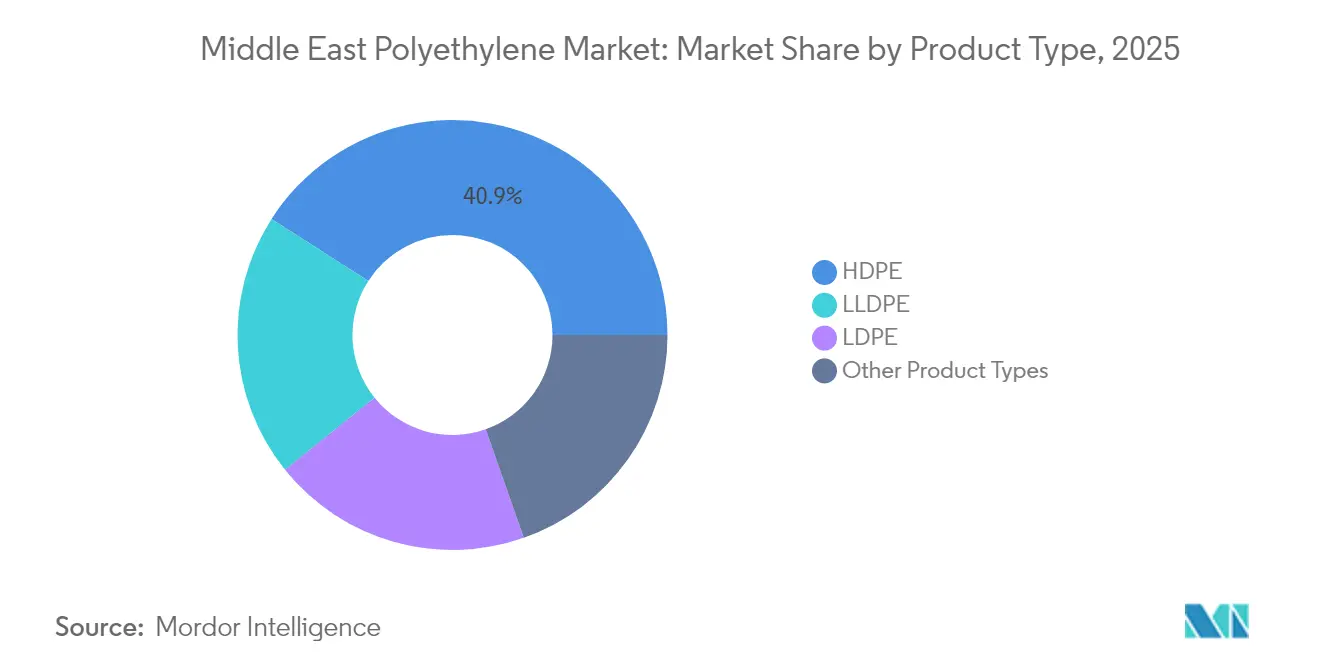
HDPE Dominates, LLDPE Gains in Specialty FilmsHigh-density polyethylene retained 40.92% of the 2025 Middle East polyethylene market share, buoyed by demand for blow-molded drums, IBCs, and large-diameter pressure pipes. Tasnee’s 400,000 tpa HDPE train at Jubail supplies raffia, injection molding, and pipe resins that meet ISO 4427 standards. Low-density polyethylene performs well in shrink films and lamination layers, while linear low-density polyethylene experiences the strongest growth, aided by Borstar Enhanced grades that enable 15–20% downgauging without compromising mechanical properties.
Down-gauged e-commerce mailers, puncture-resistant stretch films, and clarity-enhanced greenhouse covers drive LLDPE’s forecast CAGR to 5.05%, narrowing its contribution to the Middle East polyethylene market size to approximately one-third by 2031. Ultra-high-molecular-weight polyethylene and EVA copolymers occupy niche medical, conveyor, and photovoltaic applications, although they collectively account for a share below mid-single digits.

By Application:
Films Lead, Wires and Cables AccelerateFilms and sheets captured 46.05% of the 2025 demand, mirroring a significant value in the flexible packaging sector that supplies FMCG and e-commerce customers. Government-backed producer-responsibility frameworks drive the adoption of mono-materials, reinforcing polyethylene’s role as a recyclable-friendly substrate.
Cross-linked polyethylene insulation for subsea interconnectors and data-center cabling fuels a 5.12% CAGR in wires and cables. Borouge’s 100,000 tpa plant operates using peroxide cross-linking to produce cable grades certified for continuous service at 90°C. Injection-molded automotive parts and blow-molded fuel tanks round out demand, with rotomolding and extrusion coating accounting for residual volumes.
By End-User Industry:
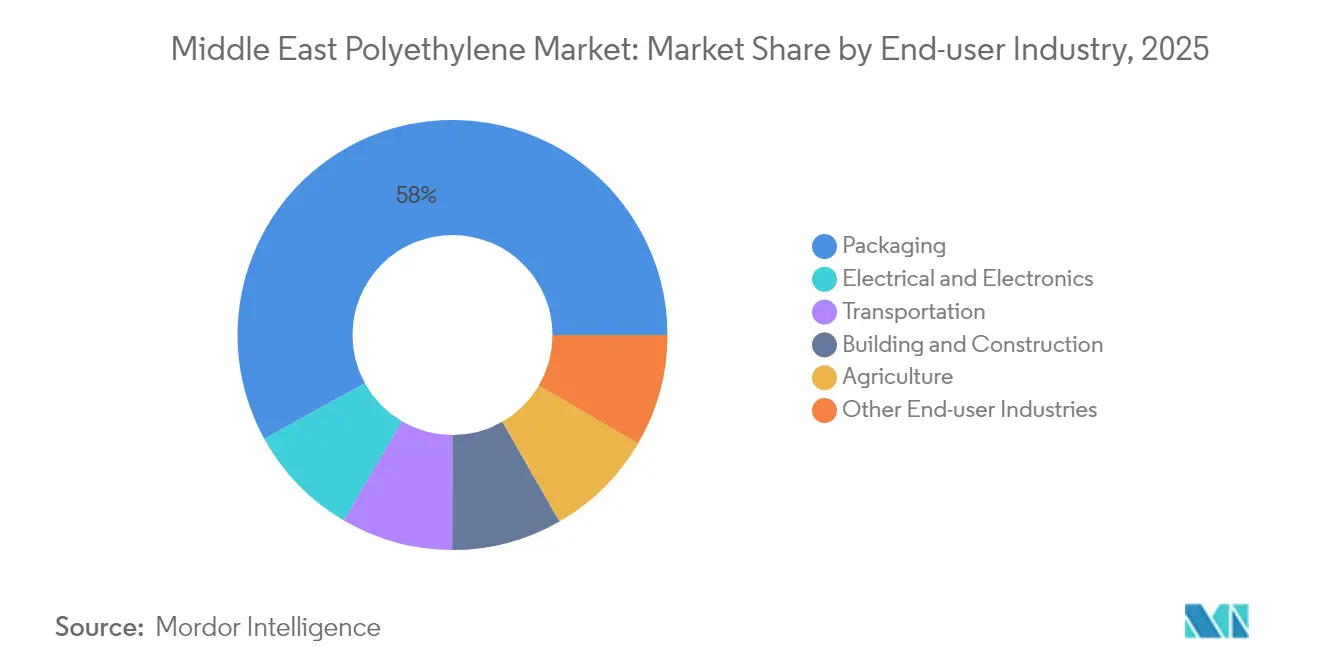
Packaging Prevails, Electrical SurgesPackaging end-users consumed 58.02% of all resin in 2025, driven by demographic tailwinds and urbanization rates above 80% in Saudi Arabia and the UAE. Protective-packaging formats—air pillows, foam, bubble wrap—scale with e-commerce parcel flows that surpassed several hundred million transactions in 2024.
Electrical and electronics demand expands at a 4.99% CAGR as utility-scale renewables, EV charging corridors, and hyperscale data centers multiply cable-grade purchases. ADNOC’s Ta’ziz complex will localize the production of vinyl chloride monomer and caustic soda, securing upstream inputs for wire-and-cable jackets and further solidifying polyethylene’s role in the segment. Building, agriculture, and consumer-goods categories together account for the remaining balance.
Geography Analysis
Saudi Arabia Polyethylene Market
Saudi Arabia held 39.35% of 2025 Middle East polyethylene market share owing to 4.01 million tonnes of SABIC capacity, Tasnee’s dual HDPE/LDPE trains, and generous ethane allocations that keep integrated cracker margins near 88%. District-cooling installations in Riyadh and Jeddah and SASO recyclability mandates sustain domestic demand, while Jubail and Yanbu industrial cities provide a hub for export logistics under the High Commission for Industrial Security.
United Arab Emirates Polyethylene Market
The United Arab Emirates records the top regional growth pace of 4.84% CAGR as Borouge lifts Ruwais nameplate to 6.4 million tonnes by 2025, underpinning the country’s rise as the leading polyethylene exporter after the planned Borouge–Borealis–Nova merger. Ta’ziz infrastructure investments worth AED 7.34 billion add a chemicals port and storage facilities that streamline outbound volumes toward Africa and South Asia.
MEA Polyethylene Market
Qatar brings a 1.68 million-tonne HDPE project online at Ras Laffan in 2026, while Kuwait and Oman contribute incremental swing output. Iran aims for 8.6 million tonnes under its Seventh Plan but faces gas shortfalls that limit near-term utilization. Rest-of-Middle-East nations, led by Egypt’s 7 million-tonne build-out and cross-border projects under the Integrated Industrial Partnership, round out the regional landscape.
Value Chain Analysis
The Middle East polyethylene value chain centers on integrated refinery-petrochemical hubs that secure advantaged ethane and naphtha feeds, convert these into ethylene, and polymerize into HDPE, LDPE, and LLDPE for regional converters as well as export customers. Saudi Arabia and the UAE lead upstream and midstream conversion, with major producers such as SABIC and Borouge supplying resin to film, packaging, pipe, and wire-and-cable compounders. Borouge’s Borstar platform also supports higher-performance grades used for downgauged films and specialty applications.
Downstream, converters and brand owners are increasingly tying resin procurement to circularity and compliance requirements, including demand for certified circular and recyclate-blended polyethylene. Industry bodies such as GPCA coordinate across plastics, supply chain, and responsible care committees, while procurement localization programs such as ADNOC’s In-Country Value (ICV) shape supplier selection and service coverage around major sites like Ruwais. For exports to Africa and South Asia, logistics, port handling, and trade documentation remain key value-chain nodes, because lead times and compliance hurdles can affect netbacks for Gulf producers.
Competitive Landscape
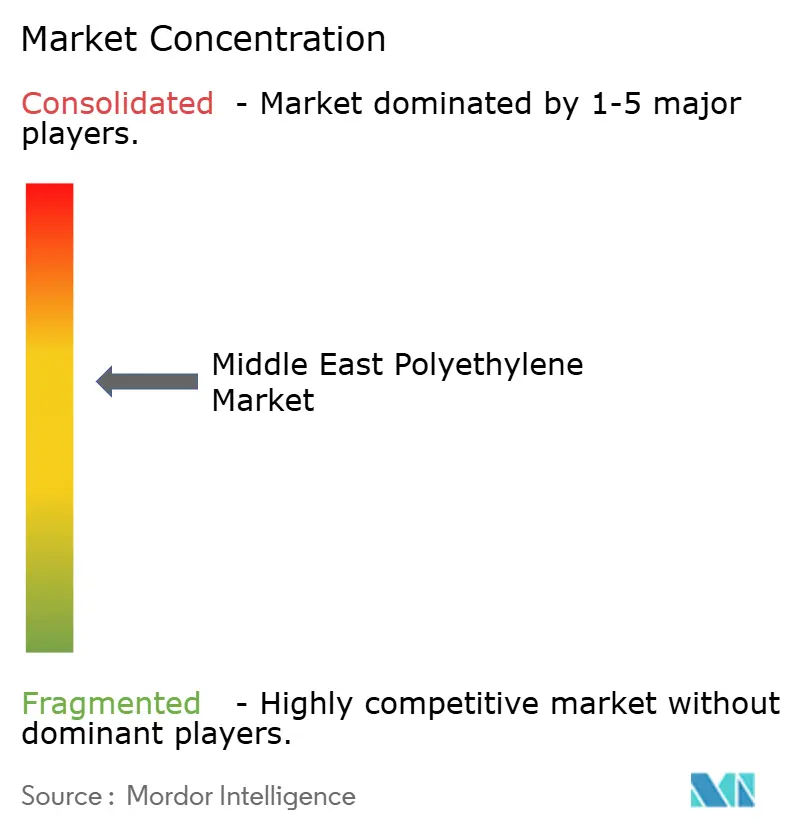
The Middle East Polyethylene Market is moderately consolidated. ADNOC’s USD 9.7 billion deal to merge Borouge with Borealis and acquire Nova Chemicals establishes a USD 60 billion polyolefins champion that will operate with a combined polyethylene and polypropylene capacity of 13.6 million tonnes upon completion in 2026. Strategic thrusts center on feedstock integration, specialty-grade development, and circular economy positioning. SABIC’s TRUCIRCLE mechanical-recycling initiative secures offtake agreements with global FMCG companies seeking certified circular resins. Borouge’s Borstar Enhanced PE delivers downgauging advantages prized by film converters wrestling with volatile feedstock costs.
Middle East Polyethylene Industry Leaders
-
Dow
-
Exxon Mobil Corporation
-
SABIC
-
Qatar Petrochemical Company (QAPCO)
-
Borouge
- *Disclaimer: Major Players sorted in no particular order
Middle East Polyethylene Market Companies Covered in this Report
- Advanced Petrochemical Company,
- Amir Kabir Petrochemical Co. (AKPC)
- Borouge
- Dow
- Eastern Petrochemical Company
- Exxon Mobil Corporation
- Ilam Petrochemical
- Jam Petrochemical Co.
- LyondellBasell Industries BV
- Marun Petrochemical Co.
- National Petrochemical Industrial Co. (NPIC)
- Qatar Chemical Company Ltd
- Qatar Petrochemical Company (QAPCO)
- SABIC
- Saudi Ethylene & Polyethylene Co. (Tasnee)
- Saudi Polymers LLC,
- TotalEnergies
Market Opportunities and Future Outlook
Capacity additions and portfolio premiumization are creating whitespace for higher-value polyethylene grades tied to energy and infrastructure build-outs, especially cable compounds and cross-linkable polyethylene (XLPE). Borouge 4 is a concrete example, with commissioning progressing through 2026 and a 100,000 tpy XLPE unit that is designed to double regional XLPE output to 200,000 tpy, matching demand from power-grid expansion, subsea interconnectors, and industrial electrification projects that pull through wire-and-cable and conduit materials.
On the supply side, new trains and debottlenecking programs strengthen the region’s export leverage, but they also increase the emphasis on differentiated grades and application development to protect margins. SABIC’s Yanbu expansion targets a Q3 2026 production start, adding 500,000 tonnes of polyethylene capacity (alongside 250,000 tonnes of polypropylene), while Borouge’s post-2026 expansion roadmap includes enlarging PE4 and PE5 to 700,000 tpy each by Q1 2027 and increasing EU2 ethane cracker capacity by 230,000 tpy by Q4 2028. These visible projects support opportunities for local compounding, converter investment, and certified circular offerings that align with recyclate-content and mono-material packaging initiatives already influencing procurement decisions in Saudi Arabia and the UAE.
Recent Industry Developments in Middle East Polyethylene Market
- May 2026: Borouge 4 expansion Cross-Linkable Polyethylene (XLPE) plant delivers first batch of materials. The XLPE capacity addition impacts ME PE premium grades. The expansion strengthens UAE capacity and supports high-value film and HDPE segments, signaling premium product focus in the ME market.
- March 2026: Formation of Borouge Group International AG with Asset Usage Agreement for Borouge 4 complex. Consolidates regional polyolefin leadership. Creates integrated governance for Borouge assets, potential pricing and capex synergies.
- February 2026: Five-year PE marketing agreement for S-Oil Shaheen project products. Direct ME/Asia PE product marketing arrangement. Improves access to global PE markets, reinforces SABIC’s polymer offtake strategy.
Middle East Polyethylene Market Report Scope and Research Methodology
Market Definition and Coverage
For this methodology, the market covers polyethylene sold and consumed across Middle East countries, measured in value terms at the resin level across common grades and major end uses.
Scope exclusions: The sizing excludes downstream converted plastic products and any non-polyethylene polymers, even if they compete in the same applications.
Segments Covered in This Report
- By Product Type
- HDPE
- LDPE
- LLDPE
- Other Product Types
- By Application
- Blow Molding
- Films and Sheets
- Injection Molding
- Pipes and Conduits
- Wires and Cables
- Other Applications
- By End-user Industry
- Packaging
- Transportation
- Electrical and Electronics
- Building and Construction
- Agriculture
- Other End-user Industries
- By Geography
- Saudi Arabia
- United Arab Emirates
- Qatar
- Kuwait
- Oman
- Iran
- Rest of Middle East
Data Sources, Market Sizing, and Validation
Desk Research
Desk research was used to set the boundary of what counts as polyethylene in the region, and to build the first pass of demand and pricing inputs. We leaned on public sources such as national statistics portals and customs trade records, Saudi General Authority for Statistics, UN Comtrade, and official energy and petrochemicals publications that help explain feedstock and operating conditions.
To keep the market model grounded, we also reviewed public company annual reports, investor presentations, and reputable press coverage on capacity changes, turnarounds, and export positioning. In a few cases, paid subscriptions for company financials and intelligence, news and financials, and shipment-level import and export data were used to speed up cross-checking and reduce gaps. The sources listed here are illustrative, and other references were also used for data collection, validation, and clarification during the research process.
Primary Interviews and Surveys
Primary work was done through expert interviews and structured surveys with producers, distributors, converters, and large buyers to confirm assumptions on grade mix, typical pricing behavior, and demand swings by end use. Because this is a regional market, conversations were balanced across key Middle East countries and major trade corridors, and then follow-up questions were used to resolve cases where desk signals and field inputs did not match.
The table below shows the respondent mix used for this fieldwork.
Distribution of primary research fieldwork respondents
| Company type | Respondent position |
|---|---|
| Top tier: 27% | CXOs: 14% |
| Mid tier: 53% | Functional/Unit leaders: 33% |
| Smaller Players: 20% | Managers: 53% |
Market-Sizing & Forecasting
The core sizing logic used a top-down approach where regional polyethylene demand was reconstructed using production context, trade flows, and consumption pull from key end uses, and then converted into value using typical annual price bands by grade. To make sure the totals were not only theoretical, we also ran selective bottom-up checks using sampled volumes by application and grade, along with channel feedback on average selling prices, which were then used to adjust the final market value.
The inputs that most influenced the model were polyethylene grade split (HDPE, LDPE, and LLDPE), operating rate and planned maintenance at major crackers and polymerization units, net export intensity versus domestic absorption, end-use demand signals from packaging and construction activity, and the timing of oil and naphtha movements that impact resin pricing. Where direct visibility was limited for smaller importing countries, gaps were handled by using trade proxies and validating the implied consumption against local converter activity shared in interviews.
For the forecast, scenario analysis was applied so near-term volatility in operating rates and pricing could be separated from steadier demand growth. The scenario paths were informed by expert views on capacity additions, expected trade rebalancing, and realistic price normalization rather than a single straight-line assumption.
Data Validation & Update Cycle
Model outputs were validated through multiple checks that compare the implied market value against independent signals such as trade value trends, capacity and utilization direction, and the price ranges discussed by market participants. When a country or grade showed unusual jumps, the drivers were reviewed again, and the assumptions were revisited with additional desk verification and selective re-contact with respondents.
Before sign-off, the work is reviewed in steps so calculation logic, unit conversions, and year mapping are consistent across the model. Reports are refreshed annually, and interim updates are triggered when material events occur, such as a major plant outage, a new capacity start-up, or a sharp shift in trade patterns. Right before delivery, an analyst performs a fresh pass so clients receive the latest updated view.
Mordor Intelligence's Middle East Polyethylene Market Size Compared Against Other Published Estimates
Published market sizes for Middle East polyethylene do not always match because the scope boundary is not set the same way, and the pricing and trade assumptions are also handled differently across sources.
Export intensity signals and grade-level price bands are two checks that keep Mordor Intelligence tied to resin-only polyethylene value in the Middle East, which avoids inflating totals by mixing in downstream converted film or sheet revenue.
Benchmark comparison
| Source | Market Size | Gaps in Research Methodology |
|---|---|---|
| Mordor Intelligence | USD 13.23 B (2025) | |
| Trade Journal A | USD 4.40 B (2024) | This figure is limited to non-cellular polyethylene film, sheet, foil, and strip consumption, so it is a narrower product boundary than total polyethylene resin demand across all applications. |
| Regional Consultancy B | USD 14.00 B (2024) | The estimate appears to rely on a broad consumption times average price approach for a single base year, with less visible treatment of grade mix, trade re-exports, and consistent currency timing, which can shift the value upward or downward. |
The comparison shows that the main spread comes from what is counted as polyethylene and how pricing is applied across grades and trade positions. By keeping the scope at resin value and then pressure-testing the totals with trade and capacity signals, the final number stays traceable to clear steps that can be repeated year to year.
Key Questions Answered in the Report
What is the current value of the Middle East polyethylene market?
The market is valued at USD 13.77 billion in 2026 and is projected to reach USD 16.79 billion by 2031.
Which country leads regional polyethylene production?
Saudi Arabia contributes 39.35% of 2025 output, backed by SABIC’s 4.01 million-tonne integrated capacity.
Which segment grows fastest through 2031?
Wires and cables, supported by cross-linked polyethylene grades, show a 5.12% CAGR through 2031.
How will recyclate-content mandates affect resin demand?
Regulations in Saudi Arabia and the UAE push converters toward virgin–recycle blends, lifting demand for certified circular polyethylene.
What are the key risks to Middle East exporters?
Feedstock price swings, logistics disruptions in the Red Sea, and rising import tariffs in African markets can erode cost advantages.