
Biohazard Bags Market Size and Share
Market Overview
| Study Period | 2020 - 2031 |
|---|---|
| Market Size (2026) | USD 472.37 Million |
| Market Size (2031) | USD 701.32 Million |
| Growth Rate (2026 - 2031) | 8.24 % |
| Fastest Growing Market | Asia Pacific |
| Largest Market | North America |
| Market Concentration | Medium |
Major Players *Disclaimer: Major Players sorted in no particular order Image © Mordor Intelligence. Reuse requires attribution under CC BY 4.0. | |
Biohazard Bags Market Analysis by Mordor Intelligence
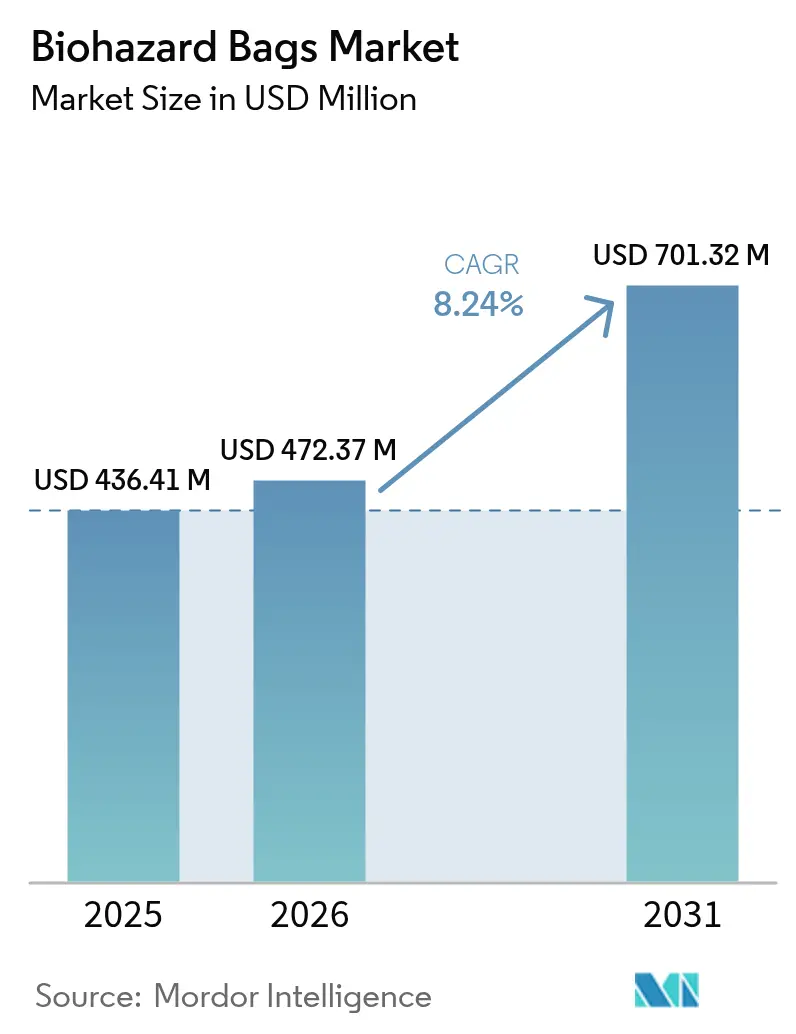
The biohazard bags market size was valued at USD 436.41 million in 2025 and estimated to grow from USD 472.37 million in 2026 to reach USD 701.32 million by 2031, at a CAGR of 8.24% during the forecast period (2026-2031). Expansion reflects the healthcare sector’s heightened emphasis on infection-control protocols, the post-pandemic rise in single-use consumables and the steady tightening of hazardous-waste regulations. Demand is further underpinned by the volume of biomedical waste, 15% of which is classified as hazardous, and by the spread of standardized compliance rules such as the Hazardous Waste Generator Improvements Rule adopted by 40 states. Hospitals, diagnostic laboratories and pharmaceutical plants continue to scale capacity, and each new facility embeds waste-segregation requirements at the design stage. These combined factors reinforce sustained purchasing of color-coded, puncture-resistant containment products across the biohazard bags market[1]Centers for Disease Control and Prevention, “Healthcare Infection Prevention and Control,” cdc.gov.
Key Report Takeaways
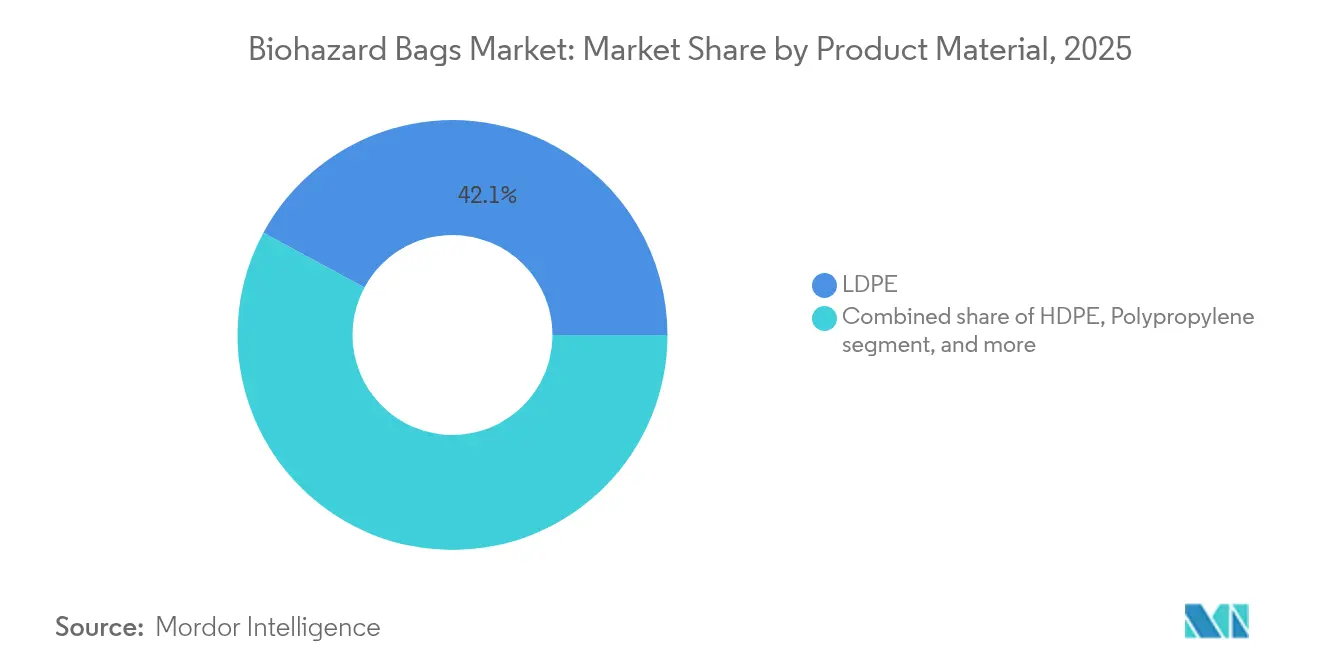
- By product material, low-density polyethylene led with 42.11% revenue share in 2025; polypropylene is projected to expand at a 10.01% CAGR through 2031.
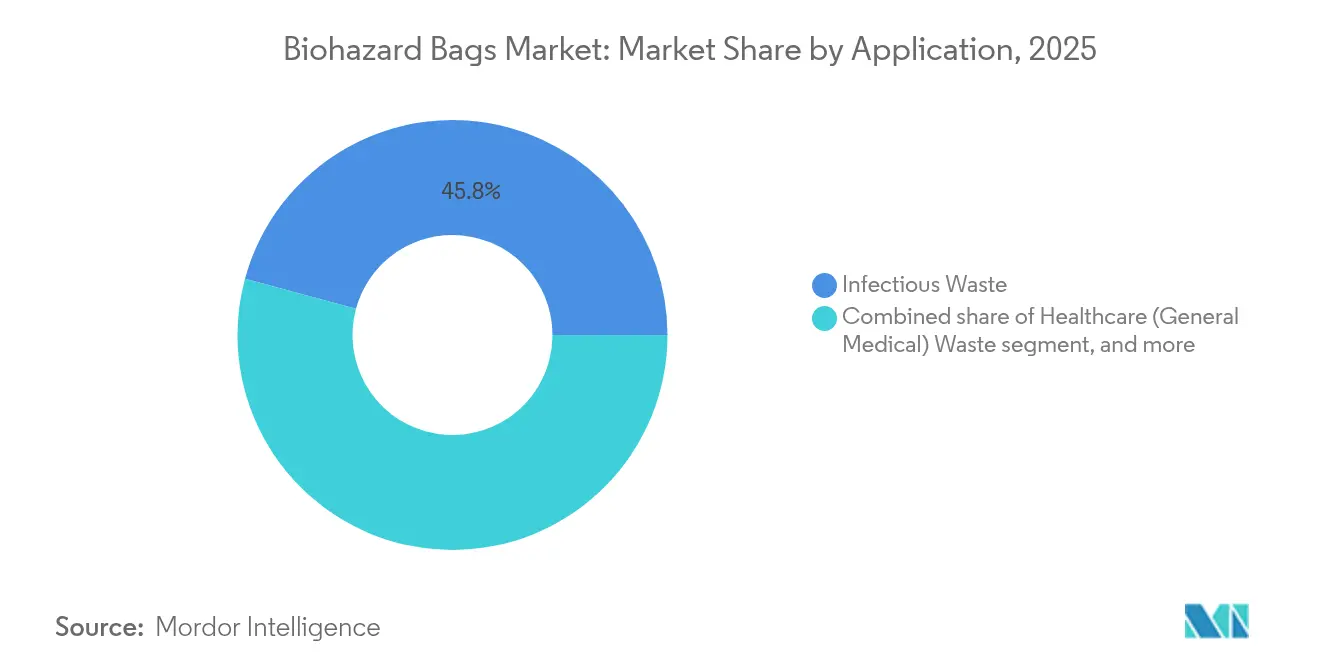
- By application, infectious waste captured 45.78% of the biohazard bags market size in 2025 while healthcare general medical waste records the highest expected CAGR at 9.74% to 2031.
- By end user, hospitals held 55.02% of the biohazard bags market share in 2025, whereas diagnostic laboratories are set to post an 10.92% CAGR during the forecast period.
- By geography, North America accounted for 38.12% revenue share in 2025; Asia-Pacific is forecast to grow the fastest, at 9.34% CAGR through 2031.
Note: Market size and forecast figures in this report are generated using Mordor Intelligence’s proprietary estimation framework, updated with the latest available data and insights as of 2026.
Market Trends and Insights
Drivers Impact Analysis of Biohazard Bags Market*
| Driver | (~) % Impact on CAGR Forecast | Geographic Relevance | Impact Timeline |
|---|---|---|---|
| Accelerating generation of biomedical waste | +2.1% | Global, concentrated in North America & Europe | Medium term (2 – 4 years) |
| Expansion of global healthcare infrastructure | +1.8% | Asia-Pacific core, spill-over to MEA and South America | Long term (≥ 4 years) |
| Stricter regulatory compliance for hazardous waste segregation | +1.6% | North America & EU, expanding to Asia-Pacific | Short term (≤ 2 years) |
| Rising adoption of single-use medical consumables | +1.4% | Global, led by developed markets | Medium term (2 – 4 years) |
| Growth of pharmaceutical and biologics manufacturing | +1.2% | North America, Europe and emerging Asia-Pacific hubs | Long term (≥ 4 years) |
| Increasing public-health awareness of infection control | +1.0% | Global post-pandemic | Short term (≤ 2 years) |
| Source: Mordor Intelligence | |||
Accelerating Generation of Biomedical Waste
Healthcare facilities now classify 15% of waste as hazardous, a share that remains elevated after 2020. Intensive care units and emergency departments generate larger volumes of contaminated disposables than before, and the World Health Organization’s guidance on point-of-generation segregation has become a routine benchmark. Hospitals respond by purchasing colour-coded bag systems that align with federal, state and international requirements for traceability, puncture resistance and leak protection. Mandatory staff-training modules on handling procedures further increase reorder frequency, making this factor one of the most durable growth contributors for the biohazard bags market.
Expansion of Global Healthcare Infrastructure
Asia-Pacific governments are commissioning hospitals, outpatient clinics and diagnostic hubs at a pace unmatched elsewhere. These projects embed medical-waste rooms, automated bag-sealers and inspection points into facility blueprints. New plants for biologics and vaccines use containment specifications based on United States and European Union rules, which accelerates demand for thicker-gauge polypropylene and high-density polyethylene bags. Builders and operators also stipulate eco-labels as they move toward sustainable procurement targets set by regional authorities. The long-term investment cycle therefore feeds continuous volume growth across the biohazard bags market.
Stricter Regulatory Compliance for Hazardous Waste Segregation
Forty states now enforce the Hazardous Waste Generator Improvements Rule, and the EPA’s e-Manifest system obliges healthcare providers to document waste from point of origin to disposal. The Management Standards for Hazardous Waste Pharmaceuticals prohibit sewer disposal and direct generators toward compliant containment and incineration. Recent state proposals on sharps handling add further specificity, prompting hospitals to adopt heavy-duty bag formats certified for both tear strength and bar-code tracking. Suppliers able to match these niche requirements gain an advantage in the biohazard bags market.
Rising Adoption of Single-Use Medical Consumables
The FDA re-emphasized single-use device safety guidelines in 2024, discouraging reprocessing of items that contact sterile tissue. Dental clinics and ambulatory centers must now dispose of gloves, gowns and tubing immediately after patient contact, each item classified as regulated medical waste. Proper disposal relies on bags that meet ASTM puncture- and impact-resistance thresholds. Facilities embed disposal policies into daily checklists, translating directly into higher bag consumption per procedure.
Restraints Impact Analysis of Biohazard Bags Market*
| Restraints Impact Analysis | (~) % Impact on CAGR Forecast | Geographic Relevance | Impact Timeline |
|---|---|---|---|
| Availability of reusable waste containment systems | -0.8% | Global, stronger in sustainability-focused markets | Medium term (2-4 years) |
| Volatility in polyethylene raw material prices | -0.6% | Global, with regional supply-chain variations | Short term (≤ 2 years) |
| Emerging bans on single-use plastics | -0.7% | Europe, North America and select Asia-Pacific jurisdictions | Medium term (2-4 years) |
| High capital requirements for waste-treatment compliance | -0.5% | Global, more pronounced in developing markets | Long term (≥ 4 years) |
| Source: Mordor Intelligence | |||
Availability of Reusable Waste Containment Systems
Large hospitals adopting circular-economy objectives trial bag-less cart systems that integrate solid plastic linings and sealed lids. Firms such as Daniels Health market cassette-style sharps units that can be emptied, sterilized and redeployed. Sustainability committees note lower cradle-to-grave emissions and reduced worker-injury risk compared with double-bag techniques. Initial capital outlay and comprehensive staff retraining limit adoption to major networks, yet the option introduces price sensitivity within the biohazard bags market, particularly for low-value red bags.
Volatility in Polyethylene Raw Material Prices
Surges in naphtha and ethane feedstock costs prompt resin price swings, compressing margins for converters and prompting healthcare buyers to renegotiate contracts. Manufacturers hedge with multi-month inventories, but smaller converters remain exposed to spot-price fluctuations. Some hospitals test alternative materials or request mid-contract price reviews. Meanwhile, supply-chain departments diversify suppliers to reduce disruption risk. Extended volatility therefore delays bulk-purchase decisions and introduces a moderate dampening effect on biohazard bags market growth[2]Environmental Protection Agency, “Hazardous Waste Generator Improvements Rule,” epa.gov.
*Our forecasts treat driver/restraint impacts as directional, not additive. The impact forecasts reflect baseline growth, mix effects, and variable interactions.
Biohazard Bags Market Segment Analysis
By Product Material:
Polypropylene Gains Ground Despite LDPE DominanceLow-density polyethylene commanded 42.11% of the biohazard bags market share in 2025, reflecting its proven flexibility and puncture-resistance attributes that satisfy general infectious-waste handling requirements. The material dominates high-throughput hospital settings where cost, availability and automated-sealing compatibility matter most. However, polypropylene continues to outpace all other resins, and the biohazard bags market size for the polypropylene segment is projected to expand at 10.01% CAGR between 2026 and 2031 thanks to its higher chemical-resistance threshold, suitability for chemotherapeutic and pharmaceutical waste and ability to withstand high-temperature autoclave cycles.
The preference landscape is evolving. Specialized cancer centers and biologics plants often specify high-density polyethylene or multilayer co-extruded structures to secure extra leak resistance. A niche group of facilities is also piloting biopolymers derived from polylactic acid or polyhydroxyalkanoate, aiming to lower carbon footprints, yet uptake remains embryonic because healthcare regulators require exhaustive validation before approving bag materials for hazardous waste. Manufacturers are therefore balancing environmental claims with mandatory ASTM and ISO puncture, tear and transmissibility testing, ensuring that innovation continues without undermining the core performance expectations of the biohazard bags market.



By Application:
Healthcare General Medical Waste Accelerates GrowthInfectious waste accounted for 45.78% of the biohazard bags market size in 2025, driven by sustained use of disposable drapes, gowns and gloves across surgical suites and intensive-care units. These procedures generate consistent daily volumes that must be removed quickly, making red infectious-waste bags the workhorse of hospital operations. At the same time, the healthcare general medical waste category is forecast to grow the fastest, with 9.74% CAGR through 2031, as outpatient clinics and point-of-care diagnostic sites multiply. These facilities produce a broad mix of partially contaminated items that still require containment but do not always meet the infectious threshold, thereby expanding mid-gauge bag demand.
Chemical and pharmaceutical waste will remain a speciality sub-segment, drawing demand for thicker, yellow or black bags incorporating heavyweight polypropylene to resist aggressive solvents. Other categories, such as pathological waste, hold smaller shares but command premium-priced, vapor-barrier configurations. Regulators continue to refine bag specifications, especially for drug-contaminated disposables, which funnel additional purchase orders toward suppliers adept at application-specific designs within the biohazard bags market.
By End User:
Diagnostic Laboratories Drive Fastest ExpansionHospitals represented more than half of the biohazard bags market size in 2025 at 55.02%, a share reflecting their high patient throughput, complex waste matrices and on-site autoclave facilities. Within hospitals, peri-operative departments and catheterization labs consume the bulk of bags due to constant instrument turnover. Diagnostic laboratories, however, are projected to post the highest growth at 10.92% CAGR through 2031 as molecular-testing volumes climb and decentralized testing formats spread to pharmacies and retail clinics. Each specimen loop, pipette tip and microcentrifuge tube must be disposed of in a compliant liner, driving frequent reorder cycles.
Pharmaceutical manufacturing plants also add incremental demand as they expand batch sizes for biologics and vaccines. These sites require bags that survive chemical-decontamination steps before incineration, favoring multilayer polypropylene or co-extruded substrates. Research institutions and veterinary facilities round out the end-user mix, forming smaller yet steady revenue pools within the broader biohazard bags market.
Geography Analysis
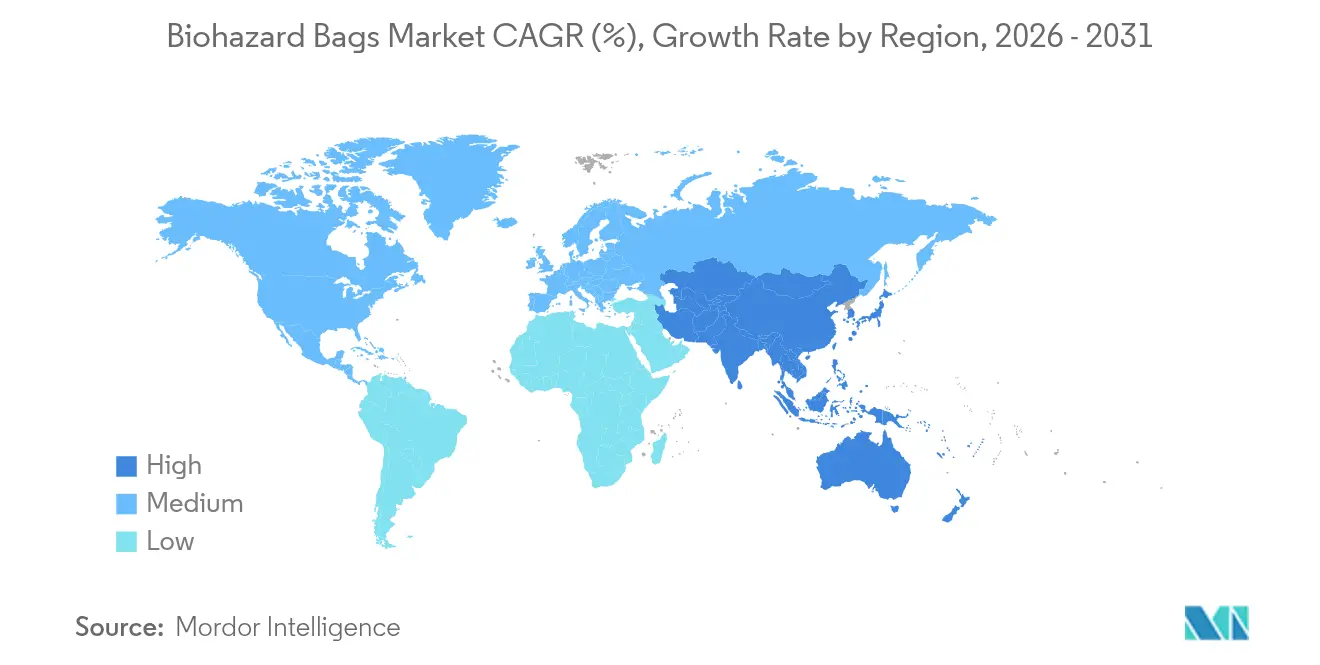
North America Biohazard Bags Market
North America retained leadership with a 38.12% revenue share in 2025, anchored by a well-established regulatory network comprising the EPA, OSHA and FDA. Hospitals allocate dedicated compliance budgets to ensure waste-tracking accuracy and purchase bags meeting ASTM D1709 puncture standards. States’ uptake of the Hazardous Waste Generator Improvements Rule harmonizes documentation requirements, further embedding standardized liner use and sustaining demand across the United States and Canada. While growth is slower than in developing regions, replacement cycles, red-bag subsidies for rural clinics and consolidation among waste-management service providers preserve market vibrancy.
APAC Biohazard Bags Market
Asia-Pacific contributes the most dynamic growth storyline. Government funding for new inpatient beds, oncology centers, dialysis units and vaccine plants is accompanied by mandatory waste-segregation guidelines modeled on United States and European Union directives. As governments implement these rules, procurement teams specify minimum bag thickness, bag color by waste class and traceability features. Local manufacturers ramp production, yet premium imports still dominate high-spec orders, ensuring cross-border supply chains form an integral part of the biohazard bags market. With healthcare expenditure rising alongside urban population growth, Asia-Pacific’s 9.34% CAGR is likely to remain intact this decade.
EMEA and South America Biohazard Bags Market
Europe maintains a significant market position thanks to Green Deal policy incentives and stringent circular-economy objectives. Hospitals are piloting low-carbon or reusable waste systems, yet infection-prevention priorities keep single-use liners firmly in place for high-risk waste streams. Regulatory authorities such as the European Chemicals Agency frequently update guidance on halogenated plastics, prompting manufacturers to adjust formulations. The Middle East and Africa display moderate yet accelerating growth as Gulf states commission teaching hospitals with Western-style waste rooms, while South America records steady improvement as public-sector hospitals upgrade to meet revised waste-handling laws.

Regulatory Landscape
Regulation of biohazard bags sits at the intersection of worker-safety rules, hazardous-waste requirements, and packaging performance standards. In the United States, OSHA bloodborne pathogens requirements (29 CFR 1910.1030) drive core bag attributes for regulated waste, including leak resistance and clear biohazard marking (or red-bag equivalency), while medical waste oversight is decentralized across state environmental and health agencies, creating a fragmented compliance map for manufacturers and multi-state healthcare networks.
Across global procurement, technical qualification is commonly anchored in widely used film test standards such as ASTM D1709 for impact resistance and ASTM D1922 for tear propagation. Buyers use these tests to validate durability during handling and transport. In Europe, Regulation (EU) 2017/745 (MDR) adds emphasis on packaging information that supports safe handling and disposal for products associated with infection risk, reinforcing the need for clear labeling, instructions, and traceability cues aligned to facility waste-stream segregation protocols.
Competitive Landscape
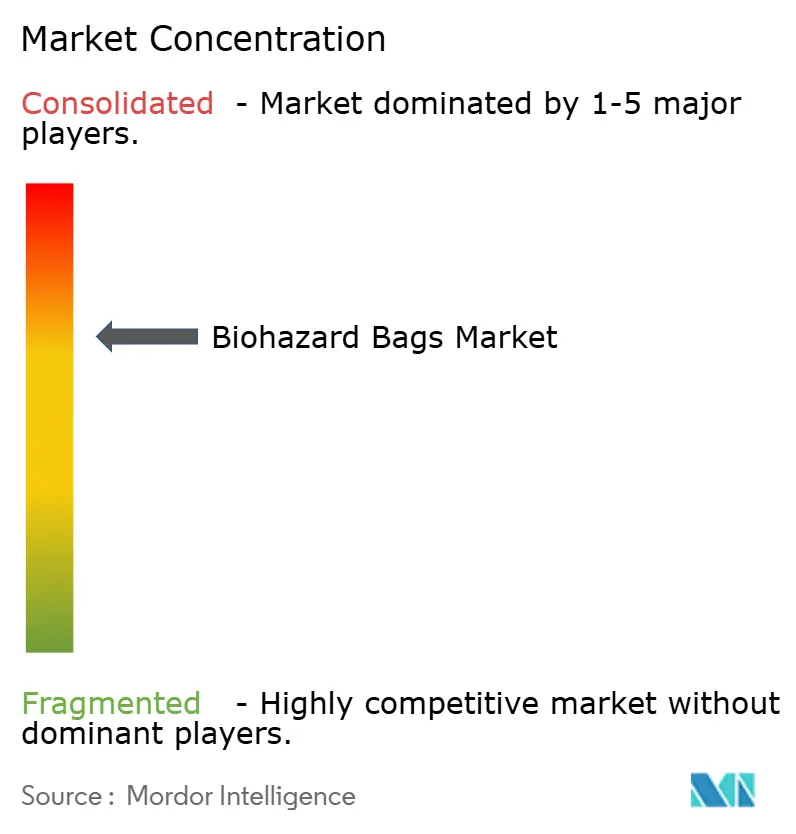
The biohazard bags market is moderately consolidated. Waste Management’s USD 7.2 billion purchase of Stericycle in June 2024 produced the largest integrated medical waste company in North America and yielded USD 125 million in annual synergies, boosting cross-selling opportunities for proprietary bag lines positioned alongside haul-off services. The merger accelerates vertical integration, enabling bundled contracts that cover liner supply, pickup, treatment and compliance reporting within a single service agreement.
Traditional bag specialists compete by refining niche products. STERIS introduced Verafit Sterilization Bags with viewing windows that confirm dryness after steam exposure, specifically targeting EU GMP Annex 1 requirements for sterile-manufacturing fill-finish zones[3]STERIS, “Verafit Sterilization Bags and Covers,” steris.com. Smaller converters differentiate through short-run color printing, biodegradable additives and strong customer service for rural or specialty clinics. Meanwhile, sustainability ambitions push manufacturers to research plant-derived resins or to collaborate with chemical recyclers aiming to close the loop on polyethylene waste.
Technology adoption is another differentiator. Smart bag dispensers equipped with RFID tags allow environmental-services teams to track daily liner consumption by department. Data generated helps hospitals refine supply forecasts and minimize stockouts. Players able to integrate digital-tracking options, offer compliant film recipes and document full chain-of-custody continue to capture higher-margin contracts. Consolidation is likely to continue as service providers and bag producers seek scale advantages, especially within international markets where multi-facility health networks demand harmonized supply.
Biohazard Bags Industry Leaders
Thermo Fisher Scientific, Inc.
Inteplast Group (Minigrip)
Transcendia Inc.
SP Bel-Art
Merck KGaA (MilliporeSigma)
- *Disclaimer: Major Players sorted in no particular order
Biohazard Bags Market Companies Covered in this Report
- Thermo Fisher Scientific
- SP Bel-Art
- International Plastics Inc.
- Inteplast Group (Minigrip)
- Merck KGaA (MilliporeSigma)
- Transcendia Inc.
- Champion Plastics
- Desco Medical
- Welpack Industries Pvt. Ltd
- Propper Manufacturing Co.
- Daniels Health
- Stericycle Inc.
- Lithey Inc.
- BioMedical Waste Solutions LLC
- Dana Poly Inc.
- Plasti-Med (Turkey)
- PacMed Labs
- Safetec of America
- Jiangsu Huanxin High-Tech Materials Co.

Market Opportunities and Future Outlook
Opportunity concentrates around solutions that reduce compliance friction while improving traceability and handling safety in high-volume hospital and laboratory waste streams. Healthcare providers must use closable, leak-resistant, clearly labeled regulated medical-waste packaging, which creates whitespace for higher-specification liners (thicker gauges, enhanced tear and impact resistance tied to ASTM test regimes) and workflow-enabling formats such as compartmentalized or tamper-evident bags used for specimen movement and internal transport between departments. Supplier offerings that pair compliant bags with digital consumption tracking at the point of use also fit hospital supply-chain efforts to minimize stockouts and standardize waste segregation across departments.
A second opportunity area is the interface between containment products and on-site or decentralized treatment initiatives, particularly where transport to centralized facilities is costly or logistically difficult. In June 2025, CSIR-NIIST reported development of in-situ biomedical waste disposal technology with testing in military hospital settings (including a Siachen glacier site) and at AIIMS New Delhi, highlighting a push toward localized waste processing in parts of Asia. As these programs expand, procurement requirements increasingly focus on compatibility with autoclave and treatment workflows, including autoclave-ready materials and clear process indicators, which supports differentiated product lines beyond standard red-bag infectious waste.
Recent Industry Developments in Biohazard Bags Market
- January 2026: The European Union consolidated text updates to Regulation (EU) 2017/745 (MDR) continued to reinforce packaging information requirements linked to safe handling and disposal of contaminated substances. This keeps pressure on healthcare supply chains and suppliers to provide clear, standardized labeling and disposal instructions that align with infection-control and waste segregation practices across EU facilities.
- June 2025: CSIR-NIIST disclosed development of an in-situ biomedical waste disposal technology, with units tested for military hospitals (including a Siachen glacier site) and AIIMS New Delhi. The initiative highlights increased attention on decentralized waste processing, which elevates demand for containment consumables that integrate smoothly with on-site treatment steps such as autoclaving and controlled transfer.
- June 2024: Waste Management completed its USD 7.2 billion acquisition of Stericycle, creating a larger integrated medical-waste management platform in North America. The combination strengthens bundled contracting across liner supply, pickup, treatment, and compliance documentation, influencing purchasing decisions for biohazard bags through consolidated service-led procurement.


Biohazard Bags Market Report Scope and Research Methodology
Market Definition and Coverage
The market covers revenue generated from biohazard bags used to collect, store, and move infectious or biomedical waste in regulated settings, where labeling and safe containment are required during handling and disposal.
Scope exclusions: sharps containers, rigid reusable canisters, and broader chemical packaging are excluded from this sizing.
Segments Covered in This Report
- By Product Material
- LDPE
- HDPE
- Polypropylene
- Cellophane
- Other Product Materials
- By Application
- Infectious Waste
- Healthcare (General Medical) Waste
- Chemical & Pharmaceutical Waste
- Other Applications
- By End User
- Hospitals
- Diagnostic Laboratories
- Pharmaceutical & Biologics Manufacturing
- Other End Users
- Geography
- North America
- United States
- Canada
- Mexico
- Europe
- Germany
- United Kingdom
- France
- Italy
- Spain
- Rest of Europe
- Asia-Pacific
- China
- Japan
- India
- Australia
- South Korea
- Rest of Asia-Pacific
- Middle East & Africa
- GCC
- South Africa
- Rest of Middle East & Africa
- South America
- Brazil
- Argentina
- Rest of South America
- North America
Data Sources, Market Sizing, and Validation
Desk Research
Desk work starts by clarifying what counts as a biohazard bag and where demand is created, then mapping it to observable waste handling activity in healthcare and labs. We rely on public references such as CDC guidance on healthcare waste and infection control, WHO materials on health-care waste, EPA hazardous waste rules and state implementation notes, and OSHA bloodborne pathogens requirements to keep the definition consistent across regions.
To anchor volumes and adoption signals, we also review national health statistics releases, customs and trade datasets for relevant polymer films and bags, and peer-reviewed articles that discuss biomedical waste generation rates by facility type. Company filings, investor decks, association websites, and reputed press are used to sanity check capacity additions, pricing movements, and distribution reach, and a paid subscription for company financials and news helps track changes that do not show up quickly in public releases. This list is indicative only, and many other sources were consulted for data collection, validation, and clarification.
Primary Interviews and Surveys
Primary interviews and surveys are used to pressure-test bag usage rates, compliance-driven purchasing patterns, and regional differences in color coding and labeling expectations. We typically speak with manufacturers, converters, distributors, healthcare procurement teams, and waste handling stakeholders across APAC, EMEA, and the Americas, so assumptions from desk inputs can be confirmed and adjusted.
Distribution of primary research fieldwork respondents
| Company type | Respondent position | Region |
|---|---|---|
| Top tier: 39% | CXOs: 14% | APAC: 38% |
| Mid tier: 47% | Functional/Unit leaders: 36% | EMEA: 36% |
| Smaller Players: 14% | Managers: 50% | Americas: 26% |
Market-Sizing & Forecasting
For sizing, we use a top-down build where biomedical waste generation and regulated handling requirements are translated into an addressable bag demand pool, then converted into value using pricing benchmarks. Since reporting practices vary by country, the model is built at a regional level first and then rolled up to the global market total, which keeps assumptions visible.
Key inputs include biomedical waste volume trends by care setting, hospital and diagnostic lab activity levels, penetration of segregation practices, average bags consumed per bed or per procedure day (where applicable), and typical unit prices by thickness and material family. If an input series is incomplete, we fill the gap using nearby public indicators and confirm the reasonableness through interview feedback before it is included in the final run.
For forecasting, we use scenario analysis supported by regression-style checks on drivers such as healthcare utilization, lab testing volumes, and regulatory enforcement intensity, then apply a realistic price progression based on resin and film cost direction. Results are corroborated with selective bottom-up approximations, such as sampled supplier and channel price points multiplied by inferred volumes, which helps avoid totals that look mathematically neat but do not match how buyers purchase.
Data Validation & Update Cycle
Model outputs are cross-checked against independent signals, including waste management spend direction, healthcare facility growth, and observed pricing changes for comparable polymer packaging. Outliers are flagged, investigated, and reworked if the driver trail cannot explain the change, and then the full set of assumptions is reviewed in more than one internal pass before sign-off.
Reports are refreshed annually, and interim updates are triggered when a material event is seen, such as a major regulatory change, a sharp resin price shift, or a supply disruption that affects pricing and availability. Before delivery, we do a final update sweep so clients receive an outlook that reflects the most recent public information and validated expert inputs.
Mordor Intelligence's Biohazard Bags Market Estimate Compared With Other Published Estimates
Published market values for biohazard bags can differ even when the topic name appears identical, because each publisher draws the line around products, end uses, and time periods in a slightly different way. Differences also show up when pricing is handled as a single average versus being linked to bag material and thickness that buyers actually specify.
Sharps waste and chemical or pharmaceutical waste categories sit outside Mordor Intelligence's scope here, which explains why some broader waste containment write-ups land on a larger number even if the growth trend direction is similar.
Benchmark comparison
| Source | Market Size | Gaps in Research Methodology |
|---|---|---|
| Mordor Intelligence | USD 472.37 M (2026) | |
| Global Research Publisher A | USD 407.40 M (2024) | Uses an earlier base year, and the scope description is broader around waste streams, which can blend biohazard bags with adjacent waste handling categories when totals are summarized. |
| Industry Publisher B | USD 512.51 M (2025) | Presents a higher base value without clearly stating scope exclusions, and the pricing build is less transparent, which can lift the total if thicker bags or premium labeling formats are assumed as standard. |
Taken together, the spread in published figures is mainly explained by which waste categories are included, the year chosen as the starting point, and how average price is carried into the model. Our sizing stays traceable because the demand pool is linked to regulated infectious waste handling activity, and then validated through interviews that check usage rates and price ranges before the forecast is finalized.


Key Questions Answered in the Report
What is the current value of the biohazard bags market?
The market stands at USD 472.37 million in 2026 and is projected to hit USD 701.32 million by 2031.
Which material leads sales within the biohazard bags market?
Low-density polyethylene leads, accounting for 42.11% of revenue in 2025.
Why are diagnostic laboratories the fastest-growing end-user group?
Rising molecular-testing volumes and the spread of decentralized point-of-care diagnostics increase contaminated consumables, which drives 10.92% CAGR for laboratories.
Which region shows the fastest market growth?
Asia-Pacific posts the highest CAGR at 9.34% through 2031, due to major healthcare infrastructure investments and stricter waste-handling regulations.
What sustainability initiatives affect the biohazard bags market?
Hospitals in North America and Europe are piloting reusable container systems and exploring plant-based resins, pushing suppliers to invest in lower-carbon or recyclable product lines.
Page last updated on:


 Your data is secure and never sold or shared.


