


For evaluators and anyone doing diligence: Robotics Platform Data Sources and Research Methodology
- Public sources onlyPermits, filings, tender portals, patent registers, award notices
- Provenance on every recordSource type and date stored with each one
- Scoring inputs visibleEvery likelihood band shows the inputs that produced it
- Continuously refreshedRecords published as verified, revised as status changes.
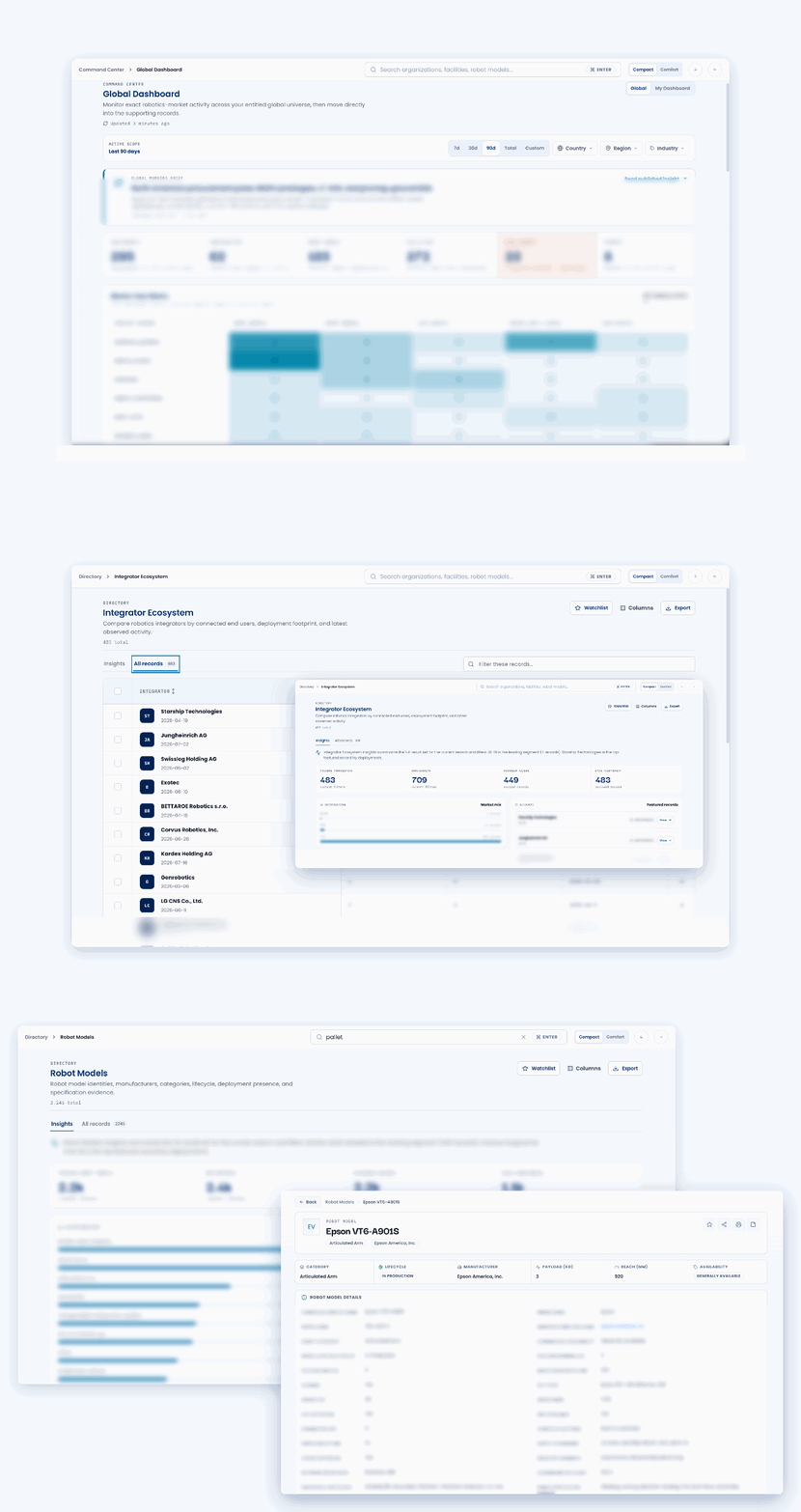
What the Robotics Data Holds, Module by Module: Where It Comes From and How It Is Scored
Pipeline Modules
- Construction signals
A construction or expansion project with owner and operator, facility, location and industry, construction stage, expected opening, robotics likelihood band and the evidence behind it.
- Tender notices
A robotics procurement opportunity with the buying authority, named suppliers where disclosed, submission deadlines, source-reported values, industry, jurisdiction and evidence.
- Contract awards
An awarded robotics contract with buyer, supplier, award date, value band, jurisdiction and evidence.
Signal Modules
- Deployments
A verified or emerging deployment linked to the end user, facility and robot model, with lifecycle status from announced through planned, pilot, testing, operational, scaling, paused and decommissioned.
- Patents
A robotics intellectual-property filing linked to its assignee, technology domain, jurisdiction and legal status.
- Policy and regulation
A policy or regulatory change with jurisdiction, authority, effective date and the sectors it affects.
- Risk events
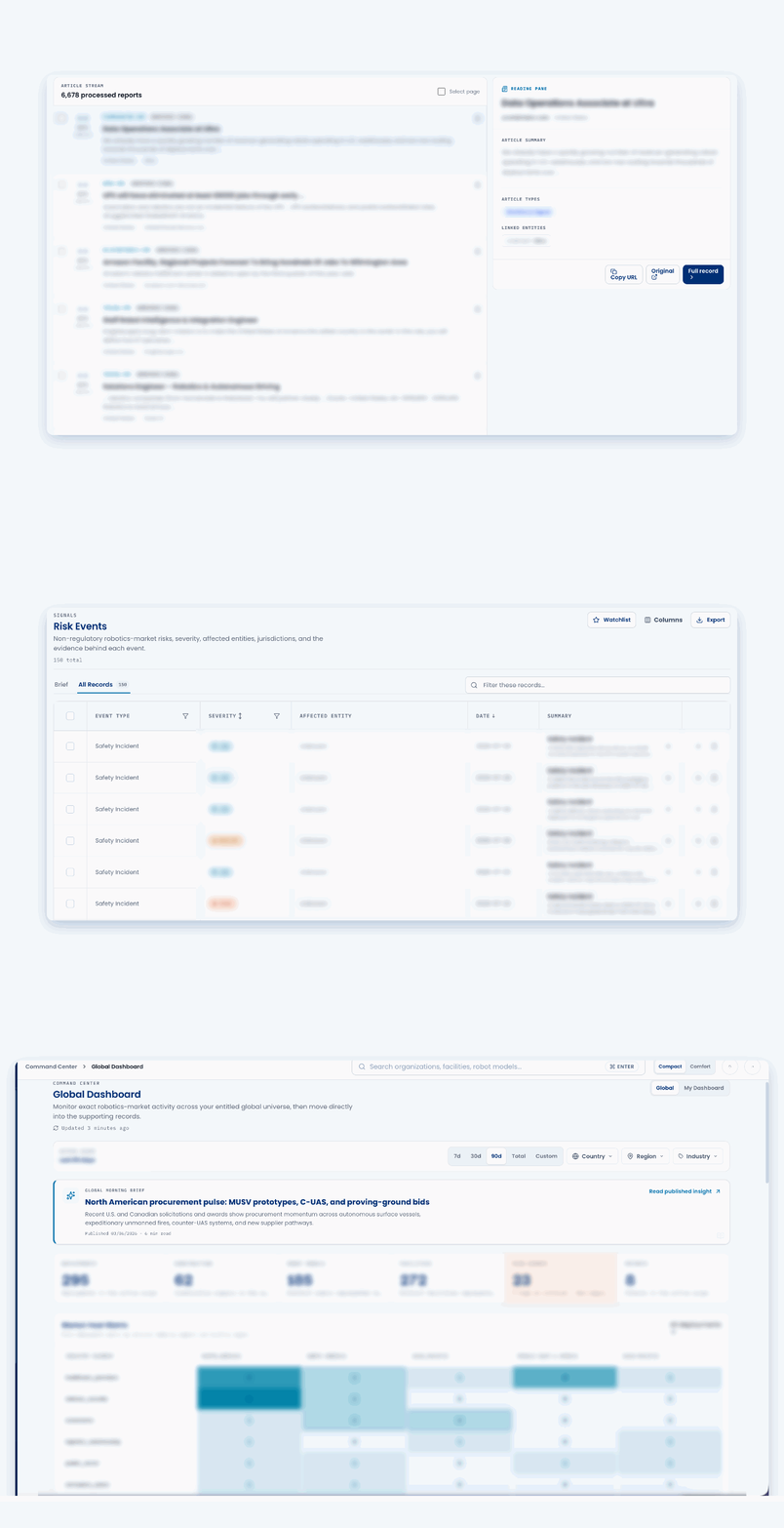
A non-regulatory market risk with severity, affected entities and jurisdiction, across safety incidents, operational disruption, cyber incidents, financial distress and litigation.
- Workforce signals
A hiring surge, layoff or reskilling programme linked to organization, facility, roles and location, with the direction of change recorded.
- News
Processed market reporting with publisher, linked entities and locations, industry, and the original public source.
Directory Modules
- Organizations
Manufacturers, end users, integrators, suppliers and other participants, with their linked facilities, deployments, tenders, awards and activity.
- Facilities
A site with operator, site type, location, status, linked deployments and construction activity, and the evidence behind each.
- Robot models
A model identity with manufacturer, category, lifecycle stage, specification evidence and the deployments it appears in.
- Integrator ecosystem
Robotics integrators compared by connected end users, deployment footprint and most recent observed activity.

Reading Across the Modules
- Reads across every module for the chosen scope and returns counts, a market heat matrix by industry segment and region, activity over time, the most active manufacturers, risk by severity, leading countries, top applications and robot category mix. Every figure links to the records behind it.
- Places facilities, deployments, construction signals and risk exposure geographically, filtered by status and severity.
- A date window of seven, thirty or ninety days, full history or a custom range, combined with country, region and industry filters, applied across every module.
- Tracked opportunities with ownership, next actions and audit history, plus watchlists, saved views, alerts and export history.
- Reviewed analyst posts written from the same source material, covering procurement pipelines and policy risk by region.
Coverage: Industries, Applications, Robot Categories and Geography
Dimension · Coverage
01
Industries
Manufacturing and industrial, logistics and warehousing, healthcare and life sciences, defence and security, retail and e-commerce, automotive and mobility, aerospace and space, agriculture, energy and infrastructure, education and research.
02
Applications
Material handling and internal transport, warehouse fulfilment, surgical and clinical robotics, inspection and quality, security and surveillance, defence operations, passenger and goods transport, research and testing.
03
Robot categories
Articulated and collaborative arms, wheeled and tracked mobile robots, teleoperated manipulator systems, aerial and ground unmanned vehicles, humanoids, gantry and specialised systems.
04
Geography
Global. North America and Asia Pacific carry the largest record volumes, followed by Europe, Latin America, and the Middle East and Africa.
05
Facility types
Distribution and fulfilment centres, processing and production plants, assembly facilities, hospitals and clinical sites, laboratories and cleanrooms, data centres, cold storage, defence and public infrastructure, and their expansions.
Robotics Research Methodology
When Automation Is Actually Bought
How many months before a plant opens is the automation vendor selected?
For most industrial and logistics facilities, automation is specified and bought twelve to twenty-four months before the site opens, during the second half of the construction sequence. The building layout has to be settled first, because equipment decisions depend on it, and the order has to be placed early enough for build and commissioning. That interval is why construction activity works as a demand signal, and the procurement window is the estimate the product is organised around.How far in advance should a manufacturer be approached?
Earlier than the window itself. If the specification is written twelve to twenty-four months before opening, the conversations that shape it happen before that, while the operator is still choosing an approach. Reaching a project at permit or early-construction stage means arriving while the operator is still deciding what to buy.How to estimate the automation pipeline in a territory?
The method is the same whether the territory is a state, a country or a sales region. Filter the tracked facilities to that geography, then narrow by sector, procurement window and robotics likelihood. The count that remains is the automation pipeline in that territory, and every facility behind that number is listed.
This is the highest-value single line change on the site. It sits on the page whose only job is to survive scrutiny.
Current Record Coverage
Construction and expansion signals
494Tender notices
342Contract awards
705Verified deployments
1459Patent filings
436Policy and regulation records
574Workforce signals
1144Risk events
150Organizations
5346Facilities
2892Robot models
2245Integrators
483
Last Updated: September 22, 2026
Robotics Data Sources and Methodology FAQs
01
What are the sources of information?
Public and licensed sources: planning applications, permits, announcements, capital-expenditure disclosures, tender portals, award notices, patent registers, policy publications, job listings and market reporting, each stored with source type and date.02
How is robotics likelihood calculated?
From rule-based inputs: facility type, sector, stage, scale and context, visible per record. Each record shows which inputs produced its score.03
How is the twelve to twenty-four month window derived?
It reflects typical gaps between construction stage and automation procurement for each facility type. It has not been back-tested against a completed cohort, and the deployment links are how it will be tested as tracked sites open.04
How often is everything refreshed?
Continuously. Records carry update notes showing what changed.05
How does this compare with construction-lead services?
Broad construction-project databases cover every building type. This is narrower by design: facilities with plausible robotics use, scored for robotics demand and timing, and connected to the tenders, awards, deployments and companies around them.
See the facilities entering the window in your territory.