

Market Overview
| Study Period | 2017 - 2029 |
|---|---|
| Base Year For Estimation | 2024 |
| Forecast Data Period | 2025 - 2029 |
| Market Size (2025) | USD 28.5 Billion |
| Market Size (2029) | USD 45.8 Billion |
| Growth Rate (2025 - 2029) | 12.59% CAGR |
| Market Concentration | High |
Major Players
*Disclaimer: Major Players sorted in no particular order Image © Mordor Intelligence. Reuse requires attribution under CC BY 4.0. |
|

Japan Commercial Vehicles Market Analysis by Mordor Intelligence
The Japan Commercial Vehicles Market size is estimated at 28.5 billion USD in 2025, and is expected to reach 45.8 billion USD by 2029, growing at a CAGR of 12.59% during the forecast period (2025-2029).
Japan's commercial vehicle industry is undergoing a transformative shift driven by the nation's ambitious environmental objectives and technological innovation. The Japanese government has established a clear roadmap toward carbon neutrality, setting a target for zero carbon emissions by 2050. This commitment is backed by substantial financial support, with the government offering significant incentives, including tax exemptions and financial incentives, targeting a boost of JPY 90 trillion (USD 870 billion) annually through green investments and sales by 2030. The transportation sector's significant environmental impact, accounting for 19% of the nation's total emissions, has catalyzed this transition toward sustainable mobility solutions.
The commercial vehicle market landscape is being reshaped by strategic partnerships and technological advancements, particularly in the electric vehicle segment. Major industry players are forming collaborative ventures to accelerate innovation and market penetration. A notable example is the May 2023 partnership between Toyota and Suzuki to co-develop new mini electric vans and BEV platforms, demonstrating the industry's commitment to electrification. These collaborations are crucial for sharing development costs and accelerating the commercialization of next-generation vehicles.
Infrastructure development plays a pivotal role in supporting the industry's transformation, with Japan maintaining a robust charging network comprising 29,400 EV charging stations as of 2022. The government's commitment to infrastructure development is evident in its comprehensive approach to creating an ecosystem that supports alternative fuel vehicles. This infrastructure expansion is complemented by enhanced support for EV adoption, as demonstrated by the government's decision in 2022 to double its subsidy for battery electric vehicle purchases to JPY 850,000 (USD 6,500).
The industry is witnessing a significant technological evolution, particularly in the development of alternative powertrains and advanced vehicle systems. Japanese manufacturers are at the forefront of innovation in hybrid and electric vehicle technology, with companies introducing new models equipped with advanced features and improved performance capabilities. The government's policy to phase out gasoline-powered vehicles by the mid-2030s has accelerated research and development in electric and fuel cell technologies, fostering an environment of continuous innovation and technological advancement in the commercial vehicle sector.
Japan Commercial Vehicles Market Trends and Insights
Japan's electric vehicle market grows gradually due to government and industry partnerships
- The electric vehicle industry in Japan is growing gradually, and the government's norms and targets to electrify all new car sales by 2035 are shifting the country toward electric mobility. Moreover, government efforts in terms of subsidies and rebates are driving the country's electric vehicle market. In November 2021, the government of Japan announced that it would provide subsidies on electric vehicles, i.e., up to USD 7200 per vehicle. However, hybrid vehicles are not included in the subsidy program. Such factors contribute to the growth of electric vehicles (passenger cars) by 11.11% in 2022 over 2021.
- Various companies are signing partnerships and ventures to enhance electric mobility in various sectors across Japan. In June 2022, the technology company Sony and the Japanese automaker Honda signed a joint venture to work on electric mobility together. The objective of the venture is to produce and sell electric cars in Japan by 2025. Moreover, Honda has announced the launch of 30 electric vehicles and the production of 2 million vehicles annually by 2030. Each company has invested approximately USD 37.52 million in the venture. Such factors are expected to impact electric mobility positively.
- In April 2022, the US-based automaker General Motors announced an expand its partnership with Honda to produce electric vehicles. As part of the expansion, the companies will develop new affordable electric vehicles, including cars. The production of the vehicles is expected to start in early 2027. Moreover, such international expansions are expected to develop new designs and enhanced cars, which further is expected to raise the sales of electric cars During the 2024-2030 period in Japan, which will also accelerate the demand for battery packs across Japan.

Understand The Key Trends Shaping This Market
Download PDF
OTHER KEY INDUSTRY TRENDS COVERED IN THE REPORT
- Japan's population decline, driven by aging demographics and low birth rates, presents challenges and highlights the need for policy reforms
- Japan's automotive market in the Asia-Pacific region displays a trend of cautious recovery in 2022-2023 after a period of fluctuations
- Japan's auto interest rates have shown a sustained downward trend, driven by the country's low-interest-rate policy and efforts to combat deflation
- In 2022, while South Africa, Kenya, and Morocco witnessed decreasing inflation hinting at economic stabilization, Nigeria faced a surge before stabilizing in 2023; future projections suggest a trend towards declining inflation and economic stability for all four countries
- Japan, known for its "Kaizen" approach and technological prowess, consistently maintained high LPI scores near 4 from 2010 to 2018. With a 2023 LPI score of 3.9 and ongoing tech-driven innovations, Japan remains a formidable player in the global logistics arena
- Japan's commercial vehicle sector in 2023 Witnessed a rise in bus production, possibly due to infrastructure or public transport initiatives, while light trucks declined.
- Japan's GDP per capita is poised for a robust rebound, projected to reach USD 47,745.41 by 2030
- Japan's transition from deflation to moderate inflation signals cautious economic progress
- Japan's EV charging network stabilizes at 29,400 stations, reflecting maturity and technological excellence
- Automakers are launching electric SUVs to drive electrification and battery pack demand in Japan
- The Japanese government decided to extend its gasoline subsidy program until the end of 2023, citing concerns over potential price hikes should the program be discontinued
Segment Analysis: Vehicle Type
Light Commercial Pick-up Trucks Segment in Japan Commercial Vehicles Market
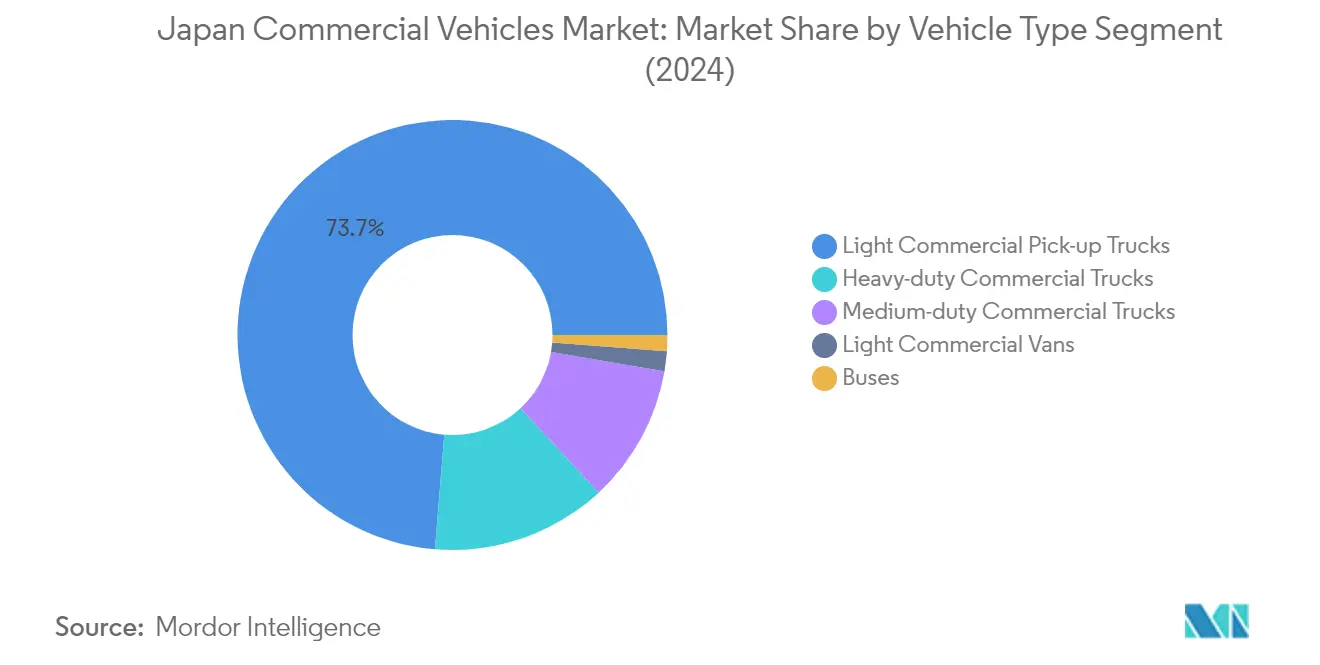
Light commercial vehicles, particularly pick-up trucks, dominate the Japanese commercial vehicles market, commanding approximately 74% market share in 2024. This segment's prominence is driven by Japan's robust e-commerce sector and growing demand for efficient urban logistics solutions. The segment benefits from technological advancements in electric and hybrid powertrains, with major manufacturers like Toyota and Nissan introducing innovative models equipped with advanced safety features and improved fuel efficiency. The segment's strong performance is further supported by government initiatives promoting sustainable transportation and the vehicles' versatility in meeting diverse business needs, from last-mile delivery to construction and agricultural applications.
Buses Segment in Japan Commercial Vehicles Market
The buses segment is emerging as the fastest-growing category in Japan's commercial vehicles market, with a projected growth rate of approximately 14% between 2024 and 2029. This remarkable growth is primarily driven by increasing investments in public transportation infrastructure and the government's push towards sustainable mobility solutions. The segment is witnessing significant transformation with the introduction of electric and hydrogen fuel cell buses, particularly in urban areas. Japanese manufacturers are focusing on developing advanced bus models with enhanced safety features, improved passenger comfort, and reduced environmental impact. The growth is further supported by rising tourism activities and the need to replace aging fleet vehicles with more efficient and environmentally friendly alternatives.
Remaining Segments in Vehicle Type
The other segments in Japan's commercial vehicles market include heavy commercial vehicles, medium-duty commercial trucks, and light commercial vans, each serving distinct market needs. Heavy commercial vehicles play a crucial role in long-haul transportation and construction activities, while medium-duty trucks cater to regional distribution and specialized applications. Light commercial vans are essential for urban delivery services and small business operations. These segments are experiencing varying levels of technological advancement, particularly in terms of electrification and automation, with manufacturers focusing on developing more efficient and environmentally friendly vehicles to meet evolving market demands and regulatory requirements.
Segment Analysis: Propulsion Type
ICE Segment in Japan Commercial Vehicles Market
The Internal Combustion Engine (ICE) segment continues to dominate the Japanese commercial vehicles market, holding approximately 89% market share in 2024. This substantial market presence is primarily driven by the widespread adoption of diesel engines in medium and heavy-duty trucks, which remain the preferred choice for long-haul transportation and construction applications. The segment's strength is further reinforced by Japan's well-established infrastructure for conventional fuels and the proven reliability of ICE vehicles in commercial applications. Japanese manufacturers like Isuzu, Hino, and Mitsubishi Fuso have maintained their strong position in this segment by continuously improving engine efficiency and meeting stringent emission standards. The segment also benefits from the lower initial acquisition costs compared to alternative powertrains and the extensive service network available throughout the country.
PHEV Segment in Japan Commercial Vehicles Market
The Plug-in Hybrid Electric Vehicle (PHEV) segment is emerging as the fastest-growing segment in Japan's commercial vehicles market, with a projected growth rate of approximately 104% from 2024 to 2029. This remarkable growth trajectory is being driven by several factors, including increasing government incentives for eco-friendly vehicles and growing corporate commitment to sustainability goals. Japanese manufacturers are actively expanding their PHEV commercial vehicle offerings, introducing new models that combine the benefits of electric propulsion with the practicality of conventional powertrains. The segment is particularly gaining traction in urban delivery and logistics applications, where the ability to operate in zero-emission zones while maintaining longer range capabilities is highly valued. The growth is further supported by improvements in charging infrastructure and advancements in battery technology, making PHEVs an increasingly attractive option for fleet operators looking to balance environmental responsibility with operational requirements.
Competitive Landscape
Top Companies in Japan Commercial Vehicles Market
The commercial vehicles market in Japan is characterized by intense innovation and strategic developments among key players like Toyota, Suzuki, Daihatsu, Honda, and Mazda. Companies are increasingly focusing on developing electric and hybrid commercial vehicles, with significant investments in research and development for next-generation powertrains and autonomous driving capabilities. Manufacturers are strengthening their market positions through strategic partnerships and collaborations, particularly in areas of battery technology and charging infrastructure development. The industry is witnessing a notable shift towards sustainable transportation solutions, with companies introducing new electric models and expanding their eco-friendly vehicle portfolios. Operational agility has become paramount, with manufacturers optimizing their production processes and supply chains to meet evolving market demands. Companies are also expanding their service networks and after-sales support to enhance customer experience and maintain market competitiveness.
Domestic Players Dominate Japanese Commercial Market
The Japanese commercial vehicles market exhibits a highly consolidated structure dominated by domestic manufacturers with deep-rooted presence and established distribution networks. These local players leverage their understanding of domestic market requirements and the regulatory landscape to maintain their competitive edge, while global players like Volkswagen and Stellantis maintain a smaller but significant presence through strategic partnerships with local entities. The market's consolidation is further reinforced by the strong vertical integration of major players, who control everything from manufacturing to distribution and after-sales services.
The market has witnessed selective merger and acquisition activities, primarily focused on strengthening technological capabilities and expanding market reach. Japanese manufacturers are increasingly forming strategic alliances with global technology companies and startups to enhance their electric vehicle capabilities and autonomous driving technologies. These partnerships are reshaping the competitive landscape, with traditional manufacturers adapting to new mobility solutions and digital technologies while maintaining their core strengths in vehicle manufacturing and quality control.
Innovation and Sustainability Drive Future Success
For incumbent players to maintain and expand their commercial vehicle market share, a focus on technological innovation and sustainability will be crucial. Companies need to invest heavily in electric and hybrid vehicle technologies while maintaining strong relationships with fleet operators and commercial fleet customers. The development of comprehensive mobility solutions, including connected vehicle services and fleet management systems, will become increasingly important. Additionally, manufacturers must optimize their production costs and strengthen their supply chain resilience to maintain competitive pricing while ensuring consistent quality.
New entrants and challenger brands can gain ground by focusing on specific market niches, particularly in the emerging electric Japanese commercial trucks segment. Success will depend on developing innovative financing solutions, building strong dealer networks, and offering superior after-sales support. The regulatory environment, particularly regarding emissions standards and safety requirements, will continue to shape market dynamics and investment decisions. Companies must also consider the growing influence of e-commerce and last-mile delivery services, which are creating new opportunities in the light commercial vehicle segment while potentially disrupting traditional business models.
Japan Commercial Vehicles Industry Leaders
-
Daihatsu Motor Co. Ltd.
-
Honda Motor Co. Ltd.
-
Mazda Motor Corporation
-
Suzuki Motor Corporation
-
Toyota Motor Corporation
- *Disclaimer: Major Players sorted in no particular order

Need More Details on Market Players and Competitors?
Download PDF
Recent Industry Developments
- August 2023: Toyota Kirloskar Motor launched the MPV Vellfire strong hybrid electric vehicle (SHEV) for a starting price of INR 11.99 million and going to INR 12.99 million.
- August 2023: Subaru and Panasonic Energy planned to establish partnerships for lithium-ion battery supply.
- July 2023: Honda's next-generation fuel cell system makes its Chinese debut. It is mainly applied to fuel cell electric vehicles, commercial vehicles, fixed power supply, and engineering machinery.
Japan Commercial Vehicles Market Report Scope
Commercial Vehicles are covered as segments by Vehicle Type. Hybrid and Electric Vehicles, ICE are covered as segments by Propulsion Type.
Vehicle Type
| Commercial Vehicles | Buses |
| Heavy-duty Commercial Trucks | |
| Light Commercial Pick-up Trucks | |
| Light Commercial Vans | |
| Medium-duty Commercial Trucks |
Propulsion Type
| Hybrid and Electric Vehicles | By Fuel Category | BEV |
| FCEV | ||
| HEV | ||
| PHEV | ||
| ICE | By Fuel Category | CNG |
| Diesel | ||
| Gasoline |
| Vehicle Type | Commercial Vehicles | Buses | |
| Heavy-duty Commercial Trucks | |||
| Light Commercial Pick-up Trucks | |||
| Light Commercial Vans | |||
| Medium-duty Commercial Trucks | |||
| Propulsion Type | Hybrid and Electric Vehicles | By Fuel Category | BEV |
| FCEV | |||
| HEV | |||
| PHEV | |||
| ICE | By Fuel Category | CNG | |
| Diesel | |||
| Gasoline | |||
Need A Different Region or Segment?
Customize Now
Market Definition
- Vehicle Type - The category covers light, medium, and heavy duty commercial vehicle.
- Vehicle Body Type - This includes Light Commercial Pick-up Trucks, Light Commercial Vans, Medium-duty Commercial Trucks, Heavy-duty Commercial Trucks, and Medium and Heavy Duty Buses.
- Fuel Category - The category includes various fuel types such as Gasoline, Diesel, LPG (Liquefied Petroleum Gas), CNG (Compressed Natural Gas), HEV (Hybrid Electric Vehicles), PHEV (Plug-in Hybrid Electric Vehicles), BEV (Battery Electric Vehicles), and FCEV (Fuel Cell Electric Vehicles)
| Keyword | Definition |
|---|---|
| Electric Vehicle (EV) | A vehicle which uses one or more electric motors for propulsion. Includes cars, buses, and trucks. This term includes all-electric vehicles or battery electric vehicles and plug-in hybrid electric vehicles. |
| BEV | A BEV relies completely on a battery and a motor for propulsion. The battery in the vehicle must be charged by plugging it into an outlet or public charging station. BEVs do not have an ICE and hence are pollution-free. They have a low cost of operation and reduced engine noise as compared to conventional fuel engines. However, they have a shorter range and higher prices than their equivalent gasoline models. |
| PEV | A plug-in electric vehicle is an electric vehicle that can be externally charged and generally includes all-electric vehicles as well as plug-in hybrids. |
| Plug-in Hybrid EV | A vehicle that can be powered either by an ICE or an electric motor. In contrast to normal hybrid EVs, they can be charged externally. |
| Internal combustion engine | An engine in which the burning of fuels occurs in a confined space called a combustion chamber. Usually run with gasoline/petrol or diesel. |
| Hybrid EV | A vehicle powered by an ICE in combination with one or more electric motors that use energy stored in batteries. These are continually recharged with power from the ICE and regenerative braking. |
| Commercial Vehicles | Commercial vehicles are motorized road vehicles designed for transporting people or goods. The category includes light commercial vehicles (LCVs) and medium and heavy-duty vehicles (M&HCV). |
| Passenger Vehicles | Passenger cars are electric motor– or engine-driven vehicles with at least four wheels. These vehicles are used for the transport of passengers and comprise no more than eight seats in addition to the driver’s seat. |
| Light Commercial Vehicles | Commercial vehicles that weigh less than 6,000 lb (Class 1) and in the range of 6,001–10,000 lb (Class 2) are covered under this category. |
| M&HDT | Commercial vehicles that weigh in the range of 10,001–14,000 lb (Class 3), 14,001–16,000 lb (Class 4), 16,001–19,500 lb (Class 5), 19,501–26,000 lb (Class 6), 26,001–33,000 lb (Class 7) and above 33,001 lb (Class 8) are covered under this category. |
| Bus | A mode of transportation that typically refers to a large vehicle designed to carry passengers over long distances. This includes transit bus, school bus, shuttle bus, and trolleybuses. |
| Diesel | It includes vehicles that use diesel as their primary fuel. A diesel engine vehicle have a compression-ignited injection system rather than the spark-ignited system used by most gasoline vehicles. In such vehicles, fuel is injected into the combustion chamber and ignited by the high temperature achieved when gas is greatly compressed. |
| Gasoline | It includes vehicles that use gas/petrol as their primary fuel. A gasoline car typically uses a spark-ignited internal combustion engine. In such vehicles, fuel is injected into either the intake manifold or the combustion chamber, where it is combined with air, and the air/fuel mixture is ignited by the spark from a spark plug. |
| LPG | It includes vehicles that use LPG as their primary fuel. Both dedicated and bi-fuel LPG vehicles are considered under the scope of the study. |
| CNG | It includes vehicles that use CNG as their primary fuel. These are vehicles that operate like gasoline-powered vehicles with spark-ignited internal combustion engines. |
| HEV | All the electric vehicles that use batteries and an internal combustion engine (ICE) as their primary source for propulsion are considered under this category. HEVs generally use a diesel-electric powertrain and are also known as hybrid diesel-electric vehicles. An HEV converts the vehicle momentum (kinetic energy) into electricity that recharges the battery when the vehicle slows down or stops. The battery of HEV cannot be charged using plug-in devices. |
| PHEV | PHEVs are powered by a battery as well as an ICE. The battery can be charged through either regenerative breaking using the ICE or by plugging into some external charging source. PHEVs have a better range than BEVs but are comparatively less eco-friendly. |
| Hatchback | These are compact-sized cars with a hatch-type door provided at the rear end. |
| Sedan | These are usually two- or four-door passenger cars, with a separate area provided at the rear end for luggage. |
| SUV | Popularly known as SUVs, these cars come with four-wheel drive, and usually have high ground clearance. These cars can also be used as off-road vehicles. |
| MPV | These are multi-purpose vehicles (also called minivans) designed to carry a larger number of passengers. They carry between five and seven people and have room for luggage too. They are usually taller than the average family saloon car, to provide greater headroom and ease of access, and they are usually front-wheel drive. |
Need More Details on Market Definition?
Ask a Question
Research Methodology
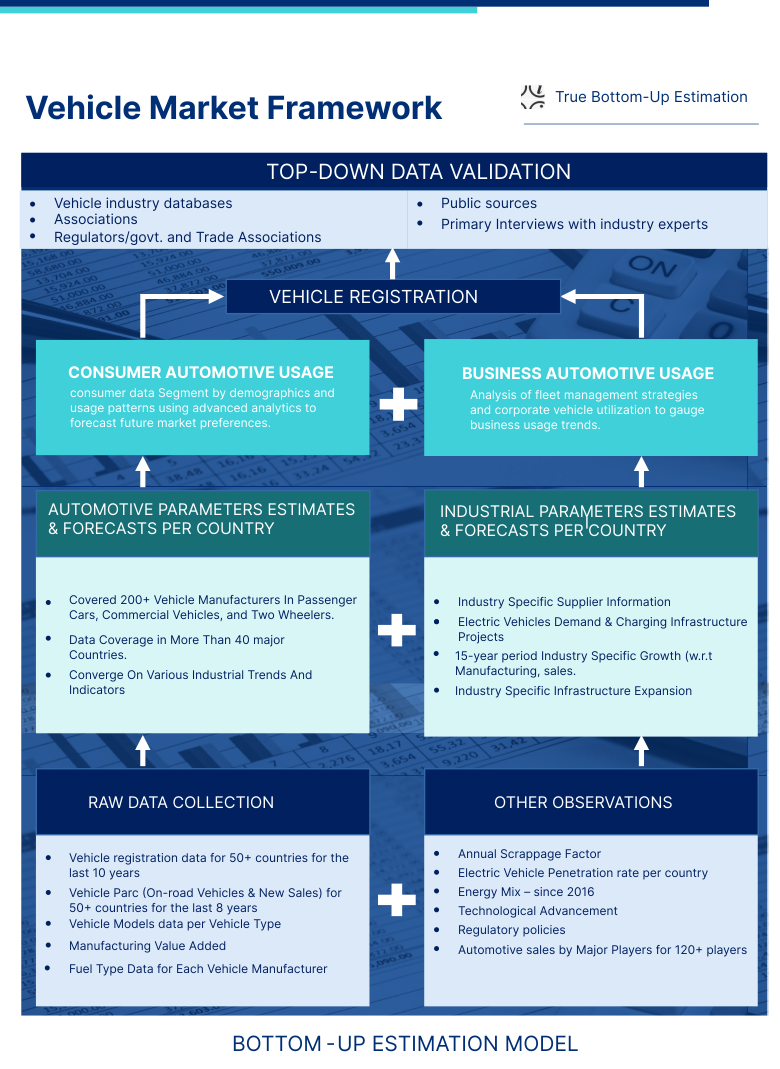
Mordor Intelligence follows a four-step methodology in all its reports.
- Step-1: Identify Key Variables: To build a robust forecasting methodology, the variables and factors identified in Step-1 are tested against available historical market numbers. Through an iterative process, the variables required for market forecast are set and the model is built based on these variables.
- Step-2: Build a Market Model: Market-size estimations for the historical and forecast years have been provided in revenue and volume terms. Market revenue is calculated by multiplying the sales volume with their respective average selling price (ASP). While estimating ASP factors like average inflation, market demand shift, manufacturing cost, technological advancement, and varying consumer preference, among others have been taken into account.
- Step-3: Validate and Finalize: In this important step, all market numbers, variables, and analyst calls are validated through an extensive network of primary research experts from the market studied. The respondents are selected across levels and functions to generate a holistic picture of the market studied.
- Step-4: Research Outputs: Syndicated Reports, Custom Consulting Assignments, Databases & Subscription Platforms.
Get More Details On Research Methodology
Download PDF




