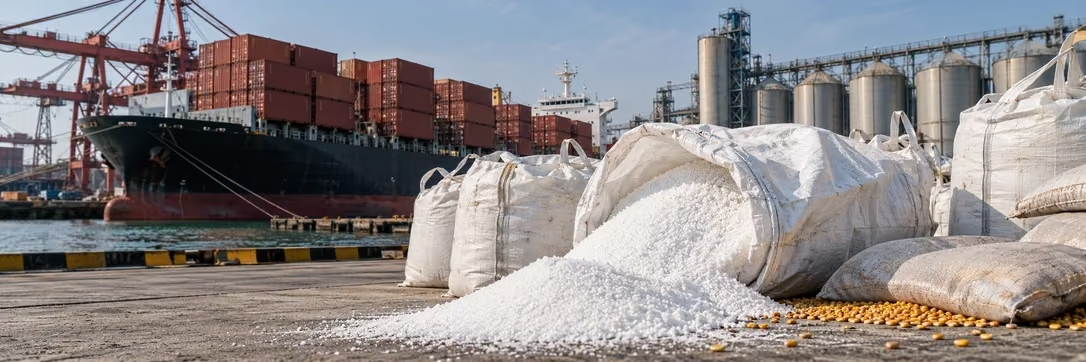
Higher tariffs are making Chinese lysine more expensive to sell into the US and Europe. At the same time, Chinese producers have added more capacity than the market is comfortably absorbing. For buyers planning 2027 contracts, the price outcome will depend on how these two forces play out together.
In a normal tariff cycle, buyers expect imported material to get more expensive and alternative suppliers to gain pricing power. Lysine is behaving differently because Chinese production has kept growing at the same time trade barriers have gone up.
That extra supply still has to find a market. If less of it moves directly into the US or Europe, more can be pushed into other regions or routed through different sourcing channels. For buyers, that is where the real uncertainty sits. The Chinese lysine tariff affects landed cost, while Chinese lysine oversupply continues to put pressure on the wider market and on lysine prices.
Executive Summary
US duty exposure on Chinese L-lysine now varies sharply by exporter, from about 122% for cooperating exporters to roughly 222% at the highest end. At the same time, Jilin Meihua added 600,000 metric tons of lysine capacity, the largest single addition identified in the source analysis behind the current oversupply.
That combination is creating a much wider spread between sourcing options. China-origin supply has seen price swings of 20% to 35%. Western-origin supply has been far more stable at 0% to 5%, although buyers pay more for that stability. Third-country routes sit between the two, with lower duty exposure and a 15% to 20% price swing.
The cost picture also goes beyond tariffs. Corn and dextrose account for 35% to 45% of lysine and threonine production costs, while Mordor Intelligence's baseline projects global amino acid prices to decline 8% to 12% from 2024 through 2028 as fermentation efficiency improves and capacity expands.
For buyers working on 2027 contracts, the main task is to understand where their lysine supply chain sits across those different exposures. Duty rates, supplier capacity, feedstock costs, and third-country routing can all change the final cost, and the cheapest-looking route today may not stay that way through the contract period.
At a Glance
- 1The global feed amino acids market is estimated at USD 8.76 billion in 2026. Mordor Intelligence expects it to reach USD 10.78 billion by 2031, even as excess capacity puts pressure on unit prices. See the Global Feed Amino Acids Market.
- 2US duty exposure varies considerably by exporter. Antidumping cash-deposit rates run from 73.37% for cooperating exporters to 139.65% for the China-Wide Entity. Countervailing duty rates are 48.21% for Inner Mongolia Eppen and other exporters, and 82.11% for Heilongjiang Wanli Runda and Shouguang Golden-land. Combined exposure therefore ranges from about 122% to roughly 222%.
- 3Jilin Meihua added 600,000 metric tons of lysine capacity. The project was commissioned in September 2025 and reached full production in Q1 2026. It is the largest individual capacity addition identified in the source analysis behind the move into oversupply.
- 4Mordor Intelligence projects global amino acid prices to decline 8% to 12% from 2024 through 2028. The baseline assumes fermentation efficiency continues to improve while new capacity enters the market.
- 5Corn and dextrose account for 35% to 45% of lysine and threonine production costs. Feedstock pricing therefore remains important even when US tariffs on Chinese lysine dominate sourcing discussions. See the China Feed Amino Acids Market.
Chinese Lysine Tariffs vs. Oversupply: What Drives Prices?
The latest trade measures have changed the economics of buying Chinese lysine in Western markets. For suppliers outside China, that creates an opportunity to compete for volume that previously went to lower-cost Chinese material.
China's capacity position is pulling the market another way. Producers spent 2024 and 2025 adding fermentation capacity for domestic demand and exports. Much of that supply arrived just as trade restrictions tightened, and amino acids were selling below cost on a China FOB basis across much of the first quarter of 2026 before prices partly recovered.
The key issue for buyers is where that volume goes next. If direct access to the US or Europe becomes more expensive, producers can look to other destination markets or third-country routes. That can keep pressure on lysine prices even while the Chinese L-lysine tariff raises costs on specific trade lanes.
The China Feed Amino Acids Market tracks the capacity build behind those shifts.
Amino Acid Tariffs and Capacity: Key Events, 2022–2026
| Date | Event |
|---|---|
| September 2022 | Adisseo's 180,000-ton liquid methionine plant starts production in Nanjing, China |
| August 2024 | Evonik expands Singapore methionine capacity by 40%, targeting Chinese competitors losing share to trade restrictions |
| December 2024 | EU enforces anti-dumping tariff on Chinese lysine |
| January 2025 | Meihua Holdings suspends 100,000 metric tons of lysine capacity and shifts toward higher-value amino acids |
| May 2025 | Lysine Fair Trade Coalition, comprising ADM, CJ Bio America, and Evonik, files the US antidumping and countervailing duty petition |
| March 2026 | Amino acids sell below cost on a China FOB basis across nearly every major product |
| July 2026 | US Department of Commerce finalizes antidumping cash-deposit rates of 73.37% to 139.65% |
| July 2026 | Countervailing duty determination sets rates of 48.21% to 82.11%, taking combined exposure toward 188% for China-Wide Entity exporters |
Why Rising Tariffs May Not Mean Higher Lysine Prices
Trade protection around Chinese amino acids is already stronger, and the source analysis expects that pressure to continue through 2027. Further filings become more likely if Chinese pricing continues to undercut domestic cost structures in the US and EU.
The capacity side has more room to move. China's larger producers can absorb weak margins for longer than smaller competitors, while the additional fermentation capacity still needs buyers. That gives oversupply time to keep weighing on the market even as tariffs alter individual trade routes.
This is why EU tariffs on Chinese lysine and US duties can produce very different outcomes depending on where a buyer sources. Direct Chinese material, Western-origin supply, and product moving through third countries each carry a different mix of tariff exposure and price volatility.
OUR VIEW
Mordor Intelligence expects trade policy to keep tightening through 2027, with further anti-dumping filings likely wherever Chinese pricing continues to undercut domestic producers in the US and EU.
The source analysis does not expect that tightening to translate into higher landed costs for most buyers before 2028 unless Chinese capacity discipline changes sooner than the current data suggests. Producer-level margin data from Shandong and Jilin is therefore worth watching closely because those two provinces carry much of China's fermentation capacity.
Lysine Sourcing: Comparing Duty Exposure and Price Risk
| Channel | Duty Exposure | Price Swing Range | Capacity Trend | Best Fit For |
|---|---|---|---|---|
| China-origin | High, AD+CVD combined up to ~220% | 20% to 35%, volatile | Expanding, oversupplied | Buyers with hedging capacity and appetite for volatility |
| EU/Western-origin | None | 0% to 5%, stable and premium-priced | Expanding, slower | Buyers prioritizing supply certainty over cost |
| Third-country routed | Low as of September 2026 | 15% to 20%, moderately volatile | Growing rapidly | Buyers actively using the tariff structure across sourcing routes |
The spread between the three channels shows why the sourcing decision is more complicated than moving away from China. Western-origin material has been considerably more stable, but buyers pay a premium for that certainty. China-origin supply carries the widest price range, while third-country routes offer lower duty exposure with more volatility than Western material.
For 2027 contracts, the mix depends on how much price movement a buyer can carry and how much certainty the operation needs. That calculation will differ by buyer, particularly where amino acids represent a meaningful share of feed formulation costs.
Amino Acid Price Outlook Through 2028: Three Scenarios
| Scenario | Price Trajectory | Driving Condition |
|---|---|---|
| Conservative | Broadly flat, within 1% of current levels | Trade barriers hold and Chinese capacity growth slows on margin pressure |
| Baseline, Mordor Intelligence's central estimate | Declines 8% to 12% | Fermentation efficiency gains continue even with tariffs in place |
| Optimistic for buyers | Declines around 23% | Chinese capacity discipline breaks down further, deepening oversupply and increasing pressure on Western producers |
The baseline is the most useful reference point for 2027 contract discussions. It assumes efficiency gains continue and the market remains well supplied even with tariffs in place.
That also explains the trade-off in Western sourcing. Moving more volume outside China can reduce duty risk and improve price stability, but the buyer may be paying a premium while the wider amino acid market continues lower. The Global Feed Amino Acids Market sets out the assumptions behind that price path.
Who Gains and Who Loses from Chinese Amino Acid Oversupply?
Chinese amino acid oversupply reaches well beyond the companies named in the tariff filings. The impact runs through Chinese producers of different sizes, Western competitors, livestock integrators, and industries drawing on the same fermentation capacity.
- Large Chinese producers are better placed to withstand a long period of weak prices. Their scale gives them more room to absorb thin or negative margins. If smaller producers cut output or exit, more market share can move toward the companies already leading the capacity expansion.
- Mid-tier and smaller Chinese producers face tighter economics. Below-cost pricing and environmental compliance costs are squeezing margins together, and Mordor Intelligence's market analysis already identifies stricter effluent requirements as one factor behind consolidation in this tier.
- Western producers gain protection from higher duties, although volume is less certain. Evonik and Adisseo are among the companies that benefit from stronger trade barriers, while buyers still have the option of looking to Southeast Asia, Kazakhstan, or other routes. In methionine, five producers already control more than 80% of global capacity, so moving away from Chinese exposure can still leave buyers dependent on a concentrated supplier base.
- Downstream livestock integrators carry the costs that are not absorbed upstream. Poultry and swine operations with limited flexibility can see higher amino acid costs before those movements become obvious in broader market figures.
- Adjacent industries compete for the same technology and inputs. Pet food and aquaculture formulations draw on overlapping amino acid supply, while food-grade and pharmaceutical-grade lysine provide higher-margin outlets for the same underlying fermentation technology. Corn and dextrose also put amino acid producers in the same feedstock market as ethanol and sweetener manufacturers.
- Other agricultural-input markets will be watching the trade case. A finding around government-supported Chinese overcapacity in lysine can influence how producers in soy derivatives, specialty fertilizers, and related categories approach future trade action.
A European Feed Integrator’s Tariff and Supply Exposure
A European poultry feed integrator approached Mordor Intelligence ahead of its 2027 contract cycle. Broiler diets account for around 44% of global amino acid demand by animal type, and the company's shift toward lower crude-protein formulations had increased its use of crystalline lysine and methionine.
Lysine accounted for close to one-third of its crystalline amino acid budget. The EU sources around 60% of its lysine demand from China, while an individual buyer's supplier base can be much more concentrated than the regional average. The procurement team needed to see how much of its supply was exposed to duties and how much could benefit from the current oversupply.
The supply base was split into three channels. The first covered China-origin volume carrying direct tariff exposure. The second covered EU and Western-origin supply. The third covered a smaller but growing share moving through Southeast Asia and Kazakhstan.
Each channel was then assessed against duty exposure, available capacity, and price volatility. Mordor Intelligence's driver analysis puts the price swing for the most exposed channels at 20% to 35%, giving the integrator a way to compare tariff protection with the premium attached to alternative supply.
The sourcing map showed that shifting too much volume away from China under the baseline scenario would leave the integrator paying a sizeable premium against a supply squeeze that may never fully develop.
The value came from seeing where that premium bought useful protection and where lower-cost exposure remained worth carrying. The team could allocate volume by channel rather than make one broad sourcing shift across the entire book.
Reducing China exposure can still leave a buyer concentrated in another region or supplier group. The useful decision is how much volume belongs in each channel once duty exposure, capacity, and price volatility are considered together.
For this integrator, pricing those channels before the renewal cycle gave the procurement team a clearer basis for deciding where to pay for certainty and where to retain more price exposure.
Strategic Synthesis: What Chinese Oversupply Means for Amino Acid Prices
The current lysine market shows how quickly trade policy and production capacity can move apart. Western duties are changing the economics of individual sourcing routes, while the underlying Chinese fermentation base remains large enough to keep supplying the wider market.
That helps explain why the global feed amino acids market can grow from an estimated USD 8.76 billion in 2026 to USD 10.78 billion by 2031 while unit prices soften. Demand can continue expanding while producers compete more aggressively for volume.
For buyers, the more useful signal heading into 2027 is how long Chinese producers are prepared to run through weak margins. Continued high utilization would keep excess supply moving into new markets. Meaningful production cuts would tighten the picture much faster.
The China amino acid oversupply story therefore comes down to producer behavior as much as trade policy. Margin data, utilization, export flows, and third-country capacity will help show whether the current price pressure has further to run.
Executive Imperatives: Five Sourcing Actions Before Locking In 2027 Contracts
- 1Model tariff exposure alongside available capacity.A sourcing plan built around duties alone can miss the price pressure coming from excess production. The China Feed Amino Acids Market tracks where fermentation capacity is landing and how the supply base is changing.
- 2Price feedstock volatility into the same contract model.Corn and dextrose account for 35% to 45% of lysine and threonine production costs. A large feedstock movement can materially change producer economics even when tariff rates stay unchanged. The China Feed Amino Acids Market provides the underlying input-cost structure.
- 3Watch where Chinese-linked capacity appears outside China.China exported more than 1 million metric tons of lysine in 2024, and March 2026 shipments were close to a record 111,000 metric tons. India overtook the US as China's second-largest lysine market, Russia absorbed a meaningful share of additional volume, and Southeast Asian methionine flows grew. Fufeng Group's USD 1.5 billion facility in Kazakhstan's Zhambyl Region produced its first commercial amino acids in March 2026 and is targeting 300,000 to 500,000 metric tons of lysine and MSG capacity for Russia, Europe, and the Middle East. Its Kazakhstan-origin classification sits outside the EU's China-origin duty order. The Asia-Pacific Feed Amino Acids Market tracks these redirected flows by destination.
- 4Use the 2028 price curve when negotiating contract flexibility.Mordor Intelligence's baseline projects an 8% to 12% decline from 2024 through 2028. Contracts priced materially above that path should leave room for renegotiation if the market continues lower. The Global Feed Amino Acids Market sets out the assumptions behind that projection.
- 5Check supplier concentration in Western markets as closely as Chinese exposure.Evonik, Adisseo, Zhejiang NHU, Novus International, and Sumitomo Chemical together control more than 80% of global methionine production capacity as of the end of 2024. The Methionine Market maps that concentration by producer, while the Global Feed Additives Market places it within the wider additives market.
The Next Layer of Intelligence: Assessing Your Amino Acid Supply Chain’s Tariff and Oversupply Exposure
For 2027 contracts, customs origin tells only part of the sourcing story. Capacity is moving between China, Southeast Asia, Kazakhstan, and Western producers, while feedstock costs and producer margins can change the economics of those routes from one quarter to the next.
Mordor Intelligence's Strategic Sourcing & Category Intelligence practice builds supplier-level cost and capacity models using primary interviews with producers and buyers alongside syndicated market data. The analysis looks at where capacity is being added, how individual sourcing routes respond to tariffs, and where price pressure may still have room to move.
Related Insights
Chicken Supply Chain Disruption: Why Breeder-Flock Capacity Is the Real Bottleneck
2025 US Pharma Tariffs: Reshaping Global Supply Chains and Strategy
The EU–India FTA: Reshaping Agriculture, Food & Beverages, and FMCG Sectors