
Wired Drill Pipe Market Size and Share
Market Overview
| Study Period | 2022 - 2032 |
|---|---|
| Market Size (2027) | USD 3.43 Billion |
| Market Size (2032) | USD 4.47 Billion |
| Growth Rate (2027 - 2032) | 5.42 % |
| Fastest Growing Market | Asia-Pacific |
| Largest Market | North America |
| Market Concentration | Medium |
Major Players *Disclaimer: Major Players sorted in no particular order Image © Mordor Intelligence. Reuse requires attribution under CC BY 4.0. | |
Wired Drill Pipe Market Analysis by Mordor Intelligence
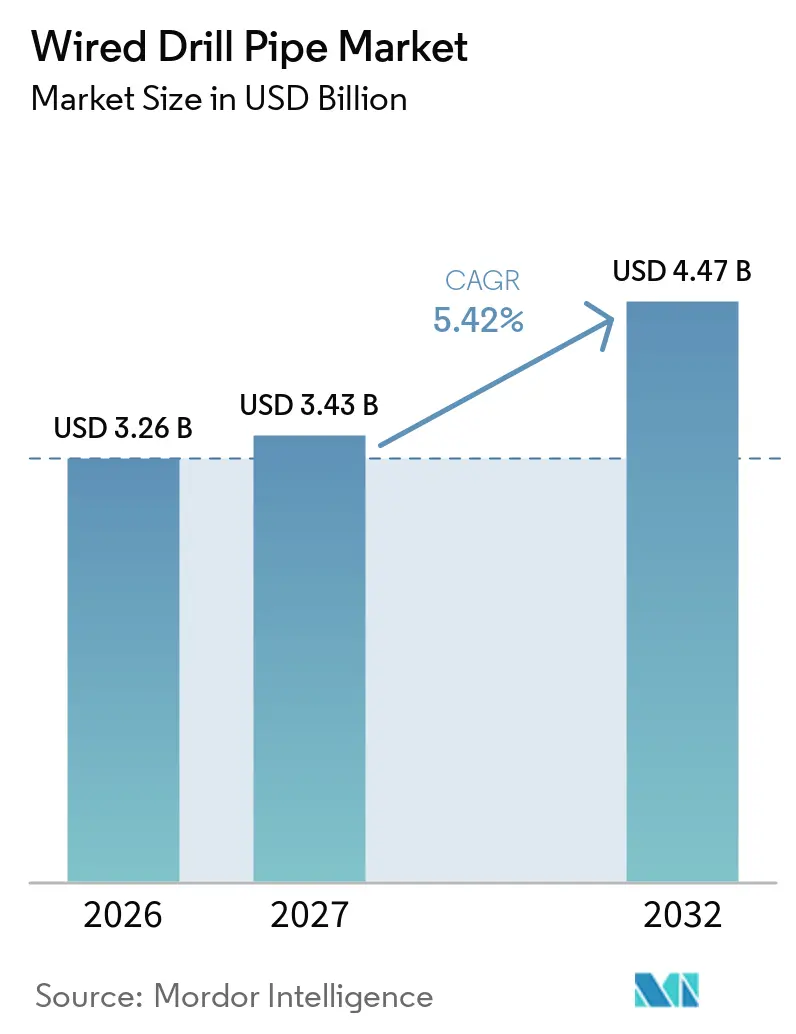
The Wired Drill Pipe Market size was valued at USD 3.26 billion in 2026 and is estimated to grow from USD 3.43 billion in 2027 to reach USD 4.47 billion by 2032, at a CAGR of 5.42% during the forecast period (2027-2032). The wired drill pipe market is supported by drilling programs that need faster well control in deep, extended-reach, and high-pressure wells. Operators are placing more value on continuous downhole data because it allows drilling teams to respond while the well is being drilled, rather than after a delay. This need is strongest where unplanned time carries a high rig cost, particularly in offshore programs. Suppliers are also linking wired connections with automated drilling platforms, which makes data transmission part of the drilling control system rather than a separate service. Open interfaces and national technical standards may widen adoption, although they could reduce the advantage created by proprietary data links.
Key Report Takeaways
- By component, wired drill pipe body held 65.6% of revenue in 2026, while telemetry systems are forecast to grow at a 5.8% CAGR through 2032.
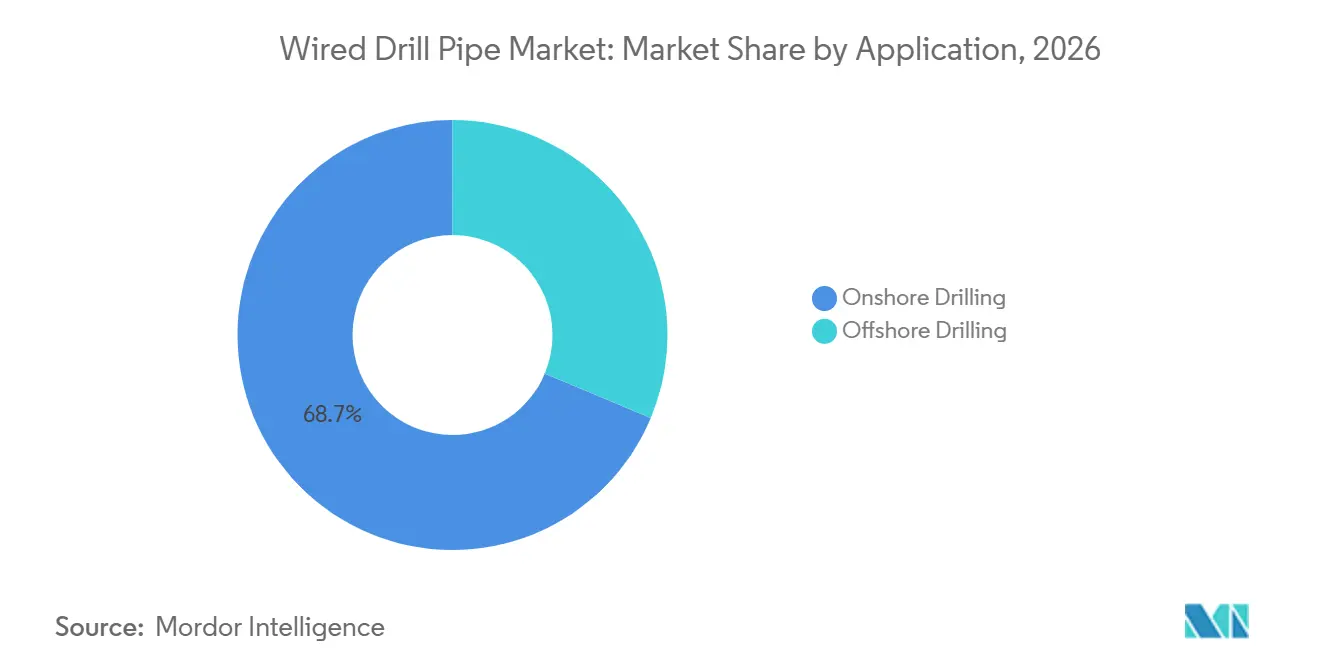
- By application, onshore drilling held 68.7% of revenue in 2026, while offshore drilling is forecast to grow at a 6.4% CAGR through 2032.
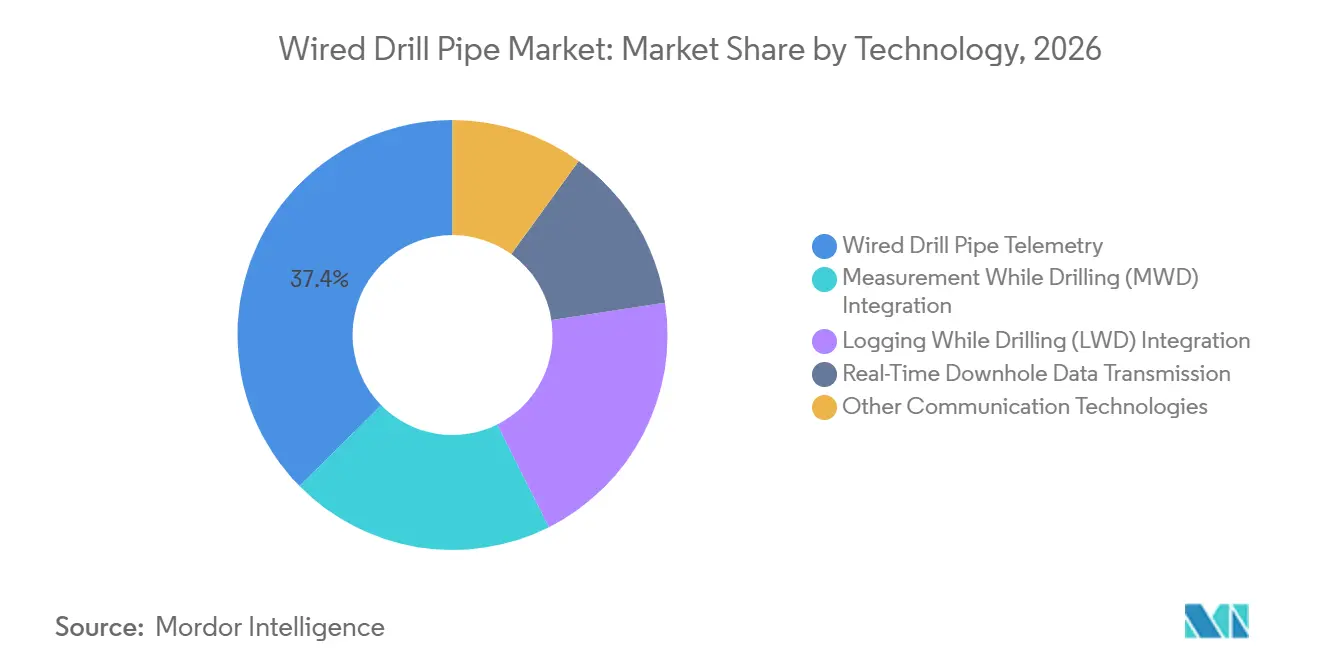
- By technology, wired drill pipe telemetry held 37.4% of revenue in 2026, while real-time downhole data transmission is forecast to grow at a 6.1% CAGR through 2032.
- By geography, North America held 36.3% of revenue in 2026, while Asia-Pacific is forecast to grow at a 6.3% CAGR through 2032.
Note: Market numbers in this report are based on Mordor Intelligence's proprietary estimation framework, which combines nine months of actuals with Q4 projections for base year 2026.
Market Trends and Insights
Drivers Impact Analysis of Wired Drill Pipe Market*
| Driver | (~) % Impact on CAGR Forecast | Geographic Relevance | Impact Timeline |
|---|---|---|---|
| Adoption of Real-Time Data in Complex Wells | +1.2% | Global, concentrated in offshore North Sea and Gulf of America | Medium term (2-4 years) |
| Automation and Closed-Loop Well Construction | +1.0% | Global, with early commercial gains in Norway and the U.S. Gulf Coast | Long term (≥ 4 years) |
| Offshore and Extended-Reach Drilling Economics | +0.8% | Asia-Pacific core, with spillover to the Middle East, Africa, and Brazil | Medium term (2-4 years) |
| Geothermal and Non-Hydrocarbon Drilling Use Cases | +0.4% | North America and Europe, including the Netherlands, Germany, and Iceland | Long term (≥ 4 years) |
| Interoperable Powered Drill Pipe Architectures | +0.6% | Global, with first commercial deployments on the Norwegian Continental Shelf | Short term (≤ 2 years) |
| High-Frequency Drilling-Dynamics Data for Performance Optimization | +0.5% | North America and the Middle East | Medium term (2-4 years) |
| Source: Mordor Intelligence | |||
Adoption of Real-Time Data in Complex Wells
The wired drill pipe market benefits when drilling teams need immediate information from complex boreholes. Extended reach, high-pressure, and deep horizontal wells create more downhole events than conventional wells, which raises the cost of delayed decisions. NOV states that its IntelliServ system can transmit bidirectional data at up to 57,600 bits per second, well above the rates associated with conventional mud-pulse telemetry.[1] Within the wired drill pipe market, this bandwidth can support measurements that are difficult to use through slower communications, including high-resolution ultrasonic borehole images sent to the surface in real time.[2] API Specification 5DP Addendum 1, effective in July 2025, also reinforced manufacturing requirements that matter for instrumented drill pipe connections.[3] China’s GB/T 46212-2025 standard adds a local technical route for electromagnetic telemetry equipment and may influence future equipment qualification in the country.
Automation and Closed-Loop Well Construction
The wired drill pipe market also gains from drilling systems that connect downhole measurements with surface equipment. A closed control loop needs reliable communication in both directions, especially where drilling parameters must change quickly. NOV has described the use of its NOVOS automation platform with wired pipe data to support automated drilling decisions and improve drilling consistency. In September 2025, the Norwegian Ocean Industry Authority ordered Equinor to complete technology qualification work before wider use of specified digital well planning and automated drilling systems.[4] Within the wired drill pipe market, that requirement favors providers that can document field performance, system integration, and control safeguards, while it makes the communications layer more important because automated actions depend on reliable downhole data. The wired drill pipe market therefore has an opportunity to serve as part of a controlled drilling environment instead of only a faster telemetry option.
Offshore and Extended-Reach Drilling Economics
The wired drill pipe market has a clear use case in offshore and extended-reach drilling, where rig time is expensive and delays multiply across a program. Faster survey cycles and gesturing responses can reduce the time spent waiting for downhole information. SLB reported that its NeoLink system supported a fluid-mapping-while-drilling campaign in Norway, sustained 85 to 90 meters per hour of rate of penetration, and saved 3 days of rig time. Reelwell’s DualLink system adds electrical power delivery of up to 500 W with data transmission, reducing dependence on downhole batteries and turbines in some bottomhole assemblies. Vallourec’s September 2025 offshore supply agreement with Petrobras, with potential revenue of up to USD 1 billion through 2029, indicates continued capital deployment for offshore wells that require high-performance tubular systems. For the wired drill pipe market, these programs create conditions in which the incremental cost of an instrumented string can be weighed against avoided delay and better well placement.
Geothermal and Non-Hydrocarbon Drilling Use Cases
The wired drill pipe market can also serve drilling work outside conventional oil and gas wells. Geothermal wells often pass through hot, hard formations where real-time temperature and pressure information supports well placement. A wired connection can continue transmitting data without drilling fluid flow, which is useful during loss-circulation events in fractured formations. Baker Hughes identifies geothermal and carbon capture and storage as growth areas in its Well Construction business, which includes its wired-pipe telemetry offering. Hunting reported that its premium connection products have been qualified for geothermal and carbon capture and storage applications. For the wired drill pipe market, these applications can diversify demand for specialized pipe and downhole communication systems while reducing reliance on a single upstream investment cycle.
Restraints Impact Analysis of Wired Drill Pipe Market*
| Restraint | (~) % Impact on CAGR Forecast | Geographic Relevance | Impact Timeline |
|---|---|---|---|
| High Fleet and Deployment Cost | -0.8% | Global, most constraining for smaller independents in North America and Asia-Pacific | Short term (≤ 2 years) |
| Specialist Handling and Maintenance Requirements | -0.5% | Global, more acute in frontier basins in West Africa and South America | Medium term (2-4 years) |
| Limited Interoperability Across Tool Ecosystems | -0.4% | Global, with pronounced pressure in the Middle East and Asia-Pacific | Medium term (2-4 years) |
| Data Governance and Cybersecurity Exposure at the Rig | -0.3% | North America and Europe | Long term (≥ 4 years) |
| Source: Mordor Intelligence | |||
High Fleet and Deployment Cost
High fleet cost remains a restraint for the wired drill pipe market, particularly where operators have short programs or limited technology budgets. A deployment requires instrumented pipe, surface decoding equipment, repeater subs, specialized handling tools, and support services. These items place the investment outside the routine purchasing cycle for many small independent operators. The precision required for inductive coils and connections also increases manufacturing cost, while API has continued to update requirements under Specification 5DP. For the wired drill pipe market, economics improve when one inventory can be used across multiple wells on the same pad or rig contract. However, operators must first commit to enough work to recover the initial fleet cost, and that decision can be delayed by capital discipline or commodity price uncertainty.
Specialist Handling and Maintenance Requirements
The wired drill pipe market faces further constraints because its electrical components require more careful handling than conventional drill pipes. Make-up torque deviations, thread contamination, and impact damage can affect the integrity of embedded components. Rig crews need training in connection care, inductive coil inspection, fault isolation, and field repair procedures. The added skills requirement can raise mobilization cost and limit use on rigs without experienced service support. In remote areas, the need to move qualified technicians can reduce the financial benefit expected from higher data rates, while NORSOK D-001:2026 adds qualification work where data architectures relate to rig automation systems. Limited interoperability and cybersecurity governance present related constraints because operators must connect tools from several suppliers and protect persistent data links at the rig.
*Our forecasts treat driver/restraint impacts as directional, not additive. The impact forecasts reflect baseline growth, mix effects, and variable interactions.
Wired Drill Pipe Market Segment Analysis
By Component:
Wired Drill Pipe Body Anchors Demand While Telemetry Systems ExpandThe wired drill pipe market share held by the wired drill pipe body reached 65.6% in 2026. Each wired string requires many instrumented pipe joints, which makes the pipe body the physical base of the installed system. Hilong’s 2025 annual report described demand for high-specification drill pipe, including super high-torque, sulfur-resistant, and ultra-deep well products. The company identified U165 drill pipe for wells up to 10,000 meters, a capability aimed at challenging drilling conditions. TMK also commissioned thermal treatment equipment for the welded joint area of friction-welded drill pipe in 2025, supporting pipe performance under high loads and elevated pressure and temperature.
The wired drill pipe market relies on the pipe-body base, while telemetry systems carry a higher share of the digital value proposition and are forecast to grow at a 5.8% CAGR through 2032. Halliburton launched StreamStar in October 2025 as an interface designed to work with third-party wired pipe systems. The company reported data rates of up to 200 kbps during a Norway field test. This approach may allow telemetry upgrades to be sold separately from the pipe string, while surface equipment and downhole communication components support digital rig control integration.
By Application:
Onshore Drilling Provides Volume While Offshore Drilling Creates UrgencyOnshore drilling commanded 68.7% of application revenue in 2026. This position reflects the larger number of land wells drilled across North America, the Middle East, and China. Even limited penetration across high-volume land programs can create substantial demand for instrumented drill pipe in the wired drill pipe market. China is important because domestic systems may increase local availability and reduce dependence on established overseas suppliers. The national standard for electromagnetic telemetry equipment gives locally qualified systems a defined technical route for use, which may reshape supplier choices in high-volume onshore drilling programs.
Offshore drilling is forecast to grow at a 6.4% CAGR through 2032 within the wired drill pipe market, driven by deepwater wells in the Gulf of America, Norway, Brazil, and Asia. High rig costs create a stronger case for systems that shorten data transmission and control cycles. SLB’s Norwegian case study showed that continuous high-bandwidth communications can support higher rate of penetration and reduce rig time. Vår Energi’s use of Reelwell’s DualLink system on the Norwegian Continental Shelf shows operator interest in powered wired pipe where battery-free bottomhole assembly designs offer operational value.
By Technology:
Telemetry Remains Established While Real-Time Data Transmission AdvancesWired drill pipe telemetry accounted for 37.4% of revenue in 2026 and remains the largest technology group. Its installed base is tied to inductive coil networks that have been deployed across North Sea and Gulf of America operations. MWD and LWD integration also benefit from the same communications channel because higher bandwidth allows more formation data to reach surface teams during drilling. This reduces reliance on post-drilling wireline work for some measurements. The technology remains relevant where operators need dependable, continuous data transmission across complex well sections.
Real-time downhole data transmission is forecast to grow at a 6.1% CAGR through 2032, making it the fastest-growing technology group. The shift reflects the use of high-bandwidth data as part of a complex-well drilling workflow. The 2025 EAGE workshop paper described high-resolution ultrasonic borehole images sent in real time through wired drill pipe. That capability can support geosteering decisions using observed borehole geometry rather than only estimated formation response. Hybrid electromagnetic and mechanical-pulse systems remain relevant where full-string deployment is not practical, and the technology mix will depend on well geometry, rig capability, and the degree of planned automation.
Geography Analysis
North America held 36.3% of the wired drill pipe market share in 2026. The region combines offshore drilling in the Gulf of America with long horizontal wells in major unconventional basins. NOV’s installed IntelliServ network and Baker Hughes’ wired-pipe telemetry offering are established parts of the regional service base. The Bureau of Safety and Environmental Enforcement issued a 2025 rule addressing offshore downhole commingling requirements, reinforcing the importance of well information and operating controls in offshore activity. Canadian extended-reach programs add demand for high-torque and hardbanded pipe, and Hilong reported higher North American demand for drill pipe products used in horizontal drilling.
Europe is a major site for high-specification field deployment, particularly in Norway where operators, regulators, and service suppliers are testing drilling automation and powered wired pipe. Reelwell secured a January 2025 contract with Vår Energi for the first deployment of its DualLink powered wired drill pipe on the Norwegian Continental Shelf. Odfjell Technology later acquired a 10% stake in Reelwell and extended their cooperation agreement for 5 years. NORSOK D-001:2026 and the 2025 Havtil order to Equinor highlight the need for integrated drilling control systems and thorough technology qualification.
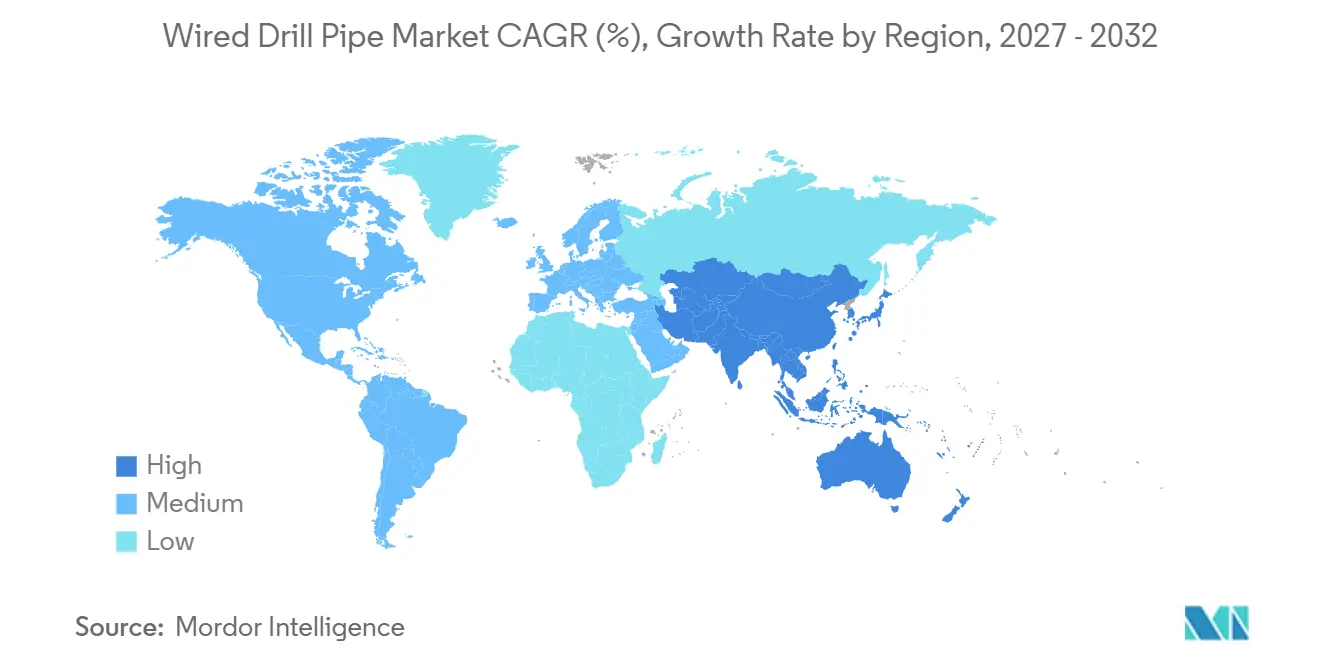
Asia-Pacific is forecast to grow at a 6.3% CAGR through 2032, making it the fastest-growing regional group in the wired drill pipe market. China’s focus on energy security, offshore development in Indonesia and Malaysia, and deepwater exploration in India support demand for more capable drilling systems. CNOOC stated that its Xuanji rotary steerable and LWD system had been used in 151 overseas wells by April 2025, including work in Iraq, Uganda, and Indonesia. GB/T 46212-2025 may direct Chinese purchasing toward locally qualified electromagnetic telemetry systems after its March 2026 effective date. South America, the Middle East, and Africa are supported by offshore projects and longer laterals, while Vallourec’s 2025 agreements with Petrobras and ADNOC show continued tubular investment for high-specification wells.
Competitive Landscape
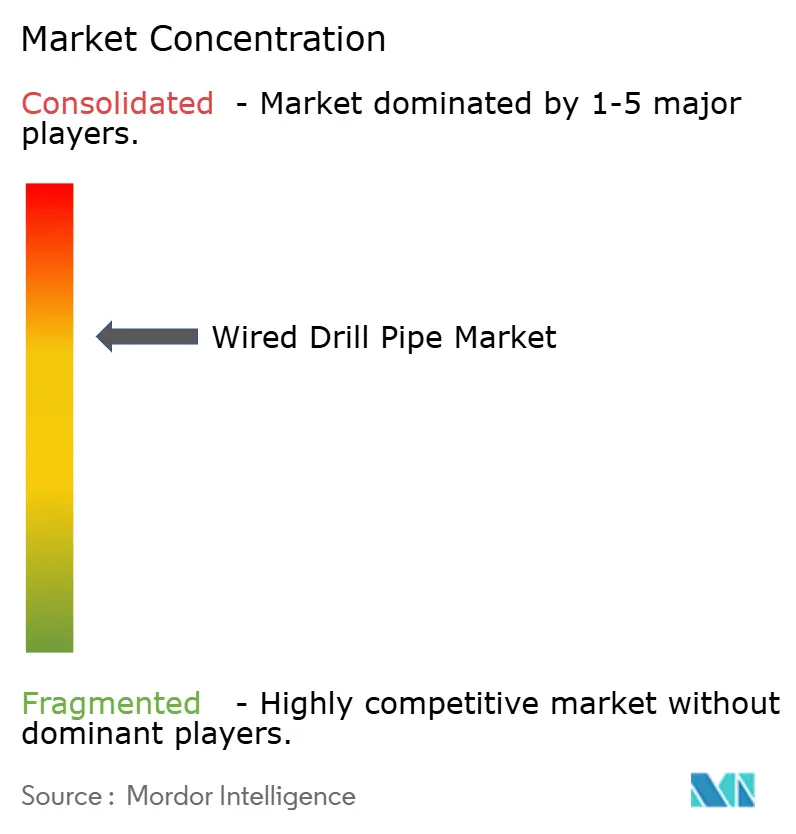
The wired drill pipe market is moderately concentrated market and a more fragmented pipe-body supply base. NOV IntelliServ, SLB, and Halliburton compete through data architecture, bottomhole assembly integration, and customer access. Tenaris, Vallourec, Hilong, TMK, and other pipe suppliers compete through steel grades, connections, manufacturing capability, and service reach. Within the wired drill pipe market, operators need compatible pipe and communications equipment within the same drill string. The competitive model therefore depends on technical compatibility and service execution.
Halliburton’s October 2025 StreamStar launch was a significant competitive move in the wired drill pipe market. The system was designed to provide an interface for third-party wired pipe platforms and to connect with Halliburton’s iStar intelligent drilling system. Field validation in Norway reported up to 200 kbps of data transmission. The open-interface model could help Halliburton sell drilling intelligence services without requiring customers to buy a proprietary pipe system.
Powered wired pipe is an emerging area within the wired drill pipe market. Reelwell’s DualLink deployment with Vår Energi combines power delivery and communications, offering a different approach to bottomhole assembly power needs. Nabors strengthened its related service position when it closed the acquisition of Parker Wellbore in March 2025, adding tubular running services and an alliance connected with TDE powerline wired drill pipe technology. Hilong is expanding the geographic reach of its high-specification pipe business, including work associated with demanding operator programs. The market is not dominated by one supplier because component compatibility, regional service capacity, and specialized drilling requirements keep several firms relevant.
Wired Drill Pipe Industry Leaders
-
NOV Inc.
-
SLB
-
Halliburton Company
-
Baker Hughes Company
-
Weatherford International plc
- *Disclaimer: Major Players sorted in no particular order
Wired Drill Pipe Market Companies Covered in this Report
- APS Technology, Inc.
- Baker Hughes Company
- DP-Master Manufacturing Pte Ltd.
- Dril-Quip, Inc.
- Forum Energy Technologies, Inc.
- Halliburton Company
- Hilong Group of Companies
- Hunting PLC
- IntelliServ, LLC
- NOV Inc.
- Parker Wellbore
- Reelwell AS
- Scientific Drilling International
- SLB
- Superior Drillpipe Manufacturing, Inc.
- Tenaris S.A.
- Tercel Oilfield Products
- TMK Group
- Vallourec S.A.
- Weatherford International plc
Recent Industry Developments in Wired Drill Pipe Market
- September 2025: Vallourec signed a long-term OCTG agreement with Petrobras for offshore well supply from 2026 to 2029, representing potential revenue of up to USD 1 billion and covering the full scope of seamless pipes and VAM premium connections for Petrobras' offshore wells from 4.5 into 18 in.
- July 2025: SLB launched the OnWave autonomous logging platform, a cable-free downhole formation evaluation system deployed via drill pipe without a wireline unit; achieved 70% reduction in landing time versus conventional wireline methods in Eagle Ford high-temperature managed pressure drilling conditions.
- July 2025: Vallourec received a significant ADNOC order for more than 30,000 tons of carbon steel tubulars with VAM premium connections under its ongoing Long-Term Agreement, reflecting sustained UAE capital commitment to offshore and onshore drilling programs.
- April 2025: Vallourec was awarded a contract by Kuwait Oil Company worth more than USD 130 million for OCTG supply, including high-torque flush premium connections for technically demanding well applications.
Global Wired Drill Pipe Market Report Scope
A Wired Drill Pipe (WDP) is an advanced type of oil and gas drill pipe that features an embedded high-speed data transmission system, typically a coaxial cable routed through each pipe joint.
The wired drill pipe market is segmented into component, application, technology, and geography. By component, the market is divided into the wired drill pipe body, the telemetry system, the surface equipment, the downhole communication and connection components, and other components. By application, the market is segregated into onshore drilling and offshore drilling. By technology, the market is segmented into wired drill pipe telemetry, real-time downhole data transmission, measurement while drilling (MWD) integration, logging while drilling (LWD) integration, and other communication technologies. The report also covers the market size and forecasts for the global wired drill pipe market across 26 countries in key regions. For each segment, the market sizing and forecasts have been provided on the basis of value (USD).
Segmentation Overview
| Wired Drill Pipe Body |
| Telemetry System |
| Surface Equipment |
| Downhole Communication and Connection Components |
| Other Components |
| Onshore Drilling |
| Offshore Drilling |
| Wired Drill Pipe Telemetry |
| Real-Time Downhole Data Transmission |
| Measurement While Drilling (MWD) Integration |
| Logging While Drilling (LWD) Integration |
| Other Communication Technologies |
| North America | United States |
| Canada | |
| Mexico | |
| Europe | Germany |
| France | |
| Italy | |
| Spain | |
| United Kingdom | |
| Netherlands | |
| Norway | |
| Russia | |
| Rest of Europe | |
| Asia-Pacific | China |
| India | |
| Japan | |
| Australia | |
| Indonesia | |
| Malaysia | |
| Thailand | |
| Rest of Asia-Pacific | |
| South America | Brazil |
| Argentina | |
| Colombia | |
| Rest of South America | |
| Middle East and Africa | Saudi Arabia |
| United Arab Emirates | |
| Egypt | |
| Oman | |
| Nigeria | |
| Rest of Middle East and Africa |
| By Component | Wired Drill Pipe Body | |
| Telemetry System | ||
| Surface Equipment | ||
| Downhole Communication and Connection Components | ||
| Other Components | ||
| By Application | Onshore Drilling | |
| Offshore Drilling | ||
| By Technology | Wired Drill Pipe Telemetry | |
| Real-Time Downhole Data Transmission | ||
| Measurement While Drilling (MWD) Integration | ||
| Logging While Drilling (LWD) Integration | ||
| Other Communication Technologies | ||
| By Geography | North America | United States |
| Canada | ||
| Mexico | ||
| Europe | Germany | |
| France | ||
| Italy | ||
| Spain | ||
| United Kingdom | ||
| Netherlands | ||
| Norway | ||
| Russia | ||
| Rest of Europe | ||
| Asia-Pacific | China | |
| India | ||
| Japan | ||
| Australia | ||
| Indonesia | ||
| Malaysia | ||
| Thailand | ||
| Rest of Asia-Pacific | ||
| South America | Brazil | |
| Argentina | ||
| Colombia | ||
| Rest of South America | ||
| Middle East and Africa | Saudi Arabia | |
| United Arab Emirates | ||
| Egypt | ||
| Oman | ||
| Nigeria | ||
| Rest of Middle East and Africa | ||
Key Questions Answered in the Report
What is driving demand for wired drill pipe?
Demand is supported by the need for faster downhole data, drilling automation, and lower nonproductive time in complex wells. The sector is forecast to grow at a 5.42% CAGR from 2027 to 2032.
How large is the wired drill pipe sector in 2027?
The sector is estimated at USD 3.43 billion in 2027 and is forecast to reach USD 4.47 billion by 2032.
Which application is growing fastest for wired drill pipe?
Offshore drilling is forecast to grow at a 6.4% CAGR through 2032 because deepwater and extended-reach wells place a higher value on real-time data and rig-time savings.
Which region has the strongest growth outlook for wired drill pipe?
Asia-Pacific is forecast to grow at a 6.3% CAGR through 2032, supported by drilling activity in China, Southeast Asia, and India.
What is the main barrier to wider wired drill pipe adoption?
High fleet and deployment costs remain the main barrier, particularly for smaller operators that cannot spread the initial investment across several wells.
Which technology segment is growing fastest?
Real-time downhole data transmission is forecast to grow at a 6.1% CAGR through 2032 as operators use high-bandwidth connections for richer measurements and faster drilling decisions.