
Wet Pet Food Market Size and Share
Market Overview
| Study Period | 2021 - 2031 |
|---|---|
| Market Size (2026) | USD 47.86 Billion |
| Market Size (2031) | USD 66.12 Billion |
| Growth Rate (2026 - 2031) | 6.68 % |
| Fastest Growing Market | Africa |
| Largest Market | North America |
| Market Concentration | Medium |
Major Players *Disclaimer: Major Players sorted in no particular order Image © Mordor Intelligence. Reuse requires attribution under CC BY 4.0. | |
Wet Pet Food Market Analysis by Mordor Intelligence
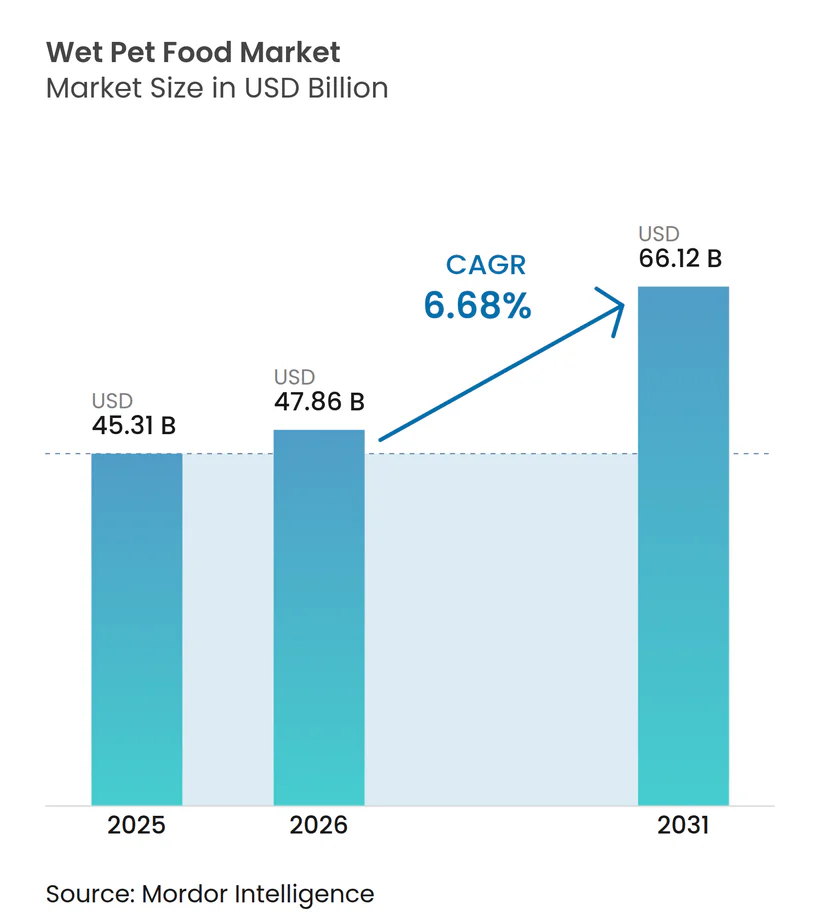
The Wet Pet Food Market size is projected to be USD 45.31 billion in 2025, USD 47.86 billion in 2026, and reach USD 66.12 billion by 2031, growing at a CAGR of 6.68% from 2026 to 2031. Consumer expectations increasingly link pet diets to freshness, functional nutrition, and clear ingredient information, particularly among urban households with rising incomes. This change supports premium products and gives brands room to differentiate through nutrition, format, and service in the wet pet food market. Established markets continue to build value through premiumization, while developing markets expand their customer base as households shift from informal feeding to packaged products. Local production, specialty retail, and online replenishment are becoming important ways for companies to improve access and manage distribution costs. Pricing pressure, cold-chain gaps, and differing labeling requirements remain material constraints to broader adoption in the wet pet food market.
Key Report Takeaways
- By pet type, cats were the largest segment with 52.3% of the wet pet food market share in 2025, while dogs were the fastest-growing segment and are forecast to grow at a 7.4% CAGR from 2026 to 2031.
- By distribution channel, specialty stores were the largest segment with 32.9% of the wet pet food market size in 2025, while the online channel was the fastest segment and is forecast to grow at an 8.6% CAGR from 2026 to 2031.
- By geography, North America was the largest region with 44.4% of the wet pet food market share in 2025, while Africa was the fastest region and is forecast to grow at a 9% CAGR from 2026 to 2031.
Note: Market size and forecast figures in this report are generated using Mordor Intelligence’s proprietary estimation framework, updated with the latest available data and insights as of January 2026.
Market Trends and Insights
Drivers Impact Analysis of Wet Pet Food Market*
| Driver | (~) % Impact on CAGR Forecast | Geographic Relevance | Impact Timeline |
|---|---|---|---|
| Rising Pet Humanization and Premium Nutrition Demand | +2.3% | Global, concentrated in North America, Europe, and Asia-Pacific premium clusters | Long term (≥ 4 years) |
| Expansion of Modern Retail and Specialty Pet Channels | +1.1% | North America, Europe, and major Asia-Pacific cities | Medium term (2-4 years) |
| Local Manufacturing And Import Substitution In Key Hubs | +1% | Global, fastest in North America, Asia-Pacific, and Western Europe | Medium term (2-4 years) |
| Functional Diets for Health, Weight, and Skin Support | +0.9% | North America, Western Europe, Australia, and New Zealand | Long term (≥ 4 years) |
| Informal Feeding Conversion Into Packaged Pet Food | +0.8% | Africa, South Asia, and South America | Long term (≥ 4 years) |
| E-commerce and Direct-to-consumer Brand Reach | +0.7% | South America, Asia-Pacific, and Africa | Medium term (2-4 years) |
| Source: Mordor Intelligence | |||
Rising Pet Humanization and Premium Nutrition Demand
Pet humanization has become a central force in the wet pet food market. Owners increasingly apply the same expectations for nutrition, freshness, and ingredient clarity to pet food that they apply to their own purchases. In France, portion meals and premium treats showed strong growth in specialist channels. Pet food quality tends to remain important for urban premium consumers even when household budgets are under pressure. Nestlé S.A. stated in July 2026 that pet care represented 29% of its European sales and 21% of its global sales, and its European pet care leadership identified super-premium wet food as particularly attractive[1]. These preferences allow manufacturers to increase per-unit value, creating a clearer divide between mass products and premium offerings in the wet pet food market.
Expansion of Modern Retail and Specialty Pet Channels
Specialty retailers play an active role in shaping premium demand in the wet pet food market. Germany’s pet sector generated approximately EUR 6.99 billion (about USD 8.0 billion) in 2025, while specialist trade retained a 76% channel share in accessories and specialty products. These stores can carry refrigerated, freeze-dried, and therapeutic formats that need temperature control and product knowledge. Mars, Incorporated, appointed The Petshop Group as its exclusive specialty retail distribution partner in the United Arab Emirates in January 2026. This arrangement showed how brands can use specialist outlets to introduce premium products before pursuing wider retail coverage. Independent stores also remain important for smaller premium brands where consumers still depend on in-store guidance and product trial in the wet pet food market.
E-Commerce and Direct-to-Consumer Brand Reach
Online selling is changing how consumers replenish wet pet food purchases. Subscription programs reduce the effort required to reorder and can strengthen brand retention over time. In April 2025, Onedot Inc. expanded its Petnote direct-to-consumer pet food platform to 192 warehouses in 40 Chinese cities, supporting delivery within 30 to 60 minutes from local facilities[2]. This localized delivery model addresses a practical barrier that previously limited wet formats in many Asian cities. Large online marketplaces also broaden the availability of functional formulas beyond established specialty retail catchments. The online channel, therefore, gives brands in the wet pet food market a route to reach households that may not have easy access to a specialized pet store.
Functional Diets for Health, Weight, and Skin Support
Functional products are moving therapeutic nutrition from veterinary settings into more widely available wet food formats. High moisture content and flexible recipes can support the use of omega fatty acids, probiotics, glucosamine, and taurine without the same palatability limits associated with some dry foods. In African specialist retail, products for skin conditions, digestion, weight control, renal care, and urinary health are gaining traction. Veterinary credibility can make functional products more relevant in the wet pet food market, even in price-sensitive settings. This development positions wet food as a nutrition option with both daily feeding and condition-specific roles in the wet pet food market.
Restraints Impact Analysis of Wet Pet Food Market*
| Restraint | (~) % Impact on CAGR Forecast | Geographic Relevance | Impact Timeline |
|---|---|---|---|
| High Price Sensitivity Outside Premium Urban Clusters | -0.9% | Africa, South Asia, South America outside major cities, and Southeast Asia | Long term (≥ 4 years) |
| Limited Cold Chain and Logistics Coverage for Moist and Fresh Formats | -0.6% | Africa, South Asia, rural North America, and emerging Southeast Asia | Long term (≥ 4 years) |
| Weak Online Penetration in Most African Markets | -0.5% | Sub-Saharan Africa outside South Africa, and North Africa | Medium term (2-4 years) |
| Fragmented Regulation and Labeling Compliance Across Countries | -0.4% | Cross-border operations, with high friction in Asia-Pacific and Africa | Long term (≥ 4 years) |
| Source: Mordor Intelligence | |||
High Price Sensitivity Outside Premium Urban Clusters
The price gap between packaged wet food and informal feeding remains a persistent limit on adoption. Homemade meals, leftovers, and low-cost alternatives are still common across parts of Africa, South Asia, and nonmetropolitan South America. Wet food carries higher packaging, storage, and handling costs than dry food, which widens the affordability challenge. Imported brands may find it difficult to offer entry-level pouches or cans at prices that appeal to aspirational middle-income households. Local suppliers have started to address this need in South Africa and Brazil through lower logistics costs. Wider replication in the wet pet food market remains difficult where ingredients and packaging materials are not reliably available.
Limited Cold Chain and Logistics Coverage for Moist and Fresh Formats
Fresh wet products require storage and transport at 2°C to 8°C, while sterilized cans and pouches can remain at ambient temperature before opening. This creates a distribution challenge for the wet pet food market in areas with limited cold warehouses, unreliable electricity, or few refrigerated delivery services. Refrigerated pet food producers identify carrier capacity, warehouse availability, and fast-rising demand as recurring distribution barriers. The issue also affects the usability of opened trays and pouches in homes without dependable refrigeration. Rural households may postpone category trial even when they have the ability to pay. Cold-chain investment is therefore needed before fresh formats can reach many new areas of the wet pet food market. The Association of American Feed Control Officials Pet Food Label Modernization model regulations became effective in January 2024 and require full state-level compliance by January 2030[3]. This program provides clearer labeling language for premium and functional claims in the United States. European Pet Food Industry Federation nutrition and safety guidance similarly supports established European markets. Different ingredient approvals, labels, and registration requirements in many African and Asian countries add time and cost for companies that want to operate across borders.
*Our forecasts treat driver/restraint impacts as directional, not additive. The impact forecasts reflect baseline growth, mix effects, and variable interactions.
Wet Pet Food Market Segment Analysis
By Pets:
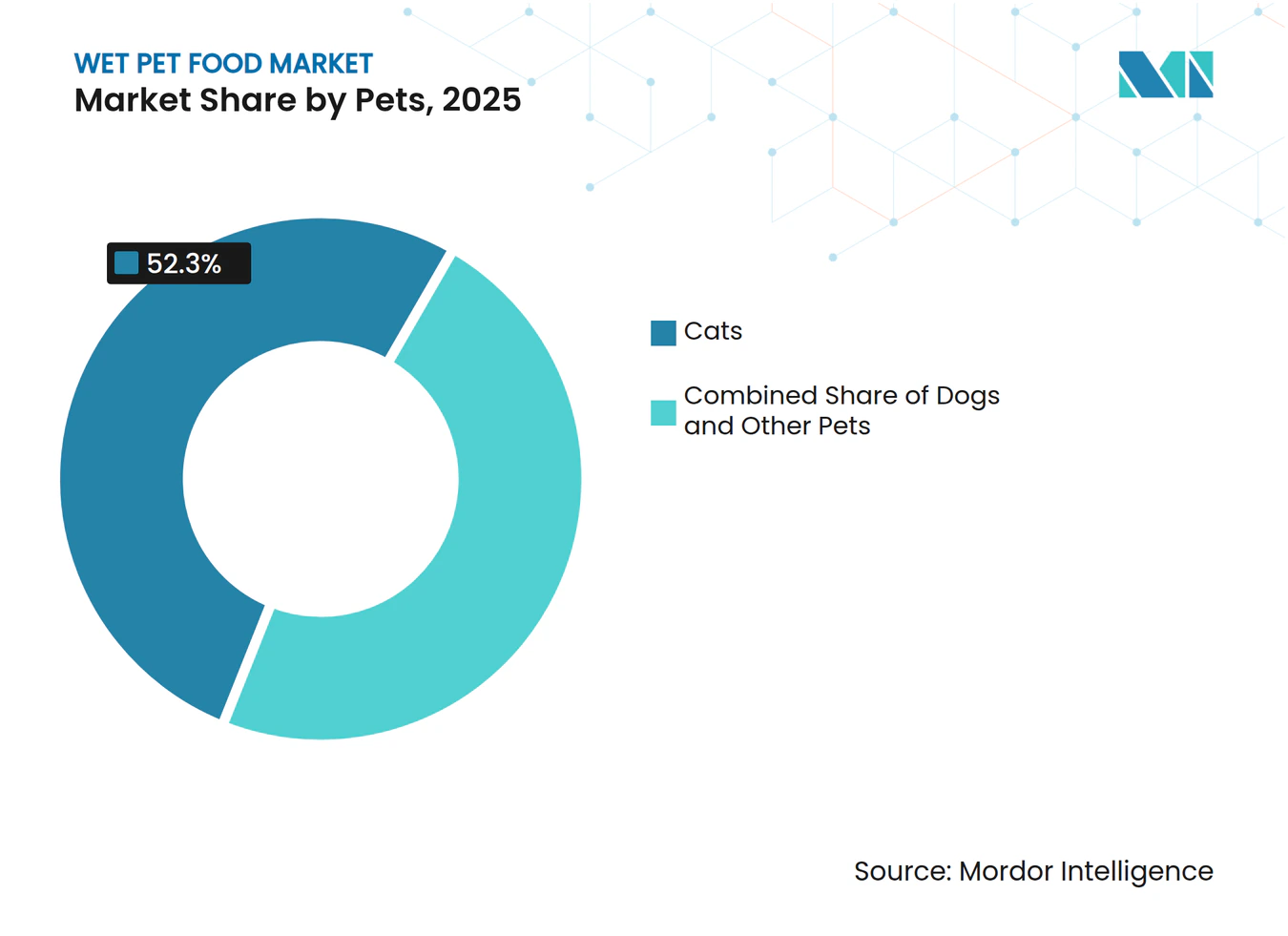
Cats Lead Demand and Dogs Drive Faster AdoptionCats were the largest pet segment, accounting for 52.3% of the wet pet food market share in 2025. Their position reflects the connection between feline diets and higher moisture intake, which supports urinary and renal health management. According to the Pet Food Association of Japan, Japan’s dog and cat pet food retail market reached approximately JPY 637.5 billion (USD ~4.3 billion) in 2025, with premium segments such as gourmet and functional pet food continuing to expand. Nestlé S.A. relaunched its Gourmet Perle range across nearly 30 European markets in 2026, introducing new textures, including Ocean Flakes made with Marine Stewardship Council-certified fish. Wellness Pet, LLC also introduced more than 20 wet cat food products at SuperZoo 2025, featuring proteins and textures designed to support hydration and overall well-being.
Dogs are the fastest-growing segment of pets and are forecast to expand at a 7.4% CAGR from 2026 to 2031. The wet pet food market size for dog products is driven by owners shifting from dry-only or mixed feeding to wet-primary diets. Palatability, portion control, hydration, and recipes for different life stages contribute to this shift. Condition-specific diets for weight management, sensitive digestion, and joint support are becoming more available through specialty stores and online subscriptions. In August 2026, Canidae, LLC launched its Heartland dog food line across Walmart stores in the United States, targeting value-conscious households, including multi-dog families. Other pets, including rabbits, ferrets, and birds, remain a smaller niche that is served mainly through veterinary and independent specialty channels.



By Distribution Channel:
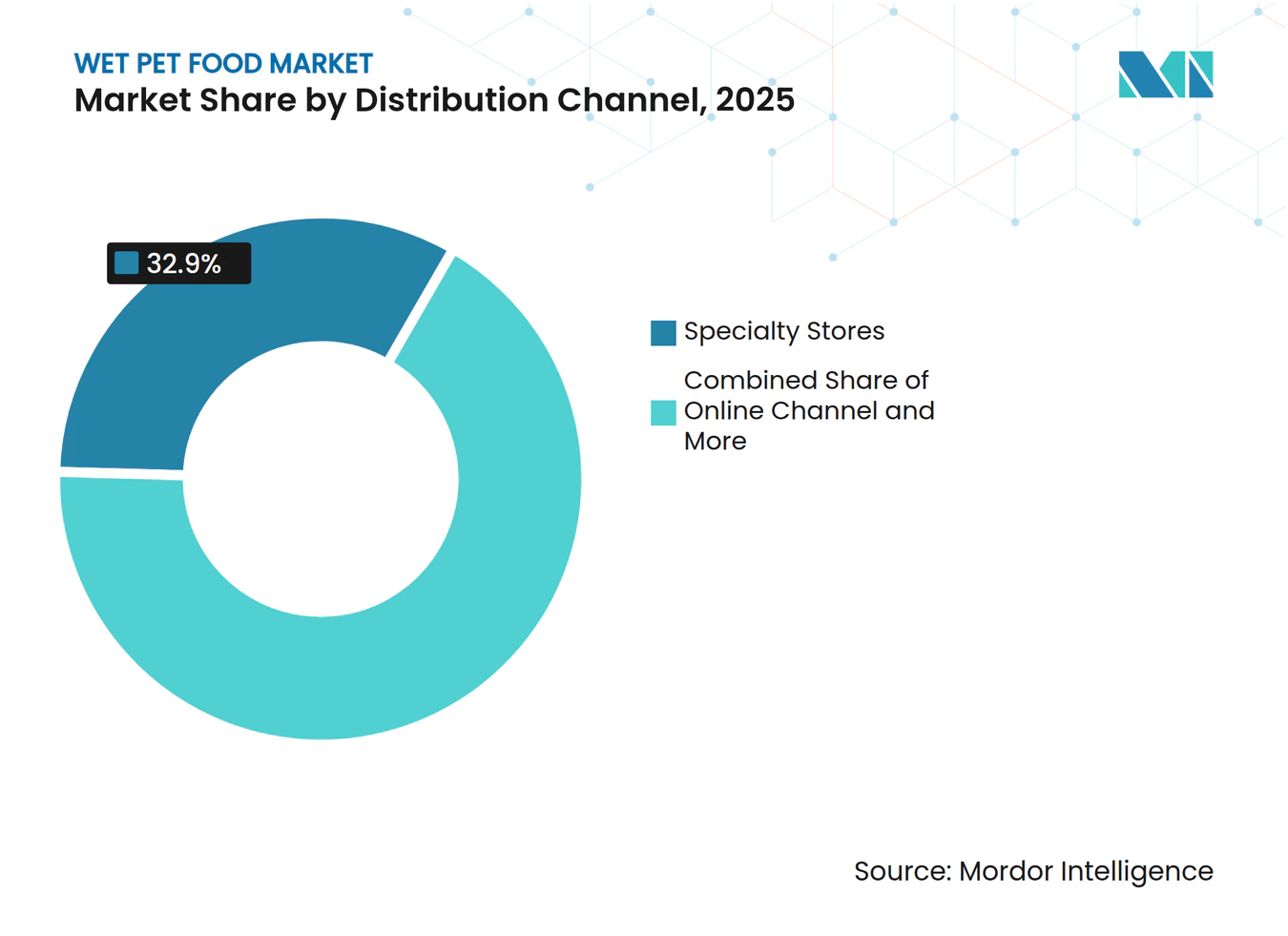
Specialty Stores Lead and Online Replenishment Grows FasterSpecialty stores were the largest distribution segment, accounting for 32.9% of the wet pet food market share in 2025. Their role is supported by a wider assortment of premium, refrigerated, and therapeutic products. These formats may require product advice, dedicated refrigeration, and more shelf space than mass retailers can sustain. The wet pet food market benefits when specialty retailers help consumers select formats that match a pet’s nutritional needs. Specialist retail also remains important in Germany, France, and the United Kingdom, where premium service supports repeat purchases. In January 2026, Mars, Incorporated selected The Petshop Group as its exclusive specialist distribution partner in the United Arab Emirates, reflecting the strategic role of this channel.
The online channel is the fastest distribution segment and is forecast to advance at an 8.6% CAGR from 2026 to 2031. Automatic replenishment can reduce the inconvenience of repeat purchases and support predictable ordering cycles. Wellness Pet, LLC launched Wellness Protein Bowls in January 2026 through PetSmart, followed by an April 2026 rollout to independent specialty stores and e-commerce channels. This sequence used specialty retail to build awareness before widening online access. Convenience stores, supermarkets, hypermarkets, and other channels continue to serve value-oriented and impulse purchases. Private-label products from contract manufacturers, including Simmons Foods, Inc. and United Petfood Group BV, are gaining relevance as retailers improve formula quality.

Geography Analysis
North America was the largest regional segment, accounting for 44.4% of the wet pet food market share in 2025. The region benefits from high per-pet spending, broad access to veterinary care, and retail networks that support both mass-market and super-premium products. Pet humanization trends continue to drive demand for premium and natural wet food options, with consumers increasingly prioritizing ingredient quality and nutritional value. In the United States, subscription models and direct-to-consumer sales are gaining traction, while veterinary clinics and specialty stores remain important channels for therapeutic products. Canada follows a similar consumption pattern, with growing interest in grain-free and limited-ingredient wet food formulations across both urban and suburban markets.
Africa was the fastest regional segment and is projected to expand at a 9% CAGR from 2026 to 2031. South Africa has the continent’s most developed wet food market, while Nigeria, Kenya, and Ghana are growing from lower bases as income and retail access improve. Informal retail remains important for early adoption because online penetration is limited across much of Sub-Saharan Africa, except in South Africa. South America is also attracting investment in capacity as companies seek local supply. Nestlé S.A. invested CHF 370 million (USD 473.6 million) in its Vargeão, Brazil, facility in 2026, nearly doubling local wet food capacity. Mars, Incorporated opened a BRL 430 million (USD 76 million) wet food facility in Ponta Grossa, Brazil, to supply Chile, Colombia, Peru, and Ecuador. Saudi Arabia and the United Arab Emirates are smaller premiumizing markets where specialist partnerships are helping global brands enter urban households.
Europe and the Asia-Pacific form the next group of strategic markets for the wet pet food market. According to the Fédération des Fabricants d’Aliments pour Chiens, Chats, Oiseaux et autres animaux familiers (FACCO)–Odoxa 2024–2025 Barometer, France had approximately 79 million companion animals in 2025, while 61% of French people owned at least one pet. Dogs and cats represented the largest companion-animal categories, with 53% of the population owning at least one dog or cat, including 30% owning a dog and 39% owning a cat. According to Nestlé Purina PetCare Europe, European wet cat food grew 8% in 2025, supporting a value-led rather than volume-led regional pattern. Nestlé S.A. announced a CHF 520 million (USD 641.9 million) manufacturing and logistics facility in Mantova, Italy, that is projected to begin production in 2029.
Competitive Landscape
Market Concentration
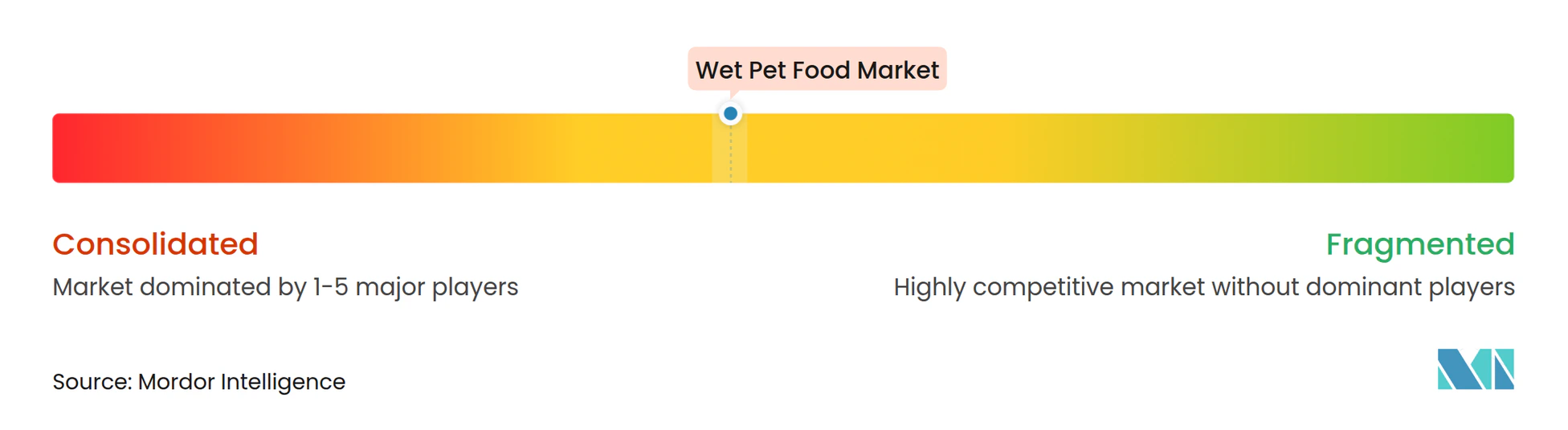
The wet pet food market is moderately consolidated among leading multinational manufacturers. Mars, Incorporated and Nestlé S.A. hold strong positions in canned, pouched, and tray formats through multi-brand portfolios and manufacturing networks. Their product coverage includes mass, premium, and super-premium price tiers. Mars, Incorporated opened an AUD 112.6 million (USD 72.1 million) cat food kitchen in Wodonga, Australia, in June 2026. The site produces 290 million wet food pouches annually and supports local production for Australia and New Zealand. Such investments improve supply reliability and increase the scale required for smaller competitors to match established players.
Private-label and contract producers are forming an important second tier in the wet pet food market. Simmons Foods, Inc. is a major private-label and contract wet pet food manufacturer in North America. Heristo Aktiengesellschaft, through Saturn Petcare, is a major European private-label wet pet food producer. United Petfood Group BV operates 30 facilities across Europe and the Americas and reported annual turnover above USD 1.8 billion. These companies give retailers and branded businesses access to manufacturing capacity without requiring each customer to build a dedicated plant. Automation also supports their cost position, as Saturn Petcare reported that automated variety-pack sorting at its Terre Haute, Indiana, facility avoided the need for 150 additional manual employees.
Premium functional products in developed markets and affordable packaged products in Africa and South Asia remain important areas of competition. Wellness Pet, LLC, Canidae, LLC, and Tiernahrung Deuerer GmbH use protein-forward, life-stage, and condition-specific products to compete for premium demand. Mars, Incorporated, introduced Royal Canin Fresh Veterinary Diets in July 2026, extending its veterinary nutrition offer into fresh therapeutic food. Nestlé S.A. also announced plans for a Mantova facility to support the production of European super-premium wet food. Food safety certifications, including the International Featured Standards and the Food Safety System Certification 22000, support participation in European private-label tenders and specialty retail programs.
Wet Pet Food Industry Leaders
-
Mars, Incorporated
-
The J.M. Smucker Company
-
General Mills, Inc.
-
Colgate-Palmolive Company
-
Nestle S.A. (Purina)
- *Disclaimer: Major Players sorted in no particular order
Wet Pet Food Market Companies Covered in this Report
- Mars, Incorporated
- Nestle S.A. (Purina)
- Colgate-Palmolive Company
- General Mills, Inc.
- The J.M. Smucker Company
- Unicharm Corporation
- United Petfood Group BV
- heristo aktiengesellschaft
- Schell & Kampeter Inc. (Diamond Pet Foods)
- Simmons Foods, Inc.
- Wellness Pet, LLC
- Freshpet, Inc.
- Canidae, LLC
- Tiernahrung Deuerer GmbH (Deuerer Group)
- Affinity Petcare, S.A. (Agrolimen, S.A.)
Recent Industry Developments in Wet Pet Food Market
- July 2026: Nestlé S.A. (Purina) announced a CHF 520 million (USD 641.9 million) investment in a new wet pet food manufacturing and logistics facility in Mantova, Italy, targeting super-premium wet food production for European cats and dogs. Production is planned to begin in 2029, and the facility will serve 111 million cats and 91 million dogs across Europe.
- June 2026: Mars, Incorporated officially opened its AUD 112.6 million cat-food facility in Wodonga, Victoria, making it Australia’s largest cat food kitchen. The facility produces 290 million premium wet cat-food pouches annually for brands including WHISKAS, DINE, OPTIMUM, and ADVANCE.
- March 2026: Wellness Pet Company showcased protein-forward innovations at Global Pet Expo 2026, including Appetizing Entrées Kitten and Age Advantage wet cat foods, as well as eight new Protein Bowls slow-cooked dog recipes, spanning new textures, formats, and life-stage nutrition.
Global Wet Pet Food Market Report Scope
Wet pet food refers to moisture-rich formulated food for cats and dogs, typically made with meat, poultry, fish, or other animal proteins and packaged in cans, trays, or pouches. It provides high palatability and moisture intake and is available in formats such as pâté, chunks in gravy, jelly, and mousse.
The Wet Pet Food Market Report is Segmented by Pet Type (Cat, Dog, and Other Pets), by Distribution Channel (Convenience Stores, Online Channel, Specialty Stores, Supermarkets and Hypermarkets, and Other Channels), and by Geography (North America, South America, Europe, Asia-Pacific, Middle East, and Africa). The market forecasts are provided in terms of value in USD and volume.
Segmentation Overview
| Cats |
| Dogs |
| Other Pets |
| Convenience Stores |
| Online Channel |
| Specialty Stores |
| Supermarkets/Hypermarkets |
| Other Channels |
| North America | United States |
| Canada | |
| Mexico | |
| Rest of North America | |
| South America | Brazil |
| Argentina | |
| Rest of South America | |
| Europe | Germany |
| United Kingdom | |
| France | |
| Italy | |
| Spain | |
| Russia | |
| Rest of Europe | |
| Asia-Pacific | China |
| India | |
| Japan | |
| South Korea | |
| Australia | |
| Rest of Asia-Pacific | |
| Middle East | Saudi Arabia |
| United Arab Emirates | |
| Rest of Middle East | |
| Africa | South Africa |
| Egypt | |
| Rest of Africa |
| Pets | Cats | |
| Dogs | ||
| Other Pets | ||
| Distribution Channel | Convenience Stores | |
| Online Channel | ||
| Specialty Stores | ||
| Supermarkets/Hypermarkets | ||
| Other Channels | ||
| Geography | North America | United States |
| Canada | ||
| Mexico | ||
| Rest of North America | ||
| South America | Brazil | |
| Argentina | ||
| Rest of South America | ||
| Europe | Germany | |
| United Kingdom | ||
| France | ||
| Italy | ||
| Spain | ||
| Russia | ||
| Rest of Europe | ||
| Asia-Pacific | China | |
| India | ||
| Japan | ||
| South Korea | ||
| Australia | ||
| Rest of Asia-Pacific | ||
| Middle East | Saudi Arabia | |
| United Arab Emirates | ||
| Rest of Middle East | ||
| Africa | South Africa | |
| Egypt | ||
| Rest of Africa | ||
Key Questions Answered in the Report
What isthe projected value of the wet pet food market by 2031?
It is projected to reach USD 66.12 billion by 2031, growing at a 6.68% CAGR from 2026.
Which pet type has the highest wet pet food consumption?
Cats were the largest segment, accounting for 52.3% of global sales in 2025, supported by the role of moisture in feline diets.
Which distribution channel is growing fastest for wet pet food?
The online channel is projected to grow at an 8.6% CAGR through 2031 as subscriptions make repeat purchases easier.
Which region is expanding fastest for wet pet food?
Africa is projected to grow at a 9% CAGR from 2026 to 2031, driven by urbanization, retail development, and packaged-food adoption.
Why are specialty stores important for wet pet food brands?
Specialty stores held 32.9% of sales in 2025 and can support refrigerated, therapeutic, and premium formats that require product guidance.
How concentrated is the wet pet food sector?
The sector has moderately consolidated because Mars, Incorporated and Nestlé S.A. have strong global positions, while private-label, premium, and regional companies keep the remaining supply base fragmented.