
Water-Soluble Coatings Market Size and Share
Market Overview
| Study Period | 2021 - 2031 |
|---|---|
| Market Size (2026) | USD 11.52 Billion |
| Market Size (2031) | USD 15.99 Billion |
| Growth Rate (2026 - 2031) | 6.78 % |
| Fastest Growing Market | Asia-Pacific |
| Largest Market | Asia-Pacific |
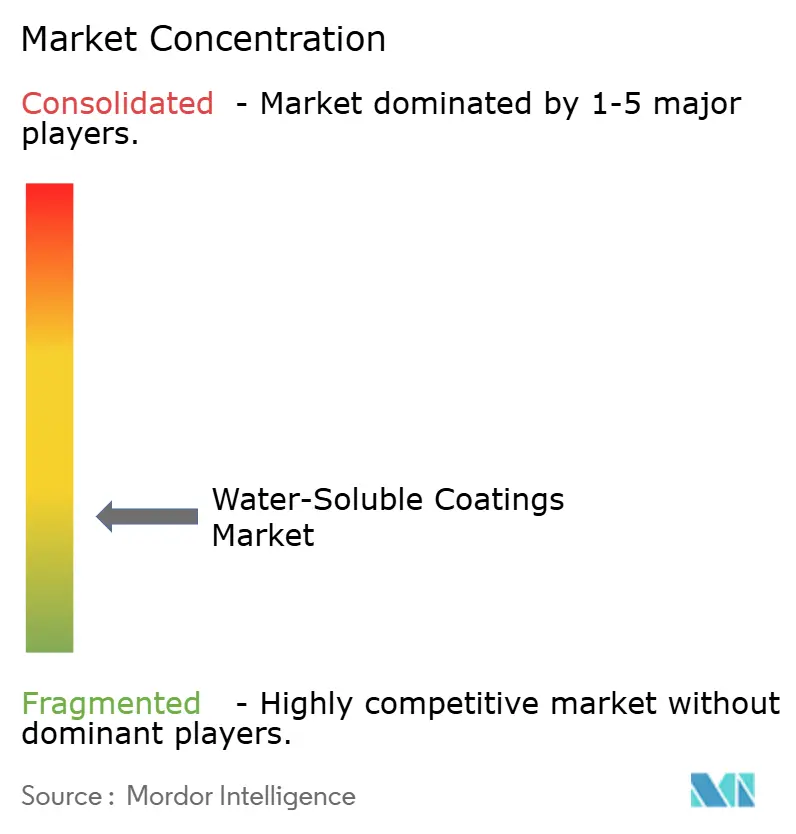
| Market Concentration | Low |
Major Players *Disclaimer: Major Players sorted in no particular order Image © Mordor Intelligence. Reuse requires attribution under CC BY 4.0. | |
Water-Soluble Coatings Market Analysis by Mordor Intelligence
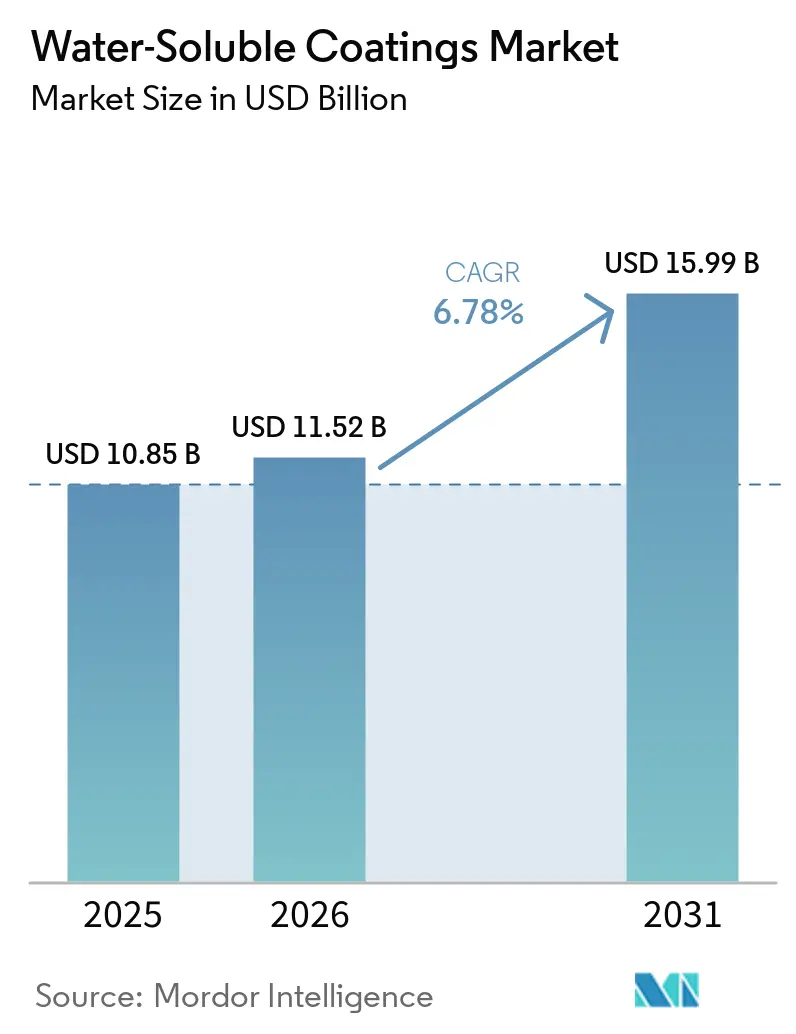
The water-soluble coatings market size was valued at USD 10.85 billion in 2025 and is estimated to grow from USD 11.52 billion in 2026 to USD 15.99 billion by 2031, at a CAGR of 6.78% during the forecast period (2026-2031). Tightening regulations on volatile organic compounds (VOCs) are shifting manufacturers away from solvent-borne systems in major regulated regions. US requirements and California limits have increased demand for compliant architectural formulations. Green building standards incorporate low-VOC coatings into construction specifications, broadening demand beyond voluntary environmental purchasing. The water-soluble coatings market is also benefiting from automotive paint shop conversions and the requirement for lower curing temperatures on electric vehicle platforms. Competition increasingly depends on formulation performance, compliant raw materials, and the ability to manage volatile input costs.
Key Report Takeaways
- By coating type, acrylic held 38.11% of the water-soluble coatings market share in 2025, while polyurethane is forecast to grow at a 7.23% CAGR through 2031.
- By end-user industry, construction and infrastructure held 55.56% of the water-soluble coatings market share in 2025, while automotive and transportation are forecast to expand at a 7.54% CAGR through 2031.
- By geography, Asia-Pacific accounted for 39.73% of the value in 2025 and is forecast to grow at a 7.48% CAGR through 2031.
Note: Market size and forecast figures in this report are generated using Mordor Intelligence’s proprietary estimation framework, updated with the latest available data and insights as of January 2026.
Global Water-Soluble Coatings Market Trends and Insights
Drivers Impact Analysis*
| Drivers | (~) % Impact on CAGR Forecast | Geographic Relevance | Impact Timeline |
|---|---|---|---|
| Tightening VOC and Indoor-Air-Quality Requirements | +2.0% | Global, led by Europe, North America, and China | Short term (≤ 2 years) |
| Architectural Repainting and Green-Building Activity | +1.5% | Global, with the greatest uplift in Asia-Pacific and the Middle East | Medium term (2-4 years) |
| Automotive OEM and Refinish Conversion to Water-Based Systems | +1.2% | Europe and North America, with spillover to the Asia-Pacific and South America | Medium term (2-4 years) |
| Performance Gains in Acrylic, Polyurethane, Epoxy, and Hybrid Systems | +1.0% | Global | Long term (≥ 4 years) |
| Under-Served Demand for Low-Odor Coatings in Occupied Facilities | +0.5% | North America and Europe, with early gains in Asia-Pacific urban markets | Medium term (2-4 years) |
| Source: Mordor Intelligence | |||
Tightening VOC and Indoor-Air-Quality Requirements
Volatile organic compound (VOC) regulation is becoming a stronger basis for product selection in the water-soluble coatings market. The U.S. Environmental Protection Agency updated national architectural coatings standards in January 2025. California's South Coast Air Quality Management District (SCAQMD) Rule 1113 limits most architectural categories to less than 50 g/L VOC. These measures favor waterborne systems where manufacturers need dependable compliance. Research published by the Royal Society of Chemistry (RSC) showed that UK decorative paint VOC emissions fell from 0.532 kg per person per year in 2004 to 0.210 kg per person per year in 2019 following the implementation of the EU Paints Directive[1]R. T. Lidster et al., “Regulation and Reformulation: How the EU Paints Directive Shaped Volatile Organic Compound Emissions from UK Decorative Paints,” Environmental Science: Atmospheres, pubs.rsc.org.. China's GB/T 41659-2025 standard extends this regulatory direction into a major manufacturing economy.
Architectural Repainting and Green-Building Activity
Green building programs are increasing demand for low-emission materials across construction and renovation work. LEED operates across more than 180 countries and applies requirements for indoor environmental quality. The Building Research Establishment Environmental Assessment Method (BREEAM) also supports lower-emission material specifications across many construction projects. The water-soluble coatings market benefits when low VOC requirements are included in original construction contracts. These specifications can continue to influence repainting and refurbishment decisions during a building's operating life. India's Green Rating for Integrated Habitat Assessment (GRIHA) program and Singapore's Green Mark scheme also support waterborne specifications in construction procurement.
Automotive OEM and Refinish Conversion to Water-Based Systems
Automotive conversion remains an important source of demand for the water-soluble coatings market. Waterborne basecoat systems reached 70-75% penetration in European original equipment manufacturer (OEM) paint shops by 2025. Waterborne primer formulations also reached VOC levels below 35 g/L by 2025. Electric vehicle platforms require clearcoats that cure at 100-130°C rather than 140-160°C, as used in conventional internal-combustion paint shops. This operating range can lower energy demand while meeting emissions requirements. The water-soluble coatings market has further opportunity in commercial and specialty vehicles, where conversion remains less complete.
Performance Gains in Acrylic, Polyurethane, Epoxy, and Hybrid Systems
Technical performance is improving in waterborne systems used in demanding applications. Lubrizol introduced Sancure 942 in July 2025 for wood-floor finishes requiring wear protection, chemical resistance, and adhesion. Covestro's Bayhydur quix ultra hardener has VOC levels below 97 g/L and supports fast drying. A 2024 study found that double-crosslinked waterborne polyurethane coatings can compete with solvent-borne 2K products in industrial applications. A 2025 study also reported improved hardness, flexibility, and corrosion resistance for epoxy-acrylic hybrid latexes. These improvements extend the water-soluble coatings market into applications once reserved for solvent-borne chemistry.
Restraints Impact Analysis*
| Restraints | (~) % Impact on CAGR Forecast | Geographic Relevance | Impact Timeline |
|---|---|---|---|
| Longer Drying and Cure Sensitivity to Humidity and Temperature | -0.8% | Global, with acute exposure in Southeast Asia, South America, and the Middle East | Short term (≤ 2 years) |
| Raw-Material and Additive Cost Volatility | -0.9% | Global, especially North America, China, and Europe | Short term (≤ 2 years) |
| Water Sensitivity, Substrate Preparation, and Corrosion-Protection Gaps | -0.7% | Marine, offshore, and heavy industry, especially coastal Middle East and Southeast Asia facilities | Medium term (2-4 years) |
| Source: Mordor Intelligence | |||
Longer Drying and Cure Sensitivity to Humidity and Temperature
Water-based systems require controlled conditions for reliable film formation. High humidity or low temperatures can extend drying times compared with solvent-borne alternatives. Humidity above 80% can impair film quality without climate-controlled application booths, adding capital costs for smaller fabricators and regional contractors. Two-component waterborne polyurethane systems can also have shorter pot life under elevated humidity. Fast-drying additives, water-release resins, and infrared curing can mitigate these issues, but add to overall costs.
Raw-Material and Additive Cost Volatility
The water-soluble coatings market remains exposed to volatility in acrylic derivatives, polyurethane precursors, and titanium dioxide. North American rutile-grade titanium dioxide was priced near USD 2,970 per metric ton in 2026. Western producers raised titanium dioxide prices by USD 100-150 per metric ton from late 2025. Butyl acrylate prices increased during the first quarter of 2026 as crude oil pushed up acrylic acid and n-butanol feedstock costs. Simultaneous increases in pigment and acrylic acid costs can compress margins when contracts limit price pass-through. Smaller producers with shorter hedging windows face greater earnings pressure than large multinational suppliers.
*Our forecasts treat driver/restraint impacts as directional, not additive. The impact forecasts reflect baseline growth, mix effects, and variable interactions.
Segment Analysis
By Coating Type: Acrylic Leads Architectural Demand, While Polyurethane Advances in Performance Applications
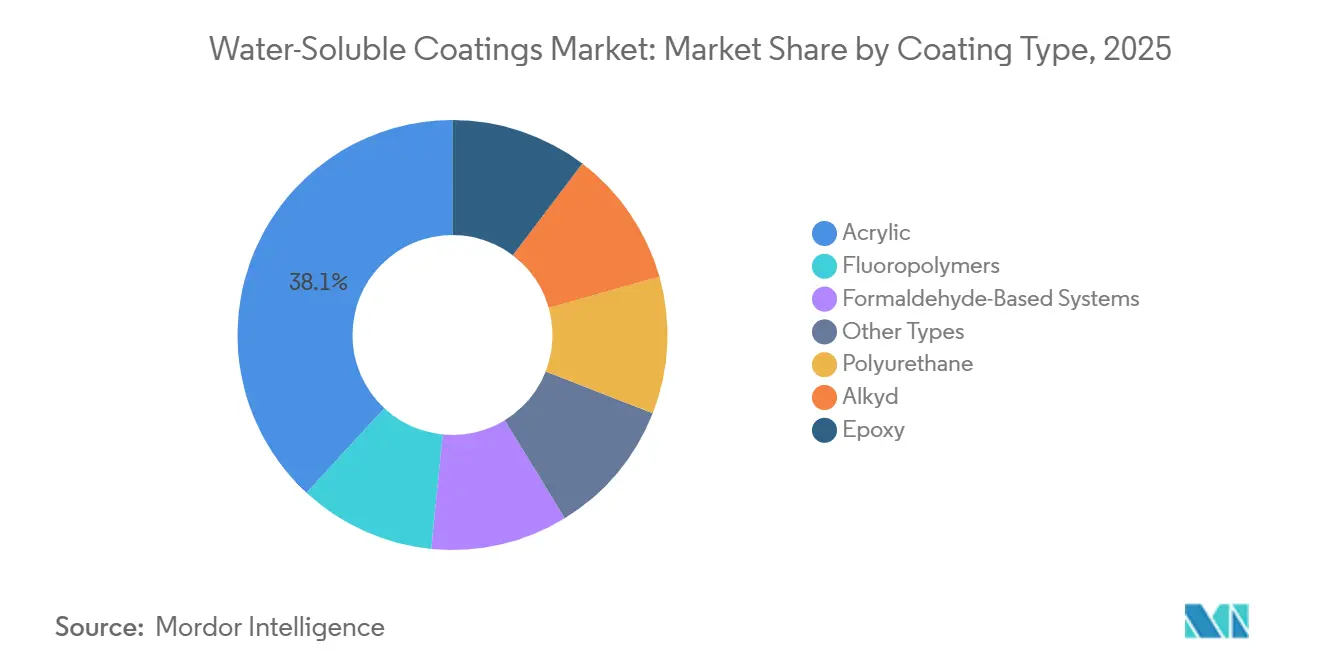
Acrylic accounted for 38.11% of the water-soluble coatings market in 2025, supported by its established use in interior and exterior architectural coatings. Contractors widely recognize these formulations, and their cost position supports use across large building projects. China's interior and exterior wall coatings category reached 99% waterborne penetration in 2025, reflecting years of regulatory pressure and customer acceptance for water-based architectural products. Alkyd systems continue to serve wood trim applications that require film hardness. Epoxy systems address direct-to-metal and heavy-duty flooring requirements. Fluoropolymer systems support durable facade and cool-roof applications. Formaldehyde-based systems retain narrow roles in paper and textile coatings, although increasing enforcement of the Registration, Evaluation, Authorization and Restriction of Chemicals (REACH) in Europe is driving pressure to substitute.
Polyurethane grew at a 7.23% CAGR through 2031 within the water-soluble coatings market. Demand came from wood flooring, furniture manufacturing, and automotive refinishing, which required greater mechanical performance. Double-crosslinked waterborne polyurethane exhibited tensile strength, hardness, and adhesion performance comparable to those of conventional solvent-borne two-component (2K) products. Polyurethane-acrylic combinations balanced performance requirements with cost considerations. Lubrizol's July 2025 launch of Sancure 942 illustrated the move toward broader commercial use of specialty polyurethane dispersions. These formulations were used for residential and commercial wood-floor finishes, reducing the performance gap that had previously restricted waterborne use in premium applications. The water-soluble coatings market, therefore, expanded its offering beyond standard architectural paint.



By End-User Industry: Construction Provides the Demand Base, While Automotive Supports Faster Growth
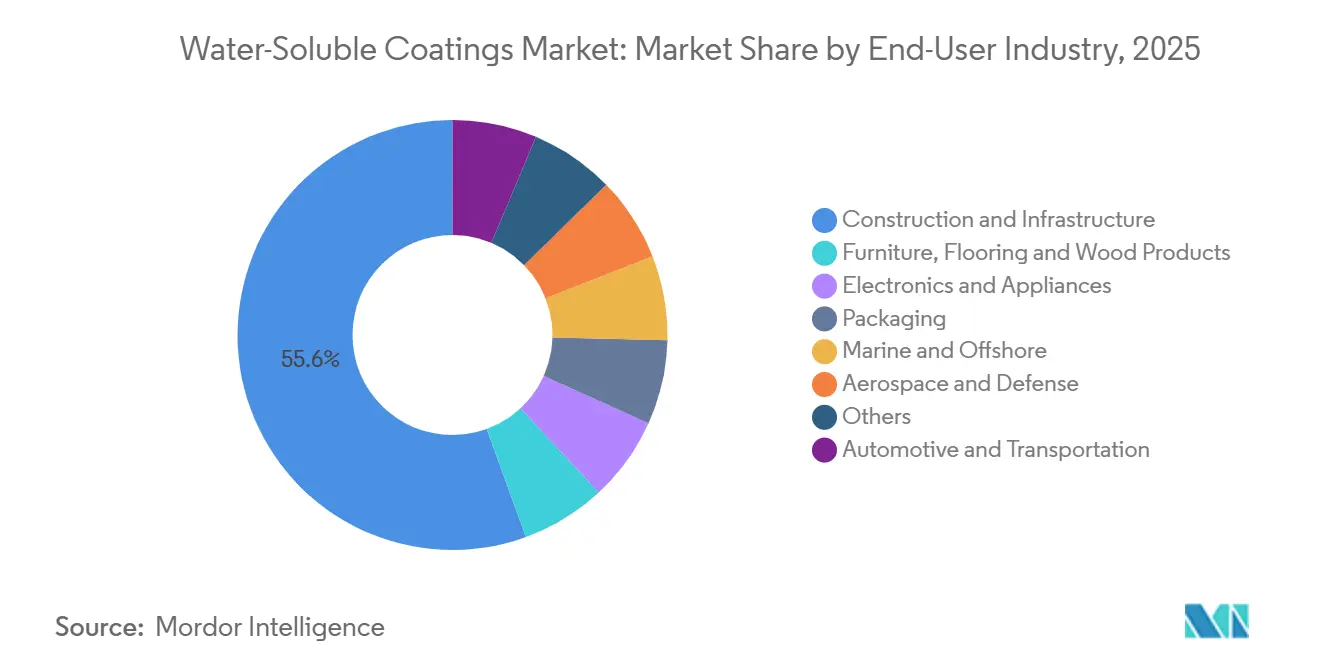
Construction and infrastructure held 55.56% of the water-soluble coatings market share in 2025. New buildings, renovation activity, and public infrastructure all required substantial quantities of architectural coatings. Low-Volatile Organic Compound (VOC) specifications were increasingly included in tender documents for major projects, shifting product selection toward compliant waterborne formulations rather than decisions based solely on purchase price. Furniture, flooring, and wood products formed a meaningful secondary demand base, with Chinese furniture production supporting conversion from solvent-borne lacquers and nitrocellulose systems. Packaging, electronics, marine, and aerospace applications broadened demand beyond the construction cycle, reducing exposure to the volatility that affected architectural-coatings-only suppliers.
Automotive and transportation grew at a 7.54% CAGR through 2031. Original Equipment Manufacturer (OEM) mandates, electric vehicle production, and assembly expansion in South and Southeast Asia supported this growth. Waterborne products met automotive performance requirements while helping manufacturers comply with VOC limits. Commercial and specialty vehicles presented further conversion opportunities in regions where waterborne adoption remained limited. Marine and offshore applications presented a more difficult path, as immersion corrosion protection was critical, though waterborne epoxy systems gained acceptance for topside and interior uses. Aerospace and defense remained small but important application areas for qualified primer and topcoat systems. Waterborne formulations meeting demanding military specifications added credibility to the broader water-soluble coatings market.
Geography Analysis
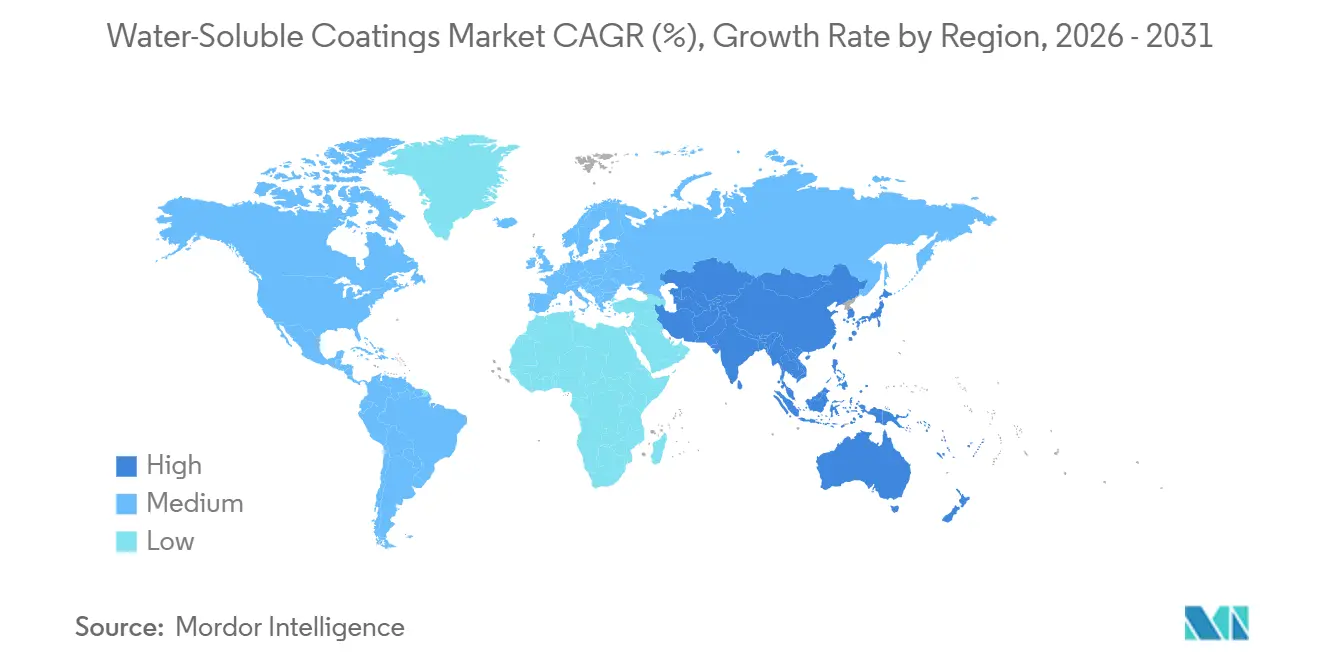
Asia-Pacific accounted for 39.73% of the water-soluble coatings market in 2025 and is forecast to expand at a 7.48% CAGR through 2031. China supports regional demand through urban housing, manufacturing scale, and successive VOC reforms. The penetration of water-based wall coatings reflects the extent of conversion in architectural applications. Japan and South Korea contribute to the demand for high-specification industrial coatings. ASEAN countries offer further growth through construction and vehicle assembly. The region combines large existing output with growing requirements for compliant formulations.
North America holds the second-largest position in the water-soluble coatings market. California's South Coast Air Quality Management District (SCAQMD) Rule 1113 limits most architectural categories to less than 50 g/L VOC. Federal architectural-coatings requirements and state-level standards reinforce this regulatory foundation. Institutional and commercial construction supports steady demand for compliant coating products. Canada's sustainable building activity is aligned with LEED v4.1 and is transitioning to LEED v5. Mexico also benefits from nearshoring investment in automotive assembly and electronics manufacturing.
Europe is a mature market with high waterborne penetration across decorative coatings. The EU Paints Directive and REACH requirements established regional harmonization ahead of many other markets. Germany, the United Kingdom, and France have largely completed decorative-paint conversion. Growth is concentrated in maintenance, facade protection, industrial applications, and specialty products. South America, the Middle East, and Africa are smaller but increasingly relevant markets. Brazil's construction and automotive assembly support demand, although humid conditions can present challenges for film formation. The UAE's Estidama Pearl Rating System and Saudi Arabia's Vision 2030 projects are driving the adoption of low-VOC specifications in commercial and industrial procurement.

Competitive Landscape
The water-soluble coatings market is fragmented. PPG Industries, AkzoNobel, Sherwin-Williams, Nippon Paint Holdings, and Axalta hold strong positions in professional, industrial, and automotive applications. Asia-Pacific decorative coatings remain more fragmented due to the importance of local distribution networks. AkzoNobel and Axalta announced an all-stock merger of equals in November 2025, which Axalta shareholders approved in August 2026. The transaction carries an enterprise value of USD 25 billion and is expected to generate synergies of USD 600 million. The combined entity may increase pricing and distribution pressure on mid-sized competitors in the refinish, automotive, and industrial coatings markets.
Companies are pursuing technology leadership through proprietary resin chemistry and targeted acquisitions. Nippon Paint has expanded its presence in the Asia-Pacific through regional consolidation. Kansai Paint's 2024 acquisition of WEILBURGER added exposure to European industrial coatings. Indian suppliers Asian Paints and Berger Paints remain competitive in architectural and automotive refinish products through local distribution and lower-cost structures. The water-soluble coatings market also presents opportunities in direct-to-metal and self-healing functional systems. Bio-based resin platforms are gaining relevance where construction specifications require renewable content. These areas are likely to drive the next stage of product differentiation.
Arkema launched ENCOR bio-based acrylic binders with 30% bio-based content and a 40% reduction in carbon footprint. These products can support LEED v5 renewable-material credits in institutional and commercial construction. Covestro's Decovery acrylic emulsion has a 52% bio-based carbon content, validated under ASTM D6866[2]Covestro AG, “Decovery® SP-8406: Biobased Acrylic Emulsion for Decorative Applications,” Covestro Product Database, solutions.covestro.com.. These examples indicate that commercially relevant bio-based content is already available. Suppliers that combine renewable inputs with technical performance are positioned to strengthen their standing in the water-soluble coatings market.
Water-Soluble Coatings Industry Leaders
The Sherwin-Williams Company
PPG Industries, Inc.
Akzo Nobel N.V.
Nippon Paint Holdings Co., Ltd.
RPM International Inc.
- *Disclaimer: Major Players sorted in no particular order

Recent Industry Developments
- August 2026: PPG Industries began construction of a USD 280 million expansion at its automotive coatings plant in Delaware, Ohio, adding 100,000 square feet dedicated to waterborne basecoats and primers for North American vehicle manufacturers. The facility is scheduled to begin operating in 2028, creating approximately 100 full-time positions alongside the existing 450-person workforce.
- July 2026: Kansai Paint signed a non-binding MOU to acquire the remaining 50% stake in its Turkish affiliate Polisan Kansai Boya for approximately USD 93 million, following its increase in Kansai Altan ownership to 74.88%. This move strengthens its coatings presence across Europe, the Middle East, and Africa.


Global Water-Soluble Coatings Market Report Scope
Water-soluble coatings are protective or decorative layers made from resins that dissolve completely in water. These coatings are applied across various industries, including construction, automotive, and packaging, due to their ability to reduce volatile organic compound (VOC) emissions compared to solvent-based alternatives.
The water-soluble coatings market is segmented by coating type, end-user industry, and geography. By coating type, the market is segmented into acrylic, polyurethane, alkyd, epoxy, fluoropolymers, formaldehyde-based systems, and other types. By end-user industry, the market is segmented into construction and infrastructure, automotive and transportation, furniture, flooring and wood products, electronics and appliances, packaging, marine and offshore, aerospace and defense, and others. The report also covers market size and forecasts for water-soluble coatings across 15 countries in major regions. The market sizes and forecasts are provided in terms of value (USD).
| Acrylic |
| Polyurethane |
| Alkyd |
| Epoxy |
| Fluoropolymers |
| Formaldehyde-Based Systems |
| Other Types |
| Construction and Infrastructure |
| Automotive and Transportation |
| Furniture, Flooring and Wood Products |
| Electronics and Appliances |
| Packaging |
| Marine and Offshore |
| Aerospace and Defense |
| Others |
| Asia-Pacific | China |
| India | |
| Japan | |
| South Korea | |
| ASEAN Countries | |
| Rest of Asia-Pacific | |
| North America | United States |
| Canada | |
| Mexico | |
| Europe | Germany |
| United Kingdom | |
| France | |
| Italy | |
| NORDIC Countries | |
| Rest of Europe | |
| South America | Brazil |
| Argentina | |
| Rest of South America | |
| Middle East and Africa | Saudi Arabia |
| South Africa | |
| Rest of Middle East and Africa |
| By Coating Type | Acrylic | |
| Polyurethane | ||
| Alkyd | ||
| Epoxy | ||
| Fluoropolymers | ||
| Formaldehyde-Based Systems | ||
| Other Types | ||
| By End-User Industry | Construction and Infrastructure | |
| Automotive and Transportation | ||
| Furniture, Flooring and Wood Products | ||
| Electronics and Appliances | ||
| Packaging | ||
| Marine and Offshore | ||
| Aerospace and Defense | ||
| Others | ||
| By Geography | Asia-Pacific | China |
| India | ||
| Japan | ||
| South Korea | ||
| ASEAN Countries | ||
| Rest of Asia-Pacific | ||
| North America | United States | |
| Canada | ||
| Mexico | ||
| Europe | Germany | |
| United Kingdom | ||
| France | ||
| Italy | ||
| NORDIC Countries | ||
| Rest of Europe | ||
| South America | Brazil | |
| Argentina | ||
| Rest of South America | ||
| Middle East and Africa | Saudi Arabia | |
| South Africa | ||
| Rest of Middle East and Africa | ||


Key Questions Answered in the Report
What is current market size of Water-Soluble Coatings Market?
The water-soluble coatings market size was valued at USD 10.85 billion in 2025 and is estimated to grow from USD 11.52 billion in 2026 to USD 15.99 billion by 2031, at a CAGR of 6.78% during the forecast period (2026-2031).
Which coating type held the largest share in 2025?
Acrylic held 38.11% in 2025, supported by its broad use in architectural applications.
Which end-user application is growing fastest through 2031?
Automotive and transportation are projected to grow at a 7.54% CAGR through 2031.
Why are water-soluble coatings relevant for electric vehicles?
Low-temperature-cure clearcoats can operate at 100-130°C, compared with 140-160°C for conventional internal-combustion paint shops.
Page last updated on:





