
Water-Repellent Textile Finishes Market Size and Share
Market Overview
| Study Period | 2022 - 2032 |
|---|---|
| Market Size (2027) | USD 2.70 Billion |
| Market Size (2032) | USD 3.73 Billion |
| Growth Rate (2027 - 2032) | 6.67 % |
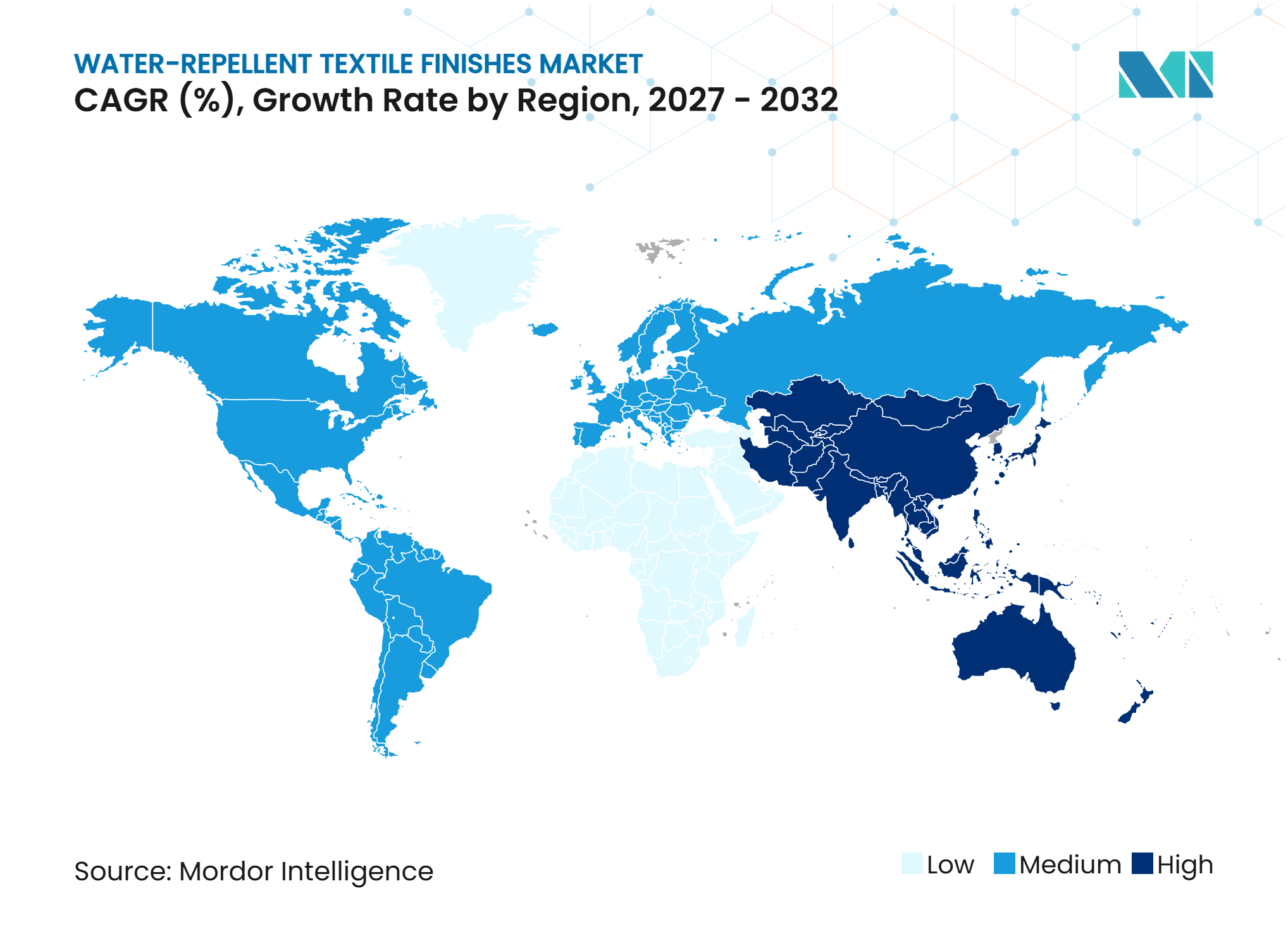
| Fastest Growing Market | Asia-Pacific |
| Largest Market | Asia-Pacific |
| Market Concentration | Medium |
Major Players *Disclaimer: Major Players sorted in no particular order Image © Mordor Intelligence. Reuse requires attribution under CC BY 4.0. | |
Water-Repellent Textile Finishes Market Analysis by Mordor Intelligence
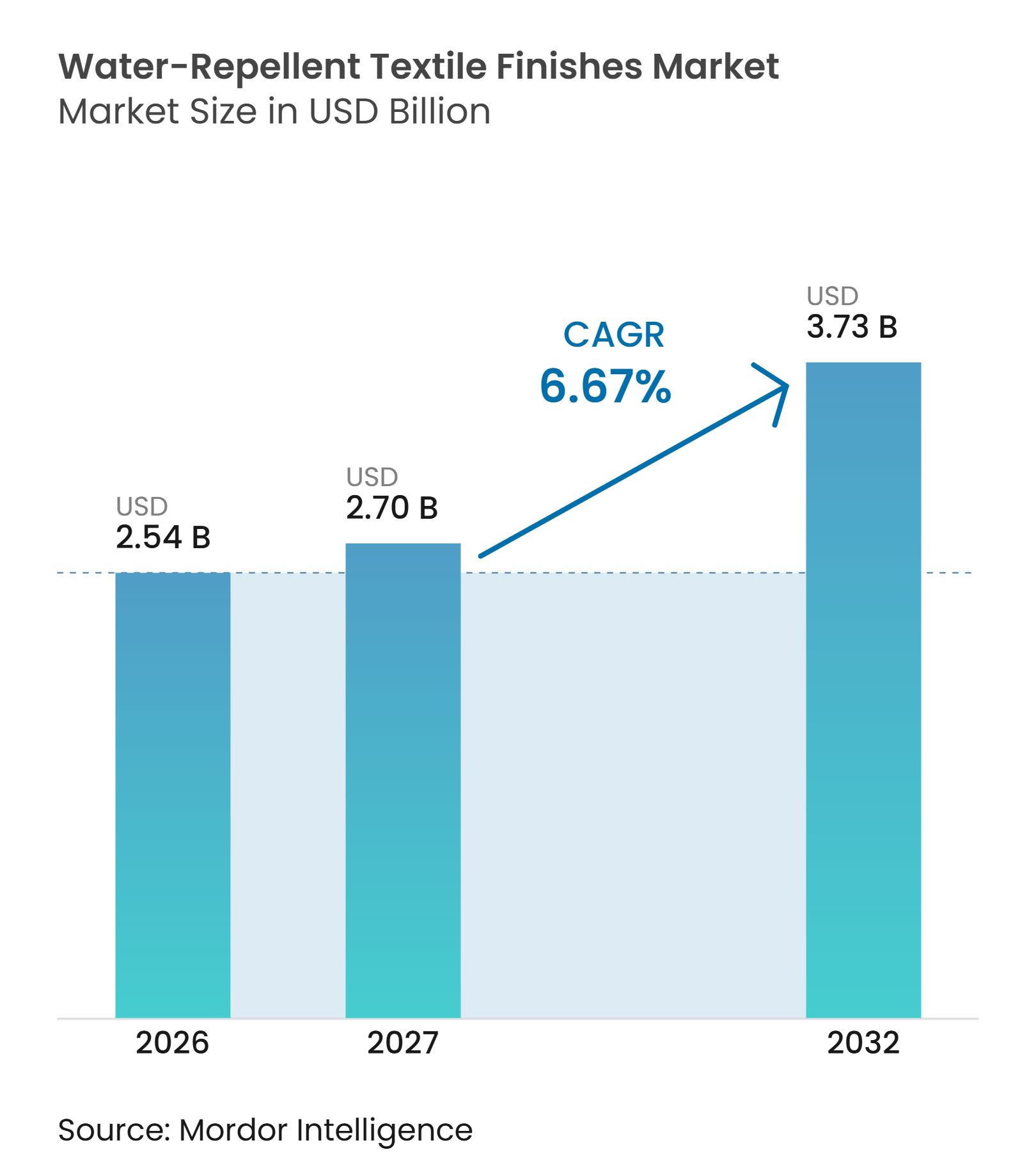
The Water-Repellent Textile Finishes market size was valued at USD 2.54 billion in 2026 and is estimated to grow from USD 2.70 billion in 2027 to USD 3.73 billion by 2032, at a CAGR of 6.67% during the forecast period (2027-2032). Restrictions on per- and polyfluoroalkyl substances (PFAS) are shifting demand toward C0 and fluorine-free durable water-repellent chemistries, with brands moving ahead of formal compliance deadlines. This shift gives suppliers room to develop bio-based polymers, dendrimer systems, and silicone-wax hybrids that carry higher formulation value than older fluorinated products. Market growth also depends on whether suppliers can close remaining performance gaps in oil repellency for protective textiles. Product development, compliance support, and mill-level application expertise are becoming more important competitive factors than production output alone. The market is further shaped by mills' ability to apply these alternatives consistently across changing fabric specifications.
Key Report Takeaways
- By chemistry type, C0/Fluorine-Free Finishes held 47.13% of market share in 2026 and are forecast to grow at a 7.24% CAGR through 2032.
- By textile type, Outdoor/Performance Fabrics accounted for 34.56% of the Water-Repellent Textile Finishes market share in 2026 and are projected to expand at a 7.78% CAGR through 2032.
- By application, Sportswear commanded 36.34% of market share in 2026 and is forecast to grow at an 8.13% CAGR through 2032.
- By geography, Asia-Pacific accounted for 38.67% of market share in 2026 and is forecast to grow at a 7.66% CAGR through 2032.
Note: Market numbers in this report are based on Mordor Intelligence's proprietary estimation framework, which combines nine months of actuals with Q4 projections for base year 2026.
Market Trends and Insights
Drivers Impact Analysis of Water-Repellent Textile Finishes Market*
| Drivers | (~) % Impact on CAGR Forecast | Geographic Relevance | Impact Timeline |
|---|---|---|---|
| PFAS Reformulation Across Textile Supply Chains | +2.0% | Global, most intense in Europe, North America, and China | Short term (≤ 2 years) |
| Growth of Performance Apparel and Outdoor Fabrics | +1.6% | Asia-Pacific, North America, Europe | Medium term (2-4 years) |
| Increasing Use of Functional Finishes in Technical Textiles | +1.1% | Global, with early leadership in Europe and Asia-Pacific | Medium term (2-4 years) |
| Brand and Retailer Preference for Traceable Sustainable Chemistry | +0.9% | North America, Europe, with spillover to Asia-Pacific and Middle East and Africa | Long term (≥ 4 years) |
| Mill-Level Demand for Low-Curing and Resource-Efficient Finishes | +0.7% | Asia-Pacific, especially China, India, Bangladesh, and Vietnam | Short term (≤ 2 years) |
| Source: Mordor Intelligence | |||
PFAS Reformulation Across Textile Supply Chains
PFAS restrictions are reshaping textile finish supply chains rather than simply replacing one product with another. The European Chemicals Agency continues to advance a broad PFAS restriction proposal, increasing pressure on brands and mills to remove fluorinated durable water repellent (DWR) chemistry. EN 17681-1:2025 introduced alkaline hydrolysis extraction for PFAS testing in textiles, which may require mills to reassess products previously described as PFAS-free. Rudolf positions BIONIC-FINISH ECO, a dendrimer-based finish, against this stricter testing environment. This creates demand for reformulation among both legacy fluorocarbon users and mills that adopted early C0 systems. The water-repellent textile finishes market benefits as brands treat delayed action as a procurement and reputational risk.
Growth of Performance Apparel and Outdoor Fabrics
Outdoor and performance apparel require durable water repellency because product claims are tied to functional performance. Brand qualification requirements can make third-party chemical validation a prerequisite for mills and finish suppliers. Archroma states that its PHOBOTEX NTR-50 uses 50% renewable carbon content and does not require a crosslinker. Its collaboration with Monforts and Baldwin made TexCoat G4 digital spray trials available in February 2025. The companies reported that the system can reduce chemical and water use by up to 50% compared with conventional application methods. Improved application efficiency can offset part of the cost of premium fluorine-free finishes for the water-repellent textile finishes market.
Increasing Use of Functional Finishes in Technical Textiles
Technical textiles have more formal procurement requirements, which can slow adoption but make it more stable once a finish is approved. Automotive and medical specifications are also expanding the application of DWR chemistry beyond apparel. AGC Chemicals Americas announced FibraLAST in March 2025 as a non-fluorinated oil- and water-repellent finish for nonwovens and technical textiles. Cornell's technology licensing office confirmed that the technology was developed through its licensed startup DRYFIBER. A 2025 peer-reviewed study reported that stearyl acrylate-siloxane copolymer emulsions maintained an ISO 4920 spray rating of grade 5 on cotton at concentrations as low as 20 g/L[1]. Mills still require finishes that are compatible with existing production lines, making dip-and-spray compatibility an important consideration.
Brand and Retailer Preference for Traceable Sustainable Chemistry
Large retailers are extending sustainability expectations to chemical sourcing and supply chain traceability. This favors suppliers that can document material inputs and provide independently reviewed environmental credentials. Evonik and AMSilk extended their partnership for biotech silk materials in September 2025, indicating that sustainable textile chemistry is expanding beyond established DWR suppliers. ZDHC MRSL alignment, bluesign system partner certification, and OEKO-TEX Standard 100 are shaping finish selection criteria for mills and brands. These compliance factors can simplify supplier approval for brands that source globally. They also shift demand toward companies with broader environmental management systems rather than product-level claims alone.
Restraints Impact Analysis of Water-Repellent Textile Finishes Market*
| Restraints | (~) % Impact on CAGR Forecast | Geographic Relevance | Impact Timeline |
|---|---|---|---|
| Lower Oil Repellency of Most Fluorine-Free Alternatives | -0.8% | Global, most pronounced in North America and Europe protective workwear | Medium term (2-4 years) |
| Sensitivity of Finish Performance to Fabric and Process Conditions | -0.5% | Asia-Pacific, especially high fabric-variety manufacturing environments | Short term (≤ 2 years) |
| Fragmented PFAS Compliance Requirements Across Jurisdictions | -0.4% | Global, most burdensome for cross-border mills and exporters | Long term (≥ 4 years) |
| Source: Mordor Intelligence | |||
Lower Oil Repellency of Most Fluorine-Free Alternatives
Fluorine-free finishes still have a persistent oil-repellency gap compared with legacy C6 and C8 per- and polyfluoroalkyl substances (PFAS) treatments. This limitation is most significant in industrial workwear, military clothing, food-service protection, and other textiles that require resistance to hydrocarbon stains. Bio-based wax, dendrimer, and silicone-based C0 products do not yet provide equivalent oil repellency and wash durability across all use cases. Transfar and Daikin have identified oil repellency and fabric feel as focus areas for their joint research program. The water-repellent textile finishes market therefore retains a fluorocarbon-dependent portion in high-specification protective applications. Suppliers that achieve commercially viable non-fluorinated oleophobic performance could open this restricted application area.
Sensitivity of Finish Performance to Fabric and Process Conditions
Fluorine-free durable water repellent (DWR) systems can be more sensitive to fabric composition, formulation concentration, and curing conditions than fluorocarbon systems. Their performance relies heavily on polymer surface bonding and crosslinker selection, making application choices more substrate-specific. Mills that handle short runs and diverse fabric mixes may face greater reliability challenges. A University of Würzburg publication in October 2026 described PFAS-free, solvent-free inorganic-organic sol-gel coatings with water-repellent and stain-resistant performance on various textile substrates at an industrial scale[2]. This work points to a coating class that may reduce sensitivity to process conditions. Differences in PFAS regulations and testing methods across the European Union, the United States, Japan, and China also increase portfolio management costs for exporters.
*Our forecasts treat driver/restraint impacts as directional, not additive. The impact forecasts reflect baseline growth, mix effects, and variable interactions.
Water-Repellent Textile Finishes Market Segment Analysis
By Chemistry Type:
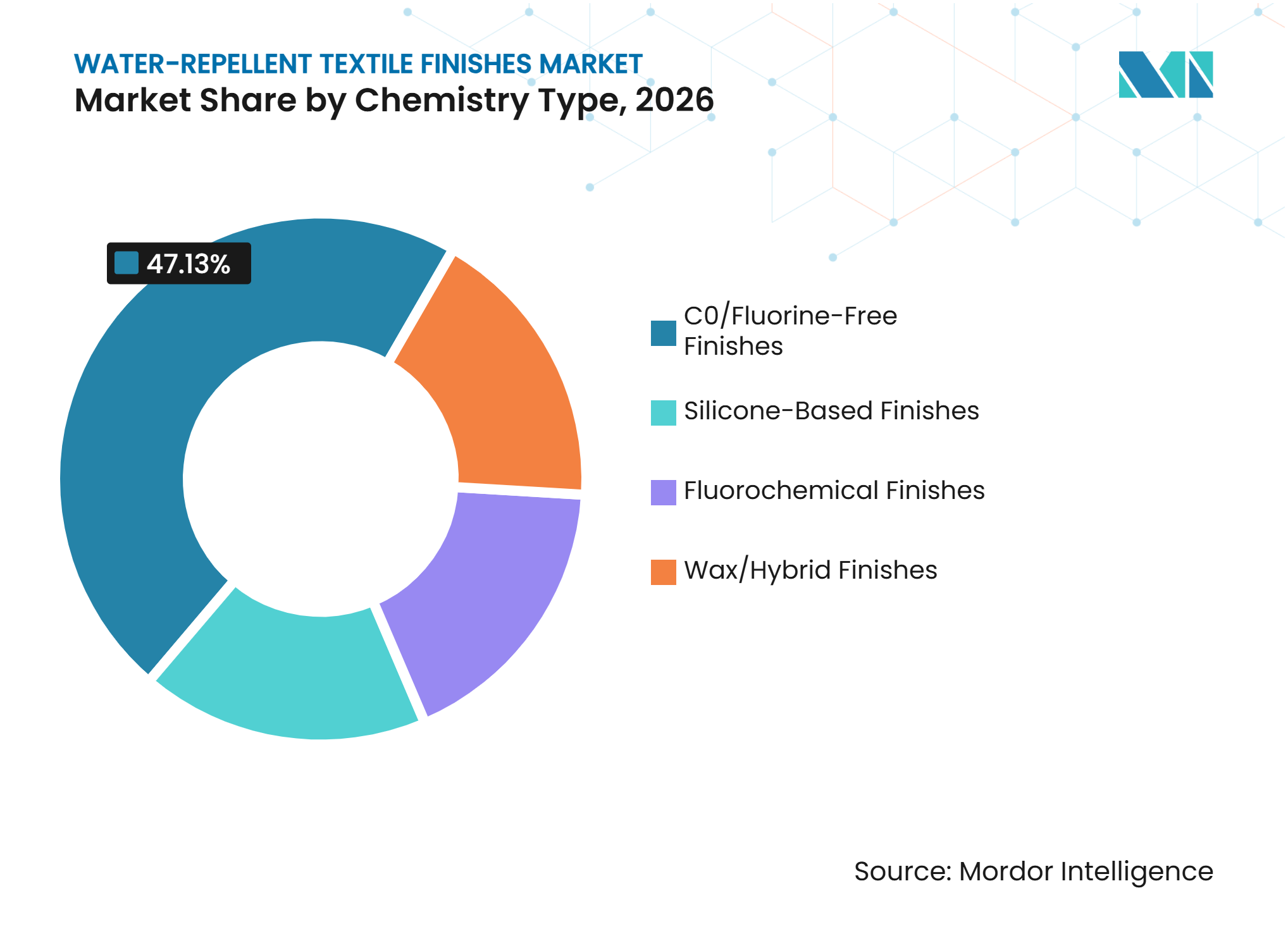
C0 Chemistry Establishes the New BaselineC0/Fluorine-Free Finishes held 47.13% of the Water-Repellent Textile Finishes market share in 2026 and are expected to grow at a 7.24% CAGR through 2032. Their market position reflects years of brand phase-out programs rather than a single regulatory event. Fluorochemical finishes remain concentrated in industrial and workwear applications that require high oil repellency. Silicone-based finishes offer greater wash durability than many wax-based alternatives and are not subject to fluorocarbon regulations. Wax and hybrid products continue to serve price-sensitive applications, supported by the availability of renewable raw materials in Asia-Pacific.
NICCA Chemical acquired Chemours' Zelan non-fluorinated water-repellent business in March 2026. The transaction added urethane chemistry to NICCA's acrylic and silicone C0 offerings. NICCA stated that its non-fluorinated water-repellent revenue is expected to exceed JPY 5 billion following the integration. The University of Würzburg also reported an inorganic-organic sol-gel approach that functions without PFAS or organic solvents at industrial scale. These chemistry options could broaden coverage across different fabric substrates and finishing conditions.



By Textile Type:
Outdoor and Performance Fabrics Drive Specification DemandOutdoor/Performance Fabrics represented 34.56% of the Water-Repellent Textile Finishes market size in 2026 and are forecast to grow at a 7.78% CAGR through 2032. This segment requires premium performance, strong wash durability, and documented sustainability credentials. Brands are increasingly interested in fiber- and yarn-level treatments as a means of retaining repellency throughout a garment's life. This could alter chemistry requirements and how suppliers compete for specification work. General apparel remains the largest output base for rainwear and fashion outerwear.
Home textiles generate steady demand in upholstery, table linen, and curtains, where stain resistance is more important than rain protection. Silicone-and-wax hybrid systems align well with this requirement. The Others category includes filtration fabrics, geotextiles, and technical wovens. AGC's FibraLAST program targets nonwoven and technical textile applications where fluorine-free alternatives have been limited. Bluesign system certification and OEKO-TEX Standard 100 approval can affect supplier eligibility in performance-fabric supply chains.
By Application:
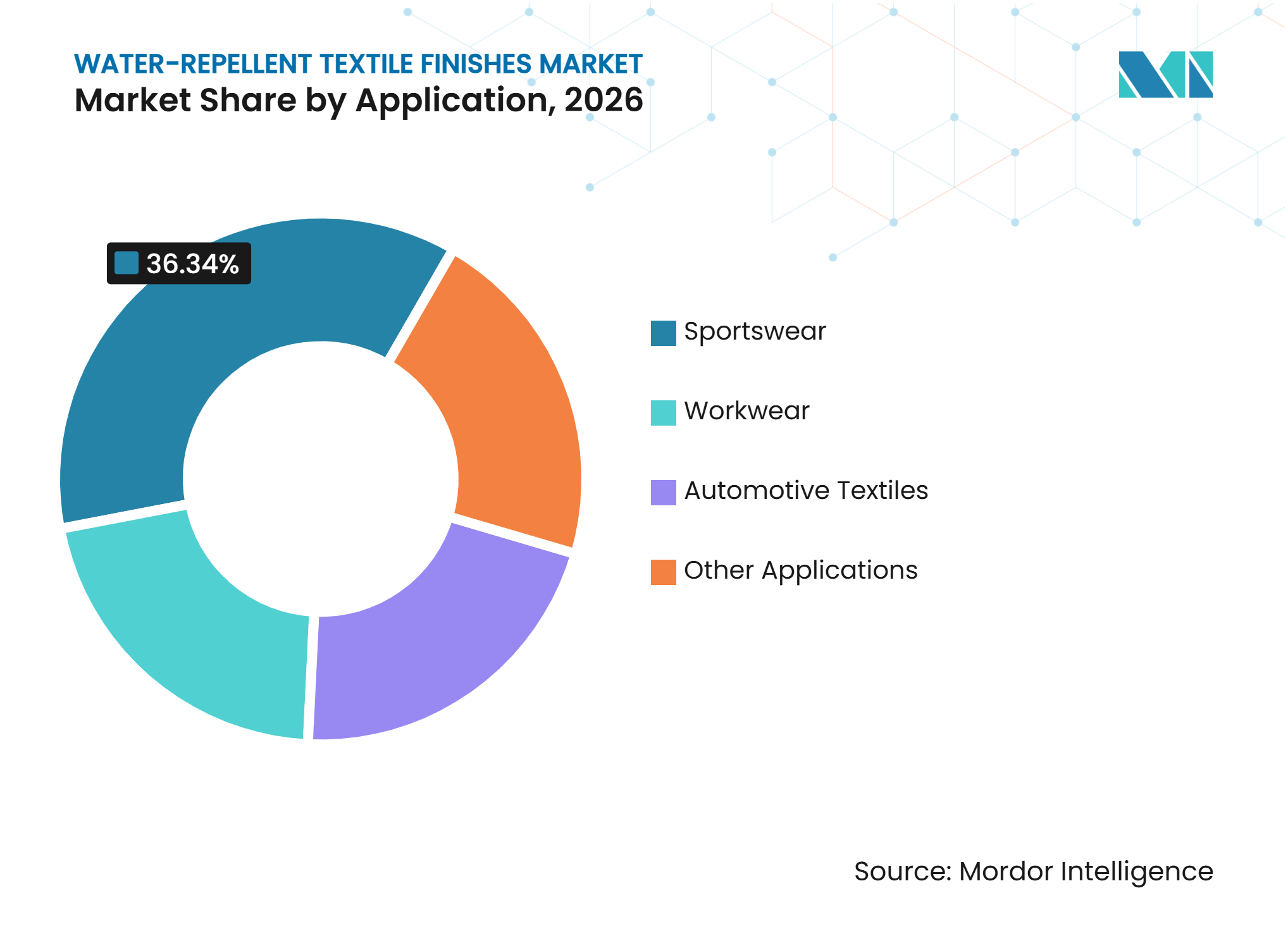
Sportswear Anchors Demand While Workwear Retains Technical BarriersSportswear accounted for 36.34% of the water-repellent textile finishes market share in 2026 and is projected to grow at an 8.13% CAGR through 2032. A large share of sportswear manufacturing takes place in Asia-Pacific. European and North American brand requirements therefore pass through to Asian mills, even where domestic regulations are less stringent. Workwear is divided between office and light-industrial garments that can transition to C0 chemistry, and protective clothing that still requires fluorocarbon performance. Automotive textiles represent another growth area as electric-vehicle interiors shift toward breathable, water-managed materials.
DyStar positions Evo Protect DWR as a bio-based, fluorine-free finish with 36% bio-carbon content, verified by ASTM D6866, with spray ratings above 80 after 20 wash cycles under AATCC 22 and ISO 4920 testing. Institutional textiles in hospitality, healthcare, and military applications are also procurement-driven. Archroma launched Smartrepel Hydro SR liq at Techtextil Frankfurt in September 2025 for repellency of water-based stains in automotive seating and home-textile interiors, extending the use of C0 chemistry beyond conventional weather protection.

Geography Analysis
Asia-Pacific
Asia-Pacific held 38.67% of regional market revenue in 2026 and is expected to record a 7.66% CAGR through 2032. China leads regional demand due to the scale of its textile exports and domestic environmental requirements. Transfar and Daikin held a groundbreaking ceremony for their special emulsion project in Hangzhou in September 2025. The facility addresses demand from Chinese mills and downstream markets in Southeast Asia. India's sportswear and technical textile manufacturing base also supports demand for certified fluorine-free finishes. Vietnam and Bangladesh are increasingly subject to unified chemical approval requirements set by export-oriented brands.
Europe
Europe is shaped more by compliance requirements than by manufacturing output. EN 17681-1:2025 changed textile PFAS testing by incorporating alkaline hydrolysis extraction, increasing scrutiny of residues from side-chain polymers that may have passed earlier testing methods. Germany, the United Kingdom, France, and the Nordic countries are key demand centers for outdoor, workwear, and technical textile finishes. Rudolf's BIONIC-FINISH ECO illustrates how suppliers are positioning dendrimer chemistry in this environment. CHT also expanded its fluorine-free DWR offering at the European Coatings Show in March 2025.
North America, South America, Middle East and Africa
North America is structurally important, as U.S. PFAS policy actions influence brand and chemical supplier decisions. AGC Chemicals Americas launched FibraLAST in March 2025, linking non-fluorinated product development with the technical textiles opportunity. Brazil is at an earlier stage of transition, although export-oriented textile suppliers are responding to international chemical requirements. Mexico also inherits demand from U.S. brand specifications through regional manufacturing relationships. Saudi Arabia is developing technical textile capacity to meet demand for workwear and industrial applications. South Africa remains a distribution base for broader Sub-Saharan African demand. In these regions, global compliance expectations generally precede local regulation of equivalent detail.
Competitive Landscape
Market Concentration
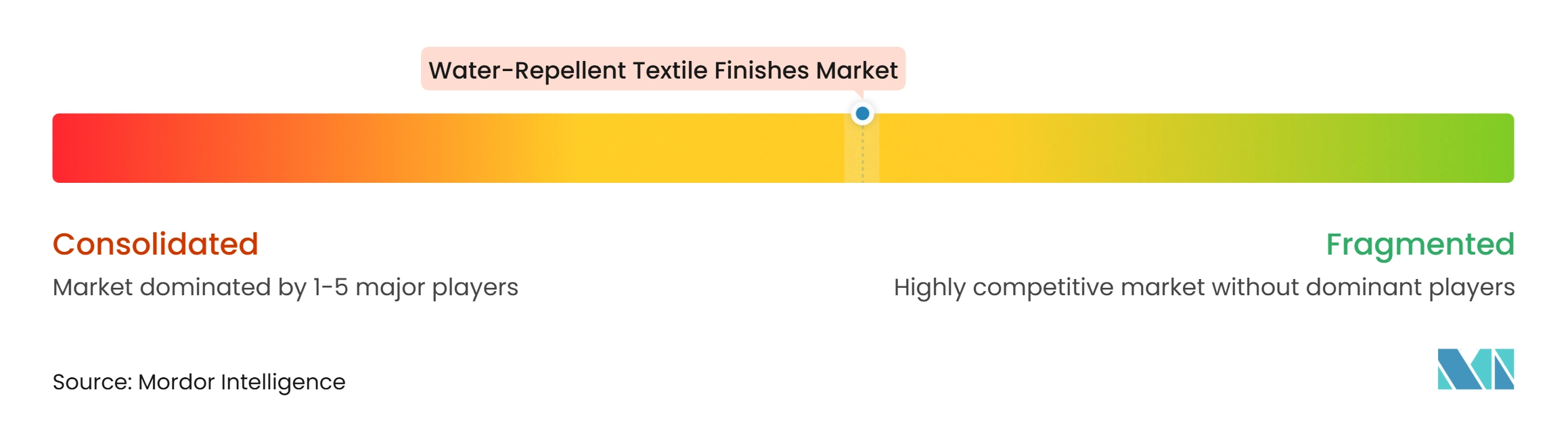
The water-repellent textile finishes market is moderately fragmented, with Archroma, NICCA Chemical, Zhejiang Transfar Chemicals, Rudolf Holding, and CHT Group holding established positions in C0 and bio-based durable water repellent (DWR) chemistry. Competition in 2025 and 2026 has centered on intellectual property and the range of fluorine-free platforms. NICCA's acquisition of Zelan illustrates this trend, combining acrylic, silicone, and urethane approaches into a single supplier portfolio. Chemours' 2025 annual filing also described patent positions in non-fluorinated DWR materials within its Advanced Performance Materials business.
Application systems, certification coverage, and mill technical service are key areas of differentiation. Archroma, Monforts, and Baldwin are developing a digital spray system aimed at reducing water and chemistry use in textile finishing. CHT markets ECOPERL with Zero Discharge of Hazardous Chemicals (ZDHC), bluesign, and OEKO-TEX Standard 100 validation. These certifications can reduce approval requirements for global brands. Cornell-linked DRYFIBER and AGC also demonstrate how university-originated materials can reach commercial production through licensing and co-development.
The largest unaddressed opportunity remains fluorine-free oil repellency for workwear and industrial textiles. Transfar and Daikin have identified this performance gap through their cooperation on non-fluorinated repellents. Suppliers must balance water repellency, oil repellency, fabric feel, wash durability, and ease of application. Regional Chinese formulators can compete by offering lower-cost, fluorine-free alternatives, while established specialists rely on proprietary chemistry and service capabilities.
Water-Repellent Textile Finishes Industry Leaders
-
Archroma
-
RUDOLF Holding SE & Co. KG
-
Huntsman International LLC
-
NICCA CHEMICAL CO.,LTD.
-
TANATEX Chemicals B.V.
- *Disclaimer: Major Players sorted in no particular order
Water-Repellent Textile Finishes Market Companies Covered in this Report
- AGC Chemicals Americas, Inc.
- Archroma
- CHT Germany GmbH
- DAIKIN INDUSTRIES, Ltd.
- Dymatic Chemicals, Inc.
- DyStar Group
- Evonik Industries AG
- Huntsman International LLC
- NICCA CHEMICAL CO.,LTD.
- Pulcra Chemicals GmbH
- RUDOLF Holding SE & Co. KG
- Sarex Chemicals
- TANATEX Chemicals B.V.
- The Chemours Company
- Zhejiang Transfar Chemicals Co., Ltd.
Recent Industry Developments in Water-Repellent Textile Finishes Market
- October 2026: Commission Regulation (EU) 2024/2462 took effect on October 10, 2026, restricting Perfluorohexanoic acid (PFHxA) and its related substances in clothing, accessories, and footwear textiles at 25 parts per billion (ppb) for PFHxA and its salts and 1,000 ppb for related substances. The restriction extends to carpets, upholstery, and home textiles as of October 10, 2027, driving reformulation investment across the water-repellent textile-finish supply chain.
- March 2026: NICCA CHEMICAL CO., LTD. concluded a contract with The Chemours Company to acquire the Zelan non-fluorinated water-repellent brand's manufacturing and sales business. The transaction gives NICCA three fluorine-free chemistry platforms, acrylic, silicone, and urethane, with annual non-fluorinated water-repellent textile finish revenue projected to exceed JPY 5 billion (~USD 0.03 billion) post-integration.
Global Water-Repellent Textile Finishes Market Report Scope
Water-repellent textile finishes lower the surface energy of fabric fibers below the surface tension of water, causing liquid to bead and roll off rather than spread across the material. Unlike waterproof treatments that seal pores and block air completely, water-repellent finishes maintain the fabric's natural breathability and air permeability.
The water-repellent textile finishes market is segmented by chemistry type, textile type, application, and geography. By chemistry type, the market is segmented into C0/fluorine-free finishes, silicone-based finishes, fluorochemical finishes, and wax/hybrid finishes. By textile type, the market is segmented into apparel, outdoor/performance fabrics, home textiles, and others. By application, the market is segmented into sportswear, workwear, automotive textiles, and other applications. The report also covers market sizes and forecasts for water-repellent textile finishes across 15 countries in major regions. The market sizes and forecasts are provided in terms of value (USD).
Segmentation Overview
| C0/Fluorine-Free Finishes |
| Silicone-Based Finishes |
| Fluorochemical Finishes |
| Wax/Hybrid Finishes |
| Apparel |
| Outdoor/Performance Fabrics |
| Home Textiles |
| Others |
| Sportswear |
| Workwear |
| Automotive Textiles |
| Other Applications |
| Asia-Pacific | China |
| India | |
| Japan | |
| South Korea | |
| ASEAN Countries | |
| Rest of Asia-Pacific | |
| North America | United States |
| Canada | |
| Mexico | |
| Europe | Germany |
| United Kingdom | |
| France | |
| Italy | |
| NORDIC Countries | |
| Rest of Europe | |
| South America | Brazil |
| Argentina | |
| Rest of South America | |
| Middle East and Africa | Saudi Arabia |
| South Africa | |
| Rest of Middle East and Africa |
| By Chemistry Type | C0/Fluorine-Free Finishes | |
| Silicone-Based Finishes | ||
| Fluorochemical Finishes | ||
| Wax/Hybrid Finishes | ||
| By Textile Type | Apparel | |
| Outdoor/Performance Fabrics | ||
| Home Textiles | ||
| Others | ||
| By Application | Sportswear | |
| Workwear | ||
| Automotive Textiles | ||
| Other Applications | ||
| By Geography | Asia-Pacific | China |
| India | ||
| Japan | ||
| South Korea | ||
| ASEAN Countries | ||
| Rest of Asia-Pacific | ||
| North America | United States | |
| Canada | ||
| Mexico | ||
| Europe | Germany | |
| United Kingdom | ||
| France | ||
| Italy | ||
| NORDIC Countries | ||
| Rest of Europe | ||
| South America | Brazil | |
| Argentina | ||
| Rest of South America | ||
| Middle East and Africa | Saudi Arabia | |
| South Africa | ||
| Rest of Middle East and Africa | ||
Key Questions Answered in the Report
What is current market size of Water-Repellent Textile Finishes Market?
The Water-Repellent Textile Finishes market size was valued at USD 2.54 billion in 2026 and is estimated to grow from USD 2.70 billion in 2027 to USD 3.73 billion by 2032, at a CAGR of 6.67% during the forecast period (2027-2032).
Which chemistry is leading the Water-Repellent Textile Finishes market transition away from PFAS?
C0/Fluorine-Free Finishes held a 47.13% share in 2026 and are projected to grow at a 7.24% CAGR. In the Water-Repellent Textile Finishes market, this chemistry group includes acrylic, silicone, urethane, dendrimer, wax, and hybrid approaches that aim to reduce dependence on fluorine across multiple textile applications.
Which textile category is growing fastest in the Water-Repellent Textile Finishes market?
Outdoor/Performance Fabrics are forecast to grow at a 7.78% CAGR through 2032. This part of the Water-Repellent Textile Finishes market needs reliable performance after repeated washing and increasingly requires certification or validation to support apparel brands' product claims.
Why is sportswear important for water-repellent finishes?
Sportswear held a 36.34% share in 2026 and is forecast to grow at an 8.13% CAGR. The Water-Repellent Textile Finishes market depends on sportswear because brands set a high bar for water repellency, fabric feel, and wash durability, and then pass those requirements through Asian manufacturing supply chains.