
Water Bottle Market Size and Share
Market Overview
| Study Period | 2022 - 2032 |
|---|---|
| Market Size (2027) | USD 11.32 Billion |
| Market Size (2032) | USD 14.31 Billion |
| Growth Rate (2027 - 2032) | 4.80 % |
| Fastest Growing Market | Asia-Pacific |
| Largest Market | Asia-Pacific |
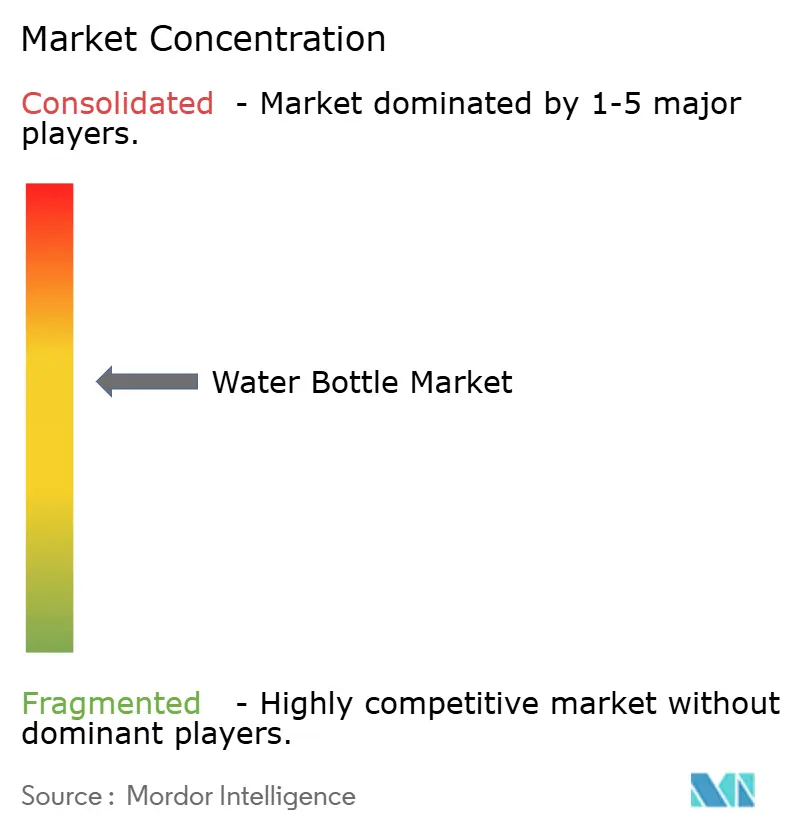
| Market Concentration | Medium |
Major Players *Disclaimer: Major Players sorted in no particular order Image © Mordor Intelligence. Reuse requires attribution under CC BY 4.0. | |
Water Bottle Market Analysis by Mordor Intelligence
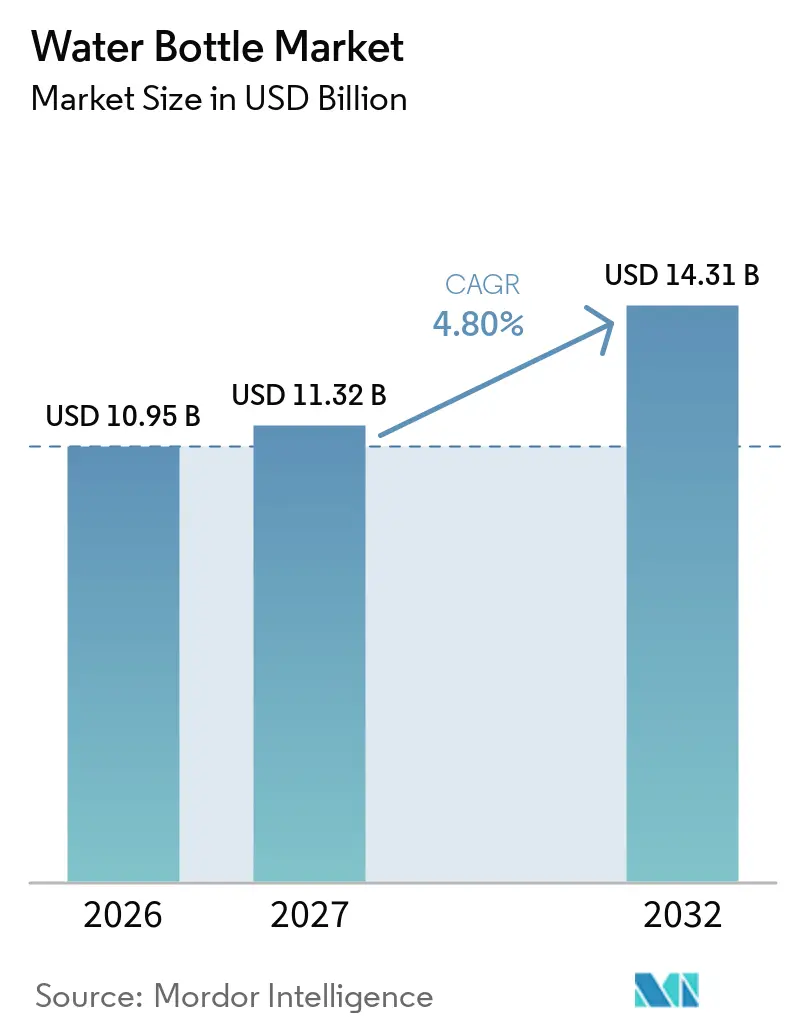
The water bottle market size is expected to grow from USD 10.95 billion in 2026 to USD 11.32 billion in 2027 and is forecast to reach USD 14.31 billion by 2032 at a 4.80% CAGR over 2027-2032. The market is supported by growing environmental awareness, evolving consumer lifestyles, and increasing demand for convenient and reusable hydration solutions. Market development is influenced by regulatory initiatives, changing purchasing preferences, and continued product innovation across established and emerging markets. Regional growth patterns reflect differences in consumer adoption, economic conditions, and market maturity. Competition remains dynamic, with established companies and emerging brands seeking to strengthen their positions through product differentiation, pricing strategies, and distribution reach. However, cost pressures, trade-related uncertainties, and market saturation in mature regions may constrain profitability and growth. Overall, the market is expected to maintain steady expansion, supported by sustained demand for practical, durable, and reusable hydration products.
Key Report Takeaways
- By material, plastic accounted for the largest water bottle market share at 42.25% in 2026, while stainless steel is forecast to grow at a 5.34% CAGR through 2032.
- By price range, mass held 79.43% of market value in 2026, while premium is forecast to grow at a 5.87% CAGR through 2032.
- By end user, adults held 74.62% of market value in 2026, while kids is forecast to grow at a 5.32% CAGR through 2032.
- By distribution channel, supermarkets/hypermarkets held 38.62% of market value in 2026, while online retail is forecast to grow at a 5.41% CAGR through 2032.
- By geography, Asia-Pacific held 43.73% of the water bottle market share in 2026 and is forecast to grow at a 5.91% CAGR through 2032.
Note: Market numbers in this report are based on Mordor Intelligence's proprietary estimation framework, which combines nine months of actuals with Q4 projections for base year 2026.
Market Trends and Insights
Drivers Impact Analysis of Water Bottle Market*
| Driver | (~) % Impact on CAGR Forecast | Geographic Relevance | Impact Timeline |
|---|---|---|---|
| Shift from single-use to reusable water bottles | +1.4% | Global; strongest in Europe, Japan, South Korea, Australia | Short term (≤ 2 years) |
| Expansion of sports, fitness, and outdoor recreation participation | +0.8% | North America and Europe; spill-over to Asia-Pacific urban centres | Medium term (2-4 years) |
| Growing demand for convenient, on-the-go hydration | +0.6% | Global | Short term (≤ 2 years) |
| Rising demand for temperature-retaining and durable water bottles | +0.5% | North America, Europe, East Asia | Medium term (2-4 years) |
| Increasing emphasis on drinking-water access and quality | +0.3% | South America, South and Southeast Asia | Long term (≥ 4 years) |
| Product innovation through smart hydration and personalization | +0.5% | North America, Europe, East Asia | Long term (≥ 4 years) |
| Source: Mordor Intelligence | |||
Shift from Single-Use to Reusable Water Bottles
Growing environmental concerns and efforts to reduce plastic waste are encouraging consumers to shift from disposable bottles toward reusable alternatives. According to the United Nations Environment Programme, approximately one million plastic drinking bottles are purchased worldwide every minute, highlighting the scale of single-use consumption and the need for waste-reduction measures. Consumer adoption of reusable alternatives is evident across markets, including the United Kingdom, where the North London Waste Authority reported in 2025 that 90% of surveyed residents in North London used reusable water bottles[1]. Increasing awareness of plastic pollution, alongside public campaigns promoting reuse and refill practices, is strengthening the appeal of durable water bottles for everyday hydration. This shift supports demand for reusable products as consumers seek to reduce their reliance on disposable packaging.
Expansion of Sports, Fitness, and Outdoor Recreation Participation
Increasing participation in sports, fitness activities, and outdoor recreation is supporting demand for water bottles as individuals seek convenient hydration during physical activity. According to the Sports & Fitness Industry Association, 250 million Americans aged six and older participated in at least one sport, fitness, or leisure activity in 2025, representing a 1.2% increase from the previous year[2]. This engagement across physical activities creates recurring opportunities for reusable water bottles designed for portability and everyday use. Similar demand drivers across markets include growing health awareness, interest in active lifestyles, and participation in recreational activities. As consumers incorporate exercise and outdoor pursuits into their routines, demand for accessible hydration solutions is expected to support market growth.
Growing Demand for Convenient, On-the-Go Hydration
Increasingly mobile lifestyles and busy daily schedules are strengthening demand for convenient access to drinking water during commutes, work, travel, and other activities away from home. According to the Japan Delivery Water and Server Association, 76.3% of surveyed respondents used portable personal water bottles in 2025, compared with 72.0% in the previous year's survey[3]. This widespread use highlights the role of portable bottles in providing readily accessible drinking water throughout the day. Similarly, the Promotional Products Association International reported that 73% of surveyed consumers in the United States used branded bottles or tumblers daily in its 2026 consumer study. Together, these findings indicate that water bottles have become integrated into everyday routines, supporting demand for convenient, lightweight, and easy-to-carry hydration solutions.
Rising Demand for Temperature-Retaining and Durable Water Bottles
Growing consumer preference for functional and long-lasting hydration products is supporting demand for water bottles that maintain beverage temperatures and withstand frequent use. Consumers increasingly value products that keep drinks hot or cold for extended periods while offering reliable performance across different daily activities. Durable construction, leak-resistant designs, and effective insulation are becoming important considerations when selecting water bottles for work, travel, fitness, and outdoor recreation. These features also enhance product convenience by allowing consumers to carry beverages according to their individual preferences and routines. As purchasing preferences increasingly emphasize functionality, durability, and long-term usability, demand for temperature-retaining water bottles is expected to support market growth.
Restraints Impact Analysis of Water Bottle Market*
| Restraint | (~) % Impact on CAGR Forecast | Geographic Relevance | Impact Timeline |
|---|---|---|---|
| Price competition from low-cost plastic and private-label bottles | -1.0% | Global; most acute in Asia-Pacific mass market, South America, and United States value retail | Short term (≤ 2 years) |
| High material and manufacturing costs for premium water bottles | -0.7% | North America and Europe; import tariff exposure in United States | Short-Medium term (≤ 3 years) |
| Technical limitations affecting smart bottle accuracy and reliability | -0.2% | North America, Europe, East Asia | Medium term (2-4 years) |
| Challenges in recycling and managing end-of-life bottle materials | -0.3% | Global; compliance deadlines concentrated in Europe and developed Asia-Pacific | Medium-Long term (2-6 years) |
| Source: Mordor Intelligence | |||
Price Competition from Low-Cost Plastic and Private-Label Bottles
The availability of inexpensive plastic water bottles and private-label alternatives creates pricing pressure for manufacturers across the water bottle market. These products appeal to price-conscious consumers by offering basic hydration functionality at relatively low purchase costs, making it challenging for higher-priced brands to compete on price alone. This pressure is particularly relevant for companies investing in premium materials, insulation, product design, and durability, which can increase manufacturing costs and retail prices. Retailers' private-label offerings further intensify competition by providing alternatives across different price points. As a result, manufacturers must balance affordability with product quality and differentiation to maintain competitiveness and protect profit margins.
High Material and Manufacturing Costs for Premium Water Bottles
High material and manufacturing costs can constrain profitability in the water bottle market, particularly for premium products requiring specialized materials and advanced construction. Stainless steel, high-quality plastics, insulation components, and protective finishes can increase production expenses, while complex manufacturing processes add to overall costs. Maintaining product quality, durability, leak resistance, and temperature-retention performance can also require additional investment in equipment and quality control. These expenses may translate into higher selling prices, potentially limiting affordability among price-sensitive consumers. Manufacturers must therefore balance product performance and quality with cost efficiency to remain competitive while protecting profit margins.
*Our forecasts treat driver/restraint impacts as directional, not additive. The impact forecasts reflect baseline growth, mix effects, and variable interactions.
Water Bottle Market Segment Analysis
By Material:
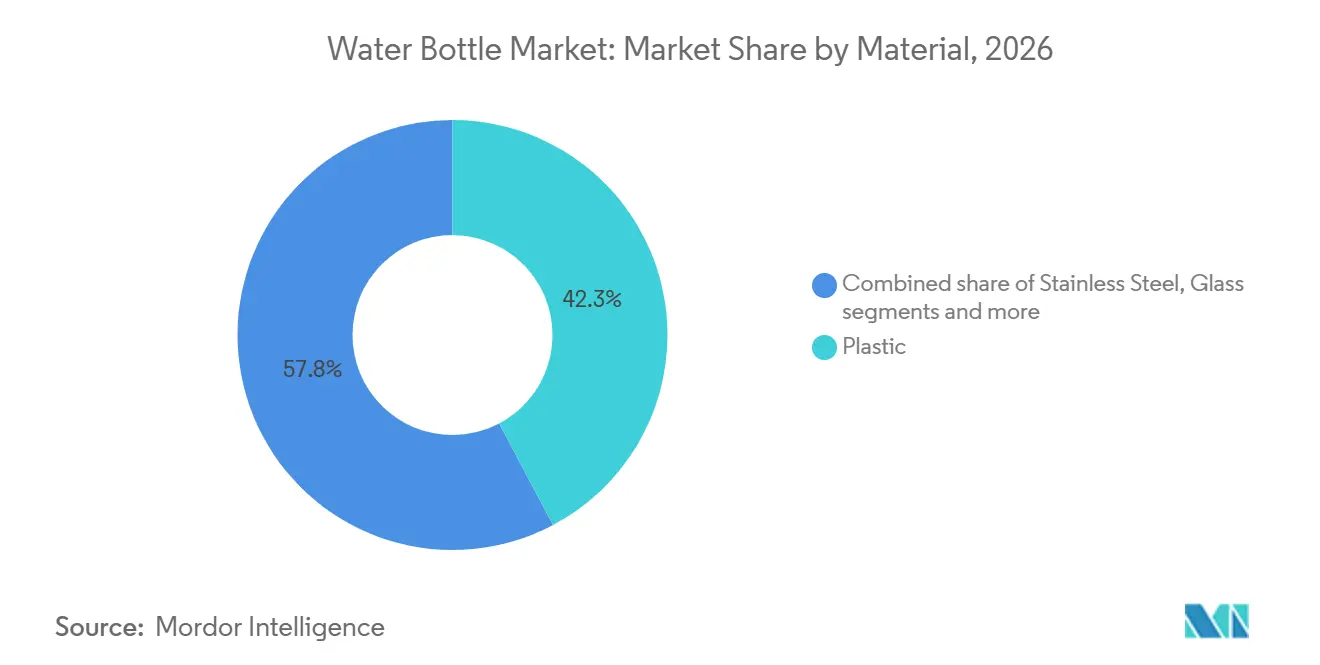
Plastic Leads as Stainless Steel Gains SteadilyPlastic holds the largest share of the water bottle market, accounting for 42.25% of market value in 2026, supported by its low production costs, design flexibility, and suitability for mass-market pricing. Its lightweight construction and versatility make it suitable for a broad range of consumer requirements and everyday applications. The material also allows manufacturers to offer bottles in varied shapes, sizes, and designs at accessible price points. Glass retains a niche among consumers prioritising flavour neutrality, while aluminium appeals to buyers seeking lightweight alternatives. Copper and brass remain relevant in traditional and artisanal product categories, particularly in markets where these materials have established cultural associations.
Stainless steel is the fastest-growing material segment, projected to expand at a compound annual growth rate (CAGR) of 5.34% from 2027 to 2032, supported by demand for durable and temperature-retaining bottles. Insulated metal designs are gaining relevance as consumers seek products that maintain beverage temperatures and withstand repeated use. Manufacturers are also incorporating recycled materials to strengthen product differentiation and respond to growing interest in material sustainability. For example, Klean Kanteen uses steel containing 90% recycled content, while Nalgene introduced its Fresh Flow Straw Bottle in May 2026 using Tritan Renew recycled-content plastic. These developments indicate that material innovation is influencing competition across both established and emerging bottle categories.

By Price Range:
Mass Values Anchor While Premium AcceleratesThe Mass segment accounts for 79.43% of the water bottle market value in 2026, reflecting the strong demand for affordable products across consumer groups. Basic plastic and entry-level stainless steel bottles appeal to price-conscious buyers through their accessibility and practical functionality. This segment benefits from broad retail availability and a wide selection of designs, sizes, and everyday-use options. Competitive pricing and promotional offers remain important factors influencing purchasing decisions, while established retail networks support product accessibility across regions. As a result, the Mass segment continues to represent the largest share of the market.
The Premium segment is the fastest-growing price category, projected to expand at a compound annual growth rate (CAGR) of 5.87% from 2027 to 2032, supported by consumer interest in differentiated designs and enhanced product features. Premium bottles compete through distinctive aesthetics, material quality, insulation performance, and brand positioning. Retail exclusivity and product collaborations also provide opportunities for brands to distinguish their offerings from lower-priced alternatives. Consumers seeking products that combine functionality with design appeal support demand across this category. These factors are expected to contribute to continued growth in the Premium segment over the forecast period.
By End User:
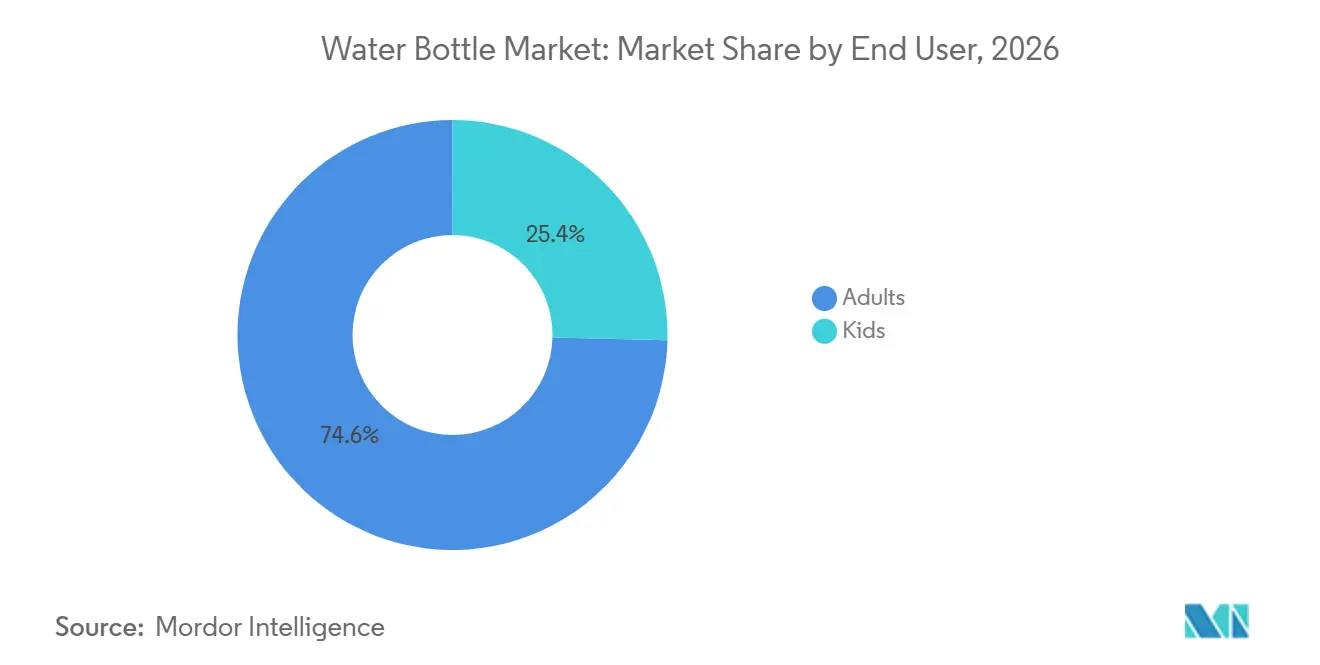
Adults Command Share, Kids Drive Incremental GrowthAdults account for 74.62% of water bottle market value in 2026, reflecting their broad hydration needs across work, travel, fitness, and everyday activities. This consumer group supports demand across a wide range of product types, from affordable everyday bottles to premium insulated and feature-rich designs. Purchasing preferences are influenced by convenience, durability, design, and functional performance, while some consumers increasingly use different bottles for specific activities. These varied requirements encourage manufacturers to offer products across multiple price points and usage occasions. As a result, adults remain the largest end-user segment, supported by the integration of water bottles into daily routines.
The Kids segment is the fastest-growing end-user category, projected to expand at a compound annual growth rate (CAGR) of 5.32% from 2027 to 2032. Demand is supported by children's participation in school, sports, and outdoor activities, where convenient access to drinking water is important. Parents and caregivers often prioritize easy-to-carry designs, spill resistance, durability, and materials considered suitable for children. Schools and other educational settings also provide opportunities for the use of dedicated hydration products. Manufacturers are responding with child-friendly designs, appealing colours, and practical features that encourage regular use. These factors are expected to support continued growth in the Kids segment over the forecast period.
By Distribution Channel:
Online Retail Outpaces Established Physical ChannelsSupermarkets and hypermarkets account for 38.62% of the water bottle market value in 2026, supported by their broad product availability, high customer traffic, and established retail networks. These outlets allow consumers to compare products, assess designs, and select bottles based on their preferences and budgets. Convenience stores also contribute to market sales by catering to consumers seeking hydration products during commutes, travel, and other daily activities. Specialty retailers and department stores serve additional demand by offering a wider selection of products for specific usage needs. Together, these physical retail channels remain important for product visibility, accessibility, and consumer purchasing decisions.
Online retail is the fastest-growing distribution channel, projected to expand at a compound annual growth rate (CAGR) of 5.41% from 2027 to 2032. E-commerce platforms provide access to a broad range of brands, designs, sizes, and price points, allowing consumers to compare options and review product information before purchasing. Digital marketplaces and direct-to-consumer websites also enable brands to reach customers beyond their physical retail presence. Promotional events and online marketing further support product discovery and purchasing activity. At the same time, brands are increasingly combining digital sales with physical retail distribution to broaden their reach and serve consumers across different shopping preferences.
Geography Analysis
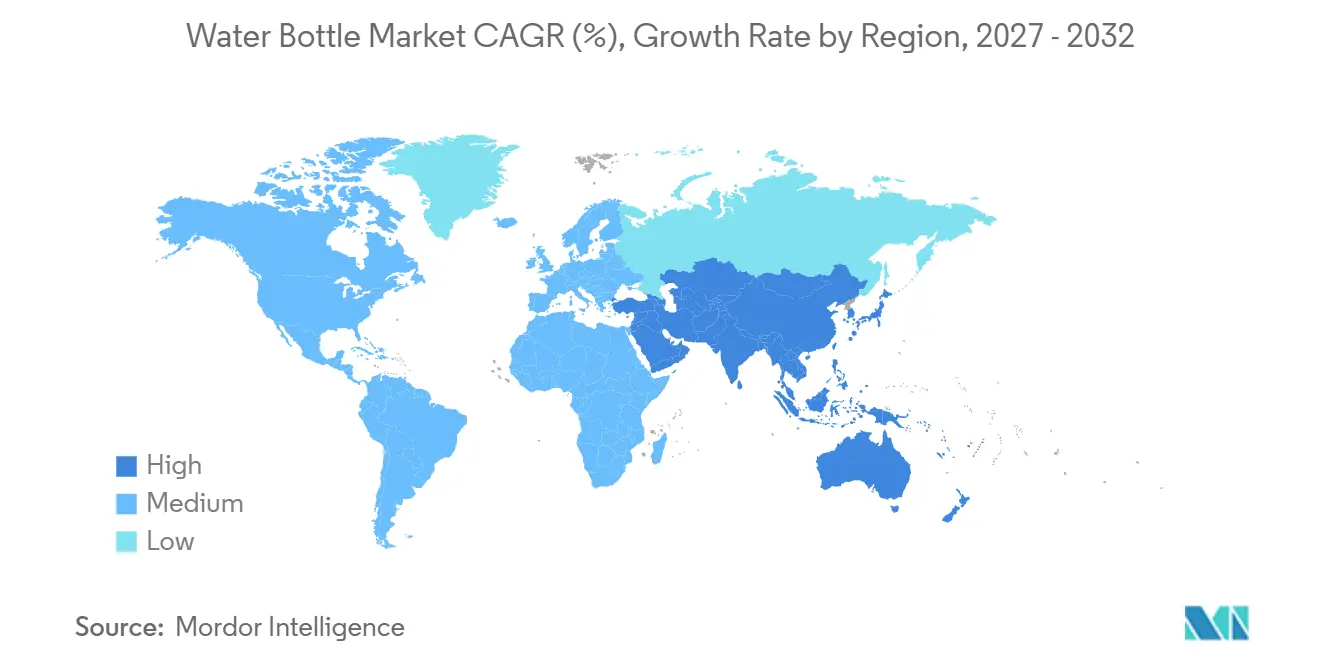
APAC Water Bottle Market
Asia-Pacific holds the largest share of the water bottle market, accounting for 43.73% of market value in 2026, and is projected to grow at a compound annual growth rate (CAGR) of 5.91% from 2027 to 2032. Market development is supported by urbanisation, rising disposable incomes, and increasing consumer interest in convenient hydration across China, India, and Southeast Asia. Japan represents a relatively mature market where changing weather conditions and evolving purchasing preferences continue to influence demand for insulated and larger-capacity bottles. Regulatory initiatives, including South Korea's requirements for recycled plastic content in certain products, are also influencing material choices and product development. The region's combination of established manufacturing capabilities and expanding consumer demand reinforces its leading position.
North America and Europe Water Bottle Market
North America and Europe represent established markets, with demand shaped by product differentiation, consumer preferences, and regulatory developments. In North America, market maturity and changing sales patterns are encouraging brands to explore new growth opportunities and expand their geographic reach. Europe is influenced by packaging and waste-reduction policies that promote reuse and refill practices, potentially supporting demand for reusable water bottles. Consumer interest in durable, insulated, and design-oriented products also contributes to market development across both regions. However, competition and saturation in established product categories may encourage manufacturers to focus on innovation, pricing strategies, and expansion into additional markets.
South America and MEA Water Bottle Market
South America and the Middle East and Africa represent emerging opportunities, with market development influenced by improving retail access, changing consumption patterns, and varying levels of consumer purchasing power. In South America, infrastructure investment and urban development may support broader access to hydration products, although differences in water access and affordability continue to shape purchasing requirements. In the Middle East and Africa, demand varies considerably between markets, reflecting differences in income levels, retail infrastructure, and consumer preferences. More developed urban markets offer opportunities for premium and insulated bottles, while price-sensitive markets remain important for affordable products. Over time, wider product availability and growing awareness of reusable hydration solutions may support further market development across these regions.
Competitive Landscape
The market is moderately concentrated, with established companies such as Newell Brands, Thermos L.L.C., YETI Holdings, Inc., Zhejiang Haers Vacuum Containers Co., Ltd., and CamelBak Products, LLC competing alongside regional manufacturers, direct-to-consumer brands, and private-label suppliers. Leading players benefit from established brand recognition, broad product portfolios, manufacturing capabilities, and distribution networks. Competition spans mass-market plastic bottles, insulated stainless steel products, and specialised hydration solutions, with companies differentiating their offerings through product design, functionality, durability, and pricing. Smaller brands and regional manufacturers contribute to a fragmented competitive landscape, particularly in specialised product categories and price-sensitive markets.
Leading players continue to strengthen their positions through product innovation and portfolio development. YETI Holdings, Inc. reported growth in its drinkware business in its fiscal 2025 results and expanded its Bottles and Jugs platform through new product lines, reinforcing its focus on premium hydration products. Meanwhile, Newell Brands competes through its consumer product portfolio, including its Rubbermaid hydration offerings, while Thermos L.L.C. maintains a presence in insulated bottles and beverage containers. Zhejiang Haers Vacuum Containers Co., Ltd. focuses on vacuum-insulated drinkware and container manufacturing, while CamelBak Products, LLC serves hydration needs across outdoor recreation, sports, and everyday use. These companies compete by aligning product features and distribution strategies with different consumer requirements.
Emerging and specialist brands are developing differentiated positions through focused product features, materials, and specific use occasions. Simple Modern competes through varied designs, colours, and accessible premium-style drinkware, while HydraPak focuses on lightweight and collapsible hydration products for outdoor activities. HidrateSpark differentiates itself through smart water bottles with hydration-tracking features, while Klean Kanteen and Nalgene emphasise material choices and reusable product designs. LARQ also targets consumers seeking bottles that combine hydration with water-purification technology. These companies contribute to competitive pressure by addressing specialised consumer needs and encouraging established manufacturers to continue investing in design, functionality, and product differentiation.
Water Bottle Industry Leaders
-
Newell Brands
-
Thermos L.L.C.
-
YETI Holdings, Inc.
-
Zhejiang Haers Vacuum Containers Co., Ltd.
-
CamelBak
- *Disclaimer: Major Players sorted in no particular order
Water Bottle Market Companies Covered in this Report
- Newell Brands
- Thermos L.L.C.
- CamelBak
- Klean Kanteen, Inc.
- Thermo Fisher Scientific Inc.
- Simple Modern
- YETI Holdings, Inc.
- HydraPak
- PMI WW Brands, LLC
- Chilly's Bottles
- SIGG Switzerland AG
- Tupperware Brands Corporation
- Zhejiang Haers Vacuum Containers Co., Ltd.
- Zojirushi Corporation
- Helen of Troy Limited
- Brita, LP.
- Aquasana, Inc.
- LARQ Inc.
- Hidrate Inc.
- Takeya USA Corporation
- LocknLock Co., Ltd.
- O2COOL, LLC
Recent Industry Developments in Water Bottle Market
- October 2026: CamelBak relaunched its custom bottle program as Custom by CamelBak, allowing consumers, cycling clubs, teams, event organizers, and retail partners to personalize Podium and Thrive bottles. The initiative includes expanded customization options for trade customers and a direct-to-consumer ordering experience.
- September 2026: Hydro Flask partnered with singer-songwriter Role Model to launch a limited-edition reusable drinkware collection featuring eight products, including several water bottle formats. The collection forms part of its ongoing partnership with Universal Music Group to promote reusable drinkware in music settings.
- May 2026: Nalgene Outdoor introduced the Fresh Flow straw bottle, a 24-ounce reusable bottle with a removable, easy-to-clean straw and interchangeable cap options. The cap is also compatible with existing 24-ounce and 32-ounce wide-mouth Nalgene bottles, extending functionality across its existing range.
- March 2026: Ocean Bottle launched its Peak collection for outdoor use, offering insulated, leakproof stainless-steel bottles in multiple lid configurations. The range includes modular lids, a reinforced body, and a built-in near-field communication chip that connects with the Ocean Bottle application to track refills.
Global Water Bottle Market Report Scope
The water bottle market comprises containers designed for storing and carrying drinking water across everyday, recreational, and professional activities. The water bottle market is segmented by material into plastic, stainless steel, glass, aluminium, and other materials; by price range into mass and premium; by end user into adults and kids; by distribution channel into supermarkets and hypermarkets, convenience stores, online retail, and other channels; and by geography into North America, Europe, Asia-Pacific, South America, and the Middle East and Africa. Market forecasts are provided in terms of value in USD.
Segmentation Overview
| Plastic |
| Stainless Steel |
| Glass |
| Aluminium |
| Other Materials (Copper & Brass) |
| Mass |
| Premium |
| Adults |
| Kids |
| Supermarkets/Hypermarkets |
| Convenience Stores |
| Online Retail |
| Other Distribution Channels |
| North America | United States |
| Canada | |
| Mexico | |
| Rest of North America | |
| Europe | Germany |
| United Kingdom | |
| Italy | |
| France | |
| Spain | |
| Netherlands | |
| Poland | |
| Belgium | |
| Sweden | |
| Rest of Europe | |
| Asia-Pacific | China |
| India | |
| Japan | |
| Australia | |
| Indonesia | |
| South Korea | |
| Thailand | |
| Singapore | |
| Rest of Asia-Pacific | |
| South America | Brazil |
| Argentina | |
| Colombia | |
| Chile | |
| Peru | |
| Rest of South America | |
| Middle East and Africa | South Africa |
| Saudi Arabia | |
| United Arab Emirates | |
| Nigeria | |
| Egypt | |
| Morocco | |
| Turkey | |
| Rest of Middle East and Africa |
| By Material | Plastic | |
| Stainless Steel | ||
| Glass | ||
| Aluminium | ||
| Other Materials (Copper & Brass) | ||
| By Price Range | Mass | |
| Premium | ||
| By End User | Adults | |
| Kids | ||
| By Distribution Channel | Supermarkets/Hypermarkets | |
| Convenience Stores | ||
| Online Retail | ||
| Other Distribution Channels | ||
| By Geography | North America | United States |
| Canada | ||
| Mexico | ||
| Rest of North America | ||
| Europe | Germany | |
| United Kingdom | ||
| Italy | ||
| France | ||
| Spain | ||
| Netherlands | ||
| Poland | ||
| Belgium | ||
| Sweden | ||
| Rest of Europe | ||
| Asia-Pacific | China | |
| India | ||
| Japan | ||
| Australia | ||
| Indonesia | ||
| South Korea | ||
| Thailand | ||
| Singapore | ||
| Rest of Asia-Pacific | ||
| South America | Brazil | |
| Argentina | ||
| Colombia | ||
| Chile | ||
| Peru | ||
| Rest of South America | ||
| Middle East and Africa | South Africa | |
| Saudi Arabia | ||
| United Arab Emirates | ||
| Nigeria | ||
| Egypt | ||
| Morocco | ||
| Turkey | ||
| Rest of Middle East and Africa | ||
Key Questions Answered in the Report
What is the projected value of the Water Bottle Market by 2032?
The market is projected to reach USD 14.31 billion by 2032, growing at a 4.80% CAGR from 2027 to 2032.
Which material has the largest position in water bottles?
Plastic held 42.25% of market value in 2026.
Which bottle material is expected to grow the fastest?
Stainless Steel is forecast to grow at a 5.34% CAGR through 2032.
Why is Asia-Pacific important for water bottle manufacturers?
Asia-Pacific held 43.73% of the market value in 2026 and is forecast to grow at a 5.91% CAGR through 2032.