
Watch Components Manufacturing Market Size and Share
Market Overview
| Study Period | 2020 - 2031 |
|---|---|
| Market Size (2026) | USD 21.89 Billion |
| Market Size (2031) | USD 29.49 Billion |
| Growth Rate (2026 - 2031) | 6.14 % |
| Fastest Growing Market | Middle East and Africa |
| Largest Market | Europe |
| Market Concentration | Medium |
Major Players *Disclaimer: Major Players sorted in no particular order Image © Mordor Intelligence. Reuse requires attribution under CC BY 4.0. | |
Watch Components Manufacturing Market Analysis by Mordor Intelligence
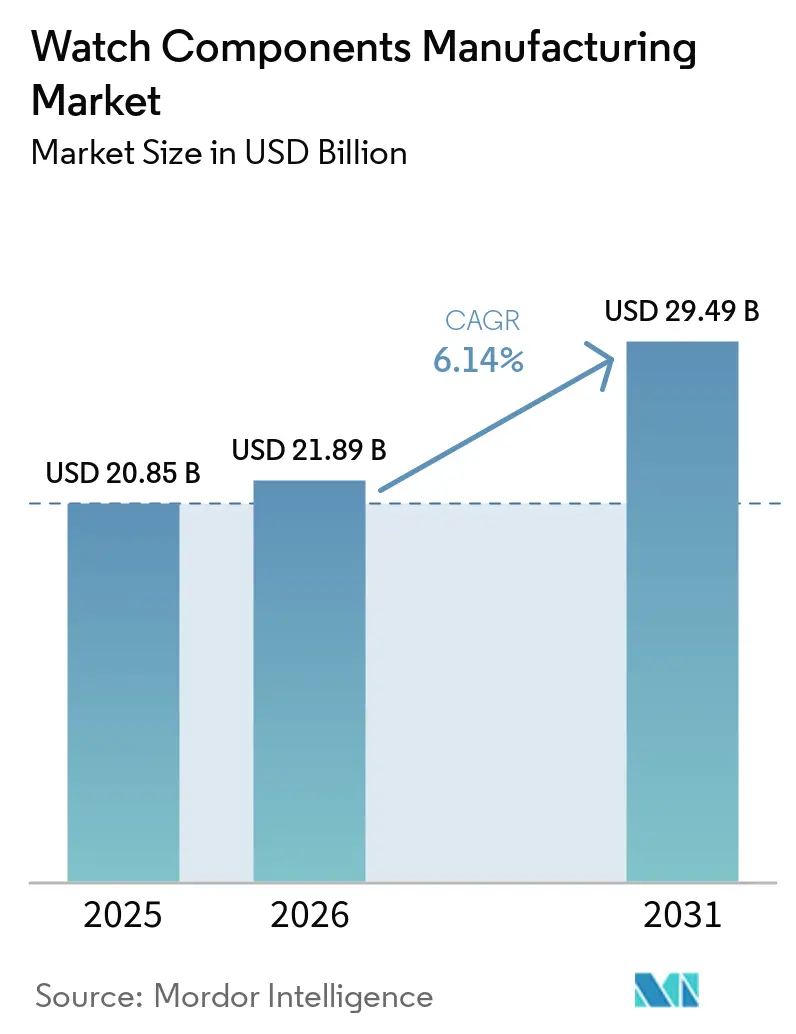
The Watch Components Manufacturing Market size is projected to expand from USD 20.85 billion in 2025 and USD 21.89 billion in 2026 to USD 29.49 billion by 2031, registering a CAGR of 6.14% between 2026 and 2031.
The watch components manufacturing market is being shaped by a shift toward higher-value mechanical and luxury watches, where each piece requires more specialized parts and finishing work. Manufacturers also serve a broader group of independent brands that need smaller orders and faster product development. This changes production planning because suppliers must balance large established accounts with short production runs. Investment in automation, silicon processing, and decorative finishing can strengthen established suppliers, while weaker demand and high input costs can limit capacity additions. The watch components manufacturing market, therefore, favors suppliers that can protect quality, manage costs, and meet brand-specific specifications.
Key Report Takeaways
- By component type, movement components held 36% of the watch components manufacturing market share in 2025, while crystal components recorded the highest projected CAGR at 7.2% through 2031.
- By watch type, mechanical watches held 45% of the watch components manufacturing market share in 2025, while Smart and hybrid watches recorded the highest projected CAGR at 8.5% through 2031.
- By material, stainless steel and other ferrous alloys held 30% of the watch components manufacturing market share in 2025, while Silicon, Nickel-Phosphorus, and silicon-based materials recorded the highest projected CAGR at 9% through 2031.
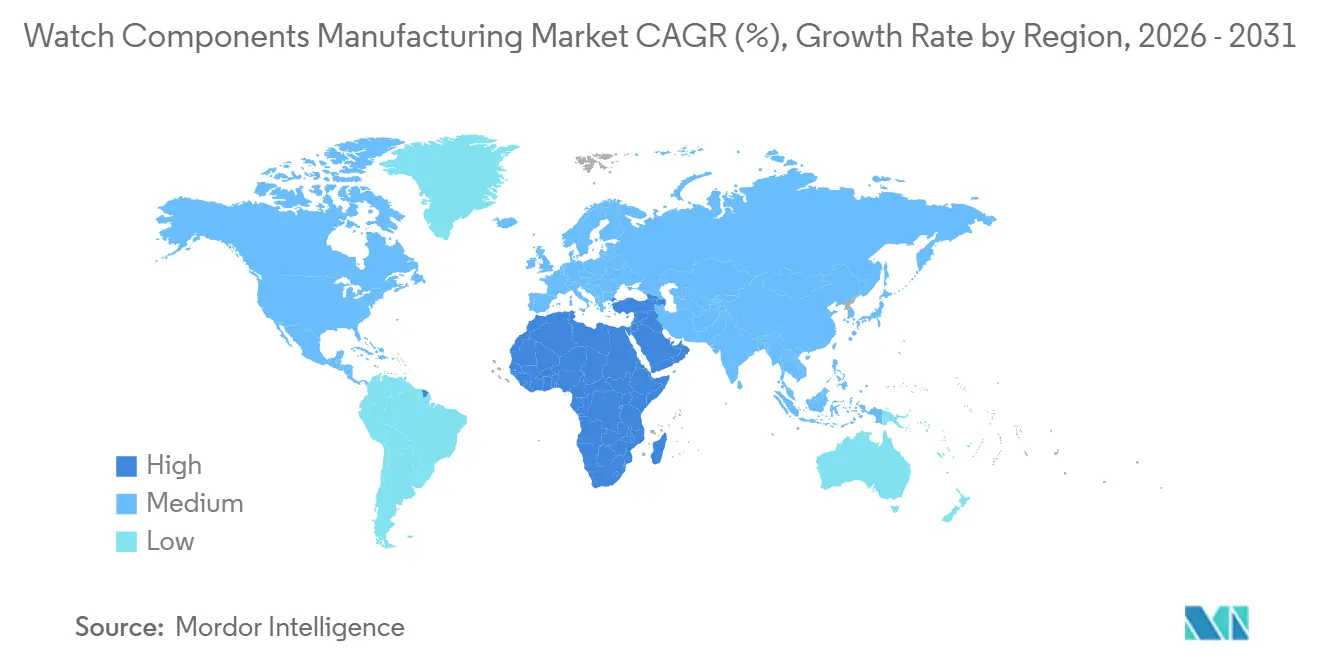
- By geography, Europe held 44.5% of the watch components manufacturing market share in 2025, while the Middle East and Africa recorded the highest projected CAGR at 7.5% through 2031.
Note: Market size and forecast figures in this report are generated using Mordor Intelligence’s proprietary estimation framework, updated with the latest available data and insights as of January 2026.
Global Watch Components Manufacturing Market Trends and Insights
Drivers Impact Analysis*
| Driver | (~) % Impact on CAGR Forecast | Geographic Relevance | Impact Timeline |
|---|---|---|---|
| Premiumization and Revival of Mechanical and Luxury Watchmaking | +2.1% | Global, the highest intensity in Europe and Gulf markets | Long term (≥ 4 years) |
| Increasing Component Complexity in Complications and High-End Calibres | +1.5% | Europe, Japan | Long term (≥ 4 years) |
| Growth of Independent, Microbrand, and Small-Batch Watch Production | +0.9% | Global demand, with sourcing in the Asia-Pacific | Medium term (2-4 years) |
| Rising Demand for Component Customization and Differentiation | +0.7% | Global, the highest in Europe and North America | Medium term (2-4 years) |
| Silicon, Ceramic, Titanium, and Other Advanced Material Adoption | +0.5% | Europe, Japan | Long term (≥ 4 years) |
| Regionalization of Sourcing and ASEAN Capacity Diversification | +0.3% | Asia-Pacific, with spillover to North America | Short term (≤ 2 years) |
| Source: Mordor Intelligence | |||
Premiumization and Revival of Mechanical and Luxury Watchmaking
Swiss watch export volumes declined 4.8% to 14.6 million pieces in 2025, while export value fell only 1.7%, showing greater value per exported watch. This difference supports demand for components that add value through precision, finishing, and technical performance. The watch components manufacturing market benefits when brands concentrate output in watches with more elaborate movements and stronger material specifications. Switzerland requires at least 60% of a watch movement's manufacturing cost to be incurred domestically under the Swiss Made rules, which supports local suppliers of core movement parts. Rolex introduced the Land-Dweller in 2025 with its Dynapulse silicon escapement, supported by 16 movement patents and 7 escapement-specific patent applications. Such systems require specialized production methods and supplier qualification.
Increasing Component Complexity in Complications and High-End Calibres
Independent brands create a different order pattern from large integrated groups. They often require limited runs, customized cases, dials, hands, or crystals, and dependable delivery from suppliers. The watch components manufacturing market can serve this demand when manufacturers have flexible tooling and short production cycles. Singapore's 2025 independent watch fair included nearly 60 brands and drew nearly 3,000 visitors, indicating stronger organization within this customer base. Custom complication development can take 6 to 18 months from the initial brief to the first production sample, which makes qualified supplier relationships difficult to replace. Decorative work, proprietary dial designs, and uncommon case geometries also make components part of a brand's product identity.
Growth of Independent, Microbrand, and Small-Batch Watch Production
Silicon, ceramic, titanium, and related materials support performance, durability, and distinctive product design. The watch components manufacturing market uses these materials in escapements, cases, bezels, crystals, and regulating systems. Acrotec introduced its industrialized ORA non-magnetic regulating organ in 2025, combining silicon, metallic glass, and ceramic through six group entities. The system shows how several specialized processes can be combined in a single supplier network. Rolex's silicon escapement also illustrates the increased use of microfabrication for high-end movement architecture. These technologies require capital investment, process knowledge, and close quality control.
Rising Demand for Component Customization and Differentiation
Brands are widening their manufacturing options across Asia-Pacific while retaining critical Swiss production. The watch components manufacturing market has scope for regional capacity that supports exterior parts, electronics-adjacent parts, and export-oriented assembly. Thailand approved Garmin's THB 3 billion (USD 95.3 million) investment in a Chonburi facility for smartwatches and GPS devices, with production scheduled to begin in 2026. This investment supports local demand for watch-specific exterior components and related precision inputs. Parts Seiko opened a USD 10 million factory in Vietnam in 2025 to produce precision metal components for export, mainly to Japan. Suppliers must still meet brand requirements for traceability, tolerance, and finishing quality.
Restraints Impact Analysis*
| Restraint | (~) % Impact on CAGR Forecast | Geographic Relevance | Impact Timeline |
|---|---|---|---|
| Luxury Watch Demand and Export-Market Volatility | -1.3% | Global, most acute in Switzerland and East Asia | Short term (≤ 2 years) |
| Skilled Micromechanics and Precision-Manufacturing Labor Shortages | -0.9% | Europe and Japan | Medium term (2-4 years) |
| Raw-Material, Precious-Metal, Energy, and Currency Cost Volatility | -0.7% | Global, the highest exposure in Switzerland and Japan | Short term (≤ 2 years) |
| Long Supplier Qualification Cycles and High Switching Costs | -0.4% | Global | Long term (≥ 4 years) |
| Source: Mordor Intelligence | |||
Luxury Watch Demand and Export-Market Volatility
Swiss watch exports declined for a second consecutive year in 2025, reaching CHF 25.6 billion (USD 32.4 billion), while exported pieces fell by 740,000 to 14.6 million.[1] Exports to China fell 12.1% in 2025, which increased pressure on suppliers linked to mid-range movement assemblers.[2] The watch components manufacturing market is exposed because suppliers often carry fixed costs, while customer orders can move quickly. Gold prices also increased material costs for case and bracelet producers, particularly where raw metal represents a large share of product cost. Lower order volumes can leave inventories at integration points and reduce factory utilization. The watch components manufacturing market must manage purchasing, inventory, and pricing discipline carefully during weaker export cycles.
Skilled Micromechanics and Precision-Manufacturing Labor Shortages
The Swiss watch industry lost 835 positions in 2025, leaving employment at 64,807 at the end of September. Skilled workers in micromechanics, finishing, and escapement adjustment remain difficult to replace once they leave the sector. A federal vocational certificate introduced in 2024 aims to build future watchmaking skills, but training capacity takes time to expand. The watch components manufacturing market also faces long supplier qualification cycles for proprietary parts. Changing suppliers during product development can reset testing and approval work, especially for complications and advanced materials.[3] These constraints protect qualified producers, but they can slow expansion when new capacity or specialist skills are needed.
*Our forecasts treat driver/restraint impacts as directional, not additive. The impact forecasts reflect baseline growth, mix effects, and variable interactions.
Segment Analysis
By Component Type: Movement Components Lead While Crystals Grow Faster
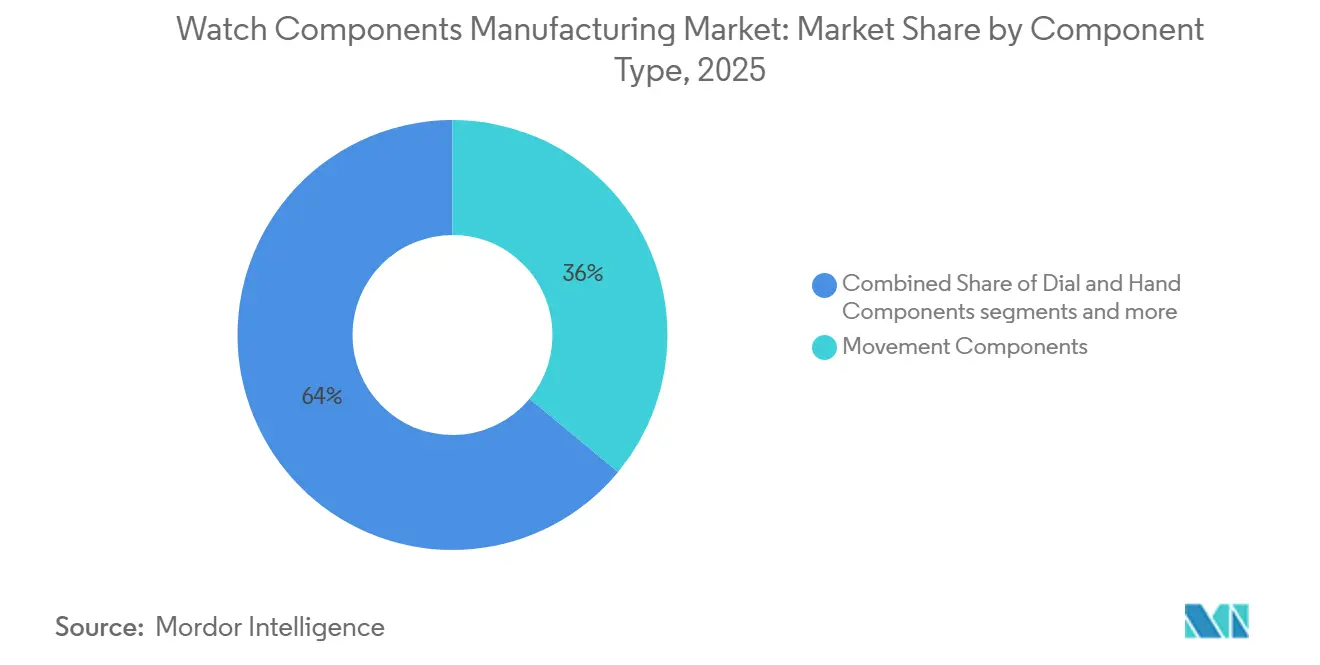
Movement Components accounted for 36% of the watch components manufacturing market size in 2025. Mainplates, bridges, gear trains, pinions, escapements, springs, barrels, and rotors require separate precision operations. Mechanical movements need tight tolerances, careful material selection, and extensive assembly knowledge. This supports a larger value contribution from movement parts than from simpler exterior components. The watch components manufacturing market includes habillage, dials and hands, bracelets and clasps, sealing parts, and crystals alongside movement components.
Crystal Components are projected to grow at 7.2% CAGR through 2031. Sapphire and colored sapphire are extending beyond highly exclusive models into broader premium watch ranges. Crystal suppliers must balance optical clarity, scratch resistance, shape control, and reliable sealing performance. This demand favors manufacturers with cutting, coating, and finishing capabilities. Decorative and functional requirements can increase the value of a crystal even when the overall watch volume is modest.

By Watch Type: Mechanical Watches Provide Value While Smart Watches Expand
Mechanical Watches held 45% of the watch components manufacturing market size in 2025. Their component intensity is high because complex movements can contain more than 300 individually manufactured parts. Brands are continuing to invest in proprietary calibers that require specialized component ecosystems. Standard catalog products cannot always replace these parts. Mechanical watches also require cases, crystals, crowns, bracelets, and decorative elements that support premium positioning.
Smart and Hybrid Watches are projected to grow at 8.5% CAGR through 2031. Their scope in this assessment is limited to watch-specific exterior components, rather than electronic modules. Premium smartwatch designs use sapphire crystals, titanium cases, and precision crowns alongside digital functionality. Garmin's approved Thailand facility is scheduled to start production in 2026, creating demand for specialized exterior components at scale. Quartz watches continue to support steady volume for habillage, bracelet, and crystal suppliers across fashion and mid-range price points.
By Material: Steel Supports Volume While Silicon-Based Materials Advance
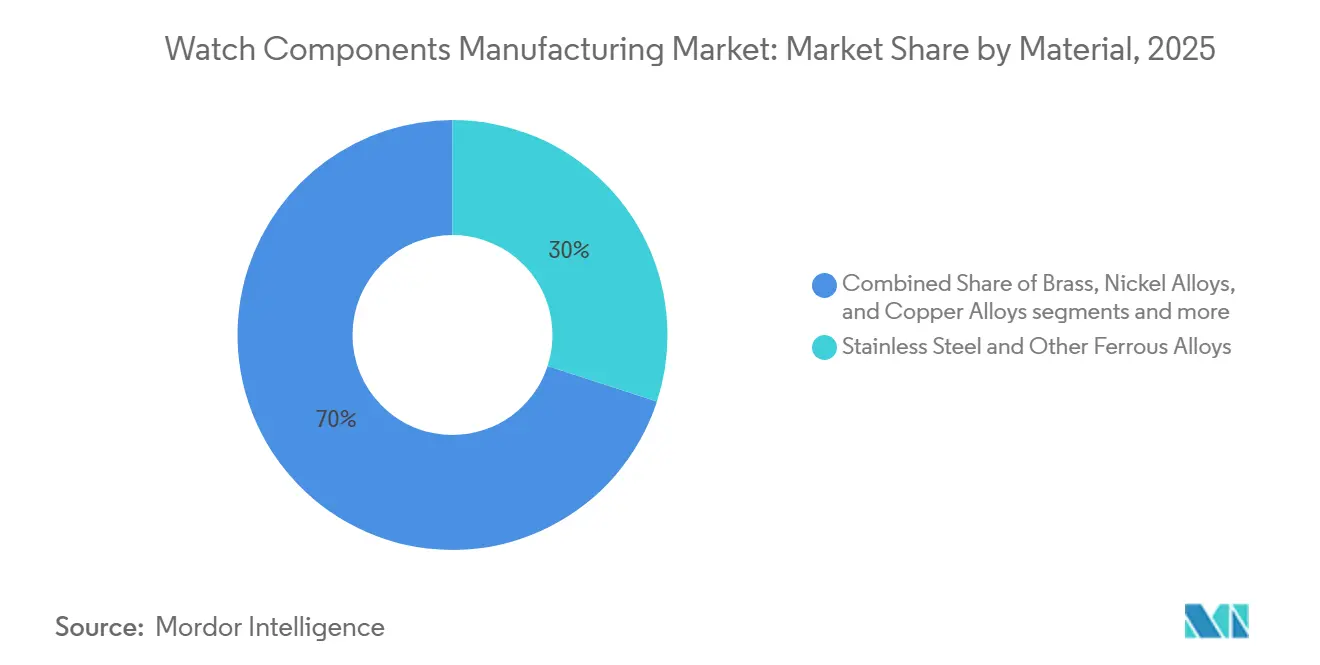
Stainless Steel and Other Ferrous Alloys held 30% of the watch components manufacturing market share in 2025. Grade 316L and grade 904L steel remain important for cases, bracelets, and movement plates. Steel offers durability, familiar processing methods, corrosion resistance, and wide use across sports and mid-range watches. Brass also remains important for selected movement plates and bridges. These established materials support the watch components manufacturing market through broad production volumes. The material also benefits from established CNC machining, stamping, polishing, brushing, and surface-treatment capabilities, allowing manufacturers to produce complex components at relatively high volumes. Demand for steel components remains closely linked to replacement parts, mass-market mechanical watches, sports watches, and premium models requiring high resistance to wear and corrosion.
Silicon, Nickel-Phosphorus, and Silicon-Based Materials are projected to grow at 9% CAGR through 2031; their non-magnetic properties and microfabrication potential support advanced regulating systems and escapement components. Acrotec reported annual production of more than 2 million non-magnetic regulating organ assemblies through its Sigatec network. The adoption of these materials is also supported by their ability to reduce component weight, improve dimensional consistency, and enable the production of intricate geometries that are difficult to achieve through conventional metal machining. Silicon-based components are particularly relevant for hairsprings, escape wheels, and pallets, where low mass and resistance to magnetic fields can support mechanical performance.
Geography Analysis
Europe held 44.5% of the watch components manufacturing market share in 2025. Switzerland's Jura Arc, Vallée de Joux, and Canton Neuchâtel combine specialist labor, established suppliers, and close links to luxury watch brands. The Swiss Made rules continue to support domestic movement production by linking origin claims to local manufacturing cost. Germany contributes precision tooling, gear cutting, CNC machining, and laser processing. Portugal supports bracelet and strap production within the regional supply base.
North America remained an important demand center, absorbing 17% of Swiss watch exports in 2025. It supports aftermarket, spare-part, and habillage demand across several price categories. Asia-Pacific combines Japanese and Taiwanese precision capability with scale production in China, India, Thailand, and South Korea. Citizen Fine Device completed a new Kawaguchiko factory building in Japan in January 2026, with production operations begin progressively from September 2026. Thailand and Vietnam provide additional capacity for export-oriented precision production.
The Middle East and Africa represent the fastest-growing geography, with a 7.5% CAGR expected through 2031. Saudi Arabia and the UAE recorded Swiss watch export growth of 8.9% and 3.5%, respectively, in 2025. Luxury retail growth and high-income consumer demand support orders for sapphire crystals, precious-metal cases, and premium bracelets. Saudi Arabia's economic diversification and tourism development are expected to support watch consumption through 2031. The watch components manufacturing market can benefit where regional demand remains focused on higher-value watches.
Competitive Landscape
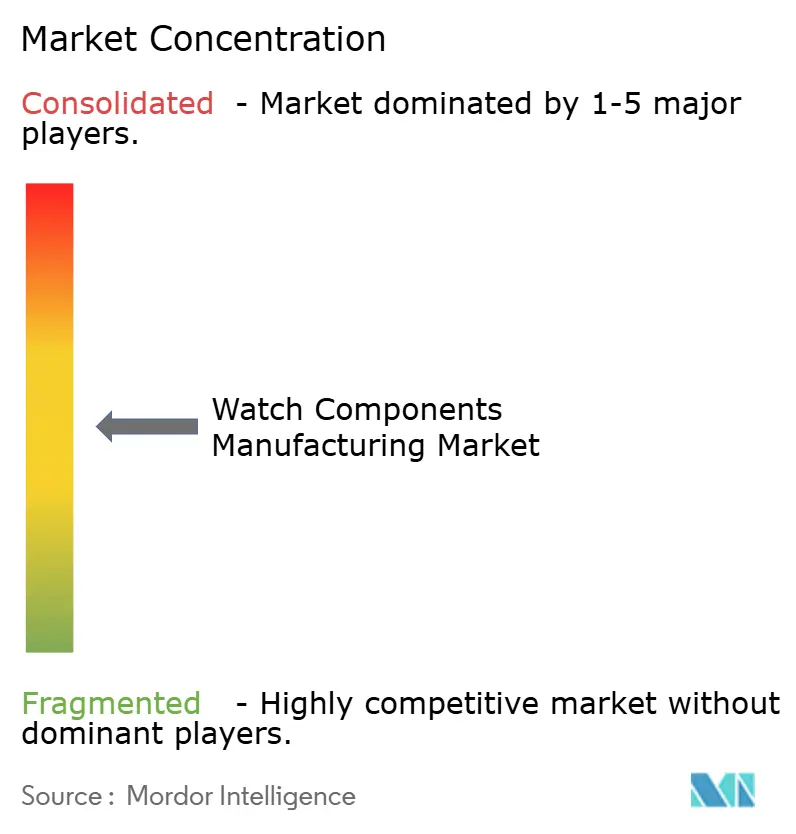
The watch components manufacturing market exhibits a medium level of market concentration, combining large captive groups with many independent subcontractors. Swatch Group operates ETA and Nivarox-FAR within an integrated structure, while Rolex, Richemont's ValFleurier, and LVMH use internal movement and component capabilities. Independent suppliers compete on technical skill, confidentiality, capacity flexibility, and customer relationships. Acrotec has built a multi-company network that covers silicon processing, decorative finishing, and related precision activities. This structure gives larger suppliers a broader technical offering without requiring brands to manage several separate relationships.
Swatch Group retained qualified production staff during 2025 and reported stronger sales momentum across price segments and geographies in May and June 2026. Acrotec displayed its component ecosystem at EPHJ 2026, including Sigatec's silicon microfabrication and Horlyne's decorative finishing. Rolex used the Land-Dweller launch to advance its patented Dynapulse silicon escapement architecture. These actions show that scale, material expertise, and protected process knowledge are central competitive tools. The watch components manufacturing market also offers room for suppliers that can serve brands needing small minimum order quantities and customized development.
Groupe Chaumont was established in Neuchâtel in 2025 to bring together specialists in movement design, oscillating weights, complication development, and precision cutting tools. Its formation reflects demand for integrated bespoke supply among high-end watch brands. Independent suppliers can also differentiate through traceable material sourcing and non-magnetic regulating assemblies. Long qualification cycles make dependable delivery and process control especially important in this market.
Watch Components Manufacturing Industry Leaders
-
Swatch Group – Component Manufacturing Operations
-
Citizen Group – Component Manufacturing Operations
-
Seiko Instruments Inc.
-
KDDL Limited
-
Acrotec Group
- *Disclaimer: Major Players sorted in no particular order
Recent Industry Developments
- June 2026: Acrotec Group exhibited at EPHJ 2026 to mark its 20th anniversary and presented its component ecosystem, from Sigatec's silicon microfabrication to Horlyne's decorative finishing.
- January 2026: Citizen Fine Device completed a new factory building at its Kawaguchiko facility in Japan. Full production operations begin progressively from September 2026.
- October 2025: Thailand's Board of Investment approved Garmin's THB 3 billion investment in a Chonburi facility to manufacture smartwatches and GPS devices, with production scheduled to start in 2026.
Global Watch Components Manufacturing Market Report Scope
The Watch Components Manufacturing Market is Segmented By Component Type (Movement Components, Dial and Hand Components, and more), By Watch Type / End Use (Mechanical Watches, Quartz Watches and more) By Material (Gold, Platinum, and Precious-Metal Alloys, Titanium, Aluminum, Magnesium, and Zirconium and more) By Geography (North America, Europe and more). The Market Forecasts are Provided in Terms of Value (USD).
| Movement Components | Mainplates, Bridges, and Plates |
| Gear Trains, Wheels, and Pinions | |
| Escapements, Anchors, and Regulating Components | |
| Springs, Barrels, and Shock-Protection Components | |
| Rotors, Oscillating Weights, Screws, Jewels, and Other Movement Components | |
| Watch Exterior / Habillage Components | Cases, Case Middles, and Casebacks |
| Bezels, Lugs, Flanges, and Casing Rings | |
| Crowns, Tubes, Pushers, and Correctors | |
| Dial and Hand Components | Dial Plates, Indexes, Applied Markers, and Decorative Dial Elements |
| Hour, Minute, Seconds, and Chronograph Hands | |
| Crystal Components | Sapphire Crystals |
| Mineral Glass Crystals | |
| Acrylic and Specialty Crystals | |
| Bracelet, Strap, and Clasp Components | Metal Bracelets and Links |
| Leather, Rubber, Textile, and Polymer Straps | |
| Buckles, Clasps, Spring Bars, and End Links | |
| Sealing and Other Watch-Specific Components | Gaskets, Seals, and Water-Resistance Components |
| Decorative, Authentication, and Specialty Components |
| Mechanical Watches |
| Quartz Watches |
| Smart and Hybrid Watches – Watch-Specific Mechanical and Exterior Components Only |
| Stainless Steel and Other Ferrous Alloys |
| Gold, Platinum, and Precious-Metal Alloys |
| Titanium, Aluminium, Magnesium, and Zirconium |
| Brass, Nickel Alloys, and Copper Alloys |
| Ceramic, Sapphire, Glass, and Carbon Composites |
| Silicon, Nickel-Phosphorus, and Silicon-Based Materials |
| Leather, Rubber, Textile, and Engineering Polymers |
| North America | United States |
| Canada | |
| Mexico | |
| Europe | Switzerland |
| Germany | |
| France | |
| Italy | |
| Portugal | |
| Rest of Europe | |
| Asia-Pacific | China |
| Japan | |
| India | |
| Thailand | |
| Taiwan | |
| South Korea | |
| Rest of Asia-Pacific | |
| Middle East and Africa | Saudi Arabia |
| United Arab Emirates | |
| South Africa | |
| Rest of Middle East and Africa |
| By Component Type | Movement Components | Mainplates, Bridges, and Plates |
| Gear Trains, Wheels, and Pinions | ||
| Escapements, Anchors, and Regulating Components | ||
| Springs, Barrels, and Shock-Protection Components | ||
| Rotors, Oscillating Weights, Screws, Jewels, and Other Movement Components | ||
| Watch Exterior / Habillage Components | Cases, Case Middles, and Casebacks | |
| Bezels, Lugs, Flanges, and Casing Rings | ||
| Crowns, Tubes, Pushers, and Correctors | ||
| Dial and Hand Components | Dial Plates, Indexes, Applied Markers, and Decorative Dial Elements | |
| Hour, Minute, Seconds, and Chronograph Hands | ||
| Crystal Components | Sapphire Crystals | |
| Mineral Glass Crystals | ||
| Acrylic and Specialty Crystals | ||
| Bracelet, Strap, and Clasp Components | Metal Bracelets and Links | |
| Leather, Rubber, Textile, and Polymer Straps | ||
| Buckles, Clasps, Spring Bars, and End Links | ||
| Sealing and Other Watch-Specific Components | Gaskets, Seals, and Water-Resistance Components | |
| Decorative, Authentication, and Specialty Components | ||
| By Watch Type / End Use | Mechanical Watches | |
| Quartz Watches | ||
| Smart and Hybrid Watches – Watch-Specific Mechanical and Exterior Components Only | ||
| By Material | Stainless Steel and Other Ferrous Alloys | |
| Gold, Platinum, and Precious-Metal Alloys | ||
| Titanium, Aluminium, Magnesium, and Zirconium | ||
| Brass, Nickel Alloys, and Copper Alloys | ||
| Ceramic, Sapphire, Glass, and Carbon Composites | ||
| Silicon, Nickel-Phosphorus, and Silicon-Based Materials | ||
| Leather, Rubber, Textile, and Engineering Polymers | ||
| By Geography | North America | United States |
| Canada | ||
| Mexico | ||
| Europe | Switzerland | |
| Germany | ||
| France | ||
| Italy | ||
| Portugal | ||
| Rest of Europe | ||
| Asia-Pacific | China | |
| Japan | ||
| India | ||
| Thailand | ||
| Taiwan | ||
| South Korea | ||
| Rest of Asia-Pacific | ||
| Middle East and Africa | Saudi Arabia | |
| United Arab Emirates | ||
| South Africa | ||
| Rest of Middle East and Africa | ||
Key Questions Answered in the Report
What is the projected growth rate for watch components manufacturing through 2031?
The sector is projected to grow at a 6.1% CAGR from 2026 to 2031, increasing from USD 21.89 billion in 2026 to USD 29.49 billion in 2031. Growth reflects higher component content in premium mechanical watches, wider use of specialized materials, and demand from both established brands and smaller producers.
Which component category holds the largest share?
Movement Components held 36% in 2025 because mechanical movements require many precision-made parts. The category includes plates, bridges, gear trains, springs, barrels, rotors, and escapements. Each part has its own tolerance, material, finishing, and assembly requirements, which makes movement production central to the sector's value base.
Which watch type creates the greatest demand for components?
Mechanical Watches held 45% in 2025, supported by their high part count and need for specialized movements and exterior parts. High-complication watches can contain more than 300 parts. This supports demand for movement specialists as well as suppliers of cases, crowns, crystals, bracelets, decorative surfaces, and other finished exterior components.
Which materials are growing fastest in watch components?
Silicon, Nickel-Phosphorus, and Silicon-Based Materials are projected to grow at 9% CAGR through 2031. These materials are used in non-magnetic regulating systems and advanced escapement designs. They require specialized microfabrication capability and close quality control, which makes them especially relevant to producers of premium mechanical movements.
Which region leads watch component manufacturing?
Europe held 44.5% in 2025, led by Switzerland's established precision watchmaking clusters. Germany also contributes tooling, gear-cutting, CNC machining, and laser processing. The region's position is supported by skilled labor, long-standing supplier relationships, and the Swiss Made framework for movements that require substantial domestic production costs.
What is the main challenge facing component suppliers?
Export volatility, specialist labor constraints, high material costs, and lengthy supplier qualification cycles can limit production flexibility. Suppliers must preserve precision and delivery performance even when customer order patterns weaken. These pressures are more demanding for businesses with fixed equipment costs, limited production scale, or dependence on a narrow customer group.