
Washable Label Adhesives Market Size and Share
Market Overview
| Study Period | 2021 - 2031 |
|---|---|
| Market Size (2026) | USD 0.84 Billion |
| Market Size (2031) | USD 1.25 Billion |
| Growth Rate (2026 - 2031) | 8.14 % |
| Fastest Growing Market | Asia-Pacific |
| Largest Market | Asia-Pacific |
| Market Concentration | Medium |
Major Players *Disclaimer: Major Players sorted in no particular order Image © Mordor Intelligence. Reuse requires attribution under CC BY 4.0. | |
Washable Label Adhesives Market Analysis by Mordor Intelligence
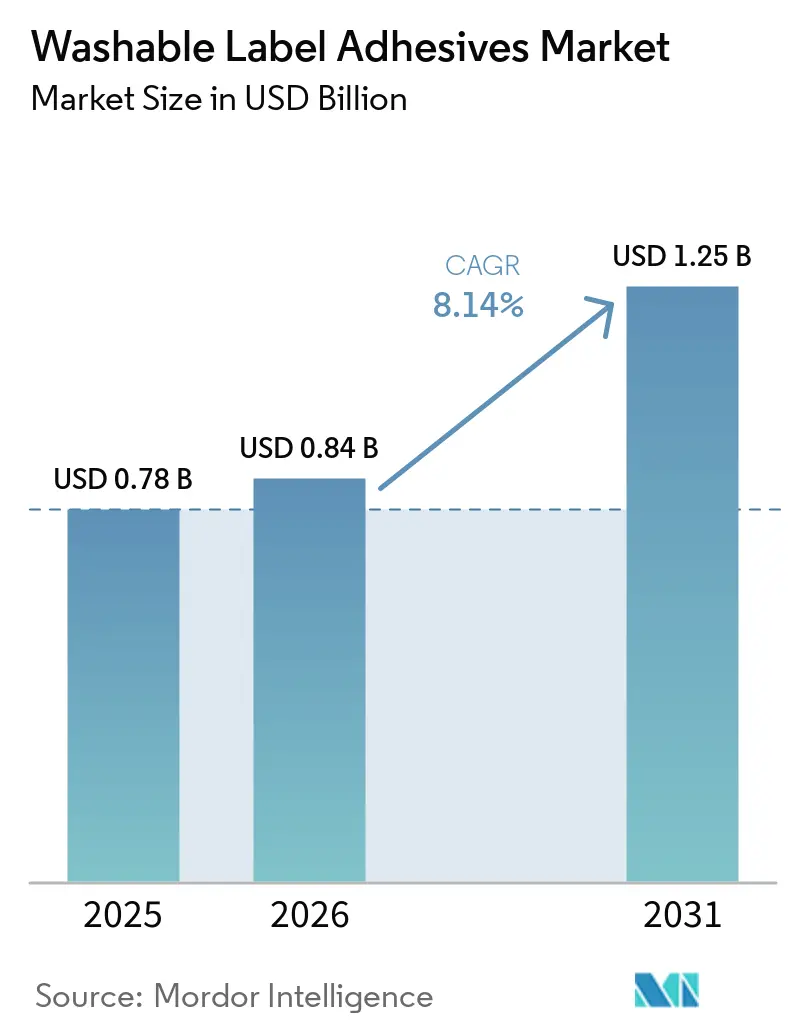
The Washable Label Adhesives Market size was valued at USD 0.78 billion in 2025 and is estimated to grow from USD 0.84 billion in 2026 to reach USD 1.25 billion by 2031, at a CAGR of 8.14% during the forecast period (2026-2031). The washable label adhesives market is being shaped by bottle-to-bottle recycling, where labels and adhesive residue must separate cleanly during hot caustic washing to support food-grade recycled polyethylene terephthalate (rPET). Deposit-return systems are expanding the volume of containers handled through centralized washing facilities, which makes reliable adhesive removal more important for converters and brand owners. Regulatory requirements on recycled content, recyclability, per- and polyfluoroalkyl substances (PFAS), and volatile organic compounds (VOCs) are also moving wash-off adhesive specifications from a packaging preference to a compliance requirement. Suppliers are responding through certified adhesive portfolios, high-speed hot-melt formats, and materials that can work across polyethylene terephthalate (PET), high-density polyethylene (HDPE), and polypropylene containers. The washable label adhesives market continues to have opportunities where recyclability certification, production speed, and low-emission chemistry can be delivered together.
Key Report Takeaways
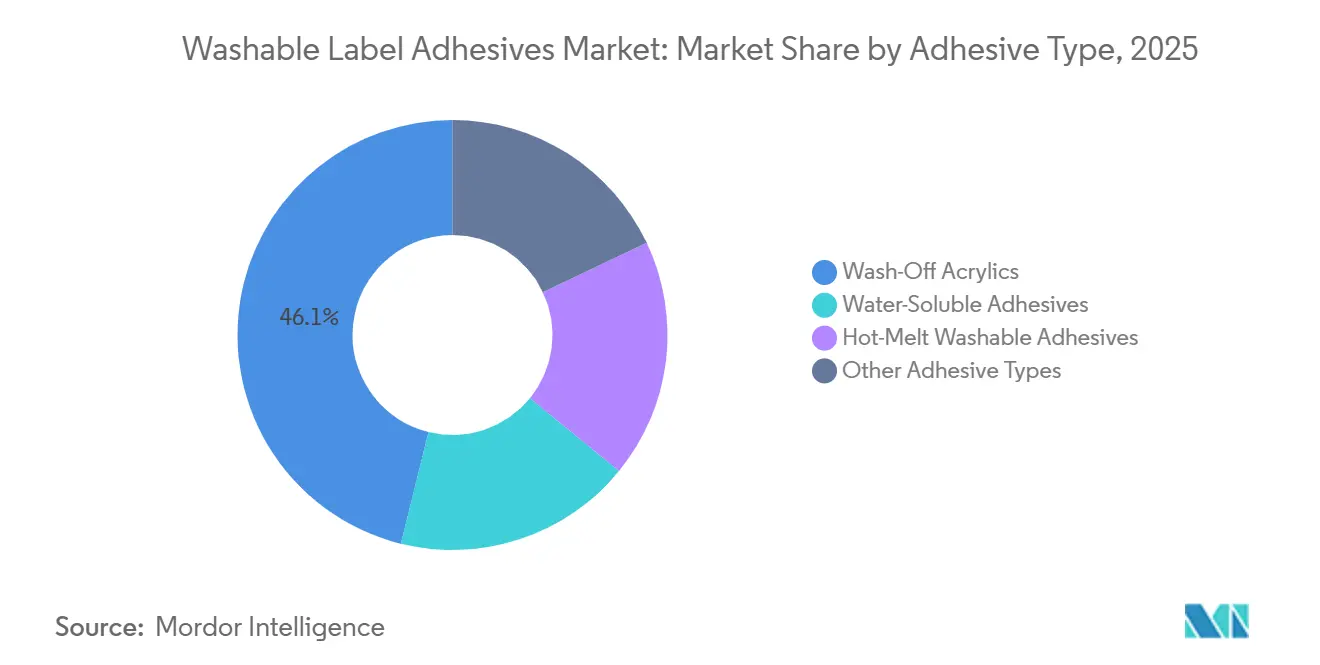
- By adhesive type, wash-off acrylics held 46.13% of the washable label adhesives market share in 2025, while hot-melt washable adhesives are projected to advance at a 9.12% CAGR through 2031.
- By label type, pressure-sensitive labels held 48.64% of the washable label adhesives market share in 2025, while wraparound labels are projected to advance at a 9.17% CAGR through 2031.
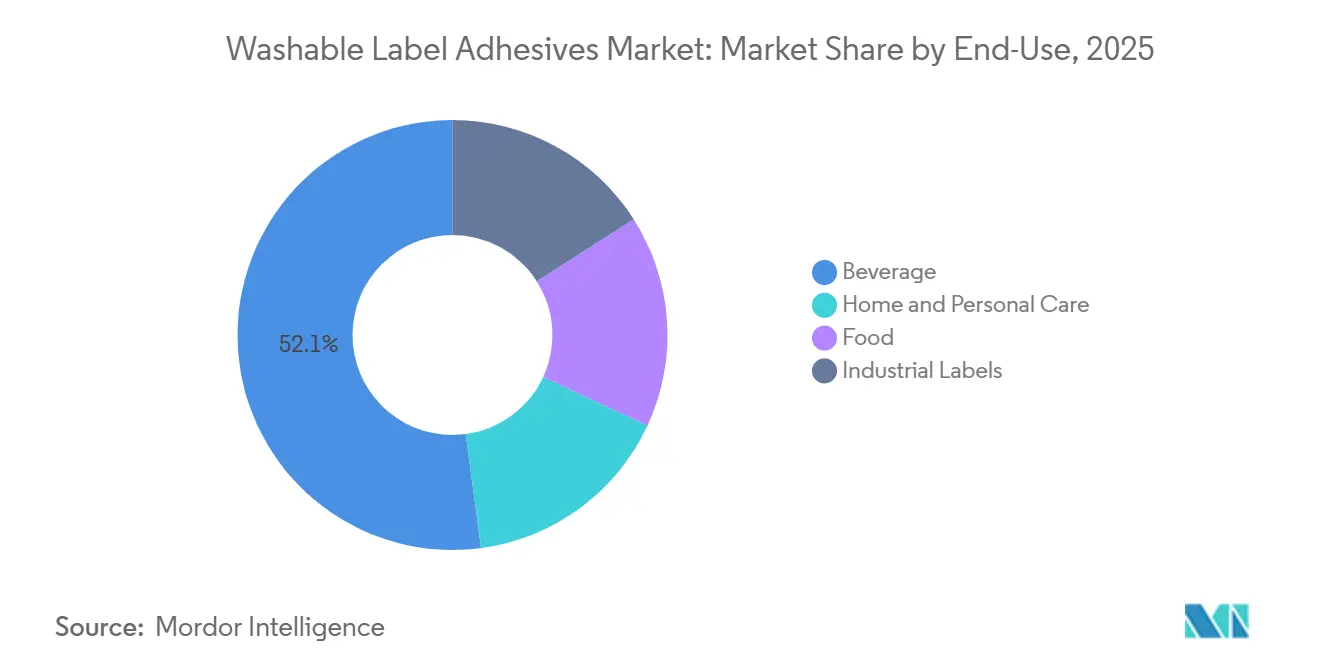
- By end-use, beverage held 52.11% of the washable label adhesives market share in 2025, while home and personal care is projected to advance at a 9.42% CAGR through 2031.
- By geography, Asia-Pacific held 37.28% of the washable label adhesives market share in 2025 and is projected to advance at a 9.31% CAGR through 2031.
Note: Market size and forecast figures in this report are generated using Mordor Intelligence’s proprietary estimation framework, updated with the latest available data and insights as of January 2026.
Global Washable Label Adhesives Market Trends and Insights
Drivers Impact Analysis*
| Driver | (~) % Impact on CAGR Forecast | Geographic Relevance | Impact Timeline |
|---|---|---|---|
| Expansion of Bottle-to-Bottle Recycling | +2.5% | Global, concentrated in Asia-Pacific, Europe, and North America | Medium term (2–4 years) |
| Mandatory Recycled Content and Packaging Circularity Rules | +2.0% | Europe (PPWR core), spillover to APAC and North America EPR frameworks | Medium term (2–4 years) |
| Growth of Deposit-Return and Refillable Packaging Systems | +1.5% | Europe (DRS-dense), Asia-Pacific (Singapore, India), North America | Short term (≤ 2 years) |
| Rising Demand for Low-VOC Water-Based Adhesives | +1.2% | Asia-Pacific (China VOC code), Europe (PPWR PFAS provisions), North America | Short term (≤ 2 years) |
| Converter Qualification of Certified Wash-Off Systems | +1.0% | Global, with early gains in North America & EU via APR and RecyClass frameworks | Long term (≥ 4 years) |
| Source: Mordor Intelligence | |||
Expansion of Bottle-to-Bottle Recycling
Bottle-to-bottle PET recycling requires labels and adhesive residue to be released during hot caustic washing. Standard adhesive systems can leave residue on PET flakes, which can restrict the use of the recovered material in higher-value applications. A 2025 UPM trial with Nongfu Spring used RW85C wash-off adhesive and reported contamination below 600 parts per million, meeting food-grade rPET thresholds. The trial also improved the value of recovered PET pellets by CNY 300-400 per metric ton (approximately USD 40-55 per metric ton). In the washable label adhesives market, rPET buyers are increasingly influencing adhesive specifications because their material-quality needs determine whether recycling loops can produce food-grade output. This shift reinforces the washable label adhesives market as it moves product development away from general-purpose acrylic systems toward formulations that can demonstrate clean separation under defined recycling conditions, retain suitable labeling performance, and provide evidence that recovered PET will meet the requirements of subsequent recycling and packaging users.
Mandatory Recycled Content and Packaging Circularity Rules
Regulation (EU) 2025/40, the Packaging and Packaging Waste Regulation, entered into force on February 11, 2025, and applies across European Union member states from August 12, 2026[1]. The regulation requires 30% recycled content in single-use PET beverage bottles by 2030 and requires packaging to be recyclable at scale by 2030. Its PFAS restrictions for food-contact packaging adhesives became applicable on August 12, 2026. The Association of the European Adhesive & Sealant Industry (FEICA) stated that adhesive manufacturers supplying packaging placed on the European Union market must document PFAS compliance and provide chain-of-custody information to packaging manufacturers. For the washable label adhesives market, recyclability is assessed at the packaging-system level, so an adhesive layer that impedes PET recovery can affect a brand owner’s claim for the complete product stock-keeping unit. This creates a direct reason for converters to qualify wash-off constructions before customers need proof of compliance, because testing after a packaging specification is set can delay the commercial launch of a new label construction and create avoidable reformulation work.
Growth of Deposit-Return and Refillable Packaging Systems
Deposit-return schemes place returned containers into centralized collection and washing systems, where wash-off performance must work consistently at an industrial scale. TOMRA reported that 60 regions worldwide operated deposit-return schemes in 2026. Portugal launched its national scheme on April 8, 2026, becoming the 19th European country with a national deposit-return system for PET bottles and metal cans. Singapore launched its Beverage Container Return Scheme on April 1, 2026, creating Southeast Asia’s first national scheme and recording more than 33 million container returns during its initial phase. The Packaging and Packaging Waste Regulation requires operational deposit-return systems in European Union member states by 2029 and sets a 90% collection target for single-use beverage containers. These collection targets support the washable label adhesives market and encourage brands and converters to qualify washable systems earlier because labels must be compatible with the recycling route that follows collection, sorting, baling, flake washing, and the production of recycled resin for new packaging applications.
Rising Demand for Low-VOC Water-Based Adhesives
VOC rules are encouraging converters to consider water-based and ultraviolet-cured formulations that can also support washable adhesive requirements. China’s Environmental Code became effective on August 15, 2026, and reduced the VOC limit for packaging adhesives to 90 g/L from 150 g/L. China’s GB/T 43215-2023 standard for thermal-paper self-adhesive labels became effective in 2024 and set a VOC emission limit of 50 mg/m². The U.S. Food and Drug Administration updated 21 Code of Federal Regulations (CFR) Part 175.105 on June 25, 2026, adding exemption pathways for water-based cold adhesives used in food-contact paper packaging. These developments support the washable label adhesives market because low-VOC qualification can use polymer approaches that are also suited to alkali-releasable adhesives. Converters that meet emissions rules can therefore have a clearer route into recycling-compatible product lines, particularly where customers prefer to reduce compliance work by selecting materials that address both emissions and recyclability considerations within the same packaging design.
Restraints Impact Analysis*
| Restraint | (~) % Impact on CAGR Forecast | Geographic Relevance | Impact Timeline |
|---|---|---|---|
| Performance Trade-Off Between In-Use Moisture Resistance and Recycling Release | -1.5% | Global, most acute in tropical ASEAN markets and chilled-beverage supply chains in North America | Medium term (2–4 years) |
| Premium Cost of Certified Washable Adhesive Systems | -1.2% | South America, Middle East and Africa, and price-sensitive ASEAN markets | Medium term (2–4 years) |
| Uneven Collection and Recycling Infrastructure | -1.0% | South America, Middle East and Africa, Rest of Asia-Pacific | Long term (≥ 4 years) |
| Source: Mordor Intelligence | |||
Performance Trade-Off Between In-Use Moisture Resistance and Recycling Release
Washable labels must maintain tack, condensation resistance, and peel strength during use, while separating rapidly during hot caustic recycling washes. These requirements are difficult to balance for chilled drinks, humid distribution conditions, and multiple container substrates. Henkel AG & Co. KGaA’s TECHNOMELT EM 335 RE alkali-dispersible hot-melt adhesive achieved up to 98% residue-free removal under recycling conditions. Even limited adhesive contamination can affect PET flake quality and can reduce rPET performance. Converters must qualify a label construction for both in-use performance and recycling compatibility under Association of Plastic Recyclers and RecyClass methods, which can delay commercialization by 12-18 months. This qualification burden can constrain the washable label adhesives market and limit the use of washable formats in glass and multi-polymer applications where recycling conditions are less standardized, where container designs vary more widely, and where performance under local collection and wash processes is harder to document consistently.
Premium Cost of Certified Washable Adhesive Systems
Certified washable systems cost more than commodity general-purpose adhesives because they use controlled-hydrophilicity acrylic copolymers or alkali-dispersible block-copolymer hot melts. Laboratory testing, documentation, periodic revalidation, and third-party certification add to the cost for converters. These costs are especially significant for small and mid-sized converters in South America, the Middle East, and price-sensitive ASEAN markets. Adoption in those locations tends to depend on strong brand sustainability requirements or a direct regulatory mandate. Uneven collection and recycling infrastructure adds another constraint because a premium adhesive is harder to justify when local recovery systems cannot consistently capture and process containers. The washable label adhesives market can therefore develop unevenly across regions, even where brand owners use common global packaging specifications, because the economic case still depends on local recycling capacity, available certification services, converter capability, and the willingness of customers to absorb additional material costs.
*Our forecasts treat driver/restraint impacts as directional, not additive. The impact forecasts reflect baseline growth, mix effects, and variable interactions.
Segment Analysis
By Adhesive Type: Wash-off Acrylics Lead Revenue, Hot-Melt Washable Adhesives Expand
Wash-off acrylics held 46.13% share of the washable label adhesives market in 2025, supported by their established use in pressure-sensitive label constructions. Their coating flexibility, dependable application behavior, and existing compliance profiles have supported their use in PET recycling applications. Hot-melt washable adhesives are projected to advance at a 9.12% CAGR through 2031. Beverage brands operating labeling lines at more than 60,000 bottles per hour value rapid set speed, cold-temperature adhesion, and reliable processing on high-speed equipment. A 2026 Henkel AG & Co. KGaA patent application for an alkali-dispersible hot-melt pressure-sensitive adhesive for PET and glass bottle labeling showed continued focus on formats that combine line efficiency with recycling requirements.
Water-soluble adhesives serve a narrower role in returnable glass-bottle labeling systems, where established washing conditions remain important. They can release at 21 °C without alkaline additives and can work with older washing equipment in European and Latin American return systems. BASF’s acResin UV 3532 received RecyClass approval for PET bottle label applications in March 2026. Certification status is increasingly important because it gives converters and brand owners documented evidence that a formulation suits a stated recycling route, reduces uncertainty during packaging reviews, and supports communication between adhesive suppliers, label converters, recyclers, and brand owners.

By Label Type: Pressure-Sensitive Labels Support Adoption While Wraparound Labels Grow Faster
Pressure-sensitive labels held 48.64% of the washable label adhesives market share in 2025. Their position reflects versatility across container types, filling-line speeds, print-quality requirements, and varied decoration needs. The Association of Plastic Recyclers' PET-S-01 wash-water evaluation protocol has supported repeated improvements in pressure-sensitive label constructions. Wraparound labels are projected to advance at a 9.17% CAGR through 2031. Brand owners are moving from shrink-sleeve to roll-fed formats where they seek to reduce multi-material complexity and improve compatibility with PET recycling.
H.B. Fuller Company’s Earthic 4010N, Clarity PHL 4150, and Clarity PHL 4155 hot-melt adhesives received Association of Plastic Recyclers Design Recognition for PET bottle wraparound applications. These portfolios give bottlers documented options for adhesive performance and recyclability. Cut-and-stack labels are moving from wet-glue casein or dextrin systems toward synthetic water-based and hot-melt solutions. H.B. Fuller Company’s Earthic 2026 water-based adhesive was designed for glass-bottle labeling lines operating at up to 65,000 bottles per hour. This development shows how cut-and-stack labels can meet production-speed and wash-off requirements, which is relevant for bottlers that need to preserve existing equipment efficiency while improving compatibility with the collection and recycling systems used for their containers.
By End-Use: Beverage Leads Demand, While Home and Personal Care Broaden Growth
Beverage held 52.11% of the washable label adhesives market share in 2025. PET beverage bottles account for a large portion of recycling volumes, so their label specifications have become a common reference point for washable adhesive development. The Packaging and Packaging Waste Regulation requires 30% recycled content for single-use PET beverage bottles by 2030. This requirement makes clean label and adhesive removal relevant to the consistent production of high-quality rPET. Qualification methods developed for carbonated PET beverage containers do not automatically apply to glass wine bottles or opaque HDPE milk containers.
Home and personal care is projected to advance at a 9.42% CAGR through 2031. Growth follows the extension of wash-off specifications to HDPE shampoo bottles and polypropylene household cleaner containers. Avery Dennison Corporation’s AD CleanFlake adhesive was initially commercialized for PET beverage applications and was subsequently validated for HDPE containers. Food and industrial labels are smaller applications where food-contact requirements and materials certification influence adhesive selection. The washable label adhesives market can develop further as the washable label adhesives industry extends beyond beverages when new substrate combinations meet their own performance and compliance requirements, since household, food, industrial, and personal care containers can have different resin types, label designs, filling environments, and recycling routes.
Geography Analysis
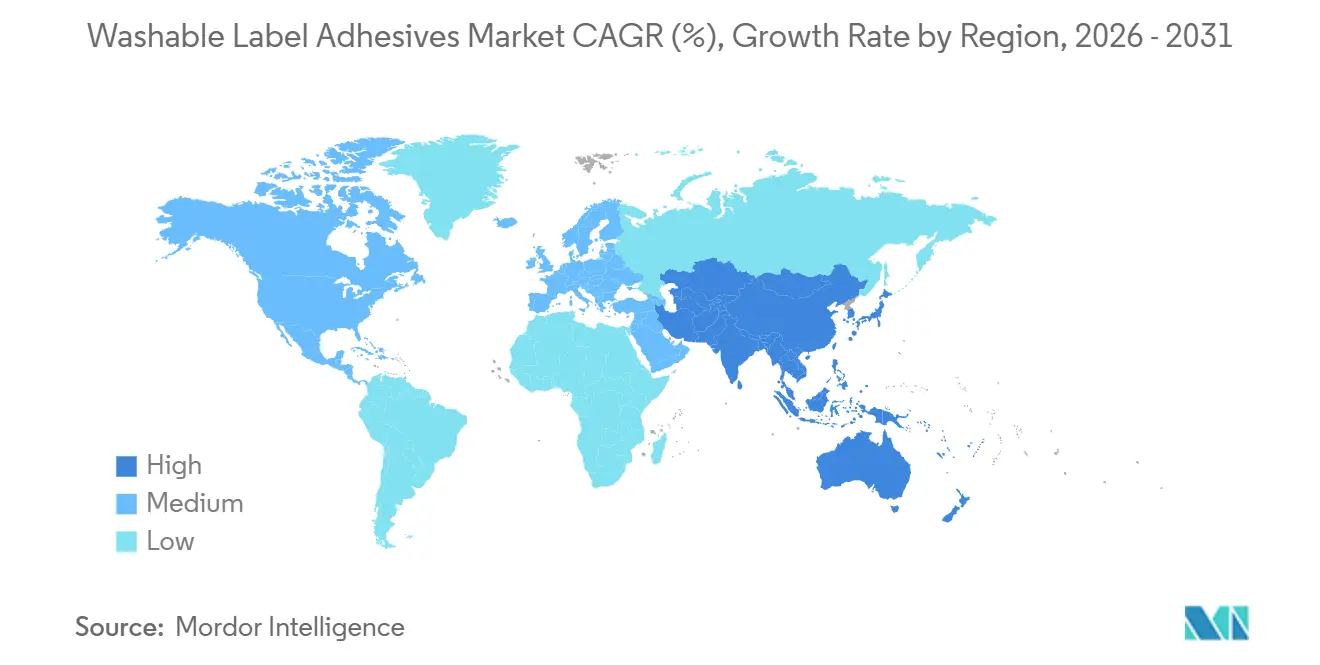
Asia-Pacific held a 37.28% share of the washable label adhesives market in 2025 and is projected to advance at a 9.31% CAGR through 2031. China’s National Standards Administration published 11 national recyclable plastic packaging design standards in September 2025, including requirements for label-container separability in PET containers. The country’s VOC limit of 90 g/L from August 2026 is also prompting domestic converters to consider formulations with lower emissions and washable properties. India’s extended producer responsibility framework and its commitment to 30% recycled content in PET packaging by 2029 support the use of recyclable label constructions. South Korea’s PET sorting rules, Japan’s container-return culture, and Singapore’s April 2026 Beverage Container Return Scheme create varied but supportive regional conditions.
North America and Europe have established deposit-return infrastructure, formal recyclability evaluation processes, and a strong presence of packaging companies that require documented technical performance. Packaging extended producer responsibility laws in 7 U.S. states use eco-modulated fee structures that can make the Association of Plastic Recyclers Design Recognition financially relevant for packaging choices[2]. The Food and Drug Administration update to 21 CFR Part 175.105 became effective on June 25, 2026, and expanded pathways for water-based adhesives in food-contact paper packaging. In Europe, the Packaging and Packaging Waste Regulation application date of August 12, 2026, brought PFAS restrictions for food-contact packaging adhesives into effect. Portugal’s national deposit-return scheme expanded demand for washable formats in Southern Europe and illustrated how collection systems can pull technical specifications into new locations.
South America and Middle East and Africa are earlier-stage areas for the washable label adhesives market, where recovery infrastructure and price sensitivity can limit adoption. Brazil has demand from multinational beverage and personal care companies that apply common sustainability standards across their supply chains, although Argentina’s macroeconomic conditions have limited investment in premium adhesive specifications. Uruguay’s preparations for Latin America’s first national deposit-return system can support adoption in the Southern Cone as processing capacity develops. Saudi Arabia and South Africa are regional demand anchors because export-oriented food and beverage producers face recyclability requirements from multinational buyers, while local circular-economy and packaging extended producer responsibility measures provide a policy basis for the gradual adoption of improved label constructions.
Competitive Landscape
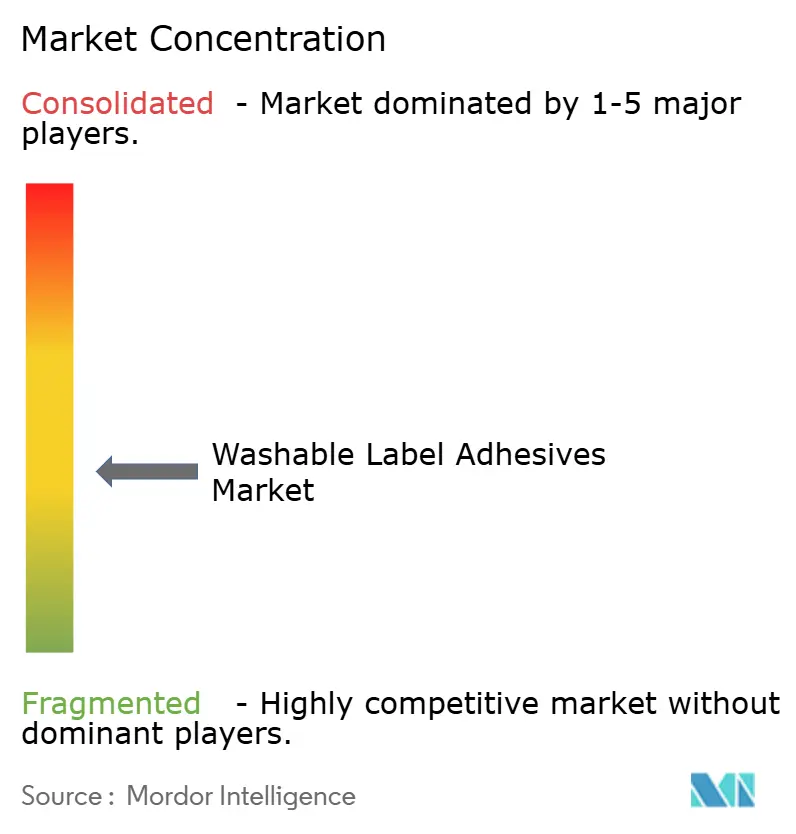
The washable label adhesives market is moderately concentrated, with the top five players including Henkel AG & Co. KGaA, Avery Dennison Corporation, H.B. Fuller Company, Arkema, and UPM. Avery Dennison Corporation reported USD 8.9 billion in global sales in 2025 and used AD CleanFlake technology in a portfolio with the Association of Plastic Recyclers and RecyClass recognition. BASF is a founding member of the Circular Economy for Labels coalition, which lets it take part in collaborative work on label circularity. Larger suppliers can invest in proprietary formulations, testing, regulatory documentation, and certification portfolios that smaller producers may find difficult to match.
Within the washable label adhesives market, competitive opportunities remain in low-temperature wash-off below 50 °C without alkaline additives and in certified systems for glass and metal substrates. These applications can matter in developing markets with older deposit-return washing equipment, while optical clarity and high-speed processing can matter in premium beverage applications. HERMA launched clear-on-clear label materials in January 2026 using its 72Hpw multi-layer adhesive for PET containers at 80 °C and HDPE at 40 °C. BASF announced in March 2026 that acResin UV 3532 received RecyClass approval for PET bottle label applications. Henkel AG & Co. KGaA’s 2026 patent activity in alkali-dispersible block-copolymer hot-melt pressure-sensitive adhesives points to continued focus on formulation exclusivity for high-speed labeling.
UPM expanded its recycling-compatible portfolio through UPM ProCycle in May 2026, covering rigid PET and HDPE applications across beverage, food, and home and personal care packaging. Avery Dennison Corporation received RecyClass Technology Approval for AD CleanFlake RFID tags in July 2026, combining its CleanFlake adhesive with a separating RFID construction for rigid PET recycling. BASF and Avery Dennison Corporation also launched butyl acrylate RE and 2-ethylhexyl acrylate RE made with attributed renewable electricity in March 2026. These actions show that product differentiation includes recyclability, material compatibility, certification evidence, and upstream emissions, rather than adhesive bonding performance alone, as customers weigh both packaging recovery requirements and broader sustainability expectations when they evaluate supplier portfolios.
Washable Label Adhesives Industry Leaders
-
Henkel AG & Co. KGaA
-
Avery Dennison Corporation
-
H.B. Fuller Company
-
Arkema
-
UPM
- *Disclaimer: Major Players sorted in no particular order
Recent Industry Developments
- May 2026: UPM expanded its wash-off adhesive portfolio under UPM ProCycle for rigid PET, HDPE, and PP packaging, with solutions designed to release cleanly during recycling wash processes. The development supports the washable label adhesives market by increasing the availability of recycling-compatible adhesives that reduce label and adhesive contamination in recovered plastic streams.
- March 2026: BASF announced that acResin UV 3532, an ultraviolet-curable acrylic hot-melt pressure-sensitive adhesive, received RecyClass approval for PET bottle label applications. The approval supports the washable label adhesives market by confirming compatibility with established European PET recycling processes and strengthening demand for recycling-compatible label adhesive solutions.
Global Washable Label Adhesives Market Report Scope
Washable label adhesives are adhesive formulations designed to securely bond labels to containers while allowing the labels to be removed during washing or recycling processes. They support clean label separation and container reuse or recycling by providing adhesion during use and controlled removability when exposed to water or washing conditions.
The Washable Label Adhesives Market is segmented by adhesive type, label type, end-use, and geography. By adhesive type, the market is segmented into wash-off acrylics, water-soluble adhesives, hot-melt washable adhesives, and other adhesive types. By label type, the market is segmented into pressure-sensitive labels, wraparound labels, and cut-and-stack labels. By end-use, the market is segmented into beverage, food, home and personal care, and industrial labels. The report also covers the market size and forecasts for washable label adhesives across 15 countries. For each segment, the market sizing and forecasts have been done on the basis of value (USD).
| Wash-Off Acrylics |
| Water-Soluble Adhesives |
| Hot-Melt Washable Adhesives |
| Other Adhesive Types |
| Pressure-Sensitive Labels |
| Wraparound Labels |
| Cut-and-Stack Labels |
| Beverage |
| Food |
| Home and Personal Care |
| Industrial Labels |
| Asia-Pacific | China |
| India | |
| Japan | |
| South Korea | |
| ASEAN Countries | |
| Rest of Asia-Pacific | |
| North America | United States |
| Canada | |
| Mexico | |
| Europe | Germany |
| United Kingdom | |
| France | |
| Italy | |
| NORDIC Countries | |
| Rest of Europe | |
| South America | Brazil |
| Argentina | |
| Rest of South America | |
| Middle East and Africa | Saudi Arabia |
| South Africa | |
| Rest of Middle East and Africa |
| By Adhesive Type | Wash-Off Acrylics | |
| Water-Soluble Adhesives | ||
| Hot-Melt Washable Adhesives | ||
| Other Adhesive Types | ||
| By Label Type | Pressure-Sensitive Labels | |
| Wraparound Labels | ||
| Cut-and-Stack Labels | ||
| By End-Use | Beverage | |
| Food | ||
| Home and Personal Care | ||
| Industrial Labels | ||
| By Geography | Asia-Pacific | China |
| India | ||
| Japan | ||
| South Korea | ||
| ASEAN Countries | ||
| Rest of Asia-Pacific | ||
| North America | United States | |
| Canada | ||
| Mexico | ||
| Europe | Germany | |
| United Kingdom | ||
| France | ||
| Italy | ||
| NORDIC Countries | ||
| Rest of Europe | ||
| South America | Brazil | |
| Argentina | ||
| Rest of South America | ||
| Middle East and Africa | Saudi Arabia | |
| South Africa | ||
| Rest of Middle East and Africa | ||
Key Questions Answered in the Report
What is the size of the washable label adhesives market?
The washable label adhesives market stands at USD 0.84 billion in 2026 and is projected to reach USD 1.25 billion by 2031.
What is driving demand for washable label adhesives?
Bottle-to-bottle recycling, deposit-return systems, recycled-content requirements, and VOC rules are supporting demand for adhesive systems that release cleanly during recycling.
Which adhesive type held the largest share in 2025?
Wash-off acrylics held 46.13% of the market share in 2025, supported by established use in pressure-sensitive label constructions.
Which label type is projected to grow the fastest through 2031?
Wraparound labels are projected to advance at a 9.17% CAGR through 2031, supported by the movement from shrink-sleeve to roll-fed constructions.