
VR Streaming Market Size and Share
Market Overview
| Study Period | 2020 - 2031 |
|---|---|
| Market Size (2026) | USD 3.05 Billion |
| Market Size (2031) | USD 6.33 Billion |
| Growth Rate (2026 - 2031) | 15.72 % |
| Fastest Growing Market | Asia-Pacific |
| Largest Market | North America |
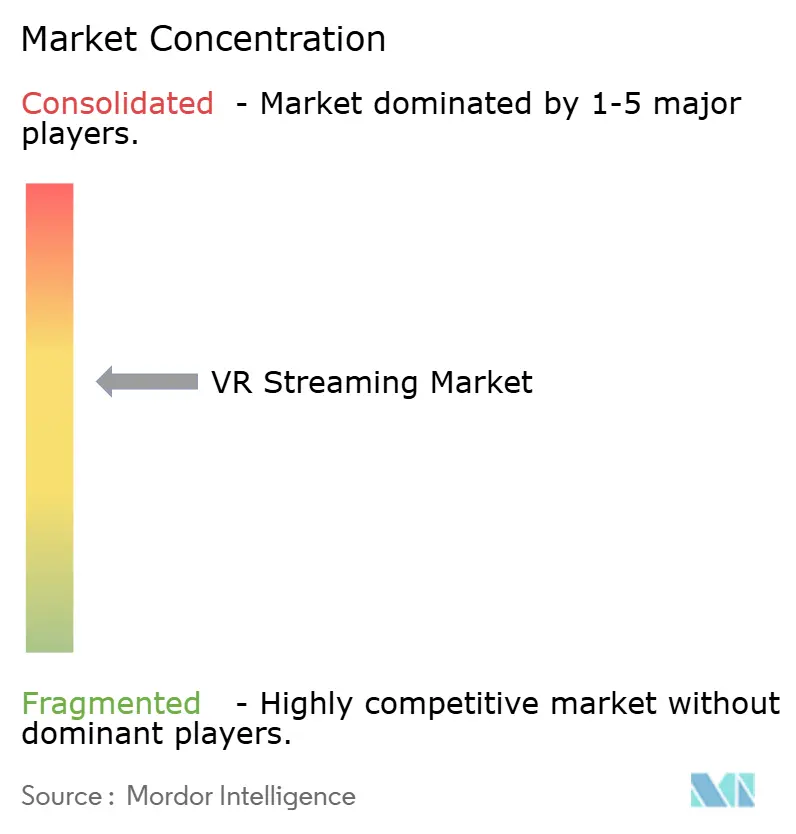
| Market Concentration | Medium |
Major Players *Disclaimer: Major Players sorted in no particular order Image © Mordor Intelligence. Reuse requires attribution under CC BY 4.0. | |
VR Streaming Market Analysis by Mordor Intelligence
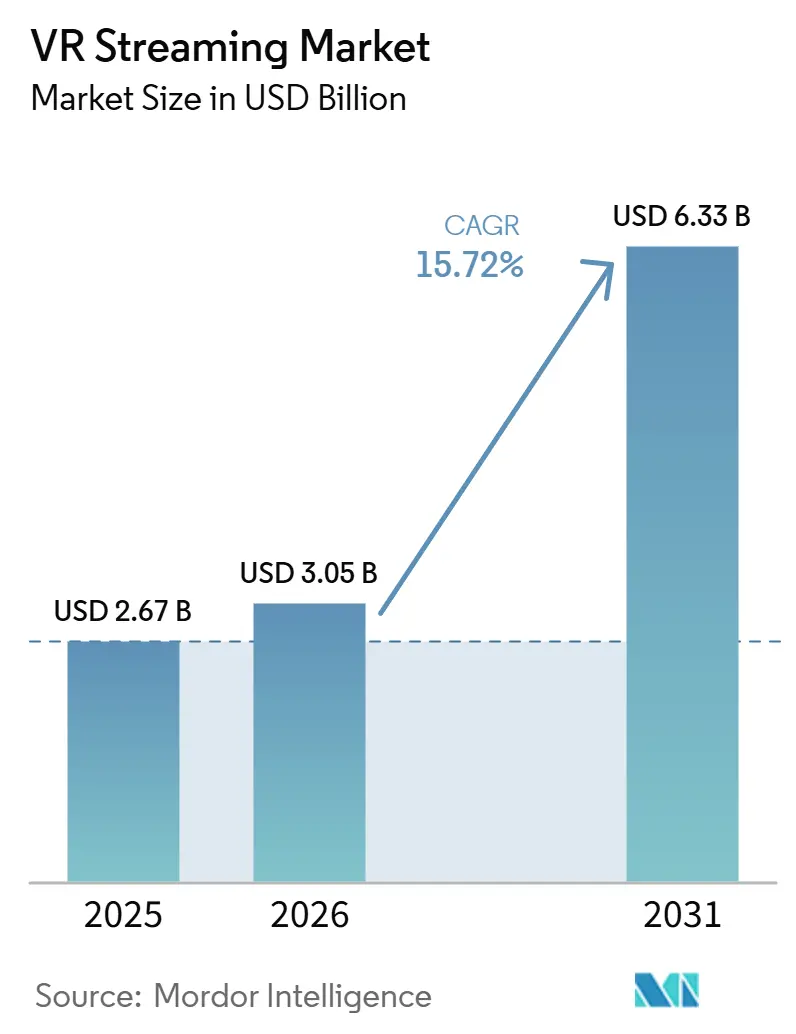
The VR streaming market size was valued at USD 2.67 billion in 2025 and estimated to grow from USD 3.05 billion in 2026 to reach USD 6.33 billion by 2031, at a CAGR of 15.72% during the forecast period 2026-2031. The VR streaming market is expanding as network capacity, headset design, and immersive content pipelines improve simultaneously. Live event viewing remains central to adoption because audiences still place a higher value on real-time participation than on static libraries. Enterprise demand also provides the VR streaming market with a steadier revenue base, as training, remote collaboration, and guided demonstrations are less exposed to short-term consumer spending swings. Platform owners compete through device ecosystems, cloud-delivery tools, and subscription access rather than through a single, uniform strategy. This leaves room for the VR streaming market to grow through both premium consumer content and enterprise-grade streaming use cases.
Key Report Takeaways
- By streaming type, live VR streaming led with 47.35% of the VR streaming market in 2025, while interactive and real-time VR streaming is projected to expand at a 16.07% CAGR through 2031.
- By device type, standalone VR headsets accounted for 36.48% of the VR streaming market size in 2025 and are projected to expand at a 16.31% CAGR through 2031.
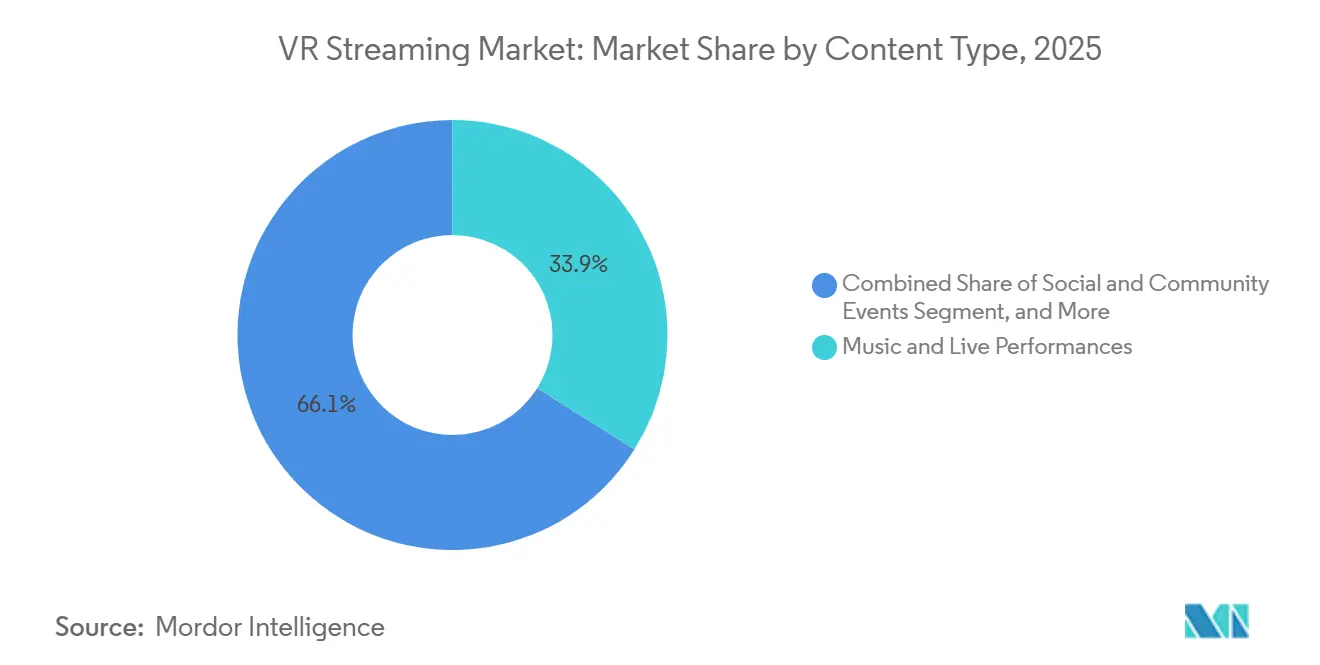
- By content type, music and live performances accounted for 33.92% of revenue in 2025, while sports are projected to expand at a 16.25% CAGR through 2031.
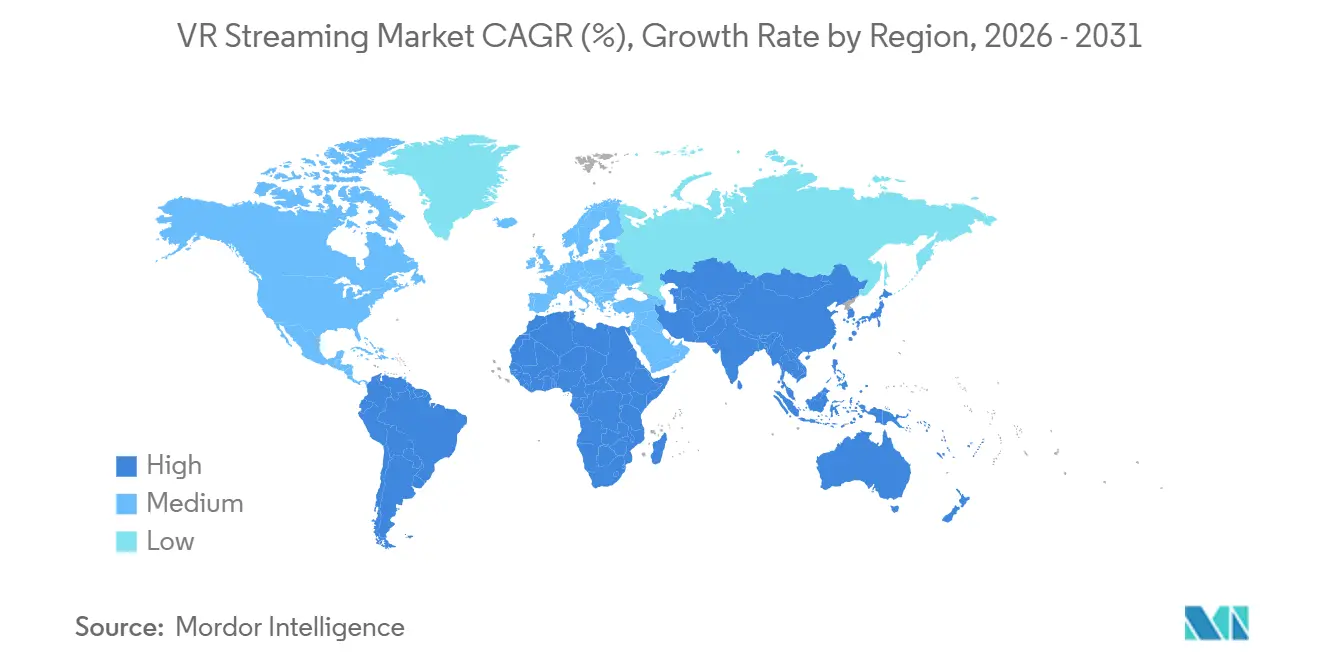
- By geography, North America held 44.73% of the VR streaming market share in 2025, while Asia-Pacific is projected to expand at a 16.48% CAGR through 2031.
Note: Market size and forecast figures in this report are generated using Mordor Intelligence’s proprietary estimation framework, updated with the latest available data and insights as of January 2026.
Market Trends and Insights
Drivers Impact Analysis of VR Streaming Market*
| Driver | (~) % Impact on CAGR Forecast | Geographic Relevance | Impact Timeline |
|---|---|---|---|
| Lower Latency 5G And Wi-Fi 7 Playback Conditions | +3.5% | Global, highest impact in Asia-Pacific and North America, where 5G Standalone rollout is most advanced | Short term (≤ 2 years) |
| Falling Standalone Headset Prices | +2.8% | Global, most pronounced in North America and Asia-Pacific consumer markets, as component costs normalize beyond 2026 | Medium term (2-4 years) |
| Edge Rendering Adoption For High-Fidelity Cloud Delivery | +2.5% | Global, North America, and Europe lead enterprise deployment, while Asia-Pacific is advancing through telecom-led programs | Medium term (2-4 years) |
| Subscription Bundling Across Device, Content, And Cloud Access | +2.2% | North America and Europe primarily, with spillover into the Asia-Pacific through platform expansion | Short term (≤ 2 years) |
| Enterprise Training Demand For Remote Immersive Delivery | +1.8% | Global, strongest in North America, Western Europe, and the Asia-Pacific enterprise corridors | Medium term (2-4 years) |
| Cross-Platform Content Portability Across Headsets And Services | +1.4% | Global, with standards adoption led by North America and Europe | Medium term (2-4 years) |
| Source: Mordor Intelligence | |||
Lower Latency 5G And Wi-Fi 7 Playback Conditions
The VR streaming market relies on low, stable latency because viewing comfort drops sharply as latency increases during head movement. Wi-Fi 7 multi-link operation has already shown stronger support for dense XR traffic, with academic testing indicating up to 50% more concurrent VR users than single-link operation under comparable bandwidth conditions. This matters most for live sports, concerts, and shared virtual events where image delay directly affects immersion. The NTT and NTT DOCOMO IOWN APN experiment in 2026 also showed that real-time fan interaction could run at an average one-way network latency of 0.04 milliseconds, reinforcing that a stronger network architecture can expand commercial use cases.[1]NTT Group Staff, “IOWN × VTuber Enable VR Meet and Greet with Virtual High-Five Experiences,” NTT Group News Release, group.ntt As a result, the VR streaming market is moving fastest in locations where high-performance wireless infrastructure is already usable at scale.
Falling Standalone Headset Prices
The VR streaming market should benefit as standalone headset pricing becomes easier for mainstream buyers over the forecast period. Standalone devices eliminate the need for a separate console, smartphone, or PC, simplifying the purchase decision for first-time users. That shift matters because adoption tends to rise when the buyer sees one device rather than a multi-device setup. Even with temporary cost pressure on components in 2026, the broader trend still favors broader access over time. This supports the VR streaming market by expanding the installed base able to consume immersive live, on-demand, and interactive content without additional hardware friction.
Edge Rendering Adoption for High-Fidelity Cloud Delivery
The VR streaming market is also being supported by edge rendering, which shifts heavy processing away from the headset and closer to the network. NVIDIA states that CloudXR 6.0 brings a universal OpenXR-based streaming runtime across headsets, operating systems, and browsers, including native Apple Vision Pro integration through visionOS 26.4. This lowers device dependency because the same high-fidelity content can be streamed across several hardware environments with less rework. It also helps enterprise buyers because lightweight devices can access more advanced simulations without relying only on local compute power. That makes the VR streaming market more scalable across training, design review, and premium consumer experiences.
Subscription Bundling Across Device, Content, and Cloud Access
The VR streaming market is gradually shifting from one-time hardware sales toward recurring access models. Meta states that Horizon+ had expanded to more than 100 titles by January 2026, indicating that subscription catalogs are becoming an increasingly important part of user retention. Bundled access also shortens the decision cycle because the user receives hardware, content, and service value together. Meta also reported that 67 apps in Horizon+ earned more than USD 20 million from the program, and some titles saw revenue growth of more than 60% after joining the catalog. This supports the VR streaming market by giving platforms and developers a more stable revenue path than relying solely on single-title purchases.
Restraints Impact Analysis of VR Streaming Market*
| Restraint | (~) % Impact on CAGR Forecast | Geographic Relevance | Impact Timeline |
|---|---|---|---|
| Latency Sensitivity in High Motion Content | -1.5% | Global, most acute where 5G Standalone coverage is limited, and Wi-Fi 7 infrastructure remains early | Short term (≤ 2 years) |
| Fragmented Device Ecosystems and App Store Constraints | -1.2% | Global, with the developer burden highest in North America and Europe | Medium term (2-4 years) |
| Limited Premium VR Content Libraries | -0.9% | Global, most visible in North America and Europe, where early adopters expect high-fidelity content | Short term (≤ 2 years) |
| Comfort, Motion Sickness, and Session Duration Limits | -0.7% | Global, with a stronger effect among older users and markets with lower prior VR exposure | Long term (≥ 4 years) |
| Source: Mordor Intelligence | |||
Latency Sensitivity in High-Motion Content
The VR streaming market still faces a technical ceiling for high-motion content because even modest delays can compromise comfort and performance. IEEE research in 2025 found that latency above 50 milliseconds measurably reduced task performance and triggered neural responses before users consciously recognized the delay. That makes fast camera movement, interactive sports viewing, and audience participation harder to scale across uneven network environments. A separate IEEE umbrella review found that latency was the most consistently cited hardware risk factor in cybersickness research, appearing in 72% of the reviewed literature. This means the VR streaming market will continue to generate revenue first in areas where high-performance wireless coverage is already reliable.
Fragmented Device Ecosystems and App Store Constraints
The VR streaming market also remains constrained by platform fragmentation across headset software stacks and storefront rules. Developers still face different requirements across Meta Horizon OS, Apple visionOS, Android XR, and other emerging spatial systems. That fragmentation raises publishing costs and slows the portability of content from one installed base to another. It also favors larger companies that can afford parallel development and certification work. As a result, the VR streaming market can expand more slowly outside the leading ecosystems when smaller studios choose to prioritize only one platform.
*Our forecasts treat driver/restraint impacts as directional, not additive. The impact forecasts reflect baseline growth, mix effects, and variable interactions.
VR Streaming Market Segment Analysis
By Streaming Type:
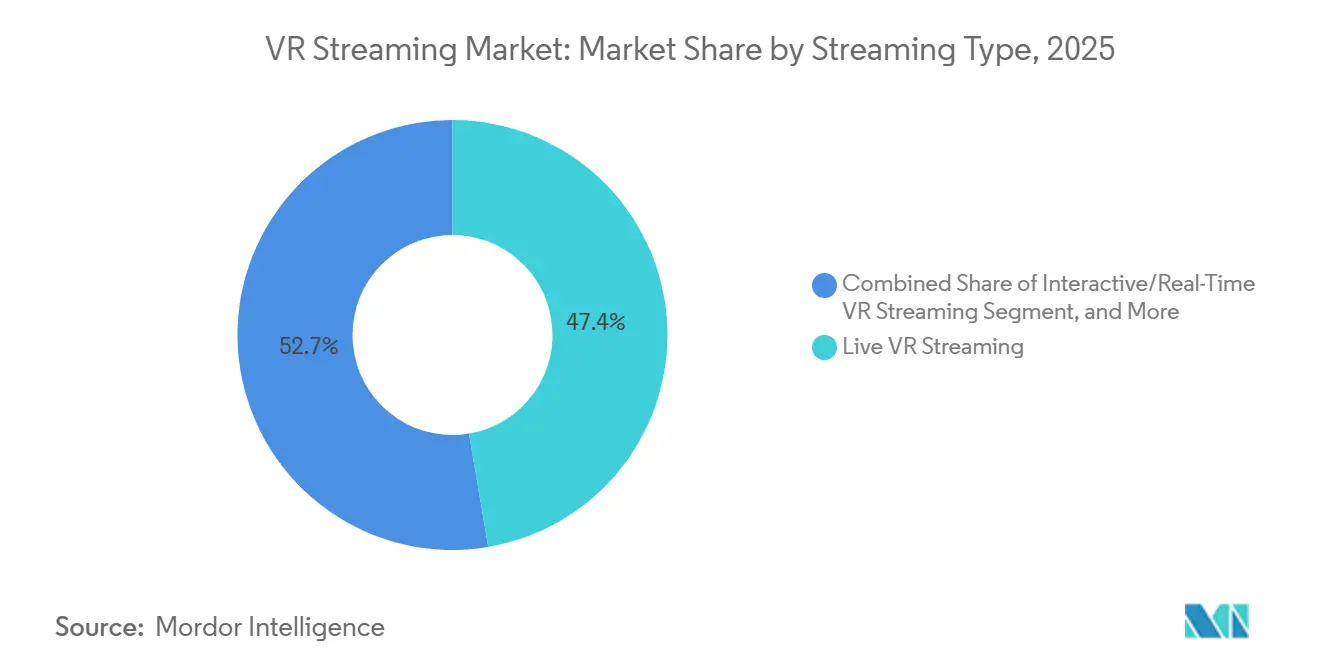
Live Formats Hold Revenue Leadership While Interactivity Raises Monetization PotentialLive VR streaming accounted for 47.35% of revenue in 2025, making it the largest format in the VR streaming market. Its lead reflects the simple fact that real-time events create urgency that catalog viewing cannot fully match. Audiences are more likely to pay for access when the value depends on being present during the event itself. That keeps live viewing central to sports, concerts, and special event programming across the VR streaming market.
On-demand streaming still plays an important role because it introduces users to immersive viewing before they commit to live sessions. It also gives platforms a library layer that helps extend engagement between tentpole events. Interactive, real-time VR streaming is projected to expand at a 16.07% CAGR through 2031, making it the fastest-growing streaming type in the VR streaming market. NTT and NTT DOCOMO demonstrated this direction in 2026 through a VR fan meeting featuring real-time high-five interaction at an average one-way network latency of 0.04 milliseconds, showing how participation can become part of the paid experience.



By Device Type:
Standalone Headsets Lead Adoption Through Simplicity and PortabilityStandalone VR headsets held a 36.48% share in 2025 and are projected to grow at a 16.31% CAGR through 2031, positioning them at the center of the VR streaming market. Their strongest advantage is ease of use, because tracking, computing, and display functions are built into one device. That setup removes cable friction and dependence on secondary hardware, which had previously limited consumer uptake. The result is a device segment that leads both present demand and future growth in the VR streaming market.
This pattern also changes how content providers think about distribution, as a single self-contained device is easier to support at scale. Tethered headsets still matter in enterprise and professional simulation, where visual fidelity remains the main priority. NVIDIA positions CloudXR 6.0 as a cross-device streaming runtime, which supports the role of premium and enterprise-grade headsets in cases where advanced rendering still matters most. Smartphone-based viewers continue to lose structural importance, while console-based setups retain a narrower but defensible role among existing gaming households within the VR streaming market.
By Content Type:
Music And Live Performances Lead Revenue While Sports Gains SpeedMusic and live performances accounted for 33.92% of content revenue in 2025, making them the largest category in the VR streaming market. The segment benefited from a repeatable concert format and a stronger base of immersive entertainment use. It has also been easier to scale because performance capture and event scheduling align well with premium virtual access. This gives music content a broad installed audience while the VR streaming market continues to widen into additional use cases.
Sports is projected to expand at a 16.25% CAGR through 2031, making it the fastest-growing content type in the VR streaming market. Apple and Charter launch Spectrum Front Row in January 2026 to deliver live Los Angeles Lakers games in the Apple Immersive format, demonstrating that sports viewing can work as a premium extension within an existing subscription relationship.[2]Apple Newsroom Staff, “Spectrum Front Row Tips Off January 9 on Apple Vision Pro,” Apple Newsroom, apple.com Education and training continue to build institutional demand, while branded experiences and social events add a smaller but growing commercial layer. Together, these categories broaden the VR streaming market beyond entertainment and support a more diverse mix of revenue sources.
Geography Analysis
North America and Europe VR Streaming Market
North America accounted for 44.73% of global revenue in 2025, making it the largest region in the VR streaming market. The United States leads because it brings together platform operators, sports rights holders, enterprise adopters, and premium content budgets into a single ecosystem. Apple launches Spectrum Front Row in January 2026 for qualifying Spectrum subscribers on the Apple Vision Pro, demonstrating that U.S. rights structures are already supporting commercial immersive sports distribution. Europe remains important because industrial simulation and enterprise training create demand outside pure consumer entertainment.
Europe and APAC VR Streaming Market
Focal Point XR reported that Roland-Garros 2025 delivered the first 8K-per-eye, 50 FPS live, immersive, 180° stereoscopic tennis livestream on Apple Vision Pro, signaling early investment in premium immersive sports production across the region.[3]Focal Point XR Staff, “RGLAB 2025,” Focal Point XR, focalpointxr.com Asia-Pacific is projected to grow at a 16.48% CAGR through 2031, making it the fastest-expanding regional segment in the VR streaming market. Growth in the region is supported by strong network quality, active virtual entertainment ecosystems, and wider institutional interest in immersive formats. Japan stands out because its VTuber and live-event economy provides the VR streaming market with a recurring commercial model beyond one-off demonstrations.
APAC, South America and MEA VR Streaming Market
NTT and NTT DOCOMO show this in 2026 through an IOWN APN experiment that reduced event operating costs by 20% versus conventional studio setups while enabling real-time virtual fan interaction. China is developing along both consumer entertainment and enterprise deployment tracks, while India and Australia add access and training demand through different adoption models. South America remains in an earlier expansion phase of the VR streaming market, with Brazil acting as the primary regional hub. Adoption is moving more slowly because network readiness and headset affordability still limit wider scale. The Middle East is emerging through public investment in digital entertainment and immersive experience infrastructure. Africa is the smallest regional segment in the VR streaming market, and near-term progress remains tied to bandwidth upgrades and device access in early-adopter countries.

Competitive Landscape
The VR streaming market is moderately concentrated at the platform layer and fragmented across content and application layers. Meta holds a strong position in the consumer installed base through the Quest ecosystem, which keeps it central to how developers prioritize headset support. NVIDIA is shaping a different role in the VR streaming market by positioning CloudXR 6.0 as a cross-platform streaming layer that works across multiple device environments.[4]Max Bickley, “Stream High-Fidelity Spatial Computing Content to Any Device with NVIDIA CloudXR 6.0,” NVIDIA Technical Blog, developer.nvidia.com This means competition is not defined by a single model, because some companies are building on hardware scale while others are building on infrastructure, content access, or enterprise delivery.
Meta is strengthening its platform position by offering bundled content access and a broader subscription catalog in the VR streaming market. The company states that Horizon+ had expanded to more than 100 titles by January 2026, while developers in the program had already generated more than USD 20 million in revenue across 67 participating apps. Apple is pursuing a premium path in the VR streaming market through immersive sports distribution tied to its Vision Pro ecosystem and existing pay-TV relationships. NVIDIA is focusing on the infrastructure side by making high-fidelity streaming less dependent on local device power. NTT and NTT DOCOMO add another competitive angle because telecom-backed low-latency experiences can support premium interactive events as the VR streaming market matures.
The remaining white space is strongest in enterprise-grade interactive delivery, where regulated training and professional collaboration still need more specialized solutions. That gap leaves room for vendors that can combine device compatibility, cloud rendering, and compliance-oriented delivery. It also means the VR streaming market is unlikely to be controlled by one company across all content types and regions during the forecast period. Competitive pressure should stay high because growth is being shaped by several distinct positions rather than by a single winner-take-all structure.
VR Streaming Industry Leaders
Microsoft Corporation
NVIDIA Corporation
Meta Platforms, Inc.
Google LLC
Apple Inc.
- *Disclaimer: Major Players sorted in no particular order
VR Streaming Market Companies Covered in this Report
- Apple Inc.
- ByteDance Ltd.
- Ericsson
- Google LLC
- HTC Corporation
- Intel Corporation
- Meta Platforms, Inc.
- Microsoft Corporation
- NVIDIA Corporation
- PICO Immersive Pte. Ltd.
- Qualcomm Incorporated
- Samsung Electronics Co., Ltd.
- Sony Group Corporation
- Tencent Holdings Limited
- Unity Software Inc.
- Valve Corporation
- Varjo Technologies Oy
- Amazon.com, Inc.
- NetEase, Inc.

Recent Industry Developments in VR Streaming Market
- April 2026: NTT and NTT DOCOMO completed a joint VR fan meeting experiment, conducted March 15, 2026, using IOWN APN, achieving 0.04-millisecond average one-way network latency and 20% lower operational costs versus conventional studio setups, demonstrating commercial viability of real-time haptic VR events at scale.
- March 2026: NVIDIA launched CloudXR 6.0 at GTC 2026, introducing a universal OpenXR-based streaming runtime with native Apple Vision Pro integration via visionOS 26.4, enabling 4K-class spatial content at 90 FPS over standard 5 GHz Wi-Fi at 8 Mbps downstream, making high-fidelity VR streaming device-agnostic for the first time at commercial scale.
- January 2026: Apple and Charter Communications launched Spectrum Front Row on Apple Vision Pro from January 9, 2026, delivering live Los Angeles Lakers NBA games in Apple Immersive format to qualifying Spectrum subscribers in Southern California, Hawaii, and parts of Nevada, the first recurring regional sports VR streaming service tied to an existing pay-TV authentication system.
- January 2026: Meta expanded the Horizon+ catalog to more than 100 titles after the service crossed 1 million active subscribers in 2025 and opened developer enrollment to eligible apps through both the Games Catalog and a new Indie Catalog, broadening the subscription content pipeline for platform-level VR streaming.


Global VR Streaming Market Report Scope
The VR streaming market refers to the delivery of immersive virtual reality content through internet-based streaming platforms and services, enabling users to access real-time or on-demand VR experiences across compatible devices. The scope of the report covers market trends, growth drivers, restraints, opportunities, and key developments across VR streaming applications, platforms, content types, and end-user segments.
The VR Streaming Market Report is Segmented by Streaming Type (Live VR Streaming, On-Demand VR Streaming, and Interactive/Real-Time VR Streaming), Device Type (Standalone VR Headsets, Tethered VR Headsets, Smartphone-Based VR Viewers, and Console-Based VR Setups), Content Type (Music and Live Performances, Sports, Education and Training, Branded Experiences, Brand Events, and Advertising, Social and Community Events, and Other Content Types), and Geography (North America, South America, Europe, Asia-Pacific, Middle East, and Africa). The Market Forecasts are Provided in Terms of Value (USD).
| Live VR Streaming |
| On-Demand VR Streaming |
| Interactive/Real-Time VR Streaming |
| Standalone VR Headsets |
| Tethered VR Headsets |
| Smartphone-Based VR Viewers |
| Console-Based VR Setups |
| Music and Live Performances |
| Sports |
| Education and Training |
| Branded Experiences, brand events and Advertising |
| Social and Community Events |
| Other Content Types |
| North America | United States |
| Canada | |
| Mexico | |
| South America | Brazil |
| Argentina | |
| Chile | |
| Rest of South America | |
| Europe | Germany |
| United Kingdom | |
| France | |
| Italy | |
| Spain | |
| Rest of Europe | |
| Asia-Pacific | China |
| Japan | |
| India | |
| South Korea | |
| Australia | |
| Rest of Asia-Pacific | |
| Middle East | Saudi Arabia |
| United Arab Emirates | |
| Qatar | |
| Rest of Middle East | |
| Africa | South Africa |
| Egypt | |
| Nigeria | |
| Rest of Africa |
| By Streaming Type | Live VR Streaming | |
| On-Demand VR Streaming | ||
| Interactive/Real-Time VR Streaming | ||
| By Device Type | Standalone VR Headsets | |
| Tethered VR Headsets | ||
| Smartphone-Based VR Viewers | ||
| Console-Based VR Setups | ||
| By Content Type | Music and Live Performances | |
| Sports | ||
| Education and Training | ||
| Branded Experiences, brand events and Advertising | ||
| Social and Community Events | ||
| Other Content Types | ||
| By Geography | North America | United States |
| Canada | ||
| Mexico | ||
| South America | Brazil | |
| Argentina | ||
| Chile | ||
| Rest of South America | ||
| Europe | Germany | |
| United Kingdom | ||
| France | ||
| Italy | ||
| Spain | ||
| Rest of Europe | ||
| Asia-Pacific | China | |
| Japan | ||
| India | ||
| South Korea | ||
| Australia | ||
| Rest of Asia-Pacific | ||
| Middle East | Saudi Arabia | |
| United Arab Emirates | ||
| Qatar | ||
| Rest of Middle East | ||
| Africa | South Africa | |
| Egypt | ||
| Nigeria | ||
| Rest of Africa | ||


Key Questions Answered in the Report
What is the current and forecast size of the VR streaming market?
The VR streaming market size was USD 2.67 billion in 2025, stands at USD 3.05 billion in 2026, and is forecast to reach USD 6.33 billion by 2031 at a 15.72% CAGR.
Which streaming format leads revenue generation?
Live VR streaming led with 47.35% revenue share in 2025 because real-time events create urgency and stronger willingness to pay than library viewing.
Which device category is growing fastest in VR streaming?
Standalone VR headsets are both the largest device segment, with a 36.48% share in 2025, and the fastest-growing segment, with a 16.31% CAGR through 2031.
Why are sports becoming more important for immersive video platforms?
Sports are projected to grow at a 16.25% CAGR through 2031 as rights holders begin using immersive viewing as a premium distribution layer beyond flat-screen streaming.
Which region leads to global revenue, and which one is growing the fastest?
North America held 44.73% of revenue in 2025, while Asia-Pacific is expected to record the fastest growth at a 16.48% CAGR through 2031.
What is the main challenge slowing wider adoption?
Latency remains the biggest operational challenge because high-motion content becomes uncomfortable as delays increase, especially in environments without strong 5G Standalone or advanced Wi-Fi.
Page last updated on:





