
Visual Quality Inspection Platforms Market Size and Share
Market Overview
| Study Period | 2020 - 2031 |
|---|---|
| Market Size (2026) | USD 3.85 Billion |
| Market Size (2031) | USD 5.28 Billion |
| Growth Rate (2026 - 2031) | 6.52 % |
| Fastest Growing Market | South America |
| Largest Market | Asia-Pacific |
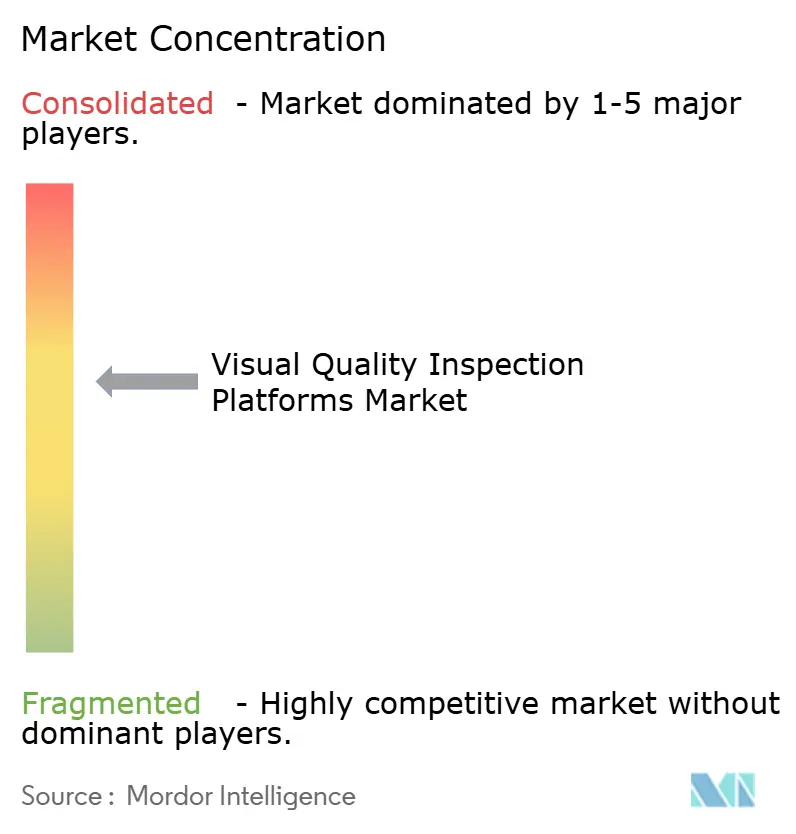
| Market Concentration | Medium |
Major Players *Disclaimer: Major Players sorted in no particular order Image © Mordor Intelligence. Reuse requires attribution under CC BY 4.0. | |
Visual Quality Inspection Platforms Market Analysis by Mordor Intelligence
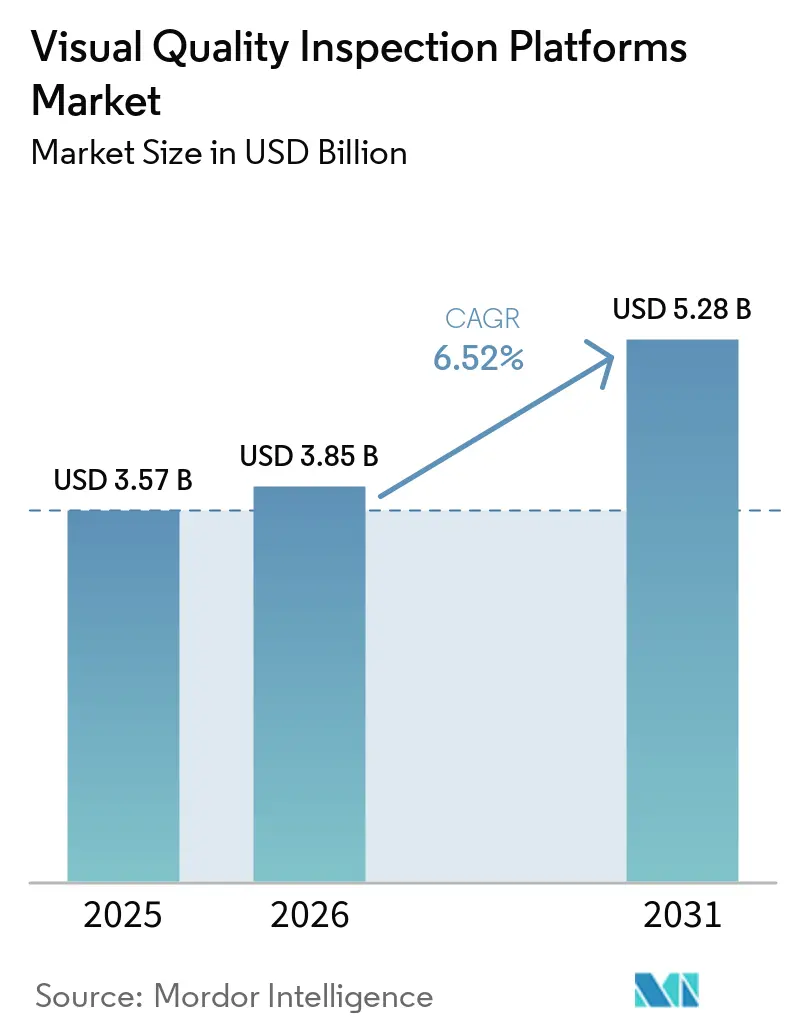
The visual quality inspection platforms market size is projected to expand from USD 3.57 billion in 2025 and USD 3.85 billion in 2026 to USD 5.28 billion by 2031, registering a CAGR of 6.52% between 2026 and 2031. Lower edge computing costs, broader deep-learning use cases, and tighter quality requirements support adoption across industrial production lines. Manufacturers are using these systems to reduce manual inspection errors in areas where a defective part can create high safety, recall, or compliance costs. The visual quality inspection platforms market is moving from specialized electronics applications toward wider use in mid-sized and large manufacturing facilities. Suppliers are combining cameras, optics, lighting, processing, and software into integrated products, while platform providers are making it easier to manage models across several sites. Data availability, model validation, cybersecurity, and integration with older factory systems continue to shape buying decisions and deployment schedules.
Key Report Takeaways
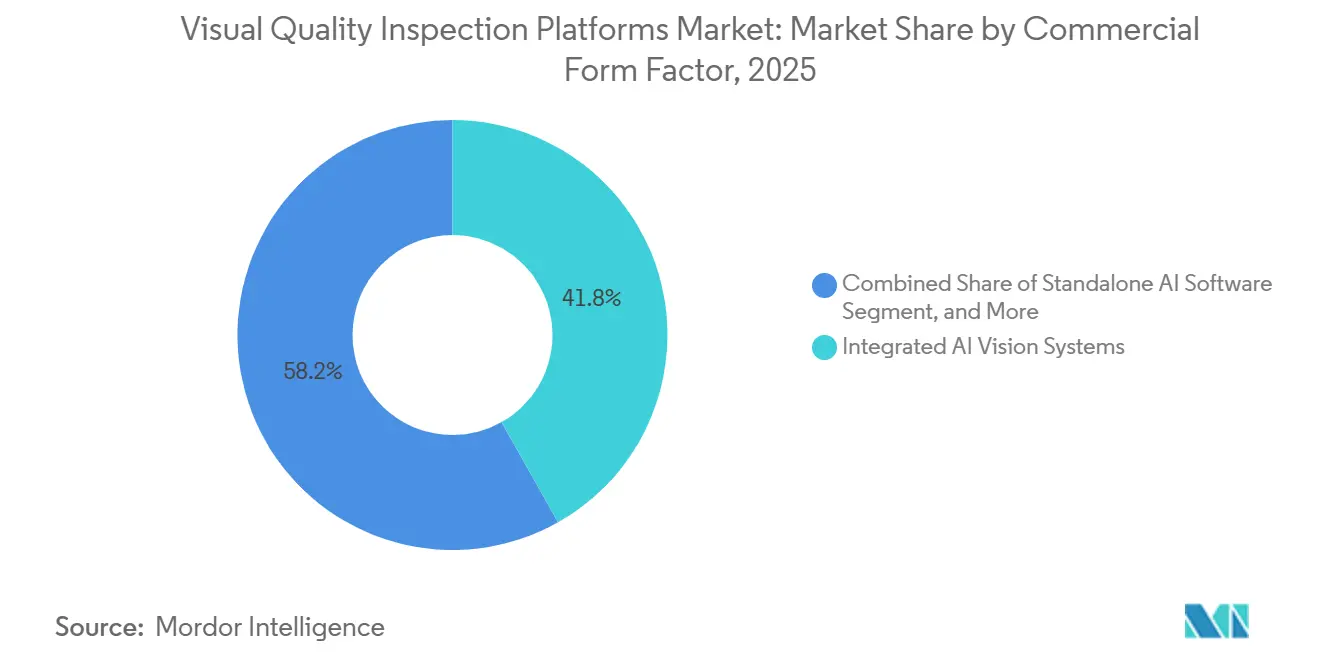
- By commercial form factor, integrated AI vision systems held 41.83% of the visual quality inspection platforms market share in 2025, while AI vision platforms and APIs are projected to expand at an 8.27% CAGR through 2031.
- By deployment architecture, edge or embedded AI held 56.92% revenue share in 2025, while cloud or SaaS is projected to expand at a 9.12% CAGR through 2031.
- By inspection modality, 2D imaging inspection held 65.07% revenue share in 2025, while multispectral and hyperspectral inspection is projected to expand at a 9.37% CAGR through 2031.
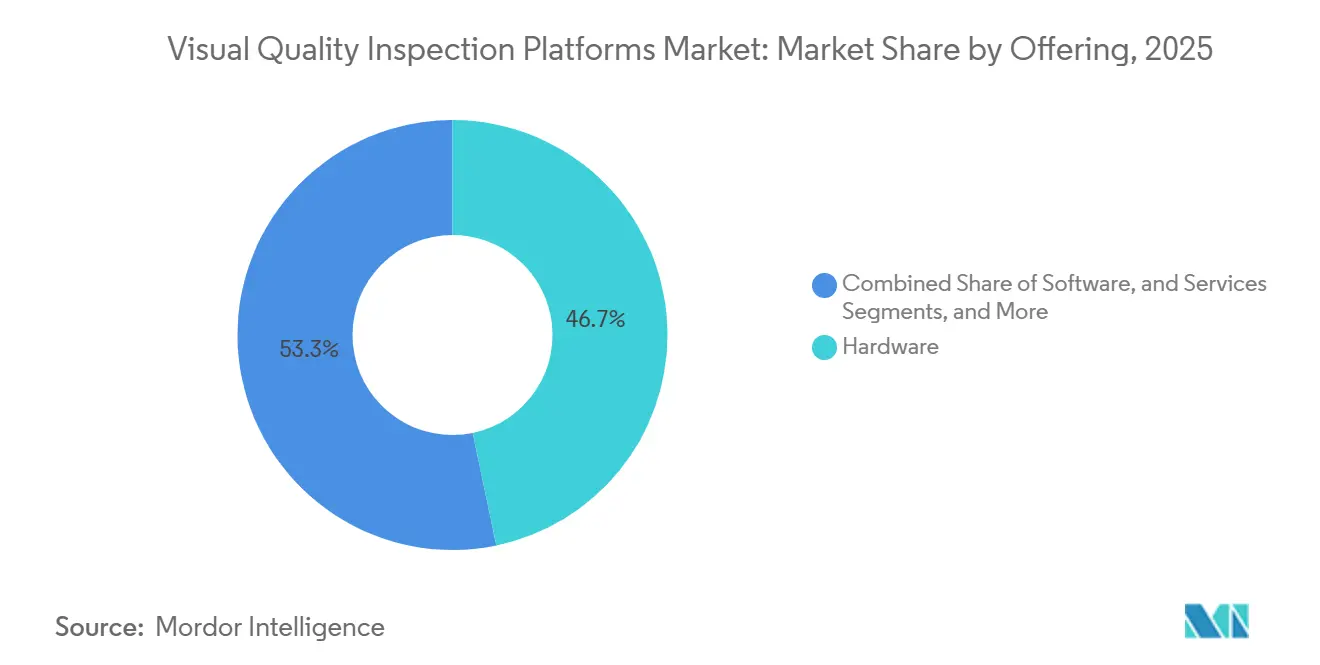
- By offering, hardware held 46.74% revenue share in 2025 in the visual quality inspection platforms market, while software is projected to expand at a 7.91% CAGR through 2031.
- By end-user industry, electronics and semiconductor held 26.17% revenue share in 2025, while EV and battery manufacturing is projected to expand at a 9.16% CAGR through 2031.
- By geography, Asia-Pacific held 39.12% revenue share in 2025, while South America is projected to expand at an 8.06% CAGR through 2031 in the visual quality inspection platforms market.
Note: Market size and forecast figures in this report are generated using Mordor Intelligence’s proprietary estimation framework, updated with the latest available data and insights as of January 2026.
Global Visual Quality Inspection Platforms Market Trends and Insights
Drivers Impact Analysis*
| DRIVER | (~) % IMPACT ON CAGR FORECAST | GEOGRAPHIC RELEVANCE | IMPACT TIMELINE |
|---|---|---|---|
| AI-Based Defect Detection and Classification | +1.5% | Global | Short term (≤ 2 years) |
| EV and Battery Manufacturing Quality Requirements | +1.2% | Asia-Pacific, Europe, North America | Medium term (2-4 years) |
| Falling Edge AI Compute Costs | +1.0% | Global | Short term (≤ 2 years) |
| Labor Shortages in Quality Operations | +0.8% | North America and Europe, spill-over to Asia-Pacific | Short term (≤ 2 years) |
| Factory Digitalization and Industry 4.0 Investment | +0.7% | Asia-Pacific core, Europe, spill-over to Middle East and Africa | Medium term (2-4 years) |
| Regulatory Traceability and Validation Requirements | +0.5% | Europe, North America | Medium term (2-4 years) |
| Source: Mordor Intelligence | |||
AI-Based Defect Detection and Classification
Deep-learning vision models can classify surface defects at sub-100-micrometer tolerances across several material types. Rule-based systems often need manual recalibration when products, materials, or lighting conditions change. A 2026 Scientific Reports study found that multi-scale contextual detection architectures achieved mAP50 scores above 95% on industrial defect benchmarks while processing more than 100 frames per second. This performance supports real-time use on factory lines with limited latency tolerance. The visual quality inspection platforms market benefits because manufacturers can extend an existing inspection setup to new stock-keeping units with fewer relabeling cycles. A 2025 study of the CLIP-MDC architecture reported 99.9% AUROC on the MVTec AD dataset and an average inference speed of 6.6 milliseconds, showing how faster inference and improved accuracy can support high-frequency product changeovers.
EV and Battery Manufacturing Quality Requirements
Battery manufacturing requires close control of joining, sealing, assembly, and thermal conditions because a defective component can reach a finished pack with serious safety consequences. A faulty cell connector cannot be treated like an ordinary powertrain defect, and an undetected issue can raise the risk of thermal runaway, recall activity, and liability. Atlas Copco’s VisionTools offering uses AI-based verification for battery-line joining, sealing, and assembly steps, with anomaly detection supporting corrective action during production.[1]Cognex Corporation, “Cognex Launches In-Sight Vision Controller Powered by NVIDIA,” Cognex Corporation, prnewswire.com Its Advanced Verification with V60 software also supports thermal profiling of cell modules. Research on lithium-ion pouch-cell laser welds found that an AI classifier trained with synthetic data achieved precision of 0.94 and recall of 0.98. These uses make combined 2D, 3D, and thermal inspection more relevant as battery manufacturers require traceable inspection records for high-volume production.
Falling Edge AI Compute Costs
Lower-cost edge processing is helping factories place AI inference closer to cameras and production equipment. In 2026, neural processing units and edge-focused graphics processors operate at power envelopes below 15 watts, making fanless and rugged installations more practical in factory settings. Cognex launched the In-Sight 6900 Vision Controller in April 2026 with NVIDIA Jetson processing and 157 TOPS of AI compute for neural-network inspection tasks. In May 2026, Cognex introduced the In-Sight 3900 with Qualcomm Dragonwing processing, offering up to 25 MP imaging and processing speeds four times faster than its predecessor. These products reduce dependence on an external PC and simplify system design for packaging, automotive, and electronics lines. The visual quality inspection platforms market can therefore reach food, beverage, and mid-tier automotive suppliers that had delayed deployment because of integration and hardware costs.
Labor Shortages in Quality Operations
Labor shortages are increasing the value of systems that can perform repetitive visual checks without relying on scarce inspection personnel. In ETQ’s 2025 survey of 752 quality leaders in the United States, United Kingdom, and Germany, 70% of U.S. respondents said labor shortages affected their organizations. Of those affected respondents, 88% said the shortage had affected product or service quality.[2]ETQ, a Hexagon Division, “Annual ETQ Pulse of Quality in Manufacturing Survey Reveals Widespread Labor Shortage Continues in 2025, Growing Use of Automation, AI, to Address It,” ETQ, prnewswire.com The survey also found that 45% cited AI applications for spotting factory-floor defects as a deployed or planned response, while 49% planned to implement AI within 2 years and 60% planned to increase quality spending. Historical inspection images can preserve the judgment of experienced inspectors who are leaving the workforce. This gives visual inspection systems a role in retaining operating knowledge as well as reducing manual workload.
Restraints Impact Analysis*
| RESTRAINT | (~) % IMPACT ON CAGR FORECAST | GEOGRAPHIC RELEVANCE | IMPACT TIMELINE |
|---|---|---|---|
| Training-Data and Model-Validation Costs | -0.8% | Global | Short term (≤ 2 years) |
| Legacy Automation and MES Integration Complexity | -0.6% | North America and Europe, brownfield facilities | Medium term (2-4 years) |
| Cloud Data Sovereignty and Industrial Cybersecurity Exposure | -0.5% | Asia-Pacific core, Europe | Medium term (2-4 years) |
| Model Drift in High-Mix, Low-Volume Production | -0.4% | Global, concentrated in precision manufacturing hubs | Long term (≥ 4 years) |
| Source: Mordor Intelligence | |||
Training-Data and Model-Validation Costs
Production-grade AI inspection models need labeled images for each relevant defect class, which can be difficult for companies without systematic image archives. A 2025 study on active learning for industrial defect detection found that competitive F1 scores required more than 2,400 labeled samples across defect classes, even when hybrid sampling methods were used.[3]Ricardo Pinto et al., “Active Learning for Industrial Defect Detection: A Study on Hybrid Sampling Strategies,” International Journal of Advanced Manufacturing Technology, link.springer.com Collecting and labeling this volume can take weeks before validation begins. Model validation must also be repeated after a line change, different lighting, or a material supplier change. These requirements can leave high-mix facilities with proof-of-concept projects that exceed their original budget or deployment schedule. Synthetic data can help, but it is less dependable for subtle surface textures where simulated images differ from actual production images.
Legacy Automation and MES Integration Complexity
AI vision outputs must connect with manufacturing execution systems, supervisory control systems, and programmable logic controllers to influence production decisions. Older facilities often combine automation equipment from several suppliers and generations. This can require protocol translation, network upgrades, and coordination between information technology and operational technology teams. Modern manufacturing execution systems with open application programming interfaces can support integration in weeks. Proprietary or end-of-life systems can require multi-month projects, including cybersecurity reviews and network segmentation. The visual quality inspection platforms market, therefore, sees earlier adoption in greenfield facilities and at large manufacturers with dedicated automation teams, while many brownfield sites progress more slowly.
*Our forecasts treat driver/restraint impacts as directional, not additive. The impact forecasts reflect baseline growth, mix effects, and variable interactions.
Segment Analysis
By Commercial Form Factor - Integrated Systems Lead, While Platforms Support Scaling
Integrated AI vision systems held 41.83% of revenue in 2025, giving them the leading commercial form-factor position. Buyers favor purpose-built hardware-and-software combinations when a production line cannot tolerate prolonged configuration work or unclear accountability. A single supplier can provide the camera, optics, lighting, controller, software, and technical support. This structure helps manufacturers reduce deployment risk on high-throughput lines. Existing hardware customers can often upgrade to AI-capable systems without replacing mounting equipment, cabling, or lighting. That upgrade path supports renewals for established equipment suppliers. It also makes it harder for software-only vendors to replace an installed system in a single purchasing cycle. Integrated products remain important where the customer wants a defined inspection system rather than a separately assembled solution. This preference gives the visual quality inspection platforms market a practical entry route for buyers that prioritize deployment certainty over component-level choice.
Standalone AI software remains relevant for manufacturers with serviceable camera infrastructure. These buyers can add inference capability without replacing working industrial cameras and related equipment. AI inspection services include model training, deployment support, optimization, and managed operations. These services are useful in pharmaceutical, food safety, and regulated electronics settings where internal teams may not have machine-learning operations capability. AI vision platforms and APIs are projected to expand at an 8.27% CAGR through 2031 as multi-site manufacturers seek centralized model governance. Cognex made OneVision generally available in May 2026 after beta testing with more than 100 customers. The company reported that Essity built a sealing inspection application in less than 1 day, compared with an earlier process that took more than 1 year of iteration, while Schneider Electric reported a doubling of yield after a centralized deployment. These cases show why platforms are becoming increasingly important as inspection programs expand across multiple plants.



By Deployment Architecture - Edge Retains Its Lead While Cloud Supports Model Management
Edge or embedded AI accounted for 56.92% of revenue in 2025. Fast production lines often require pass-or-fail decisions in less than 50 milliseconds. Local processing also avoids dependence on uninterrupted internet connectivity, which may not meet factory uptime requirements. Data-handling rules in Asia-Pacific and Europe can limit the transfer of production images to outside cloud infrastructure. These conditions favor systems that execute inference at the camera or near the line. Edge installations can also keep sensitive product images inside the facility. This approach is particularly suitable for applications where response speed and local data control are both essential. It explains why embedded systems remain common despite the growth of cloud tools. This requirement continues to shape the visual quality inspection platforms market as customers compare local control with centralized management.
On-premise servers and workstations continue to serve semiconductor wafer inspection and aerospace surface analysis. These use cases may need more processing capacity than an embedded controller can provide, while still requiring local control of sensitive images. Cloud or SaaS is projected to expand at a 9.12% CAGR through 2031, mainly for model training, image annotation, version control, and fleet-wide updates. Panasonic Holdings began global licensing of its AI Platform for Visual Inspection in March 2026, offering on-premises, cloud, and hybrid configurations.[4]Panasonic Holdings Corporation, “Panasonic HD Launches Global Licensing of AI Platform for Visual Inspection,” Panasonic Holdings Corporation, news.panasonic.com The platform includes blockchain-based data integrity management and supports model development through monitoring. The International Federation of Robotics reported 542,000 industrial robot installations worldwide in 2024, creating a growing installed base of potential endpoints for managed model updates. Cloud tools can therefore support lifecycle management without requiring cloud-based runtime inspection for every application.
By Inspection Modality - 2D Leads While Spectral Systems Extend Detection
2D imaging inspection accounted for 65.07% of revenue in 2025, the largest share of inspection modalities. Area-scan and line-scan camera systems are already widely used in electronics, automotive, and food and beverage production. Their installed base and broad fit with surface-defect tasks support continued demand. AI models can improve detection performance without requiring customers to replace all camera hardware. A 2025 study reported a 99.9% AUROC on industrial defect benchmarks, with inference times suitable for line-speed operations. This lets facilities extend the useful life of established 2D camera systems. The modality remains the practical starting point for many visual quality-control applications. Its maturity also gives customers a large pool of integrators and proven components. These established ecosystems support the visual quality inspection platforms market, where manufacturers need a lower-risk path from conventional vision to AI-assisted inspection.
3D imaging is gaining use in precision assembly verification, weld-bead geometry measurement, and semiconductor packaging confirmation. Volumetric information can resolve issues that a 2D image cannot show clearly. Thermal and specialty imaging support applications, such as weld monitoring and additive manufacturing certification, where temperature patterns can indicate internal material conditions. Multispectral and hyperspectral inspection is projected to expand at a 9.37% CAGR through 2031. Pharmaceutical tablet verification, food contamination screening, and EV electrode-coating checks are driving this demand. A 2026 systematic review found that spectral sensors can identify subsurface anomalies through absorption differences. This capability helps manufacturers inspect chemical and material characteristics without destroying the product. Spectral systems, therefore, address tasks in which surface geometry alone is insufficient to establish product safety or quality.
By Offering - Hardware Holds the Largest Position While Software Grows Through Recurring Models
Hardware accounted for 46.74% of revenue in 2025, the largest offering position. Initial installations require industrial cameras, optics, lighting, controllers, and edge compute modules. These components make up much of the initial system cost and create a capital-intensive entry point. Replacing legacy rule-based cameras with AI-capable embedded systems increases hardware demand. Automotive, electronics, and industrial manufacturers have a large installed base that can be upgraded over several years. This replacement cycle gives hardware suppliers a stable revenue base. It also supports their position among customers who prefer a complete product from a single provider. Hardware leadership does not remove the need for software, but it reflects the physical requirements of an inspection station. The visual quality inspection platforms market remains tied to this installed equipment base, even as software subscription models become more common.
Software is projected to expand at a 7.91% CAGR through 2031 as subscription and platform pricing become more common. AI vision SaaS, managed training environments, and per-station licenses can change one-time equipment spending into recurring revenue. KEYENCE introduced the VS-G Series AI-powered vision platform in July 2026 with a custom 32-core processor and an onboard AI engine.[5]KEYENCE CORPORATION, “VS-G Series AI-Powered Vision Platform,” KEYENCE CORPORATION, keyence.com The company stated that the platform can process tasks up to 13 times faster than conventional vision systems. The offering shows how hardware suppliers are embedding more software intelligence directly into their products. Services are also expanding to include integration, dataset development, post-deployment optimization, and managed inspection operations. These services help manufacturers without internal computer vision specialists manage the full lifecycle, from model creation to production use.
By End-User Industry - Electronics Leads While EV and Battery Manufacturing Expands Fastest
Electronics and semiconductors accounted for 26.17% of revenue in 2025, the leading end-user segment. The sector requires 100% in-line inspection at tolerances that are difficult for human inspectors to maintain at production speeds. Semiconductor wafer and printed circuit board inspection were among the early commercial settings for neural-network-based inspection. These environments already had detailed defect taxonomies, image libraries, and measurement procedures. That foundation made it easier to train and validate visual models. Electronics manufacturers also operate high-throughput lines where even small improvements in detection can affect yield and rework. The segment remains a core customer base for machine vision suppliers. Its need for precision continues to support demand for advanced cameras, optics, and AI software. This long-standing use case provides the visual quality inspection platforms market with a stable base as newer end-user industries adopt related capabilities.
EV and battery manufacturing is projected to expand at a 9.16% CAGR through 2031. Growth is tied to gigafactory expansion and the high costs of failures in energy storage production. IBM and Seres Group expanded an AI visual inspection deployment across 3 smart factories in China in April 2026. The platform supported the rollout of a self-service model for more than 100 inspection scenarios. Pharmaceutical and medical device manufacturers are also increasing adoption because inspection records must support batch release and comply with good manufacturing practice requirements. Automotive, food and beverage, aerospace and defense, and metals and machinery remain meaningful end-user groups. Daihatsu deployed an AI inspection system at its Shiga plant in June 2026 to detect scratches in machined aluminum holes at a 0.1 mm tolerance. This use reflects deeper adoption in powertrain processes that previously relied on manual inspection methods.
Geography Analysis
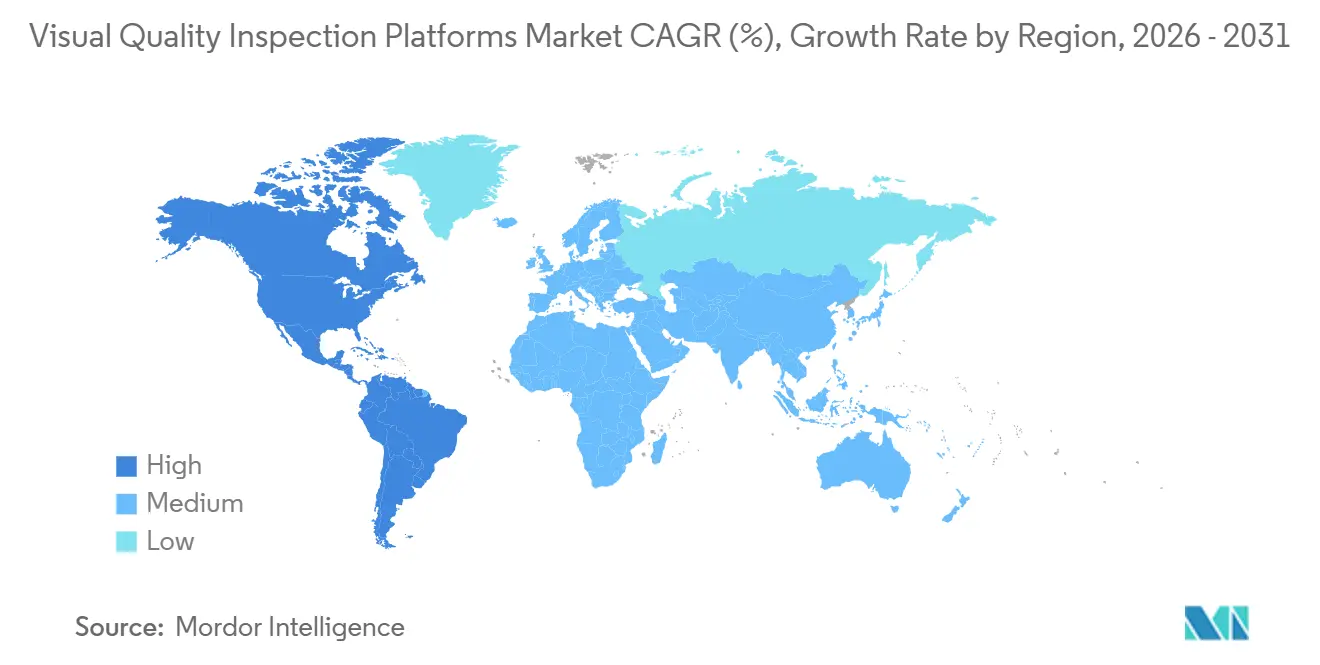
Asia-Pacific held 39.12% of the visual quality inspection platforms market share in 2025. The region combines major electronics and semiconductor supply chains with EV battery capacity and established factory automation. China, South Korea, and Japan are central sources of demand because their manufacturing sectors operate high-volume, quality-sensitive production lines. In January 2026, China’s Ministry of Industry and Information Technology and 7 co-ministries issued the AI Plus Manufacturing Action Plan. The plan includes targets for 500 benchmark AI inspection application scenarios and 1,000 high-performance industrial AI agents. Japan’s pattern emphasizes customized systems and intellectual-property ownership, as shown by Daihatsu’s jointly developed deployment with VRAIN Solution. South Korea’s display and semiconductor base, India’s electronics production-linked incentive program, and Australia’s precision manufacturing activity extend the region’s demand beyond its largest markets. Together, these conditions keep Asia-Pacific central to the visual quality inspection platforms market as suppliers develop systems for high-volume and quality-sensitive manufacturing.
North America and Europe are the second- and third-largest regional revenue pools. In North America, aerospace and defense manufacturers are placing greater emphasis on auditable systems that keep controlled information within defined IT boundaries. The U.S. Department of Defense formalized CMMC 2.0 in the Defense Federal Acquisition Regulation Supplement in November 2025, with mandatory third-party assessment requirements entering a further phase in November 2026. These requirements can support demand for on-premise inspection architectures in defense supply chains. Europe combines advanced automotive, precision machinery, and pharmaceutical manufacturing with cybersecurity requirements for connected industrial equipment. Volkswagen Group extended its Digital Production Platform collaboration in 2025, while Audi’s IRIS inspection system was being rolled out to 10 Volkswagen Group locations in 2026. The rollout covers assembly, battery production, logistics, and press shop operations following qualification under VDA QMC 5 Part 3.
South America is projected to record the fastest regional CAGR of 8.06% through 2031, although it starts from a smaller installed base. Brazil’s automotive assembly activity, electronics investment, and nearshoring trends are the main drivers of demand. Suppliers working with global OEMs increasingly need to meet the inspection standards used in North American and European programs. The Middle East and Africa remain at earlier stages of adoption. Saudi Arabia’s Vision 2030 program is directing industrial investment toward petrochemical and process applications where surface and weld inspection can be useful. The UAE’s AI-focused industrial strategy is supporting the automation of inspections in electronics and pharmaceutical manufacturing clusters. In Africa, demand is concentrated in South Africa’s automotive cluster, where supplier audits can make visual inspection capabilities important for ongoing program participation.

Competitive Landscape
The visual quality inspection platforms market is semi-consolidated. Cognex Corporation, Keyence Corporation, Teledyne Technologies, OMRON Corporation, SICK AG, and Basler AG have broad installed bases, extensive application libraries, and established distribution networks. Their advantage comes from extensive experience across many manufacturing verticals and the ability to support deployments across several countries. Competition is shifting beyond camera specifications toward software tools that manage models, data, and system updates. Cognex made OneVision generally available in May 2026, extending its cloud-to-edge offering for training, governance, and local runtime inspection. Basler and Orbbec announced a technology partnership for integrated industrial 3D vision systems in March 2026.[6]Basler AG, “Basler AG and Orbbec: Technology Partnership for Industrial 3D Vision,” Basler AG, baslerweb.com These actions show that leading suppliers are adding platform and 3D capabilities around their established camera portfolios.
AI-native companies, including Landing AI, Robovision NV, Qualitas Technologies, and Visionary.ai, compete through vendor-agnostic hardware support and lower upfront deployment costs. Their SaaS models can appeal to manufacturers that cannot justify large initial equipment purchases. The strongest open opportunity is in high-mix, low-volume settings such as contract electronics production, job shops, and specialty chemical processing. Static inspection recipes are less effective when products change frequently, and sustained performance remains difficult to prove in these settings. Established suppliers are developing on-device adaptation and few-shot learning approaches to address this problem. Their efforts may limit newer software providers' ability to build a lasting position in this gap. Customers are also paying more attention to operational technology cybersecurity reviews and quality management documentation. These requirements favor suppliers that can provide repeatable deployment methods and audit support.
Panasonic Holdings began global licensing of its AI Platform for Visual Inspection in March 2026, offering on-premise, cloud, and hybrid options with blockchain-based data integrity management. Panasonic Connect launched the Bead Eye M edition in June 2026, combining 3D sensing and AI for weld-appearance inspection. OKI deployed its Metsuke-Handan AI technology across Marugo EMS production service lines in July 2026, aiming to reduce manual review after automated optical inspection. These moves show that competition encompasses both broad AI platforms and applications tailored to specific industrial processes. OMRON also introduced a detection module for clean-suit environments in March 2026, supporting semiconductor and pharmaceutical clean-room applications. The supplier landscape, therefore, combines broad machine vision incumbents with companies pursuing targeted applications in production, safety, and logistics. These product launches also broaden the visual quality inspection platforms market by making advanced inspection more relevant to specific factory conditions.
Visual Quality Inspection Platforms Industry Leaders
Cognex Corporation
Keyence Corporation
Teledyne Technologies Incorporated
OMRON Corporation
Siemens AG
- *Disclaimer: Major Players sorted in no particular order

Recent Industry Developments
- July 2026: Keyence unveiled the VS-G Series AI-Powered High-Performance Vision System, featuring a custom 32-core processor with a built-in AI engine that delivers processing speeds up to 13x faster than conventional vision systems. The system targets 100% visual traceability in automated inline appearance inspection and marks KEYENCE’s transition of inspection AI from an experimental capability into a rugged, high-throughput production asset.
- July 2026: OKI Electric Industry deployed its AI visual inspection technology, branded “Metsuke-Handan AI,” in its “Marugo EMS” production service lines, reducing AOI post-inspection manual review time by approximately 80%. The system uses a good-sample-only learning algorithm combined with a proprietary detection technique to suppress false-rejection rates of solder defects in PCB and high-density substrate manufacturing, with commercial rollout commencing July 1, 2026.
- June 2026: Panasonic Connect launched “Bead Eye M edition,” a commercial AI weld appearance inspection solution combining a 3D sensor and AI technology. The product addresses the setup complexity that has historically limited AI adoption in weld inspection, targeting automotive, metal fabrication, and industrial equipment manufacturers.
- June 2026: Daihatsu Motor, in collaboration with AI solutions company VRAIN Solution, deployed an AI-based inspection system for transmission components at its Shiga (Ryuo) Plant in Japan. The system detects scratches and defects within machined aluminum holes to a 0.1 mm tolerance using image recognition, thereby replacing skilled manual inspection. Daihatsu and VRAIN Solution jointly filed patent applications covering the image-recognition methodology.
- May 2026: Cognex Corporation released OneVision to general availability following beta testing with more than 100 customers worldwide. The platform’s cloud-to-edge architecture enables AI model training and governance in the cloud with runtime inspection executed locally on Cognex edge hardware without requiring ongoing cloud connectivity. Customers, including Essity, Schneider Electric, and 3M, reported faster application development, improved throughput, and globally scaled deployments.


Global Visual Quality Inspection Platforms Market Report Scope
The visual quality inspection platforms market comprises software platforms that facilitate the automated inspection of products, components, and manufacturing processes through computer vision, image analysis, and machine learning technologies. These platforms capture and analyze visual data from cameras, sensors, and imaging systems to identify defects, inconsistencies, and quality deviations in real time. Industries including manufacturing, automotive, electronics, food and beverage, pharmaceuticals, and other industrial sectors deploy these platforms to enhance quality control, reduce manual inspection efforts, improve production efficiency, and ensure compliance with quality standards.
The Visual Quality Inspection Platforms Market Report is Segmented by Commercial Form Factor (Integrated AI Vision Systems, Standalone AI Software, AI Vision Platform and API, and AI Inspection Services), Deployment Architecture (Edge or Embedded AI, On-Premise Server or Workstation, and Cloud or SaaS), Inspection Modality (2D Imaging Inspection, 3D Imaging Inspection, Multispectral and Hyperspectral Inspection, and Thermal and Specialty Imaging Inspection), Offering (Hardware, Software, and Services), End-user Industry (Electronics and Semiconductor, EV and Battery Manufacturing, Pharmaceutical and Medical Devices, Food and Beverage, Automotive, Aerospace and Defense, Metals and Machinery, and Other End-user Industries), and Geography (North America, South America, Europe, Asia-Pacific, Middle East, and Africa). The Market Forecasts are Provided in Terms of Value (USD).
| Integrated AI Vision Systems |
| Standalone AI Software |
| AI Vision Platform and API |
| AI Inspection Services |
| Edge or Embedded AI |
| On-Premise Server or Workstation |
| Cloud or SaaS |
| 2D Imaging Inspection |
| 3D Imaging Inspection |
| Multispectral and Hyperspectral Inspection |
| Thermal and Specialty Imaging Inspection |
| Hardware |
| Software |
| Services |
| Electronics and Semiconductor |
| EV and Battery Manufacturing |
| Pharmaceutical and Medical Devices |
| Food and Beverage |
| Automotive |
| Aerospace and Defense |
| Metals and Machinery |
| Other End-user Industries |
| North America | United States |
| Canada | |
| Mexico | |
| South America | Brazil |
| Rest of South America | |
| Europe | Germany |
| United Kingdom | |
| France | |
| Italy | |
| Russia | |
| Rest of Europe | |
| Asia-Pacific | China |
| Japan | |
| South Korea | |
| India | |
| Australia | |
| Rest of Asia-Pacific | |
| Middle East | Saudi Arabia |
| United Arab Emirates | |
| Turkey | |
| Rest of Middle East | |
| Africa | South Africa |
| Rest of Africa |
| By Commercial Form Factor | Integrated AI Vision Systems | |
| Standalone AI Software | ||
| AI Vision Platform and API | ||
| AI Inspection Services | ||
| By Deployment Architecture | Edge or Embedded AI | |
| On-Premise Server or Workstation | ||
| Cloud or SaaS | ||
| By Inspection Modality | 2D Imaging Inspection | |
| 3D Imaging Inspection | ||
| Multispectral and Hyperspectral Inspection | ||
| Thermal and Specialty Imaging Inspection | ||
| By Offering | Hardware | |
| Software | ||
| Services | ||
| By End-user Industry | Electronics and Semiconductor | |
| EV and Battery Manufacturing | ||
| Pharmaceutical and Medical Devices | ||
| Food and Beverage | ||
| Automotive | ||
| Aerospace and Defense | ||
| Metals and Machinery | ||
| Other End-user Industries | ||
| By Geography | North America | United States |
| Canada | ||
| Mexico | ||
| South America | Brazil | |
| Rest of South America | ||
| Europe | Germany | |
| United Kingdom | ||
| France | ||
| Italy | ||
| Russia | ||
| Rest of Europe | ||
| Asia-Pacific | China | |
| Japan | ||
| South Korea | ||
| India | ||
| Australia | ||
| Rest of Asia-Pacific | ||
| Middle East | Saudi Arabia | |
| United Arab Emirates | ||
| Turkey | ||
| Rest of Middle East | ||
| Africa | South Africa | |
| Rest of Africa | ||


Key Questions Answered in the Report
What is the size of the visual quality inspection platforms market?
The visual quality inspection platforms market size is projected to expand from USD 3.57 billion in 2025 and USD 3.85 billion in 2026 to USD 5.28 billion by 2031, registering a CAGR of 6.52% between 2026 and 2031.
Which deployment architecture leads visual quality inspection platforms?
Edge or embedded AI led with 56.92% revenue share in 2025 because it supports low-latency decisions, local data control, and reliable factory operations.
Why are EV and battery manufacturers adopting AI visual inspection?
EV and battery manufacturing is projected to expand at a 9.16% CAGR through 2031 because it needs traceable checks for defects that can create severe safety and liability risks.
Which inspection modality is growing fastest?
Multispectral and hyperspectral inspection is projected to grow at a 9.37% CAGR through 2031, supported by pharmaceutical, food safety, and battery-coating uses.
What limits wider deployment of AI inspection systems?
Labeled training data, repeated model validation, and integration with older manufacturing systems can extend project costs and schedules.
Which region is growing fastest for visual quality inspection platforms?
South America is projected to expand at an 8.06% CAGR through 2031, supported by Brazilian automotive and electronics manufacturing and nearshoring activity.
Page last updated on:





