
Vietnam Wire and Cable Market Size and Share
Market Overview
| Study Period | 2020 - 2031 |
|---|---|
| Forecast Data Period | 2026 - 2031 |
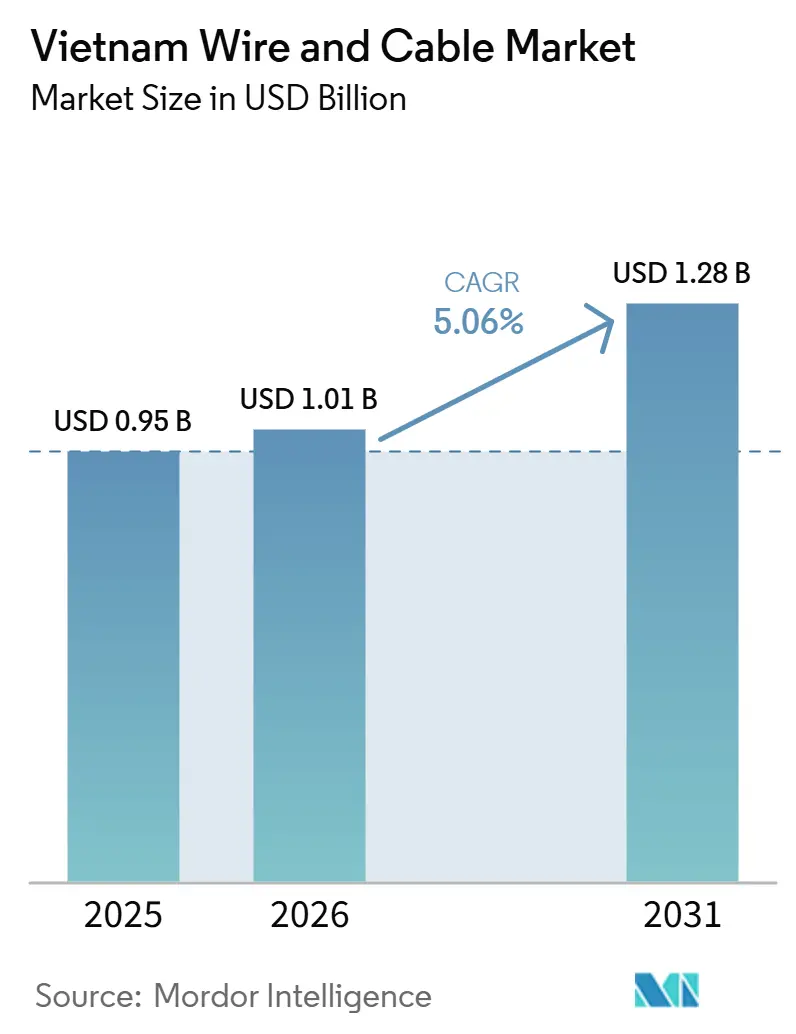
| Base Year Market Size (2025) | USD 0.95 Billion |
| Market Size (2026) | USD 1.01 Billion |
| Market Size (2031) | USD 1.29 Billion |
| Growth Rate (2026 - 2031) | 5.02 % |
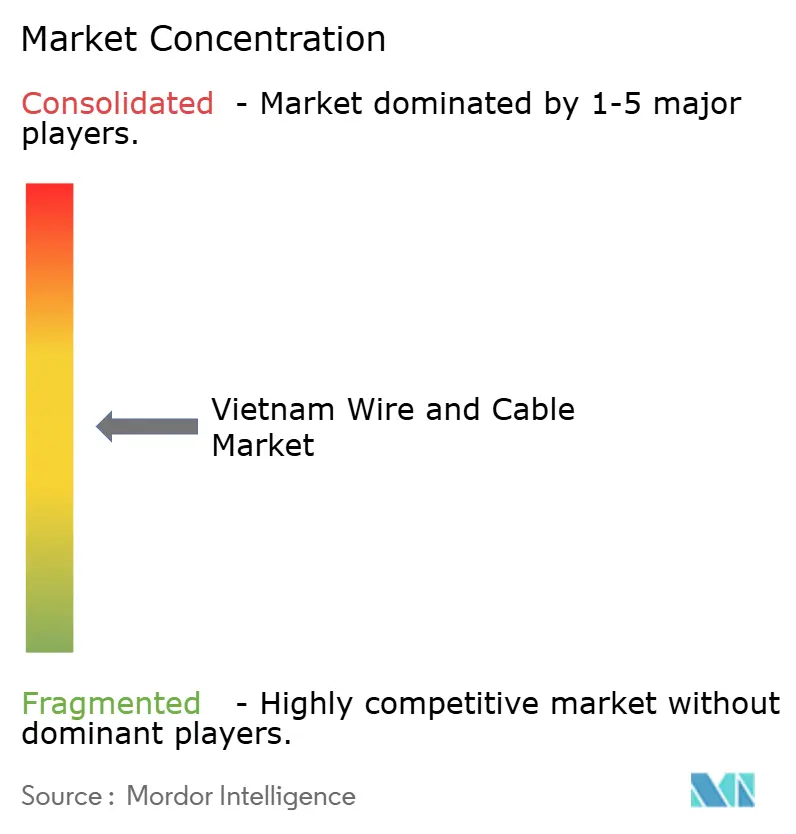
| Market Concentration | Medium |
Major Players *Disclaimer: Major Players sorted in no particular order Image © Mordor Intelligence. Reuse requires attribution under CC BY 4.0. | |
Vietnam Wire and Cable Market Analysis by Mordor Intelligence
The Vietnam wire and cable market size is projected to expand from USD 0.95 billion in 2025 and USD 1.01 billion in 2026 to USD 1.29 billion by 2031, registering a CAGR of 5.02% between 2026 to 2031. The revised Power Development Plan VIII supports transmission investment, renewable interconnection, and grid upgrades across several voltage classes. Manufacturing investment is shifting toward more complex facilities that require higher-specification power, control, and data cables. Airport, rail, urban construction, and digital infrastructure projects widen the sources of demand beyond utility procurement. Approval reforms may shorten ordering cycles for state grid projects, although site clearance and implementation capacity still affect purchase timing. This combination gives the Vietnam wire and cable market a broader demand base than one driven by a single construction or utility cycle.
Key Report Takeaways
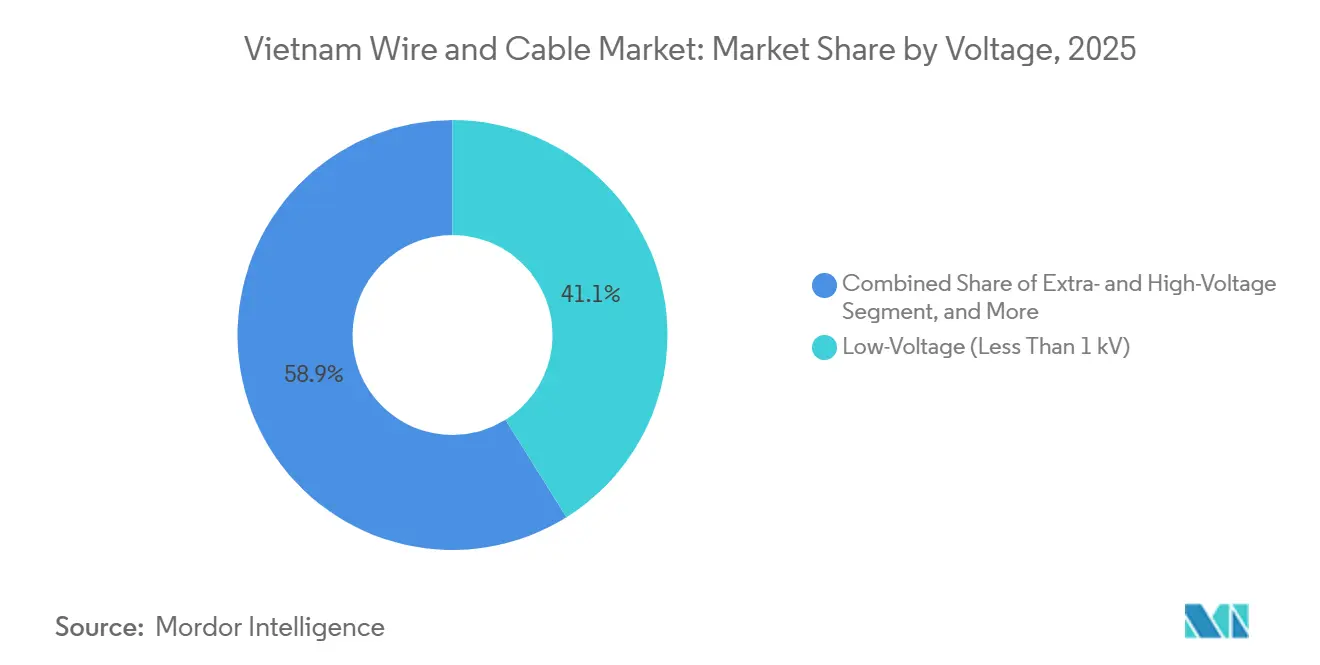
- By voltage, low-voltage cables held 41.11% of demand in 2025, while extra- and high-voltage cables are projected to expand at a 7.12% CAGR through 2031 in the Vietnam wire and cable market.
- By cable type, power cables accounted for 39.76% of the Vietnam wire and cable market share in 2025, while fiber-optic cables are expected to grow at a 6.98% CAGR through 2031.
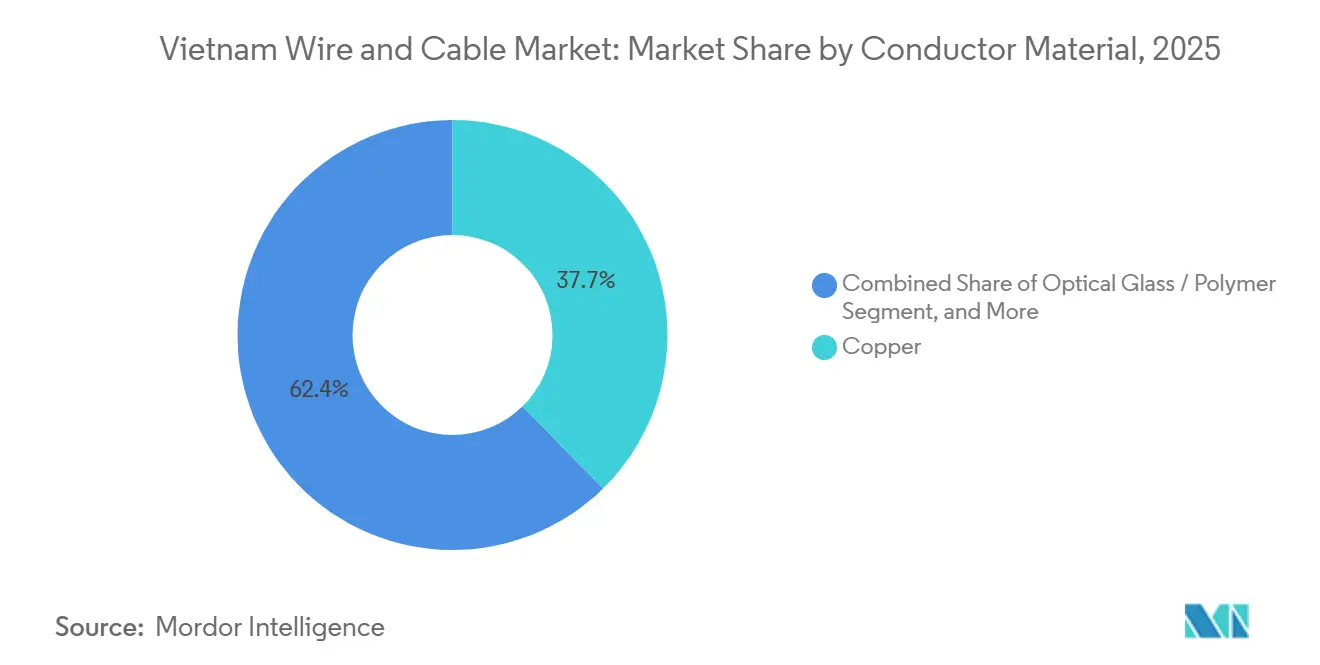
- By conductor material, copper held 37.65% share in 2025, while aluminum is projected to record a 6.44% CAGR through 2031 in the Vietnam wire and cable market.
- By installation, underground cables accounted for 41.34% share in 2025, while submarine cables are expected to expand at a 7.02% CAGR through 2031 in the Vietnam wire and cable market.
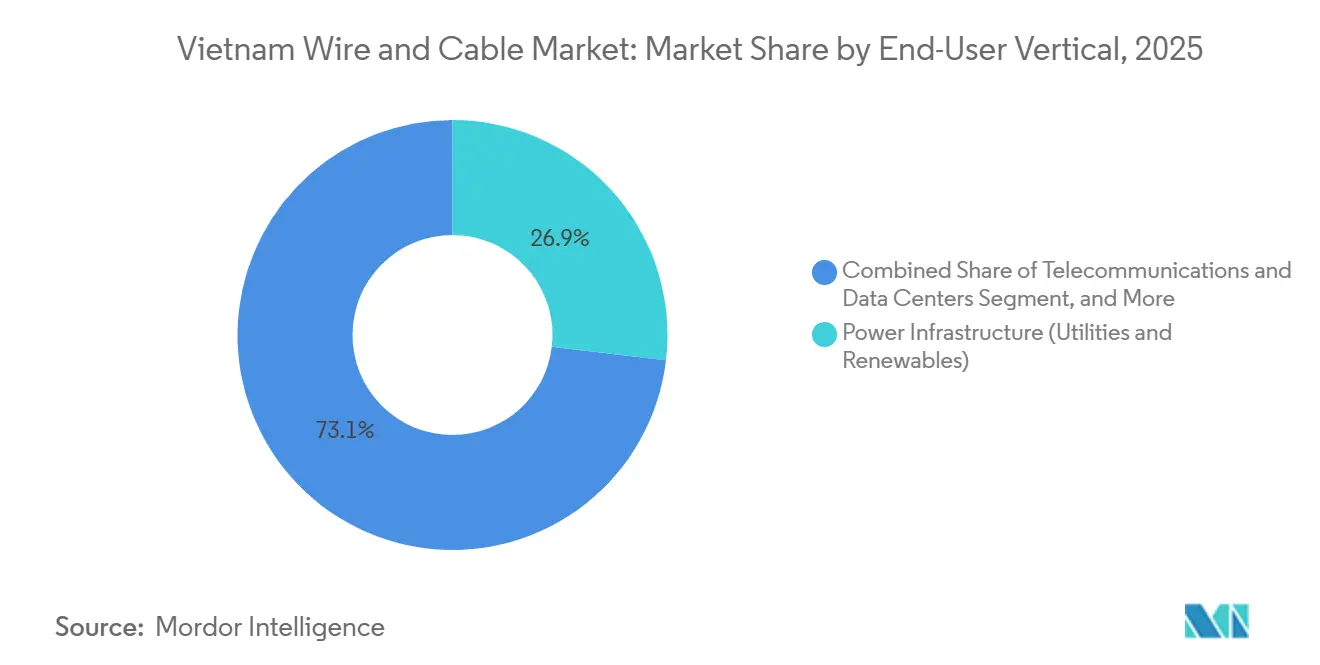
- By end-user vertical, power infrastructure held 26.87% of demand in 2025, while telecommunications and data centers are projected to grow at a 5.98% CAGR through 2031 in the Vietnam wire and cable market.
- By insulation, insulated cables accounted for 80.12% of demand in 2025 and are projected to grow at a 6.14% CAGR through 2031 in the Vietnam wire and cable market.
Note: Market size and forecast figures in this report are generated using Mordor Intelligence’s proprietary estimation framework, updated with the latest available data and insights as of January 2026.
Vietnam Wire and Cable Market Trends and Insights
Drivers Impact Analysis*
| DRIVER | (~) % IMPACT ON CAGR FORECAST | GEOGRAPHIC RELEVANCE | IMPACT TIMELINE |
|---|---|---|---|
| Grid Modernization and Renewable Energy Interconnection | +1.5% | National, with emphasis on Hanoi, Hai Phong, Quang Ninh, Quang Tri, and Ninh Thuan | Long term (≥ 4 years) |
| Industrial Manufacturing and Electronics Expansion | +1.2% | Northern and southern industrial corridors, including Bac Ninh, Binh Duong, and Dong Nai | Medium term (2-4 years) |
| Urban Construction, Transport, and Airport Infrastructure | +0.9% | Greater Ho Chi Minh City, Hanoi metropolitan area, and Dong Nai | Short term (≤ 2 years) |
| Fiber-Optic, Data Center, and 5G Connectivity Buildout | +0.7% | Ho Chi Minh City, Hanoi, and Tier-2 cities along the 5G rollout corridors | Short term (≤ 2 years) |
| Export-Oriented Cable Manufacturing and Regional Supply Chain Integration | +0.5% | Hai Phong, Long An, and Dong Nai | Medium term (2-4 years) |
| Demand for High-Specification and Low-Smoke Cable Products | +0.3% | National, with early use in Ho Chi Minh City and Hanoi | Medium term (2-4 years) |
| Source: Mordor Intelligence | |||
Grid Modernization and Renewable Energy Interconnection Support Cable Demand
Vietnam’s grid upgrade program remains the leading source of long-cycle demand for the Vietnam wire and cable market. Decision 768/QD-TTg confirmed the revised Power Development Plan VIII in April 2026 and set a direction for a grid capable of integrating a larger renewable generation base.[1] The plan’s transmission corridors require more high-voltage connections than comparable distributed generation projects. The 500kV Monsoon-Thanh My line was energized in January 2025, enabling 600MW of electricity imports from Laos. Northern demand centers have a local generation deficit, making long-distance transmission investment important for supply security. Resolution 253/2025/QH15 also established special energy development mechanisms through 2030, including faster decision-making for qualifying state-owned grid projects.[2]
Industrial Manufacturing and Electronics Expansion Increases Facility-Scale Cabling
Manufacturing investment supports demand for electrical and data cabling within new industrial facilities. Vietnam recorded USD 38.42 billion in registered foreign direct investment in 2025, including USD 27.62 billion in disbursed investment. The draft also reported USD 24.81 billion in registered foreign direct investment during the first 5 months of 2026, with manufacturing receiving USD 15.01 billion. This creates construction demand before facilities begin operating and replacement demand as production capacity expands. Semiconductor, precision manufacturing, and electric-vehicle component facilities need more controlled power, shielding, and data connections than earlier light-assembly operations. Their cable requirements may include medium-voltage distribution, shielded signal cables, and low-smoke, halogen-free control products.
Urban Construction, Transport, and Airport Infrastructure Broadens Cable Use
Large public works projects create simultaneous demand for power, control, lighting, and communications cables. Long Thanh International Airport had a total planned investment of USD 16 billion and was scheduled to begin commercial operations in December 2026. The airport requires low- and medium-voltage power networks, baggage-system controls, airfield lighting, and fire-resistant connections. Vietnam also planned to expand its airport network from 22 to 32 airports by 2030, with an investment of VND 485 trillion (USD 18.4 billion).[3] These projects increase procurement across multiple cable types rather than concentrating demand within a single utility category. The Vietnam wire and cable market can therefore receive support from both large terminals and smaller supporting transport facilities.
Fiber-Optic, Data Center, and 5G Connectivity Buildout Opens New Demand
Digital infrastructure brings fiber-optic and low-voltage power demand outside the traditional utility cycle. Vietnam had nearly 40,000 5G base stations by February 2026, covering 90% of the population and serving close to 23 million subscribers. Viettel planned to add 20,000 stations in 2026, targeting 98% population coverage.[4] Each site needs fiber backhaul, power feeds, and local distribution connections. This supports recurring cable procurement as coverage expands into urban corridors and secondary cities. The Vietnam wire and cable market is consequently exposed to telecom capital spending and energy investment.
Restraints Impact Analysis*
| RESTRAINT | (~) % IMPACT ON CAGR FORECAST | GEOGRAPHIC RELEVANCE | IMPACT TIMELINE |
|---|---|---|---|
| Copper and Aluminum Price Volatility | -0.9% | Global, with direct effects on Vietnamese manufacturers using internationally priced inputs | Short term (≤ 2 years) |
| Project Approval, Tendering, and Grid Connection Delays | -0.7% | National, especially northern grid zones and offshore wind corridors | Medium term (2-4 years) |
| Dependence on Imported High-Grade Resins and Specialized Components | -0.5% | National, with exposure in Ho Chi Minh City and Hanoi manufacturing clusters | Medium term (2-4 years) |
| Subsea Cable Reliability, Weather Exposure, and Route Redundancy Risk | -0.3% | Coastal and offshore areas in central and southern Vietnam | Long term (≥ 4 years) |
| Source: Mordor Intelligence | |||
Copper and Aluminum Price Volatility Pressures Manufacturer Margins
Elevated metal prices have created an immediate cost challenge for cable producers. LME copper reached an intraday record of USD 14,527.50 per tonne on January 29, 2026, while the copper-to-aluminum price ratio remained near 4.2 at the end of June 2026. Copper can account for 70%-85% of total cable manufacturing cost, leaving producers exposed when contract prices do not adjust quickly. The Vietnam wire and cable market faces more pressure in fixed-price contracts because raw material prices can change before delivery. Producers have responded by using formulas linked to market prices with monthly or quarterly adjustments. This can complicate government tenders designed around multi-year fixed pricing.
Project Approval, Tendering, and Grid Connection Delays Postpone Orders
Project demand can remain strong even as purchase orders are delayed due to land, environmental, and approval requirements. Several 220kV projects in Quang Ninh had completed land handover at only 17-23 of the more than 100 required sites by mid-2026. This makes cable purchasing sensitive to site-level progress rather than plan-level capacity targets. Offshore wind has faced similar timing constraints because survey approvals are needed before projects can reach a firm procurement stage. By April 2026, only 2 sea-area allocation decisions for marine surveys had been granted nationwide. These delays do not remove long-term need for grid and subsea connections. They defer converting planned capacity into near-term cable orders.
*Our forecasts treat driver/restraint impacts as directional, not additive. The impact forecasts reflect baseline growth, mix effects, and variable interactions.
Segment Analysis
By Voltage: Transmission Buildout Changes the Voltage Mix
Extra-and high-voltage cables are projected to register the highest growth among voltage categories, with a CAGR of 7.12% between 2026 and 2031 in the Vietnam wire and cable market. This forecast reflects the expansion of 500 kV corridors, cross-border interconnections, and the need to evacuate renewable power. Northern Vietnam is projected to require 5,000-8,000 MW of electricity imports by 2030, supporting demand for long-distance transmission links. Each major interconnection requires longer and more specialized cable systems than local distribution projects, creating a sustained procurement cycle for high-specification products. This trend also increases the importance of suppliers with proven technical compliance.
Low-voltage cables are expected to account for 41.11% of the Vietnam wire and cable market in 2025, supported by residential wiring, commercial construction, and light industrial activity. Their large volume base reflects the broad number of buildings and small facilities that require basic power connections. Medium-voltage products serve industrial parks, urban substations, offshore wind array systems, and larger production facilities. Semiconductor and electric-vehicle component plants are increasing demand for products with higher temperature ratings and stronger electromagnetic shielding. LS-VINA is expected to receive KEMA certification for its 230-kV ultra-high-voltage cable in January 2026, enabling the Hai Phong plant to pursue U.S. power grid projects. This development highlights the expansion of domestic capability into higher-voltage and export-grade products.

By Cable Type: Power Cables Lead While Fiber Optic Expands
Power cables are expected to account for 39.76% of the Vietnam wire and cable market share in 2025, making them the leading cable category. Grid transmission and industrial power distribution provide the largest spending base for this segment. Utility upgrades, renewable interconnections, and factory construction require power cables across different voltage levels. Their broad application supports demand across state, private, and industrial projects. The category also benefits from upgrades to urban distribution and airport construction. As a result, demand for power cables remains closely linked to the pace of capital projects.
Fiber-optic cables are projected to record a CAGR of 6.98% between 2026 and 2031 in the Vietnam wire and cable market. Growth is supported by 5G backhaul, data centers, enterprise networks, and smart-city deployments. Nearly 40,000 5G base stations are expected to be installed by February 2026, and the planned addition of 20,000 more stations during 2026 is expected to create further backhaul demand. Signal and control cables support automation in semiconductor, automotive, and precision manufacturing plants. Coaxial and data cables also benefit from distributed antenna systems, cable-network upgrades, and enterprise connectivity. The shift from PVC to cross-linked polyethylene insulation in medium-voltage power cables further reflects rising demand for thermal performance in industrial and data-center settings.
By Conductor Material: Copper Leads While Aluminum Gains Use
Copper is expected to hold a 37.65% share in 2025, making it the largest conductor material category. It remains important in building wires, data cables, and precision industrial applications that require high conductivity and flexibility. These applications cannot easily adopt aluminum without changes to design or product specifications. Copper is also embedded in many existing product lines and customer approval systems. These factors protect its role in cable applications where physical size and electrical performance are critical. Therefore, the Vietnam wire and cable market is expected to retain a substantial copper base despite pressure from raw material prices.
Aluminum is projected to grow at a CAGR of 6.44% through 2031 in the Vietnam wire and cable market as developers seek lower-cost conductors for selected transmission and distribution applications. Overhead 500 kV and 220 kV corridors already widely use aluminum for its weight and cost advantages. High copper prices strengthen the case for substitution in medium-voltage distribution projects. However, this shift remains selective because aluminum requires engineering review and customer approval in many applications. Optical glass and polymer conductors constitute a distinct, growing group of fiber-optic products. A larger aluminum share also increases exposure to imported aluminum rod because Vietnam has limited domestic primary aluminum capacity.
By Installation: Underground Networks Lead and Submarine Cables Grow Fastest
Underground cables are expected to account for 41.34% of the Vietnam wire and cable market in 2025. New townships and industrial parks often prefer buried networks for safety, visual, and resilience-related reasons. Urban construction in southern Vietnam and around Hanoi supports this installation method. Underground systems are also relevant to airports, commercial developments, and dense industrial developments. Their use is expected to grow with urban expansion, even as long-distance transmission continues to rely on overhead routes. This gives the segment a large and durable installation base.
Submarine cables are projected to expand at a CAGR of 7.02% between 2026 and 2031 in the Vietnam wire and cable market. Offshore wind development, island-grid electrification, and proposed links to Singapore and Malaysia are the main sources of demand. The World Bank’s ESMAP assessment identified 599 GW of technical offshore wind potential in Vietnam, including 261 GW of fixed-bottom potential and 338 GW of floating potential. PTSC and LS Eco Energy have considered developing a high-voltage offshore cable factory in Vietnam, with a final investment decision expected in 2027. Until domestic capacity is established, critical marine projects are expected to remain dependent on imported supply.
By End-User Vertical: Power Infrastructure Leads and Digital Uses Grow Fastest
Power infrastructure, including utilities and renewables, is expected to account for 26.87% of demand in 2025. It is the largest end-user category because transmission upgrades and renewable projects require substantial volumes of cable. EVN procurement and investment by renewable developers are central to this demand base. The category includes interconnections, substations, distribution systems, and project connections. The implementation of the Power Development Plan VIII and project approvals influences its direction. Therefore, the Vietnam wire and cable market remains sensitive to utility budgets and the pace of grid construction.
Telecommunications and data centers are projected to grow at a CAGR of 5.98% through 2031, the fastest rate among end-user verticals. The 5G rollout and new data-center campuses are creating demand for both fiber and reliable power infrastructure. Viettel’s An Khanh facility and other announced projects add substantial cabling requirements inside campuses and between facilities and the grid. Industrial manufacturing also supports demand, as plants require complete medium- and low-voltage installations during construction. Residential and commercial demand remains significant but can vary with property approvals. Oil, gas, petrochemicals, and mobility applications require flame-retardant, oil-resistant, and armored cable products with more demanding specifications.
By Insulation: Insulated Cables Remain the Core Product Group
Insulated cables are expected to account for 80.12% of demand in 2025 in the Vietnam wire and cable market. Their position reflects safety and regulatory requirements across enclosed buildings, industrial sites, public infrastructure, and urban networks. Most power, control, and communications installations require insulated products. This broad application base makes insulated cables central to nearly every end-user category. Urbanization also favors protected and buried connections over bare conductors. The segment’s scale reflects this fundamental technical requirement.
Non-insulated cables remain relevant in rural aerial distribution and inter-substation bus connections. However, their role is constrained as new urban networks increasingly use underground distribution. Within insulated products, demand is shifting from PVC toward cross-linked polyethylene and low-smoke halogen-free compounds. TCVN 11341-3:2016, aligned with IEC standards, governs performance for halogen-free low-smoke cables used in fixed wiring. CADIVI holds a certificate of conformity for fire-resistant, low-smoke, halogen-free cables under BS 6387:2013, valid through November 2030. Higher safety requirements can raise product value because these compounds cost more than standard PVC alternatives.
Geography Analysis
Northern Vietnam is the main center for extra-high-voltage cable procurement, as its power deficit is projected to require 5,000-8,000 MW of imports by 2030. Hanoi, Hai Phong, and Quang Ninh combine grid investment with large electronics and industrial clusters. The region requires high-voltage links, medium-voltage factory connections, shielded data cables, and low-smoke building wires. Hai Phong is also home to LS-VINA, one of the country’s largest cable exporters. Its 230 kV certification supports the region’s position in export-grade cable manufacturing. Viettel’s national 5G plan is also expected to create demand for fiber and low-voltage cables across northern industrial parks and urban corridors.
Southern Vietnam supports the Vietnam wire and cable market through construction, data-center investment, telecommunications, and advanced cable manufacturing. Long Thanh International Airport in Dong Nai has a planned investment of USD 16 billion and is scheduled to begin commercial operations in December 2026. The project requires fire-resistant, signal, and low-voltage systems across a large airport site. Taihan Cable Vina plans to break ground on a USD 50.6 million 400 kV plant in Long Thanh Industrial Park in March 2026. The plant is targeted to begin commercial operations in 2027. Ho Chi Minh City and nearby provinces also have substantial data-center commitments, supporting demand for fiber and medium-voltage cabling.
Central Vietnam currently accounts for a smaller share of demand but offers the largest offshore wind opportunity. The revised Power Development Plan VIII identifies 6,000-17,032 MW of offshore wind capacity for domestic use, with projects expected to operate between 2030 and 2035. Quang Tri, Ninh Thuan, and the central coastal waters are relevant to renewable transmission and array-cable requirements. Marine survey allocations remain limited, which is expected to delay firm ordering. Da Nang and coastal tourism corridors also support demand for commercial construction and smart-city cables. The region could gain importance as offshore projects move from planning to construction.
Competitive Landscape
The Vietnam wire and cable market has a fragmented domestic tier in low- and medium-voltage products and a more concentrated premium tier in high- and extra-high-voltage products. Domestic producers compete through pricing, distribution, compliance with national standards, and established customer relationships. CADIVI, ThiPha Cable, and CADISUN are active in residential wiring, low-voltage power cables, and fire-resistant construction products. These products depend on agent coverage and reliable local supply as much as advanced transmission technology. Domestic companies also pursue export opportunities within ASEAN, including CADISUN’s discussions with representatives from Myanmar's electricity sector and with Padauk Power. Therefore, the domestic tier remains competitive across distribution-intensive categories, even where it does not yet match the certification position of leading extra-high-voltage producers.
Korean-invested manufacturers hold strong positions in premium cable applications because international certification and utility relationships are difficult to replicate. Taihan Cable Vina plans to begin construction of a USD 50.6 million 400 kV plant in Dong Nai in March 2026 and expects commercial operations in 2027. LS-VINA plans to start pre-qualification testing for 400 kV-class cables in May 2026, expanding its ability to participate in global transmission bids. LS-VINA is also expected to secure KEMA certification for 230 kV cables in January 2026. These moves are expected to strengthen competition in a premium segment with high technical barriers. Certification affects a company’s ability to participate in utility tenders and international grid projects, not only its ability to manufacture a cable. Testing and qualification requirements can protect established suppliers when purchasers need evidence of long-term operating performance.
Offshore and high-voltage subsea manufacturing remain major opportunities because Vietnam relies on imported supplies for critical marine infrastructure. PTSC and LS Eco Energy have explored a domestic high-voltage direct-current submarine cable facility, although the final investment decision is expected in 2027. Global companies, such as Prysmian and Nexans, retain selective roles in specialty and submarine applications. Their engineering capabilities are relevant when projects require complex design and international project experience. Local producers can remain competitive in high-volume categories by combining distribution reach with compliance and price discipline. Their customer relationships are especially relevant in residential wiring, standard low-voltage power cables, and public building projects that require local delivery.
Vietnam Wire and Cable Industry Leaders
-
Prysmian S.p.A.
-
Nexans S.A.
-
CADISUN Vietnam Joint Stock Company
-
Taihan Cable Vina Co., Ltd.
-
ThiPha Cable Joint Stock Company
- *Disclaimer: Major Players sorted in no particular order
Recent Industry Developments
- July 2026: G-Group Technology Corporation announced plans for G-Campus Hoa Lac, a USD 300 million AI data center campus in Hanoi with an initial IT power capacity of 20MW, supporting Hanoi's target of operating AI and big-data government platforms by 2035 and generating near-term demand for high-specification power and fiber-optic cables.
- June 2026: LS Eco Energy's Vietnamese subsidiary, LSCV, supplied railway communication cables to Hyundai Rotem for hydrogen tram projects in Daejeon and Ulsan, marking the first entry into Hyundai Rotem's supply chain. LS Eco Energy expected growing demand from Vietnam's North-South high-speed railway and urban metro pipeline.
- May 2026: LS-VINA commenced international certification and pre-qualification testing for 400kV-class extra-high-voltage cables, targeting full-scale mass production in 2027 and positioning the Vietnamese plant to bid on major global transmission grid projects alongside its 230kV North American certification.
- March 2026: Taihan Cable Vina broke ground on a USD 50.6 million, 400kV extra-high-voltage cable plant at Long Thanh Industrial Park in Dong Nai. Commercial operations are targeted for 2027, after which Taihan Vina will be the only company in Vietnam capable of independently producing 400 kV-class cable without relying on LS-VINA.
Vietnam Wire and Cable Market Report Scope
The Vietnam Wire and Cable Market Report is Segmented by Voltage (Extra-and High-Voltage [Greater Than 35 kV], Medium-Voltage [1-35 kV], and Low-Voltage [Less Than 1 kV]), Cable Type (Power Cable, Fiber-Optic Cable, Signal and Control Cable, and Coaxial and Data Cable), Conductor Material (Copper, Aluminum, and Optical Glass / Polymer), Installation (Overhead, Underground, and Submarine), End-User Vertical (Residential Construction, Commercial Construction, Power Infrastructure, Telecommunications and Data Centers, Oil and Gas and Petrochemicals, Automotive and Mobility, and Industrial Manufacturing), and Insulation (Insulated, and Non-Insulated). The Market Forecasts are Provided in Terms of Value (USD).
| Extra- and High-Voltage (Greater Than 35 kV) |
| Medium-Voltage (1-35 kV) |
| Low-Voltage (Less Than 1 kV) |
| Power Cable |
| Fiber-Optic Cable |
| Signal and Control Cable |
| Coaxial and Data Cable |
| Copper |
| Aluminum |
| Optical Glass / Polymer |
| Overhead |
| Underground |
| Submarine |
| Residential Construction |
| Commercial Construction |
| Power Infrastructure (Utilities and Renewables) |
| Telecommunications and Data Centers |
| Oil and Gas and Petrochemicals |
| Automotive and Mobility |
| Industrial Manufacturing |
| Insulated |
| Non-Insulated |
| By Voltage | Extra- and High-Voltage (Greater Than 35 kV) |
| Medium-Voltage (1-35 kV) | |
| Low-Voltage (Less Than 1 kV) | |
| By Cable Type | Power Cable |
| Fiber-Optic Cable | |
| Signal and Control Cable | |
| Coaxial and Data Cable | |
| By Conductor Material | Copper |
| Aluminum | |
| Optical Glass / Polymer | |
| By Installation | Overhead |
| Underground | |
| Submarine | |
| By End-User Vertical | Residential Construction |
| Commercial Construction | |
| Power Infrastructure (Utilities and Renewables) | |
| Telecommunications and Data Centers | |
| Oil and Gas and Petrochemicals | |
| Automotive and Mobility | |
| Industrial Manufacturing | |
| By Insulation | Insulated |
| Non-Insulated |
Key Questions Answered in the Report
What is the size of the Vietnam wire and cable market?
The Vietnam wire and cable market was valued at USD 1.01 billion in 2026 and is projected to reach USD 1.29 billion by 2031, at a 5.02% CAGR.
Which voltage segment is growing fastest in Vietnam?
Extra- and high-voltage cables are projected to grow at a 7.12% CAGR through 2031, supported by transmission corridors and renewable-energy interconnection.
What cable type holds the largest share in Vietnam?
Power cables accounted for 39.76% of demand in 2025 because grid transmission and industrial power distribution accounted for substantial procurement.
Why are fiber-optic cables expanding in Vietnam?
Fiber-optic cables are projected to grow at a 6.98% CAGR through 2031 as 5G coverage and data-center construction expand.
Which installation method leads to cable demand in Vietnam?
Underground cables accounted for 41.34% of demand in 2025, supported by urban development and industrial park construction.
What constrains wire and cable suppliers in Vietnam?
Metal price volatility and delays in land clearance, tendering, and grid connections can postpone orders and put pressure on manufacturers' margins.