
Vietnam Healthcare Logistics Market Size and Share
Market Overview
| Study Period | 2021 - 2032 |
|---|---|
| Forecast Data Period | 2027 - 2032 |
| Base Year Market Size (2026) | USD 2.04 Billion |
| Market Size (2027) | USD 2.21 Billion |
| Market Size (2032) | USD 3.23 Billion |
| Growth Rate (2027 - 2032) | 7.91 % |
| Market Concentration | Medium |
Major Players *Disclaimer: Major Players sorted in no particular order Image © Mordor Intelligence. Reuse requires attribution under CC BY 4.0. | |
Vietnam Healthcare Logistics Market Analysis by Mordor Intelligence
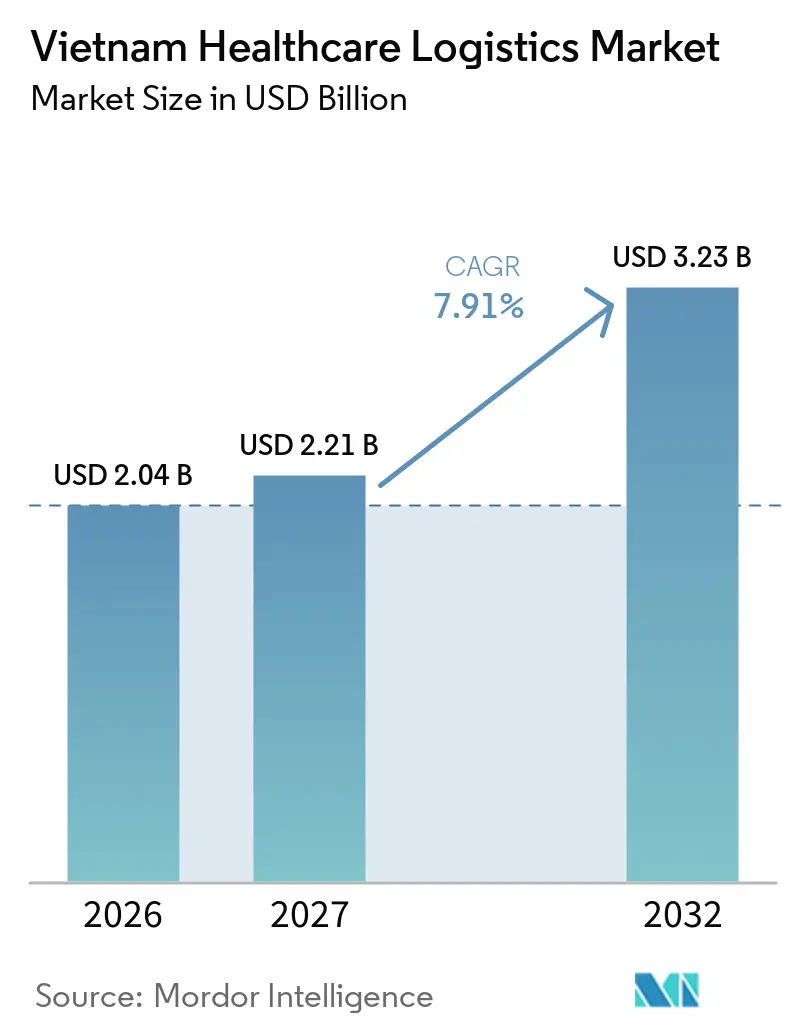
The Vietnam healthcare logistics market size is valued at USD 2.04 billion in 2026. It is estimated to grow from USD 2.21 billion in 2027 to reach USD 3.23 billion by 2032, at a CAGR of 7.91% during the forecast period (2027-2032).
Growth is supported by rising healthcare expenditure, pharmaceutical distribution requirements, and the need for controlled handling of increasingly complex therapies. The country also relies substantially on imported finished medicines and active pharmaceutical ingredients, creating requirements for international transport, customs coordination, storage, and domestic distribution. Providers with validated facilities, temperature-monitoring systems, trained staff, and documented quality controls are positioned to serve increasingly specialized healthcare supply chains. However, compliance costs, uneven infrastructure, and the need to maintain product integrity across long distribution routes remain important operating challenges.
Key Report Takeaways
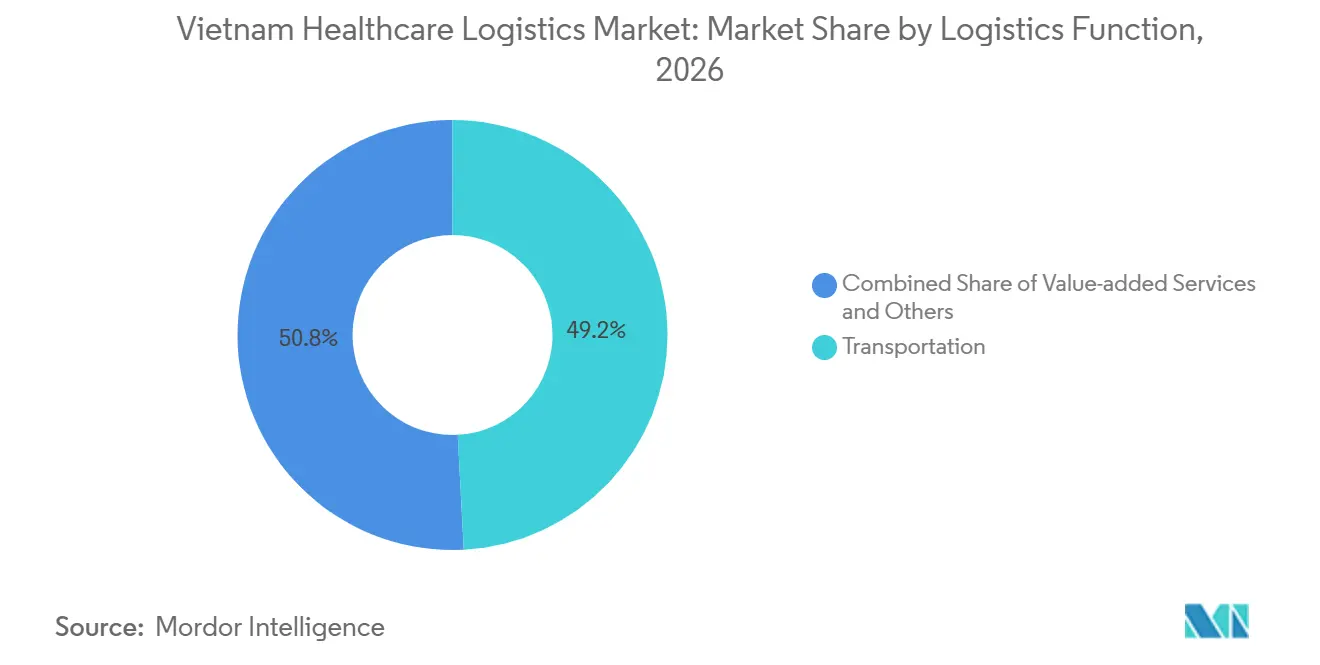
- By logistics function, transportation accounts for 49.16% of the Vietnam healthcare logistics market size in 2026, while value-added services and others are projected to register a CAGR of 9.89% through 2032.
- By temperature type, temperature-controlled logistics accounts for 55.92% of the Vietnam healthcare logistics market share in 2026 and is projected to register a CAGR of 8.45% through 2032.
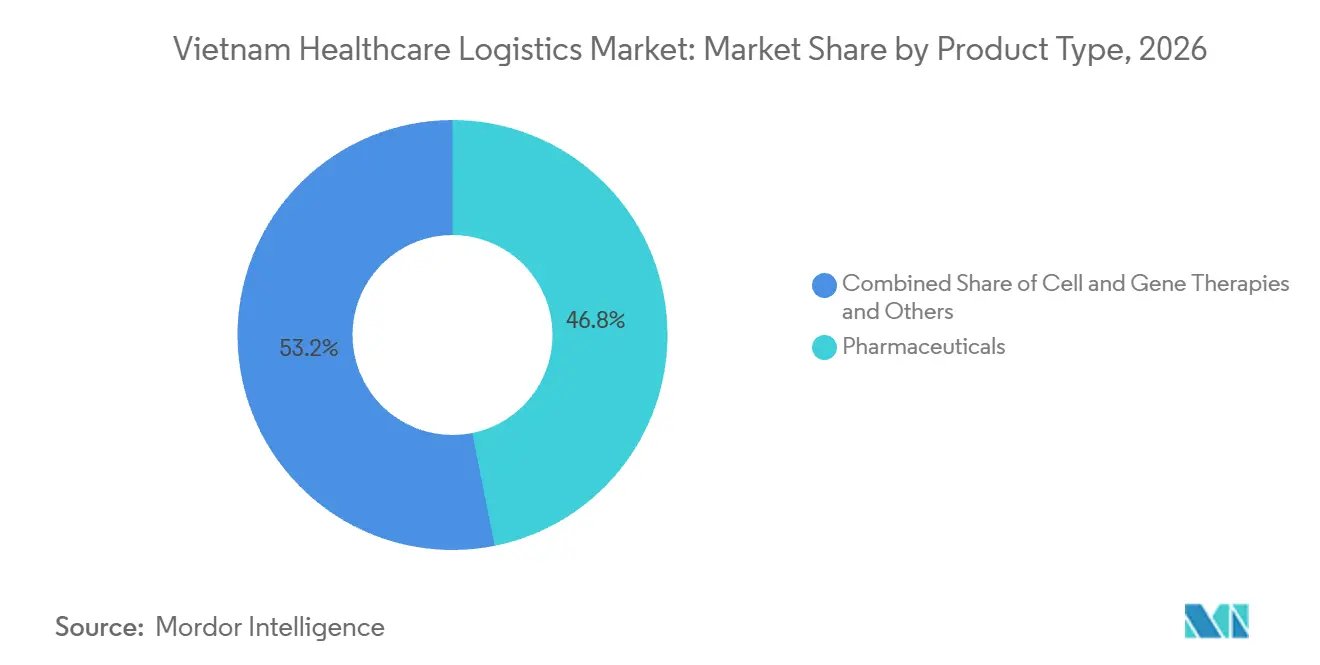
- By product type, pharmaceuticals account for 46.84% of the Vietnam healthcare logistics market size in 2026, while cell and gene therapies are projected to register a CAGR of 8.75% through 2032.
- By destination, domestic distribution accounts for 73.13% of the Vietnam healthcare logistics market share in 2026, while international logistics is projected to register a CAGR of 8.68% through 2032.
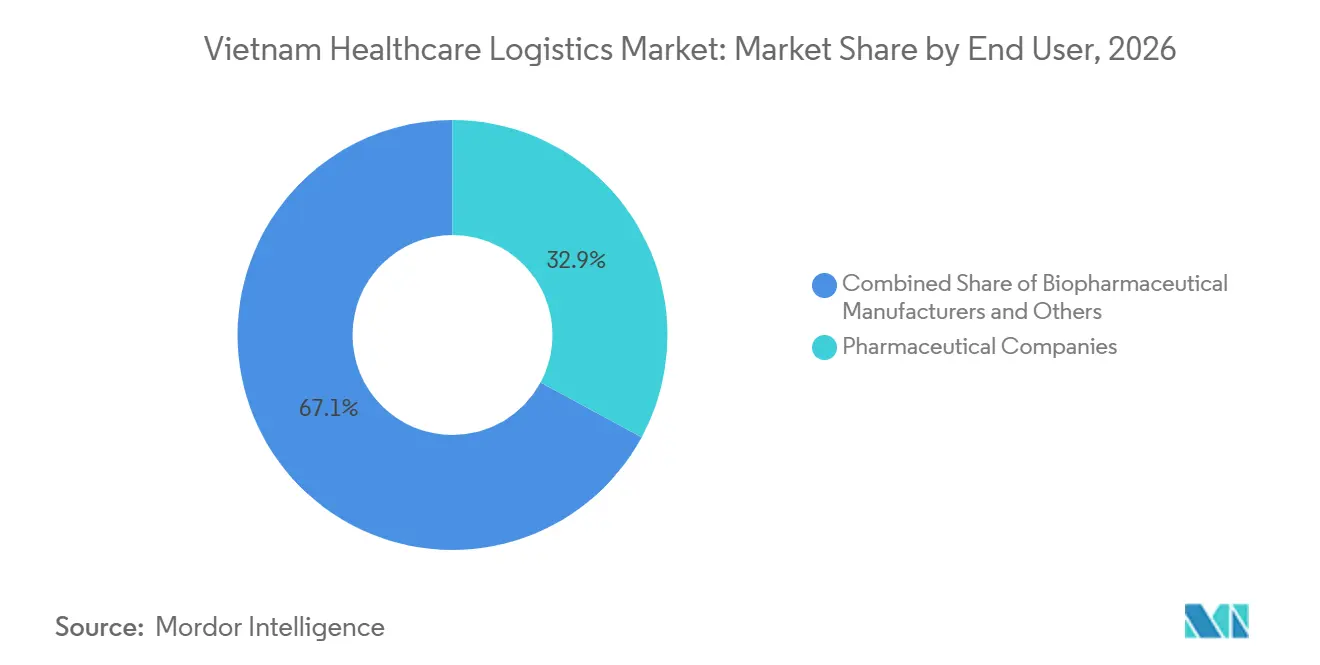
- By end user, pharmaceutical companies account for 32.88% of the Vietnam healthcare logistics market size in 2026, while biopharmaceutical manufacturers are projected to register a CAGR of 9.29% through 2032.
- By geography, Southern Vietnam accounts for 48.36% of the Vietnam healthcare logistics market share in 2026, while Central Vietnam is projected to register a CAGR of 9.92% through 2032.
Note: Market numbers in this report are based on Mordor Intelligence's proprietary estimation framework, which combines nine months of actuals with Q4 projections for base year 2026.
Market Trends and Insights
Drivers Impact Analysis of Vietnam Healthcare Logistics Market*
| Driver | (~) % Impact on CAGR Forecast | Geographic Relevance | Impact Timeline |
|---|---|---|---|
| Temperature-Sensitive Therapies Increasing Specialized Logistics Demand | +1.5% | Global procurement, concentrated in HCMC and Hanoi | Long-term (≥ 4 years) |
| Healthcare Investment Expanding Pharmaceutical Distribution Requirements | +1.8% | National, with strongest gains in Southern Vietnam and Hanoi | Medium-term (2–4 years) |
| Logistics Outsourcing Increasing Specialist Provider Adoption | +1.2% | National, concentrated in urban and industrial zones | Medium-term (2–4 years) |
| Regulatory Opening Supporting Foreign Logistics Participation | +0.8% | National, early gains in HCMC, Hanoi, and Da Nang | Short-term (≤ 2 years) |
| Digital Monitoring Strengthening GDP Compliance and Visibility | +0.7% | National | Medium-term (2–4 years) |
| Remote Healthcare Access Expanding Specialized Distribution Networks | +0.6% | Northern Midlands, Central Highlands, and Mekong Delta | Long-term (≥ 4 years) |
| Source: Mordor Intelligence | |||
Temperature-Sensitive Therapies Increasing Specialized Logistics Demand
The Vietnam healthcare logistics market is seeing demand for more specialized handling as biologics, vaccines, and advanced therapies require product-specific storage and transport conditions. Some cell and gene therapy products require cryogenic temperatures of −150 °C or below, supported by suitable containers, monitoring, and chain-of-custody procedures. Other products require different temperature ranges, so requirements must be determined by the product and its validated shipping system. These needs increase the importance of qualified packaging, trained personnel, and documented handling procedures. In October 2025, LOGISTEED Vietnam received IATA CEIV Pharma certification at Tan Son Nhat International Airport, becoming the first freight forwarder in Vietnam to obtain the certification[1]. The certification supports pharmaceutical air cargo quality management and strengthens the country's specialist handling capability at a major international gateway.
Healthcare Investment Expanding Pharmaceutical Distribution Requirements
Healthcare investment supports demand for the movement and storage of medicines, medical devices, diagnostic products, and hospital supplies. In 2026, the National Assembly approved an investment policy for the 2026–2030 phase of the National Target Program on Healthcare, Population, and Development, with planned funding of VND 88.635 trillion (USD 3.55 billion). Greater healthcare activity can increase demand for inbound transport, compliant storage, inventory management, and distribution to hospitals and other healthcare outlets. Expanding access to healthcare could also create a need for more reliable distribution networks connecting major supply hubs with underserved areas.
Logistics Outsourcing Increasing Specialist Provider Adoption
Pharmaceutical companies can use specialist logistics providers to access temperature-controlled transport, qualified storage, monitoring systems, and trained operating teams without developing every capability internally. Outsourcing can also support distribution across multiple regions while allowing manufacturers to focus on production, product registration, and commercial operations. In September 2025, ITL Freight Management received its first TF 820V 2S cool van, equipped with GPS-connected sensors for real-time temperature monitoring and alerts when readings move outside preset ranges[2]. The company initially deployed the vehicle in Southern Vietnam to support pharmaceutical and other temperature-sensitive shipments. This investment illustrates how specialist providers are adding equipment and monitoring capabilities to serve healthcare customers. As outsourcing develops, the ability to demonstrate product integrity, maintain records, and respond to exceptions can become an important factor in provider selection.
Regulatory Requirements Shaping Specialist Logistics Participation
Vietnam's pharmaceutical regulations place importance on distribution authorization, quality systems, product traceability, and compliance with applicable Good Distribution Practice requirements. Specialist logistics providers can support pharmaceutical supply chains through permitted transport, storage, handling, and other contracted services, subject to applicable licensing and distribution rules. Companies serving regulated products need appropriate infrastructure, documented procedures, trained personnel, and effective quality management. These requirements can increase the cost of serving healthcare customers, but they also make compliance capability an important competitive differentiator.
Restraints Impact Analysis of Vietnam Healthcare Logistics Market*
| Restraint | (~) % Impact on CAGR Forecast | Geographic Relevance | Impact Timeline |
|---|---|---|---|
| Validated Cold-Chain Operations Increasing Logistics Costs | -1.2% | National, with highest cost pressure in urban distribution zones | Medium-term (2–4 years) |
| Rural Infrastructure Gaps Raising Temperature-Excursion Risks | -0.8% | Northern Midlands, Central Highlands, Mekong Delta | Long-term (≥ 4 years) |
| Skilled Talent Shortages Constraining Healthcare Logistics Expansion | -0.5% | National | Medium-term (2–4 years) |
| Fragmented Qualification Standards Increasing Provider Compliance Complexity | -0.4% | National | Short-term (≤ 2 years) |
| Source: Mordor Intelligence | |||
Validated Cold-Chain Operations Increasing Logistics Costs
Cold-chain operations generally cost more than ambient warehousing and transportation because they require suitable equipment, temperature monitoring, documented procedures, trained staff, and ongoing quality management. Providers may also need to maintain backup systems, calibrate monitoring devices, and preserve records that demonstrate compliance during storage and transport. These requirements can increase the cost of handling vaccines, biologics, and other temperature-sensitive products. Providers serving smaller customers or routes with low shipment density may find it more difficult to spread these costs across sufficient volume. Certified facilities and specialist vehicles are therefore more commercially viable where demand is concentrated around major healthcare centres, airports, pharmaceutical customers, and distribution hubs. Providers need to balance investment in validated infrastructure with the expected volume and service requirements of their customers.
Rural Infrastructure Gaps Raising Temperature-Excursion Risks
Healthcare distribution outside major urban centres can be more challenging where road access, power reliability, and availability of controlled storage or transport are limited. These constraints can increase the complexity of delivering temperature-sensitive medicines to remote healthcare facilities and provincial markets. Vietnam's reliance on imported finished medicines and active pharmaceutical ingredients also means that some products travel internationally before entering domestic distribution networks.
*Our forecasts treat driver/restraint impacts as directional, not additive. The impact forecasts reflect baseline growth, mix effects, and variable interactions.
Vietnam Healthcare Logistics Market Segment Analysis
By Logistics Function:
Transportation Anchors the Market While Value-added Services Grow FasterTransportation accounts for 49.16% of the Vietnam healthcare logistics market share in 2026, reflecting the importance of moving medicines, medical devices, diagnostic products, and hospital supplies between import gateways, warehouses, manufacturers, wholesalers, hospitals, and pharmacies. Road transport supports regular domestic distribution, while air freight is important for time-sensitive imports and specialist healthcare shipments. Sea freight also supports international movements of products suitable for longer transit times. The operating requirements differ by product category, and temperature-sensitive shipments may need qualified packaging, monitoring, and documented handovers. Reliable transport networks are therefore essential to maintaining product availability across the country's geographically dispersed healthcare system.
Value-added services and others are projected to register at a CAGR of 9.89% through 2032, the fastest rate in the logistics-function segmentation. These services can include inventory management, temperature-excursion reporting, returns handling, traceability support, and other customer-specific activities. Pharmaceutical companies may use these services to strengthen product visibility and reduce the internal resources needed to manage distribution. The ability to combine transportation and storage with quality documentation and inventory information can improve service coordination. Providers must ensure that these services meet customer requirements and applicable regulations, particularly when handling products that require additional controls.

By Temperature Type:
Temperature Controlled Leads Current Demand and GrowthTemperature-controlled logistics accounts for 55.92% of the Vietnam healthcare logistics market size in 2026 and is projected to register at a CAGR of 8.45% through 2032. The segment serves products that require specified storage and transport conditions, including certain vaccines, biologics, specialty medicines, and injectables. The appropriate range depends on the product label and validated distribution requirements. Some products require refrigerated conditions, while others need frozen or ultra-low-temperature handling. Providers need to align storage equipment, packaging, transport schedules, and monitoring processes with each product's requirements. Demand for these services supports investment in qualified facilities and specialist vehicles, although the cost of maintaining controlled conditions can be higher than for ambient distribution.
Non-temperature-controlled logistics remains important for products that can be stored and transported under ambient conditions, including many medical consumables, devices, and standard medicines. These flows form a broad base of healthcare distribution activity and still require appropriate storage, traceability, and handling. Temperature-controlled operations add equipment and monitoring costs, creating a higher operating threshold for providers entering the specialist segment. The market's projected growth indicates increasing demand for controlled handling. Still, providers must continue to serve ambient products efficiently because these remain an important part of the overall healthcare supply chain.
By Product Type:
Pharmaceuticals Dominate, While Cell and Gene Therapies Expand FasterPharmaceuticals account for 46.84% of the Vietnam healthcare logistics market share in 2026. Prescription medicines and other pharmaceutical products require regular distribution between manufacturers, importers, warehouses, wholesalers, hospitals, and retail pharmacies. Product-specific requirements can vary, from ambient storage to controlled-temperature handling. Providers must coordinate inventory availability, transport schedules, product documentation, and delivery confirmation across different customer channels. Medical devices, diagnostic products, laboratory materials, and other healthcare goods also generate logistics demand, but pharmaceuticals remain the largest product category.
Cell and gene therapies are projected to register at a CAGR of 8.75% through 2032. Some products in this category require cryogenic storage and transport, specialized containers, continuous monitoring, and detailed chain-of-custody controls. The exact temperature range and handling procedure depend on the therapy. These requirements can make shipment preparation, route planning, and handover management more demanding than for conventional medicines. Although the segment's projected growth is high, the market's ability to serve it will depend on the development of suitable infrastructure, trained personnel, and validated procedures. Providers that establish these capabilities may be better positioned to support specialized biopharmaceutical and clinical supply chains.
By Destination:
Domestic Distribution Holds the Larger Base, While International Logistics Grows FasterDomestic distribution accounts for 73.13% of the Vietnam healthcare logistics market size in 2026. Domestic flows include deliveries from import gateways and manufacturing locations to hospitals, pharmacies, wholesalers, laboratories, and other healthcare customers. Vietnam's substantial geographic length creates a need for well-planned inventory locations and reliable transport connections between the northern, central, and southern regions. Southern Vietnam is an important import and distribution centre, while Hanoi and other northern locations support healthcare demand and industrial activity. Providers must manage different delivery frequencies and handling requirements across urban centres and provincial markets.
International logistics is projected to register at a CAGR of 8.68% through 2032. Vietnam's pharmaceutical sector relies on imported finished medicines and active pharmaceutical ingredients, while exports of medicines and pharmaceutical ingredients provide outbound logistics opportunities. International healthcare logistics requires coordination among exporters, importers, airlines or ocean carriers, customs agents, and domestic distribution partners. Providers with suitable documentation processes and specialist handling capabilities can support these cross-border flows.
By End User:
Pharmaceutical Companies Lead, While Biopharmaceutical Manufacturers Grow FasterPharmaceutical companies account for 32.88% of the Vietnam healthcare logistics market share in 2026. These customers require transport, storage, and distribution for raw materials, finished medicines, and related products. Their logistics needs can include ambient and temperature-controlled storage, inventory management, product traceability, and delivery to wholesalers, hospitals, and pharmacies. Manufacturers and other pharmaceutical businesses may use specialist providers to access distribution networks and quality systems without investing in every logistics capability themselves. The range of product requirements makes it important for providers to maintain appropriate processes and match handling arrangements to the products being transported.
Biopharmaceutical manufacturers are projected to register at a CAGR of 9.29% through 2032. These customers may require more specialized storage and transportation for biologics and other sensitive products, including validated packaging, temperature monitoring, and detailed shipment records. Hospitals, clinics, pharmacies, laboratories, and clinical research organizations also generate healthcare logistics demand, although their service requirements differ. The market opportunity for specialist providers depends on the scale of biopharmaceutical activity, the therapies being handled, and the availability of compliant infrastructure. Providers that can demonstrate the ability to manage specialized products and maintain reliable handovers can support more demanding healthcare supply chains.
Geography Analysis
Southern Vietnam accounts for 48.36% of the Vietnam healthcare logistics market in 2026. Ho Chi Minh City is a major healthcare and commercial centre, with connections to international air and sea gateways, pharmaceutical distributors, hospitals, and manufacturers. Tan Son Nhat International Airport supports air cargo movements, including pharmaceutical shipments requiring specialized handling. In October 2025, LOGISTEED Vietnam received IATA CEIV Pharma certification at Tan Son Nhat, strengthening certified pharmaceutical air cargo handling at this gateway. Southern Vietnam's concentration of healthcare customers and distribution activity supports demand for storage, transportation, and specialist logistics services.
Northern Vietnam is another important healthcare and logistics region, centred on Hanoi and industrial areas including Hai Phong. In May 2025, Nippon Express Vietnam opened Phase II of its Dinh Vu Logistics Center in Hai Phong, adding 8,550 m² of warehouse space with constant-temperature and low-humidity air conditioning[3]. The facility includes a bonded warehouse, container freight station, and seven container docks. Although the centre also handles high-value products beyond healthcare, its controlled environment adds capacity that can support sensitive goods where product requirements are compatible with the facility's specifications. The region's healthcare distribution network depends on links between import gateways, industrial locations, hospitals, wholesalers, and provincial customers.
Central Vietnam is projected to register a CAGR of 9.92% through 2032. Da Nang is an important regional transport and healthcare centre, while surrounding provinces require connections to hospitals, clinics, pharmacies, and laboratories. Expanding healthcare access and distribution activity can support demand for more reliable transport and storage services. The region's ability to handle specialist products will depend on the availability of appropriate facilities, transport capacity, and trained teams. Providers that improve connections between Central Vietnam and the larger northern and southern hubs can strengthen coverage. At the same time, local investment in qualified infrastructure may reduce dependence on routing every sensitive shipment through the largest metropolitan centres.
Competitive Landscape
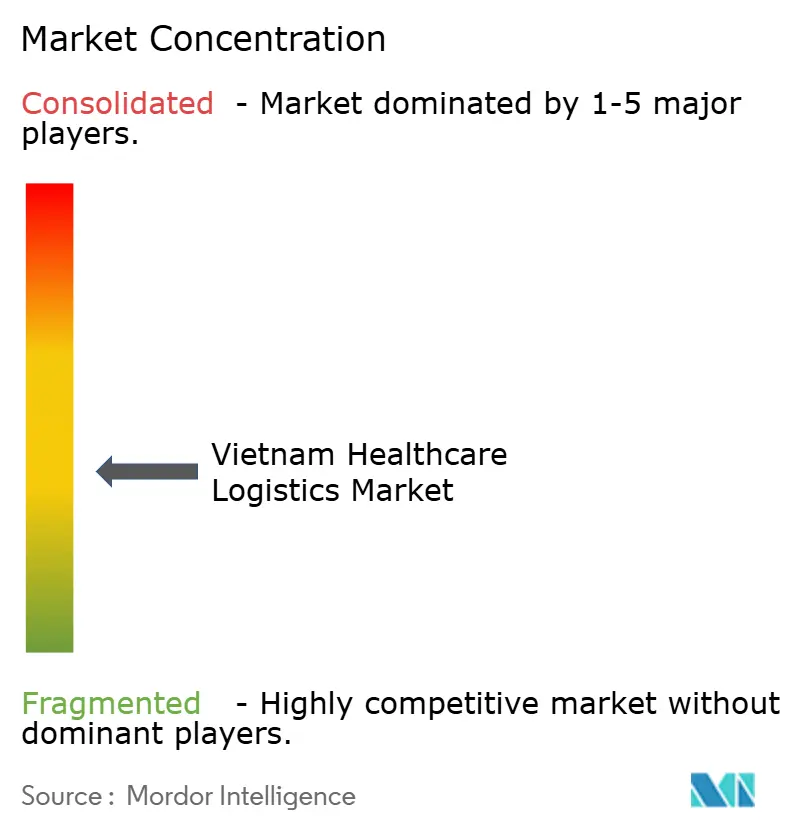
The Vietnam healthcare logistics market is fragmented and includes global logistics providers, regional healthcare distributors, and domestic transport and distribution companies. International operators such as DHL, UPS, FedEx, Kuehne+Nagel, CEVA Logistics, DSV, and A.P. Moller-Maersk compete through international networks, multimodal services, and specialist handling capabilities. Domestic and regional companies, including ITL Corporation and GONSA, serve local distribution requirements and healthcare customers. The competitive position of each provider depends on its service scope, network reach, quality systems, and ability to meet the specific requirements of the products being handled.
Quality certification and investment in specialist equipment are important competitive differentiators. In October 2025, LOGISTEED Vietnam received IATA CEIV Pharma certification at Tan Son Nhat International Airport. In September 2025, ITL Freight Management received a temperature-controlled van equipped with GPS-connected sensors and real-time monitoring. These developments demonstrate investment in pharmaceutical air cargo handling and controlled domestic transport. Providers need to demonstrate that their facilities, procedures, and equipment match the products and service requirements of their customers.
Partnerships and acquisitions can extend access to healthcare customers and specialist product categories. In December 2025, DKSH signed an agreement to acquire Biomedic Science Material Joint Stock Company, a Vietnamese distributor of biotechnology and diagnostic equipment and reagents[4]. The proposed acquisition was intended to strengthen DKSH's scientific solutions business in Vietnam. In April 2026, FedEx and Viettel Post announced an operating arrangement under which Viettel Post became FedEx's National Network Provider in Vietnam, supporting nationwide pickup and delivery and cross-border connectivity. Together, these developments illustrate how companies are extending distribution coverage and service capabilities.
Vietnam Healthcare Logistics Industry Leaders
-
Indo Trans Logistics Corporation (ITL)
-
Transimex Corporation
-
DHL Group
-
Kuehne+Nagel
-
Zuellig Pharma
- *Disclaimer: Major Players sorted in no particular order
Vietnam Healthcare Logistics Market Companies Covered in this Report
- DHL Group
- United Parcel Service (UPS)
- Kuehne+Nagel
- DSV
- CEVA Logistics
- FedEx Corporation
- Yusen Logistics
- Nippon Express Holdings
- CJ Logistics
- A.P. Moller - Maersk
- Zuellig Pharma
- DKSH Holding
- Indo Trans Logistics Corporation (ITL)
- Transimex Corporation
- LOGISTEED Group
- ABA Cooltrans
- GONSA
- Sapharco
- FM Logistic
- Konoike Group
- Nichirei Logistics Group
- LOTTE Global Logistics
Recent Industry Developments in Vietnam Healthcare Logistics Market
- April 2026: FedEx and Viettel Post established a strategic operating arrangement in Vietnam. Viettel Post became FedEx's National Network Provider for nationwide pickup and delivery. The arrangement supports FedEx's domestic reach and cross-border logistics connectivity.
- December 2025: DKSH signed an agreement to acquire Biomedic Science Material Joint Stock Company. The proposed transaction was intended to expand DKSH's scientific solutions business in Vietnam through Biomedic's biotechnology and diagnostic equipment, reagent, testing, and screening distribution activities.
- September 2025: ITL Freight Management received its first TF 820V 2S cool van. The vehicle includes GPS-connected sensor technology for real-time temperature monitoring and alerts when readings move outside preset ranges. ITL initially deployed the vehicle in Southern Vietnam to serve pharmaceutical and other temperature-sensitive shipments.
- May 2025: Nippon Express Vietnam opened Phase II of its Dinh Vu Logistics Center in Hai Phong. The facility added 8,550 m² of warehouse space with constant-temperature and low-humidity air conditioning, along with a bonded warehouse, container freight station, and seven container docks.
Vietnam Healthcare Logistics Market Report Scope
Segmentation Overview
| Transportation | Road |
| Air | |
| Sea and Inland Waterways | |
| Rail | |
| Warehousing and Distribution | |
| Value-added Services and Others |
| Temperature Controlled | Chilled (0-5 °C) |
| Frozen (-20-0 °C) | |
| Ambient | |
| Deep-Frozen / Ultra-Low (less than-20 °C) | |
| Non-Temperature Controlled |
| Pharmaceuticals | Prescription and Specialty Drugs |
| OTC Drugs | |
| Biopharmaceuticals (Biologics and Biosimilars) | |
| Vaccines | |
| Clinical Trial Materials | |
| Cell and Gene Therapies | |
| Medical Devices | |
| Veterinary Medicine | |
| Blood, Plasma and Blood Components | |
| Diagnostic and Laboratory Products | |
| Organs and Human Tissues | |
| Others |
| Domestics |
| International |
| Pharmaceutical Manufacturers |
| Biopharmaceutical Manufacturers |
| Hospitals and Clinics |
| Hospitals and Retail Pharmacies |
| Healthcare Distributors and Wholesalers |
| Others |
| Northern Vietnam |
| Central Vietnam |
| Southern Vietnam |
| By Logistics Function | Transportation | Road |
| Air | ||
| Sea and Inland Waterways | ||
| Rail | ||
| Warehousing and Distribution | ||
| Value-added Services and Others | ||
| By Temperature Type | Temperature Controlled | Chilled (0-5 °C) |
| Frozen (-20-0 °C) | ||
| Ambient | ||
| Deep-Frozen / Ultra-Low (less than-20 °C) | ||
| Non-Temperature Controlled | ||
| By Product Type | Pharmaceuticals | Prescription and Specialty Drugs |
| OTC Drugs | ||
| Biopharmaceuticals (Biologics and Biosimilars) | ||
| Vaccines | ||
| Clinical Trial Materials | ||
| Cell and Gene Therapies | ||
| Medical Devices | ||
| Veterinary Medicine | ||
| Blood, Plasma and Blood Components | ||
| Diagnostic and Laboratory Products | ||
| Organs and Human Tissues | ||
| Others | ||
| By Destination | Domestics | |
| International | ||
| By End User | Pharmaceutical Manufacturers | |
| Biopharmaceutical Manufacturers | ||
| Hospitals and Clinics | ||
| Hospitals and Retail Pharmacies | ||
| Healthcare Distributors and Wholesalers | ||
| Others | ||
| By Region | Northern Vietnam | |
| Central Vietnam | ||
| Southern Vietnam | ||
Key Questions Answered in the Report
What is the forecast growth rate for Vietnam healthcare logistics?
The market is projected to register a CAGR of 7.91% from 2027 to 2032, reaching USD 3.23 billion by 2032.
Which logistics function has the largest share in Vietnam healthcare logistics?
Transportation leads with a 49.16% share in 2026, reflecting the movement of healthcare products between import gateways, warehouses, manufacturers, hospitals, and pharmacies.
Why is temperature-controlled logistics important in Vietnam?
Temperature-controlled logistics accounts for 55.92% of the market in 2026 and is projected to register a CAGR of 8.45% through 2032 as demand for controlled handling expands.
Which healthcare product category is growing fastest in logistics demand?
Cell and gene therapies are projected to register a CAGR of 8.75% through 2032, supported by demand for specialized storage, transport, and chain-of-custody procedures.
Which region leads healthcare logistics activity in Vietnam?
Southern Vietnam accounts for 48.36% of the market in 2026, supported by Ho Chi Minh City's role in healthcare distribution and international trade.
Which region has the strongest growth outlook?
Central Vietnam is projected to register a CAGR of 9.92% through 2032.