
Vietnam Customs Brokerage Market Size and Share
Market Overview
| Study Period | 2021 - 2032 |
|---|---|
| Forecast Data Period | 2027 - 2032 |
| Base Year Market Size (2026) | USD 1.16 Billion |
| Market Size (2027) | USD 1.25 Billion |
| Market Size (2032) | USD 1.8 Billion |
| Growth Rate (2027 - 2032) | 7.59 % |
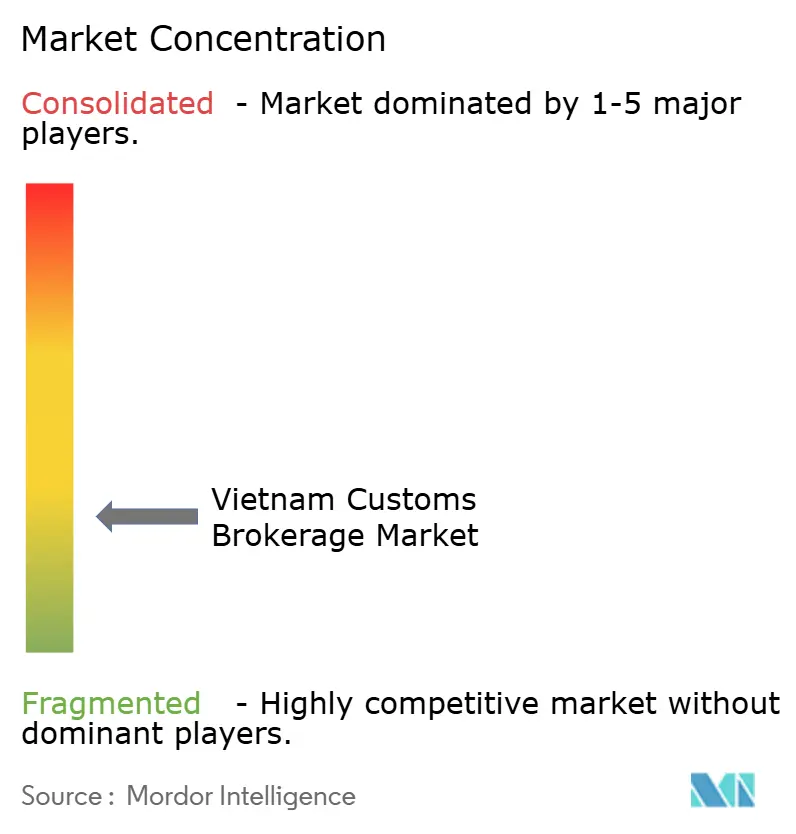
| Market Concentration | Low |
Major Players *Disclaimer: Major Players sorted in no particular order Image © Mordor Intelligence. Reuse requires attribution under CC BY 4.0. | |
Vietnam Customs Brokerage Market Analysis by Mordor Intelligence
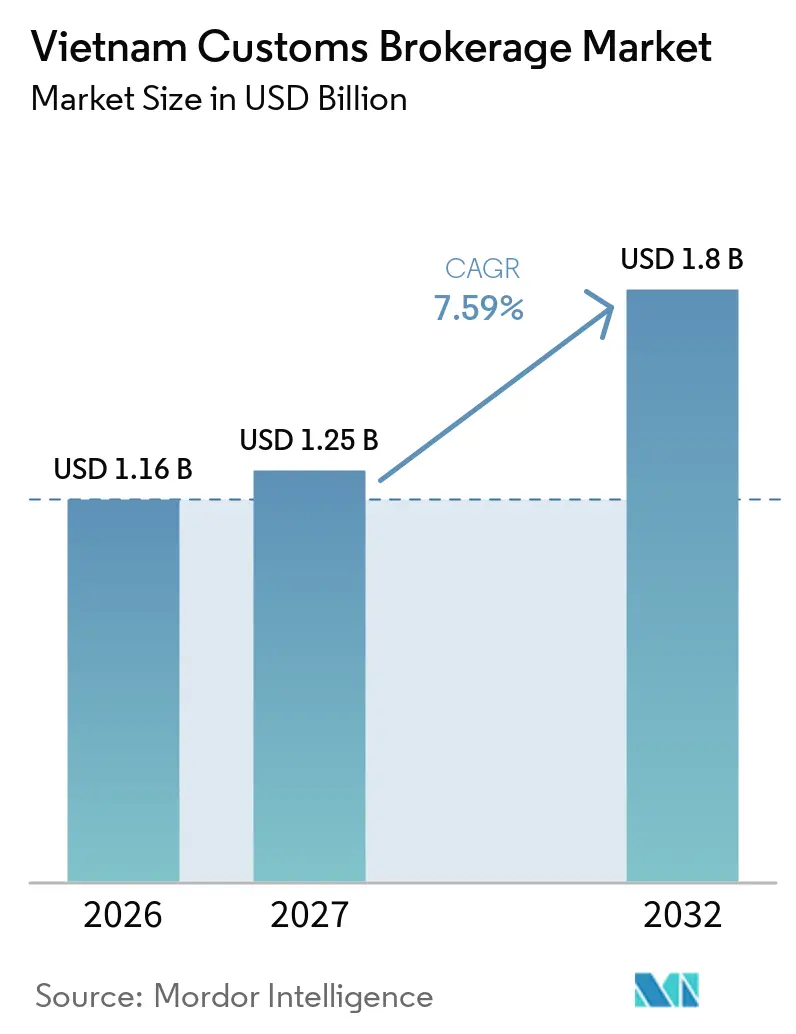
The Vietnam customs brokerage market size is valued at USD 1.16 billion in 2026 and is estimated to grow from USD 1.25 billion in 2027 to reach USD 1.80 billion by 2032, at a CAGR of 7.59% during the forecast period (2027-2032).
Manufacturing investment, cross-border trade, and the growing need for accurate customs documentation support demand for brokerage services. Vietnam attracted USD 50.36 billion in registered foreign direct investment during the first 9 months of 2026, while disbursed FDI reached USD 21.07 billion. Digitalization is changing the way customs brokerage services are delivered. Vietnam's centralized-clearance pilot at Customs Sub-department Region III in Hai Phong began in June 2026 and moves document review toward a centralized electronic process. This development increases the importance of accurate data, consistent documentation, and integration between brokers and customers. Integrated logistics providers can combine customs brokerage with freight forwarding and warehousing, while standalone brokers can differentiate themselves through tariff classification, rules-of-origin advice, and post-clearance support.
Key Report Takeaways
- By mode of transport, ocean/sea clearance accounts for 56.87% of the Vietnam customs brokerage market size in 2026, while air, including express and general cargo, is projected to register a CAGR of 8.27% during 2027–2032.
- By broker type, freight forwarder/3PL-integrated brokers account for 73.41% of the Vietnam customs brokerage market share in 2026 and are projected to register a CAGR of 8.98%.
- By importer size, large enterprises account for 59.28% of the Vietnam customs brokerage market size in 2026, while SMEs/micro-shippers are projected to register a CAGR of 9.67%.
- By digital adoption, traditional brokerages account for 79.34% of the Vietnam customs brokerage market share in 2026, while digital-first/API-based brokerages are projected to register a CAGR of 9.92%.
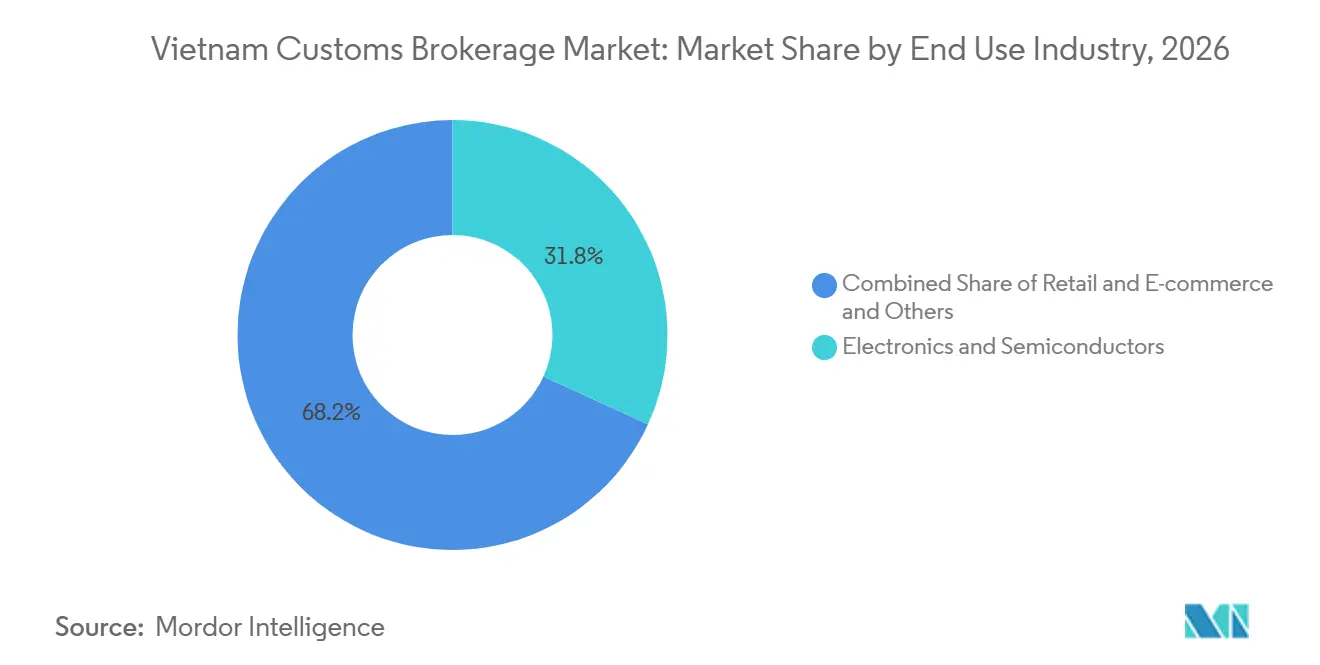
- By end-use industry, electronics and semiconductors account for 31.82% of the Vietnam customs brokerage market size in 2026, while the retail and e-commerce segment is projected to register a CAGR of 8.26%.
- By region, Southern Vietnam accounts for 51.44% of the Vietnam customs brokerage market share in 2026, while Northern Vietnam is projected to register a CAGR of 9.61%.
Note: Market numbers in this report are based on Mordor Intelligence's proprietary estimation framework, which combines nine months of actuals with Q4 projections for base year 2026.
Vietnam Customs Brokerage Market Trends and Insights
Drivers Impact Analysis*
| Driver | (~) % Impact on CAGR | Geographic relevance | Impact timeline |
|---|---|---|---|
| Manufacturing FDI Increasing Cross-Border Trade Compliance Complexity | +1.8% | Northern Vietnam, with spillover to Southern Vietnam | Short term (≤ 2 years) |
| Trade Agreements Increasing Complex Rules-of-Origin Compliance Requirements | +1.5% | International trade corridors, particularly EVFTA and CPTPP | Medium term (2–4 years) |
| Cross-Border E-Commerce Expanding SME Customs Clearance Demand | +1.2% | Southern Vietnam, especially Ho Chi Minh City, with national expansion | Short term (≤ 2 years) |
| Digital Customs Accelerating Paperless Clearance and Processing | +0.9% | National, led by Hai Phong and Ho Chi Minh City | Medium term (2–4 years) |
| Semiconductor Localization Increasing High-Tech Customs Compliance Demand | +0.7% | Northern Vietnam, including Hanoi, Bac Ninh, and Thai Nguyen | Long term (≥ 4 years) |
| AI-Assisted Classification Improving Pre-Clearance Document Validation Efficiency | +0.5% | National, particularly Ho Chi Minh City and Hanoi | Medium term (2–4 years) |
| Source: Mordor Intelligence | |||
Manufacturing FDI Increases Customs Compliance Complexity
Vietnam's manufacturing investment pipeline supports demand for customs brokers that manage the import and export documentation associated with production. Registered FDI reached USD 50.36 billion in the first 9 months of 2026, with processing and manufacturing accounting for 45.8% of total inflows[1]. These investments can generate brokerage work involving machinery, components, production inputs, and finished goods. Manufacturers with multi-country supply chains may also need support with tariff classification, origin documentation, and customs procedures for specialized equipment. Brokers that understand a customer's production processes can help resolve documentation issues before goods reach the border. This makes technical expertise and coordination with freight and compliance teams important differentiators beyond routine declaration filing.
Trade Agreements Increase Rules-of-Origin Requirements
Vietnam's trade agreements, including the EVFTA, CPTPP, and RCEP, create opportunities for exporters and importers to use preferential tariff treatment when they meet the relevant origin requirements. Applying these preferences requires accurate product information, supporting records, and compliance with the rules applicable to the shipment. Vietnam's Ministry of Industry and Trade issued Circular 14/2026/TT-BCT in March 2026, with an effective date of May 2026, setting out EVFTA rules of origin. Customs brokers can add value by helping customers identify the applicable origin requirements and assemble supporting documentation before goods are shipped. Providers that understand multiple trade agreements can support exporters serving different markets. The opportunity is strongest where product-specific origin rules or documentation requirements make self-filing more difficult.
Cross-Border E-Commerce Expands SME Clearance Demand
Cross-border e-commerce creates customs processing needs for smaller exporters and importers that may not maintain dedicated trade-compliance teams. These customers often have smaller shipments and more frequent transactions, which can make manual processing expensive relative to the value of each declaration. Brokerage providers can serve this segment more efficiently through standardized document intake, automated data checks, and clear exception-handling processes. The segment's commercial potential depends on shipment volumes, declaration requirements, and the ability to control processing costs.
Digital Customs Raises the Technology Standard
Vietnam is continuing to modernize customs processing, including through a centralized-clearance pilot at Customs Sub-department Region III in Hai Phong that began in June 2026[2]. Under the pilot, businesses complete customs procedures through electronic platforms, while document receipt and review are centralized. The initiative is intended to streamline procedures and improve processing efficiency. For brokers, digital transformation increases the importance of structured data, accurate declarations, and workflows that can connect customer systems with customs processes. Traditional firms can remain competitive by automating repetitive tasks while retaining specialist review for complex classifications and origin questions.
Restraints Impact Analysis*
| Restraint | (~) % Impact on CAGR | Geographic relevance | Impact timeline |
|---|---|---|---|
| Importer Self-Clearance Limiting Brokerage Outsourcing Demand Growth | -1.5% | National, particularly large manufacturers in Northern Vietnam | Short term (≤ 2 years) |
| Fragmented SME Brokers Creating Uneven Compliance Capabilities | -1.0% | National, particularly secondary cities and land-border gateways | Medium term (2–4 years) |
| Frequent Tariff Changes Increasing Compliance Management Complexity | -0.7% | International trade corridors and controlled-goods categories | Short term (≤ 2 years) |
| Limited Service Differentiation Compressing Brokerage Fee Margins | -0.6% | Southern Vietnam and major ocean-freight corridors | Medium term (2–4 years) |
| Source: Mordor Intelligence | |||
Importer Self-Clearance Limits Outsourcing Growth
Large importers with frequent, predictable shipments may find it economical to maintain internal customs teams, particularly when they have established compliance procedures and sufficient transaction volumes. This can limit outsourced demand for routine declarations and increase competition among brokers serving smaller accounts. In-house teams may still require external specialists for unusual classifications, complex origin questions, regulatory changes, or post-clearance reviews. The opportunity for brokers therefore depends on demonstrating value beyond data entry and declaration submission. Providers that combine filing services with compliance advice, documentation review, and coordination across freight and warehousing can make a stronger case for outsourced support.
Fragmented Brokers and Limited Differentiation Constrain Margins
Competition among customs agents can put pressure on fees when customers view routine declarations as interchangeable services. Differences in staff expertise, documentation controls, and customer support can lead to uneven service quality. Smaller brokers may face challenges investing in technology or maintaining specialist knowledge across multiple tariff classifications and trade agreements. Price competition is particularly difficult for providers that rely on routine ocean-freight filings without additional services. Brokers can protect margins by demonstrating the value of accurate classification, rules-of-origin checks, audit documentation, and proactive exception management. These capabilities are more defensible than competing on filing fees alone.
*Our forecasts treat driver/restraint impacts as directional, not additive. The impact forecasts reflect baseline growth, mix effects, and variable interactions.
Segment Analysis
By Mode of Transport: Sea Clearance Leads While Air Grows Faster
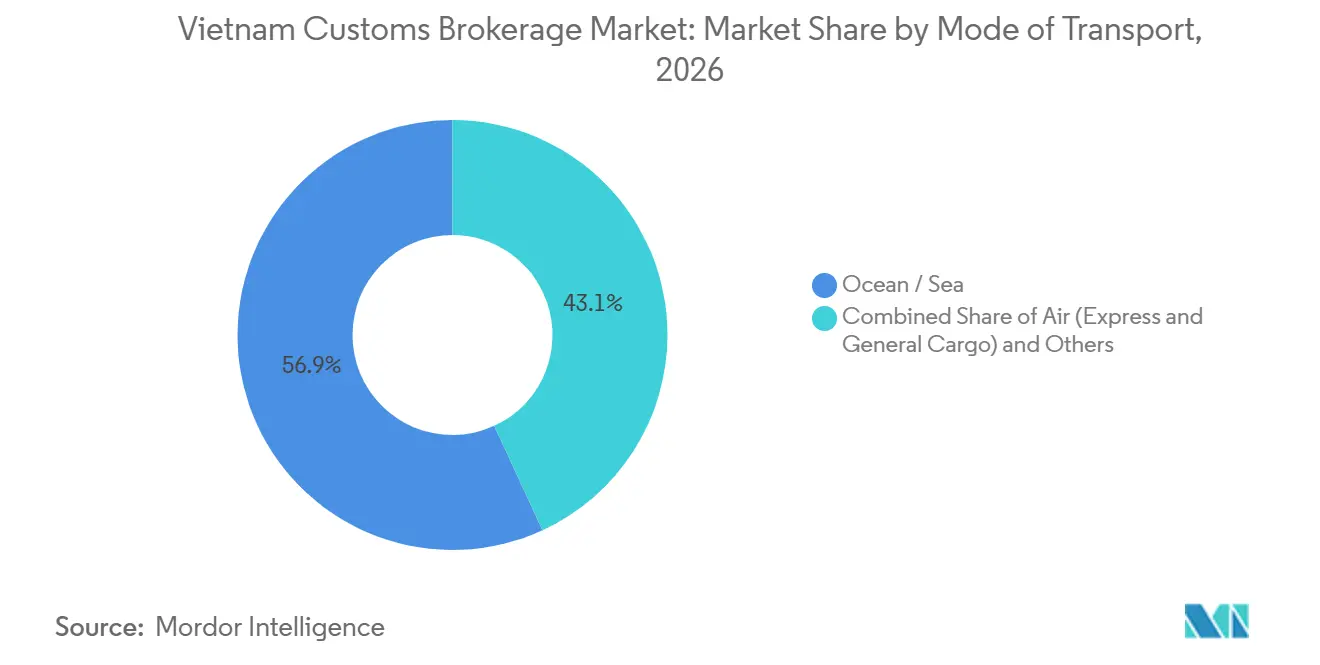
Ocean/sea clearance accounts for 56.87% of the Vietnam customs brokerage market share in 2026. Maritime trade supports a broad base of import and export declarations across containerized cargo, industrial inputs, consumer products, and manufactured goods. Ports including Cai Mep–Thi Vai and Hai Phong serve major international trade flows, sustaining demand for documentation, tariff classification, and customs coordination for sea freight.
Air, including express and general cargo, is projected to register an 8.27% CAGR during 2027–2032. Time-sensitive electronics components, pharmaceutical shipments, and express parcels can require faster document processing and close coordination between freight operators and customs teams. Brokers serving this segment need reliable data handling and the ability to resolve classification or documentation exceptions without creating unnecessary shipment delays.

By Broker Type: Integrated Providers Lead the Market
Freight forwarder / 3PL-integrated brokers account for 73.41% of the Vietnam customs brokerage market share in 2026. These providers can combine customs brokerage with freight forwarding, warehousing, and distribution, reducing the coordination burden for importers and exporters. Their integrated operating model is particularly relevant for businesses managing shipments across several transport modes or production locations.
Freight forwarder / 3PL-integrated brokers are projected to register an 8.98% CAGR during 2027–2032. Growth depends on their ability to connect customs documentation with transport schedules, cargo visibility, and warehouse operations. Pure customs brokers can remain competitive through specialist classification advice, origin support, and post-clearance services, particularly where customers need expertise that is not readily available in a standard freight contract.
By Importer Size: Large Enterprises Lead While SMEs Expand
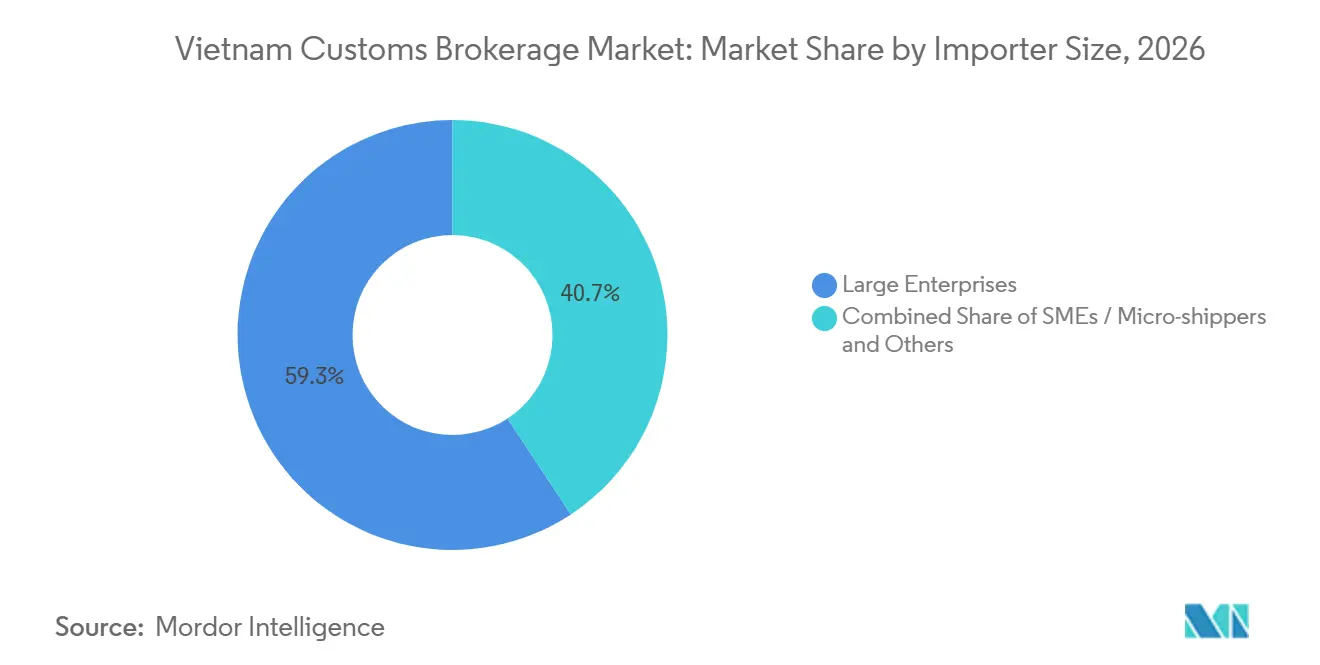
Large enterprises account for 59.28% of the Vietnam customs brokerage market share in 2026. Their shipment volumes, international sourcing networks, and more complex product portfolios support demand for regular customs declarations and compliance management. Manufacturers importing machinery, components, and production inputs may also need support coordinating documentation across suppliers and receiving facilities.
SMEs / micro-shippers are projected to register at a 9.67% CAGR during 2027–2032. Smaller businesses may lack dedicated customs teams and often need help with classification, origin documentation, and declaration preparation. Automated workflows can make these accounts more commercially viable for brokers by reducing manual processing costs. Providers that combine transparent pricing with access to specialist review can address customers who need more support than a basic self-service platform offers.
By Digital Adoption: Traditional Brokers Retain Scale While Digital Models Grow
Traditional brokerages account for 79.34% of the Vietnam customs brokerage market share in 2026. Their established customer relationships and familiarity with local procedures support their position, particularly among importers that value direct assistance with documentation and exceptions. However, the cost of manually handling repetitive declarations can limit their ability to serve high volumes of smaller transactions efficiently.
Digital-first / API-based brokerages are projected to register at a 9.92% CAGR during 2027–2032. These providers can use structured document intake, workflow automation, and system integration to improve processing consistency and customer visibility. Traditional firms can respond by digitizing repetitive steps while retaining human review for complex cases. The competitive advantage will depend on reliable data, appropriate controls, and the ability to integrate brokerage processes into customer operations.
By End-Use Industry: Electronics Leads While E-Commerce Expands
Electronics and semiconductors account for 31.82% of the Vietnam customs brokerage market share in 2026. The sector's international sourcing and production networks create demand for customs clearance covering components, manufacturing equipment, and finished goods. Some shipments require more detailed product descriptions or additional documentation, making accurate classification and coordination important for brokers serving electronics manufacturers.
Retail and e-commerce is projected to register an 8.26% CAGR during 2027–2032. Online retail can generate frequent import and export declarations across a wide range of products and shipment sizes. Other relevant customer groups include automotive and industrial manufacturers, pharmaceuticals, chemicals, and consumer goods companies. Brokers that build industry-specific expertise can differentiate themselves through product knowledge and tailored compliance support rather than relying only on routine declaration processing.
Geography Analysis
Southern Vietnam accounts for 51.44% of the market in 2026. Ho Chi Minh City and the surrounding industrial belt support customs demand from manufacturers, retail importers, exporters, and logistics providers. The region has an established base of freight forwarders and customs agents, creating opportunities for integrated service providers as well as competition for routine declarations. DHL Global Forwarding expanded its Ho Chi Minh City CFS to 6,800 m² in November 2025, strengthening cargo-handling capacity in the southern logistics network.
Northern Vietnam is projected to register a 9.61% CAGR during 2027–2032. The region's manufacturing and export activity creates demand for brokerage services covering machinery, components, and finished products. Customs modernization is also relevant to the region: the centralized-clearance pilot began at Customs Sub-department Region III in Hai Phong in June 2026, shifting document review toward a centralized electronic process[3]. This is a pilot rather than evidence of a fully implemented nationwide system.
Central Vietnam remains a smaller market, with demand linked to local manufacturing, regional trade, and port activity. Businesses operating through the region may require customs support for domestic distribution and cross-border movements, including trade connected to Laos. The region's longer-term potential will depend on the scale of new industrial activity, transport connectivity, and the number of exporters and importers using local gateways. Brokers should prioritize proven shipment flows and customer requirements when evaluating expansion opportunities.
Competitive Landscape
The Vietnam customs brokerage market is fragmented and includes global logistics companies, integrated domestic logistics providers, and independent customs agents. DHL, Kuehne+Nagel, DSV, Nippon Express Holdings, and A.P. Moller–Maersk operate across wider logistics services that can include customs brokerage. Domestic operators compete for local and regional customers, including smaller importers and exporters. The availability of integrated freight and warehousing services can strengthen providers' relationships with customers that prefer a single logistics partner. Company developments illustrate how providers are broadening their logistics capabilities. In August 2025, Seino-ITL Logistics launched in Vietnam following Seino Holdings' entry as a strategic shareholder in ITL's logistics business.
In September 2025, Kuehne+Nagel and the LEGO Group opened a regional distribution center in Dong Nai to support Asia-Pacific distribution[4]. In November 2025, DHL Global Forwarding expanded its CFS capacity in Ho Chi Minh City and Hai Phong and described additional integrated warehousing capability in Bac Ninh. In March 2026, Gemadept and CJ Logistics announced a strategic optimization of their logistics and shipping operations.
In April 2026, FedEx announced a partnership under which Viettel Post became its National Network Provider in Vietnam from April 26, supporting nationwide pickup and delivery and cross-border connectivity. The market offers opportunities in SME-focused digital processing, rules-of-origin support, complex product classification, and post-clearance compliance. Digital workflows can reduce manual effort for routine declarations, while specialist staff can handle cases requiring interpretation or supporting documentation.
Vietnam Customs Brokerage Industry Leaders
-
Indo Trans Logistics Corporation (ITL)
-
Bee Logistics Corporation
-
DHL Group
-
DSV
-
Kuehne+Nagel
- *Disclaimer: Major Players sorted in no particular order
Recent Industry Developments
- April 2026: FedEx announced a strategic collaboration with Viettel Post. Viettel Post became FedEx's National Network Provider in Vietnam, supporting nationwide pickup and delivery and cross-border logistics connectivity.
- April 2026: Gemadept and CJ Logistics announced a strategic optimization of their logistics and shipping operations, with the aim of leveraging their respective operational strengths.
- November 2025: DHL Global Forwarding expanded its Vietnam CFS network. The Ho Chi Minh City facility increased to 6,800 m², the Hai Phong facility reached 4,000 m², and DHL described a 3,000 m² integrated warehousing site in Bac Ninh.
- September 2025: Kuehne+Nagel and the LEGO Group opened a regional distribution center in Dong Nai to support distribution from LEGO's Vietnam manufacturing operation to Asia-Pacific markets.
Vietnam Customs Brokerage Market Report Scope
| Ocean / Sea |
| Air (Express and General Cargo) |
| Cross-Border Land (Truck and Rail) |
| Pure Customs Broker |
| Freight Forwarder / 3PL-Integrated Brokers |
| Large Enterprises |
| Mid-Market |
| SMEs / Micro-shippers |
| Traditional Brokerages |
| Digital-first / API-based Brokerages |
| Retail and E-commerce |
| Automotive and EV |
| Electronics and Semiconductors |
| Pharmaceuticals and Life Sciences |
| Aerospace and Defense |
| Chemicals and Industrial Goods |
| Northern Vietnam |
| Central Vietnam |
| Southern Vietnam |
| By Mode of Transport | Ocean / Sea |
| Air (Express and General Cargo) | |
| Cross-Border Land (Truck and Rail) | |
| By Broker Type | Pure Customs Broker |
| Freight Forwarder / 3PL-Integrated Brokers | |
| By Importer Size | Large Enterprises |
| Mid-Market | |
| SMEs / Micro-shippers | |
| By Digital Adoption | Traditional Brokerages |
| Digital-first / API-based Brokerages | |
| By End-Use Industry | Retail and E-commerce |
| Automotive and EV | |
| Electronics and Semiconductors | |
| Pharmaceuticals and Life Sciences | |
| Aerospace and Defense | |
| Chemicals and Industrial Goods | |
| By Region | Northern Vietnam |
| Central Vietnam | |
| Southern Vietnam |
Key Questions Answered in the Report
What is the projected value of the Vietnam customs brokerage market by 2032?
The market is projected to reach USD 1.80 billion by 2032, growing at a CAGR of 7.59% from 2027 to 2032.
Which transport mode generates the most customs brokerage revenue?
Ocean/sea clearance led with 56.87% market share in 2026, reflecting the importance of maritime trade and containerized cargo.
Why are integrated 3PL providers important in Vietnam?
Freight forwarder / 3PL-integrated brokers accounted for 73.41% of market revenue in 2026. Their combined logistics and clearance services can reduce coordination between providers.
Which importer segment is projected to grow fastest?
SMEs / micro-shippers are projected to register at a 9.67% CAGR during 2027–2032, supported by the potential for more efficient digital processing and outsourced compliance assistance.
Which region is projected to grow fastest?
Northern Vietnam is projected to register a 9.61% CAGR during 2027–2032, supported by its manufacturing base and customs modernization activity.
How is customs digitalization changing broker requirements?
Electronic processing and centralized clearance increase the importance of accurate data, efficient workflows, and reliable document review. Brokers still need specialist expertise for complex classifications and origin requirements.