
Vietnam Air Freight Transport Market Size and Share
Market Overview
| Study Period | 2021 - 2032 |
|---|---|
| Forecast Data Period | 2027 - 2032 |
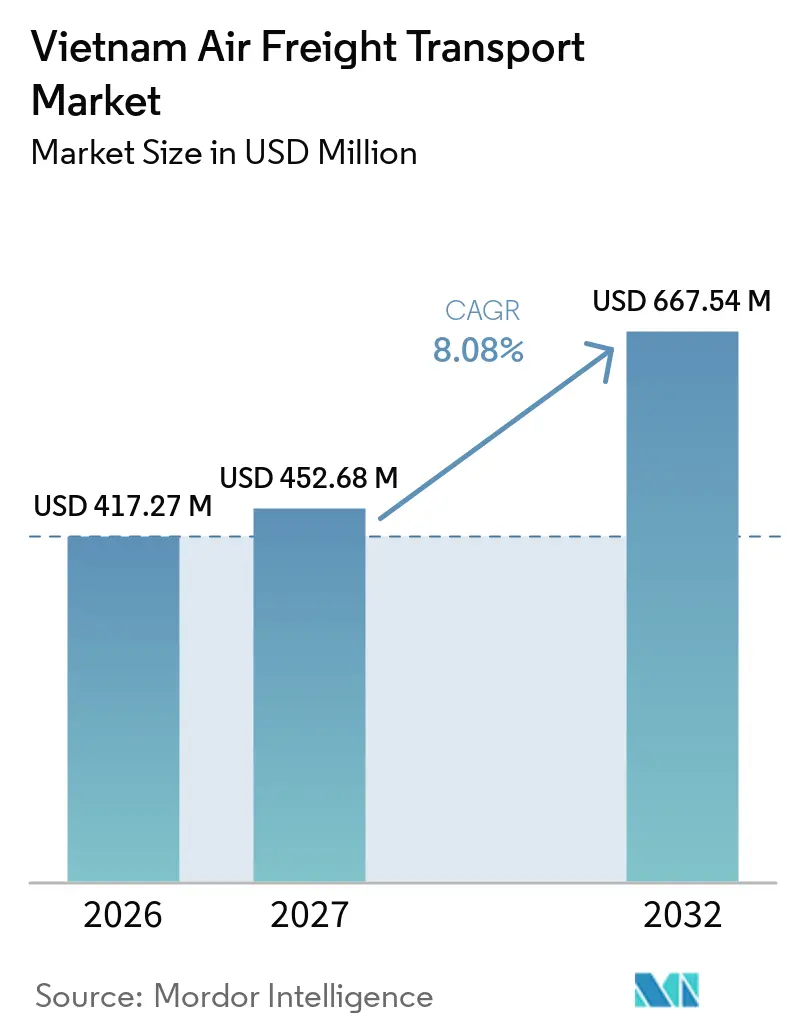
| Base Year Market Size (2026) | USD 417.27 Million |
| Market Size (2027) | USD 452.68 Million |
| Market Size (2032) | USD 667.54 Million |
| Growth Rate (2027 - 2032) | 8.08 % |
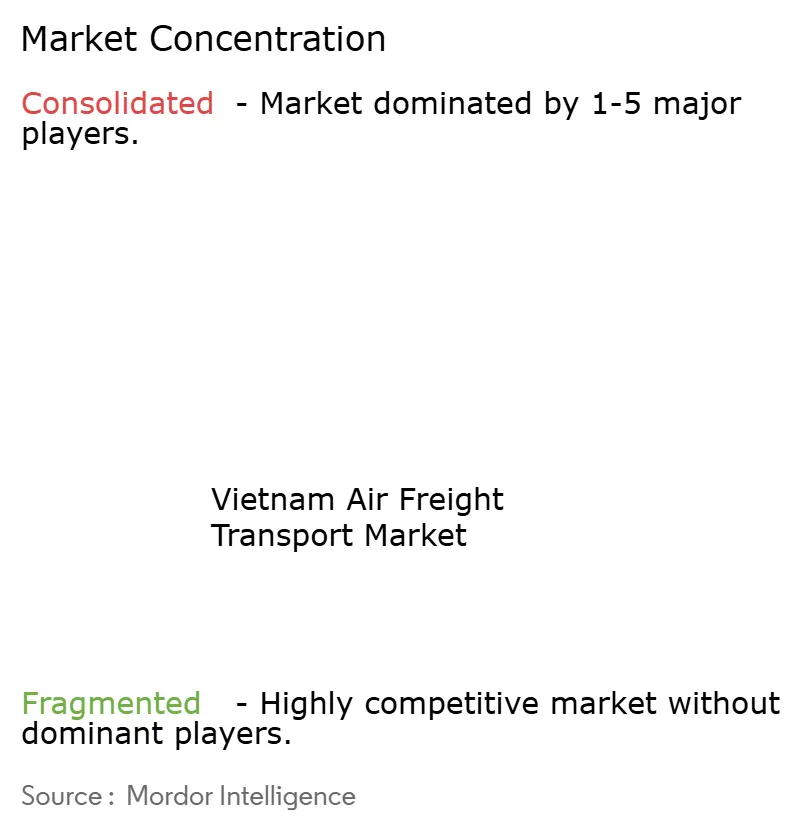
| Market Concentration | Low |
Major Players *Disclaimer: Major Players sorted in no particular order Image © Mordor Intelligence. Reuse requires attribution under CC BY 4.0. | |
Vietnam Air Freight Transport Market Analysis by Mordor Intelligence
The Vietnam air freight transport market size is valued at USD 417.27 million in 2026 and is estimated to grow from USD 452.68 million in 2027 to reach USD 667.54 million by 2032, at a CAGR of 8.08% during the forecast period (2027-2032).
Manufacturing investment is increasing the demand for fast shipment of components, machinery, and finished electronics. Airport capacity projects are intended to ease handling constraints in the north, south, and central regions. Foreign carriers retain a major role on international routes, which limits the ability of domestic airlines to set capacity and pricing independently. Dedicated freighter services and direct express networks are becoming more important as shippers seek reliable space on long-haul routes. The Vietnam air freight transport market also faces airport congestion, exposure to fuel costs, and uneven flows between outbound and inbound cargo.
Key Report Takeaways
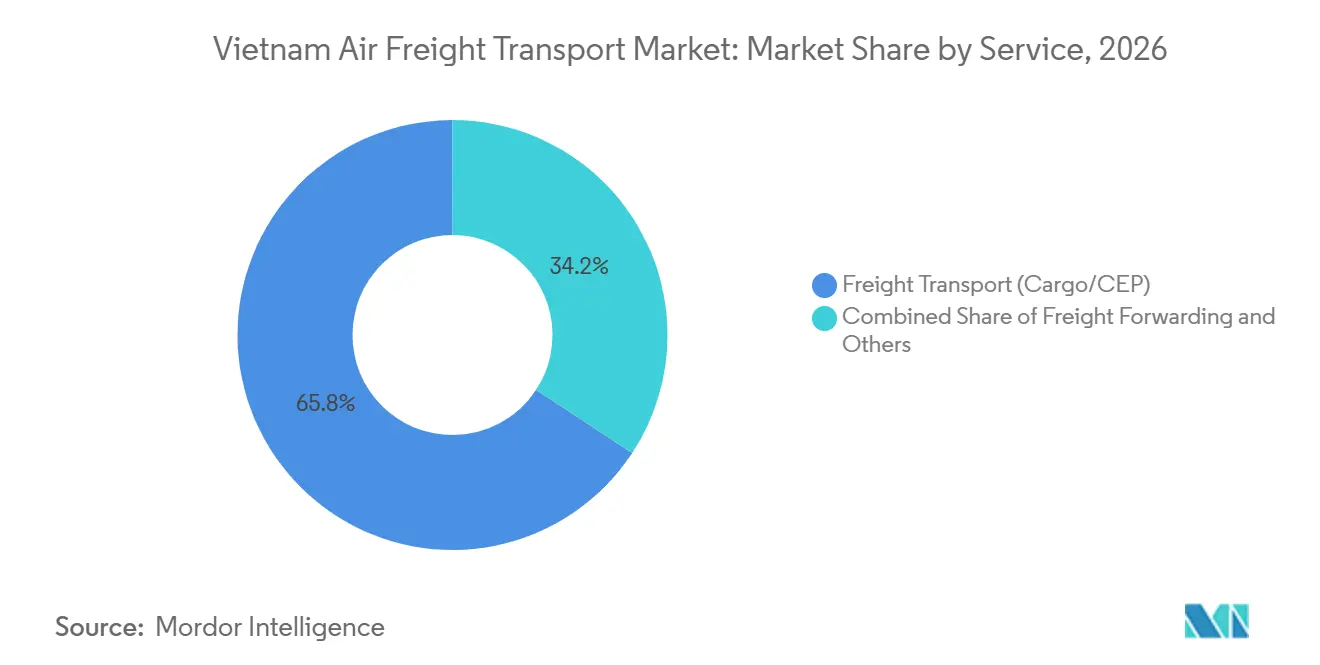
- By service, freight transport (cargo/CEP) accounts for 65.76% of the Vietnam air freight transport market share in 2026, while other value-added services are forecast to register a CAGR of 10.78% through 2032.
- By destination, international freight accounts for 74.38% of the Vietnam air freight transport market size in 2026, while domestic freight is forecast to register a CAGR of 10.39% through 2032.
- By carrier type, belly cargo accounts for 68.36% of the Vietnam air freight transport market share in 2026, while freighter services are forecast to register a CAGR of 12.98% through 2032.
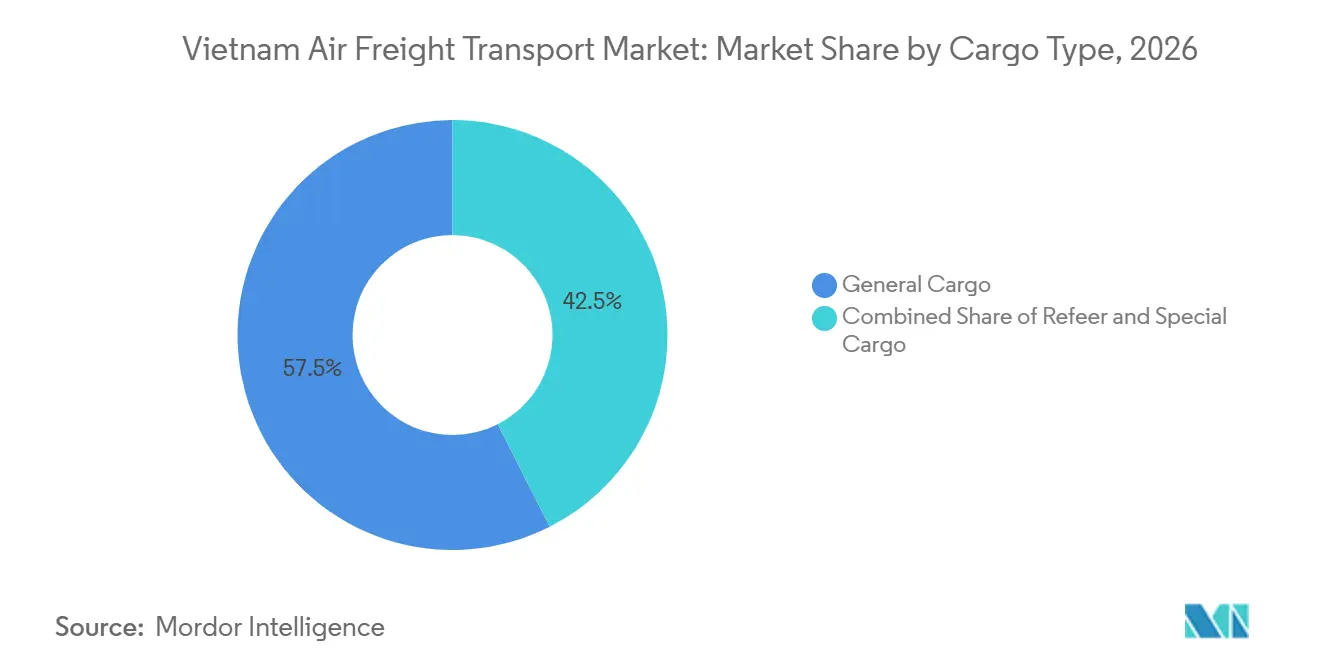
- By cargo type, general cargo accounts for 57.48% of the Vietnam air freight transport market size in 2026, while special cargo is forecast to register a CAGR of 11.27% through 2032.
- By end-user industry, high-tech and electronics account for 40.28% of the Vietnam air freight transport market share in 2026, while e-commerce and retail are forecast to register a CAGR of 9.87% through 2032.
- By geography, Northern Vietnam accounts for 56.84% of the Vietnam air freight transport market size in 2026, while Southern Vietnam is forecast to register a CAGR of 9.29% through 2032.
Note: Market numbers in this report are based on Mordor Intelligence's proprietary estimation framework, which combines nine months of actuals with Q4 projections for base year 2026.
Vietnam Air Freight Transport Market Trends and Insights
Drivers Impact Analysis*
| Driver | (~) % Impact on CAGR Forecast | Geographic Relevance | Impact Timeline |
|---|---|---|---|
| Manufacturing Relocation Increasing Export-Oriented Cargo Demand | +2.2% | National, concentrated in the Hanoi, Bac Ninh, and Thai Nguyen industrial corridor | Short term (≤ 2 years) |
| Electronics Exports Strengthening Time-Critical Shipment Volumes | +1.8% | Northern Vietnam, with secondary flows through Tan Son Nhat | Short term (≤ 2 years) |
| Cross-Border E-Commerce Expanding Express Cargo Demand | +1.4% | National, with early gains in Ho Chi Minh City and Hanoi | Medium term (2-4 years) |
| Airport Infrastructure Investment Increasing Cargo Handling Capacity | +1.0% | Long Thanh, Da Nang, and Gia Binh | Medium term (2-4 years) |
| Trade Liberalization Supporting International Route Network Expansion | +0.7% | International corridors serving the EU, Japan, and ASEAN | Long term (≥ 4 years) |
| Freighter Fleet Growth Improving Dedicated Cargo Capacity | +0.5% | National, with intercontinental routes targeted from 2029 | Long term (≥ 4 years) |
| Source: Mordor Intelligence | |||
Manufacturing Relocation Increasing Export-Oriented Cargo Demand
Supply chain diversification has strengthened Vietnam's role in production networks that serve overseas markets. New plants need machinery, equipment, spare parts, and production inputs before they reach stable output. Those movements can require air transport when delivery dates do not allow for ocean freight. The resulting demand occurs before a facility begins regular exports, which broadens the cargo base for airlines and forwarders. Manufacturing activity around Hanoi, Bac Ninh, and Thai Nguyen also supports recurring movements of high-value components. The Vietnam air freight transport market benefits when these production networks require dependable connections to suppliers and customers. Samsung, LG, and Amkor Technology have expansion commitments in northern Vietnam that support the movement of technology-related cargo. High-value cargo is less suited to delayed transport where a production line depends on a scheduled component delivery. Freight forwarders can therefore compete on planned uplift, handling quality, and customs coordination. Export manufacturing also creates demand for services beyond the flight itself, including consolidation and origin documentation. This pattern supports air cargo activity across both carriers and logistics providers.
Electronics Exports Strengthening Time-Critical Shipment Volumes
Vietnam has become an important production location for smartphones, computers, and related components. Electronics supply chains often operate to strict delivery schedules set by original equipment manufacturers. A delayed component shipment can disrupt a larger manufacturing sequence, making the cost of delay greater than the premium for air transport. This supports the use of air cargo for urgent materials, replacement parts, and finished devices. The Vietnam air freight transport market gains from the regularity of these supply chains rather than only from changes in total export volumes. Northern production centers remain especially important because they are close to Noi Bai International Airport. Vietnam Airlines appointed ECS Group as its cargo General Sales Agent in South Korea in June 2026[1]. The appointment reflects the practical importance of commercial representation on a major electronics corridor. Sales coverage can help a carrier serve exporters whose shipments require regular access to capacity. It can also improve coordination between local shippers, forwarders, and airline cargo teams. These links remain relevant to the Vietnam air freight transport market because electronics traffic depends on predictable schedules and handling standards.
Cross-Border E-Commerce Expanding Express Cargo Demand
Cross-border e-commerce increases demand for smaller, time-sensitive shipments that need end-to-end visibility. Shippers and consumers expect quicker transit times than conventional parcel networks can always provide. Express providers can differentiate their offering through customs processes, collection coverage, and delivery reliability. This demand is most visible in Ho Chi Minh City and Hanoi, where international gateways connect to large customer and business networks. The Vietnam air freight transport market benefits as express networks gain density and can support more frequent flights. Air transport is particularly relevant where merchandise must reach foreign customers within short delivery windows. FedEx moved to a direct-serve operating model in Vietnam in June 2025, launching 6 weekly Boeing 777 freighter flights connecting Ho Chi Minh City through Singapore to Anchorage in April 2025[2]. FedEx then announced a collaboration with Viettel Post in April 2026 for nationwide pickup and delivery coverage. These steps combine international air capacity with a domestic collection and delivery network. The model reduces reliance on indirect arrangements for parcels that require consistent handling. It also shows why ground network reach matters alongside aircraft capacity. This approach supports the Vietnam air freight transport market, where cross-border shipments need both airlift and local execution.
Airport Infrastructure Investment Increasing Cargo Handling Capacity
Airport infrastructure investment is important because cargo demand cannot be served efficiently without adequate terminals, access roads, and handling space. Long Thanh International Airport's Phase 1 Cargo Terminal is planned for commercial operations from December 2026, with 550,000 tons of annual capacity. The planned facility is intended to absorb pressure from Tan Son Nhat and introduce another major southern gateway. More handling capacity can reduce bottlenecks and give carriers additional options for scheduling cargo flights. This is important for the Vietnam air freight transport market because exporters need reliable cut-off times and terminal access. The development also creates opportunities for providers of bonded warehousing, ground handling, and cold-chain services. The Airports Corporation of Vietnam broke ground on a new cargo terminal at Da Nang International Airport in August 2025. The project carries a stated investment of VND 631 billion (USD 25.24 million), and targets 100,000 tons of annual capacity by 2030[3]. The facility responds to throughput that has exceeded the existing terminal's design capacity. Additional capacity in Da Nang can support cargo from central Vietnam and reduce dependence on the northern and southern gateways. Investment across several regions can improve the balance of the national cargo network. The Vietnam air freight transport market has scope to grow more evenly when these facilities become operational.
Restraints Impact Analysis*
| Restraint | (~) % Impact on CAGR Forecast | Geographic Relevance | Impact Timeline |
|---|---|---|---|
| Airport Congestion Increasing Cargo Handling and Transit Delays | -0.9% | Noi Bai and Tan Son Nhat | Short term (≤ 2 years) |
| Fuel Volatility Increasing Transportation Cost and Pricing Pressure | -0.7% | Global, with high sensitivity due to Vietnam's import dependence | Short term (≤ 2 years) |
| Foreign Carrier Dependence Limiting Domestic Capacity Flexibility | -0.5% | National, concentrated on international routes | Medium term (2-4 years) |
| Imbalanced Cargo Flows Reducing Network Utilization Efficiency | -0.4% | National, with pressure on inbound corridors | Long term (≥ 4 years) |
| Source: Mordor Intelligence | |||
Airport Congestion Increasing Cargo Handling and Transit Delays
Congestion at airport cargo terminals increases uncertainty for exporters with fixed shipment deadlines. Electronics exporters are especially exposed because their goods often move under narrow production and delivery windows. Congestion also raises the risk that cargo cannot be accepted at the intended terminal on time. The Vietnam air freight transport market is constrained when handling capacity fails to match demand from nearby manufacturing clusters. This makes the issue more persistent than a short seasonal increase in volume. NX Vietnam obtained an air cargo CFS license for its Quang Minh Logistics Center in April 2026. The facility is located 15 minutes from Noi Bai and allows cargo consolidation outside airport terminals. Its development shows that operators are creating alternatives to terminal backlogs. These off-airport facilities can help shippers manage queues, but they do not eliminate the need for airport-side capacity improvements.
Fuel Volatility Increasing Transportation Cost and Pricing Pressure
Fuel price movements can raise airline operating costs quickly because jet fuel is a large share of flight expenses. Cargo carriers and airlines may attempt to recover higher costs through surcharges, but customer contracts can limit the speed of recovery. Higher fuel costs can affect both dedicated freighter services and passenger flights carrying belly cargo. This creates a direct operating risk for the Vietnam air freight transport market. It can also make airlines more cautious about expanding frequencies during uncertain periods. Fewer passenger flights would have reduced belly cargo space at the same time. The link between passenger schedules and cargo capacity is important because belly cargo remains the largest carrier-type segment. Fuel pressure can therefore affect cargo supply even when freight demand stays firm. The Vietnam air freight transport market remains sensitive to fuel costs because capacity decisions can change before freight rates fully adjust.
*Our forecasts treat driver/restraint impacts as directional, not additive. The impact forecasts reflect baseline growth, mix effects, and variable interactions.
Segment Analysis
By Service: Freight Transport Commands Revenue While Value-Added Services Scale Faster
Freight transport (cargo/CEP) accounts for 65.76% of the Vietnam air freight transport market share in 2026. The segment provides the core movement of cargo between airports and remains essential for exporters that need scheduled international space. Its leading position reflects the central role of air transport in moving time-sensitive goods. Freight Transport includes cargo and CEP activity that requires reliable uplift and terminal handling. The Vietnam air freight transport industry depends on this core service because every other service category supports or extends the physical movement of freight.
Other value-added services are forecast to register at a 10.78% CAGR through 2032. The Vietnam air freight transport market size for these services grows as shippers seek customs brokerage, cargo insurance, and freight optimization alongside transport. These services can simplify complex international transactions for companies with several suppliers and destinations. Freight Forwarding also benefits when exporters need support with origin certificates and tariff classifications under trade agreements. Committed charter operations create additional demand for coordination between flight planning, consolidation, and documentation. Service providers that combine transport with practical support can be better positioned to retain customers as shipment requirements become more complex.

By Destination: International Routes Anchor Revenue While Domestic Throughput Accelerates
International services account for 74.38% of the Vietnam air freight transport market size in 2026, reflecting the export orientation of Vietnamese manufacturing. Overseas routes connect Vietnam's industrial centers with customers, suppliers, and distribution hubs in other regions. These routes are important for high-value electronics and urgent component shipments. International cargo also supports the scheduled passenger services that provide much of the country's belly capacity. The Vietnam air freight transport market remains closely tied to the availability and reliability of these cross-border connections.
Domestic services are forecast to expand at a 10.39% CAGR through 2032. The segment is supported by e-commerce fulfillment, healthcare distribution, and transfers of components between cities. Domestic movements can use return capacity on aircraft that operate international routes, linking local cargo economics to passenger schedule density. Faster domestic growth can improve connectivity, but it remains dependent on airport operations and airline network planning.
By Carrier Type: Belly Dominance Constrains Cargo Independence as Freighter Capacity Builds
Belly cargo accounts for 68.36% of the Vietnam air freight transport market share in 2026 and remains the largest carrier-type segment. Passenger aircraft provide cargo space that airlines can use without operating a separate freighter schedule. This model supports regular shipments on routes with strong passenger demand. It also gives exporters access to broad networks where airlines operate frequent passenger flights. The Vietnam air freight transport market has benefited from this capacity, particularly on international routes serving major manufacturing locations.
Freighter services are forecast to register a 12.98% CAGR through 2032. They give cargo operators more flexibility to carry heavy freight, special cargo, and large consolidated loads. Vietjet adopted SmartKargo's AIRCAM solution in September 2025 to improve capacity forecasting, demand prediction, and yield optimization. The Vietnam air freight transport industry can become less dependent on passenger schedules as dedicated cargo capacity grows. That transition remains gradual because belly capacity still provides the larger share of the current supply.
By Cargo Type: General Cargo Leads Volume While Special Cargo Drives Revenue Growth
General cargo accounts for 57.48% of the Vietnam air freight transport market size in 2026. It includes standard electronics assembly goods, apparel, machinery components, and consumer-manufactured products. This category provides the volume base for the Vietnam air freight transport market. Its broad product mix reflects the diversity of Vietnam's export manufacturing base. General Cargo also benefits from established handling processes at airports and forwarder facilities. The segment will remain important because many manufacturers require regular, scheduled access to international cargo capacity.
Special cargo is forecast to register at an 11.27% CAGR through 2032. The category includes dangerous goods, high-value shipments, and oversized equipment that need more specialized handling. Reefer Cargo serves a separate demand base for seafood and other temperature-sensitive exports. LOGISTEED Vietnam became the first freight forwarder in Vietnam to receive IATA CEIV Pharma certification at Tan Son Nhat in October 2025. Certified handling can help logistics providers serve pharmaceutical customers who require defined cold-chain controls.
By End-User Industry: Electronics Anchors Market Share While E-Commerce Drives the Fastest Growth
High-tech and electronics held 40.28% of the Vietnam air freight transport market share in 2026. The segment is supported by Vietnam's role in smartphone and electronics exports. Technology goods often have a high value relative to weight and can require rapid delivery. Manufacturers may use air cargo for components, finished products, and replacement parts where delays affect production or sales. The Vietnam air freight transport market has a strong connection to this end-user base because its supply chains are international and time-sensitive.
E-commerce and retail are forecast to register at a 9.87% CAGR through 2032. The segment is supported by cross-border orders that require timely collection, customs processing, and delivery. Manufacturing and automotive customers also use air freight for just-in-time component replenishment. Healthcare and pharmaceuticals require dependable cold-chain services as compliance needs become more formalized. Perishables and Fresh Produce create repeat belly demand in Japan and South Korea corridors. The Vietnam air freight transport market, therefore, serves end users with different cargo needs, but all depend on reliable air capacity and ground handling.
Geography Analysis
Northern Vietnam accounts for 56.84% of revenue in 2026 and remains the largest regional part of the Vietnam air freight transport market. Its position is tied to the industrial clusters around Bac Ninh, Thai Nguyen, and Vinh Phuc. These areas produce smartphones, camera modules, and semiconductor-related components. Noi Bai is the principal airport gateway for this activity. The concentration of technology manufacturing gives the North a strong base of high-value freight. CEVA's Hanoi-Chicago service also uses Hanoi as a gateway for cargo from several Vietnamese cities. These services reflect the North's importance for urgent exports to the United States. Congestion at the gateway nevertheless remains a material operational constraint.
Southern Vietnam is forecast to register a 9.29% CAGR through 2032. Long Thanh's Phase 1 Cargo Terminal is intended to begin commercial operations from December 2026 with 550,000 tons of annual capacity. The project is expected to relieve pressure on Tan Son Nhat and provide another southern cargo gateway. Tan Son Nhat also benefits from passenger operations that create belly capacity. This capacity supports the Vietnam air freight transport market size in the south as exporters and logistics providers seek alternative routing options. FedEx's direct-serve model and Viettel Post partnership strengthen its ability to connect southern international air capacity with nationwide collection and delivery. The region also has scope for pharmaceutical and cold-chain activity because of its healthcare manufacturing base. New airport facilities may give specialist logistics providers more room to develop temperature-controlled handling. The southern gateway can also support express and retail traffic that moves through Ho Chi Minh City. Its growth outlook depends on the timely operational readiness of Long Thanh and the continued performance of the broader aviation network.
Da Nang is its main airport and a focal point for infrastructure investment. The airport handled 41,561 tonnes of cargo in 2025. This volume exceeded the existing terminal's design capacity by more than 2.5 times. The new ACV terminal is intended to increase capacity and improve the airport's ability to handle regional export flows. The project targets 100,000 tons of annual capacity by 2030 and supports central Vietnam's longer-term logistics role. Da Nang cargo can be consolidated through Hanoi for United States-bound freight under the CEVA service model. This connection shows that central Vietnam is already linked to national export routing. Better terminal capacity can reduce the need to move all cargo through the two largest metropolitan gateways. The region's progress will depend on whether infrastructure investment produces reliable connections for local exporters.
Competitive Landscape
The Vietnam air freight transport market is fragmented among freight forwarders but concentrated among carriers. The competitive position of a provider depends on its aircraft access, gateway presence, and ability to manage ground operations. Global integrators are investing in both flight capacity and local delivery networks. FedEx's direct-serve transition in June 2025 added 6 weekly Boeing 777 freighter flights through Ho Chi Minh City. In April 2026, FedEx announced a strategic collaboration with Viettel Post to expand nationwide pickup and delivery coverage. This combination gives FedEx a more direct operating model than an agent-led arrangement. It also indicates that air freight competitiveness depends on the full journey from shipper to consignee.
Forwarders are also using committed freighter capacity to serve high-value exports. CEVA launched a 3-times-weekly Hanoi-Chicago 777F service that can carry up to 100 tons per flight[4]. The service consolidates cargo from Hanoi, Da Nang, and Ho Chi Minh City through the Hanoi gateway. DHL Global Forwarding activated a 3-times-weekly Hanoi-Taipei-Anchorage-Chicago Boeing 777 freighter rotation in July 2026. These actions show that providers are competing through committed capacity rather than relying only on the spot market. Temperature-controlled and pharmaceutical logistics remain areas where specialist capability can differentiate providers. LOGISTEED's October 2025 IATA CEIV Pharma certification created a recognized capability for handling pharmaceutical freight at Tan Son Nhat. This type of certification matters where multinational drug companies require controlled handling processes. Providers that meet such requirements can compete for cargo that does not move through standard facilities. The opportunity is linked to handling quality rather than simply offering lower prices. It also requires airport, warehouse, and transport processes to work as one system.
Domestic carriers are seeking to strengthen their cargo position through dedicated aircraft and better capacity management. Vietjet's adoption of SmartKargo's AIRCAM solution is another example of investment in cargo management technology. Better forecasting and yield management can improve the use of belly capacity. However, domestic carriers will need larger dedicated capacity to reduce their dependence on passenger schedules and foreign networks. These shipments require secure handling and long-haul capacity that can support strict delivery requirements. Cathay Cargo introduced automated loading software for semiconductor equipment and AI hardware in its 2025 interim report. This example shows how established carriers are adapting handling processes for specialized freight. Providers in Vietnam must match these operational standards if they want to secure this cargo category. Competition will therefore continue to combine network scale, specialized handling, and local infrastructure.
Vietnam Air Freight Transport Industry Leaders
-
Vietnam Airlines JSC
-
DHL Global Forwarding
-
Vietjet Aviation JSC
-
Kuehne+Nagel International AG
-
Bee Logistics Corporation
- *Disclaimer: Major Players sorted in no particular order
Recent Industry Developments
- June 2026: CEVA Logistics launched a 3-times-weekly Hanoi-Chicago 777F freighter service providing up to 100 tons per flight, consolidating export cargo from Hanoi, Da Nang, and Ho Chi Minh City through the Hanoi gateway, the first scheduled Vietnam-United States committed charter by a major logistics provider.
- April 2026: FedEx announced a strategic collaboration with Viettel Post, designating it as National Network Provider effective April 26, 2026, to cover nationwide pickup and delivery and strengthen cross-border logistics connectivity.
- September 2025: DHL Express added over 300 tons of weekly air cargo capacity from Hanoi using Boeing 777 and Airbus A330 freighters, following double-digit tech-related export growth in H1 2025.
- June 2025: FedEx transitioned to a direct-serve operating model in Vietnam, launching 6 weekly Boeing 777 freighter flights connecting Ho Chi Minh City through Singapore to Anchorage.
Vietnam Air Freight Transport Market Report Scope
| Freight Transport (Cargo/CEP) |
| Freight Forwarding |
| Other Value-Added Services (Customs Brokerage, Insurance, etc.) |
| Domestic |
| International |
| Belly Cargo |
| Freighter |
| General Cargo |
| Refeer Cargo |
| Special Cargo (Dangerous, High Value, Oversized, etc.) |
| E-commerce and Retail |
| Manufacturing and Automotive |
| Healthcare and Pharmaceuticals |
| Perishables and Fresh Produce |
| High-Tech and Electronics |
| Others |
| Northern Vietnam |
| Central Vietnam |
| Southern Vietnam |
| By Service | Freight Transport (Cargo/CEP) |
| Freight Forwarding | |
| Other Value-Added Services (Customs Brokerage, Insurance, etc.) | |
| By Destination | Domestic |
| International | |
| By Carrier Type | Belly Cargo |
| Freighter | |
| By Cargo Type | General Cargo |
| Refeer Cargo | |
| Special Cargo (Dangerous, High Value, Oversized, etc.) | |
| By End-User Industry | E-commerce and Retail |
| Manufacturing and Automotive | |
| Healthcare and Pharmaceuticals | |
| Perishables and Fresh Produce | |
| High-Tech and Electronics | |
| Others | |
| By Region | Northern Vietnam |
| Central Vietnam | |
| Southern Vietnam |
Key Questions Answered in the Report
What is the Vietnam air freight transport market forecast through 2032?
It is forecast to rise from USD 452.68 million in 2027 to USD 667.54 million by 2032, at an 8.08% CAGR.
Which service leads Vietnam air freight transport?
Freight Transport (Cargo/CEP) leads, with a 65.76% share in 2026.
Which carrier type is growing fastest in Vietnam's air freight transport?
Freighter services are forecast to register at a 12.98% CAGR through 2032, faster than other carrier types.
Why is Northern Vietnam important for air cargo?
Northern Vietnam held 56.84% revenue share in 2026 and serves technology manufacturing clusters around Hanoi, Bac Ninh, and Thai Nguyen.
What is the main constraint on Vietnam's air cargo operations?
Airport congestion at Noi Bai and Tan Son Nhat can create handling delays and tighter cargo cut-off requirements.
Which end-user segment is expanding fastest?
E-commerce and retail are forecast to register at a 9.87% CAGR through 2032.