
Video and Holographic Communications Software Market Size and Share
Market Overview
| Study Period | 2020 - 2031 |
|---|---|
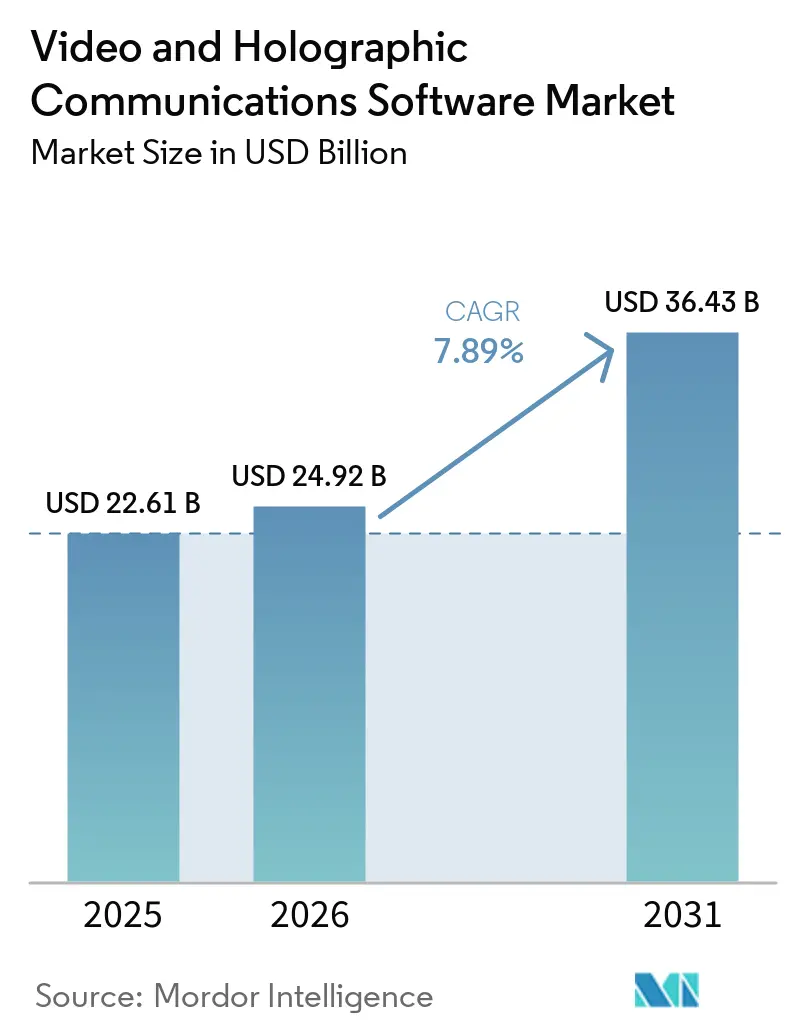
| Market Size (2026) | USD 24.92 Billion |
| Market Size (2031) | USD 36.43 Billion |
| Growth Rate (2026 - 2031) | 7.89 % |
| Fastest Growing Market | Asia-Pacific |
| Largest Market | North America |
| Market Concentration | Medium |
Major Players *Disclaimer: Major Players sorted in no particular order Image © Mordor Intelligence. Reuse requires attribution under CC BY 4.0. | |
Video and Holographic Communications Software Market Analysis by Mordor Intelligence
The video and holographic communications software market size was valued at USD 22.61 billion in 2025 and is estimated to expand from USD 24.92 billion in 2026 to reach USD 36.43 billion by 2031, at a CAGR of 7.89% during the forecast period 2026-2031. Hybrid work has become a durable operating model, which supports recurring spending on meeting platforms, collaboration tools, and related services. Enterprise buyers are shifting from basic meeting access toward platforms that support structured collaboration, workflow integration, and AI-enabled meeting support. This change favors suppliers that can combine secure video, content management, transcription, and integration capabilities within an established software environment. The video and holographic communications software market also faces a more demanding compliance environment as organizations place greater emphasis on data location, cybersecurity, and control of AI workloads. Holographic use cases remain concentrated in premium settings, but improved compression and network performance are widening the range of deployments that can be considered over time.
Key Report Takeaways
- By component, video communications software held 48.52% of the video and holographic communications software market share in 2025, while holographic communications software is projected to expand at an 8.76% CAGR through 2031.
- By deployment model, cloud and hosted deployment accounted for 58.52% of the video and holographic communications software market size in 2025, while SaaS is expected to expand at an 8.65% CAGR through 2031.
- By organization size, large enterprises held 60.64% of revenue in 2025, while SMEs are projected to expand at an 8.55% CAGR through 2031.
- By communication type, standard video conferencing accounted for 56.60% of revenue in 2025, while immersive holographic conferencing is projected to expand at an 8.43% CAGR through 2031.
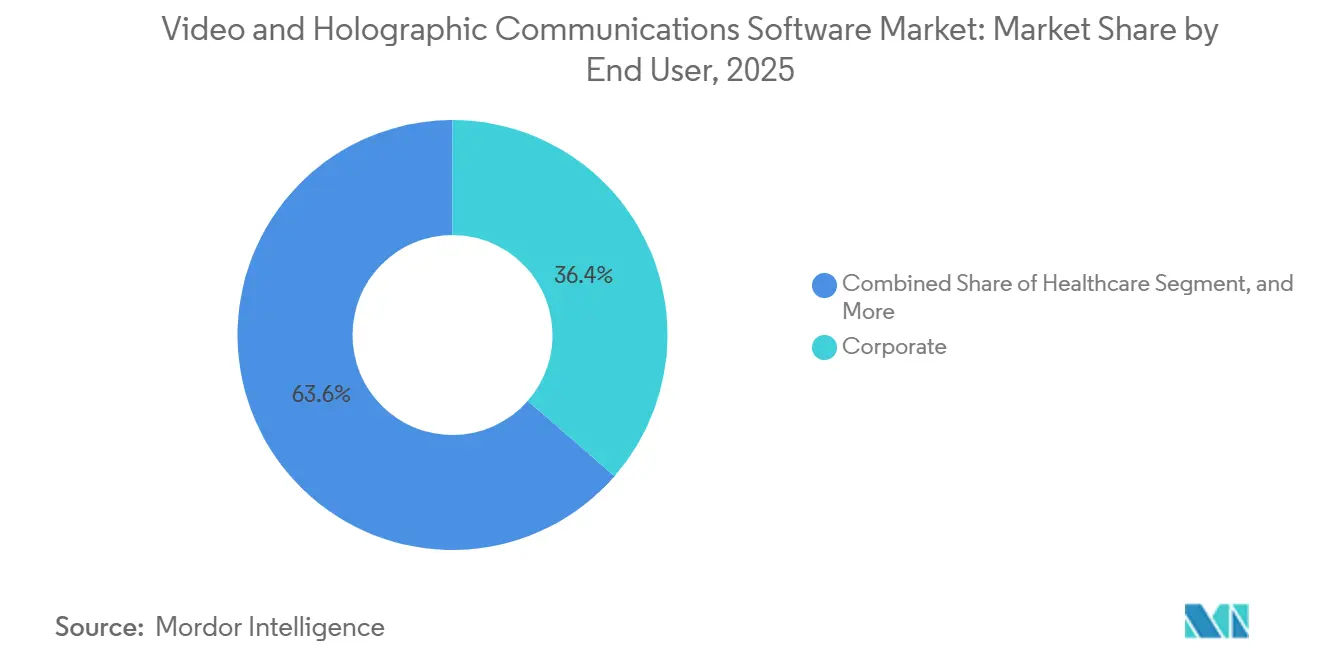
- By end user, the corporate segment held 36.42% of revenue in 2025, while healthcare is expected to expand at an 8.56% CAGR through 2031.
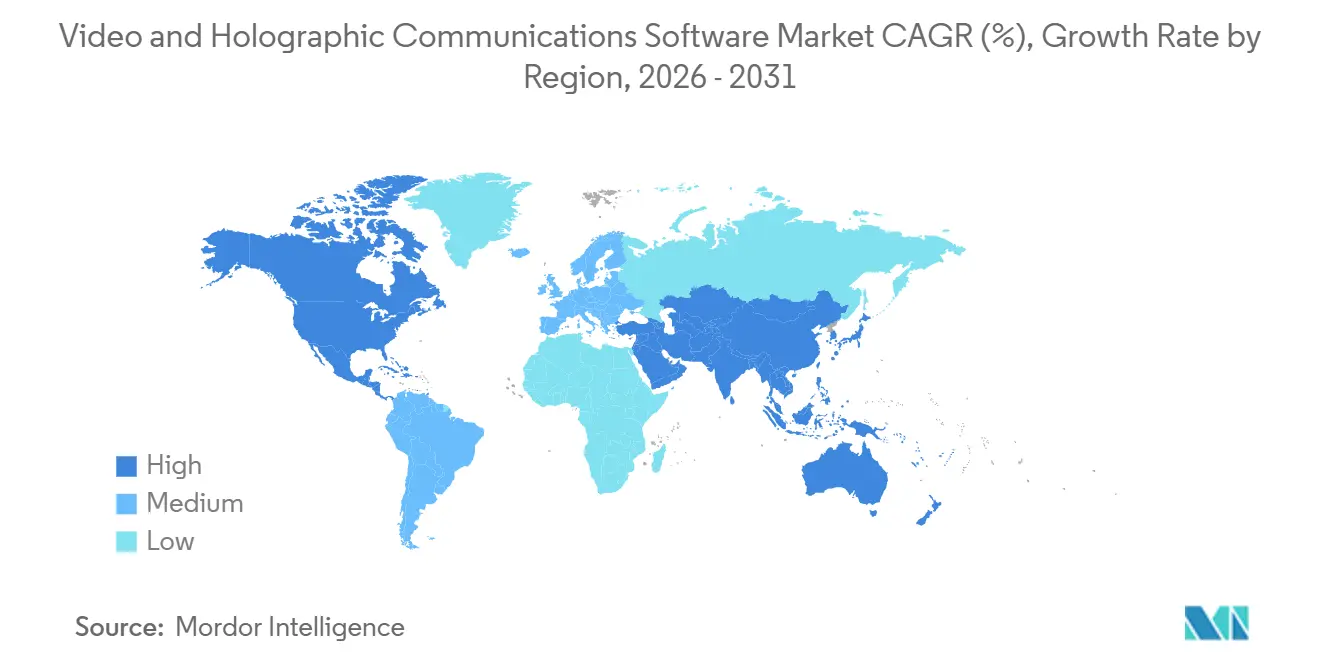
- By geography, North America accounted for 37.22% of revenue in 2025, while Asia-Pacific is projected to expand at an 8.64% CAGR through 2031.
Note: Market size and forecast figures in this report are generated using Mordor Intelligence’s proprietary estimation framework, updated with the latest available data and insights as of January 2026.
Market Trends and Insights
Drivers Impact Analysis of Video and Holographic Communications Software Market*
| Driver | (~) % Impact on CAGR Forecast | Geographic Relevance | Impact Timeline |
|---|---|---|---|
| Hybrid-Work Operating Models | +2.1% | Global | Short term (≤ 2 years) |
| AI-Powered Captioning, Translation, and Meeting Intelligence | +1.8% | Global | Short term (≤ 2 years) |
| Unified Communications and Software Suite Consolidation | +1.2% | Global | Medium term (2-4 years) |
| Low-Latency 5G and Emerging 6G Connectivity | +0.9% | Asia-Pacific core, spill-over to North America and Europe | Medium term (2-4 years) |
| Enterprise Demand for Immersive Remote Presence | +0.7% | North America and Europe | Long term (≥ 4 years) |
| Holographic Content Creation and Streaming Ecosystem Maturation | +0.5% | North America, Asia-Pacific, and Europe | Long term (≥ 4 years) |
| Source: Mordor Intelligence | |||
Hybrid-Work Operating Models
Hybrid work supports ongoing spending in the video and holographic communications software market because collaboration tools are now part of normal operating practice. Gallup reported that 52% of remote-capable US employees worked in hybrid arrangements in the second quarter of 2026, a level that had remained stable since 2022.[1] Teams working across office and remote locations need consistent meeting access, shared content, and clear processes for follow-up work. Organizations with formal collaboration plans also reported stronger engagement, which gives buyers a reason to evaluate software beyond core video availability. The result is a split between organizations that buy basic communication access and those that build a broader collaboration environment. Suppliers with workflow tools, meeting intelligence, and reliable integration options are better placed to serve the latter group.
AI-Powered Captioning, Translation, and Meeting Intelligence
AI features are becoming central to platform selection in the video and holographic communications software market. Cisco stated that AI-powered collaboration minutes on Webex increased 260% between 2024 and early 2025, while 95% of users rated AI meeting summaries positively.[2]Captioning, translation, summaries, and task creation make video meetings more useful for distributed teams and multilingual workforces. These functions can also support premium software tiers, which change the value generated per active seat. Zoom introduced Custom AI Companion capabilities that connect with 16 third-party applications, including Google Meet. Broader AI connections may increase switching costs as customers embed meeting outputs into their daily business processes. Smaller vendors that provide basic video delivery without comparable AI integration may face more difficult pricing conditions.
Unified Communications and Software Suite Consolidation
Enterprise buyers increasingly prefer fewer communications suppliers and deeper system integration. This preference shapes the video and holographic communications software market by placing value on compatibility with existing calling, messaging, identity, and productivity systems. Consolidated purchasing can reduce duplicated administration and simplify governance across dispersed teams. It also creates a challenge for specialists that offer a narrow product but lack certified links to major enterprise platforms. Holographic providers may therefore find it easier to sell through existing unified communications environments than as standalone systems. The opportunity depends on proving that immersive capabilities fit established enterprise workflows without adding a separate management burden.
Low-Latency 5G and Emerging 6G Connectivity
Network progress expands the practical scope of the video and holographic communications software market, particularly for rich visual content. The 3GPP Release 19 specification defines service and performance requirements for professional video, imaging, and audio applications over 5G systems.[3] This standards base helps software suppliers and network operators align their product design with common performance expectations. KDDI Research developed a color holographic video compression method that reduced transmission needs to below 1.5 Gbps from 72 Gbps for uncompressed video in a Beyond 5G test environment. The advance does not make broad commercial holographic services immediate, but it lowers an important technical barrier. As edge computing and high-capacity networks become more available, real-time immersive communication can move into more enterprise trials and specialized deployments.
Restraints Impact Analysis of Video and Holographic Communications Software Market*
| Restraint | (~) % Impact on CAGR Forecast | Geographic Relevance | Impact Timeline |
|---|---|---|---|
| Data Sovereignty and Cross-Border Data Transfer Restrictions | -1.1% | Europe, Asia-Pacific, North America | Short term (≤ 2 years) |
| High Holographic Infrastructure and Deployment Costs | -0.9% | Global | Medium term (2-4 years) |
| Holographic Content Bandwidth and Processing Requirements | -0.6% | Global | Medium term (2-4 years) |
| Interoperability and Standards Fragmentation | -0.4% | Global | Long term (≥ 4 years) |
| Source: Mordor Intelligence | |||
Data Sovereignty and Cross-Border Data Transfer Restrictions
Data sovereignty requirements limit some cloud deployment options in the video and holographic communications software market. Enterprises working across jurisdictions must consider where meeting data, recordings, transcripts, and AI-generated outputs are processed and stored. This concern is strongest in government, defense, finance, healthcare, and critical infrastructure. Suppliers that offer private cloud, on-premises, or customer-controlled environments can address part of this need. Pexip and Wire announced a partnership in May 2026 for sovereign, end-to-end encrypted communications aimed at governments and critical infrastructure operators. Cloud-first suppliers may need additional regional infrastructure and product controls, which can increase delivery complexity. These requirements can slow procurement, especially when a customer needs to validate its handling of meeting intelligence data.
High Holographic Infrastructure and Deployment Costs
High deployment costs keep holographic communication focused on selected use cases within the video and holographic communications software market. Full systems can require specialized capture equipment, display hardware, reliable high-throughput connectivity, and dedicated content management. This combination creates a higher initial commitment than standard video conferencing. Vendors are reducing some barriers through centrally managed content and AI avatar services. Holoconnects states that pre-built AI characters can be delivered in 2 to 4 weeks, which provides an alternative to custom volumetric production. However, real-time custom telepresence still requires more investment and operational coordination than conventional meetings. Hardware cost, content production, and network readiness will continue to determine which customers can move beyond pilots.
*Our forecasts treat driver/restraint impacts as directional, not additive. The impact forecasts reflect baseline growth, mix effects, and variable interactions.
Video and Holographic Communications Software Market Segment Analysis
By Component:
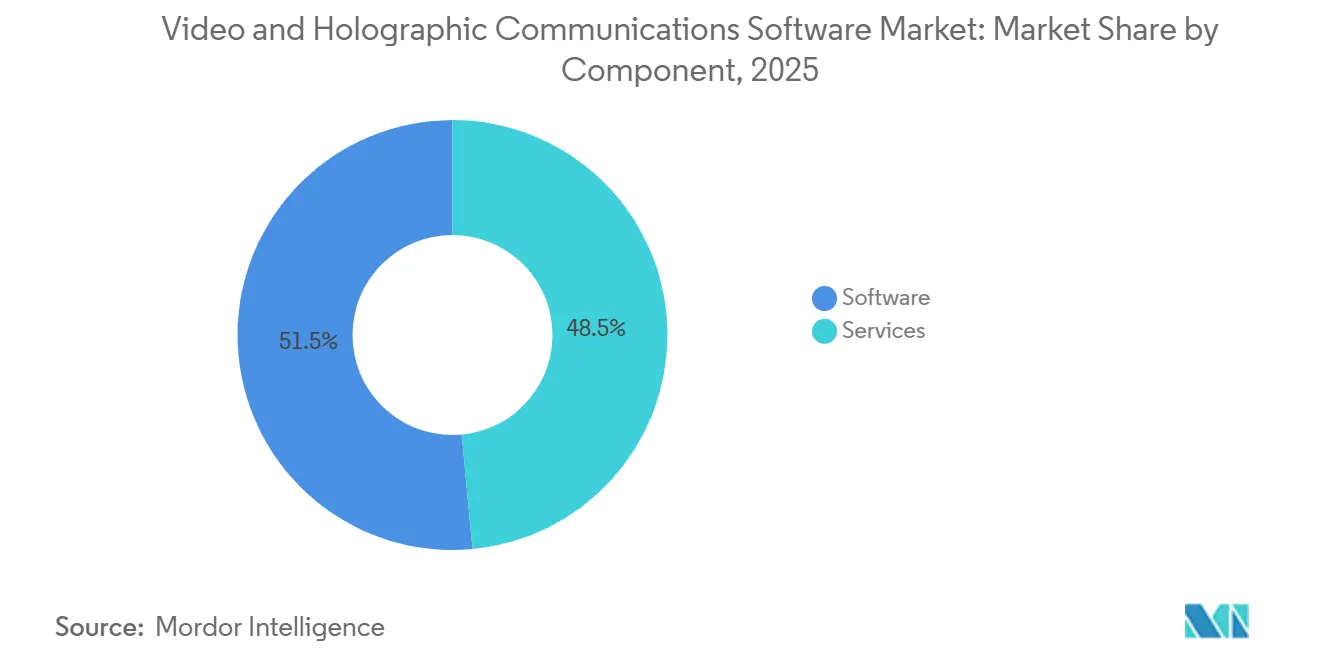
Video Communications Leads, Holographic Software AcceleratesVideo communications software held 48.52% of revenue in 2025, giving it the leading position in the component mix. Its installed base extends across corporate teams, education, healthcare, and government users. Meeting functionality is mature, and many customers face meaningful switching costs after integrating it with calendars, identity systems, and business applications. The video and holographic communications software market size for this component benefits from recurring licenses and managed-service arrangements. Video platforms are also evolving from meeting utilities into work environments that organize notes, actions, and related content. This change gives established suppliers a path to raise the value of existing subscriptions without relying only on new users.
Holographic communications software is projected to expand at an 8.76% CAGR through 2031. Its use remains narrower because deployments often depend on displays, capture workflows, and high-performance network conditions. The software layer includes content management, streaming control, AI avatar generation, and rendering functions that support immersive experiences. Healthcare, executive communications, training, and event settings provide early use cases where visual presence can justify the added cost. Zoom introduced AI Companion 3.0 in 2026 with proactive agentic skills and connections to 16 third-party platforms, illustrating the broader move toward richer software functionality around communication workflows. Suppliers serving holographic deployments will need to balance specialized visual capabilities with easy integration into the collaboration platforms already used by customers.
By Deployment Model:
Cloud Architecture Sets the Enterprise DefaultCloud and hosted deployment accounted for 58.52% of revenue in 2025, making it the leading deployment approach. The model gives customers access to centrally managed updates, flexible capacity, and lower internal infrastructure requirements. It aligns with the operating preferences of organizations that want communication workloads delivered as a service. The video and holographic communications software market share held by cloud and hosted platforms reflects the broad shift toward operator-managed communications environments. These systems also allow suppliers to release AI features and security updates more consistently across a large customer base. Their appeal is strongest where regulatory or security restrictions do not require local control of data and processing.
SaaS is projected to expand at an 8.65% CAGR through 2031. Per-user pricing and simpler onboarding can make the model more accessible for mid-sized organizations and SMEs. SaaS platforms can support rapid feature deployment and reduce the need for dedicated in-house communication specialists. On-premises systems remain important for defense, classified government work, and highly regulated sectors with strict security needs. Hybrid configurations provide an option for organizations that need both cloud flexibility and locally managed controls. For holographic offerings, managed content delivery and AI-generated characters may bring immersive services to buyers that cannot fund custom capture and infrastructure projects.
By Organization Size:
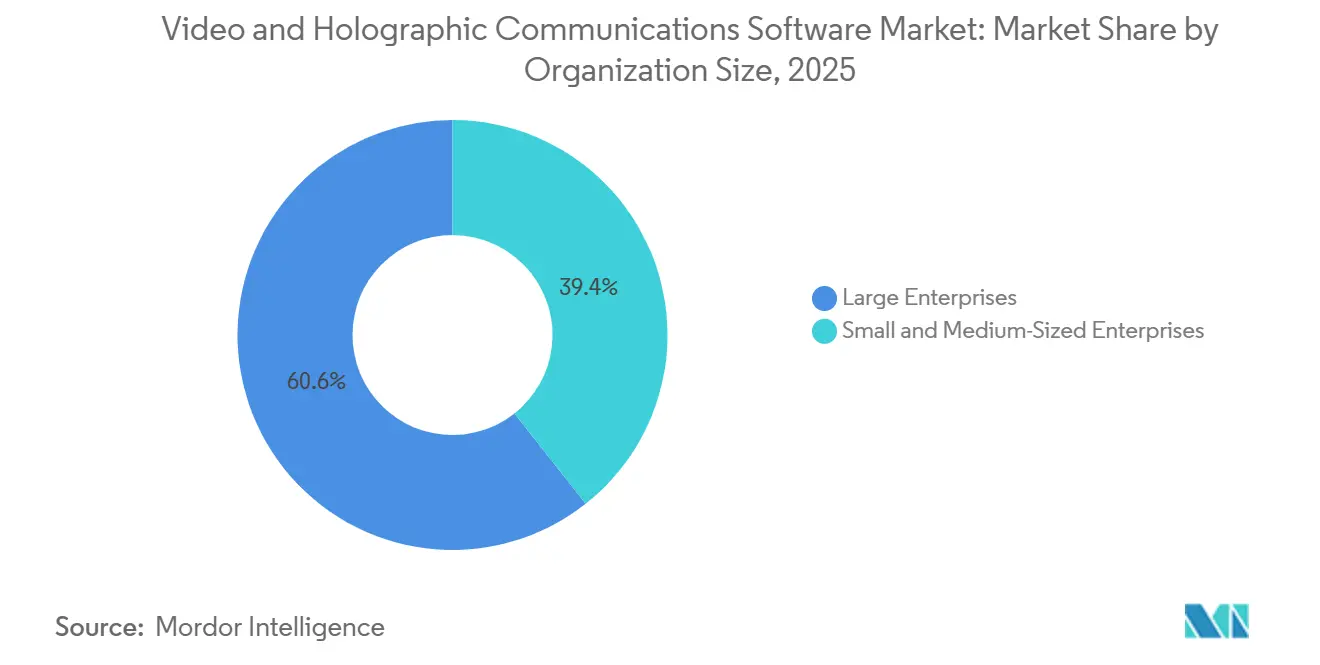
Enterprise Scale Anchors Revenue, SMEs Drive the Growth CurveLarge enterprises accounted for 60.64% of revenue in 2025. High seat counts, multi-year contracts, and spending on meeting intelligence features support this position. These customers also have the budget and organizational capacity to test holographic applications for executive communications, corporate events, and specialized training. Their focus in 2026 is increasingly on platform consolidation and AI integration rather than simple seat expansion. This favors suppliers that can integrate into a wider communications estate and meet enterprise security requirements. Large buyers may also use their scale to demand consistent service levels across regions and deployment environments.
SMEs are projected to expand at an 8.55% CAGR through 2031. Affordable SaaS bundles, guided setup, and wider AI availability support adoption among organizations with limited IT resources. This customer group is less likely to deploy dedicated on-premises video infrastructure. It may instead select a cloud platform that combines calling, meetings, messaging, and basic customer communication functions. The video and holographic communications software market offers SMEs emerging access to AI hologram services for retail, hospitality, and event use cases. Suppliers competing for this group will need transparent pricing, practical integrations, and simple support models. The strongest opportunity is likely to be in services that can be purchased and activated without a long deployment cycle.
By Communication Type:
Standard Conferencing Dominant, Holographic Formats EmergingStandard video conferencing held 56.60% of revenue in 2025. It remains the dominant communication format because it is widely installed, familiar to users, and embedded in productivity tools. Corporate teams use it for internal meetings, sales interactions, service delivery, and distributed management. Its scale comes from broad use rather than from highly specialized deployments. The segment also benefits from established integration with calendars, customer systems, and enterprise resource planning tools. Video providers are adding AI capabilities to strengthen the value of this common communication format. This approach allows them to address customer productivity needs while preserving the basic experience users already understand.
Immersive holographic conferencing is projected to expand at an 8.43% CAGR through 2031. The format serves cases where spatial representation, visual detail, or a stronger sense of presence matters more than low-cost access. Surgical guidance, architectural review, executive events, and premium customer experiences are cited as relevant uses. The video and holographic communications software market is therefore developing along 2 different demand paths, volume-driven video and higher-value immersive deployments. The buying groups can also differ, with information technology leaders typically responsible for standard video and senior business or marketing teams supporting selected holographic projects. Focused holographic suppliers can use this separation to develop relationships in specialized accounts. Their challenge is to demonstrate a clear operational benefit that standard video cannot provide.
By End User:
Corporate Segment Anchors Revenue, Healthcare Leads Growth PaceThe corporate segment held 36.42% of revenue in 2025. Distributed management, sales, customer success, and executive communication create regular demand for meeting platforms across this group. Corporate customers also use integrated tools to record decisions, capture action items, and connect meeting activity with other business systems. The segment’s scale makes it important for suppliers that offer broad, multi-seat software deployments. Education and training represent another substantial area of demand because immersive formats can support simulation and remote instruction. Government, defense, financial services, media, entertainment, retail, and e-commerce have distinct security, customer engagement, and content requirements that influence platform selection.
Healthcare is projected to expand at an 8.56% CAGR through 2031. Clinical telepresence, remote consultation, and holographic surgical navigation support its faster pace. MediView XR and Cleveland Clinic Weston Hospital completed the first intraprocedural use of the XR90 holographic surgical navigation system in Florida in August 2026. Healthcare organizations must also assess patient privacy, security controls, and workflow fit before they expand adoption. Pexip and Wire’s sovereign communications partnership shows how secure communications suppliers are targeting high-control environments. The segment can reward vendors that build compliance considerations into product design instead of relying on custom work after deployment. Its growth depends on demonstrating reliable clinical value alongside the operational requirements of healthcare delivery.

Geography Analysis
North America Video and Holographic Communications Software Market
North America held 37.22% of the video and holographic communications software market share in 2025. The region combines a deep base of large enterprises, mature cloud infrastructure, and established communications software suppliers. New small-business deployments are largely cloud-based, while large organizations focus spending on AI tools and interoperability. The United States supports unified communications incumbents and specialized holographic platform vendors. Proto Hologram reported permanent installations at San Francisco International Airport, LaGuardia Airport, and more than 100 shopping malls through its Hologram Media Network, while defense requirements support private cloud and on-premises video environments.
APAC Video and Holographic Communications Software Market
Asia-Pacific is projected to expand at an 8.64% CAGR through 2031. The region combines expanding 5G infrastructure, enterprise digitization, and public research activity related to holographic transmission. NTT demonstrated telesurgery support between distant hospitals using IOWN All-Photonics Network in February 2025. NTT DOCOMO and NTT demonstrated low-latency AI video analytics using in-network computing in March 2026, while KDDI Research reported real-time holographic streaming below 1.5 Gbps in a Beyond 5G test environment in January 2026. China, Japan, South Korea, India, and Australia provide a broad base of enterprise users and network investment, while India’s evolving data-transfer requirements will influence local data-residency design.
EMEA and South America Video and Holographic Communications Software Market
Europe represents a meaningful share of the video and holographic communications software market, led by Germany, the United Kingdom, and France. Sovereignty and data control favor private cloud, on-premises, and encrypted deployments for selected buyers. Pexip and Wire announced their May 2026 sovereign communications partnership in Bonn for government, defense, and critical infrastructure users. Holoconnects reported that its CIC Hospitality Holobox deployment had passed 30 hotels in July 2026. South America, the Middle East, and Africa represent smaller revenue pools, with Brazil and the United Arab Emirates active in their regions and cloud-first delivery practical for South Africa and Nigeria.
Competitive Landscape
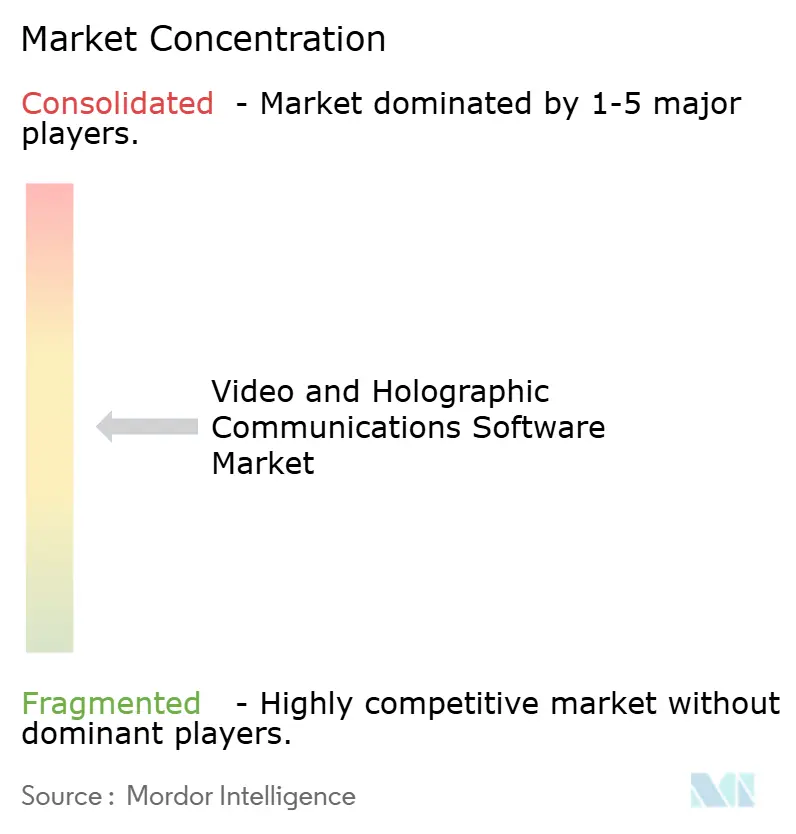
The video and holographic communications software market operates through 2 related but distinct competitive structures and is moderately fragmented. Zoom, Cisco Webex, RingCentral, and Microsoft Teams lead the video communications market. These companies compete on platform breadth, AI capabilities, security controls, and productivity tool integration. Holographic communications is more fragmented and includes Holoconnects, Proto Hologram, ARHT Media, Leia, Looking Glass Factory, VividQ, and Voxon Photonics. Their offerings differ by display architecture, content model, sector focus, and implementation approach.
AI is a central area of competition for established video providers. Zoom announced a definitive agreement to acquire Common Room in July 2026, thereby extending its platform to include buyer intelligence and intent identification. Cisco positions AI meeting summaries and related collaboration functions within Webex. Pexip’s certified integrations with Microsoft, Cisco, Zoom, Avaya, HP Poly, and Google show how interoperability can support a mid-tier position. Holoconnects’ hospitality rollout provides another route to scale through repeatable vertical deployments.
Healthcare, government, and defense, as well as smaller event or retail deployments, offer clear openings for specialized suppliers. Healthcare requires visual workflows alongside privacy, security, and operational controls. Government and defense buyers may favor systems that retain control of data location, encryption, and deployment architecture. Larger video companies are expanding their platforms with AI and business workflow features, while specialists can develop roles where hardware, content, and spatial communication expertise matter. The video and holographic communications software market remains competitive through large platform providers and focused immersive technology vendors.
Healthcare, government, and defense, as well as smaller event or retail deployments, offer the clearest openings for specialized suppliers. Healthcare requires visual workflows alongside privacy, security, and operational controls. Government and defense buyers may favor systems that retain control of data location, encryption, and deployment architecture. Retail and hospitality buyers may opt for centrally managed holographic services to enhance customer engagement. Larger video companies are expanding their platforms with AI and business workflow features, while specialists can develop roles where hardware, content, and spatial communication expertise matter. The video and holographic communications software market remains competitive through a mix of large platform providers and focused immersive technology vendors.
Video and Holographic Communications Software Industry Leaders
-
Zoom Communications, Inc.
-
RingCentral, Inc.
-
8x8, Inc.
-
Pexip Holding ASA
-
Proto Hologram Inc.
- *Disclaimer: Major Players sorted in no particular order
Video and Holographic Communications Software Market Companies Covered in this Report
- Zoom Video Communications, Inc.
- Pexip Holding ASA
- RingCentral, Inc.
- 8x8, Inc.
- GoTo Group, Inc.
- Lifesize, Inc.
- Zerify Inc.
- Proto Hologram Inc.
- ARHT Media Inc.
- Realfiction Holding AB
- Looking Glass Factory, Inc.
- Holoxica Limited
- Voxon Photonics Pty Ltd
- HYPERVSN
- Holoconnects B.V.
- VividQ Limited
- 8i Corporation
- RealView Imaging Ltd.
- Leia Inc.
- Light Field Lab, Inc.
- EON Reality, Inc.
- HoloTech Switzerland AG
- Provision Interactive Technologies, Inc.
- IKIN, Inc.
Recent Industry Developments in Video and Holographic Communications Software Market
- August 2026: MediView XR and Cleveland Clinic Weston Hospital completed the first intraprocedural clinical use of the MediView XR90 holographic surgical navigation system in Florida, marking the first holographic XR-guided navigation deployment in the state and advancing the application of holographic software from diagnostic imaging into active procedural guidance.
- July 2026: Proto Hologram was granted US Design Patent No. D1,134,257 S for the Proto M spatial display by the USPTO, adding design-level protection to its existing Utility Patent No. 11,428,952 for its core holographic display and image-capture method. The company cited the patent as enabling new market entry and scaling across its repeat Fortune 500 customer base in healthcare, education, and retail.
- July 2026: Zoom announced a definitive agreement to acquire Common Room, an AI-native go-to-market intelligence platform, extending its Zoom Revenue Accelerator from post-conversation analytics into pre-call buyer intelligence and intent identification. The acquisition positions Zoom as a revenue-orchestration platform beyond its video conferencing origins.
- July 2026: Holoconnects confirmed that its CIC Hospitality Holobox deployment across Scandinavian hotels crossed the 30-property milestone. The deployment established holographic front desk hosts as deployed hospitality infrastructure rather than a pilot, with other Scandinavian chains evaluating the same pattern.
Global Video and Holographic Communications Software Market Report Scope
The Video and Holographic Communications Software Market comprises software platforms and applications that enable real-time and asynchronous visual communication via conventional video conferencing, immersive 3D visualization, holographic telepresence, augmented reality (AR), mixed reality (MR), and virtual reality (VR).
The Video and Holographic Communications Software Market Report is Segmented by Component (Software, and Services), Deployment Model (Cloud and Hosted, Software-as-a-Service, On-Premises, and Hybrid), Organization Size (Large Enterprises, and Small and Medium-Sized Enterprises), Communication Type (Standard Video Conferencing, Telepresence, Immersive Holographic Conferencing, Volumetric Video Communication, and Other Communication Types), End User (Corporate, Education and Training, Healthcare, Government and Defense, Media and Entertainment, Retail and E-Commerce, and Financial Services), and Geography (North America, South America, Europe, Asia-Pacific, Middle East, and Africa). The Market Forecasts are Provided in Terms of Value (USD).
Segmentation Overview
| Software | Video Communications Software |
| Holographic Communications Software | |
| Services |
| Cloud and Hosted |
| Software-as-a-Service |
| On-Premises |
| Hybrid |
| Large Enterprises |
| Small and Medium-Sized Enterprises |
| Standard Video Conferencing |
| Telepresence |
| Immersive Holographic Conferencing |
| Volumetric Video Communication |
| Other Communication Types |
| Corporate |
| Education and Training |
| Healthcare |
| Government and Defense |
| Media and Entertainment |
| Retail and E-Commerce |
| Financial Services |
| North America | United States |
| Canada | |
| Mexico | |
| South America | Brazil |
| Argentina | |
| Rest of South America | |
| Europe | Germany |
| United Kingdom | |
| France | |
| Russia | |
| Rest of Europe | |
| Asia-Pacific | China |
| Japan | |
| South Korea | |
| India | |
| Australia | |
| Rest of Asia-Pacific | |
| Middle East | Saudi Arabia |
| United Arab Emirates | |
| Turkey | |
| Rest of Middle East | |
| Africa | South Africa |
| Nigeria | |
| Rest of Africa |
| By Component | Software | Video Communications Software |
| Holographic Communications Software | ||
| Services | ||
| By Deployment Model | Cloud and Hosted | |
| Software-as-a-Service | ||
| On-Premises | ||
| Hybrid | ||
| By Organization Size | Large Enterprises | |
| Small and Medium-Sized Enterprises | ||
| By Communication Type | Standard Video Conferencing | |
| Telepresence | ||
| Immersive Holographic Conferencing | ||
| Volumetric Video Communication | ||
| Other Communication Types | ||
| By End User | Corporate | |
| Education and Training | ||
| Healthcare | ||
| Government and Defense | ||
| Media and Entertainment | ||
| Retail and E-Commerce | ||
| Financial Services | ||
| By Geography | North America | United States |
| Canada | ||
| Mexico | ||
| South America | Brazil | |
| Argentina | ||
| Rest of South America | ||
| Europe | Germany | |
| United Kingdom | ||
| France | ||
| Russia | ||
| Rest of Europe | ||
| Asia-Pacific | China | |
| Japan | ||
| South Korea | ||
| India | ||
| Australia | ||
| Rest of Asia-Pacific | ||
| Middle East | Saudi Arabia | |
| United Arab Emirates | ||
| Turkey | ||
| Rest of Middle East | ||
| Africa | South Africa | |
| Nigeria | ||
| Rest of Africa | ||
Key Questions Answered in the Report
What is the video and holographic communications software market size?
The market was valued at USD 22.61 billion in 2025, is estimated at USD 24.92 billion in 2026, and is forecast to reach USD 36.43 billion by 2031, growing at a CAGR of 7.89%.
What is driving adoption of video and holographic communications software?
Permanent hybrid work models, AI-powered meeting tools, unified communications suite consolidation, and improving network performance are supporting continued demand across enterprise communications.
Which component leads revenue?
Video communications software led the market with 48.52% of revenue in 2025. Holographic communications software is projected to grow at a CAGR of 8.76% through 2031 as specialized deployments expand.
Which deployment model is most widely used?
Cloud and hosted deployment accounted for 58.52% of revenue in 2025, driven by centrally managed updates, flexible service delivery, and reduced internal infrastructure requirements.
Which end-user segment is expanding fastest?
The healthcare segment is expected to grow at a CAGR of 8.56% through 2031, supported by applications such as clinical telepresence, remote consultations, and holographic surgical navigation.
Which region is expanding fastest?
Asia-Pacific is projected to grow at a CAGR of 8.64% through 2031, supported by network infrastructure investments, enterprise digitization initiatives, and research into holographic transmission technologies.