
Vascular Ulcers Treatment Market Size and Share
Market Overview
| Study Period | 2020 - 2031 |
|---|---|
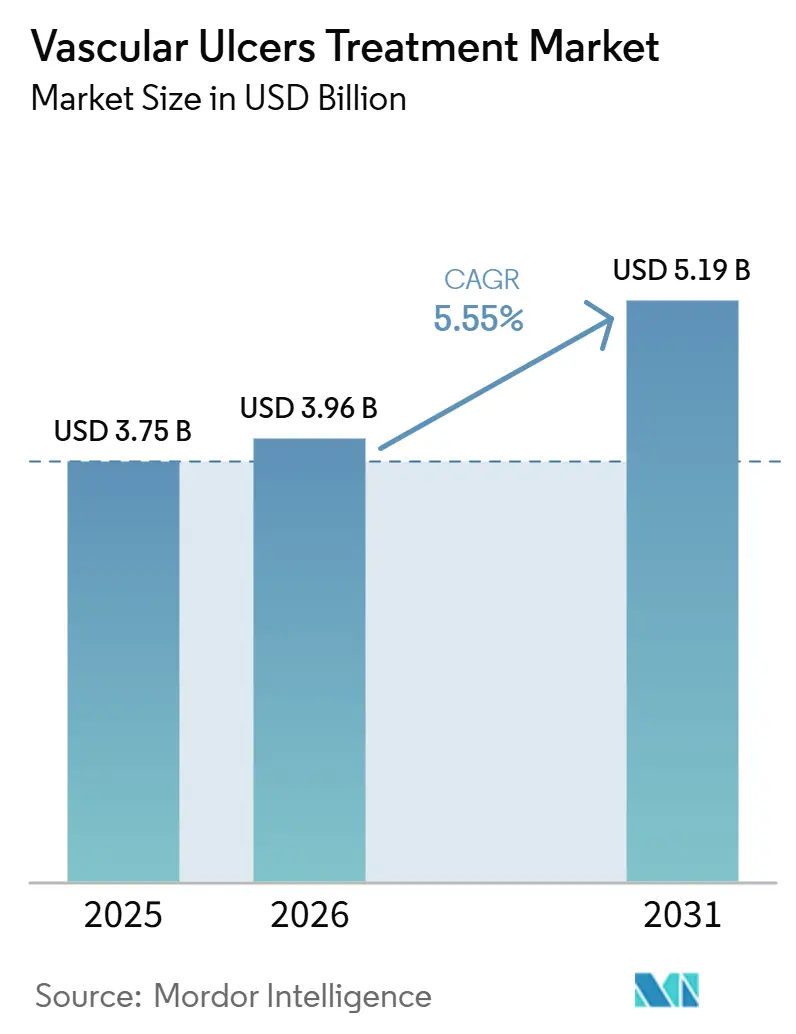
| Market Size (2026) | USD 3.96 Billion |
| Market Size (2031) | USD 5.19 Billion |
| Growth Rate (2026 - 2031) | 5.55 % |
| Fastest Growing Market | Asia-Pacific |
| Largest Market | North America |
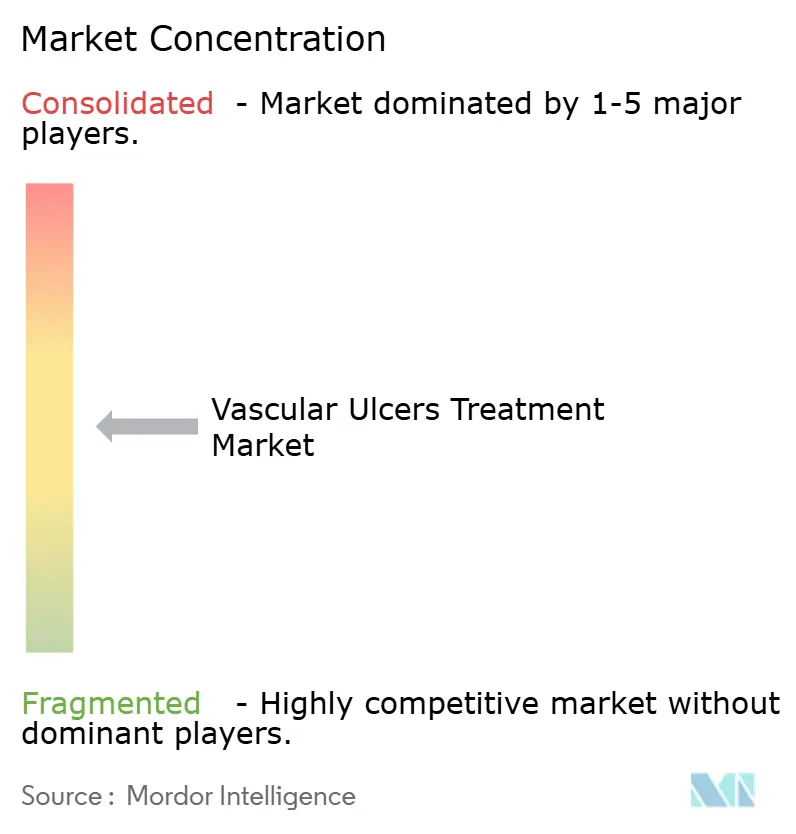
| Market Concentration | Medium |
Major Players *Disclaimer: Major Players sorted in no particular order Image © Mordor Intelligence. Reuse requires attribution under CC BY 4.0. | |
Vascular Ulcers Treatment Market Analysis by Mordor Intelligence
The Vascular Ulcers Treatment Market size is expected to increase from USD 3.75 billion in 2025 to USD 3.96 billion in 2026 and reach USD 5.19 billion by 2031, growing at a CAGR of 5.55% over 2026-2031.
The vascular ulcers treatment market is supported by a growing pool of people with diabetes, chronic venous insufficiency, and peripheral arterial disease. Longer healing periods create recurring demand for dressings, compression products, debridement supplies, and biological products. Product suppliers are placing more attention on evidence for difficult-to-heal wounds and on access to payer formularies. The movement of care toward outpatient and home settings is widening the role of self-managed compression and remote support. Reimbursement pressure and poor adherence to compression therapy may limit uptake when clinical support is not available.
Key Report Takeaways
- By ulcer type, venous ulcers held 45.31% of the vascular ulcers treatment market share in 2025, while diabetic ulcers are forecast to grow at a 7.58% CAGR through 2031.
- By product type, advanced wound dressings accounted for 38.24% of the vascular ulcers treatment market share in 2025, while skin substitutes and biological matrices are forecast to expand at an 8.22% CAGR through 2031.
- By wound stage, superficial or mild ulcers held 38.14% of revenue in 2025, while moderate ulcers are forecast to grow at a 7.22% CAGR through 2031.
- By end user, hospitals accounted for 45.21% of revenue in 2025, while homecare settings are forecast to advance at an 8.85% CAGR through 2031.
- By distribution channel, hospital pharmacies held 49.56% of revenue in 2025, while online pharmacies and e-commerce are forecast to expand at an 8.55% CAGR through 2031.
- By geography, North America held 40.61% of revenue in 2025, while Asia-Pacific is forecast to expand at an 8.25% CAGR through 2031.
Note: Market size and forecast figures in this report are generated using Mordor Intelligence’s proprietary estimation framework, updated with the latest available data and insights as of January 2026.
Market Trends and Insights
Drivers Impact Analysis of Vascular Ulcers Treatment Market*
| Driver | (~) % Impact on CAGR Forecast | Geographic Relevance | Impact Timeline |
|---|---|---|---|
| Rising Diabetes, Chronic Venous Insufficiency, and Peripheral Arterial Disease | +1.9% | Global, with highest intensity in North America, Europe, and APAC core | Long term (≥ 4 years) |
| Advanced Wound Care and Bioengineered Tissue Products | +1.4% | North America and EU, with early spillover to APAC | Medium term (2-4 years) |
| Outpatient, Homecare, and Community-Based Wound Management | +0.8% | North America, Europe, and APAC | Medium term (2-4 years) |
| Multidisciplinary Limb-Salvage and Vascular-Wound Care Pathways | +0.5% | North America and EU | Medium term (2-4 years) |
| Remote Wound Monitoring and AI-Assisted Wound Assessment | +0.3% | North America, with early APAC adoption | Short term (≤ 2 years) |
| Adjustable and Self-Managed Compression Systems | +0.3% | Europe and APAC | Short term (≤ 2 years) |
| Source: Mordor Intelligence | |||
Rising Prevalence of Diabetes, Chronic Venous Insufficiency and Peripheral Arterial Disease
The vascular ulcers treatment market draws demand from a large and growing diabetes population. In 2024, 589 million adults aged 20 to 79 lived with diabetes worldwide, or 11.11% of this adult population. The number is projected to reach 853 million by 2050, which expands the pool of patients who may require prevention, early assessment, and long-duration wound care. More than 59% of adults aged 30 and older with diabetes did not receive medication in 2022, leaving unmanaged disease concentrated in many low- and middle-income countries where access to early care is less consistent. Chronic venous insufficiency and peripheral arterial disease further complicate healing because they can coexist with diabetes and increase the need for repeated treatment decisions, specialist review, and product use. A 2025 U.S. analysis reported lower-extremity peripheral arterial disease healthcare costs above USD 21 billion annually, largely from hospital care and long-term ischemic wound management, which shows the scale of care associated with severe vascular disease.
Expansion of Advanced Wound Care and Bioengineered Tissue Products
Advanced wound care products are becoming more important when conventional treatment does not close a wound. A 2025 meta-analysis covering 29 randomized controlled trials and 2,255 patients found that cellular and acellular tissue-based products combined with standard care had a pooled odds ratio of 2.9 for complete healing versus standard care alone. This benefit remained across patient age and initial wound-size groups, which makes the evidence relevant to a broad range of difficult-to-heal wounds. The vascular ulcers treatment market therefore has greater scope for biological products in persistent wounds that have not responded to standard compression and dressings. ConvaTec received EU and UK approval for ConvaMatrix, a porcine placenta-derived skin substitute, in September 2025. Wider clinical evidence can move these products from occasional use toward earlier consideration in hospital and outpatient formularies, although suppliers still need to show that higher product costs are matched by appropriate clinical and economic value.
Shift Toward Outpatient, Homecare and Community-Based Wound Management
Homecare settings are projected to record an 8.85% CAGR through 2031 in the vascular ulcers treatment market. Payers are seeking to reduce inpatient bed use and nursing costs when patients can be managed safely outside hospitals, while many patients prefer care that fits daily routines. The change increases the need for products that patients or caregivers can apply correctly, since compression treatment is effective only when it is used consistently and at the intended pressure. A 2025 clinical evaluation found that real-time pressure monitoring raised applications within the target compression range from 39% to 66%. It also improved daily wound-area reduction from 1.31% to 2.3%, indicating that monitoring can address a practical limitation of self-managed care. North America and Europe have the payer incentives, telehealth systems, and remote monitoring capacity that support this care model, while other regions may adopt these approaches more gradually as outpatient infrastructure develops.
Growth of Multidisciplinary Limb-Salvage and Vascular-Wound Care Pathways
Multidisciplinary care is changing purchasing decisions at high-volume wound centers. A 2025 review found that multidisciplinary clinics increased amputation-free survival from 35.4% to 64% and reduced healing time from 610 days to 426.1 days. A 2025 BEST-CLI analysis also found that formally organized multidisciplinary teams independently reduced major-amputation risk[1]“Characteristics of Multidisciplinary Limb Preservation Teams and Their Impact on Outcomes in the BEST-CLI Trial,” Journal of Vascular Surgery, doi.org. These teams usually include vascular surgeons, podiatrists, plastic surgeons, and advanced practice wound-care providers, allowing a wound’s vascular cause and treatment plan to be assessed together. Their formulary committees, rather than individual clinicians, increasingly determine access to dressings and biologics at high-volume sites. The vascular ulcers treatment market favors suppliers that can provide strong comparative clinical evidence for these institutional reviews and can fit products into coordinated pathways that span assessment, treatment, and follow-up.
Restraints Impact Analysis of Vascular Ulcers Treatment Market*
| Restraint | (~) % Impact on CAGR Forecast | Geographic Relevance | Impact Timeline |
|---|---|---|---|
| High Cost of Advanced Dressings, Biologics, and Therapy Devices | -1.1% | Global, most acute in Europe and price-sensitive APAC markets | Long term (≥ 4 years) |
| Limited Specialist Access and Uneven Reimbursement Coverage | -0.8% | MEA, South America, rural APAC, and parts of Europe | Long term (≥ 4 years) |
| Compression Nonadherence from Pain, Heat, Dexterity Limits, and Poor Fit | -0.6% | Global, especially community and homecare settings | Medium term (2-4 years) |
| Inconsistent Vascular Assessment and Delayed Etiology Classification | -0.3% | APAC, MEA, and South America | Long term (≥ 4 years) |
| Source: Mordor Intelligence | |||
High Cost of Advanced Dressings, Biologics and Therapy Devices
The cost of advanced care can restrict use even when clinical evidence is favorable. Skin substitutes can cost more than USD 1,000 per application, while coverage for repeated use differs widely by payer and by the documentation required for a non-healing wound. Paul Hartmann AG reported EUR 623.6 million (USD 710.35 million) in wound-care revenue in 2025 and organic growth of 2.6%. Germany and France experienced direct revenue pressure from coverage reductions, demonstrating how reimbursement changes can affect even established suppliers. These conditions show that price and health-economic evidence must accompany clinical development and product launches. The vascular ulcers treatment market may face slower adoption in systems that are tightening reimbursement for premium wound products, particularly when less costly compression and dressing options remain available for earlier-stage care. The vascular ulcers treatment market consequently rewards suppliers that can support coverage decisions with clear evidence.
Compression Nonadherence Caused by Pain, Heat, Dexterity Limitations and Poor Fit
Long-term compression adherence was only 39.9% among patients in a 2025 concordance study, including people whose ulcers had healed but remained at risk of recurrence. A separate 2025 randomized controlled trial found that a structured multidisciplinary education program raised 3-month adherence from 26.8% to 63%. Maintaining that improvement requires continuing clinical involvement that many community settings cannot provide, especially when pain, heat, limited hand dexterity, and poor fit make compression difficult to use. A 2025 Delphi study identified 105 factors related to concordance, including comfort, clinician attributes, access, and motivation. Compression wraps may be the only practical option for some patients, although comparative effectiveness evidence remains mixed[2]National Institute for Health and Care Excellence, “Compression Products for Treating Venous Leg Ulcers: Late-Stage Assessment,” NICE, nice.org.uk. This challenge expands the need for education, fit assessment, pressure monitoring, and follow-up alongside product supply, rather than relying on the device alone. The vascular ulcers treatment market can therefore extend beyond products into support for correct and sustained use.
*Our forecasts treat driver/restraint impacts as directional, not additive. The impact forecasts reflect baseline growth, mix effects, and variable interactions.
Vascular Ulcers Treatment Market Segment Analysis
By Ulcer Type:
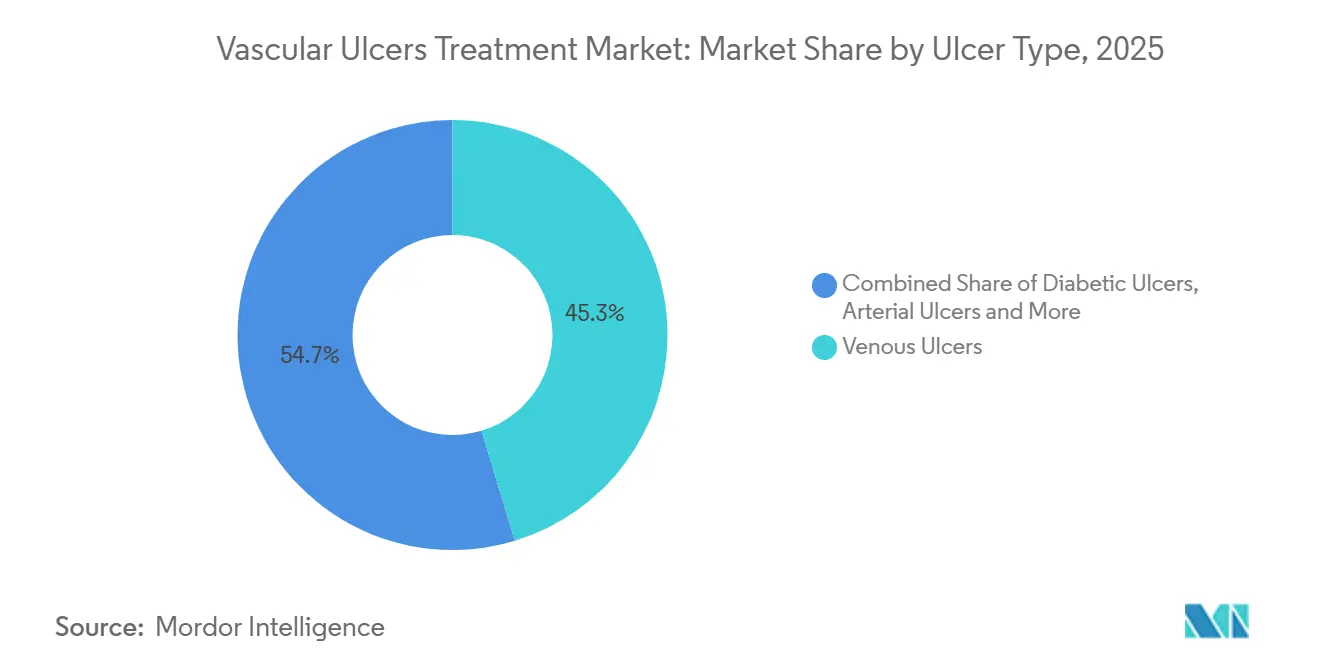
Diabetic Ulcers Are Growing Faster Than Venous UlcersVenous ulcers held 45.31% of revenue in 2025, supported by chronic venous insufficiency and long treatment cycles. Their prevalence in older Western populations provides a steady demand base for dressings, compression, and follow-up care. Active venous leg ulcer prevalence was 0.1% in the general population, but it rose to 4% to 5% among adults older than 80[3]“Das venöse Ulcus cruris,” Springermedizin, springermedizin.de. This age pattern makes population aging important to the vascular ulcers treatment market. Arterial, neurotrophic, and mixed vascular ulcers require different clinical decisions and can lengthen treatment. Mixed ulcers require confirmation of arterial sufficiency before compression is used safely.
Diabetic ulcers are projected to grow at a 7.58% CAGR through 2031. Diabetic foot ulcers affect 12% to 25% of adults with diabetes and account for 80% to 90% of lower-extremity amputations in the United States. The 2024 global diabetes population of 589 million creates a growing pathway toward established vascular ulcers. Diabetic ulcers may exceed venous ulcers in growth momentum before 2031. Suppliers need portfolios that address ischemia, infection risk, and prolonged healing without becoming too narrowly focused.



By Product Type:
Biological Products Are Changing a Dressings-Led Product MixAdvanced wound dressings held 38.24% of product revenue in 2025. They remain central to wound-bed preparation and daily exudate management across hospitals, clinics, and homes. Their broad use means they remain a core volume category even as biological products expand. Compression bandages, wraps, stockings, garments, pumps, and devices remain integral to venous ulcer treatment. NICE found that four-layer bandages and two-layer hosiery remained the most cost-effective compression configurations in the United Kingdom. That finding can constrain premium pricing for wraps and self-managed devices.
Skin substitutes and biological matrices are projected to expand at an 8.22% CAGR through 2031. A 2025 meta-analysis of 29 randomized controlled trials and 2,255 patients found an odds ratio of 2.9 for complete healing when tissue-based products were combined with standard care. The result remained consistent across age and wound-size groups. ConvaMatrix received EU and UK approval in September 2025, adding a porcine placenta-derived option for advanced wound management. The vascular ulcers treatment market needs adequate wound-bed preparation before high-cost biological products can deliver their intended value. Debridement and wound-cleansing products therefore remain stable contributors across the product mix.
By Wound Stage:
Moderate Ulcers Have the Strongest Growth ProfileSuperficial or mild ulcers accounted for 38.14% of value in 2025. Their volume reflects early presentation and a lower treatment cost per episode. Compression alone can close many venous ulcers at this stage. This limits the use of higher-cost products in uncomplicated cases. Moderate ulcers are projected to grow at a 7.22% CAGR through 2031. The vascular ulcers treatment market size for moderate ulcers expands when patients do not respond to first-line compression and need advanced dressings or skin substitutes.
Moderate ulcers mark the point at which treatment can move from over-the-counter dressings to prescription biological products. Formulary access and clinical evidence then carry more weight than price alone. Deep or severe ulcers, infected ulcers, and ischemic or neuro-ischemic ulcers require high-acuity care. These patients often need vascular surgeons, podiatrists, and wound-care nurses working together. A 2025 BEST-CLI analysis found that multidisciplinary chronic limb-threatening ischemia teams reduced major-amputation risk independently of revascularization. This favors evidence-supported product platforms instead of commodity alternatives.
By End User:
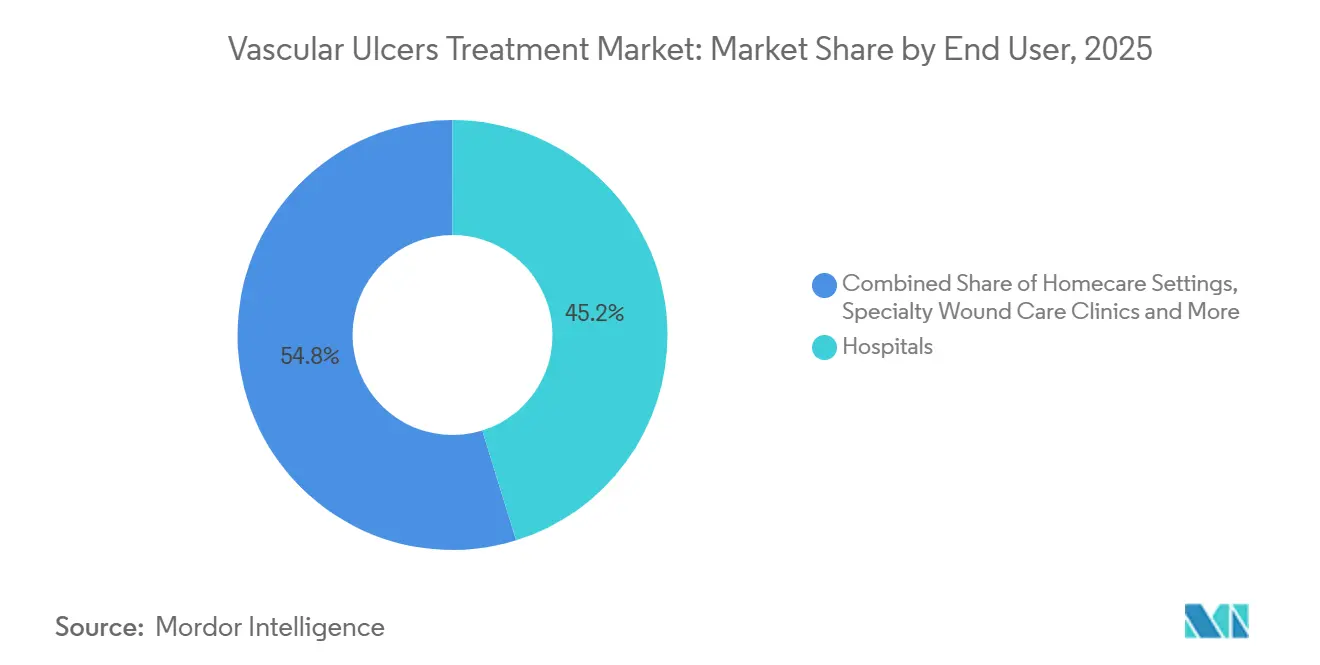
Homecare Is Expanding Beyond Hospital-Based TreatmentHospitals held 45.21% of end-user revenue in 2025. They remain the main treatment and procurement centers for moderate-to-severe vascular ulcers. Formulary decisions at high-volume hospital systems shape use across wound clinics and ambulatory surgical centers. Standardized group purchasing organization agreements can extend this influence across affiliated settings. Specialty wound-care clinics are becoming more important for complex chronic limb-threatening ischemia cases. The vascular ulcers treatment industry benefits when products meet the evidence requirements of these multidisciplinary centers.
Homecare settings are projected to grow at an 8.85% CAGR through 2031. Payer-led discharge planning, self-management preferences, and clinician-independent compression systems support this change. A 2024 Indian pilot study assessed an adjustable compression wrap in 7 patients with open venous leg ulcers. Median volume reduction reached 34.5 cc within 4 hours of self-application. Ambulatory surgical centers are also expanding as sites for debridement and minor biologic applications. These settings spread procurement beyond the hospital pharmacy model and require manufacturers to support several care pathways.
By Distribution Channel:
Digital Sales Are Growing Alongside Hospital Pharmacy ControlHospital pharmacies held 49.56% of channel revenue in 2025. They control access to many advanced products through formulary decisions and group purchasing organization contracts. MiMedx launched G4Derm Plus in May 2026 with agreements involving Premier and Vizient. The launch shows the importance of national hospital network access for biological product entrants. Retail pharmacies remain important for over-the-counter dressings and compression products. They are especially relevant when patients independently manage mild-to-moderate venous ulcers.
Online pharmacies and e-commerce are projected to grow at an 8.55% CAGR through 2031. Digital access gives patients more product information and peer feedback before they select dressings or compression products. This can create a direct consumer opportunity for brands. It can also create clinical risk when a patient selects an unsuitable product without clinician guidance. The vascular ulcers treatment market needs both direct-to-consumer capability and traditional hospital distribution in settings where digital purchasing grows. This mix can change how suppliers present product information, replenishment options, and patient support.
Geography Analysis
North America Vascular Ulcers Treatment Market
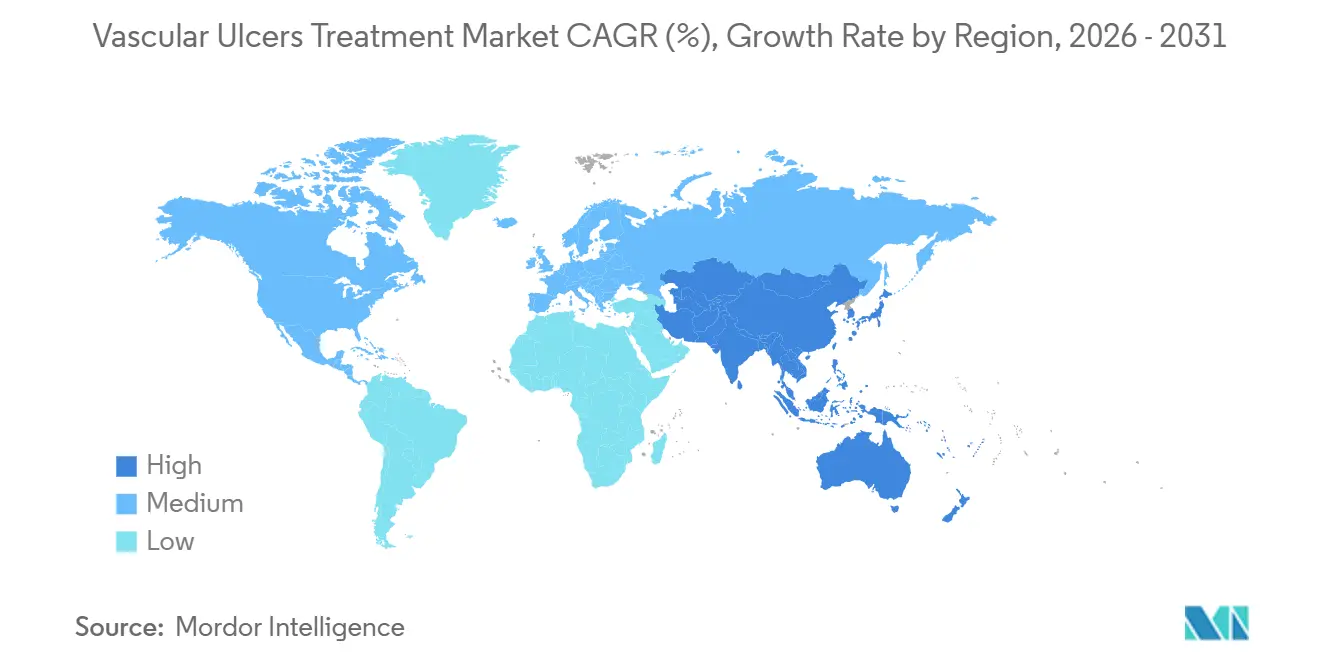
North America held 40.61% of revenue in 2025. Its specialist infrastructure and reimbursement pathways support adoption of advanced products in the vascular ulcers treatment market. The region combines specialist wound centers, hospital procurement systems, and outpatient payment structures that support the use of advanced products. The Centers for Medicare & Medicaid Services revised the Wound and Ulcer Care LCD L38902 effective September 2025. It maintained coverage for medically necessary outpatient debridement, advanced dressings, and device therapies. Smith+Nephew launched ALLEVYN COMPLETE CARE Foam Dressing in the United States in March 2026. MiMedx launched CHORIOFIX in the United States in March 2026 through national distribution. These launches illustrate why the vascular ulcers treatment market remains an important launch setting for suppliers of premium wound products.
Europe Vascular Ulcers Treatment Market
Europe is the second-largest regional area, supported by chronic venous disease across Germany, the United Kingdom, France, Italy, and Spain. The vascular ulcers treatment market depends on established care infrastructure in these countries, but patient access and reimbursement rules differ widely. A German claims analysis of 16,615 insured patients with venous leg ulcers found that 25% did not receive compression therapy during a 5-year observation period. This gap remains despite compression being the first-line guideline approach. Paul Hartmann reported direct coverage-related pressure in Germany and France during 2025. EU Medical Device Regulation requirements raise the clinical evidence threshold for biologics and advanced dressings. These requirements favor companies with established European regulatory programs and can narrow access for new suppliers.
APAC, MEA and South America Vascular Ulcers Treatment Market
Asia-Pacific is projected to grow at an 8.25% CAGR through 2031. Japan’s population aged 65 and older accounted for 29% of the national total, adding to venous leg ulcer and pressure injury caseloads. China’s venous leg ulcer prevalence was 1.5%, while its absolute peripheral arterial disease case count continued to increase despite a plateau in standardized prevalence rates. These demographic and disease patterns give the vascular ulcers treatment market a broader base for long-term growth in the region. India is the fastest-growing country in the region, supported by rising diabetes incidence and broader health coverage in tier-2 and tier-3 cities. Mölnlycke formed a joint venture with Zhende Medical in China in May 2026, showing the importance of local distribution partnerships. GCC private hospital networks support advanced product adoption, while parts of Africa, Brazil, Argentina, and other South American countries face uneven access, economic volatility, or both.

Competitive Landscape
The vascular ulcers treatment market is moderately consolidated. Smith+Nephew, ConvaTec, Mölnlycke Health Care, Coloplast, Essity, and Organogenesis compete across dressings, compression, and biologics. Their overlapping portfolios make clinical evidence, payer access, and distribution reach important sources of differentiation. ConvaTec obtained U.S. and European clearance for Aquacel ConvaFiber in July 2025. It then obtained EU and UK approval for ConvaMatrix in September 2025. ConvaTec has also committed more than USD 1 billion to research and development facility investment. This strategy broadens its position in the vascular ulcers treatment market through product launches and continued development.
Mid-sized biologics suppliers are seeking differentiation through clinical evidence and distribution access. MiMedx company is enrolling both products in prospective randomized controlled trials through its CAMPAIGN program. EU Medical Device Regulation compliance favors suppliers with existing clinical data and regulatory capacity. It can make broad European launches more difficult for smaller innovators. This competitive structure makes evidence and payer preparation important for participants in the vascular ulcers treatment market.
Coloplast recorded a DKK 3.0 billion (USD 0.46 billion) goodwill impairment related to Kerecis in May 2026. The impairment reflects slower recovery in the U.S. outpatient biologics segment after coverage disruption. It reinforces the need to align payer access planning with clinical development. AI-supported remote assessment remains an area of active clinical study. A Johns Hopkins randomized controlled trial protocol is evaluating Healthy.io Minuteful for Wound against standard in-person monitoring. If remote monitoring proves cost-effective, it could change clinic review cycles and wound-care protocols. It could also create a separate support opportunity within the vascular ulcers treatment market for monitoring, education, and care coordination.
Vascular Ulcers Treatment Industry Leaders
Smith+Nephew plc
Solventum Corporation
ConvaTec Group PLC
Organogenesis Holdings Inc.
Mölnlycke Health Care AB
- *Disclaimer: Major Players sorted in no particular order
Vascular Ulcers Treatment Market Companies Covered in this Report
- Axio Biosolutions Pvt. Ltd.
- B. Braun
- Bauerfeind
- BioTissue Holdings, Inc.
- Cardinal Health
- Coloplast
- Convatec
- Essity
- Integra LifeSciences
- Medline Industries
- MIMEDX Group, Inc.
- Molnlycke Health Care
- Organogenesis
- Hartmann Group
- PolyNovo Limited
- SIGVARIS GROUP
- Smith+Nephew plc
- Solventum Corporation
- Urgo Medical

Recent Industry Developments in Vascular Ulcers Treatment Market
- July 2026: Mölnlycke Health Care launched 3 wound care products in the United States since the start of 2026, including Mepi Press 2, a multi-layer compression system for venous disease and edema management designed to integrate with Mepilex Up wound dressings and Granudacyn Wound Wash in end-to-end venous leg ulcer care protocols.
- May 2026: MiMedx commercially launched G4Derm Plus, a peptide matrix product acquired through exclusive U.S. distribution rights, securing group purchasing organization agreements with Premier and Vizient for national hospital network access.


Global Vascular Ulcers Treatment Market Report Scope
As per the scope of the report, vascular ulcer treatment refers to the medical management and interventions aimed at healing ulcers that result from vascular conditions, primarily arterial or venous insufficiency. These ulcers are typically found on the legs or feet and are characterized by poor blood circulation, which impairs the body's ability to heal wounds.
The vascular ulcers treatment market is segmented by ulcer type into venous ulcers, diabetic ulcers, arterial ulcers, neurotrophic ulcers, and mixed vascular ulcers. By product type, the market is segmented into compression bandages and wraps, compression stockings and garments, compression pumps and devices, advanced wound dressings, skin substitutes and biological matrices, debridement and wound cleansing products, and other product types. By wound stage, the market is segmented into superficial or mild ulcers, moderate ulcers, deep or severe ulcers, infected or complicated ulcers, and ischemic or neuro-ischemic ulcers. By end user, the market is segmented into hospitals, specialty wound care clinics, ambulatory surgical centers, homecare settings, and other end users. By distribution channel, the market is segmented into hospital pharmacies, retail pharmacies, online pharmacies and e-commerce, and other distribution channels. By geography, the market is segmented into North America, Europe, Asia-Pacific, Middle East and Africa, and South America. The market report also covers the estimated market sizes and trends for 17 countries across major regions globally. For each segment, the market size and forecast are provided in terms of value (USD).
| Venous Ulcers |
| Diabetic Ulcers |
| Arterial Ulcers |
| Neurotrophic Ulcers |
| Mixed Vascular Ulcers |
| Compression Bandages and Wraps |
| Compression Stockings and Garments |
| Compression Pumps and Devices |
| Advanced Wound Dressings |
| Skin Substitutes and Biological Matrices |
| Debridement and Wound-Cleansing Products |
| Other Product Types |
| Superficial or Mild Ulcers |
| Moderate Ulcers |
| Deep or Severe Ulcers |
| Infected or Complicated Ulcers |
| Ischemic or Neuro-Ischemic Ulcers |
| Hospitals |
| Specialty Wound Care Clinics |
| Ambulatory Surgical Centers |
| Homecare Settings |
| Other End Users |
| Hospital Pharmacies |
| Retail Pharmacies |
| Online Pharmacies and E-Commerce |
| Other Distribution Channels |
| North America | United States |
| Canada | |
| Mexico | |
| Europe | Germany |
| United Kingdom | |
| France | |
| Italy | |
| Spain | |
| Rest of Europe | |
| Asia-Pacific | China |
| Japan | |
| India | |
| Australia | |
| South Korea | |
| Rest of Asia-Pacific | |
| Middle East and Africa | GCC |
| South Africa | |
| Rest of Middle East and Africa | |
| South America | Brazil |
| Argentina | |
| Rest of South America |
| By Ulcer Type | Venous Ulcers | |
| Diabetic Ulcers | ||
| Arterial Ulcers | ||
| Neurotrophic Ulcers | ||
| Mixed Vascular Ulcers | ||
| By Product Type | Compression Bandages and Wraps | |
| Compression Stockings and Garments | ||
| Compression Pumps and Devices | ||
| Advanced Wound Dressings | ||
| Skin Substitutes and Biological Matrices | ||
| Debridement and Wound-Cleansing Products | ||
| Other Product Types | ||
| By Wound Stage | Superficial or Mild Ulcers | |
| Moderate Ulcers | ||
| Deep or Severe Ulcers | ||
| Infected or Complicated Ulcers | ||
| Ischemic or Neuro-Ischemic Ulcers | ||
| By End User | Hospitals | |
| Specialty Wound Care Clinics | ||
| Ambulatory Surgical Centers | ||
| Homecare Settings | ||
| Other End Users | ||
| By Distribution Channel | Hospital Pharmacies | |
| Retail Pharmacies | ||
| Online Pharmacies and E-Commerce | ||
| Other Distribution Channels | ||
| By Geography | North America | United States |
| Canada | ||
| Mexico | ||
| Europe | Germany | |
| United Kingdom | ||
| France | ||
| Italy | ||
| Spain | ||
| Rest of Europe | ||
| Asia-Pacific | China | |
| Japan | ||
| India | ||
| Australia | ||
| South Korea | ||
| Rest of Asia-Pacific | ||
| Middle East and Africa | GCC | |
| South Africa | ||
| Rest of Middle East and Africa | ||
| South America | Brazil | |
| Argentina | ||
| Rest of South America | ||


Key Questions Answered in the Report
What is the projected value of vascular ulcers treatment by 2031?
The vascular ulcers treatment market is projected to reach USD 5.19 billion by 2031, from USD 3.96 billion in 2026.
Which ulcer type is expected to grow fastest through 2031?
Diabetic ulcers are projected to record the highest growth rate at a 7.58% CAGR through 2031.
Which product category has the highest forecast growth rate?
Skin substitutes and biological matrices are projected to expand at an 8.22% CAGR through 2031.
Why are homecare settings gaining importance for vascular ulcer treatment?
Homecare settings are projected to grow at an 8.85% CAGR through 2031 as payers support earlier discharge and patients use self-managed compression systems.
Which region is forecast to grow fastest for vascular ulcer treatment?
Asia-Pacific is projected to expand at an 8.25% CAGR through 2031, supported by aging populations and rising diabetes incidence.
What is limiting broader use of advanced wound products?
High product costs, uneven reimbursement, and low compression adherence can constrain adoption, particularly in community settings.
Page last updated on:





