
Used Lead-Acid Battery Transportation Market Size and Share
Market Overview
| Study Period | 2022 - 2032 |
|---|---|
| Market Size (2027) | USD 1.58 Billion |
| Market Size (2032) | USD 2.49 Billion |
| Growth Rate (2027 - 2032) | 9.56 % |
| Fastest Growing Market | Asia-Pacific |
| Largest Market | Asia-Pacific |
| Market Concentration | Low |
Major Players *Disclaimer: Major Players sorted in no particular order Image © Mordor Intelligence. Reuse requires attribution under CC BY 4.0. | |
Used Lead-Acid Battery Transportation Market Analysis by Mordor Intelligence
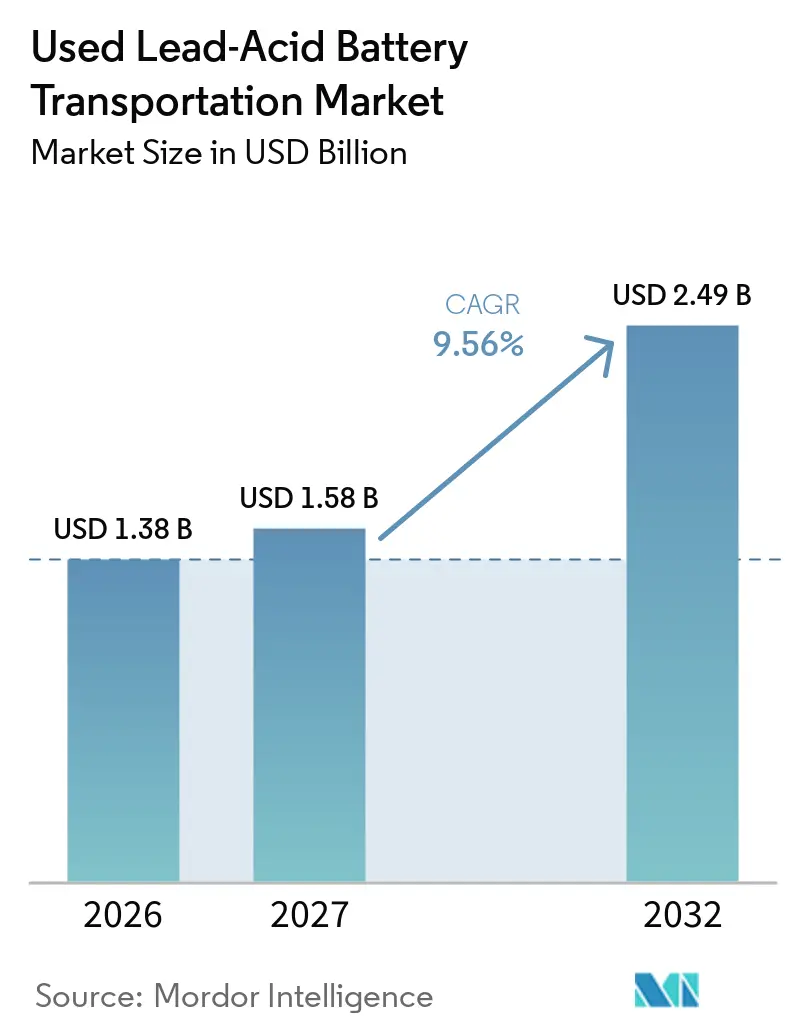
The Used Lead-Acid Battery Transportation Market size is projected to be USD 1.38 billion in 2026, USD 1.58 billion in 2027, and reach USD 2.49 billion by 2032, growing at a CAGR of 9.56% from 2027 to 2032. The Used lead-acid battery transportation market depends on moving spent lead-acid batteries from collection points to secondary-lead smelters under hazardous-material rules. Replacement batteries from vehicles provide a recurring supply of returned units, while stationary power systems add a separate stream of batteries that require collection. Extended producer responsibility requirements are making collection, transport, reporting, and delivery to authorized facilities more formal across major regions. The Used lead-acid battery transportation market also benefits when manufacturers and recyclers treat recovered lead as a supply-security input rather than only a waste-management outcome. This favors carriers that can provide reliable collection coverage, compliant packaging, traceable documentation, and efficient consolidation.
Key Report Takeaways
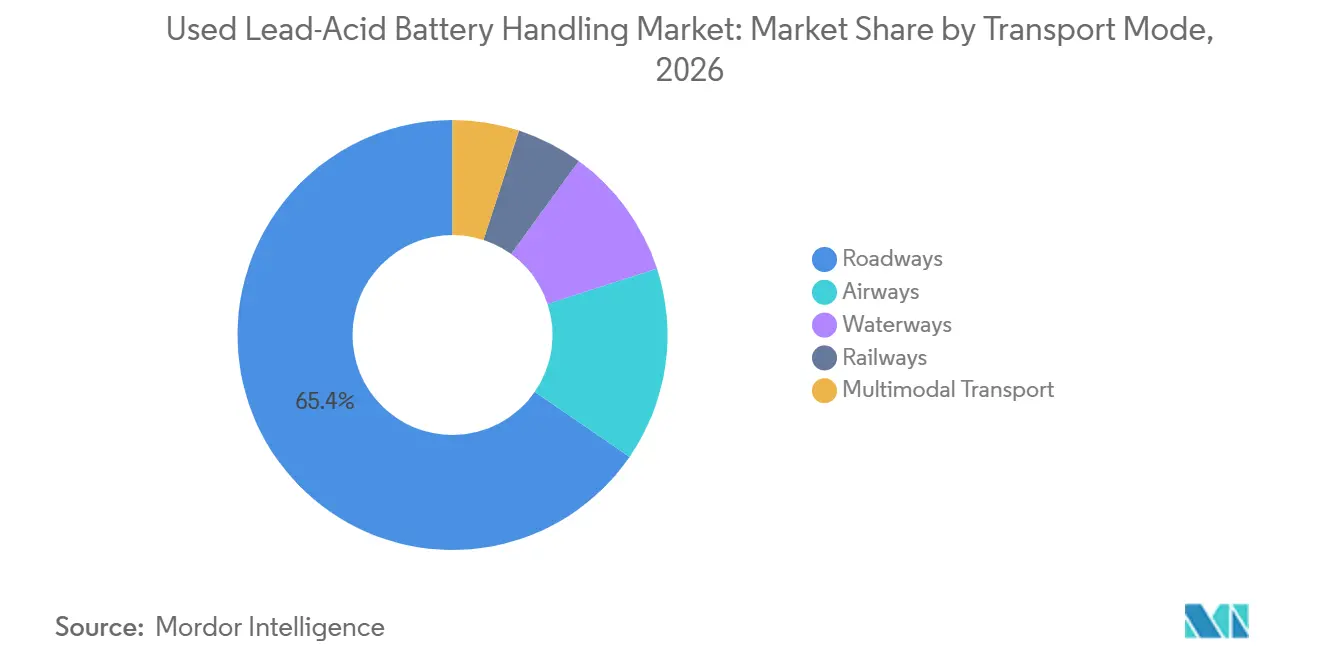
- By transport mode, roadways accounted for 65.4% of global revenue in 2026, while multimodal transport is forecast to grow at a 9.9% CAGR through 2032.
- By service type, transportation and linehaul held 37.6% of revenue in 2026, while documentation, compliance, and tracking is forecast to grow at a 10.6% CAGR through 2032.
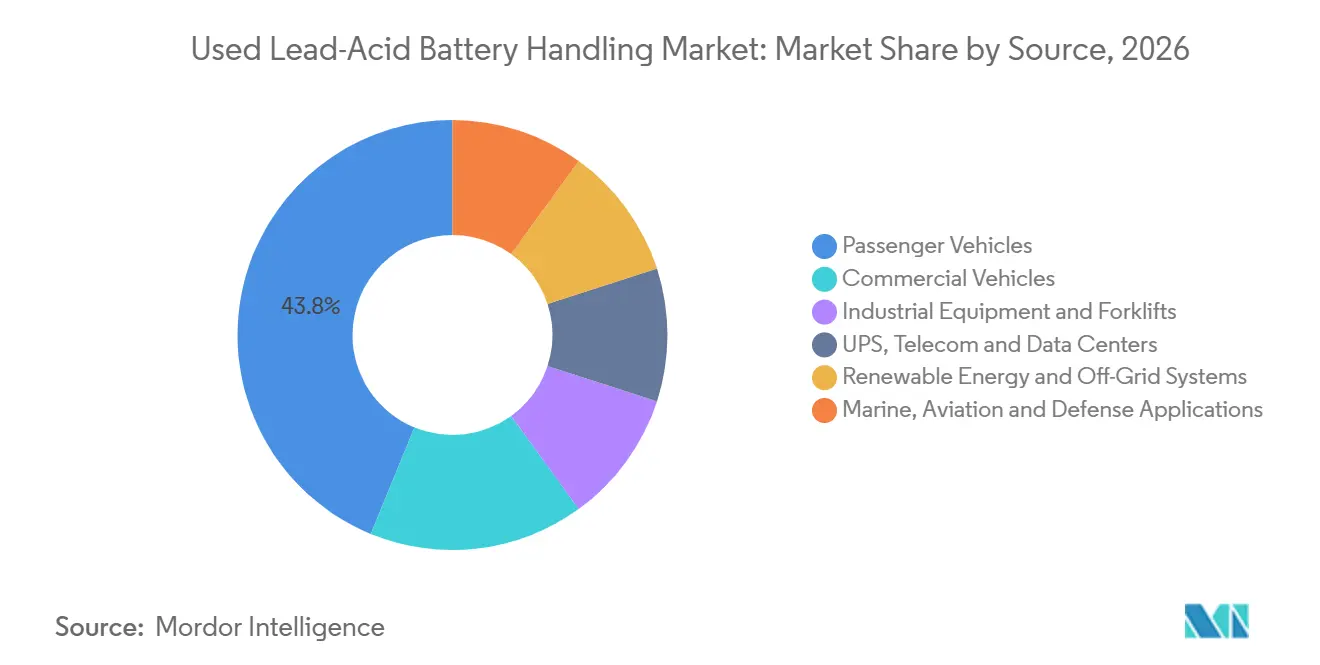
- By source, passenger vehicles accounted for 43.8% of volume in 2026, while renewable energy and off-grid systems are forecast to grow at an 11.2% CAGR through 2032.
- By geography, Asia-Pacific held 39.2% of global revenue in 2026 and is forecast to grow at a 9.8% CAGR through 2032.
Note: Market numbers in this report are based on Mordor Intelligence's proprietary estimation framework, which combines nine months of actuals with Q4 projections for base year 2026.
Market Trends and Insights
Drivers Impact Analysis of Used Lead-Acid Battery Transportation Market*
| Driver | (~) % Impact on CAGR Forecast | Geographic Relevance | Impact Timeline |
|---|---|---|---|
| Automotive Replacement and Fleet Battery Turnover | +2.5% | Global, United States, China, India, Germany, Brazil | Short term (≤ 2 years) |
| Extended Producer Responsibility and Closed-Loop Recycling Mandates | +2.8% | Global, Germany, France, United States, China, India | Medium term (2-4 years) |
| Backup Power and Distributed Renewable Storage | +2.0% | Asia-Pacific, Middle East, Africa, South America | Medium term (2-4 years) |
| Secondary-Lead Supply Security and Price Competitiveness | +1.7% | Global, China, India, United States, Germany, Brazil | Medium term (2-4 years) |
| Reverse-Logistics Digitization and Route-Density Optimization | +1.4% | North America, Europe, India, China | Medium term (2-4 years) |
| Formalization of Informal Collection Networks | +1.9% | Middle East, Africa, South Asia, Southeast Asia, South America | Long term (≥ 4 years) |
| Source: Mordor Intelligence | |||
Rising Automotive Replacement and Fleet Battery Turnover
Lead-acid batteries typically last 3 to 5 years, and the global vehicle fleet reached 1.55 billion vehicles in 2025.[1] This installed base gives the Used lead-acid battery transportation market a recurring return flow that does not depend only on new vehicle purchases. European passenger cars averaged 12.5 years of age in 2025, which supports regular replacement demand even when fleet expansion slows. Fleet operators replace batteries on planned maintenance schedules, making their collection volumes easier to forecast than household pickups. This allows carriers to plan routes, position containers, and combine loads with fewer empty miles. Fleet collection contracts can therefore improve carrier margins as well as provide volume.
Extended Producer Responsibility and Closed-Loop Recycling Mandates
Regulation (EU) 2023/1542 requires lead-acid battery recycling efficiency of 75% from December 2025 and 80% by 2030.[2] The regulation also requires 90% lead recovery by 2027, placing transport performance within the compliance chain. India’s portal listed 3,664 producers and 442 recyclers, with certificates procured for 7.29 lakh metric tonnes against a 10.96 lakh metric tonne target.[3] This shortfall indicates that substantial battery volumes remain outside formal transport channels. The Used lead-acid battery transportation market gains when informal movements become contracted services with records, authorized destinations, and reporting obligations. Certified carriers can use those requirements to compete on documented compliance rather than only on price.
Growth of Backup Power and Distributed Renewable Storage
Backup power, telecom, and distributed storage systems create battery returns that differ from conventional automotive collections. Battery Council International reported that North American stationary Uninterruptible Power Supply (UPS) battery demand increased 21% in 2025, while stationary storage demand is forecast to grow at a 4.5% CAGR through 2028. The International Renewable Energy Agency noted in 2025 that data centers are adopting grid-interactive UPS systems, increasing the importance of end-of-life batteries in urban energy corridors.[4] These sites often need scheduled collections and strong handling controls because batteries are deployed in banks rather than as individual automotive units. Renewable systems in rural and off-grid locations add dispersed loads that are harder to integrate into dealer-based networks. The Used lead-acid battery transportation market can serve these locations through cluster-based pickup routes and consolidation hubs.
Reverse-Logistics Digitization and Route-Density Optimization
China introduced a pilot in June 2025 that allows qualified enterprises to use electronic manifests for certain cross-provincial waste lead-acid battery transfers. The State Council also expanded digital tracking expectations for dangerous waste across production, transfer, and disposal activities in 2025. Digital manifests can reduce administrative delays while providing a clearer chain of custody. This matters most where transport involves multiple collection points, jurisdictions, or treatment sites. Research on sorted-waste collection networks found that two-echelon location-routing models can reduce fleet requirements and improve capacity use. Carriers that support standardized, audit-ready data can more readily work with producers operating under formal take-back schemes.
Restraints Impact Analysis of Used Lead-Acid Battery Transportation Market*
| Restraint | (~) % Impact on CAGR Forecast | Geographic Relevance | Impact Timeline |
|---|---|---|---|
| Hazardous-Material Compliance and Packaging Cost | -1.8% | Global, United States, Canada, Germany, Australia | Medium term (2-4 years) |
| Fragmented Collection and Uneven Recycling Infrastructure | -1.5% | India, Indonesia, Ghana, Brazil, South Africa | Long term (≥ 4 years) |
| Battery-Chemistry Misclassification at Collection Points | -1.2% | Global, particularly mixed-chemistry collection corridors | Medium term (2-4 years) |
| Cross-Border Documentation and Approval Complexity | -0.8% | Europe, North America, China, and other cross-border corridors | Medium term (2-4 years) |
| Source: Mordor Intelligence | |||
Hazardous-Material Compliance and Packaging Cost
Wet lead-acid batteries are generally assigned UN2794 Class 8 status, which requires certified packaging, trained personnel, emergency documentation, and transport controls. The Used lead-acid battery transportation market faces requirements that raise shipment costs above ordinary freight because the equipment and records are specific to hazardous materials. The Pipeline and Hazardous Materials Safety Administration (PHMSA) confirmed in its 2025 interpretation that wet batteries destined for recycling can still meet the definition of hazardous material under universal-waste programs. The European Commission updated battery-related waste codes in March 2025, adding new hazardous classifications across several battery chemistries. Small generators and rural collectors face the highest fixed cost per shipment because they cannot spread certified-vehicle and documentation costs across large loads. Carriers can address this constraint with standard documentation packages, trained on-call drivers, and pre-approved containment kits.
Fragmented Collection and Uneven Recycling Infrastructure
Route density in the Used lead-acid battery transportation market is limited when battery generation sites are far from permitted smelters and consolidation locations. India’s gap between 7.29 lakh metric tons of Extended Producer Responsibility (EPR) certificates procured and the 10.96 lakh metric ton target illustrates the scale of material that has not yet entered fully compliant channels. Informal operators can collect scattered batteries at lower apparent cost because they do not always carry the same compliance burden. Compliant carriers must combine small loads before long-distance transport becomes economic. This requires hubs, containers, trained staff, and reliable onward capacity before a route can achieve stable utilization. Formalization in emerging regions will therefore depend on collection infrastructure as much as on regulations.
*Our forecasts treat driver/restraint impacts as directional, not additive. The impact forecasts reflect baseline growth, mix effects, and variable interactions.
Used Lead-Acid Battery Transportation Market Segment Analysis
By Transport Mode:
Roadways Retain the Largest Role While Multimodal Corridors ExpandRoadways hold 65.4% of global revenue in 2026. Road transport reaches automotive dealers, telecom sites, industrial generators, and other dispersed collection points without requiring fixed rail or port infrastructure. It is also suited to first-mile pickup, where small and irregular loads need flexible scheduling. This operating flexibility lets road carriers support collection routes across suburban, rural, and industrial areas. Road transport remains particularly important when a carrier must supply certified packaging and handle collection directly. The Used lead-acid battery transportation market size tied to roadways remains supported by the broad distribution of replacement batteries.
Railways and waterways serve bulk transfers between established collection hubs and smelters, especially where the shipment volumes justify dedicated handling infrastructure. Germany, China, and India offer examples of corridors where high volumes can support rail sidings or barge connections. Airways serve a small but necessary role for emergency, high-value, and island shipments, subject to restrictive packaging and weight rules. Multimodal transport is projected to grow at a 9.9% CAGR through 2032, the highest rate among transport modes. Large recyclers can reduce road-only dependence by moving consolidated battery loads through rail or water on long routes. This model becomes more useful when the route has enough volume to cover transfer, storage, and coordination costs.

By Service Type:
Compliance and Tracking Develop into a Distinct Service OfferingTransportation and linehaul held 37.6% of service revenue in 2026. This service captures the cost of fuel, drivers, certified vehicles, and the longest movement between hubs and treatment facilities. Collection and pickup provide the first aggregation step and establish the quality of the transport network’s intake. Packaging and containerization are increasingly supplied with collection, which limits their standalone service revenue. Temporary storage and consolidation allow small pickups to be converted into viable linehaul loads. The Used lead-acid battery transportation market needs this intermediate function because dispersed batteries cannot always move directly to a smelter.
Documentation, compliance, and tracking are projected to grow at a 10.6% CAGR through 2032. For the Used lead-acid battery transportation market, this reflects stronger manifest, reporting, and chain-of-custody requirements across regions. Electronic recordkeeping gives battery producers and recyclers a way to demonstrate that waste reached authorized treatment facilities. It also supports audit preparation when an Extended Producer Responsibility (EPR) program requires evidence of collection and recovery. The service can command higher value when the carrier integrates weighing, pickup records, and transfer documentation into one process. For carriers, compliance capacity is becoming a commercial service rather than only a mandatory overhead.
By Source:
Passenger Vehicles Provide Scale While Off-Grid Systems Grow FasterPassenger vehicles accounted for 43.8% of source volume in 2026. Within the Used lead-acid battery transportation market, the segment draws on a global vehicle fleet of 1.55 billion units and batteries that are commonly replaced every 3 to 5 years. This produces a predictable flow of returned batteries for dealer and workshop collection systems. Commercial vehicles contribute fewer units but higher battery mass, which makes fleet contracts valuable for truck utilization. Industrial equipment and forklifts also provide concentrated battery sources at warehouses, factories, and distribution sites. The Used lead-acid battery transportation market benefits when these locations can be served through recurring, scheduled routes.
UPS, telecom, and data-center batteries are linked to the expansion of digital and backup-power infrastructure. Battery Council International recorded 21% UPS demand growth in 2025, which supports a larger future return stream from stationary installations. Renewable energy and off-grid systems are forecast to grow at an 11.2% CAGR through 2032, the fastest source category. These systems are common in rural India, sub-Saharan Africa, and island economies where lead-acid batteries remain a lower upfront-cost storage option. Marine, aviation, and defense applications remain smaller but require close chain-of-custody control. Their specialized handling needs can support higher-value transport services.
Geography Analysis
North America Used Lead-Acid Battery Transportation Market
North America has a mature position based on established recycling capacity, high collection rates, and detailed transport requirements. PHMSA’s 2025 interpretation stated that recycling-bound wet batteries are not automatically exempt from hazardous-material obligations. This strengthens the role of certified operators that can manage packaging, manifests, and emergency procedures. Canada applies its TP 14850 standard to small means of containment used for battery transport by road and rail. Mexico’s expanding secondary-lead activity adds formal collection demand, although smaller cities have less developed collection infrastructure than the United States.
Europe and South America Used Lead-Acid Battery Transportation Market
South America has a significant formalization opportunity because vehicle fleets are expanding while EPR systems are still developing. Brazil, Argentina, and Chile have potential for more structured hazardous-battery routes where informal collection remains material. The Used lead-acid battery transportation market can grow when providers use hubs to combine loads before linehaul. Europe is the most regulated geography, with the EU Batteries Regulation setting clear targets and reporting obligations. The European Commission’s July 2025 delegated act established a harmonized method for calculating recycling efficiency. The Commission confirmed in September 2026 that the recycling targets remain appropriate and would not be revised. Germany, France, and the United Kingdom have established Agreement concerning the International Carriage of Dangerous Goods by Road (ADR)-certified networks, while Poland’s older fleet adds collection potential.
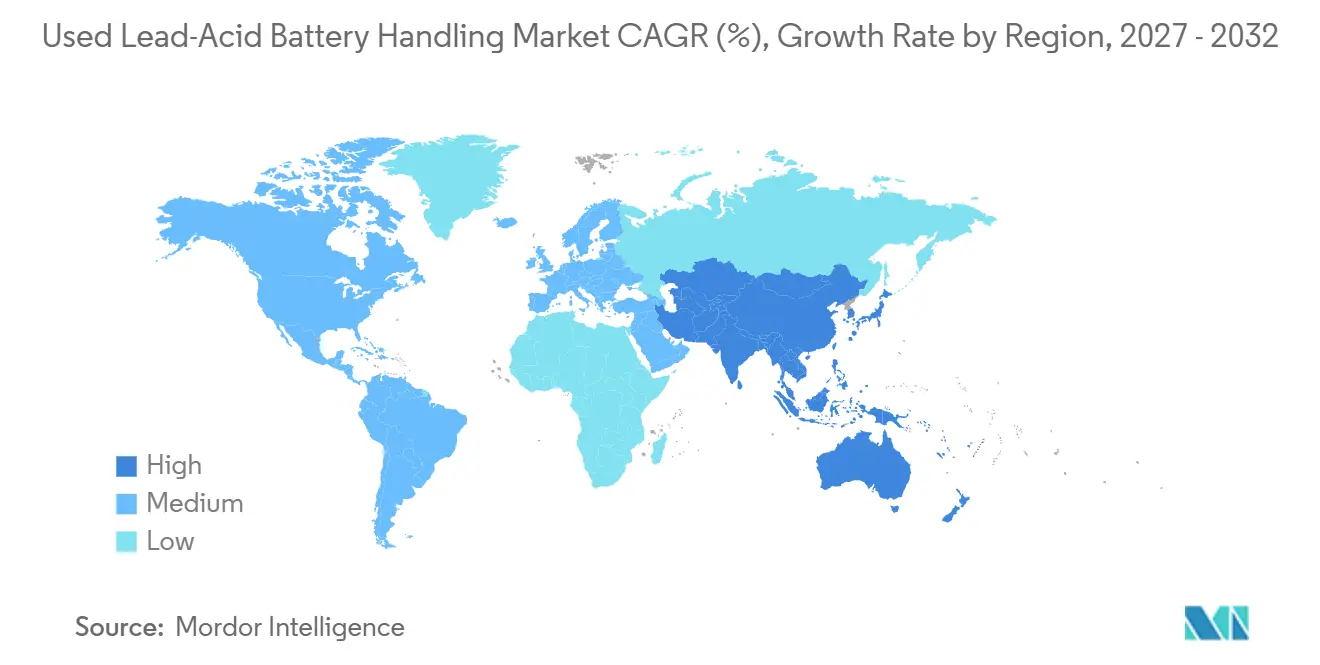
APAC and MEA Used Lead-Acid Battery Transportation Market
Asia-Pacific led the Used Lead-Acid Battery Transportation Market size with a 39.2% share in 2026 and holds the highest projected regional growth rate of 9.8% through 2032. Its demand is supported by China’s transfer reforms, India’s formal EPR system, and broader growth in vehicle and stationary battery use. Africa and the Middle East are also developing through telecom backup needs, construction activity, and closer alignment with Basel Convention transport practices. Nigeria’s March 2025 conference commitment to stronger collection practices and harmonized standards shows the direction of policy development. The Middle East is adding formal collection demand through vehicle fleets and large Uninterruptible Power Supply (UPS) deployments in Saudi Arabia and the United Arab Emirates. Hub-based aggregation is better suited than direct pickup where collection points are distant and shipment volumes are small.
Competitive Landscape
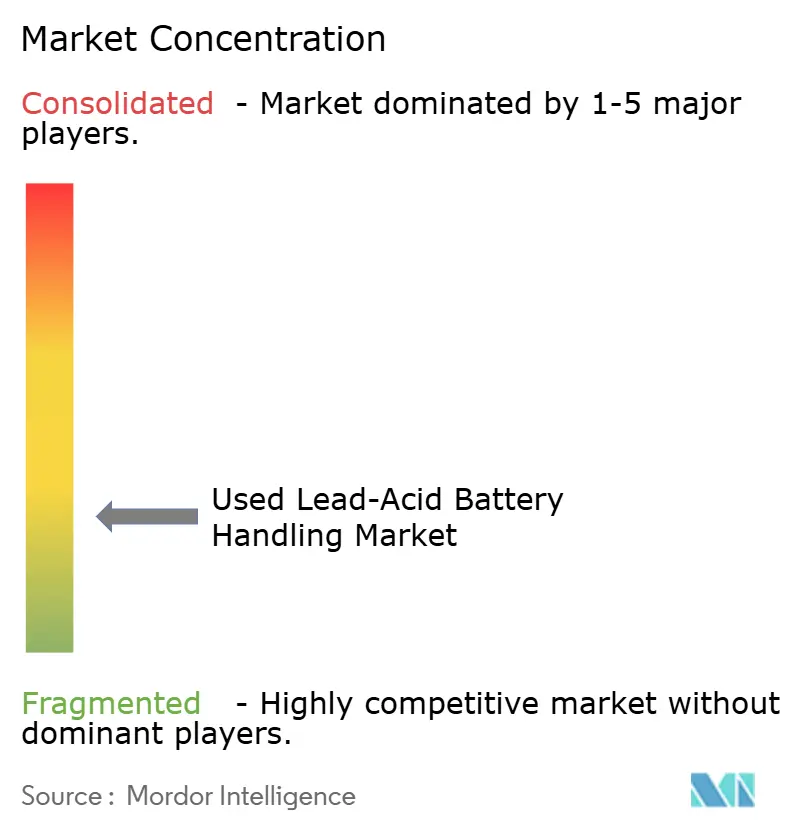
The Used lead-acid battery transportation market is fragmented, with integrated recyclers, specialist battery carriers, regional hazardous-waste operators, and third-party logistics companies serving overlapping routes. Integrated recyclers such as Clarios, Ecobat, and Gravita India use captive logistics networks to secure feedstock for their treatment facilities. Specialist providers such as Cirba Solutions and Battery Solutions supply fleet, certification, collection, and documentation services to more than one recycling client. Diversified logistics providers such as DHL Supply Chain are building battery-specific storage and dangerous-goods capability across wider networks. The scale challenge in the Used lead-acid battery transportation market is not simply obtaining compliant vehicles because dense routes, trained operators, and regular return loads determine whether an operator can sustain costs. Smaller operators can face weak economics when collection volumes are dispersed, or battery condition is not identified before pickup.
Integrated recyclers in the Used lead-acid battery transportation market are increasing control of upstream flows to improve access to recovered lead and polypropylene. Clarios completed its acquisition of 3 Ecobat facilities in Germany and Austria in May 2026, expanding its in-house recovery capability and strengthening its European closed-loop supply chain. Clarios also announced plans in November 2025 to add up to 400,000 metric tons of United States recycling capacity through a facility restart, a new plant, and automation upgrades. DHL Supply Chain broke ground on a 17,000 square meter European Battery Logistics Hub in Holtum, Netherlands, in May 2026. These actions show that transport, storage, diagnostics, and recycling preparation are becoming more closely linked in battery operations.
Technology can differentiate firms in the Used lead-acid battery transportation market when producers need proof that batteries remain in compliant custody. GPS-tracked movements, certified transport equipment, condition checks, and integrated digital records reduce the risk of a disputed handoff. Chemistry misclassification can be costly because a lithium-ion cell entering a lead-acid load can change the handling requirements and lead to rework or rejected shipments. Carriers that identify battery type and condition at a hub can reduce that risk before loads enter long-distance transport. Cross-border compliance services, mixed-chemistry collection management, and lower-emission reverse logistics remain areas where providers can add value. The Used lead-acid battery transportation industry has room for specialized providers, but route density and compliance systems remain more important than basic hauling capacity.
Used Lead-Acid Battery Transportation Industry Leaders
-
DHL Supply Chain
-
Kuehne + Nagel International AG
-
DB Schenker
-
DSV A/S
-
CEVA Logistics
- *Disclaimer: Major Players sorted in no particular order
Used Lead-Acid Battery Transportation Market Companies Covered in this Report
- Amara Raja Energy & Mobility Limited
- Aqua Metals, Inc.
- Battery Solutions, LLC
- Call2Recycle, Inc.
- Campine NV
- Cirba Solutions, Inc.
- Clarios, LLC
- East Penn Manufacturing Co.
- Eco Recycling Limited
- Ecobat, LLC
- EnerSys
- Enva Group Limited
- Exide Industries Limited
- Exide Technologies, LLC
- Gopher Resource, LLC
- Gravita India Limited
- Moore Recycling Associates, Inc.
- Terrapure BR Ltd.
- The Doe Run Resources Corporation
- Umicore SA
Recent Industry Developments in Used Lead-Acid Battery Transportation Market
- May 2026: Clarios completed the acquisition of three Ecobat battery recycling facilities in Freiberg and Braubach, Germany, and Arnoldstein, Austria, following full regulatory approval. The deal significantly expands Clarios's in-house lead and polypropylene recovery capacity and strengthens its closed-loop European supply chain.
- May 2026: DHL Supply Chain broke ground on a European Battery Logistics Hub in Holtum, Netherlands, 17,000 m² of specialized storage and service space co-located with its Holtum automotive campus, offering compliant battery storage, diagnostics, reverse logistics, and recycling preparation under one roof.
- January 2026: Gravita India launched a 6,000 metric tons per annum (MTPA) lithium-ion battery recycling plant at Mundra, Gujarat, funded from internal accruals (INR 14 crore), diversifying its recycling base beyond lead-acid while maintaining its core 1,500-touchpoint Used Lead-Acid Battery (ULAB) collection network across India.
- November 2025: Clarios announced plans for up to 400,000 MT of additional US battery recycling capacity, comprising a fast-tracked restart of its Florence, South Carolina facility, a new state-of-the-art greenfield US plant, and AI and automation upgrades at existing North American facilities.
Global Used Lead-Acid Battery Transportation Market Report Scope
Used Lead-Acid Battery Transportation refers to the regulated movement, loading, and transit of spent or waste lead-acid batteries (ULABs) from collection points, workshops, or storage facilities to authorized recycling, smelting, or disposal plants.
The global used lead-acid battery transportation market is segmented by transport mode, service type, source, and geography. By transport mode, the market is segmented into roadways, airways, waterways, railways, and multimodal transport. By service type, the market is segmented into collection and pickup, packaging and containerization, temporary storage and consolidation, transportation and linehaul, and documentation, compliance and tracking. By source, the market is segmented into passenger vehicles, commercial vehicles, industrial equipment and forklifts, UPS, telecommunications and data centers, renewable energy and off-grid systems, and marine, aviation and defense applications. The report also covers the market size and forecasts for the global used lead-acid battery transportation market across 26 countries in key regions. For each segment, the market sizing and forecasts have been provided on the basis of value (USD).
Segmentation Overview
| Roadways |
| Airways |
| Waterways |
| Railways |
| Multimodal Transport |
| Collection and Pickup |
| Packaging and Containerization |
| Temporary Storage and Consolidation |
| Transportation and Linehaul |
| Documentation, Compliance and Tracking |
| Passenger Vehicles |
| Commercial Vehicles |
| Industrial Equipment and Forklifts |
| UPS, Telecom and Data Centers |
| Renewable Energy and Off-Grid Systems |
| Marine, Aviation and Defense Applications |
| North America | United States |
| Canada | |
| Mexico | |
| Europe | Germany |
| France | |
| Italy | |
| Spain | |
| United Kingdom | |
| Poland | |
| Russia | |
| Rest of Europe | |
| Asia-Pacific | China |
| India | |
| Japan | |
| South Korea | |
| Australia | |
| Indonesia | |
| Vietnam | |
| Thailand | |
| Rest of Asia-Pacific | |
| South America | Brazil |
| Argentina | |
| Chile | |
| Rest of South America | |
| Middle East and Africa | Saudi Arabia |
| United Arab Emirates | |
| Egypt | |
| South Africa | |
| Morocco | |
| Rest of Middle East and Africa |
| By Transport Mode | Roadways | |
| Airways | ||
| Waterways | ||
| Railways | ||
| Multimodal Transport | ||
| By Service Type | Collection and Pickup | |
| Packaging and Containerization | ||
| Temporary Storage and Consolidation | ||
| Transportation and Linehaul | ||
| Documentation, Compliance and Tracking | ||
| By Source | Passenger Vehicles | |
| Commercial Vehicles | ||
| Industrial Equipment and Forklifts | ||
| UPS, Telecom and Data Centers | ||
| Renewable Energy and Off-Grid Systems | ||
| Marine, Aviation and Defense Applications | ||
| By Geography | North America | United States |
| Canada | ||
| Mexico | ||
| Europe | Germany | |
| France | ||
| Italy | ||
| Spain | ||
| United Kingdom | ||
| Poland | ||
| Russia | ||
| Rest of Europe | ||
| Asia-Pacific | China | |
| India | ||
| Japan | ||
| South Korea | ||
| Australia | ||
| Indonesia | ||
| Vietnam | ||
| Thailand | ||
| Rest of Asia-Pacific | ||
| South America | Brazil | |
| Argentina | ||
| Chile | ||
| Rest of South America | ||
| Middle East and Africa | Saudi Arabia | |
| United Arab Emirates | ||
| Egypt | ||
| South Africa | ||
| Morocco | ||
| Rest of Middle East and Africa | ||
Key Questions Answered in the Report
What is the projected size of the used lead-acid battery transportation market?
The Used lead-acid battery transportation market is projected to rise from USD 1.58 billion in 2027 to USD 2.49 billion by 2032, at a 9.56% CAGR.
Which transport mode handles the largest share of used lead-acid battery movements?
Roadways held 65.4% of revenue in 2026 because they can reach dispersed collection points and support flexible pickup schedules. They also accommodate first-mile collections without fixed rail or port connections for most collection networks.
Why is compliance important for used lead-acid battery transportation?
Wet lead-acid batteries require hazardous-material controls, documentation, trained personnel, and suitable packaging under applicable transport rules. The Used lead-acid battery transportation market depends on these controls to protect handlers and demonstrate compliant custody.
Which source category is growing fastest for returned lead-acid batteries?
Renewable energy and off-grid systems is forecast to grow at an 11.2% CAGR through 2032 as distributed storage installations create dispersed returns.
Which region leads used lead-acid battery transportation?
Asia-Pacific held 39.2% in 2026 and is projected to record the fastest regional CAGR of 9.8% through 2032.
What services create value beyond collection and linehaul?
Documentation, compliance, and tracking is forecast to grow at a 10.6% CAGR through 2032 because producers need auditable chain-of-custody records. The Used lead-acid battery transportation market relies on these records when producers must document treatment outcomes.