
United States Rental Air Compressor Market Size and Share
Market Overview
| Study Period | 2022 - 2032 |
|---|---|
| Forecast Data Period | 2027 - 2032 |
| Base Year Market Size (2026) | USD 1.79 Billion |
| Market Size (2027) | USD 1.91 Billion |
| Market Size (2032) | USD 2.54 Billion |
| Growth Rate (2027 - 2032) | 5.87 % |
| Market Concentration | Medium |
Major Players *Disclaimer: Major Players sorted in no particular order Image © Mordor Intelligence. Reuse requires attribution under CC BY 4.0. | |
United States Rental Air Compressor Market Analysis by Mordor Intelligence
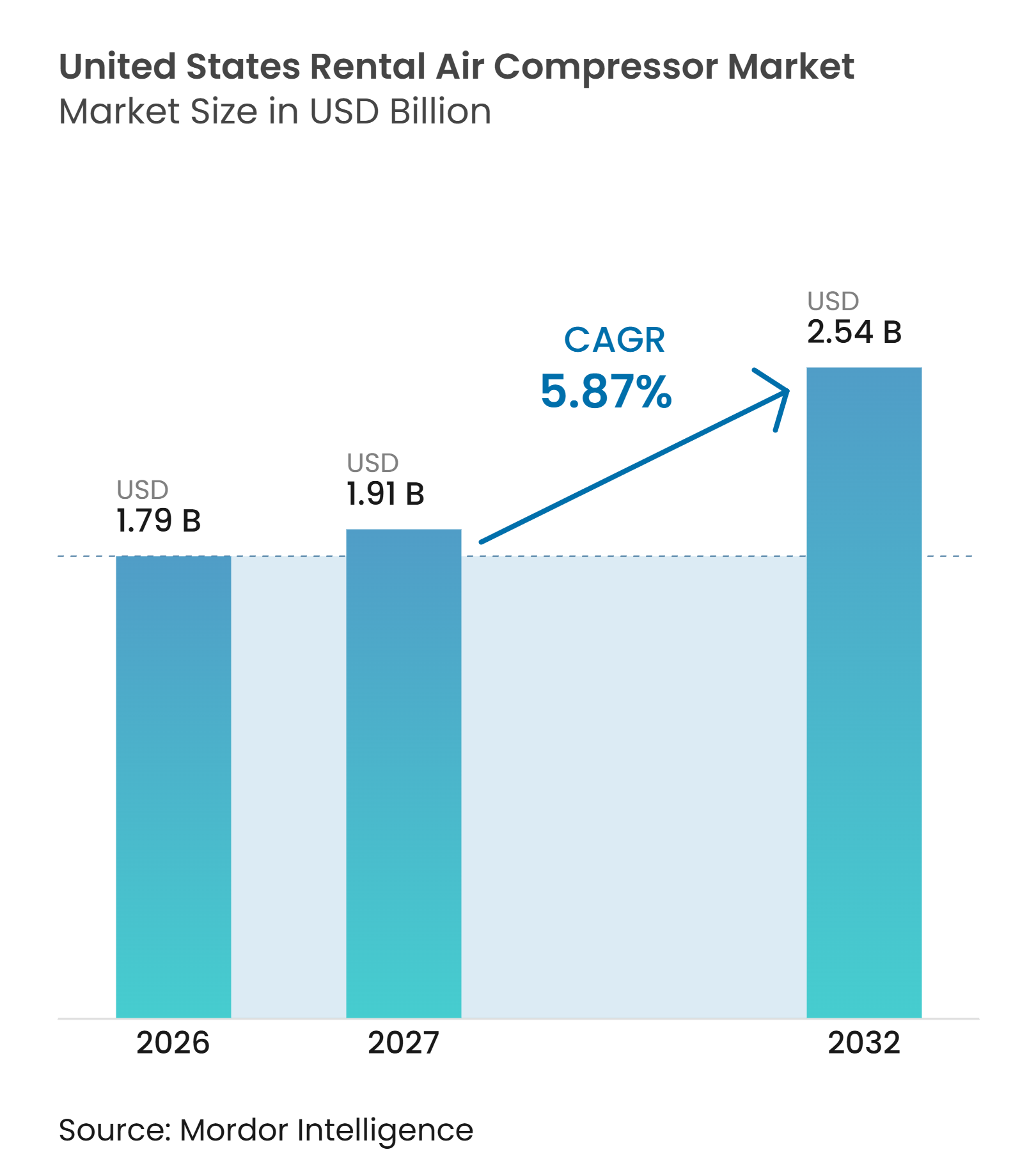
The United States Rental Air Compressor Market size was valued at USD 1.79 billion in 2026 and is estimated to grow from USD 1.91 billion in 2027 to reach USD 2.54 billion by 2032, at a CAGR of 5.87% during the forecast period (2027-2032). Federal infrastructure activity, manufacturing construction, and industrial maintenance work support equipment utilization across the US rental air compressor market. The rental model also moves maintenance and regulatory obligations from project operators to fleet providers. Clean-air requirements in pharmaceutical, food processing, electronics, and semiconductor facilities broaden demand for oil-free equipment. Larger providers are using acquisitions, fleet renewal, and digital service tools to protect utilization and respond to pressure on standard equipment rates. This leaves opportunities for providers that can supply certified oil-free equipment, reliable field service, and capacity near industrial projects.
Key Report Takeaways
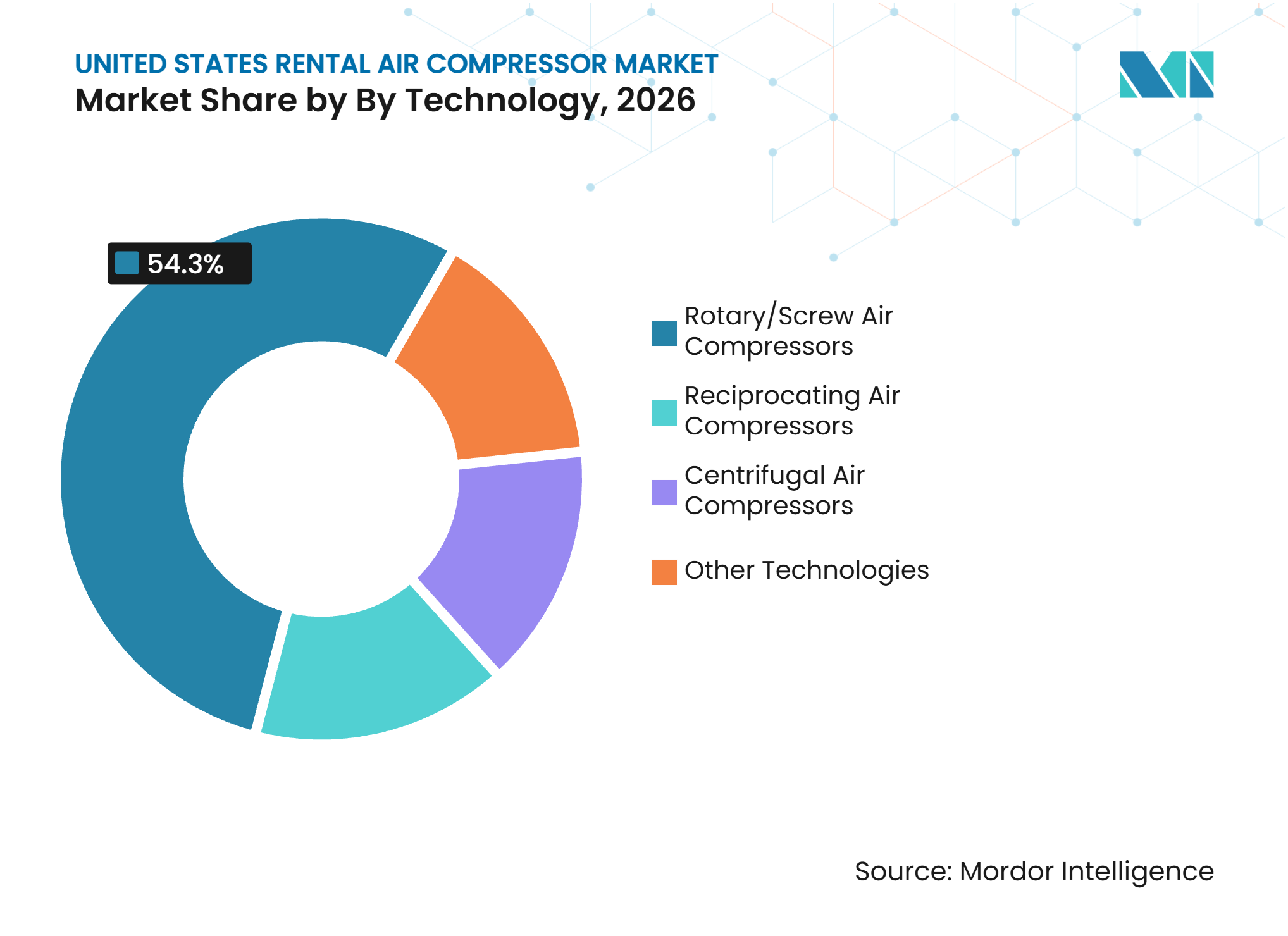
- By technology, rotary or screw compressors held 54.3% of the US rental air compressor market share in 2026 and are projected to grow at a 6.2% CAGR through 2032.
- By lubrication type, oil-filled compressors held 52.7% of the US rental air compressor market share in 2026, while oil-free compressors are projected to grow at a 6.5% CAGR through 2032.
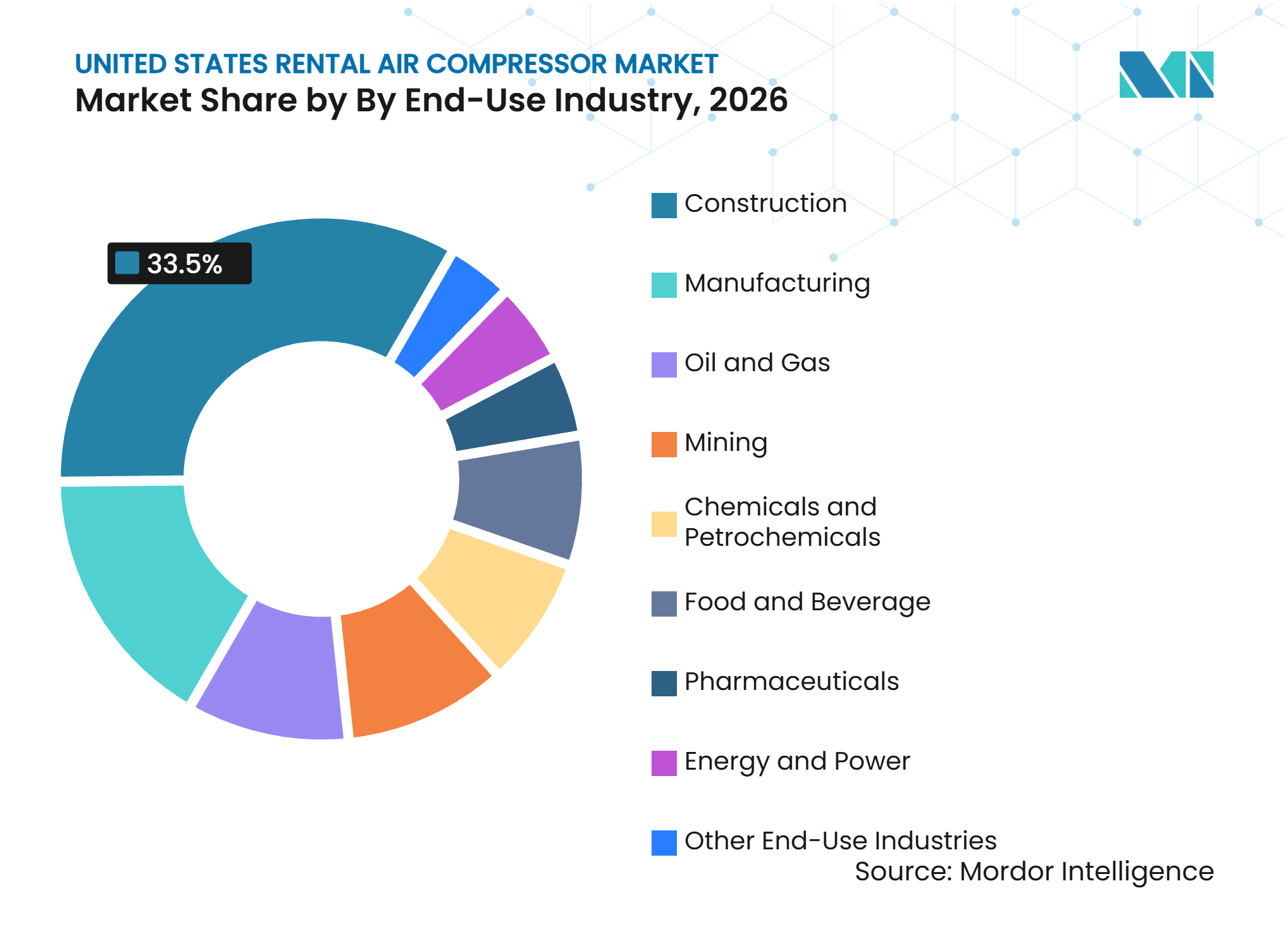
- By end-use industry, construction accounted for 33.5% of revenue in 2026, while manufacturing is forecast to expand at a 6.3% CAGR through 2032.
Note: Market numbers in this report are based on Mordor Intelligence's proprietary estimation framework, which combines nine months of actuals with Q4 projections for base year 2026.
Market Trends and Insights
Drivers Impact Analysis of United States Rental Air Compressor Market*
| Driver | (~) % Impact on CAGR Forecast | Geographic Relevance | Impact Timeline |
|---|---|---|---|
| Infrastructure And Industrial Project Expansion | +1.4% | National, concentrated in Gulf Coast, Sun Belt, and Midwest infrastructure corridors | Short term (≤ 2 years) |
| Shift From Compressor Ownership To Flexible Rental Models | +1.2% | National, with strongest traction in Southeast, Texas, and Mid-Atlantic metro markets | Medium term (2-4 years) |
| Oil-Free Air Demand In Contamination-Sensitive Industries | +0.8% | National, concentrated in Northeast pharmaceutical clusters, Midwest food processing, and Southwest semiconductor fabrication | Medium term (2-4 years) |
| Reshoring Of Manufacturing And Process Industries | +1.0% | National, with early gains in Texas, Ohio, Tennessee, and South Carolina | Medium term (2-4 years) |
| Air-As-A-Service And Digital Rental Platforms | +0.6% | National, with early gains in logistics-dense metropolitan areas | Long term (≥ 4 years) |
| Fleet Electrification In Emissions- And Noise-Restricted Sites | +0.5% | National, with early gains in California, the Northeast, and dense urban construction zones | Long term (≥ 4 years) |
| Source: Mordor Intelligence | |||
Infrastructure And Industrial Project Expansion
Highway construction spending reached a seasonally adjusted annual rate of USD 147.8 billion in March 2026.[1] Active road, bridge, and transit projects require portable air for drilling, breaking, blasting, pipework, and site preparation. Federal transportation activity provides a multi-year project pipeline for contractors. Utility investment also supports substation, transmission, and data-center construction activity. The US rental air compressor market benefits when contractors need equipment only for a defined project phase. This project-based demand supports forward fleet planning in the Gulf Coast, Sun Belt, and Midwest corridors.
Shift From Compressor Ownership To Flexible Rental Models
Industrial operators are increasingly treating compressed air as an operating expense instead of a permanent capital asset. Rental providers manage diesel particulate filters, selective catalytic reduction systems, calibration schedules, and other Tier 4 Final service requirements.[2] Defined commissioning and turnaround periods can last from 2 to 18 months, making permanent ownership less suitable for temporary capacity needs. Reshoring and foreign direct investment announcements represented 247,000 manufacturing jobs in 2025.[3] New facilities need temporary compressed air during installation and commissioning before entering regular operations. The US rental air compressor market can retain customers when an initial commissioning contract becomes a later maintenance or turnaround relationship.
Oil-Free Air Demand In Contamination-Sensitive Industries
ISO 8573-1 Class 0 requirements make oil-free compressed air important in pharmaceutical, food processing, and semiconductor applications. Product-contact, packaging, and processing activities raise the importance of verified air purity. EquipmentShare added a 1,500 Cubic Feet Per Minute (CFM) all-electric oil-free air compressor to its US rental fleet in June 2025. The addition indicates that larger rental platforms are building clean-air capacity before contract demand fully develops. Certification requirements can limit substitution with standard equipment at regulated facilities. The US rental air compressor market therefore has a growing need for certified equipment, trained service teams, and documented maintenance practices.
Reshoring Of Manufacturing And Process Industries
Reshoring and foreign direct investment announcements totaled 247,000 manufacturing jobs in 2025. Semiconductor plants, electric vehicle battery facilities, and pharmaceutical sites use temporary compressed air during installation and cleanroom qualification. These projects can require rental equipment for 12 to 24 months before permanent systems are fully operational. The installation phase requires equipment that can be deployed, resized, and removed as needs change. That flexibility supports the rental model across varied facility construction schedules. The US rental air compressor market has durable opportunities near semiconductor, battery, chemical, and advanced manufacturing corridors.
Restraints Impact Analysis of United States Rental Air Compressor Market*
| Restraint | (~) % Impact on CAGR Forecast | Geographic Relevance | Impact Timeline |
|---|---|---|---|
| Fleet Maintenance And Utilization Risk | -0.7% | National, more acute in rural and remote industrial sites | Medium term (2-4 years) |
| Price Competition And Margin Compression | -0.6% | National, most intense in metropolitan construction corridors dominated by large national chains | Short term (≤ 2 years) |
| Specialist Technician And Field-Service Shortage | -0.5% | National, with acute impact in remote oil and gas, mining, and infrastructure corridors | Medium term (2-4 years) |
| Mismatch Between Grid Availability And Electric Rental Deployment | -0.3% | Remote and rural industrial sites, with acute exposure in the Mountain West, Great Plains, and offshore locations | Long term (≥ 4 years) |
| Source: Mordor Intelligence | |||
Fleet Maintenance And Utilization Risk
Tier 4 Final compressor fleets require more technical servicing than earlier diesel equipment. Diesel particulate filter regeneration, selective catalytic reduction fluid management, and calibration schedules add field-service time and cost. Sunbelt Rentals reported an average fleet age of 52 months in July 2026, compared with 50 months a year earlier.[4] Returned equipment that awaits servicing cannot generate rental revenue, even as financing and ownership costs continue. Herc Holdings identified fuel inflation as a macroeconomic headwind in its second-quarter 2026 results. The US rental air compressor market places more strain on regional operators that lack national purchasing power, technician coverage, and replacement fleet capacity.
Price Competition And Margin Compression
National rental providers can use large fleet programs to compete aggressively in standard construction compressor categories. United Rentals reported USD 1.4 billion in specialty rental revenue in the second quarter of 2026, up 24.8% from the previous year. Procurement scale and digital transaction systems create cost advantages that local operators may find difficult to match. Air-as-a-Service pricing also makes comparisons based on delivered output more visible to customers. Standard fleet categories are therefore more exposed to day-rate pressure than certified oil-free units. The US rental air compressor market gives regional providers stronger room to defend returns through service quality, uptime commitments, and specialized equipment.
*Our forecasts treat driver/restraint impacts as directional, not additive. The impact forecasts reflect baseline growth, mix effects, and variable interactions.
United States Rental Air Compressor Market Segment Analysis
By Technology:
Rotary Or Screw Compressors Provide Broad Operating FlexibilityRotary or screw compressors held 54.3% of technology revenue in 2026, making them the largest technology segment in the US rental air compressor market. Their continuous-duty performance supports construction activity and demanding industrial applications. The segment is projected to advance at a 6.2% CAGR through 2032. Rotary or screw units serve a broad range of airflow needs and maintain low vibration in extended operating periods. Their ability to support varied project loads makes them a practical fleet anchor for rental providers.
Atlas Copco announced US assembly of G Series 90 to 250 hp oil-injected screw compressors in Bay Minette, Alabama, in June 2026. Domestic assembly can shorten delivery times and support rental fleet refresh cycles. Tier 4 Final requirements raise ownership and maintenance demands for diesel-driven equipment. Reciprocating models retain a role in lower-volume and intermittent uses, including portable tooling and pipeline maintenance. Centrifugal equipment remains suited to high-flow, oil-free applications such as pharmaceutical and semiconductor production.



By Lubrication Type:
Oil-Free Equipment Expands In Regulated ApplicationsOil-filled compressors held 52.7% of lubrication revenue in 2026, reflecting the large installed fleet serving general construction and routine industrial work. This segment remains relevant where contamination exposure is manageable and oil-free equipment is not required. Oil-filled rotary or screw configurations are replacing older reciprocating units in many fleets. That equipment renewal supports energy efficiency on longer contracts. General equipment rental chains retain broad oil-filled fleets because they serve many construction applications.
Oil-free equipment is forecast to advance at a 6.5% CAGR through 2032, the fastest rate among lubrication types in the US rental air compressor market. Pharmaceutical manufacturing, food processing, electronics, and semiconductor facilities need certified clean air for direct-contact uses. Equipment Share added a 1,500 Cubic Feet Per Minute (CFM) all-electric oil-free compressor to its fleet during June 2025. Oil-free units can earn higher daily rates than oil-filled alternatives when certification is essential. The US rental air compressor industry is therefore placing greater value on clean-air inventory and service documentation.
By End-Use Industry:
Construction Leads Volume While Manufacturing Grows FasterConstruction accounted for 33.5% of end-use revenue in 2026, supported by pneumatic work across infrastructure sites. Pavement breaking, pipe laying, sandblasting, and anchor drilling all need portable air. Road, bridge, and transit work provide a multi-year project base for construction contractors. Federal construction activity supports recurring fleet utilization across project phases. Oil and gas activity, especially Gulf Coast turnarounds and pipeline maintenance, adds higher-value contracts that can require specialized equipment.
Manufacturing is projected to expand at a 6.3% CAGR through 2032 within the US rental air compressor market. Semiconductor fabs, battery facilities, and reshored pharmaceutical plants use rental equipment during 12 to 24 month commissioning windows. Chemicals and petrochemicals create periodic turnaround demand, while food and beverage operations require compressed air for packaging. Pharmaceutical plants increasingly use ISO Class 0 oil-free air for sensitive processes. Energy and power construction also uses temporary compressed air for assembly and leak testing across solar, wind, and battery storage projects.

Geography Analysis
The Gulf Coast, led by Texas and Louisiana, has the most concentrated large-format rental demand in the US rental air compressor market. Refinery turnarounds use 300 to 3,000 cubic feet per minute (CFM) of oil-free air for cleaning, maintenance, and pipe testing. These recurring contracts often have predictable lead times, which helps providers plan fleet allocation. Atlas Copco acquired Cypress Equipment Rental in Louisiana in March 2026. The company acquired a distributor serving oil, gas, petrochemical, and offshore customers between New Orleans and Baton Rouge.
The Southeast and Midwest form the fastest-growing regional cluster for the US rental air compressor market because of reshoring activity. Alabama, Tennessee, Georgia, and South Carolina are attracting automotive and advanced-materials investment. Ohio, Michigan, and Indiana have electric vehicle battery and component manufacturing projects. New facilities create temporary air requirements during installation and qualification. Sunbelt Rentals reported 25.3% North American specialty rental revenue growth in the first quarter of fiscal 2027, citing mega-project and energy demand.
The Northeast and Pacific Coast have more frequent oil-free requirements because of pharmaceutical, biotechnology, semiconductor, and aerospace activity. Massachusetts, New Jersey, and Pennsylvania have pharmaceutical production sites that need certified air for maintenance and backup work. California emissions rules increase the appeal of electric and hybrid-electric compressors at urban sites. These regional needs favor providers that can supply clean-air equipment, digital fleet monitoring, and responsive field service.
Competitive Landscape
Market Concentration
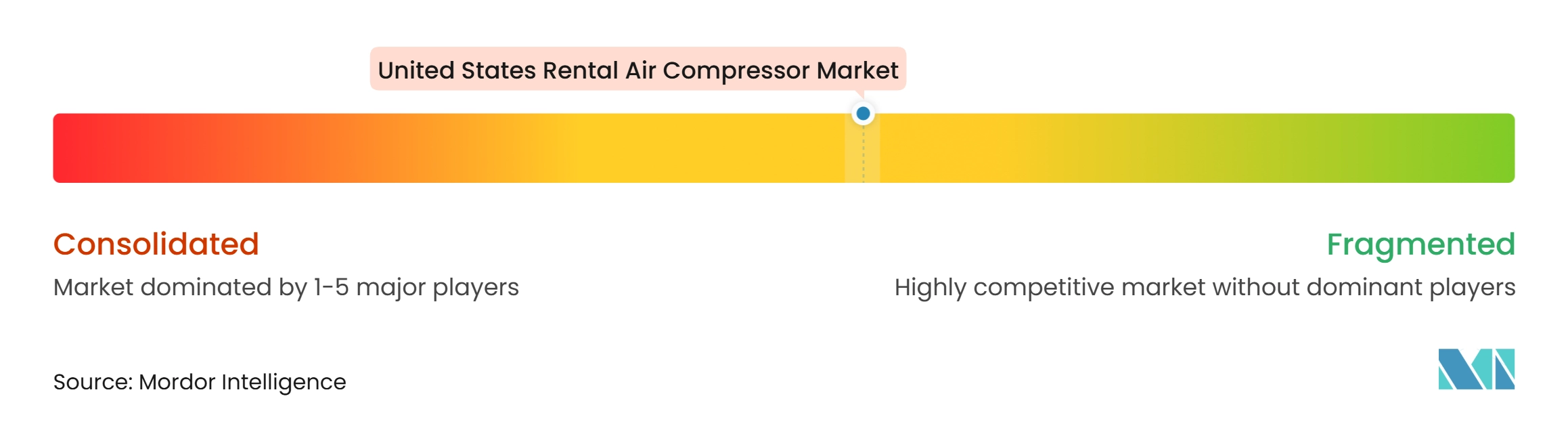
The US rental air compressor market includes national platforms, specialty providers, regional operators, and dealer-affiliated rental programs. United Rentals, Sunbelt Rentals, and Herc Holdings compete with scale, broad branch networks, and substantial fleet investment. Atlas Copco Rental and Aggreko focus on specialty equipment and industrial applications. Atlas Copco has more than 1 million cubic feet per minute (CFM) of ISO-certified oil-free rental capacity across North America, which creates a barrier for competitors pursuing pharmaceutical and semiconductor contracts. Ingersoll Rand acquired Lone Star Blower in August 2026, adding a business with a growing rental fleet for centrifugal and multistage blowers.
Fleet technology is an important way for mid-sized providers to defend margins in the US rental air compressor market. EquipmentShare T3 and Service Compression FieldTune support equipment tracking, predictive fault detection, service management, and usage-based billing. These capabilities shift competition beyond daily rental rates toward uptime and service assurance. The mid-market oil-free category remains important because many general rental firms have limited certified inventory. Air-as-a-Service and pay-per-cubic-feet-per-minute (CFM) offers may also provide an alternative to machine-day pricing.
Atlas Copco began US assembly of its G Series compressors in Alabama during June 2026, supporting shorter lead times and customer-specific configurations. Herc Holdings completed its acquisition of H&E Equipment Services in June 2025, adding specialty locations and metropolitan density. Atlas Copco also acquired Cypress Equipment Rental to strengthen its Gulf Coast compressor presence. Battery-electric equipment can differentiate providers in markets with emissions and noise restrictions, while national scale and specialized service continue to shape competition in the US rental air compressor industry.
United States Rental Air Compressor Industry Leaders
-
United Rentals, Inc.
-
Atlas Copco AB
-
Sunbelt Rentals, Inc.
-
Aggreko Limited
-
Herc Holdings Inc.
- *Disclaimer: Major Players sorted in no particular order
United States Rental Air Compressor Market Companies Covered in this Report
- Aggreko Limited
- Atlas Copco AB
- Caterpillar Inc.
- Cisco Air Systems
- Coast to Coast Equipment Rentals
- Empire Southwest, LLC
- EquipmentShare.com, Inc.
- H&E Equipment Services, Inc.
- Harris Equipment Rental
- Herc Holdings Inc.
- Ingersoll Rand Inc.
- MacAllister Rentals
- Mountain Air Compressor
- Ohio Transmission Corporation
- Pro Rentals & Sales
- Rogers Machinery Company, Inc.
- Sunbelt Rentals, Inc.
- Texas First Rentals
- United Rentals, Inc.
- Washington Air Compressor Rental
Recent Industry Developments in United States Rental Air Compressor Market
- September 2026: Sunbelt Rentals reported record Q1 FY2027 results, with total revenue of USD 3,115 million, up 11.2% year over year, and rental revenue of USD 2,927 million, up 12.5%. The company raised full-year FY2027 guidance and increased net rental equipment capital expenditure guidance from USD 2.4 billion to USD 2.8 billion.
- August 2026: Ingersoll Rand acquired Lone Star Blower, Inc., which had USD 50 million in annual revenue and a growing rental fleet focused on centrifugal and multistage blowers. The transaction expands Ingersoll Rand's Industrial Technologies and Services segment into water, wastewater, and US industrial rental applications.
- July 2026: United Rentals reported total revenue of USD 4.4 billion, up 12% year over year, and specialty rental revenue of USD 1.4 billion, up 24.8%. The company raised full-year 2026 guidance to USD 17.5 billion to USD 17.8 billion in total revenue, with gross capital expenditure of USD 4.9 billion to USD 5.3 billion.
- June 2026: Atlas Copco Compressors USA announced US assembly of G Series 90 to 250 hp oil-injected screw air compressors at Bay Minette, Alabama. The initiative improves delivery lead times and supports customer-specific configurations for the North American rental and industrial sector.
United States Rental Air Compressor Market Report Scope
Rental air compressors are compressed-air systems provided to customers on a temporary or contract basis to meet operational requirements without the need for permanent equipment ownership. These systems use mechanical energy to compress air and supply it at the required pressure and flow rate for industrial processes, construction activities, equipment operation, and other applications. Rental air compressors are available in different technologies, including reciprocating, rotary/screw, and centrifugal compressors, with oil-filled and oil-free configurations to accommodate varying performance, air-quality, and operating requirements. They are commonly used across construction sites, manufacturing facilities, oil and gas operations, mining activities, chemical processing plants, food and beverage production, pharmaceutical manufacturing, and energy and power facilities. Renting these systems enables end users to manage temporary demand, address equipment breakdowns, support planned maintenance and shutdowns, and adjust compressed-air capacity according to project requirements.
The United States Rental Air Compressor Market is segmented by technology, lubrication type, and end-use industry. By technology, the market is segmented into reciprocating air compressors, rotary/screw air compressors, centrifugal air compressors, and other technologies. By lubrication type, the market is segmented into oil-filled compressors and oil-free compressors. By end-use industry, the market is segmented into construction, manufacturing, oil and gas, mining, chemicals and petrochemicals, food and beverage, pharmaceuticals, energy and power, and other end-use industries. The report covers the market size and forecasts for the United States rental air compressor market on the basis of value (USD).
Segmentation Overview
| Reciprocating Air Compressors |
| Rotary/Screw Air Compressors |
| Centrifugal Air Compressors |
| Other Technologies |
| Oil-Filled Compressors |
| Oil-Free Compressors |
| Construction |
| Manufacturing |
| Oil and Gas |
| Mining |
| Chemicals and Petrochemicals |
| Food and Beverage |
| Pharmaceuticals |
| Energy and Power |
| Other End-Use Industries |
| By Technology | Reciprocating Air Compressors |
| Rotary/Screw Air Compressors | |
| Centrifugal Air Compressors | |
| Other Technologies | |
| By Lubrication Type | Oil-Filled Compressors |
| Oil-Free Compressors | |
| By End-Use Industry | Construction |
| Manufacturing | |
| Oil and Gas | |
| Mining | |
| Chemicals and Petrochemicals | |
| Food and Beverage | |
| Pharmaceuticals | |
| Energy and Power | |
| Other End-Use Industries |
Key Questions Answered in the Report
What is the current value of the US rental air compressor market?
The market is valued at USD 1.91 billion in 2027 and is projected to reach USD 2.54 billion by 2032 at a 5.87% CAGR. Infrastructure projects and manufacturing construction support this expansion.
Which compressor technology has the largest share in the United States?
Rotary or screw compressors lead technology revenue with a 54.3% share in 2026 and are forecast to grow at a 6.2% CAGR through 2032. Their continuous-duty capability supports both construction and industrial applications.
Why is oil-free air compressor rental demand increasing?
Pharmaceutical, food processing, electronics, and semiconductor operations need certified clean air, supporting a 6.5% CAGR for oil-free compressors. Rental fleets need documented maintenance and certified capacity for these applications.
Which end-use sector drives the greatest rental demand?
Construction accounts for 33.5% of 2026 revenue because infrastructure work uses portable air for drilling, breaking, blasting, and pipework. Manufacturing is the faster-growing end-use segment.
How does manufacturing expansion support rental providers?
Semiconductor, battery, and pharmaceutical projects use temporary compressed air during installation and commissioning periods lasting 12 to 24 months. Subsequent maintenance and turnaround work can provide repeat demand.
Which US regions have the strongest demand conditions?
The Gulf Coast has recurring refinery and petrochemical demand, while the Southeast and Midwest benefit from manufacturing expansion and reshoring activity. The Northeast and Pacific Coast have more clean-air requirements.