
United States Music Vinyl Market Size and Share
Market Overview
| Study Period | 2020 - 2031 |
|---|---|
| Forecast Data Period | 2026 - 2031 |
| Base Year Market Size (2025) | USD 1.04 Billion |
| Market Size (2026) | USD 1.18 Billion |
| Market Size (2031) | USD 1.58 Billion |
| Growth Rate (2026 - 2031) | 6.01 % |
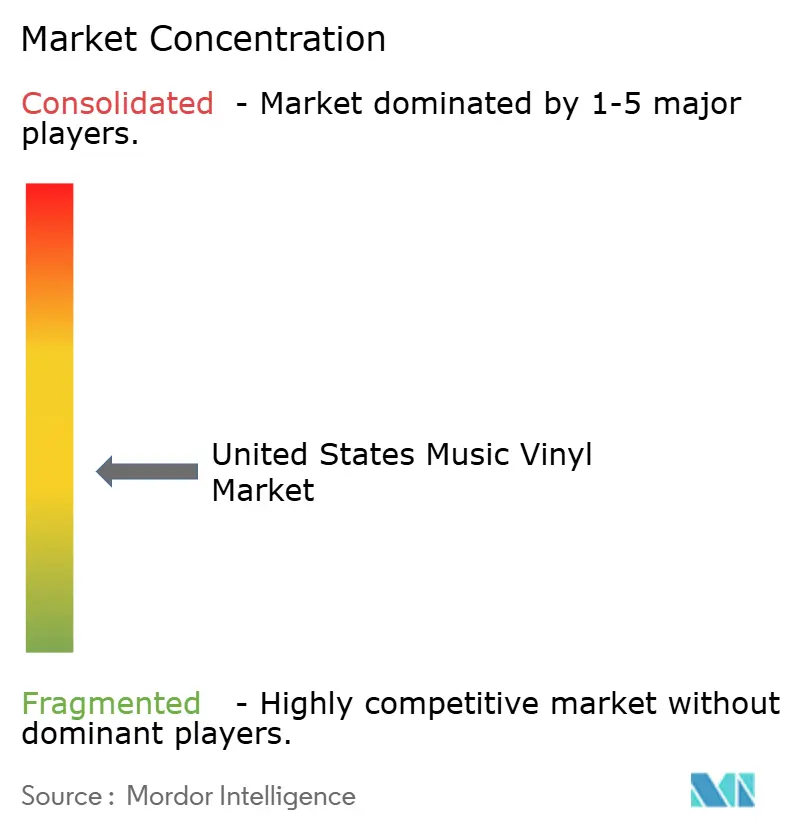
| Market Concentration | Medium |
Major Players *Disclaimer: Major Players sorted in no particular order Image © Mordor Intelligence. Reuse requires attribution under CC BY 4.0. | |
United States Music Vinyl Market Analysis by Mordor Intelligence
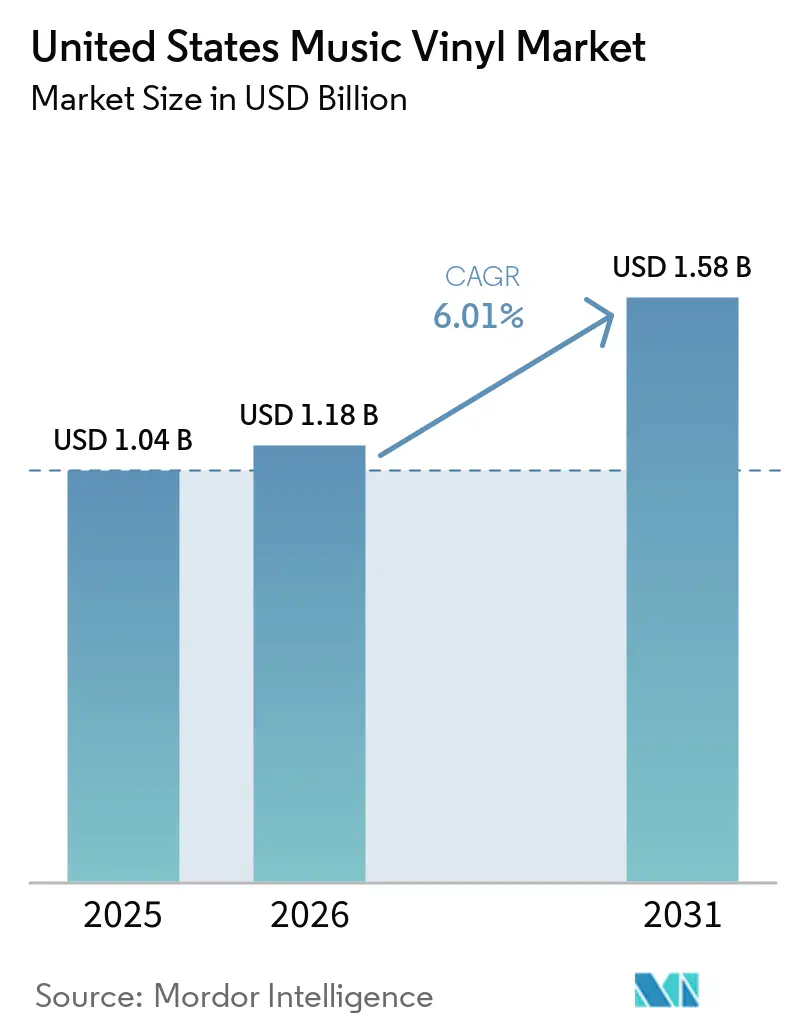
The United States Music Vinyl Market size was valued at USD 1.04 billion in 2025 and is estimated to expand from USD 1.18 billion in 2026 to reach USD 1.58 billion by 2031, at a CAGR of 6.01% during the forecast period (2026-2031). Volume stood at 46.80 million units in 2025, 52.86 million in 2026, and is forecast to reach 59.95 million units by 2031 at a 2.55% CAGR. Revenue is expected to advance faster than shipments because limited editions, colored pressings, gatefold packages, heavyweight formats, and multi-disc sets command higher prices than standard black vinyl. The United States Music Vinyl Market has become a mature, billion-dollar part of recorded music, while collectors continue to support premium physical products. Streaming discovery also supports physical purchases by connecting artists with fans who want a tangible item. Cost inflation, input tariffs, and long plant lead times may limit access for price-sensitive buyers and smaller labels.
Key Report Takeaways
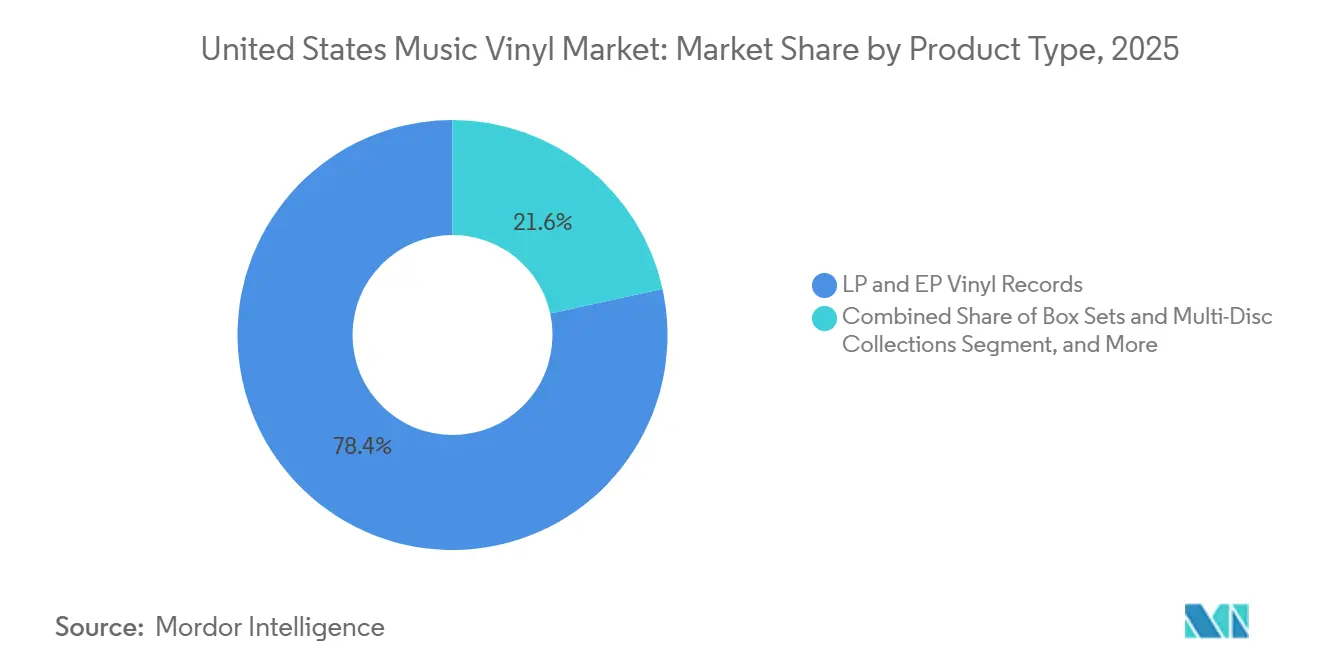
- By product type, LP and EP vinyl records held 78.43% of the United States Music Vinyl Market share in 2025, while box sets and multi-disc collections are projected to record the highest CAGR of 9.27% through 2031.
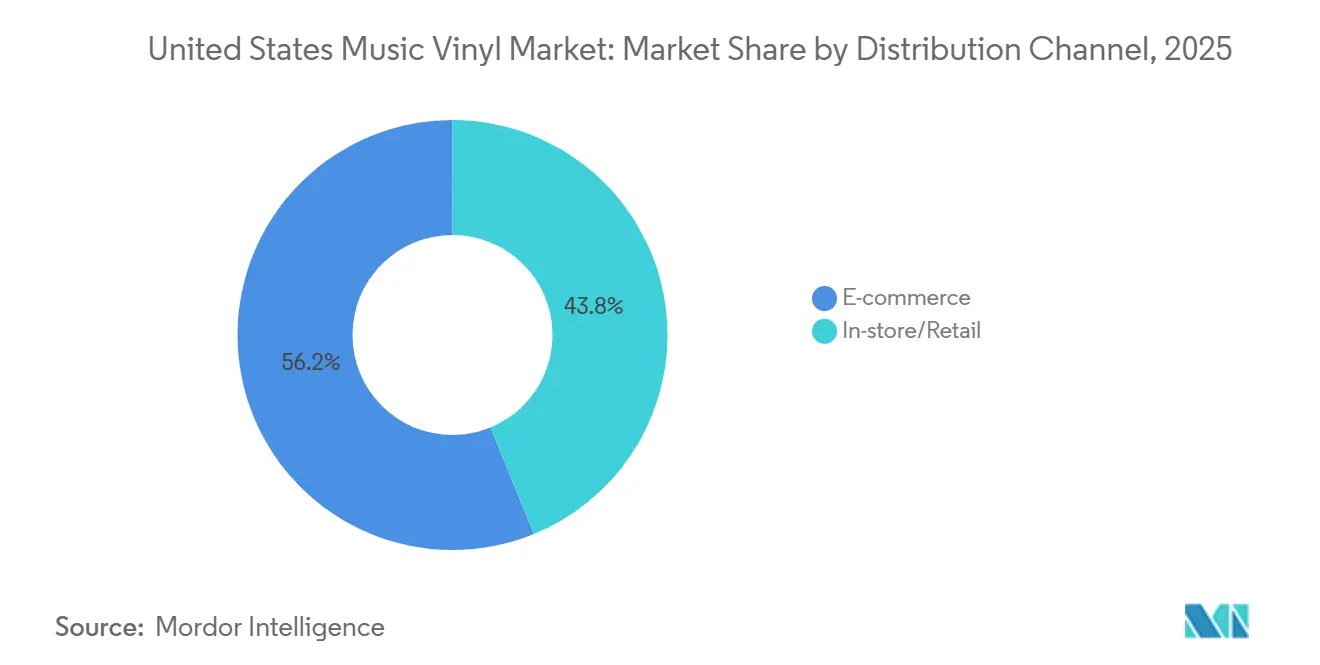
- By distribution channel, e-commerce held 56.19% of the United States Music Vinyl Market share in 2025, while record and music shops in the in-store retail channel are projected to expand at an 8.64% CAGR through 2031.
Note: Market size and forecast figures in this report are generated using Mordor Intelligence’s proprietary estimation framework, updated with the latest available data and insights as of January 2026.
United States Music Vinyl Market Trends and Insights
Drivers Impact Analysis*
| Driver | (~) % Impact on CAGR Forecast | Geographic Relevance | Impact Timeline |
|---|---|---|---|
| Gen Z and Millennial Vinyl Collecting | +2.1% | National, concentrated in major urban markets and college towns | Medium term (2-4 years) |
| Premium and Limited-Edition Pressings | +1.4% | National, strongest in Northeast and West Coast retail clusters | Medium term (2-4 years) |
| Artist-to-Fan Direct-to-Consumer Vinyl Releases | +0.7% | National, strongest in markets with large streaming fan bases | Short term (≤ 2 years) |
| Record Store Day and Independent Retail Revival | +0.5% | National, strongest in cities with established independent record retail networks | Short term (≤ 2 years) |
| Cross-Format Fan Monetization by Major and Independent Labels | +0.3% | National | Medium term (2-4 years) |
| Vinyl as a Physical Art and Merchandise Experience | +0.2% | National, strongest among younger demographic cohorts | Long term (≥ 4 years) |
| Source: Mordor Intelligence | |||
Gen Z and Millennial Vinyl Collecting
Gen Z became the largest purchasing cohort in U.S. vinyl buying, extending demand beyond nostalgia-led buying cycles. A January 2025 survey of more than 2,500 vinyl fans found that 76% of Gen Z buyers purchased records at least once a month. The same survey found that 80% owned a turntable, which indicates active use as well as collecting. It also showed that 47% viewed vinyl as expensive but worthwhile, and some respondents were willing to pay USD 40 to USD 60 for a record. As prices rose, 66% of Gen Z respondents were more likely to seek lower-priced used records, preserving engagement while placing pressure on new-release pricing. Millennial purchases increased 43% in 2024, and streaming discovery continued to lead fans toward physical releases in the United States Music Vinyl Market.[1]
Premium and Limited-Edition Pressings
Premium pressings helped revenue rise faster than unit shipments in the United States Music Vinyl Market. Labels used colored records, hand-numbered runs, gatefold packaging, and 180-gram editions to create scarcity and encourage early buying. Taylor Swift released 8 vinyl editions of The Life of a Showgirl in 2025, including limited-time web store editions, Target editions, and alternative colors. Luminate reported combined sales of more than 1.6 million units for those editions. Catalog owners also used multi-disc boxes, unreleased tracks, archive notes, and merchandise inserts to create higher-value releases. This format enables plants to handle more complex orders and longer production runs, while standard pressings remain more sensitive to price competition.[2]
Artist-to-Fan Direct-to-Consumer Vinyl Releases
Artist-operated stores changed vinyl distribution by reducing reliance on traditional retail intermediaries. Greta Van Fleet offered a direct web store edition of Palace for the People in September 2026, a limited double LP priced at USD 79.99 with a sodalite marble finish and a gatefold package. Such releases position vinyl as a direct fan product rather than only a retail item. Artist stores, preorders, and collector platforms also support the strong position of online sales in the United States Music Vinyl Market. These orders create a separate planning stream for pressing plants, as they can compete for production slots alongside label contracts. The channel may keep online sales prominent, particularly for smaller artists and limited runs, even as physical stores retain their role in discovery and local communities.
Record Store Day and Independent Retail Revival
Record Store Day continued to support independent retail and event-based buying. Record Store Day 2026 was held on April 18, with Bruno Mars serving as official ambassador. More than 350 artists participated, compared with 25 at the event's 2008 launch. Independent labels accounted for 75% of event sales, based on a statement by event cofounder Michael Kurtz. In the first 4 months of 2025, independent stores sold 5.7 million of the 13.1 million U.S. vinyl units, accounting for 44% of sales and above their 36% full-year share in 2024. The United States Music Vinyl Market, therefore, benefits from a complementary pattern in which fans discover music online and complete some purchases at local stores.[3]
Restraints Impact Analysis*
| Restraint | (~) % Impact on CAGR Forecast | Geographic Relevance | Impact Timeline |
|---|---|---|---|
| High Pressing Costs and Retail Price Inflation | -1.4% | National | Short term (≤ 2 years) |
| Pressing Capacity Constraints and Long Production Lead Times | -0.8% | National, with independent labels bearing disproportionate impact | Medium term (2-4 years) |
| PVC, Energy, Freight, and Import Cost Exposure | -0.5% | National, with upstream supply chain concentrated in Asia | Short term (≤ 2 years) |
| Small-Run Economics and Minimum Order Requirements | -0.2% | National, most acute for independent and artist-run labels | Long term (≥ 4 years) |
| Source: Mordor Intelligence | |||
High Pressing Costs and Retail Price Inflation
Vinyl economics tightened as material, labor, and packaging costs increased. Average new-record retail prices increased 24% from 2020 to 2025, according to Discogs. Small runs below 300 units cost USD 10 to USD 15 per record to press, contributing to retail prices of USD 30 to USD 45. The Vinyl Alliance found that 29% of Gen Z buyers had reduced vinyl purchases as prices increased. PVC from Thailand and nickel from Asian markets also exposed domestic pressing operations to tariffs and import costs. Premium editions may retain stronger demand, but entry-level buyers are more exposed to price increases in the United States Music Vinyl Market.
Pressing Capacity Constraints and Long Production Lead Times
U.S. pressing plants operated close to practical capacity in 2026. Maintenance, format changes, and priority queues reduced the capacity available for new orders. Standard lead times at many larger facilities ranged from 6 to 9 months, with independent labels often facing the longer wait. United Record Pressing added galvanic plating equipment and reported a 45%-50% increase in stamper yield per project. The company pressed 21% more records in 2025 than in 2024 and reduced average test-press turnaround from 21 days to 10 days. Object Permanence opened in Salem, Oregon, in July 2026 with selected turnaround times of 6 to 8 weeks, while GZ Media's Memphis galvanics operation was under completion to make stampers in the United States.
*Our forecasts treat driver/restraint impacts as directional, not additive. The impact forecasts reflect baseline growth, mix effects, and variable interactions.
Segment Analysis
By Product Type: LP and EP Formats Anchor the Market While Box Sets Scale
LP and EP vinyl records held 78.43% share of the market in 2025. Their position reflected relevance across new releases, catalog reissues, and collectible variants. Standard LPs served full-price releases, back-catalog listening, and specialty editions. Single records retained a narrower role through Record Store Day exclusives, fan-club editions, and audiophile releases. Flexi-discs, shaped records, and picture discs served collector groups at premium prices.
Box sets and multi-disc collections are projected to record the fastest product-type CAGR, at 9.27%, from 2026 to 2031. Their higher prices reflected multiple LPs, books, tour items, and audio supplements. Discogs reported that colored and deluxe formats were the most actively traded category among the 114.2 million items added to user collections in 2025, with prices of 1.5x to 2x those of equivalent standard pressings. These complex orders support per-unit revenue even as total volume is forecast to expand at a 2.55% CAGR.[4]

By Distribution Channel: E-Commerce Leads, but Independent Retail Gains Ground
E-commerce accounted for 56.19% of the market in 2025. Artist stores, online preorders, and collector marketplaces contributed to that position. Discogs users added 114.2 million items to their collections in 2025, the platform's highest annual total in its 25-year history. Online channels let niche formats and limited editions reach collectors in all 50 states. This national reach is important for 500-copy pressings that physical-store distribution may not support.
Record and music shops within in-store retail are projected to expand at the highest channel CAGR of 8.64% from 2026 to 2031. Independent stores sold 5.7 million of 13.1 million U.S. vinyl units in the first 4 months of 2025, equal to 44% and above their 36% full-year share in 2024. They offer curated inventory, local events, and in-store browsing that online channels cannot replicate. Mass-market retailers and concert merchandise tables remained relevant to mainstream and direct artist sales.
Geography Analysis
The United States accounted for a dominant share of global vinyl revenue in 2025 and was the world's largest vinyl market. Wholesale revenue reached USD 1.04 billion, the first billion-dollar year for the format in the country since 1983. The country had recorded 19 consecutive years of vinyl revenue expansion through 2025. In the first half of 2026, wholesale vinyl revenue reached USD 543.8 million, up 17.7%, while unit sales reached 26.5 million, up 20.9%. These results put the United States Music Vinyl Market on course to exceed its 2025 performance.
Tennessee formed the main domestic manufacturing cluster, with United Record Pressing and Nashville Record Pressing in Nashville, and Memphis Record Pressing and GZ Media's galvanics project in Memphis. The state's music economy, manufacturing space, and experienced workforce supported this concentration. The Northeast had a dense independent retail base, including stores in New York and Boston. The West Coast, especially Los Angeles and the San Francisco Bay Area, formed another retail center for collectors. Object Permanence opened in Salem, Oregon, in July 2026 and offered a 6- to 8-week turnaround time for select items.
The Midwest and Sun Belt were developing demand areas with fewer independent retailers than coastal markets. Detroit remained notable as the home of Third Man Pressing, while Nashville, Austin, and Chicago supported demand through music culture and live events. Younger consumers often discovered artists through streaming before seeking physical releases. GZ Media reported 2025 group revenue above EUR 320 million (USD 345.6 million) and identified the United States as its core global demand area.
Competitive Landscape
The United States Music Vinyl Market was moderately fragmented in terms of participant count, yet supply capacity was concentrated around GZ Media. GZ Media produced 75 million vinyl records globally in 2025 across 10 production sites. Its U.S. footprint included Memphis Record Pressing, Nashville Record Pressing, and a Wisconsin packaging facility. The company developed its own pressing machinery, which gave it greater control over tooling costs and machine availability. GZ Media invested nearly CZK 400 million (USD 17 million) in 2024 and planned to invest nearly CZK 500 million (USD 22 million) in 2025.
Independent pressing facilities competed through quality, lead-time reliability, and specialist production. United Record Pressing partnered with Pheenix Alpha in 2025 to improve pressing and electroplating technology. The company said the initiative increased stamping life yield by 45%-50% per project and improved production consistency. Metallica's majority acquisition of Furnace Record Pressing created an artist-led vertically integrated model with greater control over quality and supply reliability. Quality Record Pressings, Third Man Pressings, and Gotta Groove Records focused on sound quality and short-run flexibility.
GZ Media's Memphis galvanics project was intended to manufacture stampers domestically rather than import them from the Czech Republic. The company also explored Asian production and developed an in-house innovation in pressing. In May 2026, Warner Music Group and GZ Media completed a pilot that used 1,000 recycled, unsold records to press new records. The United States Music Vinyl Market, therefore, combined scale competition, specialist production, artist ownership, and process innovation.
United States Music Vinyl Industry Leaders
-
GZ Media, a.s.
-
United Record Pressing, LLC
-
Memphis Record Pressing
-
Record Industry BV
-
MPO
- *Disclaimer: Major Players sorted in no particular order
Recent Industry Developments
- September 2026: Apple Music and United Record Pressing unveiled a two-panel "This Is Country Music" mural on the Nashville plant's exterior walls, created by Nashville-based muralist Christian Green. All advertising revenue generated by the mural is directed toward restoration of the historic Motown Suite, where Black artists were housed free of charge during segregation-era Nashville recording sessions. The mural honors Black artists' foundational contributions to country music and reinforces United Record Pressing's dual identity as an active manufacturing facility and a cultural landmark.
- September 2026: United Record Pressing owners Mark and Lucas Michaels announced plans to redevelop the company's three-building Wedgewood-Houston campus in Nashville themselves, centering the project on the landmark building where over 1 billion records have been manufactured. The self-funded redevelopment, rather than a third-party sale, signals long-term commitment to the site and to Nashville's position as the U.S. vinyl manufacturing center.
- July 2026: Object Permanence, a new vinyl pressing plant, opened in Salem, Oregon, in a vertically integrated partnership with an existing record retail business. The facility targets 6-to-8-week turnaround times for select orders, below the 6-to-9-month lead times typical at larger national plants. It serves the Pacific Northwest's independent label and artist community and represented the first major new U.S. pressing capacity addition in 2026
- March 2026: Warner Music Group and GZ Media completed a pilot project using 1,000 recycled unsold vinyl records sourced from multiple pressing plants to press new records. The project confirmed that recycled vinyl can achieve high-quality pressing standards, with CO₂ lifecycle modeling showing potential savings of up to 10% when recycled content is incorporated into production runs.
United States Music Vinyl Market Report Scope
The United States Music Vinyl Market encompasses the sales and distribution of physical vinyl records, including long-playing albums, singles, and special edition box sets, driven by a resurgence in consumer demand for high-fidelity audio, tangible collectibles, and nostalgic engagement with music across various retail and online channels.
The United States Music Vinyl Market Report is Segmented by Product Type (LP and EP Vinyl Records, Single Vinyl Records, Box Sets and Multi-Disc Collections, and Other Products), Distribution Channel (E-commerce and In-store/Retail including Record and Music Shops, Mass Market Retailers, and Other Retail Channels). The Market Forecasts are Provided in Terms of Value (USD).
| LP and EP Vinyl Records |
| Single Vinyl Records |
| Box Sets and Multi-Disc Collections |
| Other Products |
| E-commerce | |
| In-store/Retail | Record and Music Shops |
| Mass Market Retailers | |
| Other Retail Channels |
| By Product Type | LP and EP Vinyl Records | |
| Single Vinyl Records | ||
| Box Sets and Multi-Disc Collections | ||
| Other Products | ||
| By Distribution Channel | E-commerce | |
| In-store/Retail | Record and Music Shops | |
| Mass Market Retailers | ||
| Other Retail Channels | ||
Key Questions Answered in the Report
What is the size of the United States Music Vinyl Market?
The United States Music Vinyl Market was valued at USD 1.04 billion in 2025, is estimated at USD 1.18 billion in 2026, and is forecast to reach USD 1.58 billion by 2031 at a 6.01% CAGR.
What is driving demand for vinyl records in the United States?
Gen Z and millennial collecting, premium editions, direct artist releases, and independent retail events support demand. Streaming discovery also leads fans to purchase physical releases.
Which product type leads U.S. vinyl sales?
LP and EP vinyl records led with 78.43% share in 2025 because they serve new releases, reissues, and collectible formats.
Which distribution channel is expanding fastest for vinyl?
Record and music shops within in-store retail are projected to expand at an 8.64% CAGR through 2031, supported by events, curated inventory, and local music communities.
What is limiting U.S. vinyl production?
High input costs, price inflation, limited pressing capacity, and 6-to-9-month lead times at larger facilities can constrain supply, especially for independent labels.
Where is U.S. vinyl manufacturing concentrated?
Tennessee is the main manufacturing hub, with facilities in Nashville and Memphis. Oregon added capacity in 2026 through the Object Permanence plant in Salem.