
United States Low Smoke Zero Halogen (LSZH) Cables Market Size and Share
Market Overview
| Study Period | 2020 - 2031 |
|---|---|
| Forecast Data Period | 2026 - 2031 |
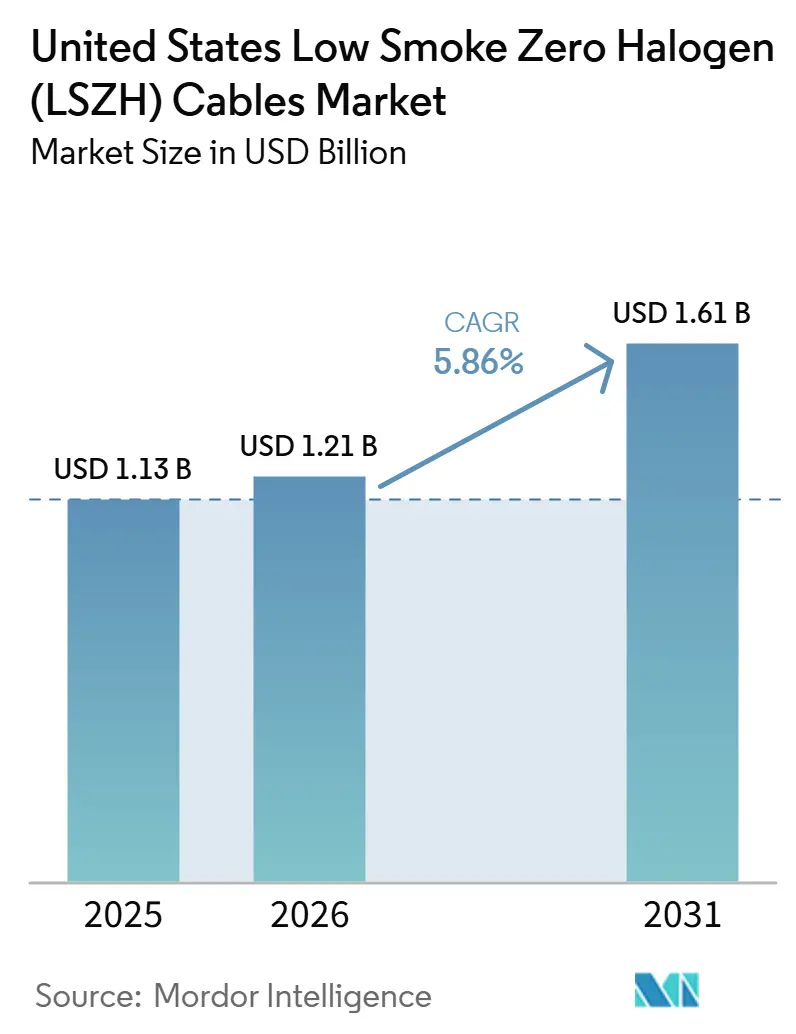
| Base Year Market Size (2025) | USD 1.13 Billion |
| Market Size (2026) | USD 1.21 Billion |
| Market Size (2031) | USD 1.61 Billion |
| Growth Rate (2026 - 2031) | 5.86 % |
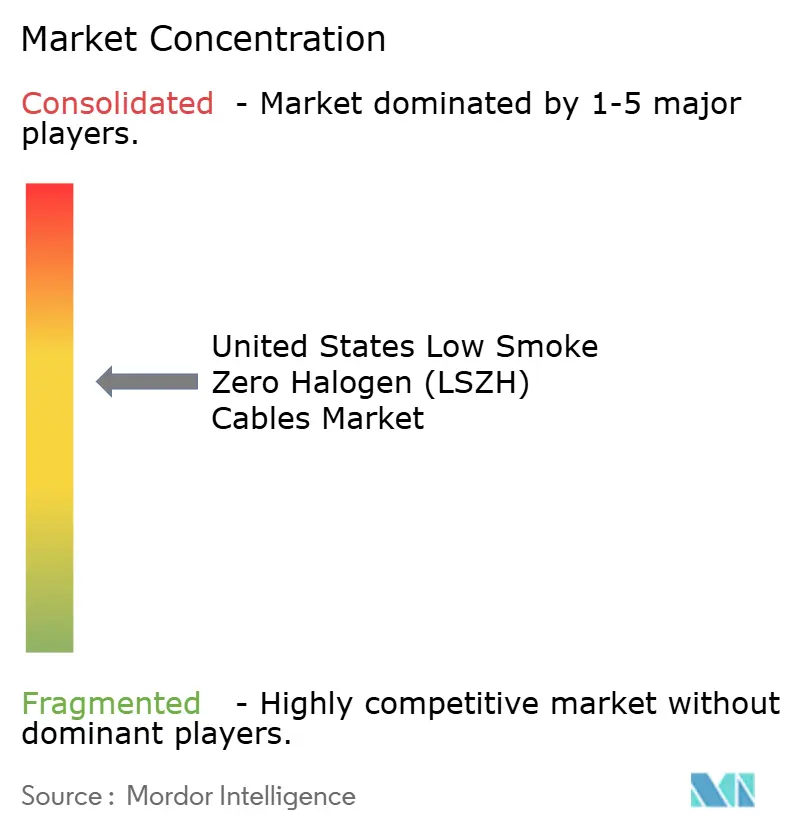
| Market Concentration | Medium |
Major Players *Disclaimer: Major Players sorted in no particular order Image © Mordor Intelligence. Reuse requires attribution under CC BY 4.0. | |
United States Low Smoke Zero Halogen (LSZH) Cables Market Analysis by Mordor Intelligence
The United States Low Smoke Zero Halogen (LSZH) cables market size was valued at USD 1.13 billion in 2025 and estimated to grow from USD 1.21 billion in 2026 to reach USD 1.61 billion by 2031, at a CAGR of 5.86% during the forecast period (2026-2031). The United States LSZH cable market is expanding as fire safety compliance is being incorporated earlier in project design, especially in enclosed buildings, transit systems, tunnels, and other critical infrastructure. AI-led data center construction is raising cable density and thermal performance requirements, thereby boosting demand for low-smoke, halogen-free designs across structured cabling, power distribution, and control systems. Record battery storage and solar additions are also expanding the use of LSZH products in inverter rooms, control buildings, substations, and egress pathways, where lithium-ion fire risk is changing cable selection. Manufacturers are responding through domestic capacity expansion, broader distribution reach, and stronger certification readiness, which makes delivery speed and specification support more important in winning orders. At the same time, compound cost volatility and revised fire-resistive testing rules are keeping pricing pressure high, which may slow adoption in retrofit projects that still compare LSZH directly with standard PVC cables.
Key Report Takeaways
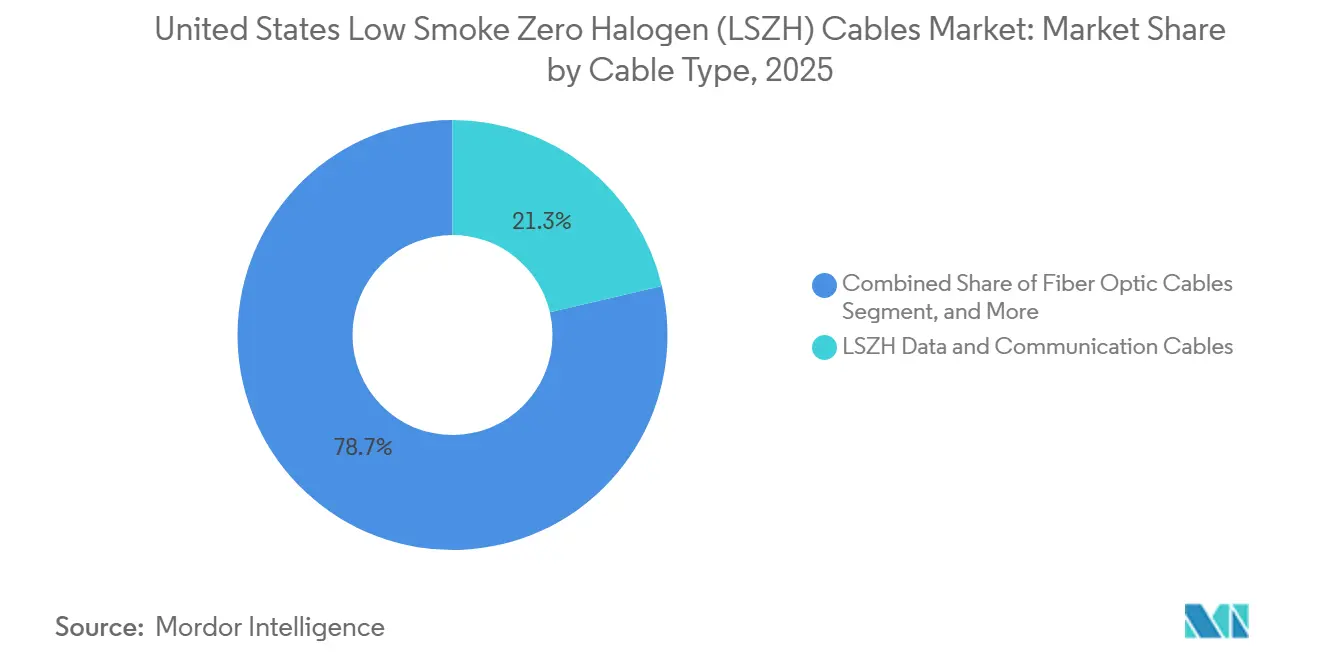
- By cable type, LSZH Data and Communication Cables held 21.34% of the United States Low Smoke Zero Halogen (LSZH) cables market share in 2025, while Fiber Optic Cables are projected to expand at a 6.45% CAGR through 2031.
- By voltage rating, the less than 1 kV segment accounted for a 32.45% share of the United States LSZH cables market size in 2025, while the 1-35 kV band is projected to grow at a 5.92% CAGR through 2031.
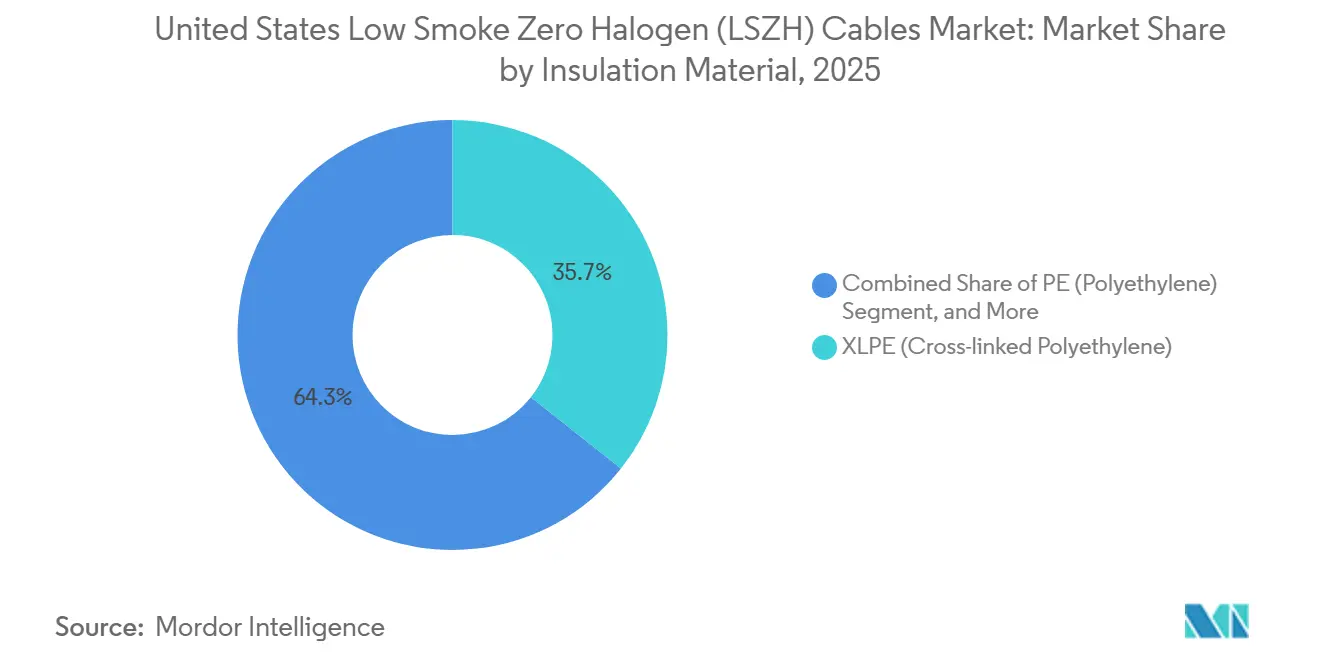
- By insulation material, XLPE held a 35.67% share of the United States Low Smoke Zero Halogen (LSZH) cables market size in 2025, while PE is projected to expand at a 6.13% CAGR through 2031.
- By end user, Data Centers accounted for a 31.89% share of the US LSZH cables market size in 2025, while Renewable Energy is projected to grow at a 5.73% CAGR through 2031.
Note: Market size and forecast figures in this report are generated using Mordor Intelligence’s proprietary estimation framework, updated with the latest available data and insights as of January 2026.
United States Low Smoke Zero Halogen (LSZH) Cables Market Trends and Insights
Drivers Impact Analysis*
| DRIVER | (~) % IMPACT ON CAGR FORECAST | GEOGRAPHIC RELEVANCE | IMPACT TIMELINE |
|---|---|---|---|
| Increasing Stringent Fire Safety and Building Code Compliance | +1.4% | National, with concentrated compliance activity in dense urban markets such as New York, Chicago, Los Angeles, and San Francisco | Short term (≤ 2 years) |
| Growing Investments in Hyperscale Data Centers | +1.2% | National, with concentrated demand in Northern Virginia, Texas, Arizona, and Georgia data center corridors | Short term (≤ 2 years) |
| Rising Adoption in Transportation and Critical Infrastructure | +0.9% | National, with early-mover activity in Northeast urban transit systems and highway tunnel projects in California and New York | Medium term (2-4 years) |
| Expansion of Renewable Energy and Battery Storage Projects | +0.8% | Texas, California, and Arizona, representing 80% of the planned 2026 battery storage capacity per the U.S. EIA | Medium term (2-4 years) |
| Increasing Demand for Environmentally Sustainable Cable Materials | +0.6% | National, led by LEED-certified commercial construction clusters in major metro areas | Medium term (2-4 years) |
| Growing Industrial Automation and Smart Manufacturing Deployments | +0.5% | Midwest and Southeast manufacturing corridors, with expanding activity in reshoring-driven semiconductor and EV battery plant construction | Long term (≥ 4 years) |
| Source: Mordor Intelligence | |||
Increasing Stringent Fire Safety and Building Code Compliance Drive Adoption
Fire safety rules remain the strongest demand trigger in the United States Low Smoke Zero Halogen (LSZH) cables market, as they shift cable choice from buyer preference to a design requirement. NFPA 70, NFPA 130, and NFPA 502 shape cable selection across enclosed buildings, transit systems, tunnels, and other critical sites where smoke release and circuit integrity matter during a fire.[1]National Fire Protection Association, “NFPA 130 Standard For Fixed Guideway Transit And Passenger Rail Systems,” NFPA, nfpa.org NFPA 130 is especially important because transit authorities use it across underground stations, passenger tunnels, and rail vehicles, thereby extending LSZH specifications across broad project scopes. The June 2025 third edition of ANSI/UL 2196 added revised binational testing criteria, so existing product lines now face requalification before they can continue serving fire-resistive applications. The 2025 IEEE guide translated these code requirements into practical cable-selection guidance for traction power, signaling, and communication systems, leaving procurement teams less room to deviate from compliant designs.[2]IEEE, “IEEE Guide For Selection And Application Of Cables Used In Enclosed Transit Infrastructure,” IEEE Standards Association, doi.org This pattern indicates that the USA Low Smoke Zero Halogen cables market is seeing demand that is fixed early and then carried through multi-year infrastructure programs.
Growing Investments in Hyperscale Data Centers Fuel Demand for Low-Smoke Cabling
The United States Low Smoke Zero Halogen (LSZH) cables market is seeing a higher demand ceiling as AI-led data center investment is increasing cable volume and simultaneously driving higher thermal performance needs. Meta stated in July 2026 that it was expanding its Richland Parish, Louisiana campus to 5 GW of AI compute capacity and nearly 10 million square feet, with more than USD 50 billion committed to the project.[3]Meta Platforms, “Deepening Our Investment In Richland Parish, Louisiana,” Meta Data Centers, datacenters.atmeta.com Projects of that scale increase the amount of LSZH cabling required in power distribution, structured cabling, network rooms, and other enclosed operating areas where smoke control is required. Prysmian’s July 2025 move to industrialize hollow-core optical fiber at scale shows that suppliers are aligning product road maps with faster, denser, and lower-latency data center networks.[4]Prysmian Group, “Investment Follows Prysmian's Agreement Announced Last March To Industrialize Hollow-Core Optical Fiber At Scale,” Prysmian Group, uk.prysmian.com AFL’s DENALI modular optical fiber platform, launched in July 2025 for high-growth GPU environments, shows how data center cable specifications are shifting beyond standard enterprise designs. As a result, the United States LSZH cables market is benefiting not only from more facilities, but also from a higher cable intensity per facility.
Rising Adoption in Transportation and Critical Infrastructure Expands the LSZH Install Base
Transportation infrastructure is becoming a more stable pull-through channel for the United States' Low Smoke Zero Halogen (LSZH) cables market, as federal transit investments require strict safety specifications for enclosed rail environments. NFPA 130 requires cables used in fixed guideway transit systems to meet defined performance levels for flame propagation, smoke release, and circuit integrity. The 2025 IEEE guide is expected to provide transit authorities and engineering teams with a clearer framework for applying these requirements across traction power, signaling, and communication cable categories. NFPA 502 extends comparable fire safety expectations to road tunnels, bridges, and limited-access highway infrastructure, where lighting, SCADA, and communication circuits must remain operational during fire exposure. This trend is significant because aging transit corridors in the Northeast are entering renovation cycles, creating a longer specification pipeline for compliant LSZH products. As a result, the United States LLow Smoke Zero Halogen cables market is seeing a more programmatic demand pattern, supporting larger, more predictable order flows.
Expansion of Renewable Energy and Battery Storage Projects Accelerates LSZH Cable Demand
Renewable energy and battery storage are expanding the application base of the United States LSZH cables market, as new projects require a large amount of enclosed electrical infrastructure. The U.S. Energy Information Administration reported that 43.4 GW of utility-scale solar and 24 GW of battery storage were planned for 2026, the largest single-year addition in more than 2 decades.[5]U.S. Energy Information Administration, “New U.S. Electric Generating Capacity Expected To Reach A Record In 2026,” Today in Energy, eia.gov Texas, California, and Arizona accounted for 80% of the planned 2026 battery storage capacity, which concentrates cable demand in a few high-build states. The American Clean Power Association and Wood Mackenzie reported a record 3.3 GW and 8.4 GWh of battery storage installations in Q1 2026 alone, and they projected cumulative capacity to reach 200 GW and 655 GWh by 2031. Battery enclosures, inverter buildings, and interconnection substations all require LSZH cabling for control and communication systems because lithium-ion environments prioritize smoke behavior and fire-safe operation. This is why the United States Low Smoke Zero Halogen (LSZH) cables market is seeing stronger demand for medium- and low-voltage cables from a customer base that now extends well beyond conventional building projects.
Restraints Impact Analysis*
| RESTRAINT | (~) % IMPACT ON CAGR FORECAST | GEOGRAPHIC RELEVANCE | IMPACT TIMELINE |
|---|---|---|---|
| Volatility in Halogen-Free Compound Prices | -0.6% | Global supply chain impact with concentrated price pressure in North America, where ATH and MDH compounders are exposed to Chinese antimony export controls | Short term (≤ 2 years) |
| Premium Pricing Compared to PVC-Based Cables | -0.4% | National, with the highest resistance in cost-sensitive residential construction and light commercial retrofit markets outside major metro code-enforcement zones | Medium term (2-4 years) |
| Limited Awareness in Cost-Sensitive End-User Segments | -0.2% | Rural and secondary markets, particularly in industrial manufacturing and small-scale commercial construction outside LSZH code-mandate zones | Long term (≥ 4 years) |
| Complex Qualification and Certification Requirements | -0.1% | National, with a disproportionate compliance burden on smaller specialty manufacturers seeking UL and NFPA product listings | Medium term (2-4 years) |
| Source: Mordor Intelligence | |||
Halogen-Free Compound Price Volatility Challenges Manufacturer Margins
Input cost volatility remains the most immediate challenge in the United States Low Smoke Zero Halogen (LSZH) cables market, as the upstream supply chain remains concentrated and difficult to hedge. Clariant cited Fastmarkets data indicating that antimony trioxide could reach USD 51,500 per ton in early 2025, following the sharpest rally since the early 1980s, driven by Chinese export controls and production suspensions in Hunan province. Although antimony is more directly linked to brominated systems, price pressure spreads across the broader flame-retardant supply chain and affects the economics of LSZH jacket formulations. Raw materials can account for 60-80% of HFFR compound production costs, which means short-term price swings quickly affect finished cable pricing and compress manufacturer margins. Clariant also stated that its Exolit OP platform could deliver a 10-15% lower cost than conventional bromine-antimony systems when antimony prices peak in 2025. This highlights how formulation strategy is becoming a competitive lever. Suppliers with stronger compound sourcing, better formulation control, or broader vertical integration are better positioned to protect their position in the United States LSZH cables market.
Premium Pricing Creates Adoption Friction in Cost-Sensitive Applications
Premium pricing continues to limit broader adoption in the United States Low Smoke Zero Halogen (LSZH) cables market, as many buyers outside code-mandated applications still prioritize upfront cost over lifecycle risk. Halogen-free phosphate ester and mineral-based compound formulations cost 30-40% more than conventional PVC compounds, and this gap significantly influences contractor and distributor decisions. Resistance remains strongest in residential construction, light commercial renovation, and smaller industrial projects, where LSZH cables are not always mandated, and bid competitiveness often drives product selection. The price gap becomes harder to absorb when buyers must also meet additional documentation, testing, and qualification requirements for compliant LSZH products. The economic case is often stronger for insurers and large facility operators than for smaller owners, as projects do not always quantify the benefits of lower smoke toxicity and liability protection. Until code adoption expands or insurance-led specification changes gain wider traction, this pricing friction is likely to keep some voluntary demand below the full structural potential of the United States Low Smoke Zero Halogen cables market.
*Our forecasts treat driver/restraint impacts as directional, not additive. The impact forecasts reflect baseline growth, mix effects, and variable interactions.
Segment Analysis
By Cable Type: Data And Communication Cables Anchor Share, Fiber Optics Drive Growth
Low Smoke Zero Halogen data and communication cables are expected to hold the largest share by cable type, accounting for 21.34% of the United States Low Smoke Zero Halogen (LSZH) cables market in 2025. This leadership reflects the high concentration of structured cabling across co-location data centers, hyperscale campuses, enterprise sites, and telecommunications central offices. These facilities rely on dense cable networks and often treat low-smoke, halogen-free performance as a baseline requirement rather than an optional specification. Power cables and control and instrumentation cables support industrial plants, utilities, and energy infrastructure, where insurers and EPC contractors are expanding the use of LSZH designs beyond limited code-mandated areas. Building wires and specialty LSZH cables also play important roles in commercial retrofits, transit systems, tunnels, and circuit-integrity applications that require compliance with more demanding fire-resistive standards.
Fiber-optic cables are projected to record the fastest growth among cable types, with a CAGR of 6.45% from 2026 to 2031. This shift is linked to AI-driven interconnect density and the transition from copper to fiber in data-intensive applications, reshaping the product mix in the US LSZH cables market. Prysmian’s July 2025 investment in hollow-core optical fiber indicates that suppliers are preparing for higher bandwidth requirements in enclosed facilities that also require compliant jacketing systems. AFL’s DENALI platform, designed for GPU-heavy environments and speeds ranging from 10 Gb/s to 800 Gb/s, reflects the same shift in performance expectations. Compliance with UL 1666 and UL 1685 remains important in riser applications. As a result, certification readiness continues to influence purchasing decisions as strongly as throughput and latency.



By Voltage Rating: Low-Voltage Dominance Reflects Building and Data Center Mix
The segment below 1 kV is expected to account for 32.45% of the United States LSZH cable market in 2025. Its leadership aligns with the current demand mix across commercial building wire, data center structured cabling, and control circuit applications, where low-voltage LSZH products are already a common specification. This segment of the United States Low Smoke Zero Halogen (LSZH) cables market industry benefits from recurring replacement, service upgrades, and tenant improvement work, as cable choices made during the initial design phase typically remain in place throughout the building cycle. The 36-65 kV and above 65 kV segments remain narrower because they primarily serve specialized utility and renewable interconnection applications. These higher-voltage categories also require more complex XLPE insulation systems, halogen-free outer jackets, and longer qualification cycles, which limit their near-term volume base.
The 1-35 kV band is projected to be the fastest-growing voltage segment, registering a CAGR of 5.92% through 2031. This growth is closely tied to utility-scale battery storage interconnections and medium-voltage distribution requirements within large renewable energy sites. The U.S. Energy Information Administration reported that 24 GW of battery storage is planned for 2026, with most of it concentrated in Texas, California, and Arizona, creating a strong pipeline for medium-voltage cables. This trend is also broadening the buyer base in the United States Low Smoke Zero Halogen cables industry, as independent power producers and storage developers are moving faster than many traditional utility procurement cycles. Their projects depend on enclosed substations, inverter rooms, and control buildings, strengthening the case for LSZH designs in medium-voltage systems.
By Insulation Material: XLPE Leads, Polyethylene Gains on Performance and Value
XLPE is expected to hold the largest share of the insulation material, in the United States Low Smoke Zero Halogen (LSZH) cables market, at 35.67% in 2025. Its leadership reflects strong dielectric strength, higher thermal endurance, and compatibility with medium-voltage cable architectures used in data center power distribution and large energy projects. PVC still appears in certain multilayer cable constructions where the inner insulation layer does not always need to meet halogen-free criteria. However, this distinction can create specification risks in code-sensitive environments. Other specialty insulation materials, including silicone, fluoropolymer, and mineral-based designs, remain relevant for harsher-duty conditions in transit, industrial automation, and adjacent defense-style applications. Southwire’s March 2025 launch of a silicone-based, fire-resistant, flexible cable shows how suppliers are differentiating by chemistry for tougher thermal conditions in transportation and renewable energy settings.
PE is projected to be the fastest-growing insulation material, registering a CAGR of 6.13% from 2026 to 2031. Its appeal stems from the development of halogen-free PE compounds, which offer lower material costs than XLPE in applications that do not require the highest electrical stress performance. Clariant’s June 2025 discussion of phosphorus-based Exolit OP additives shows why compound design is shifting toward lighter, recyclable, and halogen-free systems that still deliver fire performance. A Fraunhofer UMSICHT life-cycle assessment published in February 2024 also supported the environmental case for phosphinate-based flame retardants in electronics and e-mobility applications. This combination of cost, performance, and sustainability is helping PE gain a stronger position in the United States LSZH cables market, where the full performance envelope of XLPE is not essential.
By End User: Data Centers Anchor Demand While Renewables Shape the Forward Trajectory
Data centers are expected to hold the largest end-user share at 31.89% in 2025. This leadership reflects the very high cable intensity of hyperscale and co-location facilities, where power, control, and communication networks span several product categories within a single campus. AI-led expansion is strengthening this position, as denser compute environments generate more heat and require more structured interconnects, increasing the need for high-performance LSZH compounds. Commercial buildings remain an important secondary demand base, while healthcare, hospitality, and office projects continue to use LSZH cables in riser and enclosed installations where smoke control is critical. Telecommunications, transportation infrastructure, industrial manufacturing, and energy and utilities account for the remaining demand, providing the United States Low Smoke Zero Halogen (LSZH) cables market industry with a broad end-user base.
Renewable energy is projected to record the fastest end-user growth, registering a CAGR of 5.73% through 2031. The American Clean Power Association and Wood Mackenzie projected cumulative US battery storage capacity of 200 GW and 655 GWh by 2031, indicating a long, multi-year pipeline of enclosed electrical infrastructure. This buildout is important for the United States LSZH cables market because control rooms, inverter buildings, and substations require fire-safe cable systems. FANUC America’s March 2026 decision to invest USD 90 million in a new Michigan robot manufacturing facility also reflects the broader automation wave supporting cable demand in industrial settings. The Manufacturing Leadership Council’s June 2026 report, which finds more than USD 47 billion in industrial IoT investment over the prior three years, reinforces the same trend across factory-floor electrical and network infrastructure.
Geography Analysis
Geographic demand remains uneven, as specification intensity is strongest in dense urban areas where building codes, transit systems, and enclosed infrastructure create stricter fire-safety requirements. New York, Chicago, Los Angeles, and San Francisco remain important commercial centers, as municipal code enforcement and complex building stock support steady LSZH adoption in retrofit and new-build activity. The Northeast also remains important, as transit renovation cycles and tunnel-related infrastructure create a long specification pipeline for fire-safe cable systems. This urban compliance pattern gives the US LSZH cables market a stable demand base that is less sensitive to short procurement cycles than commodity cable categories.
The data center landscape is creating a second layer of geographic concentration in the US Low Smoke Zero Halogen cables market. Northern Virginia, Texas, Arizona, and Georgia remain the clearest data center corridors, driving demand for structured cabling, power distribution, and control systems across large multi-building campuses. Meta’s expansion in Richland Parish, Louisiana, adds another major node, and the scale of the project shows how a single campus can reshape local cable demand over several years. This corridor-driven demand favors suppliers that can deliver quickly to concentrated project clusters and support qualification requirements without delay.
Renewable energy and battery storage are shaping a third geographic layer for the United States LSZH cables market, with Texas, California, and Arizona carrying the largest near-term weight. The U.S. Energy Information Administration stated that these three states represented 80% of the planned 2026 battery storage capacity, giving them an outsized role in medium-voltage and low-voltage LSZH demand. These projects require cable systems in enclosed substations, inverter rooms, and control buildings, so growth depends on both capacity additions and facility design. The Midwest and Southeast are also gaining importance as reshoring, automation, and EV battery plant activity expand the manufacturing footprint that relies on compliant cabling. As a result, the United States Low Smoke Zero Halogen (LSZH) cables market is no longer centered only on commercial buildings, as state-level growth now comes from a mix of data infrastructure, energy storage, transport renewal, and advanced manufacturing.
Competitive Landscape
The United States Low Smoke Zero Halogen (LSZH) cables market is semi-consolidated, with a small group of vertically integrated manufacturers controlling much of the specified volume. A broader tier of regional specialists and distribution-led suppliers remains active, keeping competition open across several product categories and customer groups. This balance means scale matters, but service speed, certification readiness, and product breadth still influence share movement. Leading players are focusing on capacity, supply chain reach, and application-specific offerings rather than competing solely on price. This approach aligns with a market where compliance-heavy end uses reward availability and qualification support as much as base manufacturing scale.
Prysmian is expected to strengthen its position through the April 2026 opening of a 340,800-square-foot copper building wire plant and the expansion of its McKinney, Texas, service center to 1 million square feet. This move is expected to improve delivery capability for data center and infrastructure customers and reinforce the value of domestic fulfillment in the United States LSZH cables market. Nexans is also expected to expand its North American footprint in June 2026 through the acquisition of Republic Wire, adding a Cincinnati-based manufacturer with distribution through 18 sales agencies. Belden is also expected to expand its product line in June 2026 with rugged IT and OT network products for transportation, energy, and manufacturing environments.
Smaller regional suppliers serving cost-sensitive retrofit work face increasing pressure, as LSZH still carries a premium over PVC, and compliance documentation adds time and expense. At the same time, specialty compound developers are helping contract manufacturers improve recyclability and formulation performance, giving buyers more reason to compare technical fit rather than commodity price alone. This dynamic leaves the US LSZH cables market in a position where scale leaders hold advantages, while application know-how and certification depth continue to create room for focused challengers.
United States Low Smoke Zero Halogen (LSZH) Cables Industry Leaders
Prysmian Group
Nexans
Southwire Company LLC
TE Connectivity Ltd.
Belden Inc.
- *Disclaimer: Major Players sorted in no particular order

Recent Industry Developments
- July 2026: Meta announced an expansion of its Richland Parish, Louisiana data center campus to 5 GW of AI compute capacity, committing more than USD 50 billion in total investment to the project, up from an original USD 10 billion commitment in 2024, making it the largest in Meta's global fleet and one of the most significant AI infrastructure investments in US history. The scale of the campus, covering nearly 10 million square feet, signals sustained multi-year demand for high-density, fire-rated data center cabling.
- June 2026: Nexans completed the acquisition of 100% of the share capital of Republic Wire, Inc., a Cincinnati, Ohio-based manufacturer of low-voltage copper and aluminum wire products distributed through a national network of 18 sales agencies. The deal positions Republic Wire within Nexans' PWR-Connect business and supports the group's continued expansion in North American commercial and industrial cable channels.
- June 2026: Belden Inc. launched the PPC DiamonDrop single-fiber drop cable for FTTX last-mile and rural broadband applications, featuring an innovative core design that simplifies field termination and reduces fiber damage risk during cable preparation, targeting telecom providers and rural broadband infrastructure projects.
- June 2026: Belden Inc. introduced a range of new rugged IT/OT network products, including the FiberExpress XHD Fiber Angled Patch Panel, Hirschmann GREYHOUND GRS2000 L2/L3 switches, and updates to macmon NAC software, designed to help transportation, energy, and manufacturing operators build secure, edge-to-core connectivity networks in harsh environments.


United States Low Smoke Zero Halogen (LSZH) Cables Market Report Scope
The United States Low Smoke Zero Halogen (LSZH) Cables Market Report is Segmented by Cable Type (Power, Control and Instrumentation, Data and Communication, Fiber Optic, Building Wires, and Specialty), Voltage Rating (Less Than 1 kV, 1-35 kV, 36-65 kV, and Greater Than 65 kV), Insulation Material (PVC, XLPE, PE, and Other Insulation Materials), and End User (Commercial Buildings, Industrial Manufacturing, Data Centers, Energy and Utilities, Transportation Infrastructure, Telecommunications, Renewable Energy, and Others End User Industries). The Market Forecasts are Provided in Terms of Value (USD).
| LSZH Power Cables |
| LSZH Control and Instrumentation Cables |
| LSZH Data and Communication Cables |
| LSZH Fiber Optic Cables |
| LSZH Building Wires |
| Specialty LSZH Cables |
| Less Than 1 kV |
| 1 - 35 kV |
| 36 - 65 kV |
| above 65KV |
| PVC (Polyvinyl Chloride) |
| XLPE (Cross-linked Polyethylene) |
| PE (Polyethylene) |
| Other Insulation Materials |
| Commercial Buildings |
| Industrial Manufacturing |
| Data Centers |
| Energy and Utilities |
| Transportation Infrastructure |
| Telecommunications |
| Renewable Energy |
| Others End User Industries |
| By Cable Type | LSZH Power Cables |
| LSZH Control and Instrumentation Cables | |
| LSZH Data and Communication Cables | |
| LSZH Fiber Optic Cables | |
| LSZH Building Wires | |
| Specialty LSZH Cables | |
| By Voltage Rating | Less Than 1 kV |
| 1 - 35 kV | |
| 36 - 65 kV | |
| above 65KV | |
| By Insulation Material | PVC (Polyvinyl Chloride) |
| XLPE (Cross-linked Polyethylene) | |
| PE (Polyethylene) | |
| Other Insulation Materials | |
| By End User | Commercial Buildings |
| Industrial Manufacturing | |
| Data Centers | |
| Energy and Utilities | |
| Transportation Infrastructure | |
| Telecommunications | |
| Renewable Energy | |
| Others End User Industries |


Key Questions Answered in the Report
What is the current size of the United States Low Smoke Zero Halogen (LSZH) Cables Market?
The United States Low Smoke Zero Halogen (LSZH) cables market was valued at USD 1.13 billion in 2025 and reached USD 1.21 billion in 2026. It is forecast to reach USD 1.61 billion by 2031 at a 5.86% CAGR.
Which cable type leads demand in the United States LSZH cables market space?
LSZH Data and Communication Cables led with a 21.34% share in 2025, supported by dense cabling needs across hyperscale, co-location, and telecom environments.
What is driving growth in low-smoke, zero-halogen cables across the United States?
The main growth drivers are stricter fire safety compliance, hyperscale data center expansion, and record battery storage and solar buildouts that require more enclosed electrical infrastructure.
Which voltage segment is expanding the fastest?
The 1-35 kV band is projected to grow at a 5.92% CAGR through 2031, driven by utility-scale battery storage interconnections and renewable energy distribution needs.
Which end-user group creates the largest demand base?
Data Centers held the largest end-user share at 31.89% in 2025, reflecting the high cable intensity of AI and hyperscale campuses.
What is the biggest constraint on broader adoption?
Premium pricing versus PVC and volatility in halogen-free compound costs remain the main limits, especially in retrofit and other cost-sensitive applications outside strict code-mandate zones.
Page last updated on:





