
United States Hydroponics Market Size and Share
Market Overview
| Study Period | 2021 - 2031 |
|---|---|
| Forecast Data Period | 2026 - 2031 |
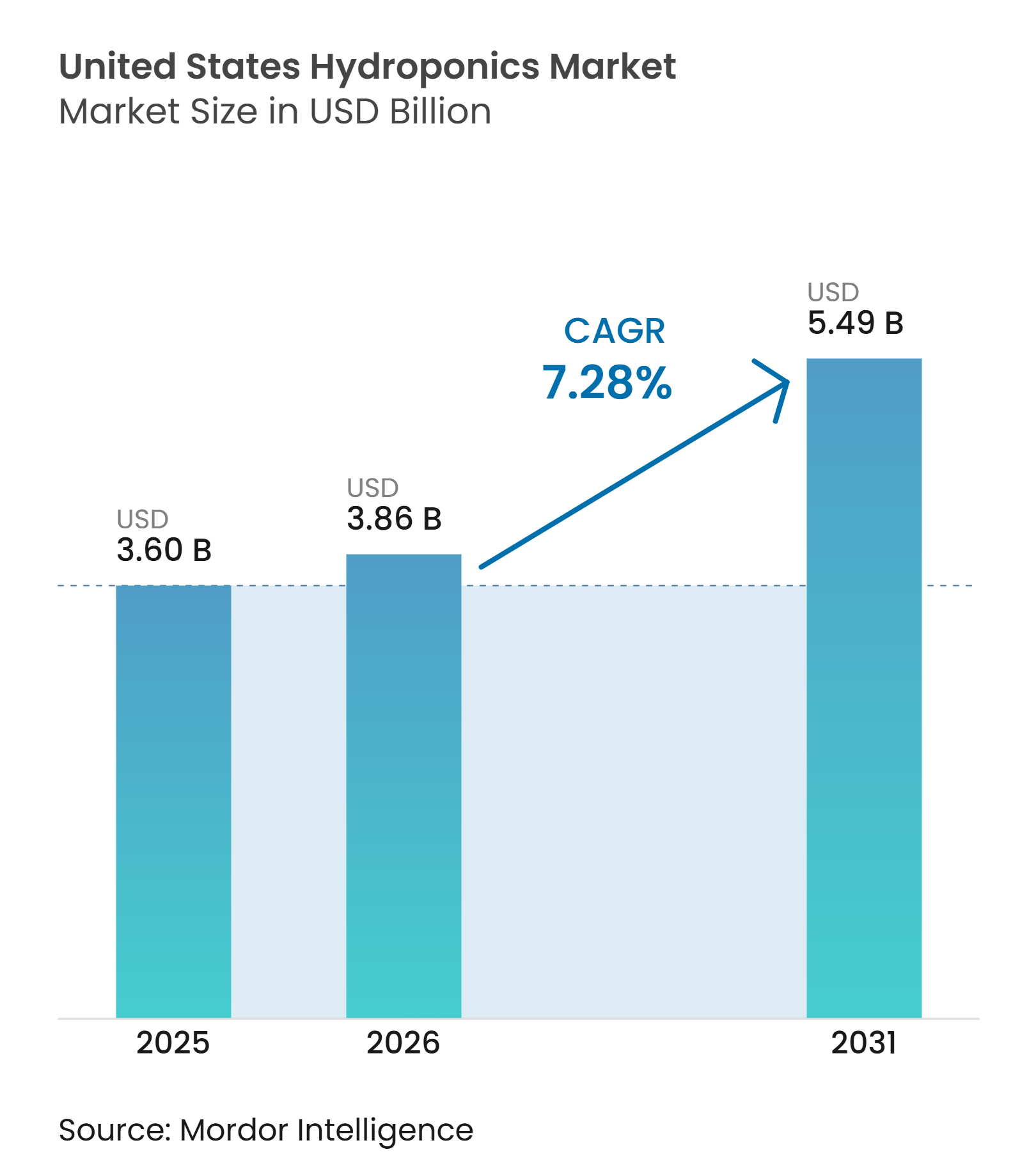
| Base Year Market Size (2025) | USD 3.60 Billion |
| Market Size (2026) | USD 3.86 Billion |
| Market Size (2031) | USD 5.49 Billion |
| Growth Rate (2026 - 2031) | 7.28 % |
| Market Concentration | Low |
Major Players *Disclaimer: Major Players sorted in no particular order Image © Mordor Intelligence. Reuse requires attribution under CC BY 4.0. | |
United States Hydroponics Market Analysis by Mordor Intelligence
The United States Hydroponics Market was valued at USD 3.60 billion in 2025, which is estimated to be USD 3.86 billion in 2026, and is projected to grow to USD 5.49 billion by 2031, registering a CAGR of 7.28% between 2026 and 2031. Demand for fresh, pesticide-free, locally grown produce is supporting investment across the United States hydroponics market, particularly where retailers require a dependable year-round supply. Controlled-environment agriculture can produce yields 10 to 100 times higher per unit area than open-field farming, making nearby production more relevant for urban retail supply chains, according to the USDA Economic Research Service. Food safety concerns in 2026 have also increased retailer interest in traceable greenhouse produce, while water availability, energy costs, and access to capital determine which facilities can expand. Operators with long-term retail contracts and disciplined investment plans are better positioned to add capacity, while weaker operators face greater financing pressure. The United States hydroponics market remains fragmented, meaning production scale and technical capability do not automatically translate into pricing power.
Key Report Takeaways
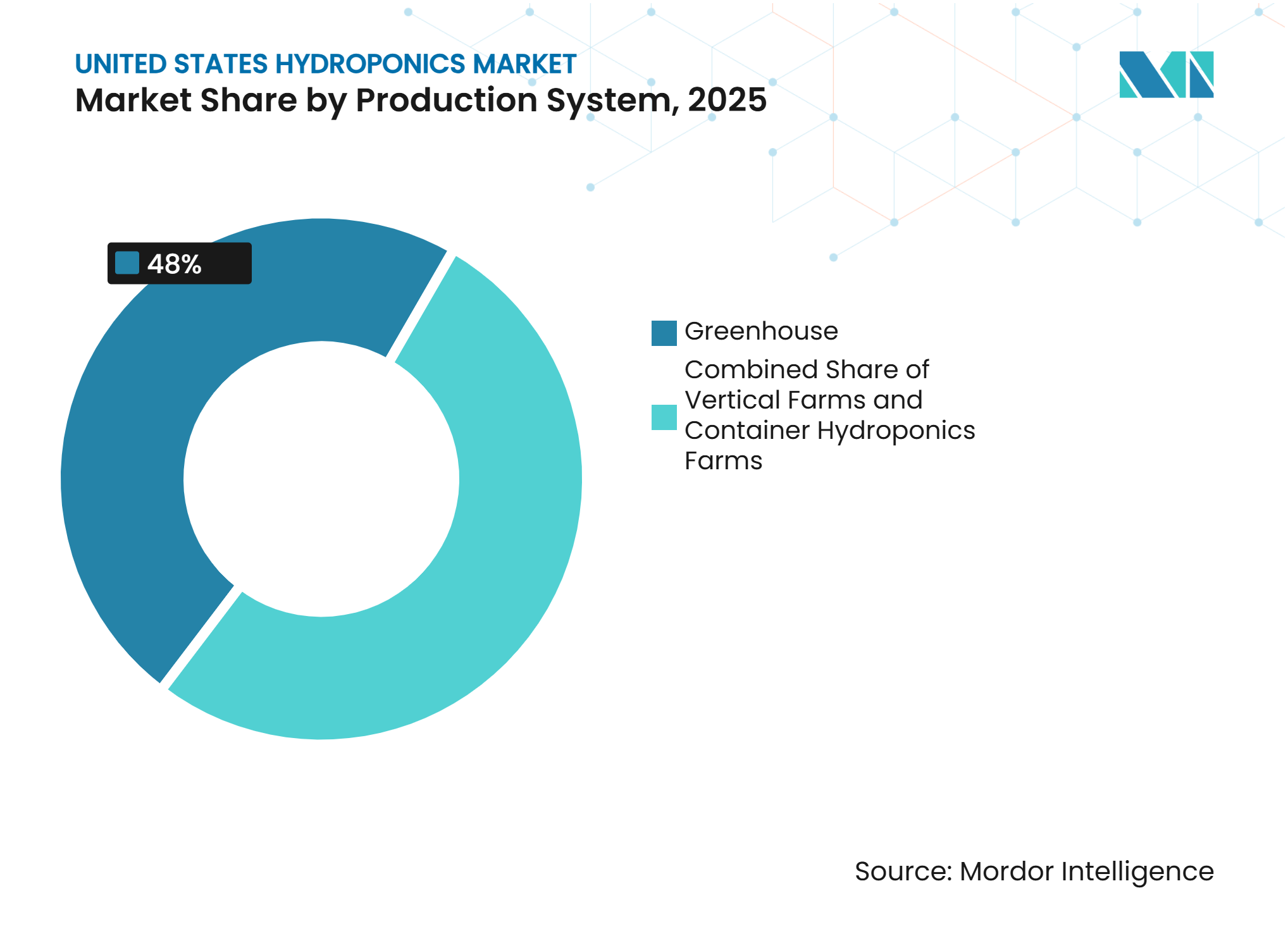
- By production system, greenhouse hydroponics held 48% of the United States hydroponics market share in 2025, while vertical hydroponic farms are projected to be the fastest growing at a 13% CAGR through 2031.
- By crop type, leafy greens accounted for 38% of the United States hydroponics market size in 2025, while herbs and microgreens are forecast to be the fastest-growing segment at an 11.5% CAGR through 2031.
- By equipment, climate systems represented 25% of sales in 2025, while automation and control systems are forecast to grow fastest at a 12% CAGR through 2031.
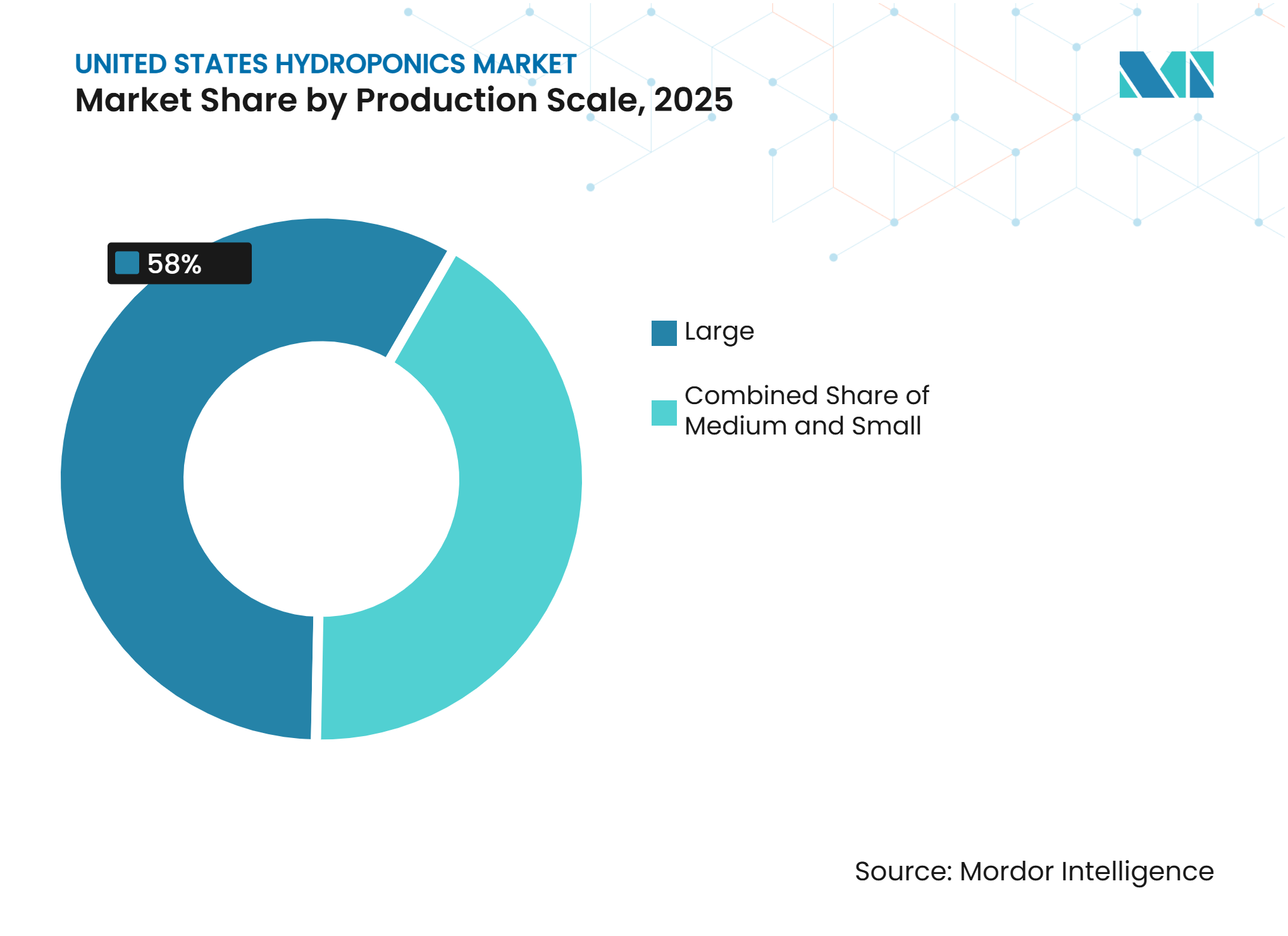
- By production scale, large held 58% of revenue in 2025, while medium is forecast to be the fastest growing at a 9.5% CAGR through 2031.
Note: Market size and forecast figures in this report are generated using Mordor Intelligence’s proprietary estimation framework, updated with the latest available data and insights as of January 2026.
Market Trends and Insights
Drivers Impact Analysis of United States Hydroponics Market*
| Driver | (~) % Impact on CAGR Forecast | Geographic Relevance | Impact Timeline |
|---|---|---|---|
| Demand for locally produced hydroponic produce | 1.80% | National, with strong demand in Northeast metropolitan areas and rapidly growing Southern cities | Short term (≤ 2 years) |
| Water-use efficiency as a competitive advantage | 1.20% | National, with high relevance in the water-stressed West and drought-affected South | Long term (≥ 4 years) |
| Higher crop yield per unit of land | 1.00% | National, especially in land-constrained Northeast and Midwest peri-urban areas | Medium term (2–4 years) |
| Year-round hydroponic production | 0.90% | National, with particular relevance in the Midwest and Northeast | Medium term (2–4 years) |
| Automation and precision nutrient management | 0.80% | National, with early uptake at large Midwest and Southern facilities | Long term (≥ 4 years) |
| Retail and foodservice procurement contracts | 0.90% | National, with new contract activity near Southern and Midwestern distribution centers | Short term (≤ 2 years) |
| Source: Mordor Intelligence | |||
Demand for Locally Produced Hydroponic Produce
Retailers and foodservice buyers are shifting part of their leafy green and herb purchasing toward domestic controlled-environment growers. The 2026 Cyclospora outbreak in field-grown lettuce increased focus on traceability, water sourcing, and facility controls. Little Leaf Farms began commissioning its Tennessee greenhouse ahead of its planned fall 2026 opening in response to increased demand from retailers. The company supplies more than 8,000 retail locations and reports holding more than 50% of the indoor leafy green category. A nearby greenhouse can deliver produce to stores within 300 miles within 24 hours of harvest, a model that can reduce spoilage and support retailers' reporting on sourcing and waste. USDA research reported that the controlled-environment agriculture growing area in the United States increased by 18% between 2022 and 2025[1].
Water-Use Efficiency as a Competitive Advantage
Water efficiency gives hydroponic production a practical advantage in regions where groundwater supplies are under pressure. Recirculating hydroponic systems can use 90% less water than conventional field farming. A 2025 life cycle assessment found that controlled hydroponic systems had lower water footprints than open-field alternatives when recirculation systems were properly maintained. This benefit extends beyond farm operating costs in the United States hydroponics market. Municipalities in water-stressed areas may view closed-loop systems more favorably during permitting and zoning reviews. USDA data show that pressurized irrigation covered 74% of irrigated cropland in the western United States in 2023[2]. Hydroponic systems can limit losses that even efficient field irrigation cannot fully avoid.
Higher Crop Yield per Unit of Land
Higher output per unit of land improves the economics of facilities located near large population centers. USDA research indicates that some vertical farms report output per acre 390 times greater than that of open-field farming for comparable crops. The same research indicates that more realistic commercial comparisons for leafy greens yield 10 to 30 times more per square foot. This productivity makes some urban and peri-urban sites viable that would otherwise not support conventional field production. It also supports shorter delivery distances for the United States hydroponics market. BrightFarms operates regional hubs in Illinois, Texas, and Georgia, each capable of producing 6 million pounds of lettuce annually. These facilities demonstrate how land productivity can be applied at a regional distribution scale. This model is most effective where both land prices and consumer access are high.
Year-Round Hydroponic Production
Year-round output helps growers meet retail demand during gaps in field production. Climate variability has reduced the reliability of traditional growing seasons in regions such as the Salinas Valley and Yuma, Arizona. Hydroponic facilities can maintain more stable output when outdoor weather conditions disrupt the field supply.AeroFarms operates its Danville, Virginia facility with 100% renewable energy and uses it as a year-round production platform. Public programs, including the USDA Specialty Crop Block Grant Program, can support smaller operators expanding year-round capacity. This is particularly relevant in the Midwest and Northeast, where field production interruptions are more pronounced. Local Bounti extended supply agreements with national accounts through the first quarter of 2027, demonstrating that predictable production schedules support longer retail commitments.
Restraints Impact Analysis of United States Hydroponics Market*
| Restraint | (~) % Impact on CAGR Forecast | Geographic Relevance | Impact Timeline |
|---|---|---|---|
| High system installation costs | -1.50% | National, with highest exposure in the Northeast and West | Long term (≥ 4 years) |
| Electricity and operating cost pressure | -1.20% | National, especially the Northeast and California | Medium term (2–4 years) |
| Nutrient, ph, and water-quality management complexity | -0.70% | National, with higher exposure among mid-scale facilities without dedicated agronomy teams | Medium term (2–4 years) |
| Limited technical labor availability | -0.60% | National, particularly in Midwest and Southern markets | Short term (≤ 2 years) |
| Source: Mordor Intelligence | |||
High System Installation Costs
Commercial hydroponic facilities require significant upfront investment in structures, climate controls, lighting, irrigation, and nutrient systems. These costs restrict market entry and can delay capacity expansion in the United States hydroponics market. Pure Green Farms planned a USD 82 million expansion in South Bend, Indiana, which required city approval and a 9-year property tax abatement to support financial viability. Higher interest rates have also affected the projected returns of projects financed during the low-rate period from 2019 to 2022, as projects that were viable under earlier interest rates no longer meet lenders' return requirements. Lighting and climate equipment installations further increase the capital required before production begins. These financing challenges favor operators with established contracts, patient investors, and access to public support.
Electricity and Operating Cost Pressure
Electricity costs affect lighting, pumps, heating, cooling, and ventilation across hydroponic facilities. These costs are particularly challenging for fully enclosed vertical farms with high lighting requirements. Revol Greens closed its California facility in late 2025, citing high energy and labor costs as major concerns. Operators are responding by improving lighting controls and reducing production heat requirements. A Signify and Grodan trial found that full LED tomato cultivation could operate with 50% less heat input. Such improvements can reduce facility operating costs, but require upfront investment. State energy-efficiency requirements may encourage adoption in high-cost power markets. Cost pressure remains a key reason why greenhouse designs that use natural light continue to compete strongly with enclosed vertical production.
*Our forecasts treat driver/restraint impacts as directional, not additive. The impact forecasts reflect baseline growth, mix effects, and variable interactions.
United States Hydroponics Market Segment Analysis
By Production System:
Greenhouse Systems Hold the Largest Position While Vertical Farms Grow FasterGreenhouse accounted for 48% of the United States hydroponics market in 2025. Natural-light supplementation reduces electricity use relative to enclosed vertical farms and supports lower operating costs per unit of output. Existing greenhouse structures can also be expanded in stages, limiting the capital required for each additional production block. This makes the format suitable for high-volume leafy green supply programs. BrightFarms opened regional greenhouse hubs in Illinois, Texas, and Georgia within 6 months, and the company now serves more than 6,500 stores[3]. The United States hydroponics industry uses greenhouse facilities to align output with national retail delivery schedules. Container farms remain the smallest production system. Freight Farms filed for Chapter 7 bankruptcy in April 2025, and Growcer later acquired its assets, illustrating the difficulty of sustaining modular container production at a commercial scale.
Vertical farms are forecast to grow at a 13% CAGR through 2031. Their strongest use case is high-value specialty crops rather than broad volumes of commodity lettuce. AeroFarms uses aeroponic vertical production at its Danville facility and accounts for more than 70% of the United States retail microgreens category. The company reported that its Micro Broccoli contains up to 35 times more of selected nutrients per ounce than mature broccoli florets. This product distinction supports higher retail pricing. The United States hydroponics market offers vertical facilities a more viable path in specialized crops with clear consumer differentiation. Enclosed systems still face higher power and capital demands. Growers need to carefully match crop selection to operating costs and buyers' willingness to pay.



By Crop Type:
Leafy Greens Provide Volume While Herbs and Microgreens Support Premium GrowthLeafy greens accounted for 38% of the United States hydroponics market in 2025. Their position reflects steady retail demand, rapid shelf turnover, and compatibility with nutrient film technique and deep-water systems. Little Leaf Farms began commissioning a 20-acre greenhouse in Tennessee in August 2026 in response to demand from retailers and consumers. The company states that the facility is the world's highest-volume indoor leafy green facility. Tomatoes and cucumbers represent established mid-tier crop categories in the United States hydroponics market. Mastronardi Produce expanded its US greenhouse network to more than 600 acres, including facilities in Minnesota and Iowa that grow tomatoes and strawberries. Peppers remain a smaller category and are generally grown as a complementary greenhouse crop. Leafy greens are likely to retain their position as production methods are well understood and suited to recurring retail demand.
Herbs and microgreens are forecast to expand at an 11.5% CAGR through 2031. Edible Garden AG launched USDA Certified Organic Hydroponic Basil in July 2025, creating a premium offering in the herb category. Its cut-herb portfolio grew 45.9% year over year in the first quarter of 2026, supported by programs with Kroger, Weis Markets, and Target. Organic certification can help justify the additional compliance costs of hydroponic herb production. Specialty greens also allow growers to avoid direct price competition with mainstream lettuce. USDA research described significant growth in controlled-environment operations, with specialty greens and herbs contributing to new farm formation. These crops allow the United States hydroponics market to develop a more differentiated retail offering. Their growth depends on maintaining product quality and consistent supply at a premium price point.
By Equipment:
Climate Systems Lead Spending While Automation and Controls Grow FasterClimate systems accounted for 25% of equipment spending in 2025. Temperature and humidity management are essential across all commercial production formats. Greenhouses must coordinate heating, ventilation, cooling, and lighting while utilizing natural sunlight. This equipment is central to reliable crop production and facility energy planning. A trial by Signify and Grodan demonstrated that full-LED tomato cultivation was achievable with 50% less heat input. Structural components, irrigation systems, and pumps constitute the remaining core of the equipment base. Irrigation systems also generate replacement demand as earlier nutrient film technique and deep-water installations reach the end of their service life. Climate infrastructure will remain central to protecting crop quality and ensuring year-round production reliability.
Automation and control systems are forecast to grow at a 12% CAGR through 2031. Growers are adopting robotic transplanting, harvesting, monitoring, and lighting controls to manage labor costs and reduce variation. Philips GrowWise Smart Spectrum received the HortiContact Innovation Award 2026 for automatically adjusting light spectra based on current sunlight data. The 3-hectare Harvest Singularity greenhouse in Florida began construction in May 2026 and incorporated AmHydro nutrient film technique channels designed to work with robotic transplanting equipment. This project indicates that automation is becoming part of facility design rather than a subsequent upgrade. Signify expanded its Philips GreenPower LED Toplighting Force range with adjustable red, blue, white, and far-red channels. Improved equipment control can enhance crop steering and electricity management. The value of these systems depends on growers' ability to utilize the data generated and maintain the equipment effectively.
By Production Scale:
Large Facilities Lead Revenue While Medium-Scale Growers Add Capacity CarefullyLarge accounted for 58% of revenue in 2025. These facilities can spread fixed costs over higher production volumes and meet the supply requirements of national retail programs. Gotham Greens operates more than 40 acres across 9 states and reported 15% year-over-year growth in 2025 and 2026. Its product range includes leafy greens, herbs, salad kits, dressings, dips, and sauces. Larger facilities can leverage this product range and broad distribution to strengthen relationships with retailers. Small-scale facilities are numerous but hold a lower revenue share. They face higher per-unit overhead and more limited access to major purchasing programs. These operators find opportunities in local and specialty channels within the United States hydroponics market, but their margins remain under pressure.
Medium is forecast to grow at a 9.5% CAGR through 2031. This scale offers a balance of access to technology, manageable capital requirements, and the ability to serve regional buyers. Great Lakes Growers invested USD 5 million in an expansion in Burton, Ohio, that added 50,000 square feet of greenhouse space. The project also included infrastructure to support an additional 4 acres of capacity. The company partnered with GreenV at its Middlefield site to deploy automated leafy green systems and closed-loop water recirculation. According to the partnership, the system can recover up to 95% of water. These examples illustrate how medium-scale growers can adopt technology without building a large national network. Capacity additions tied to retail demand may offer a more sustainable expansion path than speculative large-scale builds.

Geography Analysis
The Northeast is the most established regional base in the United States hydroponics market. According to USDA National Agricultural Statistics Service figures from the USDA Census of Agriculture, Pennsylvania had 689 hydroponic enterprises, and New York had 601. The region has long-standing greenhouse clusters, specialized inputs, and dense foodservice distribution networks. In October 2025, Little Leaf Farms expanded its McAdoo, Pennsylvania, campus to 40 acres with a fourth greenhouse. Food safety, water, and building regulations can raise entry costs, but they also support the establishment of permitted facilities. Gotham Greens serves dense urban demand through its New York and Rhode Island operations. The region continues to favor growers that can manage high land and utility costs while meeting strict retailer standards.
The South has become the most active growth area due to lower power costs, available industrial land, and favorable greenhouse conditions. BrightFarms opened hubs in Texas and Georgia and expanded into more than 1,000 Kroger stores in Dallas in August 2026. It also entered Costco locations in the Atlanta area from its greenhouse in Macon. Local Bounti completed a 6-product rollout at more than 250 Harris Teeter stores in June 2026. Little Leaf Farms began commissioning its Tennessee facility ahead of schedule, further demonstrating the region's appeal to well-funded growers. In the South, the United States hydroponics market benefits from sites located near large consumption centers and distribution networks.
The Midwest is a mature secondary region with established foodservice demand and technical expertise. Great Lakes Growers supplies more than 300 restaurants across Ohio, Pennsylvania, New York, Michigan, and Indiana from its Ohio facilities. The West remains an important produce market but faces greater cost and financing challenges. Revol Greens closed its California facility in late 2025 and issued WARN notices in August 2026 for potential closures in Minnesota and Texas. Higher energy and labor costs can weaken the financial case for West Coast operations. These differences highlight why regional operating conditions matter as much as consumer demand. The United States hydroponics market is likely to see more capacity investment in regions where utility costs, land availability, and retail logistics support stable returns.
Competitive Landscape
Market Concentration
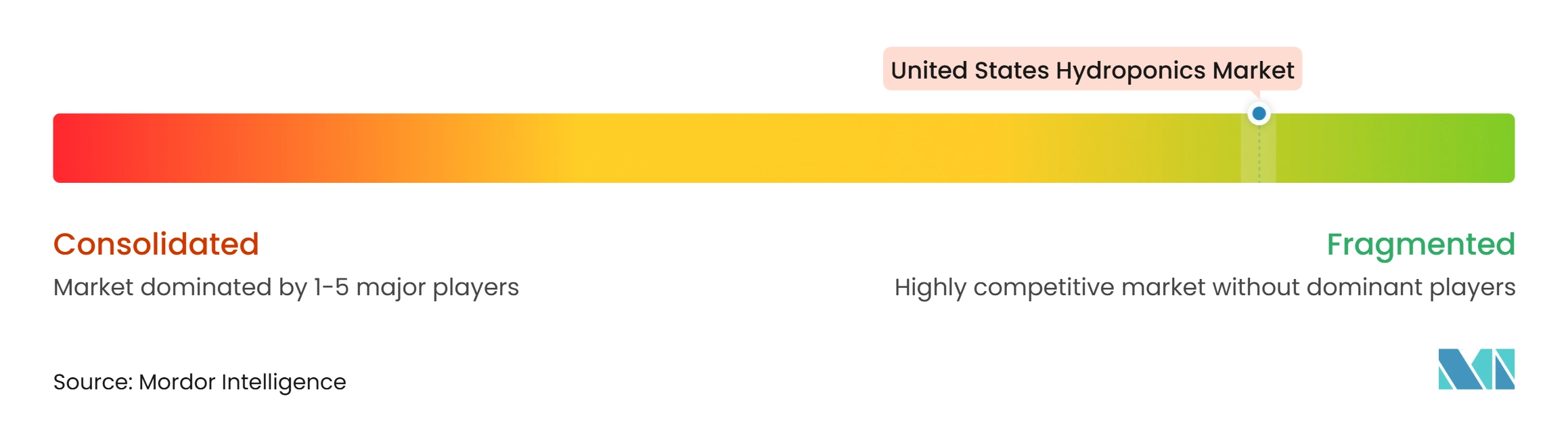
The United States hydroponics market is fragmented as of 2025. AeroFarms, AmHydro, BrightFarms, Freight Farms, and The Scotts Company LLC were identified as the leading players. Their roles differ across commercial cultivation, systems, lighting, nutrients, and regional supply. This range of business models limits direct overlap among many participants. The key competitive divide is between growers with secure national retail contracts and those without them. BrightFarms, Little Leaf Farms, and Gotham Greens continue to add capacity supported by established distribution relationships. Growers without a reliable offtake face a harder path to financing and expansion.
Technology is a major driver of competition across segments of the United States hydroponics market. Local Bounti received US Patent No. 12,557,741 in February 2026 for its Stack and Flow Technology, which uses computer vision and automated environmental controls. BrightFarms expanded distribution to more than 1,000 Kroger stores in Dallas during August 2026. Little Leaf Farms began commissioning its 20-acre greenhouse in Tennessee ahead of schedule that same month. These developments illustrate how intellectual property, regional production, and retail access can reinforce one another. Operators that add capacity without a clear route to sales face greater risk. Consolidation can also serve as a route to scale where companies have compatible crop portfolios and distribution networks.
ScottsMiracle-Gro completed the divestiture of The Hawthorne Gardening Company to Vireo Growth Inc. in April 2026. The transaction included General Hydroponics, Gavita, and Botanicare, changing ownership of equipment and nutrients. AmHydro's turnkey systems and its role in the Harvest Singularity project point to a gap between hobby systems and large commercial projects. Soli Organic merged with 80 Acres Farms in August 2025, creating a business with revenue approaching USD 200 million and a presence across 17,000 retail locations. This strategy uses a combined scale to reduce logistics duplication and broaden crop capabilities. Freight Farms, Soli Organic, Superior Fresh, and Village Farms no longer represent comparable independent hydroponic produce competitors due to bankruptcy, mergers, changes in business focus, or limited current produce relevance. The competitive landscape continues to shift as contracts, financing, and technical capabilities determine which businesses remain active.
United States Hydroponics Industry Leaders
-
AeroFarms
-
AmHydro
-
BrightFarms
-
Freight Farms
-
The Scotts Company LLC
- *Disclaimer: Major Players sorted in no particular order
United States Hydroponics Market Companies Covered in this Report
- AeroFarms
- AmHydro
- Freight Farms
- Green Sense Farms Holdings, Inc.
- LumiGrow
- BrightFarms
- Hydrodynamics International
- Signify Holding
- The Scotts Company LLC
- Mastronardi Produce Ltd.
- Village Farms International
- Gotham Greens
- Little Leaf Farms
- Local Bounti Corporation
- Edible Garden AG Incorporated
Recent Industry Developments in United States Hydroponics Market
- August 2026: BrightFarms expanded into more than 1,000 Kroger stores in Dallas, Texas, and added Costco locations in the Atlanta metropolitan area.
- April 2026: ScottsMiracle-Gro completed the divestiture of The Hawthorne Gardening Company, including the General Hydroponics, Gavita, and Botanicare brands, to Vireo Growth Inc.
- August 2025: Soli Organic merged with 80 Acres Farms to create a combined company with revenue approaching USD 200 million and service across more than 17,000 retail locations.
United States Hydroponics Market Report Scope
Hydroponics is the technique of growing plants using a water-based nutrient solution rather than soil. These production systems are used by small farmers, hobbyists, and commercial enterprises.
The United States Hydroponics Market is segmented by production system (Greenhouse, Vertical farms, and Container Hydroponic Farms), crop type (Leafy greens, Tomatoes, Cucumbers, Peppers, and Herbs and Microgreens), equipment (Lighting, Irrigation, Climate systems, Automation and control systems, and others, and production scale (Small, Medium, and Large). Market forecasts are in terms of value in USD.
Segmentation Overview
| Greenhouse |
| Vertical Farms |
| Container Hydroponic Farms |
| Leafy Greens |
| Tomatoes |
| Cucumbers |
| Peppers |
| Herbs and Microgreens |
| Lighting Systems |
| Irrigation Components and Pumps |
| Climate Systems |
| Automation and Control Systems |
| Others |
| Large |
| Medium |
| Small |
| By Production System | Greenhouse |
| Vertical Farms | |
| Container Hydroponic Farms | |
| By Crop Type | Leafy Greens |
| Tomatoes | |
| Cucumbers | |
| Peppers | |
| Herbs and Microgreens | |
| By Equipment | Lighting Systems |
| Irrigation Components and Pumps | |
| Climate Systems | |
| Automation and Control Systems | |
| Others | |
| By Production Scale | Large |
| Medium | |
| Small |
Key Questions Answered in the Report
What is the projected value of United States hydroponics market in 2031?
The market is forecast to reach USD 5.5 billion by 2031, growing at a 7.2% CAGR from 2026.
Which production system has the largest role in United States hydroponics?
Greenhouse led with 48% of revenue in 2025 because natural-light supplementation supports lower energy use and large retail supply programs.
Which crops are growing fastest in hydroponic production?
Herbs and microgreens are forecast to grow at an 11.5% CAGR through 2031, supported by premium products and organic certification opportunities.
Why are retailers buying more controlled-environment produce?
Retailers value traceability, consistent year-round supply, shorter delivery distances, and reduced exposure to field-production disruptions.
What is the largest operating challenge for hydroponic growers?
High installation costs and electricity expenses remain major barriers, particularly for facilities with intensive lighting and climate-control requirements.