
United States Grapes Harvesters Market Size and Share
Market Overview
| Study Period | 2021 - 2031 |
|---|---|
| Forecast Data Period | 2026 - 2031 |
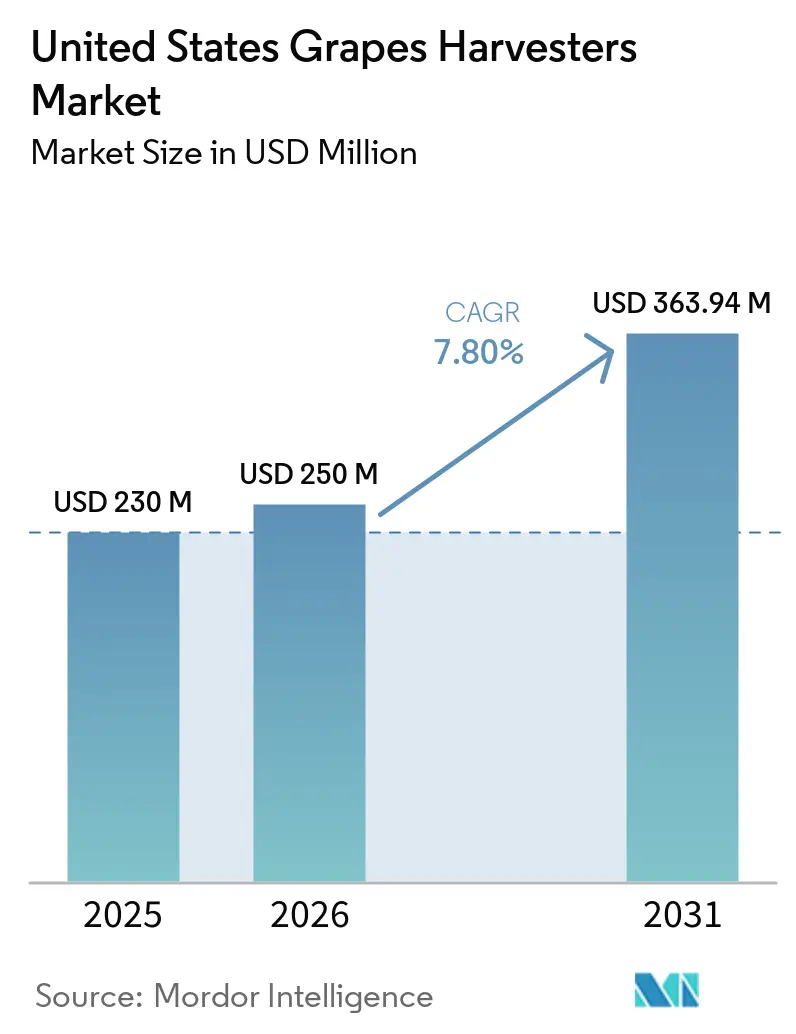
| Base Year Market Size (2025) | USD 230 Million |
| Market Size (2026) | USD 250 Million |
| Market Size (2031) | USD 363.94 Million |
| Growth Rate (2026 - 2031) | 7.80 % |
| Market Concentration | Medium |
Major Players *Disclaimer: Major Players sorted in no particular order Image © Mordor Intelligence. Reuse requires attribution under CC BY 4.0. | |
United States Grapes Harvesters Market Analysis by Mordor Intelligence
The United States grapes harvesters market size was valued at USD 230.00 million in 2025 and is forecast to grow from USD 250.00 million in 2026 to USD 363.94 million by 2031, at a CAGR of 7.80% from 2026 to 2031. Market growth is driven by increasing vineyard mechanization, labor shortages, rising labor costs, and the need for timely harvesting. Vineyard operators are adopting mechanical harvesters to improve operational efficiency, reduce dependence on seasonal labor, and maintain grape quality. Replacement of aging equipment, precision viticulture technologies, and California's emissions regulations are further supporting investments in modern harvesting machinery. Manufacturers are integrating yield monitoring, telematics, and field management capabilities to improve vineyard productivity and operational efficiency. Expanding custom harvesting and equipment rental services are also improving access to mechanization, particularly for small and medium-sized vineyards.
Key Report Takeaways
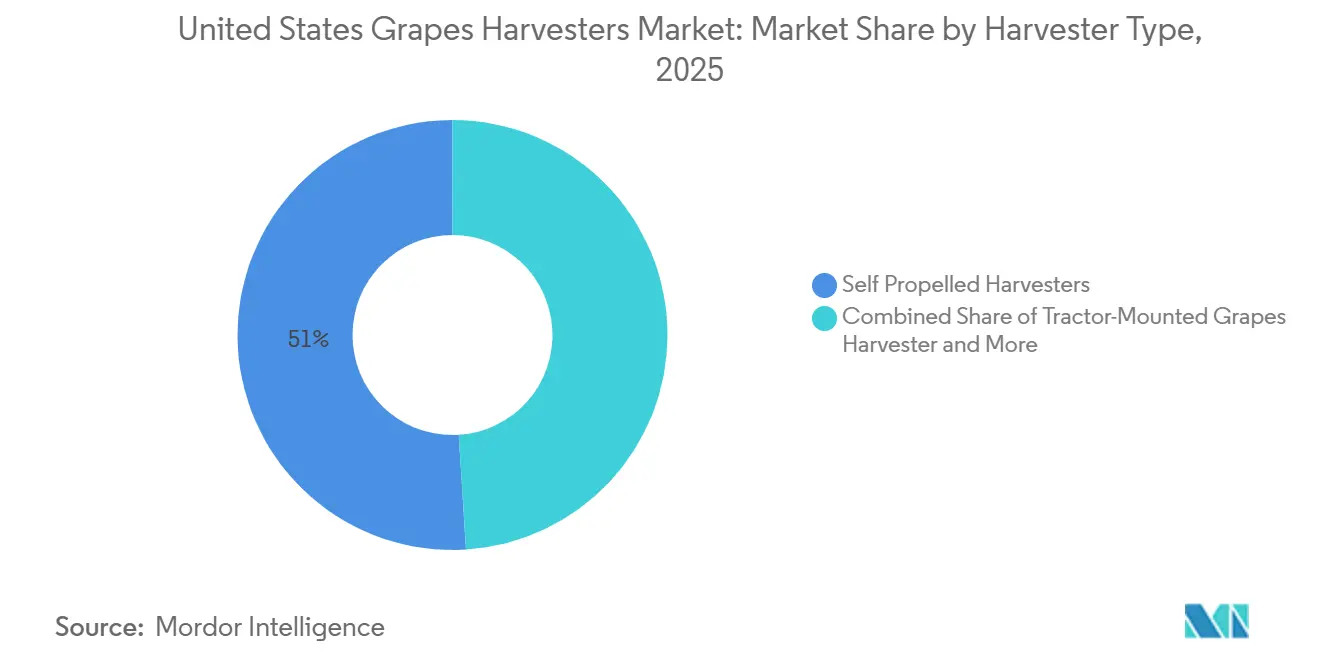
- By harvester type, self-propelled grape harvesters were the largest segment, accounting for 51.0% of the United States grapes harvesters market share in 2025, while tractor-mounted grape harvesters are forecast to grow at a CAGR of 11.8% from 2026 to 2031.
- By mode of operation, assisted/precision-guided operation was the largest segment, accounting for 56.0% of the United States grapes harvesters market size in 2025, while autonomous/semi-autonomous operation is forecast to grow at a CAGR of 13.2% from 2026 to 2031.
- By power source, diesel-powered harvesters were the largest segment, accounting for 63.0% of the United States grapes harvesters market share in 2025, while electric harvesters are forecast to grow at a CAGR of 14.0% from 2026 to 2031.
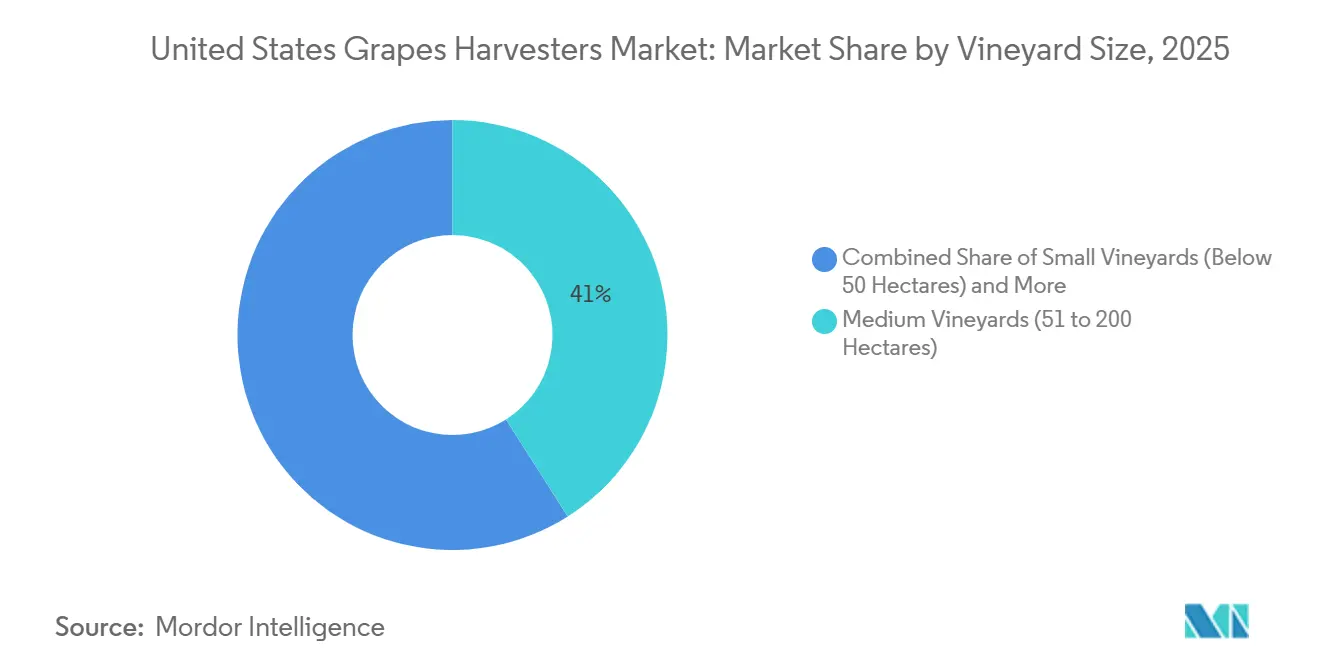
- By vineyard size, medium vineyards (51 to 200 hectares) were the largest segment, accounting for 41.0% of the United States grapes harvesters market share in 2025, while small vineyards (below 50 hectares) are forecast to grow at a CAGR of 12.4% from 2026 to 2031.
Note: Market size and forecast figures in this report are generated using Mordor Intelligence’s proprietary estimation framework, updated with the latest available data and insights as of January 2026.
Market Trends and Insights
Drivers Impact Analysis of United States Grapes Harvesters Market*
| Driver | (~) % Impact on CAGR Forecast | Geographic Relevance | Impact Timeline |
|---|---|---|---|
| Labor Scarcity and Wage Inflation | +2.5% | California, Washington, Oregon | Short term (≤ 2 years) |
| Vineyard Consolidation and Fleet Standardization | +1.5% | California, Pacific Northwest | Medium term (2-4 years) |
| Precision Viticulture and Data-Ready Equipment | +1.2% | National, with early gains in California | Medium term (2-4 years) |
| Emissions Regulations Driving Equipment Replacement | +0.9% | California core, spillover to the Pacific Northwest | Medium term (2-4 years) |
| Shorter Harvest Windows from Heat Variability | +0.7% | California, Washington | Short term (≤ 2 years) |
| Multi-Use Harvester Platforms for Year-Round Vineyard Operations | +0.5% | National | Long term (≥ 4 years) |
| Source: Mordor Intelligence | |||
Labor Scarcity and Wage Inflation
Growers are increasingly adopting mechanized harvesting solutions to improve operational efficiency and ensure timely grape harvesting within narrow harvest windows. The United States grapes harvesters market benefits as producers seek to complete harvesting with fewer seasonal workers, lower labor dependence, and more predictable field schedules. Low-light harvesting equipment is especially relevant in warm growing regions, as they can extend operating hours without relying on additional hand crews. Equipment suppliers are therefore focusing on simplified machine controls, reliable field service, and rapid deployment. These factors support the adoption of harvesting platforms that improve operational efficiency while reducing labor requirements during the most time-sensitive period of the season.
Vineyard Consolidation and Fleet Standardization
Vineyard consolidation and fleet standardization are driving demand for grape harvesters as larger growers and vineyard operators seek to improve equipment utilization, streamline maintenance, and coordinate harvesting across multiple vineyard sites. Managing standardized harvester fleets enables operators to simplify spare-parts procurement, reduce servicing complexity, and minimize operator training requirements across their operations. Consistent equipment configurations also help contractors deploy machinery across different vineyards while maintaining harvesting efficiency during compressed seasonal windows. As growers consolidate operations and prioritize cost control, demand is likely to favor reliable, high-capacity grape harvesters that can operate efficiently across larger vineyard areas and support standardized fleet management.
Precision Viticulture and Data-Ready Equipment
Harvesters are increasingly used to collect operating and crop data in addition to picking fruit. Growers can use yield maps, location-linked weight records, and machine settings to support harvest timing and field management decisions. The United States grapes harvesters market is moving toward connected platforms as large vineyard managers seek to integrate equipment data with their farm management systems. These features can also support sustainability reporting and carbon records where customers require operating documentation. Equipment manufacturers that offer software, support, and upgrades alongside hardware can strengthen customer relationships beyond the initial sale.
Emissions Regulations Driving Equipment Replacement
California's emissions regulations for off-road diesel equipment are encouraging vineyard operators to replace older self-propelled harvesters with newer, lower-emission models. As California accounts for the majority of U.S. wine grape production, fleet modernization in the state has a significant influence on the United States grapes harvesters market. Growers are increasingly investing in harvesters equipped with cleaner diesel engines and advanced engine technologies to meet regulatory requirements while improving fuel efficiency and machine productivity. This replacement cycle also strengthens the competitive position of manufacturers with established dealer networks, service capabilities, and technical expertise to support customers in meeting emissions compliance requirements.
Restraints Impact Analysis of United States Grapes Harvesters Market*
| Restraint | (~) % Impact on CAGR Forecast | Geographic Relevance | Impact Timeline |
|---|---|---|---|
| High Upfront Capital Expenditure | -1.8% | National, most acute in sub-50-hectare regions | Short term (≤ 2 years) |
| Operator and Maintenance Skill Gaps | -1.2% | California premium appellations, Pacific Northwest | Short term (≤ 2 years) |
| Premium Fruit Quality Sensitivity to Machine Settings | -1.0% | National | Medium term (2-4 years) |
| Fragmented Trellis and Row Geometry Limiting Interoperability | -0.8% | National, most acute in older eastern vineyard regions | Long term (≥ 4 years) |
| Source: Mordor Intelligence | |||
High Upfront Capital Expenditure
High upfront costs can constrain grape harvester adoption among small and medium-sized vineyard operators in the United States, particularly where machinery purchases compete with seasonal labor and other vineyard operating expenses. The acquisition cost of self-propelled harvesters can make contract harvesting, equipment leasing, or purchasing used machinery more financially attractive than buying new equipment. Financing conditions further influence these decisions because interest payments increase the total cost of equipment ownership. In January 2026, the U.S. Department of Agriculture's Farm Service Agency set its direct farm operating loan interest rate at 4.625%, adding to the financing costs that growers must consider when evaluating equipment purchases[1]. These costs, combined with maintenance, insurance, and seasonal storage expenses, can lengthen payback periods for vineyards with limited acreage or low annual machine utilization. Consequently, growers may postpone equipment purchases or rely on harvesting contractors and shared-equipment arrangements, constraining new grape harvester demand among price-sensitive operators.
Premium Fruit Quality Sensitivity to Machine Settings
Harvesting settings for high-value wine grapes can influence fruit condition, requiring careful machine adjustment. A 2026 Springer study reported that modern harvesters can achieve 99.8% cleanliness in bins under controlled conditions, but performance can vary with canopy condition, vineyard slope, and mixed varieties[2]. This limits adoption in premium appellations where growers prioritize careful fruit handling. The United States grapes harvesters market must therefore address quality concerns as directly as it addresses labor costs. Optical sorting, improved calibration, and machine vision can help suppliers demonstrate performance at the block level. Hand harvesting remains relevant where it contributes to product positioning or where field conditions are unsuitable for standard machine settings.
*Our forecasts treat driver/restraint impacts as directional, not additive. The impact forecasts reflect baseline growth, mix effects, and variable interactions.
United States Grapes Harvesters Market Segment Analysis
By Harvester Type:
Self-Propelled Platforms Lead While Tractor-Mounted Equipment Gains GroundSelf-propelled grape harvesters were the largest segment, accounting for 51.0% of the United States grapes harvesters market share in 2025, supported by high throughput, night-use capability, and integrated sorting and field-data functions. These machines are suited to large, regular vineyard blocks where compressed harvest windows require dependable capacity, including major California production areas and premium growing locations. Trailed/towed harvesters serve growers seeking a lower-cost entry point with adequate capacity on straight, accessible rows. They remain relevant where a vineyard is ready for mechanization but does not require a dedicated high-capacity platform.
Tractor-mounted grape harvesters are forecast to grow at a CAGR of 11.8% from 2026 to 2031, the fastest rate within this segment. Their growth reflects the ability to utilize tractors already present on many farms. A 2026 mechanization review found that tractor-mounted systems can be economically viable for smaller harvest areas than self-propelled equipment. Pellenc updated the Optimum XXL80 in January 2026 with a dual-head arrangement that supports orchard and vine harvesting applications. Modular machines can increase annual utilization by allowing growers to spread an investment across multiple crop tasks.

By Mode of Operation:
Assisted Systems Remain the Mainstream as Autonomous Platforms DevelopAssisted and precision-guided platforms accounted for 56.0% of the United States grapes harvesters market size in 2025. This segment combines operator control with row-following, tilt compensation, and telematics technologies to improve harvesting accuracy, operational repeatability, and oversight of harvest settings. The growing adoption of precision guidance systems reflects increasing demand for improved harvesting efficiency, reduced operator fatigue, and consistent performance across varying vineyard conditions. Manual steering remains relevant in lower-cost applications and vineyards with uneven layouts.
Autonomous and semi-autonomous grape harvesters are forecast to grow at a CAGR of 13.2% from 2026 to 2031, driven by their ability to reduce dependence on skilled machine operators during labor-constrained harvest periods. The adoption of these systems is further supported by advancements in automation, precision navigation, and digital fleet management. However, wider commercialization will depend on reliable navigation, field safety, after-sales service capabilities, and compatibility with diverse vineyard trellis systems.
By Power Source:
Diesel Retains the Largest Installed Role as Electric Equipment AdvancesDiesel-powered harvesters accounted for 63.0% share of the United States grapes harvesters market in 2025. Diesel-powered machines remain the preferred choice for remote vineyards, extended harvesting operations, and other high-duty-cycle applications due to their reliability and established fueling infrastructure. Their long replacement cycles continue to support a large installed base, while hybrid harvesters are emerging as an intermediate solution for growers seeking lower emissions without relying entirely on charging infrastructure.
Electric grape harvesters are forecast to grow at a CAGR of 14.0% from 2026 to 2031. The California Air Resources Board (CARB) continues to direct fleet owners toward lower-emission off-road equipment, and California's Clean Off-Road Equipment Voucher Incentive Project supports qualifying zero-emission equipment purchases. Electric platforms also support grower efforts to reduce local emissions near communities and tourism areas. Charging access, battery endurance, and machine price will remain key adoption factors. The United States grapes harvesters market is likely to retain diesel demand while electric machines become viable for specific vineyard applications.
By Vineyard Size:
Medium Vineyards Lead While Small Operations Expand Their Equipment OptionsMedium vineyards (51 to 200 hectares) accounted for a 41.0% share of the market in 2025. These operations typically have sufficient revenue to finance dedicated equipment or enter multi-year lease agreements. Their acreage also supports guided harvesting and telematics across multiple field blocks. Large vineyards above 200 hectares can support high-value fleet contracts, centralized service, remote diagnostics, and data utilization across multiple sites.
Small vineyards (below 50 hectares) are forecast to grow at a CAGR of 12.4% from 2026 to 2031. Compact tractor-mounted and trailed systems lower the cost of entry for this segment. The Associated Press reported in 2025 that many United States wine businesses are family-owned, reinforcing the need for accessible financing and practical equipment formats. Contractor harvesting, shared equipment, and modular tools can make mechanization accessible without a dedicated fleet. This segment offers suppliers room to develop products and service models suited to limited annual use.
Geography Analysis
California
California accounted for the largest regional demand in 2025 in the United States grapes harvesters market. Its scale supports high-volume production in the Central Valley alongside quality-focused production in Napa, Sonoma, and Paso Robles. Large blocks prioritize capacity, reliability, and night operation, while premium appellations focus more on calibration, fruit condition, and sorting performance. CARB (California Air Resources Board) rules also make California the primary location for emissions-related fleet replacement. This combination makes California central to both current demand and equipment specifications.
Washington
Washington is the fastest-growing geographic area. According to data from the USDA Economic Research Service, the state's 2025 wine grape crop declined by 21% from 2024 levels, which increased grower attention on cost control and machine productivity[3]. Oregon also contributes to equipment demand as Willamette Valley growers manage variable production conditions. Pinot Noir production adds calibration requirements as growers seek careful fruit handling.
New York and Michigan
New York and Michigan represent smaller markets within the United States grapes harvesters market, where fragmented vineyards, smaller vineyard blocks, and limited capital availability favor tractor-mounted and compact trailed harvesters. Michigan growers have identified labor cost and availability as leading concerns, supporting demand for cost-effective mechanization solutions, contractor-operated harvesting services, and equipment-sharing arrangements. The adoption of advanced vineyard technologies in commercial production is anticipated to improve mechanization efficiency and support the gradual uptake of modern harvesting equipment across these regions.
Competitive Landscape
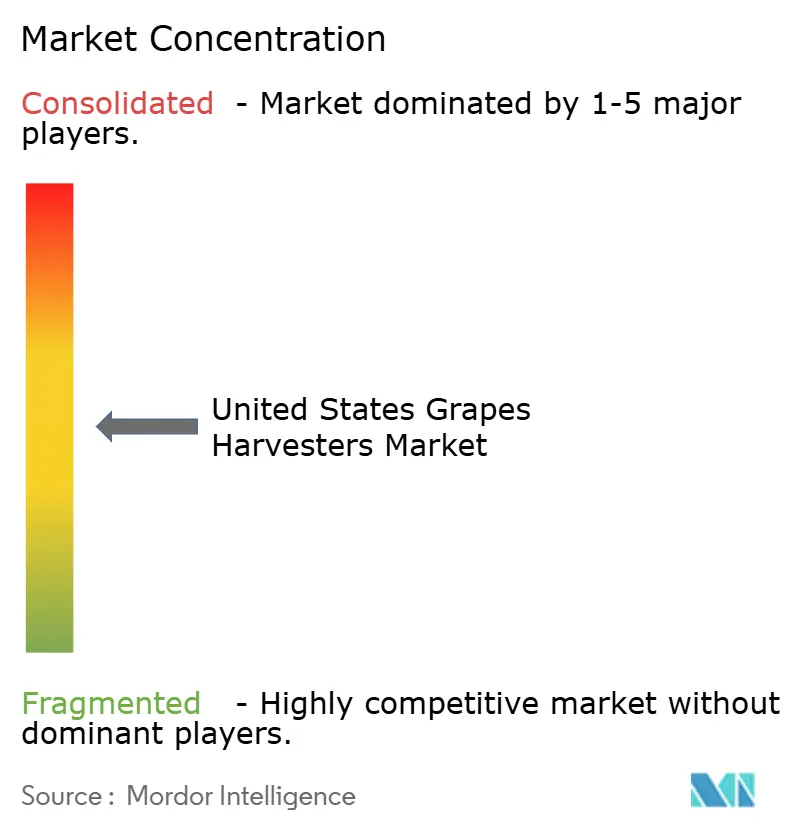
The United States grapes harvesters market was moderately concentrated in 2025, with CNH Industrial N.V. (New Holland Agriculture), Pellenc S.A.S., Oxbo International, Grégoire, and ERO GmbH collectively holding a significant market share. This concentration reflects specialized design requirements, established dealer networks, field-testing capabilities, and reliable parts support during the short harvesting season. Leading suppliers compete on output, fruit handling, reliability, field service, and data connectivity. Smaller suppliers, including Blueline Manufacturing, American Grape Harvesters, Reese Group, and Bobard, serve select requirements with a more limited ability to support nationwide software and service programs. The geographic spread of vineyards across California, Washington, and New York further reinforces the advantage of established suppliers with regional dealer and service networks. The United States grapes harvesters market therefore has meaningful barriers to entry for new equipment suppliers.
Pellenc's 2025 EASY ADJUST interface focuses on remote adjustment and machine performance records. Grégoire has used ISOBUS connectivity to support data exchange with farm management systems. These developments indicate that suppliers compete on the utility of machine data as well as physical harvesting performance. The ability to provide real-time operational data, remote diagnostics, and performance benchmarking is becoming an increasingly important differentiator among suppliers. They also increase the importance of technical support and software servicing after equipment delivery.
The lower-cost segment offers room for compact equipment, leasing, and contractor-led models, particularly for smaller vineyards. These models allow smaller growers to access mechanized harvesting without the capital commitment of full equipment ownership. Oxbo joined the National Grape Research Alliance affiliate program in 2024, linking the company with grape research and equipment standards work. CARB's phased off-road engine requirements favor suppliers with compliant diesel, hybrid, and electric portfolios, and suppliers without a clear emissions compliance roadmap will face growing commercial disadvantages in the California market.
United States Grapes Harvesters Industry Leaders
-
Pellenc S.A.S. (Pellenc Group)
-
Oxbo International Corporation (Ploeger Oxbo Group B.V.)
-
Grégoire S.A.S. (SDF S.p.A.)
-
ERO GmbH
-
CNH Industrial N.V. (New Holland Agriculture)
- *Disclaimer: Major Players sorted in no particular order
United States Grapes Harvesters Market Companies Covered in this Report
- Pellenc S.A.S.
- CNH Industrial N.V. (New Holland Agriculture)
- Oxbo International Corporation
- SDF S.p.A. (Gregoire S.A.S.)
- ERO GmbH
- Blueline Manufacturing Company
- American Grape Harvesters, Inc.
- Nairn Harvesters Limited
- Reese Group Ltd.
- Bobard S.A.S.
Recent Industry Developments in United States Grapes Harvesters Market
- April 2026: Oxbo International Corporation opened a new manufacturing and service facility in Bergen, New York, directly targeting high-value crop harvester sales and aftermarket support across premium wine appellations including Finger Lakes, Hudson Valley, and Long Island. The expansion signals growing commercial demand for mechanized grape harvesting in the US Northeast, historically reliant on hand-picking.
- December 2025: Sonoma County Winegrowers and its partners launched the world's first on-farm viticulture robotics hub at Reservoir Farms in California, providing a dedicated test site for developing and validating autonomous vineyard technologies. The initiative is anticipated to accelerate the commercial adoption of robotic harvesting and mechanized vineyard equipment across California.
- June 2025: The Wine Group completed its acquisition of approximately 6,600 owned and leased vineyard acres across California from Constellation Brands, along with brands including Woodbridge, Meiomi, SIMI, Robert Mondavi Private Selection, Cook's, and J. Rogét. The transaction expanded The Wine Group's vineyard footprint across major grape-growing regions, including Lodi, Monterey County, and Sonoma, supporting greater fleet standardization and mechanized harvesting across large-scale vineyard operations.
United States Grapes Harvesters Market Report Scope
A grape harvesting machine is a mechanized device used in vineyards to detach grapes from vines and collect them efficiently during harvest, reducing manual labor and increasing harvesting speed. The United States grapes harvesters market report is segmented by harvester type (self-propelled, trailed or towed, and tractor mounted), by mode of operation (manual steering, assisted or precision-guided, and autonomous or semi-autonomous), by power source (diesel, hybrid, and electric), and by vineyard size (small vineyards (below 50 hectares), medium vineyards (51-200 hectares) and large vineyards (above 200 hectares)). The market sizes and forecasts are provided in terms of value (USD) for all the above segments.
Segmentation Overview
| Self-Propelled Harvesters |
| Trailed/Towed Harvesters |
| Tractor-Mounted Harvesters |
| Manual Steering and Operation |
| Assisted/ Precision-Guided Operation |
| Autonomous/ Semi-Autonomous Operation |
| Diesel-Powered Harvesters |
| Hybrid Harvesters |
| Electric Harvesters |
| Small Vineyards (Below 50 Hectares) |
| Medium Vineyards (51-200 Hectares) |
| Large Vineyards (Above 200 Hectares) |
| By Harvester Type | Self-Propelled Harvesters |
| Trailed/Towed Harvesters | |
| Tractor-Mounted Harvesters | |
| By Mode of Operation | Manual Steering and Operation |
| Assisted/ Precision-Guided Operation | |
| Autonomous/ Semi-Autonomous Operation | |
| By Power Source | Diesel-Powered Harvesters |
| Hybrid Harvesters | |
| Electric Harvesters | |
| By Vineyard Size | Small Vineyards (Below 50 Hectares) |
| Medium Vineyards (51-200 Hectares) | |
| Large Vineyards (Above 200 Hectares) |
Key Questions Answered in the Report
What is the 2026 value of the United States grapes harvesters market?
The United States grapes harvesters market size is estimated at USD 250.00 million in 2026.
What is driving demand for grape harvesting equipment in the United States?
Labor constraints, agricultural wage pressure, fleet replacement needs, and demand for connected equipment are supporting purchases. The effect is strongest where harvest timing is difficult to manage with seasonal hand labor alone.
Which grape harvester type is most widely used in the United States?
Self-propelled grape harvesters are the most widely used type in the United States, accounting for 51.0% of the United States grapes harvesters market share in 2025. Their suitability for high-capacity operations and night harvesting makes them particularly relevant for large vineyards with sufficient annual utilization to justify investment in dedicated machinery.
Why are tractor-mounted grape harvesters gaining adoption?
Tractor-mounted machines are gaining adoption because they can lower ownership costs for smaller vineyards. Their use of existing farm tractors can make mechanization more attainable for owner-operators.