
United States Deodorants Market Size and Share
Market Overview
| Study Period | 2022 - 2032 |
|---|---|
| Forecast Data Period | 2027 - 2032 |
| Base Year Market Size (2026) | USD 7.15 Billion |
| Market Size (2027) | USD 7.41 Billion |
| Market Size (2032) | USD 8.91 Billion |
| Growth Rate (2027 - 2032) | 3.75 % |
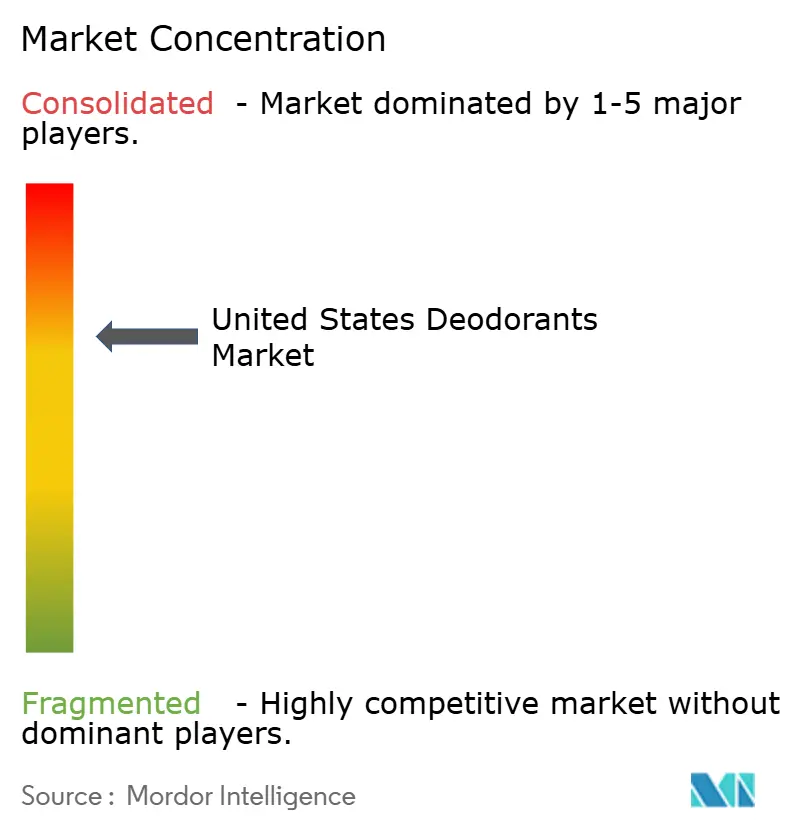
| Market Concentration | Medium |
Major Players *Disclaimer: Major Players sorted in no particular order Image © Mordor Intelligence. Reuse requires attribution under CC BY 4.0. | |
United States Deodorants Market Analysis by Mordor Intelligence
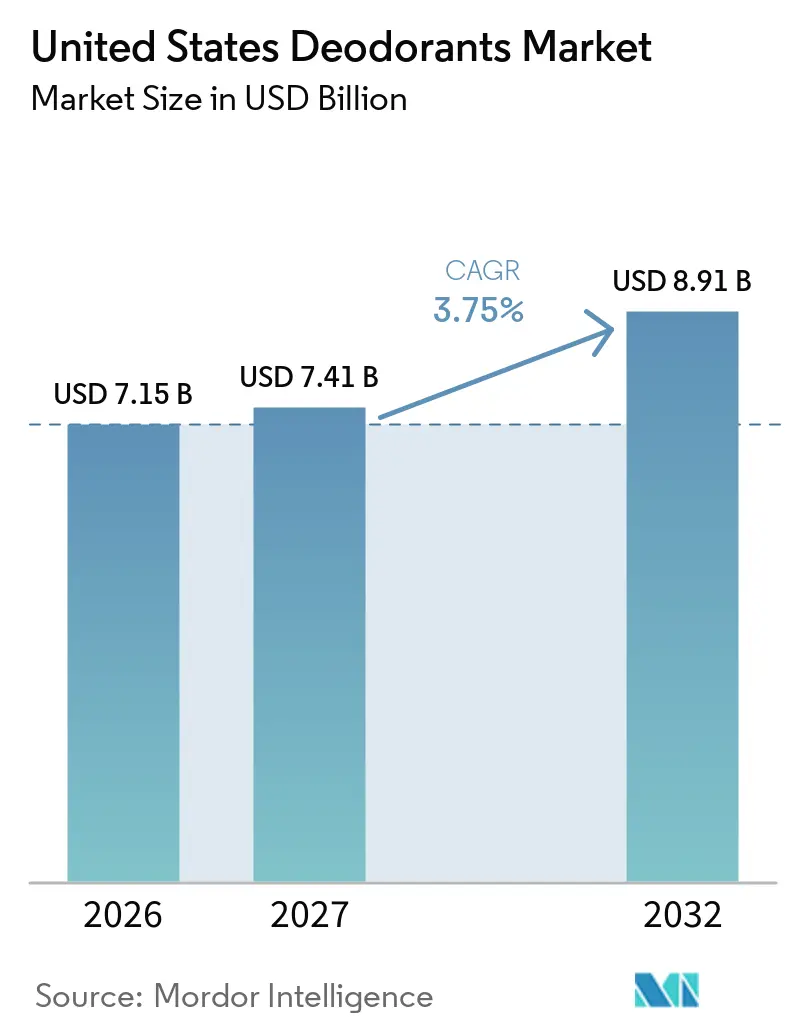
The United States deodorants market was valued at USD 7.15 billion in 2026 and estimated to grow from USD 7.41 billion in 2027 to USD 8.91 billion by 2032, at a CAGR of 3.75% during the forecast period from 2027 to 2032. Frequent replenishment and widespread daily use support stable demand compared with less essential personal care products. Whole-body deodorants are expanding usage occasions beyond underarm applications, creating additional purchase opportunities. Consumers increasingly prioritize skin compatibility, ingredients, fragrance, and packaging, enabling brands to differentiate across mass-market, natural, and premium product segments. Product safety and claims also remain important factors shaping consumer purchasing decisions.
Key Report Takeaways
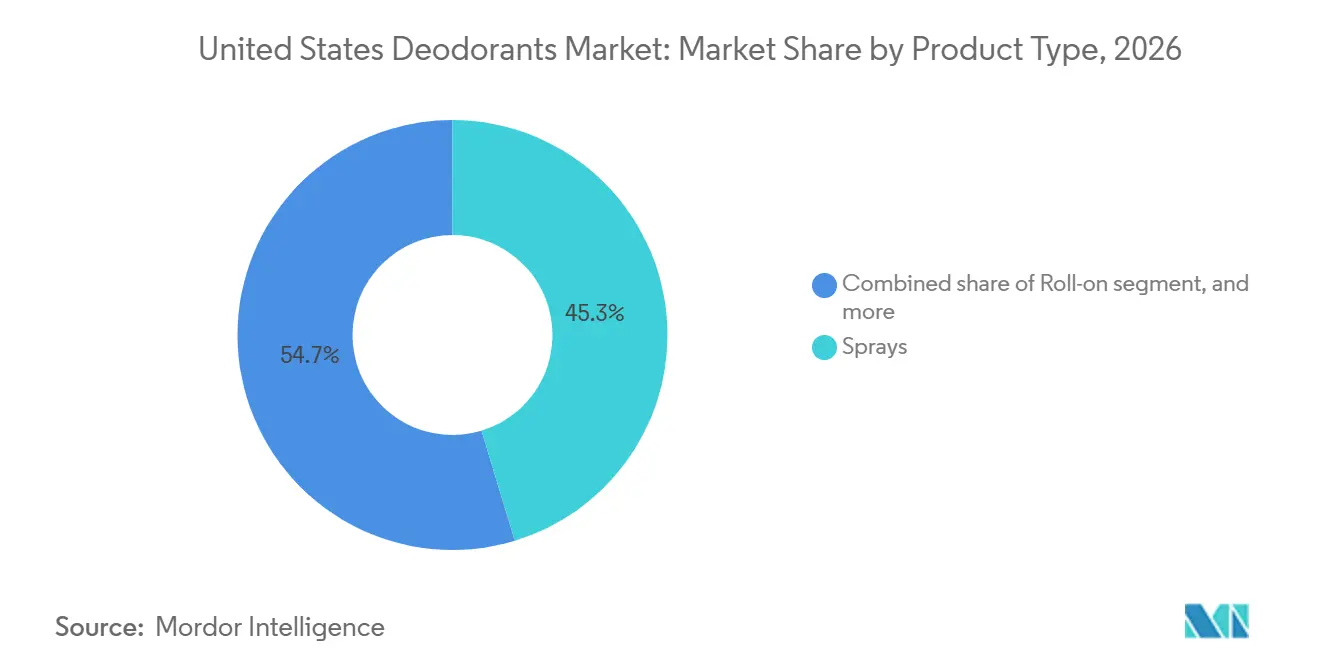
- By product type, sprays held 45.34% of the United States deodorants market share in 2026, while roll-ons recorded the fastest rise at 4.56% CAGR through 2032.
- By category, conventional products held 73.55% of the United States deodorants market share in 2026, while natural and organic products recorded the fastest rise at 4.89% CAGR through 2032.
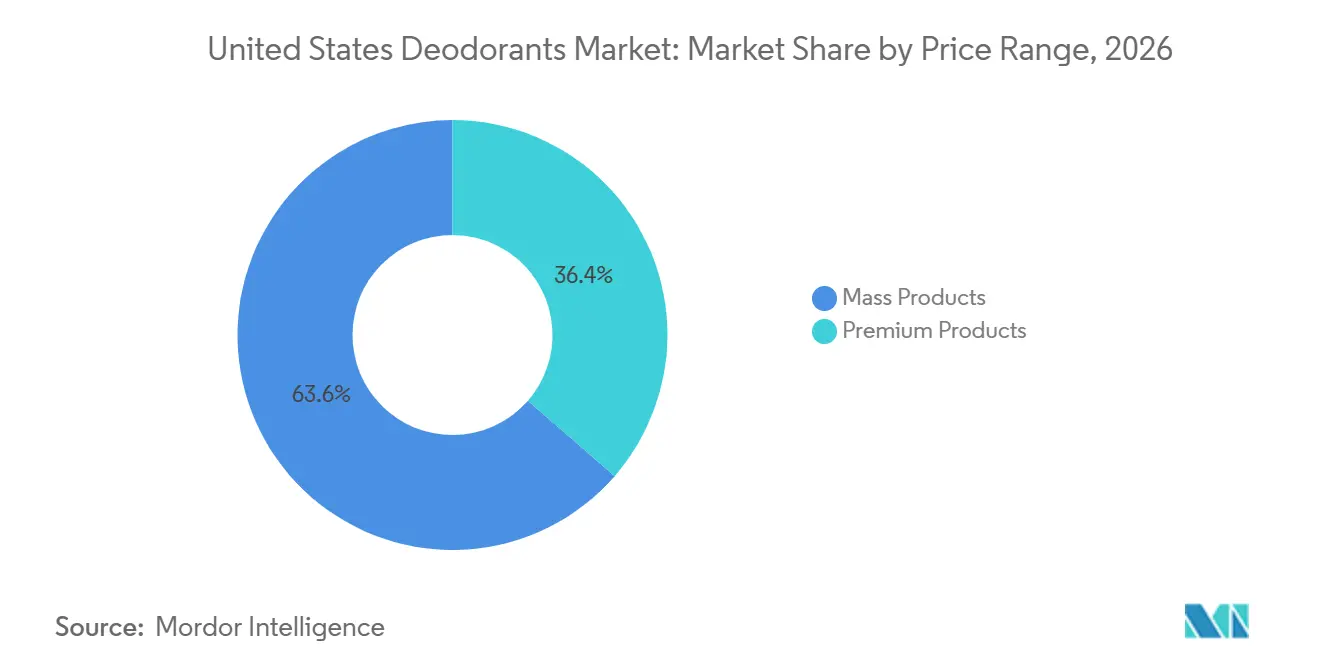
- By price range, mass products accounted for 63.63% of the United States deodorants market, while premium products recorded the fastest growth at a 4.99% CAGR through 2032.
- By distribution channel, supermarkets and hypermarkets held 45.21% of the United States deodorants market, while online retail stores recorded the fastest growth at a 4.52% CAGR through 2032.
Note: Market numbers in this report are based on Mordor Intelligence's proprietary estimation framework, which combines nine months of actuals with Q4 projections for base year 2026.
United States Deodorants Market Trends and Insights
Drivers Impact Analysis*
| Driver | (~) % Impact on CAGR Forecast | Geographic Relevance | Impact Timeline |
|---|---|---|---|
| Personal hygiene routines support recurring deodorant demand | +0.8% | National, with higher intensity in urban metros and Sun Belt states | Short term (≤ 2 years) |
| Rising demand for natural and aluminum-free formulations | +0.7% | National, with early gains in West Coast and Northeast markets | Medium term (2-4 years) |
| Increasing demand for sensitive-skin and skin-care-oriented products | +0.6% | National, led by mass-retail chains | Short term (≤ 2 years) |
| Expansion of whole-body deodorant applications | +0.5% | National, concentrated in premium and specialty channels | Medium term (2-4 years) |
| Rising demand for convenient and portable product formats | +0.4% | National, driven by urban and travel-active consumers | Medium term (2-4 years) |
| Growing demand for long-lasting odor protection | +0.3% | National, anchored in mass and mid-tier segments | Long term (≥ 4 years) |
| Source: Mordor Intelligence | |||
Personal Hygiene Routines Support Recurring Deodorant Demand
Personal hygiene routines drive recurring demand for deodorants in the United States, as consumers incorporate these products into their daily grooming habits. For instance, in July 2025, deodorant unit sales in United States supermarkets reached approximately 837.16 million units, up from 782.6 million units in 2024. Additionally, in April 2025, according to Maine's Department of Economic and Community Development, deodorants, feminine hygiene, and miscellaneous personal care products collectively accounted for USD 8.1 billion in U.S. spending in 2024 [1]. These figures indicate continued demand for deodorants and broader personal care products.
Rising Demand for Natural and Aluminum-Free Formulations
Consumers are paying greater attention to ingredients and product transparency when choosing personal care products. For instance, in March 2025, the National Sanitation Foundation reported that 74% of consumers considered organic ingredients important in personal care products, while 62% of adults aged 18–29 were willing to pay more for certified options. Additionally, only 9% completely trusted voluntary natural labels, highlighting the importance of credible certification and clear ingredient information [2]. These preferences create opportunities for natural and aluminum-free deodorants that meet consumers’ ingredient expectations.
Increasing Demand for Sensitive-Skin and Skin-Care-Oriented Products
Consumers’ concerns about cosmetic safety and skin reactions create opportunities for gentle, skin-care-oriented deodorants. In September 2025, the United States Food and Drug Administration launched a public dashboard for reporting adverse events associated with cosmetic products, improving access to safety-related information [3]. This development highlights the importance of product safety and ingredient transparency, supporting the relevance of sensitive-skin formulations in deodorant product development.
Expansion of Whole-Body Deodorant Applications
Whole-body deodorants are expanding product use beyond traditional underarm application, creating opportunities for brands to address additional usage occasions and develop premium formulations. Consumers are increasingly seeking deodorant products that offer broader coverage, including application to areas such as the feet, chest, and legs. This shift in consumer behavior is prompting brands to invest in new product lines and formulations tailored to whole-body use. For instance, Unilever reported double-digit growth in Dove deodorants, supported by expansion into whole-body products.
Restraints Impact Analysis*
| Restraint | (~) % Impact on CAGR Forecast | Geographic Relevance | Impact Timeline |
|---|---|---|---|
| Intense Competition and Brand Differentiation | -0.5% | National, most acute in mass-market channels | Medium term (2-4 years) |
| Price Sensitivity and Rising Operating Costs | -0.4% | National, with higher sensitivity in value-oriented markets | Short term (≤ 2 years) |
| Balancing Formulation Safety, Efficacy, and Consumer Preferences | -0.3% | National | Medium term (2-4 years) |
| Regulatory Compliance and Product-Claim Substantiation | -0.2% | National | Long term (≥ 4 years) |
| Source: Mordor Intelligence | |||
Intense Competition and Brand Differentiation
The United States deodorants market comprises established brands, private labels, direct-to-consumer companies, and specialty entrants competing for limited shelf space and consumer attention. This competition pressures margins, particularly as shoppers can easily compare ingredient lists and prices across retail and online channels. Legacy brands face a greater challenge in the natural deodorants segment, as newer brands often position themselves in opposition to aluminum-based products, making it difficult for established players to shift their brand perception without alienating their existing consumer base.
Price Sensitivity and Rising Operating Costs
Price pressure is most evident in mass deodorants, where private-label sticks priced between USD 2 and USD 4 can limit national brands' pricing flexibility. Higher input costs, including raw materials and packaging, along with marketing expenses, place additional pressure on companies serving value-focused shoppers. Brands must decide whether to absorb costs, raise prices, reformulate products, or increase promotional investment. Each decision carries trade-offs. Absorbing costs protects short-term volume but compresses margins, while raising prices risks losing price-sensitive consumers to private-label alternatives.
*Our forecasts treat driver/restraint impacts as directional, not additive. The impact forecasts reflect baseline growth, mix effects, and variable interactions.
Segment Analysis
By Product Type: Roll-On Gains Ground in a Spray-Led Market
Sprays held 45.34% of the market share in 2024, supported by their ease of use, rapid drying, and lighter residue. Sprays serve both conventional antiperspirant users and consumers seeking whole-body application options. They appeal to consumers who prefer broad coverage and quick application after bathing, before exercise, or during the day. Procter & Gamble attributed high single-digit organic growth in its North American deodorant business in fiscal year 2025 to innovation in nitrogen-powered spray propellants across its Native, Old Spice, and Secret brands.
Roll-ons are projected to register the fastest growth, at a CAGR of 4.56% during 2027–2032. Application supports formulations that emphasize skin-care ingredients and sensitive-skin benefits. They also address consumer concerns about propellants and reduce the perceived waste of the product. Creams serve a smaller but distinct niche, particularly where whole-body use requires a more targeted texture. Sticks remain central to conventional mass-market products due to their portability, consistent application, and wide availability.

By Category: Natural Formulations Gain Momentum
Conventional products accounted for 73.55% of the United States deodorants market in 2026. This dominant share reflects long-standing consumer confidence in aluminum-based antiperspirants for sweat control. Consumers with active lifestyles or higher perspiration needs tend to favor conventional options due to their perceived reliability. This segment also benefits from broad distribution, established brand recognition, and price points suited to frequent household purchases. To maintain relevance, companies continue to update conventional products through fragrance additions, skin-care formulations, and packaging changes.
Natural and organic products are projected to register the fastest growth, at a CAGR of 4.89% during 2027–2032. This growth is driven by shifting consumer expectations, where ingredients, certification, and transparency are as important as odor protection. Incumbent brands in the United States deodorants market are responding with products that combine conventional protection with natural-adjacent positioning. Growth in the natural segment is further supported by consumers who seek clear product information before making a purchase. Straightforward statements about ingredients, certification, and intended use reduce uncertainty for shoppers who are skeptical of broad natural claims.
By Price Range: Premium Momentum Reshapes a Mass-Dominant Category
Mass products accounted for 63.63% of the United States deodorants market in 2026. Deodorants have traditionally been everyday, low-cost products, and this price tier remains important for households that prioritize value and regular availability. National brands compete closely with private-label sticks, which are commonly priced between USD 2 and USD 4. Mass products also benefit from consistent placement in supermarkets, drugstores, convenience stores, and other retail outlets. Their wide availability keeps them relevant even as premium products grow faster.
Premium products are projected to register the fastest growth, at a CAGR of 4.99% during 2027–2032. Whole-body products are priced 30% to 50% above standard underarm deodorants, while natural formulas rely on ingredient claims and certifications to justify higher price points. For instance, in February 2026, Old Spice introduced the Spice Alchemist cologne-infused deodorant collection as a fine-fragrance option sold through mass retail, demonstrating how a large brand can offer a more elevated product without exiting its existing retail base. The mid-price range faces pressure from low-cost private label products on one side and premium innovation on the other.
By Distribution Channel: Online Retail Broadens Access for Natural and Premium Entrants
Supermarkets and hypermarkets accounted for 45.21% of the United States deodorants market share in 2026. These stores remain important because shoppers frequently replenish their deodorants when purchasing groceries and other household goods. Planogram space, established brands, and a broad price range reinforce the position of large-format stores. Mass-market products benefit from this environment, as consumers can compare brands and find multi-packs or promotional offers. Supermarkets and hypermarkets also provide whole-body brands with a channel to reach consumers who may not actively search for these products online.
Online retail stores are projected to register the fastest growth, at a CAGR of 4.52%, during 2027–2032. Online shopping allows consumers to search for products based on specific attributes such as aluminum-free formulas, sensitive-skin claims, fragrances, and certifications, rather than starting with a familiar brand name. This shift in shopping behavior benefits smaller and newer brands that may lack the shelf presence of established players but can compete effectively on product attributes and consumer reviews. It also enables direct-to-consumer companies to communicate product details and build trial before expanding into physical stores. The online channel further supports targeted marketing, subscription models, and personalized recommendations, which help drive repeat purchases
Geography Analysis
The United States deodorants market is a single-country analysis, but regional demand shapes product choice, format preferences, and retail strategy. California and the broader West Coast are early adopters of natural and aluminum-free products. Consumers in these markets show strong interest in clean-beauty products and ingredient transparency. California's cosmetics regulations reinforce the focus on formulation and labeling, often making the region an early indicator of trends that later spread nationally. Specialty beauty and health-food retailers help brands build credibility before broader national launches. Kopari and Lume both followed this approach before expanding into wider retail distribution in 2025.
Sun Belt states such as Texas, Florida, Georgia, and Arizona represent a strong base for frequent deodorant use, as warmer climates and higher levels of outdoor activity increase the number of application occasions. Conventional antiperspirants, sprays, and clinical-strength products are particularly relevant in these conditions. In these areas, consumers tend to prioritize protection and reliable performance. The Northeast and Midwest show different patterns. Urban consumers in the Northeast have higher incomes and greater access to specialty retailers, supporting the adoption of premium and certified natural products.
The Midwest remains important for value-focused shoppers and national-brand loyalty, which supports conventional mass products. Whole-body deodorants are entering these markets through mass retail at accessible price points. These regional patterns indicate that national brands need to differentiate product format, price, and messaging across the United States deodorant market. West Coast activity tends to reflect clean-beauty and ingredient preferences, while Sun Belt demand places greater emphasis on performance and frequent application. Urban Northeast consumers may respond to premium positioning and specialty retail access, while Midwestern consumers provide a stable base for established brands and value-focused products. A national strategy must therefore allow sufficient flexibility for each region without compromising a consistent brand identity.
Competitive Landscape
The United States deodorants market is moderately concentrated, with Procter & Gamble, Unilever, and Church & Dwight holding strong positions in conventional and mass products. Procter & Gamble sells Secret, Old Spice, and Native, while Unilever sells Dove, Degree, and Axe. Church & Dwight sells ARRID and ARM & HAMMER. Lume Deodorant and Kopari Beauty have gained positions in natural and whole-body products through direct-to-consumer channels, followed by retail expansion. Beiersdorf has increased its investment focus on deodorants and body care under the NIVEA brand. Competition is active, as the most attractive product space combines skin comfort, safety claims, and packaging aligned with consumer preferences.
Large companies are responding through fragrance innovation, packaging, and format extensions. Procter & Gamble introduced nitrogen-powered sprays across Native, Old Spice, and Secret, which it identified as part of its product and packaging innovation in fiscal year 2025. Old Spice launched Spice Alchemist in February 2026 with cologne-inspired scents, offering a deodorant, body wash, and cologne mist range sold through major retailers. Beiersdorf redirected NIVEA investment toward deodorants and body care, with Derma Control targeting consumers seeking a sensitive-skin option. Unilever expanded Dove's whole-body product range and introduced a refillable antiperspirant. These moves indicate that major companies are addressing multiple consumer needs simultaneously, including protection, scent, comfort, and packaging.
Smaller brands compete by focusing on distinct product stories and digital discovery. Their products often feature aluminum-free formulas, whole-body applications, skincare-oriented language, or natural credentials. Online retail allows these companies to communicate formula details before a shopper encounters the product on a store shelf. Modernization of Cosmetics Regulation Act (MoCRA's) safety substantiation requirements can benefit companies that clearly document product safety. However, established companies retain advantages in distribution, scale, and brand recognition. The United States deodorants market is therefore contested by companies with different strengths, rather than being dominated by a single product approach. This competitive environment supports continued product launches but can make it harder for brands to maintain clear differentiation.
United States Deodorants Industry Leaders
-
The Procter & Gamble Company
-
Unilever PLC
-
Colgate-Palmolive Company
-
Church & Dwight Co., Inc.
-
Henkel AG & Co. KGaA
- *Disclaimer: Major Players sorted in no particular order
Recent Industry Developments
- February 2026: Procter & Gamble, through Old Spice, launched Spice Alchemist, a premium cologne-infused collection comprising deodorant, body wash, and cologne mist in four scents, available through major retailers. The launch supports P&G's premiumization strategy, building on its leadership in whole-body deodorants across both male and female categories.
- February 2026: Axe introduced a redesigned aerosol body spray can featuring patented spray technology that delivers a more controlled, targeted, and lighter mist. The updated design helps prevent overspraying, improves fragrance application, and enables 10% more sprays over the can’s lifetime.
- January 2025: Dove Men+Care introduced Whole Body Deo Spray in partnership with Marshawn Lynch, expanding its US retail distribution by adding two new scents to its product lineup.
United States Deodorants Market Report Scope
Deodorants are personal care products designed to control or mask body odor. They are available in various formulations, categories, price ranges, and packaging formats. The United States deodorants market is segmented by product type, category, price range, and distribution channel. By product type, the market includes sprays, creams, roll-ons, and other product types. By category, the market is divided into conventional, organic, and natural deodorants. By price range, the market covers mass and premium products. By distribution channel, the market is categorized into supermarkets and hypermarkets, health and beauty stores, online retail stores, and other distribution channels. The report analyzes market size and forecasts for each segment by value (USD).
| Sprays |
| Creams |
| Roll-On |
| Other Product Types |
| Conventional |
| Organic & Natural |
| Mass Products |
| Premium Products |
| Supermarkets and Hypermarkets |
| Health & Beauty Stores |
| Online Retail Stores |
| Other Distribution Channels |
| By Product Type | Sprays |
| Creams | |
| Roll-On | |
| Other Product Types | |
| By Category | Conventional |
| Organic & Natural | |
| By Price Range | Mass Products |
| Premium Products | |
| By Distribution Channel | Supermarkets and Hypermarkets |
| Health & Beauty Stores | |
| Online Retail Stores | |
| Other Distribution Channels |
Key Questions Answered in the Report
What is the outlook for deodorants in the United States?
The category is forecast to grow from USD 7.41 billion in 2027 to USD 8.91 billion by 2032, at a 3.75% CAGR during the forecast period.
Which deodorant product type has the leading position?
Sprays led product types with 45.34% share in 2026, supported by ease of use and whole-body applications.
Which category is growing fastest in deodorants?
Natural and organic products are the fastest-growing category at a CAGR of 4.89% through 2032, supported by interest in ingredient transparency and certification.
Why are premium deodorants growing?
Whole-body formats, scent-led products, and natural ingredient claims support premium prices and faster growth.