
United States Crowdsourced (Gig Economy Couriers) Delivery Service Market Size and Share
Market Overview
| Study Period | 2021 - 2032 |
|---|---|
| Forecast Data Period | 2027 - 2032 |
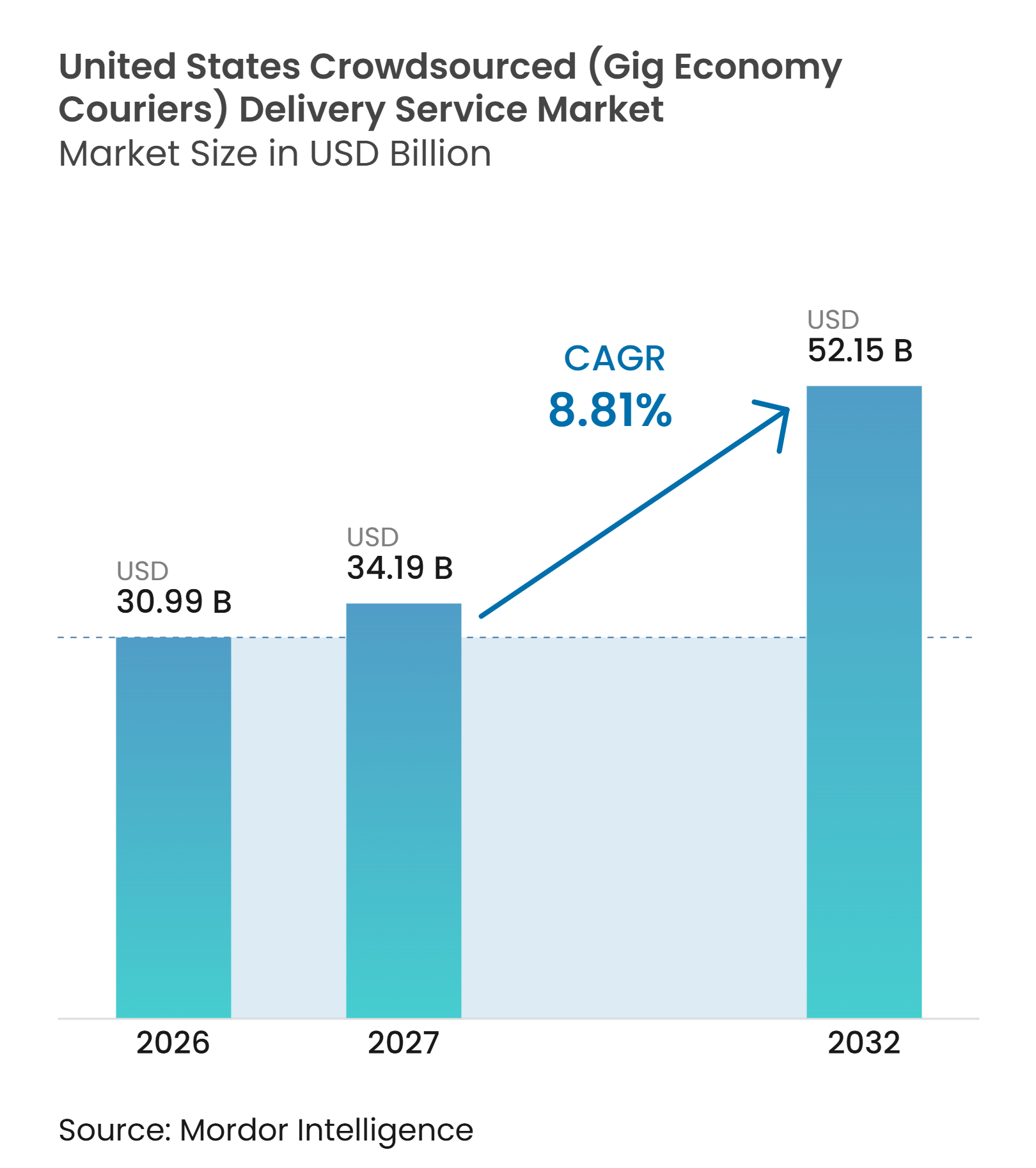
| Base Year Market Size (2026) | USD 30.99 Billion |
| Market Size (2027) | USD 34.19 Billion |
| Market Size (2032) | USD 52.15 Billion |
| Growth Rate (2027 - 2032) | 8.81 % |
| Market Concentration | Medium |
Major Players *Disclaimer: Major Players sorted in no particular order Image © Mordor Intelligence. Reuse requires attribution under CC BY 4.0. | |
United States Crowdsourced (Gig Economy Couriers) Delivery Service Market Analysis by Mordor Intelligence
The United States crowdsourced (gig economy couriers) delivery service market size was valued at USD 30.99 billion in 2026 and is estimated to grow from USD 34.19 billion in 2027 to reach USD 52.15 billion by 2032, at a CAGR of 8.81% during the forecast period (2027-2032).
The United States crowdsourced (gig economy couriers) delivery service market is supported by e-commerce activity across food, grocery, retail, and industrial deliveries, with each category creating different order frequency, delivery distance, basket size, and service-time requirements. Smartphone use, retailer use of third-party fulfillment, and the availability of independent couriers support platform coverage and order capacity, allowing operators to match local demand with available drivers through real-time dispatch systems. Retailers are increasingly using outside delivery networks when in-house last-mile operations lack sufficient order density. Drone and autonomous vehicle programs are also changing delivery cost structures and service design. Competition centers on service coverage, retailer partnerships, loyalty programs, autonomous delivery, and white-label fulfillment, with leading platforms seeking deeper retailer integration while specialists focus on delivery requirements that broad networks do not serve as efficiently.
Key Report Takeaways
- By delivery type, on-demand and instant delivery held 39.56% of the United States crowdsourced (gig economy couriers) delivery service market share in 2026, while same-day delivery recorded the highest projected CAGR at 13.12% through 2032.
- By business model, B2C held 72.37% of the United States crowdsourced (gig economy couriers) delivery service market size in 2026 and recorded the highest projected CAGR at 13.64% through 2032.
- By delivery distance, short-distance and hyperlocal delivery held 46.23% of the United States crowdsourced (gig economy couriers) delivery service market in 2026, while extended urban and peri-urban delivery recorded the highest projected CAGR at 12.84% through 2032.
- By courier engagement model, independent gig couriers held 67.19% of the United States crowdsourced (gig economy couriers) delivery service market share in 2026, while part-time contracted drivers recorded the highest projected CAGR at 12.19% through 2032.
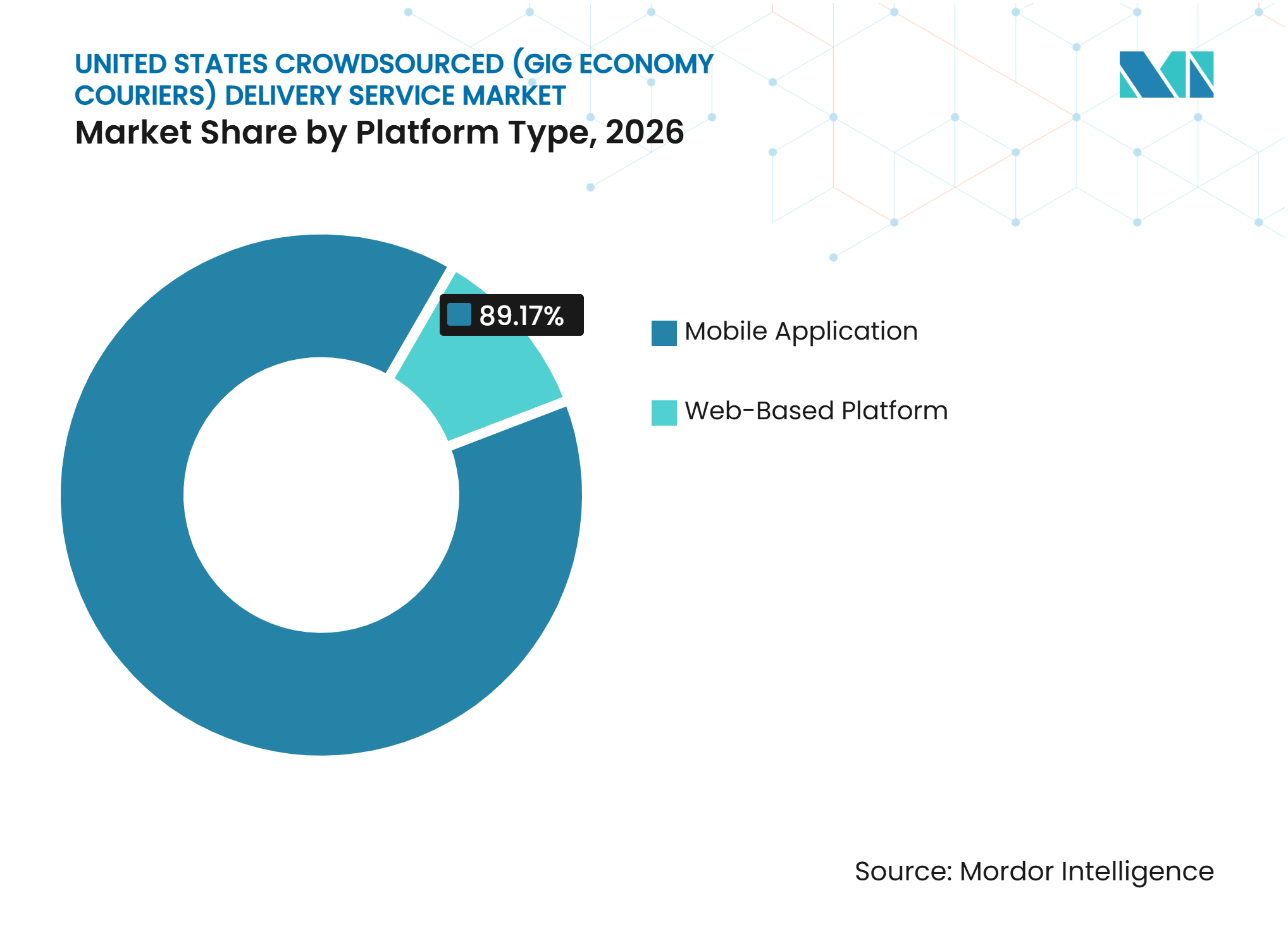
- By platform type, mobile application platforms held 89.17% of the United States crowdsourced (gig economy couriers) delivery service market size in 2026, while web-based platform recorded the highest projected CAGR at 12.23% through 2032.
- By vehicle type, four-wheelers held 76.40% share of the United States crowdsourced (gig economy couriers) delivery service market size in 2026, while drones and autonomous vehicles recorded the highest projected CAGR at 25.70% through 2032.
- By end user, e-commerce and online retail held 36.29% of the United States crowdsourced (gig economy couriers) delivery service market share in 2026, while quick commerce recorded the highest projected CAGR at 15.67% through 2032.
- By geography, the Southeast held 29.14% share of the United States crowdsourced (gig economy couriers) delivery service market size in 2026, while the Southwest recorded the highest projected CAGR at 13.05% through 2032.
Note: Market numbers in this report are based on Mordor Intelligence's proprietary estimation framework, which combines nine months of actuals with Q4 projections for base year 2026.
Market Trends and Insights
Drivers Impact Analysis of United States Crowdsourced (Gig Economy Couriers) Delivery Service Market*
| Driver | (~) % Impact on CAGR Forecast | Geographic Relevance | Impact Timeline |
|---|---|---|---|
| E-Commerce and Omnichannel Fulfillment Expansion | +2.5% | National, strongest in Northeast, Southeast, and West Coast metros | Short term (≤ 2 years) |
| Convenience-Led Consumer Adoption | +1.8% | National, deepest in urban and suburban cores across all 5 United States regions | Short term (≤ 2 years) |
| Retailer Demand for Flexible Delivery Capacity | +1.5% | National, with early gains in Southeast and Southwest | Medium term (2-4 years) |
| Growth of White-Label and Embedded Delivery | +1.3% | National, concentrated in major commerce hubs in Northeast and West | Medium term (2-4 years) |
| Underused Vehicle Capacity Monetization | +0.9% | Southeast, Midwest, and Southwest, where personal vehicle ownership is highest | Medium term (2-4 years) |
| Micro-Route Density From Local Merchant Clustering | +0.7% | Urban cores in Southeast, Southwest, and Northeast, extending to mid-tier metros | Long term (≥ 4 years) |
| Source: Mordor Intelligence | |||
E-Commerce and Omnichannel Fulfillment Expansion
Retailers are expanding platform partnerships as the economics of in-house last-mile delivery weaken below a viable order-density threshold, particularly when fixed route costs cannot be supported by local order volumes across a full operating day. Kroger expanded agreements with DoorDash across more than 2,600 stores in November 2025 and identified Instacart as a primary fulfillment partner. The company also planned an Uber Eats integration as part of its e-commerce approach. Costco expanded delivery access with DoorDash across 630 United States locations and with Uber Eats across nearly 600 locations in September 2026. These partnerships show that warehouse retailers are using third-party delivery as part of their operating model for both immediate customer orders and planned household replenishment.[1] The United States crowdsourced (gig economy couriers) delivery service market gains route density when national retailers add store networks, which makes broad coverage harder for smaller networks to replicate and can improve courier utilization across restaurant, grocery, retail, and other local delivery activity.
Convenience-Led Consumer Adoption
Consumer expectations have shifted from same-day service as a premium option toward on-demand delivery as a routine service, narrowing the time available for platforms to charge added fees for faster fulfillment. The Federal Trade Commission stated in January 2025 that independent contractors and gig workers were shielded from antitrust liability when they organized collectively.[2] Organized pay discussions could raise variable delivery costs for platforms. Fast delivery now extends from food into higher-value retail categories. Platforms with frequent grocery, pharmacy, and convenience orders have a stronger basis for repeat ordering across categories.
Retailer Demand for Flexible Delivery Capacity
Retailers are using crowdsourced networks to avoid the fixed operating costs that come with dedicated last-mile capacity, particularly when demand changes by location, day, product category, and seasonal buying patterns. DoorDash launched DashMart Fulfillment Services in October 2025, with CVS Pharmacy and Party City among the initial users. The service combines inventory handling, picking, packing, and last-mile delivery within one platform. Roadie expanded its RoadieXD cross-dock network with facilities in Canton Township, Michigan, and Pittsburgh, Pennsylvania, in May 2025. The network targeted 60% of the population of the United States for coverage through more than 310,000 independent drivers. Retailers can gain flexibility from these networks, although they give up some control over the final customer interaction.
Growth of White-Label and Embedded Delivery
White-label delivery allows customers to place orders through a retailer's own digital channel while a third-party network completes the delivery, preserving a merchant-controlled customer interface during a transaction fulfilled by outside couriers. This approach helps merchants preserve their brand experience while using a wider courier network. Uber Direct integrated with Shopify online store and point-of-sale systems in 2025, allowing store teams to activate delivery functions within minutes. GoShare used an application programming interface to help a regional retailer introduce same-day big-and-bulky delivery across more than 900 stores within 8 weeks. Embedded delivery can give platforms detailed data on demand by merchant category and geography, including patterns in order timing, local purchasing behavior, fulfillment requirements, and the service areas where individual retailers require greater courier capacity. The United States crowdsourced (gig economy couriers) delivery service market benefits when these integrations connect gig capacity with retailer order systems.
Restraints Impact Analysis of United States Crowdsourced (Gig Economy Couriers) Delivery Service Market*
| Restraint | (~) % Impact on CAGR Forecast | Geographic Relevance | Impact Timeline |
|---|---|---|---|
| Courier Compensation and Vehicle-Cost Inflation | -2.2% | National, most acute in high-cost metros in Northeast and West | Short term (≤ 2 years) |
| Worker Classification and Local Pay Regulation | -1.9% | National, with the heaviest compliance burden in Texas, Nebraska, California, and New York | Medium term (2-4 years) |
| Low-Density Routes Outside Core Urban Areas | -1.1% | Midwest and rural corridors, extending into suburban Southwest | Long term (≥ 4 years) |
| Platform Disintermediation and Merchant-Owned Fulfillment | -0.8% | National, concentrated among large-volume merchants in Southeast and West | Long term (≥ 4 years) |
| Source: Mordor Intelligence | |||
Courier Compensation and Vehicle-Cost Inflation
Courier earnings and vehicle expenses remain a structural pressure on the delivery model because the availability of drivers determines whether platforms can reliably meet service commitments in peak periods. Fuel, maintenance, and auto insurance costs reduce courier take-home income because independent drivers generally carry those expenses. Lower net earnings can make driver recruitment more difficult in high-cost metropolitan areas, especially where housing, fuel, insurance, and vehicle maintenance costs consume a larger portion of driver income. Drivers may choose only higher-value orders when compensation does not cover their time and operating costs.[3] The United States crowdsourced (gig economy couriers) delivery service market can face weaker reliability during demand peaks when courier supply falls short. This can affect repeat use when customers do not receive orders within the service window promised by the platform.
Worker Classification and Local Pay Regulation
Different state and local rules create an uneven compliance environment for delivery platforms, which need to manage federal, state, and municipal requirements at the same time. The United States Department of Labor issued Field Assistance Bulletin 2025-1 in May 2025, pausing enforcement of the prior independent contractor classification rule and returning to the Fact Sheet 13 framework. The bulletin offered near-term direction while legal uncertainty continued. Texas House Bill 4215 took effect in September 2025, requiring delivery network companies to obtain state permits, conduct driver background checks, and document independent contractor agreements in writing. Nebraska also amended its Employment Security Law in September 2025, defining conditions for marketplace platform workers to be treated as independent contractors for unemployment purposes.[4] Larger platforms can generally absorb legal and administrative work more easily than smaller regional operators.
*Our forecasts treat driver/restraint impacts as directional, not additive. The impact forecasts reflect baseline growth, mix effects, and variable interactions.
United States Crowdsourced (Gig Economy Couriers) Delivery Service Market Segment Analysis
By Delivery Type:
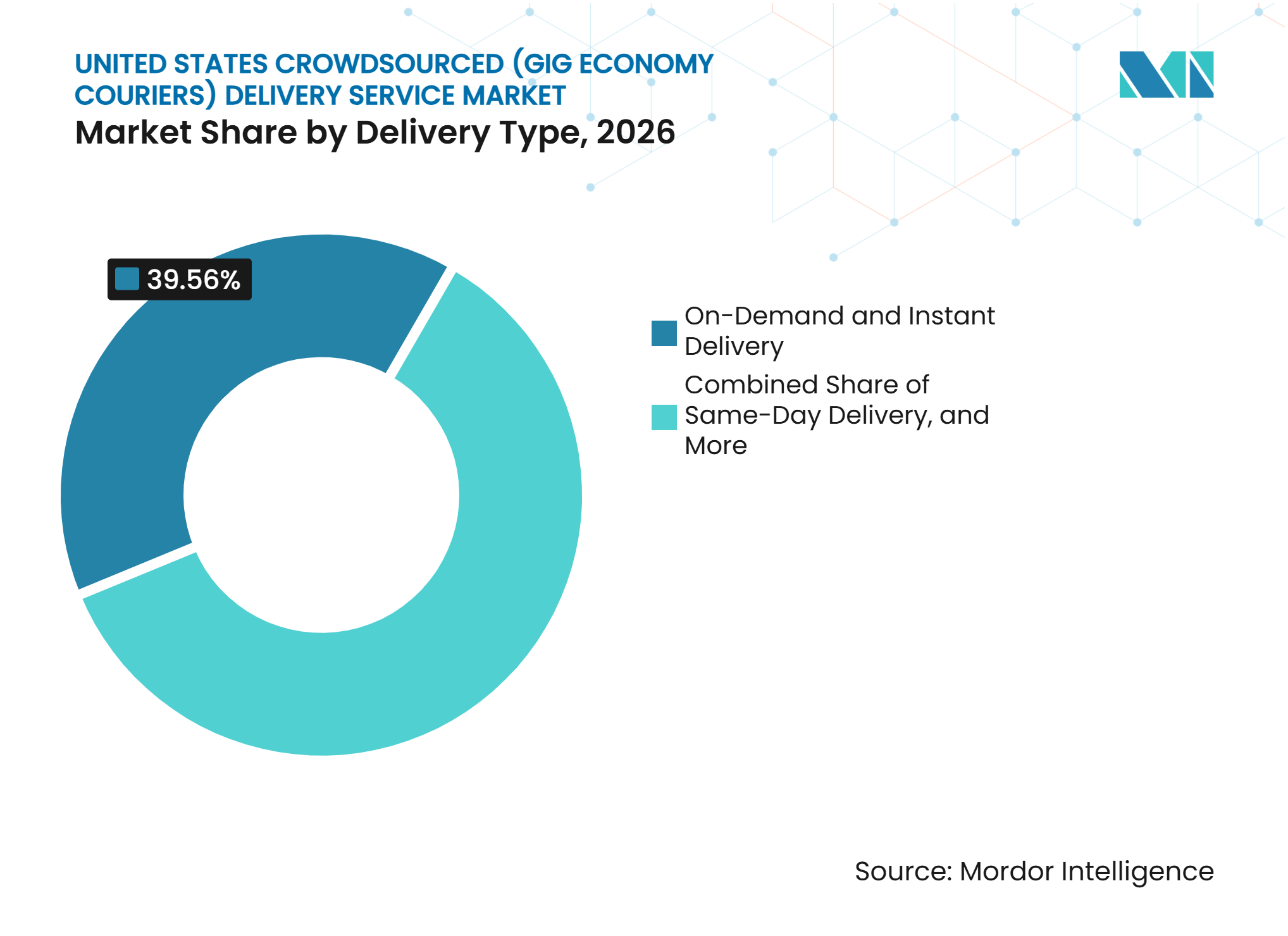
On-Demand Leads, Same-Day AcceleratesOn-demand and instant delivery held 39.56% of the United States crowdsourced (gig economy couriers) delivery service market share in 2026. It is the leading delivery type across restaurants, convenience orders, and quick retail purchases, where customers place a high value on speed. DoorDash and Uber Eats built broad consumer usage around delivery windows below 60 minutes. Those platforms have extended fast service into pharmacy, electronics, and grocery categories. Retailers are using crowdsourced networks for e-commerce orders that once moved mainly through parcel carriers. DoorDash introduced DashMart Fulfillment Services for inventory handling, picking, packing, and delivery in 2025. This gives platforms a way to handle same-day retail volume that was less available to gig networks in earlier years.
Same-day delivery records the highest growth rate among delivery types at a 13.12% CAGR from 2027 to 2032. Next-day and express delivery serve cross-district orders and larger baskets where a same-day window is impractical. These services sit between fast local delivery and conventional parcel delivery. Scheduled delivery supports recurring household purchases and subscription orders. It allows platforms to plan courier capacity before demand peaks. The mix of delivery types reflects a wider range of consumer speed requirements. It also broadens the group of orders that crowdsourced networks can serve. The United States crowdsourced (gig economy couriers) delivery service market can use planned orders to improve route efficiency. On-demand orders remain important because they sustain frequent courier activity throughout the day.



By Business Model:
B2C Commands Volume and GrowthB2C delivery accounted for 72.37% of the United States crowdsourced (gig economy couriers) delivery service market size in 2026 and recorded the highest projected CAGR at 13.64% from 2027 to 2032. Household ordering remains the principal source of demand for platform couriers. The result combines more frequent consumer ordering with a broader range of available categories. Food, grocery, convenience goods, pharmacy items, and retail purchases all contribute to this model. Walmart announced restaurant delivery from Dunkin' and Subway locations through its crowdsourced infrastructure in September 2026. This shows that large retailers are extending B2C delivery beyond their traditional product lines. B2C platforms benefit from dense household demand because it supports more orders within the same service areas. The model also creates opportunities for cross-category ordering within a single consumer account.
B2B delivery serves businesses that need same-day transportation for documents, industrial components, and professional supplies. Its share is smaller than B2C delivery, but its service requirements can be more specialized. Curri focuses on construction logistics, while Dispatch provides a business-facing same-day service. These operators compete through vertical knowledge rather than broad consumer scale. C2C delivery remains at an earlier stage. It reflects demand for peer-to-peer shipments that can use platform courier infrastructure. The United States crowdsourced (gig economy couriers) delivery service market also serves this type of marketplace transaction through providers such as GoShare. The three models give platforms different ways to use courier capacity across consumer and business demand.
By Delivery Distance:
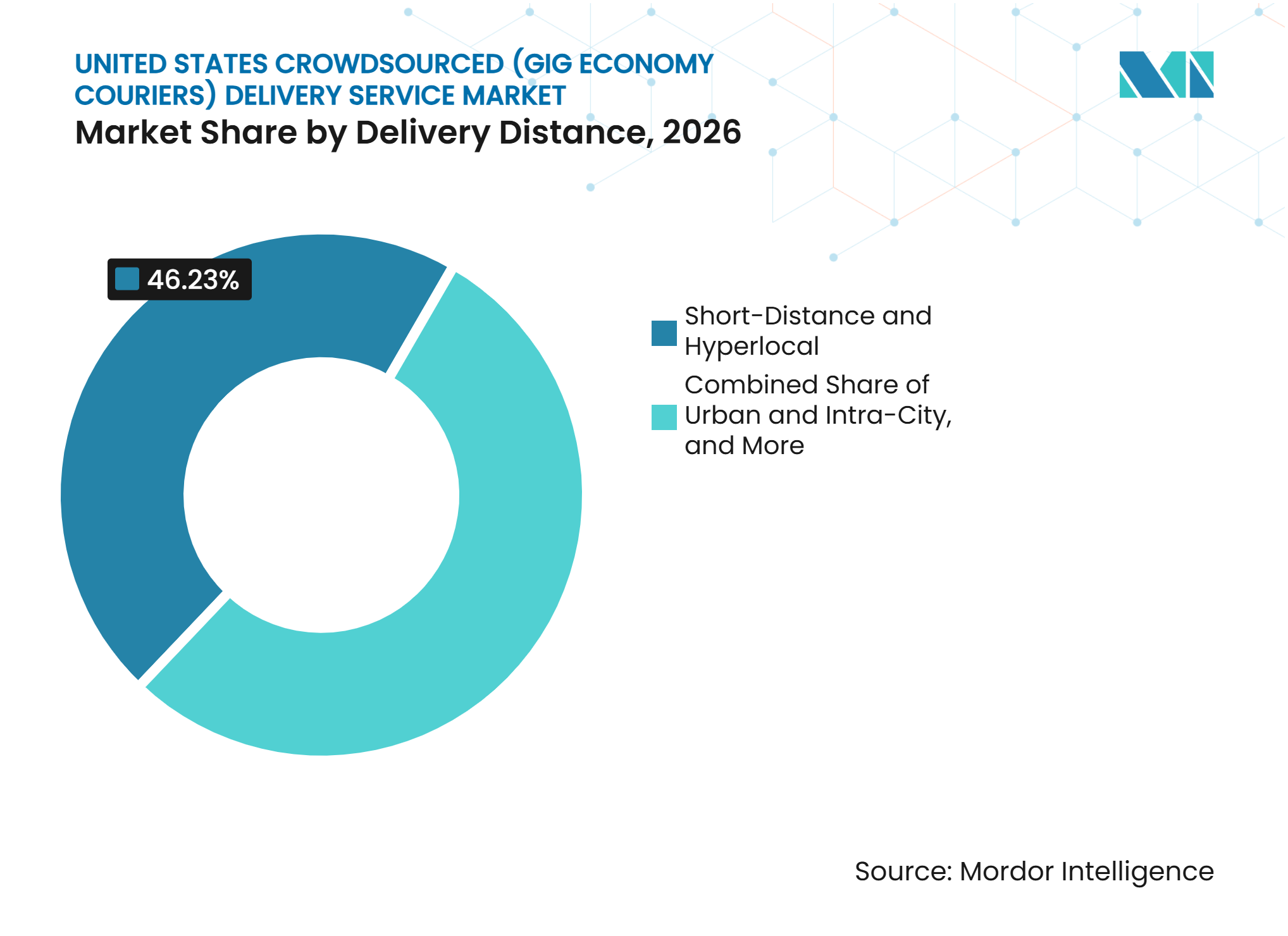
Hyperlocal Scale, Peri-Urban Momentum BuildsShort-distance and hyperlocal delivery held 46.23% of the United States crowdsourced (gig economy couriers) delivery service market in 2026. Restaurant and quick-commerce orders often move within a 1-to-3-mile area. This distance profile supports more courier trips per hour and improves delivery economics. Micro-fulfillment and dark-store investment depend on inventory being close to dense residential areas. This arrangement creates a density advantage for platforms with local merchant coverage. Population movement into suburban and exurban locations is expanding demand outside central city areas. The United States crowdsourced (gig economy couriers) delivery service market is adapting its route design to reach those communities.
Extended urban and peri-urban delivery recorded the highest growth rate at a 12.84% CAGR from 2027 to 2032. Veho expanded to 66 United States markets in February 2026, adding Phoenix, Las Vegas, and greater Los Angeles coverage and reaching 44% of Americans. The expansion shows how delivery operators are pursuing suburban density rather than waiting for these areas to develop into dense urban centers. Urban and intra-city delivery remains concentrated in city corridors with high courier availability. It also provides a primary setting for drone and autonomous robot pilots. These pilots tend to operate where demand is concentrated and local operating conditions are more manageable. Longer suburban routes can carry different costs and service risks than dense urban routes. Platforms, therefore, need both hyperlocal density and broader coverage capabilities. Distance-based service design remains central to how operators manage courier utilization.

By Courier Engagement Model:
Gig Independence Leads, Hybrid Models RiseIndependent gig couriers accounted for 67.19% of the United States crowdsourced (gig economy couriers) delivery service market size in 2026. They form the core supply model for DoorDash, Uber Eats, Instacart, Roadie, and many other platforms. Independent work gives couriers flexibility in when and where they accept orders. It also enables platforms to increase delivery capacity without maintaining a large employed driver base. This model blends flexible work with a clearer commitment to specific operating needs. It can reduce order cancellations and support more reliable same-day fulfillment for national retail agreements. State-level classification requirements encourage platforms to document these arrangements carefully.
Part-time contracted drivers record the highest projected CAGR at 12.19% from 2027 to 2032. Texas House Bill 4215 requires written independent contractor agreements for delivery network companies. Nebraska added separate conditions for marketplace platform workers under its Employment Security Law. Full-time partnered drivers serve specialized work where reliability requirements are higher. Medical and pharmaceutical deliveries are examples of service areas that can require a more dedicated courier model. A tiered labor structure allows platforms to match different courier arrangements with different delivery commitments. Independent drivers remain important for casual on-demand volume. Part-time and full-time arrangements can support contracts where service consistency is more important. This model gives operators several ways to manage supply-side risk.
By Platform Type:
Mobile Supremacy, Web Expands Enterprise ReachMobile application platforms held 89.17% of the United States crowdsourced (gig economy couriers) delivery service market share in 2026. Smartphone-based ordering and courier dispatch are the operating standard for consumer and driver activity. Mobile tools support real-time price adjustments, routing, order tracking, and courier communication. They are central to the consumer-facing delivery experience. Enterprise users are adopting browser-based tools for fleet management, multi-carrier comparison, and integrated workflows. These uses differ from consumer ordering because they often require dashboards and detailed operating data. The United States crowdsourced (gig economy couriers) delivery service market uses web systems to extend gig networks into business procurement processes.
Web-based platforms record the highest projected CAGR at 12.23% from 2027 to 2032. Enveyo integrated UniUni's last-mile delivery network into its logistics platform in January 2026. The integration gives shippers and third-party logistics providers access to delivery capacity through a web-based platform. Such access is useful for organizations managing high volumes of routing decisions. Web interfaces can support analytics and data review that are less central to a mobile ordering process. Mobile and web platforms therefore address different parts of the delivery workflow. Mobile systems coordinate individual orders and drivers in real time. Web systems connect networks with retailers, shippers, and logistics teams. The two channels operate together as delivery platforms broaden their commercial reach.
By Vehicle Type:
Four-Wheelers Lead, Drones Redefine Speed EconomicsFour-wheelers held 76.40% of the United States crowdsourced (gig economy couriers) delivery service market share in 2026. Cars remain suited to the United States grocery, restaurant, and retail delivery because many routes cover suburban areas and carry larger baskets. Their role reflects the physical layout of many American communities. Two-wheelers are more useful in dense urban locations where traffic can favor bicycles and motorcycles. Vans and light commercial vehicles support oversized and bulky orders that passenger vehicles cannot handle. The Federal Aviation Administration proposed a Part 108 framework in August 2025 to replace case-by-case waiver processes with a scalable approval path for beyond-visual-line-of-sight operations.
Drones and autonomous vehicles record the highest projected CAGR at 25.70% from 2027 to 2032. Amazon expanded Prime Air delivery during 2026, with planned service in nearly 500 cities by year-end for eligible items under 5 pounds. Zipline increased autonomous delivery flight volumes in Dallas-Fort Worth during 2025 and processed thousands of daily drone orders from restaurant and retail partners. These programs show that autonomous service is moving beyond limited demonstration activity. Drones can be suited to small, time-sensitive orders. Their use still depends on approved operating rules, suitable weather, and local route conditions. The United States crowdsourced (gig economy couriers) delivery service market may continue to use four-wheelers for larger baskets and longer suburban trips. The vehicle mix may vary by order size, location, and required delivery time.
By End User:
E-Commerce Leads Share, Q-Commerce AcceleratesE-commerce and online retail hold the largest end-user share at 36.29% of the United States crowdsourced (gig economy couriers) delivery service market size in 2026. National retailers are turning store networks into distributed fulfillment locations and moving more last-mile orders through gig delivery networks. Its growth is supported by micro-fulfillment networks that enable delivery of groceries and household essentials in less than 30 minutes. Instacart and Gopuff formed a United States partnership in September 2026 that gave Instacart customers access to Gopuff’s fulfillment network for delivery of everyday goods in as little as 15 minutes. Shipt’s gig-driver fleet supports much of this delivery activity. These steps show how e-commerce fulfillment has become closely tied to crowdsourced delivery capacity.
Quick commerce records the highest projected CAGR at 15.67% from 2027 to 2032. E-commerce and online retail, grocery, and traditional retail are other high-volume end-user groups. National chains are expanding their use of third-party delivery networks. Kroger expanded its DoorDash agreement across more than 2,600 stores in 2025. Healthcare and Pharmaceuticals remain smaller but strategically important because same-day service can be a competitive feature. Business, document, and professional courier services involve time-sensitive work that general networks do not always optimize. Dispatch and Dropoff focus on these reliability-critical delivery windows. Each end-user group has distinct order size, urgency, and handling needs. Platforms build service models around those differences.
Geography Analysis
The Southeast held 29.14% of the United States crowdsourced (gig economy couriers) delivery service market in 2026. Atlanta, Miami, Dallas, Houston, and Charlotte combine large customer bases, restaurant-dense commercial areas, and suburban route structures. Year-round demand and population growth support regular on-demand delivery use in the region. DoorDash identified the South as a strong region with demand from morning through late night, while college markets, such as Austin, added volume beyond the largest urban centers. The Northeast ranks second because high urban density supports micro-route economics.
The Southwest records the highest projected CAGR at 13.05% from 2027 to 2032. Phoenix, Las Vegas, San Antonio, and Albuquerque are receiving population inflows while delivery capacity develops. Texas rules that took effect in September 2025 gave platforms clearer operating requirements, and Favor expanded a multi-brand restaurant agreement across more than 550 Texas locations in June 2026. Veho added Phoenix, Scottsdale, and Las Vegas in February 2026, increasing its presence in the Southwest.
The United States crowdsourced (gig economy couriers) delivery service market in the West has a high concentration of platform experimentation and technology activity. The Midwest covers a broader and lower-density territory, where Roadie expanded its RoadieXD network into Canton Township and Pittsburgh in May 2025 to widen reliable same-day coverage. These cross-dock facilities support same-day service in industrial corridors. Regional performance depends on population density, merchant concentration, courier availability, and the local delivery mix.
Competitive Landscape
Market Concentration
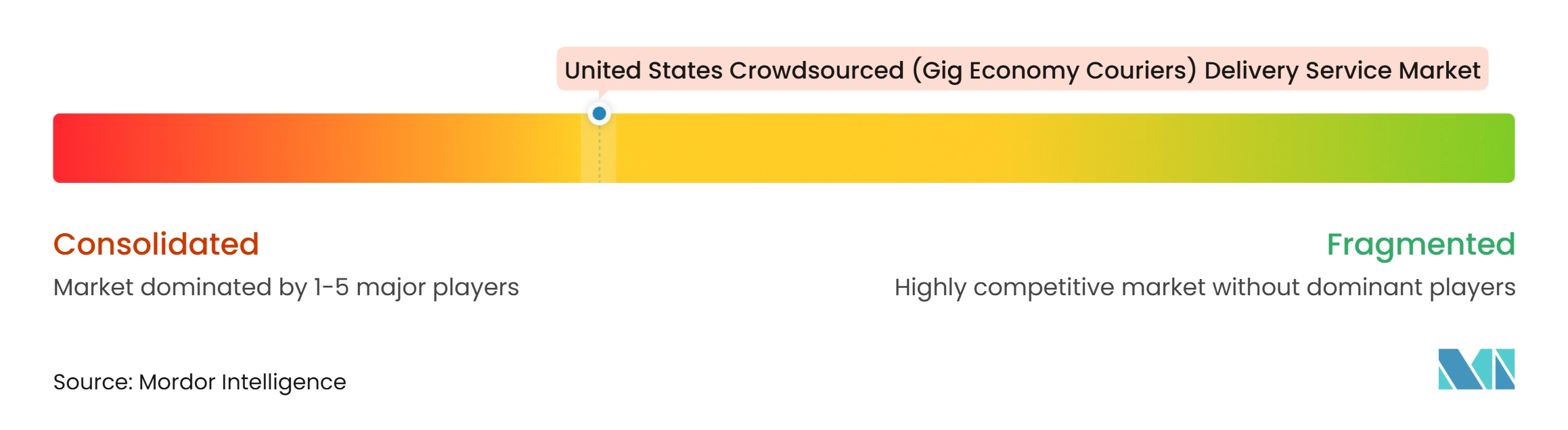
The United States crowdsourced (gig economy couriers) delivery service market is concentrated at the top tier, where DoorDash, Uber Eats, Uber Direct, and Maplebear, which operates as Instacart, hold leading positions. A fragmented group of vertical specialists serves demand profiles that broad platforms handle less efficiently. DoorDash expanded its commercial activity beyond delivery into restaurant booking, ordering, and customer management. The company also pursued commercial drone operations and introduced Dot autonomous delivery robots in Phoenix and Dallas during 2026. This approach combines human couriers, robots, and drones for different order types.
Instacart partnered with Gopuff in September 2026 to add a 15-minute delivery capability for groceries and household goods. The arrangement also extends Carrot Ads technology to Gopuff's digital storefront. Curri targets construction supply orders that can include palletized materials and jobsite protocols. Veho expanded its market coverage by 50% between 2025 and early 2026, reaching 44% of Americans. Its expansion reflects competition for e-commerce delivery volume that can move away from legacy carriers.
The United States crowdsourced (gig economy couriers) delivery service market requires platforms to manage independent contractor documentation and local operating rules. The Department of Labor bulletin gives firms a federal reference point, while state requirements can still differ. Larger platforms can spread compliance and technology costs across more orders, while smaller operators compete through specialized service, regional density, or customer-specific integrations. Pharmaceutical last-mile delivery, B2B industrial supply, and multimodal fulfillment remain areas for specialization, while retailers also need coordination across pickup, delivery, and ship-to-home orders.
United States Crowdsourced (Gig Economy Couriers) Delivery Service Industry Leaders
-
Amazon, Inc.
-
DoorDash, Inc.
-
Uber Technologies, Inc.
-
Grubhub Holdings Inc.
-
Instacart (including Maplebear, Inc.)
- *Disclaimer: Major Players sorted in no particular order
United States Crowdsourced (Gig Economy Couriers) Delivery Service Market Companies Covered in this Report
- DoorDash, Inc.
- Uber Technologies, Inc.
- Instacart (Including Maplebear Inc.)
- Grubhub Holdings Inc.
- Amazon, Inc.
- Walmart Inc.
- Target Corporation
- United Parcel Service of America, Inc. (UPS)
- Gopuff
- Taskrabbit Delivery (Dolly)
- Burq, Inc.
- Veho Technologies, Inc.
- Dispatch, Inc.
- Curri, Inc.
- GoShare, Inc.
- Dropoff, Inc.
- Jitsu (AxleHire, Inc.)
- UniUni Logistics, Inc.
- Favor Delivery, LLC
- Roadie, Inc.
Recent Industry Developments in United States Crowdsourced (Gig Economy Couriers) Delivery Service Market
- October 2026: Shipt added 8 Wakefern-affiliated grocery banners, including ShopRite, Price Rite Marketplace, and Fairway Market, covering more than 350 stores across New Jersey, New York, Pennsylvania, Connecticut, Maryland, and Massachusetts. The partnership extended same-day crowdsourced grocery coverage across the Northeast.
- September 2026: Instacart and Gopuff entered into an agreement allowing Instacart marketplace customers to access Gopuff's micro-fulfillment network for 15-minute delivery of groceries and household goods. The agreement also extended Instacart's Carrot Ads technology to Gopuff's digital storefront.
- September 2026: DoorDash and Costco launched a United States-wide same-day and scheduled delivery partnership covering nearly 630 warehouse locations across 47 states and Washington, DC.
- September 2026: Uber expanded its Uber Eats partnership with Costco from 17 states to 47 states, bringing nearly 600 United States Costco locations onto the platform for on-demand and scheduled delivery.
United States Crowdsourced (Gig Economy Couriers) Delivery Service Market Report Scope
Segmentation Overview
| On-Demand and Instant Delivery |
| Same-Day Delivery |
| Next-Day and Express Delivery |
| Scheduled Delivery |
| Other Delivery Types |
| Business-to-Business (B2B) |
| Business-to-Consumer (B2C) |
| Consumer-to-Consumer (C2C) |
| Short-Distance and Hyperlocal |
| Urban and Intra-City |
| Extended Urban and Peri-Urban |
| Independent Gig Couriers |
| Part-Time Contracted Drivers |
| Full-Time Partnered Drivers |
| Mobile Application |
| Web-Based Platform |
| Two-Wheelers |
| Four-Wheelers |
| Vans and Light Commercial Vehicles |
| Drones and Autonomous Vehicles |
| Other Vehicle Types |
| E-Commerce and Online Retail |
| Quick Commerce (Q-Commerce) |
| Foodservice and Restaurant |
| Grocery and Traditional Retail |
| Healthcare and Pharmaceuticals |
| Business, Document and Professional Courier Services |
| Other Commercial and Specialized Deliveries |
| Midwest |
| Northeast |
| Southeast |
| Southwest |
| West |
| By Delivery Type | On-Demand and Instant Delivery |
| Same-Day Delivery | |
| Next-Day and Express Delivery | |
| Scheduled Delivery | |
| Other Delivery Types | |
| By Business Model | Business-to-Business (B2B) |
| Business-to-Consumer (B2C) | |
| Consumer-to-Consumer (C2C) | |
| By Delivery Distance | Short-Distance and Hyperlocal |
| Urban and Intra-City | |
| Extended Urban and Peri-Urban | |
| By Courier Engagement Model | Independent Gig Couriers |
| Part-Time Contracted Drivers | |
| Full-Time Partnered Drivers | |
| By Platform Type | Mobile Application |
| Web-Based Platform | |
| By Vehicle Type | Two-Wheelers |
| Four-Wheelers | |
| Vans and Light Commercial Vehicles | |
| Drones and Autonomous Vehicles | |
| Other Vehicle Types | |
| By End User | E-Commerce and Online Retail |
| Quick Commerce (Q-Commerce) | |
| Foodservice and Restaurant | |
| Grocery and Traditional Retail | |
| Healthcare and Pharmaceuticals | |
| Business, Document and Professional Courier Services | |
| Other Commercial and Specialized Deliveries | |
| By Geography | Midwest |
| Northeast | |
| Southeast | |
| Southwest | |
| West |
Key Questions Answered in the Report
What is the value of the United States crowdsourced (gig economy couriers) delivery service market?
It stands at USD 30.99 billion in 2026, rises to USD 34.19 billion in 2027, and reaches USD 52.15 billion by 2032 at an 8.81% CAGR (2027-2032). E-commerce fulfillment, retailer partnerships, and courier availability support this expansion.
Which delivery type leads United States crowdsourced (gig economy couriers) delivery service market?
On-demand and instant delivery leads with 39.56% share in 2026. Same-day delivery grows fastest at a 13.12% CAGR through 2032, as retailers place more e-commerce orders on local delivery networks.
Which business model is most important for crowdsourced delivery in the United States?
B2C leads with 72.37% share in 2026 and also grows fastest at a 13.64% CAGR through 2032. Household ordering across food, grocery, and retail underpins its position.
Which United States region has the largest crowdsourced delivery presence?
The Southeast leads with 29.14% share in 2026. The Southwest grows fastest at a 13.05% CAGR through 2032, supported by migration into metropolitan areas where delivery coverage is expanding.
What vehicle category is growing fastest in the United States crowdsourced (gig economy couriers) delivery service market?
Drones and autonomous vehicles record the highest projected CAGR at 25.70% through 2032, while four-wheelers hold 76.40% share in 2026. Cars remain necessary for larger baskets and longer suburban delivery routes.
What factors limit crowdsourced delivery growth?
Courier compensation and vehicle-cost inflation, worker classification rules, low-density routes, and merchant-owned fulfillment create operating pressure. These factors can affect courier supply, compliance costs, delivery reliability, and platform margins.