
United States Compliance Training For Financial Institutions Market Size and Share
Market Overview
| Study Period | 2021 - 2031 |
|---|---|
| Forecast Data Period | 2026 - 2031 |
| Base Year Market Size (2025) | USD 1.01 Billion |
| Market Size (2026) | USD 1.05 Billion |
| Market Size (2031) | USD 1.51 Billion |
| Growth Rate (2026 - 2031) | 7.48 % |
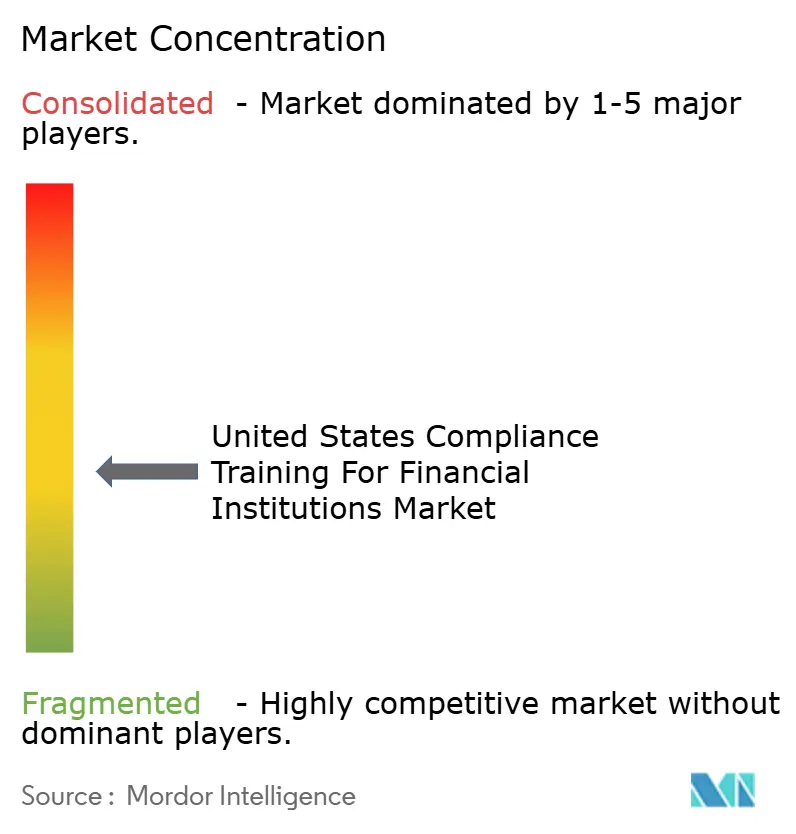
| Market Concentration | Medium |
Major Players *Disclaimer: Major Players sorted in no particular order Image © Mordor Intelligence. Reuse requires attribution under CC BY 4.0. | |
United States Compliance Training For Financial Institutions Market Analysis by Mordor Intelligence
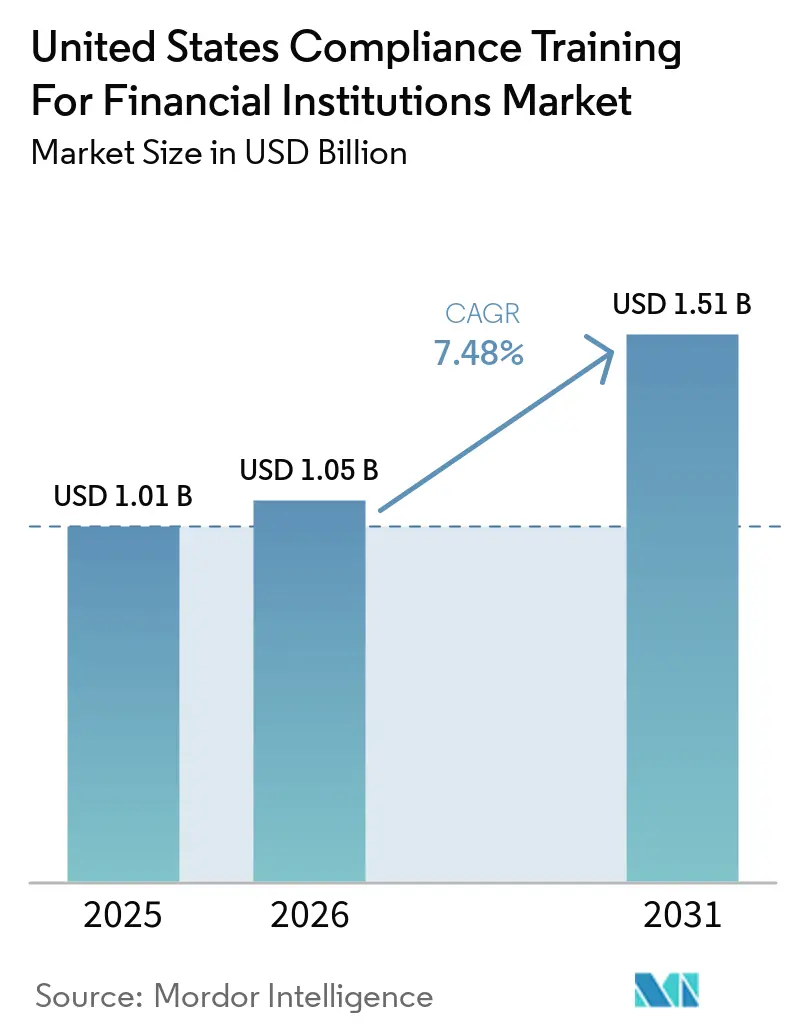
The United States compliance training market for financial institutions was valued at USD 1.01 billion in 2025 and is projected to grow from USD 1.05 billion in 2026 to USD 1.51 billion by 2031, with a CAGR of 7.48% during 2026-2031. Stricter federal training requirements drive growth, as agencies now treat employee training as a core, auditable component rather than an optional activity. The adoption of digital workflows in onboarding, surveillance, customer data management, and supervisory review is also expanding the market by creating new training needs and requiring frequent content updates. Market competitiveness increasingly depends on providers' ability to link training records with compliance evidence, risk systems, and third-party oversight requirements, rather than just offering a wide range of courses. Key opportunities include role-specific AML content, data privacy and customer information protection modules, contractor oversight training, and analytics-driven online delivery platforms, which help institutions respond effectively to regulatory changes. Challenges such as budget constraints, free introductory modules, and user fatigue persist. However, regulated demand ensures the market's stability and growth potential in the United States[1].
Key Report Takeaways
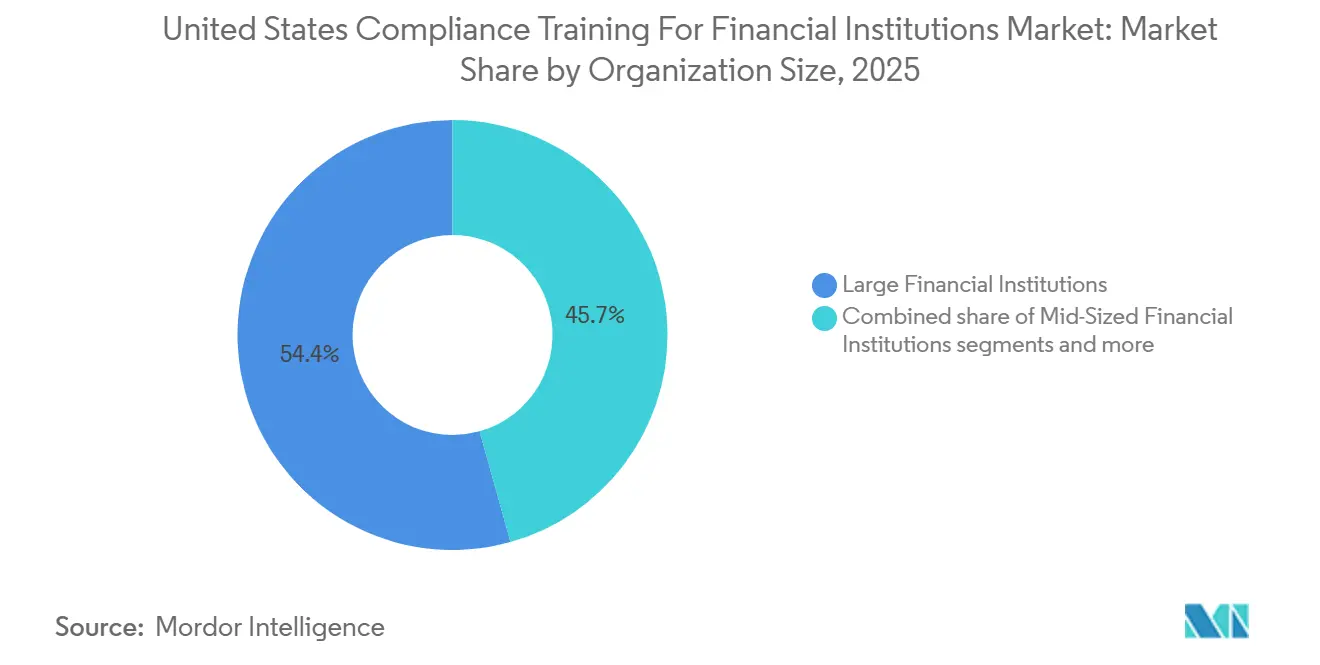
- By organization size, Large Financial Institutions commanded a 54.35% share of the United States Compliance Training for Financial Institutions Market in 2025, while Mid-Sized Financial Institutions are projected to grow at the highest CAGR of 8.51% by 2031.
- By delivery mode, Online Learning commanded a 63.46% share of the United States Compliance Training for Financial Institutions Market in 2025 and is also projected to grow at the highest CAGR of 7.98% by 2031.
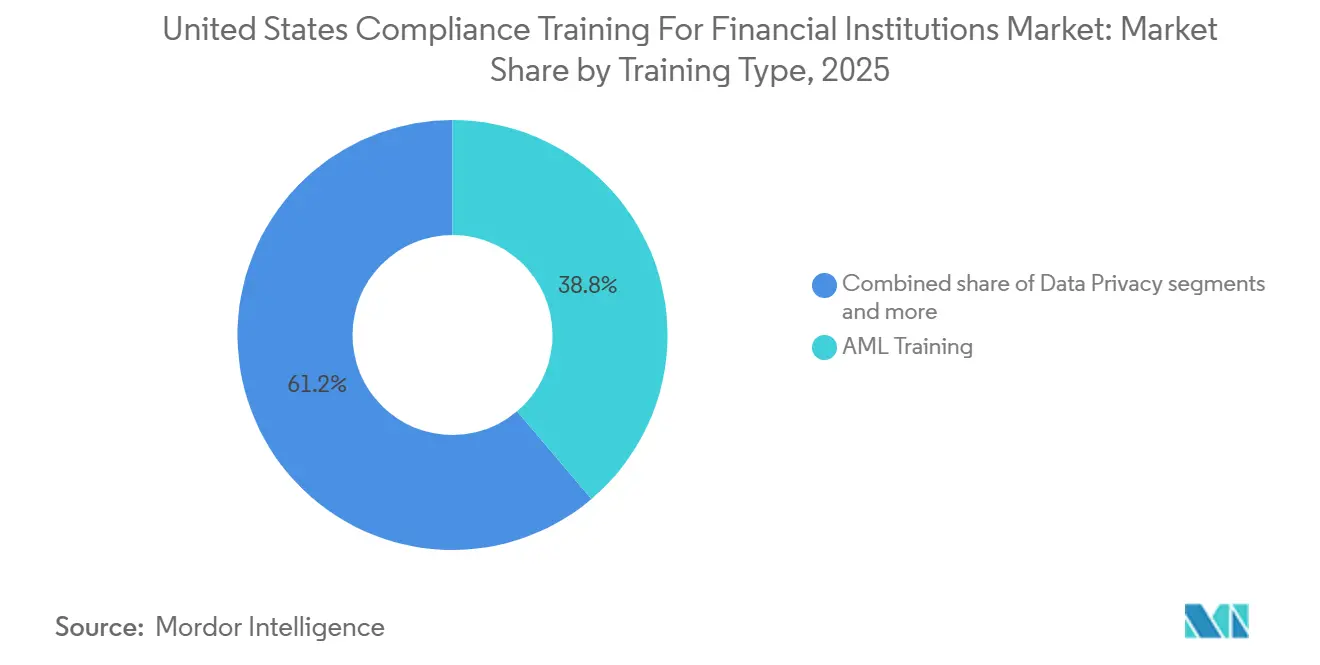
- By training type, AML Training commanded a 38.82% share of the United States Compliance Training for Financial Institutions Market in 2025, while Data Privacy Training is projected to grow at the highest CAGR of 8.43% by 2031.
- By end user, Banks commanded a 48.41% share of the United States Compliance Training for Financial Institutions Market in 2025, while Investment Firms are projected to grow at the highest CAGR of 8.84% by 2031.
- By region, the South commanded a 36.95% share of the United States Compliance Training for Financial Institutions Market in 2025, while the West is projected to grow at the highest CAGR of 8.96% by 2031.
Note: Market size and forecast figures in this report are generated using Mordor Intelligence’s proprietary estimation framework, updated with the latest available data and insights as of January 2026.
United States Compliance Training For Financial Institutions Market Trends and Insights
Drivers Impact Analysis*
| Driver | (~) % Impact on CAGR Forecast | Geographic Relevance | Impact Timeline |
|---|---|---|---|
| Rising Regulatory Intensity Across Banking and Capital Markets | +2.5% | National, concentrated in New York, California, and Texas | Short term (≤ 2 years) |
| Rapid Digitalization of Financial Workflows and Control Burden | +2.3% | National, with early gains in West and Northeast fintech hubs | Medium term (2-4 years) |
| AML and KYC Training Expansion Driven by Financial Crime Exposure | +1.7% | National, elevated in money-center markets including New York, Illinois, and California | Short term (≤ 2 years) |
| Audit-Ready Learning Records Tied to GRC and Internal Controls | +1.0% | National, with spillover to Midwest and Southeast banking clusters | Medium term (2-4 years) |
| Compliance Training Demand from Third-Party and Contractor Oversight | +0.9% | National, with early gains in California, Texas, and New York | Medium term (2-4 years) |
| AI-Assisted Personalization and Learning Analytics Adoption | +0.8% | National, with spillover to emerging technology hubs in the South | Long term (≥ 4 years) |
| Source: Mordor Intelligence | |||
Rising Regulatory Intensity Across Banking and Capital Markets
Federal agencies are enforcing stricter standards for staff training across supervised financial institutions. A joint proposal from FinCEN, the FDIC, the OCC, and the NCUA emphasizes integrating employee training into the core framework of risk-based compliance programs. This proposal highlights the importance of structured and ongoing training. FINRA requires firms to annually assess training needs and maintain a written Firm Element plan that reflects business activities, regulatory updates, and supervisory requirements. The OCC has clarified procedures for community banks by allowing examiners to evaluate or carry forward conclusions related to the training pillar only when justified by risk conditions. Training records remain within the examination scope under this approach. These developments raise the baseline for compliance training in the financial institutions market, as organizations must now prioritize defensible training designs, proper evidence retention, and regular updates. This shift moves away from reliance on one-off awareness sessions, ensuring a more robust, repeatable compliance training framework[2].
Rapid Digitalization of Financial Workflows and Control Burden
The transition to digital onboarding, customer communication, transaction monitoring, and information security has significantly expanded the scope of training required for financial institutions. FINRA's e-learning catalog highlights the reliance of United States firms on a wide range of modules addressing AML, books and records, privacy, cybersecurity, electronic communications, and supervisory responsibilities. This shift reflects a greater and more diverse training demand than in traditional compliance models[3]. The implementation of SEC Regulation S-P has further increased training needs, requiring broker-dealers and related institutions to prepare staff for incident response, customer information protection, and breach notification processes. Additionally, comments from the Bank Policy Institute on California privacy and automated decision-making proposals underscore how digital tools are reshaping governance expectations, influencing operational and training practices. As a result, the compliance training market for financial institutions in the United States is expanding not only due to regulatory changes but also because digital control environments create additional training requirements within organizations.
AML and KYC Training Expansion Driven by Financial Crime Exposure
AML and KYC remain essential as detecting suspicious activities, conducting customer due diligence, and managing escalation processes rely heavily on human judgment. Financial institutions are required to maintain AML and CFT programs that align with their specific risk profiles, products, locations, and customer bases, as highlighted in the joint SAR FAQs issued in October 2025. The increasing focus on role-specific training is evident in FINRA's 2026 course catalog, which includes tailored modules for supervisors, operations professionals, and registered representatives. A federal proposal released in April 2026 further emphasizes the need for employee training to be an integral part of an effective AML and CFT framework for supervised institutions. This approach ensures that compliance training remains relevant and adaptable, addressing the evolving nature of typologies, fraud methods, and red flags. The demand for AML compliance education in the United States compliance training market continues to grow, as institutions cannot rely on static, generic content in a constantly changing regulatory and operational environment.
Audit-Ready Learning Records Tied to GRC and Internal Controls
Training holds greater value when it serves as evidence rather than merely indicating attendance. Research by CSBS on community bank compliance costs highlights that staff training, audit procedures, regulatory information provision, and technology investments are fixed burdens that do not scale with size. This has increased the demand for systems that integrate training records with control documentation. FINRA's requirement for an annual written plan further supports platforms that consolidate learners, topics, and completion histories into a single, searchable record set. NAVEX's Training Insights launch reflects this shift by emphasizing audit-friendly dashboards, program effectiveness, and knowledge gap tracking over simple completion counts. As a result, the compliance training market for financial institutions in the United States is evolving towards evidence-based management linked to governance, risk, and compliance systems, moving away from standalone e-learning administration.
Restraints Impact Analysis*
| Restraint | (~) % Impact on CAGR Forecast | Geographic Relevance | Impact Timeline |
|---|---|---|---|
| Training Fatigue Among Frontline Staff and Branch Employees | -0.6% | National, with disproportionate impact in Midwest and Southeast community banks | Short term (≤ 2 years) |
| Budget Pressure from Consolidated RegTech and L&D Procurement | -0.5% | National, concentrated in New York, Charlotte, and Chicago | Medium term (2-4 years) |
| Open-Source and Free Introductory Modules Reducing Paid Demand | -0.4% | National, with spillover to smaller and mid-sized institutions | Short term (≤ 2 years) |
| Data Governance Concerns Around Learner Monitoring and Behavioral Analytics | -0.3% | National, with higher sensitivity in California | Long term (≥ 4 years) |
| Source: Mordor Intelligence | |||
Training Fatigue Among Frontline Staff and Branch Employees
Training requirements are increasing faster than frontline staff can effectively manage. Community banks and institutions with extensive branch networks often require the same employees to complete annual training in areas such as AML, privacy, conduct, cybersecurity, consumer protection, and operational procedures. Research from CSBS highlights that smaller institutions face significant fixed compliance costs, limiting their ability to redesign training content or adjust delivery schedules to reduce fatigue[4]. When training is viewed as a routine obligation, institutions become more cautious about adding new modules and focus on cost efficiency. This approach does not eliminate the need for compliance training in financial institutions across the United States, but it underscores the need for concise, role-specific, and well-timed training programs.
Budget Pressure from Consolidated RegTech and L&D Procurement
Financial institutions are increasingly prioritizing systems that offer multiple functionalities within a single platform. The integration of written training plans, audit evidence, regulatory change tracking, and control documentation is driving the adoption of bundled GRC platforms over stand-alone course providers. Compliance overhead data from CSBS indicates a preference for solutions that streamline processes, reduce manual tasks, and eliminate redundant technology expenses. This shift creates challenges for providers that focus solely on banking compliance courses, as it requires them to offer features such as analytics, integration, and workflow alignment. As the compliance training market for financial institutions in the United States continues to grow, vendors face challenges in maintaining pricing competitiveness if their solutions do not align with the trend toward procurement consolidation.
*Our forecasts treat driver/restraint impacts as directional, not additive. The impact forecasts reflect baseline growth, mix effects, and variable interactions.
Segment Analysis
By Organization Size: Large Institutions Anchor Spend While Mid-Sized Institutions Lift Growth
Large Financial Institutions accounted for 54.35% of the user-supplied 2025 revenue distribution, making them the largest organization-size segment in the United States compliance training market. Their scale enables multi-year contracts, centralized governance, and platforms that integrate content assignment with reporting and evidence retention. These institutions face significant control complexity, requiring coordination of training across business lines, geographies, and supervisory roles under recurring examination requirements. This complexity sustains high average spending per institution, even under-pricing pressures. The largest buyers use the market not only for training courses but also to ensure control consistency.
Mid-Sized Financial Institutions are projected to grow at a compound annual growth rate (CAGR) of 8.51% through 2031, making them the fastest-growing segment. Research by the Conference of State Bank Supervisors (CSBS) on fixed compliance costs shows that smaller and mid-tier institutions face a proportionally higher burden from training, audits, and information requests than their size would suggest. These organizations often lack internal resources to update content, manage learning systems, and document evidence at the pace regulators require. This creates demand for outsourced compliance training solutions that reduce manual effort without requiring enterprise-scale implementation. Growth in the United States compliance training market is shifting toward institutions too complex for manual programs but too resource-constrained to develop comprehensive internal systems.

By Delivery Mode: Online Learning Holds the Lead and Keeps Extending Its Reach
Online learning held 63.46% of the delivery split in 2025 and remains the primary mode in the United States compliance training market for financial institutions. Digital delivery simplifies assigning annual modules, tracking completions, storing evidence, and updating content for large employee groups. FINRA's FLEX structure supports web-based course access and helps firms implement centralized training plans. For regulated learners, online delivery offers convenience, repeatability, and documentation, driving its dominant revenue share.
Online learning is the fastest-growing delivery mode, with a reported compound annual growth rate (CAGR) of 7.98% through 2031. It supports distributed staffing models, third-party oversight workflows, and quick policy updates, which are harder to manage with classroom-based formats. Online platforms efficiently integrate features like dashboards, knowledge-gap tracking, phishing simulations, and supplier training. Offline learning remains relevant for discussions, workshops, and officer-level scenario practice but is less relevant for scalable evidence production. The United States compliance training market for financial institutions is expected to remain focused on online workflows, with selective use of in-person formats for specific needs.
By Training Type: AML Leads Current Volume While Data Privacy Gains Speed
AML Training held 38.82% of the 2025 market share, making it the largest training type in the United States compliance training market for financial institutions. This dominance is due to the ongoing importance of suspicious activity reporting, customer due diligence, and account monitoring within regulated financial institutions. The federal proposal introduced in April 2026 emphasizes employee training as a key component of the AML and CFT framework, ensuring AML compliance education remains central to compliance budgets. FINRA's role-based AML modules demonstrate greater depth in training, moving beyond a single annual standard course. This explains why AML Training continues to lead as the largest category, even as the curriculum expands.
Data Privacy Training is projected to grow at a CAGR of 8.43% through 2031, making it the fastest-growing training type in the user-defined segmentation. The focus on customer information protection, incident response readiness, and privacy-related supervisory topics is driving this growth, particularly among broker-dealers and other covered institutions. Regulation S-P amendments and rising data governance expectations contribute to this trend. Industry letters from organizations such as BPI and SIFMA on California proposals highlight how privacy and automated decision-making concerns are influencing financial operations, even as firms seek exemptions or alignment with federal frameworks. While KYC training remains integral to AML program design, and ethics and conduct training stays relevant through annual supervisory reviews, AML Training remains the largest segment, with Data Privacy Training growing rapidly.
By End-User: Banks Dominate Spending While Investment Firms Expand Faster
Banks accounted for 48.41% of the 2025 end-user market share in the United States financial institutions compliance training market. This reflects their extensive compliance obligations, large employee base, and recurring training needs in areas such as the Bank Secrecy Act (BSA), customer compliance, and operational controls, all of which require thorough documentation. The diverse roles within banks, including frontline, back-office, branch, and specialist positions, necessitate multiple tailored training paths, driving spending on both content and platforms. This positions banks as a key segment in the market.
Investment firms are projected to grow at a compound annual growth rate (CAGR) of 8.84% through 2031, making them the fastest-growing end-user segment. Growth is driven by FINRA's annual planning requirements, broker-dealer anti-money laundering (AML) content, and Regulation S-P preparation, which emphasize the need for comprehensive and documented training in securities environments. The FINRA e-learning catalog offers a wide range of broker-dealer training topics, including AML, privacy, books and records, communications, and supervision. Insurance companies and credit unions also contribute significantly to demand, as AML and related training requirements apply across various supervised institution types. While banks dominate market share, investment firms are experiencing faster growth in the United States compliance training market for financial institutions.
Geography Analysis
The South held 36.95% of the 2025 regional market share, making it the largest contributor to the compliance training market for financial institutions. It combines major banking centers with numerous community and regional institutions requiring AML, conduct, privacy, and cybersecurity training. OCC community bank procedures are significant due to the concentration of smaller and mid-sized supervised institutions in Southern states. Online training delivery suits the region's large branch and operations populations, bolstering its revenue base even before considering growth in privacy and analytics use cases.
The West is projected to grow at a CAGR of 8.96% through 2031, driven by its strong technology presence, digital banking adoption, and focus on customer data, automated processes, and third-party ecosystems. Institutions in this region face challenges related to privacy, AI usage, vendor dependencies, and scalable digital learning. These factors create demand for fintech compliance training, customer information protection modules, and supplier oversight solutions. Growth is further supported by the need for faster content updates as operating models evolve.
The Northeast remains a high-value region due to its concentration of broker-dealers, investment firms, money-center banks, and complex supervisory structures. FINRA's Firm Element requirements and Regulation S-P preparation are critical here. New York's NYDFS guidance emphasizes stronger third-party cybersecurity governance, including security awareness materials during oversight cycles. The Midwest is growing steadily, supported by its large community banking base and persistent fixed-cost burdens. Regional variations are influenced more by the mix of institutions and state-level regulations than by changes in federal training requirements.
Competitive Landscape
The United States compliance training market for financial institutions is moderately fragmented. The top players collectively hold less than half of the market, with Thomson Reuters Corporation, Wolters Kluwer N.V., KPMG LLP, Moody's Corporation, and Skillcast Group plc identified as key participants. Thomson Reuters ranks first, but no single provider dominates the market, allowing room for specialized competitors. Competition spans integrated GRC platforms, compliance content specialists, advisory-led providers, and niche online training vendors. Success depends on delivering regulatory relevance, timely updates, quality documentation, and system compatibility.
Recent strategic activities highlight evolving competition. NAVEX expanded its offerings with Training Insights and secured investment through a majority-stake acquisition led by Goldman Sachs Alternatives and Blackstone. LRN introduced Catalyst Supplier, focusing on supplier oversight and AI-enabled microlearning, and further enhanced its platform. Traliant expanded its AML and insider trading training, showing continued demand for role-specific and topical courses. These developments indicate that competition focuses on addressing emerging workflow needs rather than solely on scale.
Despite competition, opportunities remain. Third-party oversight training is less developed compared to internal employee training, even as regulatory guidance emphasizes its importance. Data privacy and customer information protection are growing, but lack the standardization seen in AML libraries. Improved learning analytics that measure knowledge retention and risk reduction without privacy concerns also present opportunities. Market share gains are likely to come from focused product development in areas such as audit evidence, supplier training, and shorter modules for high-risk teams.
United States Compliance Training For Financial Institutions Industry Leaders
-
Thomson Reuters Corporation
-
Wolters Kluwer N.V.
-
KPMG LLP
-
Moody's Corporation
-
Skillcast Group plc
- *Disclaimer: Major Players sorted in no particular order
Recent Industry Developments
- May 2026: Ncontracts launched Nquiry Ntelligence, an AI-powered regulatory intelligence platform using 17 years of compliance data verified by former regulators and compliance attorneys. It helps financial institutions generate auditable, cited answers to regulatory questions quickly, addressing the examination-readiness documentation gap across US financial institutions.
- April 2026: FinCEN, FDIC, OCC, and NCUA issued an NPR to reform AML/CFT program requirements under the Bank Secrecy Act, making risk-based employee training a statutory pillar with tailored frequency and content requirements. This rule impacts training budgets for all BSA-supervised financial institutions nationwide.
- December 2025: NAVEX launched Training Insights within the NAVEX One GRC platform, enabling compliance leaders to access real-time dashboards linking training delivery to behavioral risk outcomes and performance metrics. This feature meets regulatory demands for behavioral evidence beyond course completion records.
- October 2025: Goldman Sachs Alternatives, with Blackstone as a minority investor, acquired a majority stake in NAVEX. This supports NAVEX's global expansion and the development of its NAVEX One GRC and compliance training platform, serving 13,000 organizations worldwide.
United States Compliance Training For Financial Institutions Market Report Scope
| Large Financial Institutions |
| Mid-Sized Financial Institutions |
| Small Financial Institutions |
| Offline Learning |
| Online Learning |
| Anti-Money Laundering (AML) |
| Know Your Customer (KYC) |
| Data Privacy |
| Ethics and Conduct |
| Banks |
| Insurance Companies |
| Investment Firms |
| Credit Unions |
| Northeast |
| Midwest |
| South |
| West |
| By Organization Size | Large Financial Institutions |
| Mid-Sized Financial Institutions | |
| Small Financial Institutions | |
| By Delivery Mode | Offline Learning |
| Online Learning | |
| By Training Type | Anti-Money Laundering (AML) |
| Know Your Customer (KYC) | |
| Data Privacy | |
| Ethics and Conduct | |
| By End-User | Banks |
| Insurance Companies | |
| Investment Firms | |
| Credit Unions | |
| By Region | Northeast |
| Midwest | |
| South | |
| West |
Key Questions Answered in the Report
What is the 2026 value of the United States compliance training for financial institutions space?
The user-supplied 2026 value is USD 1.05 billion, and the same data set projects USD 1.51 billion by 2031 at a 7.48% CAGR.
Which training type leads to spending today?
AML Training is the largest category with a 38.82% share in 2025, supported by ongoing federal AML and suspicious activity reporting expectations.
Which customer group is expanding the fastest?
Investment Firms are the fastest-growing end-user segment with an 8.84% CAGR through 2031, helped by FINRA planning requirements and Regulation S-P readiness.
Why does online delivery lead in this field?
Online Learning held 63.46% share in 2025 because it supports large-scale assignments, quicker content updates, and stronger documentation for audits and exams.
Which United States region is growing the fastest?
The West is forecast to grow at 8.96% CAGR through 2031, reflecting greater exposure to digital workflows, privacy concerns, and technology-linked compliance requirements.
What is the main competitive differentiator among providers?
The strongest differentiator is the ability to combine relevant content with audit-ready reporting, GRC integration, and faster updates for AML, privacy, and third-party oversight.