
United States Compact Construction Equipment Market Size and Share
Market Overview
| Study Period | 2020 - 2032 |
|---|---|
| Forecast Data Period | 2027 - 2032 |
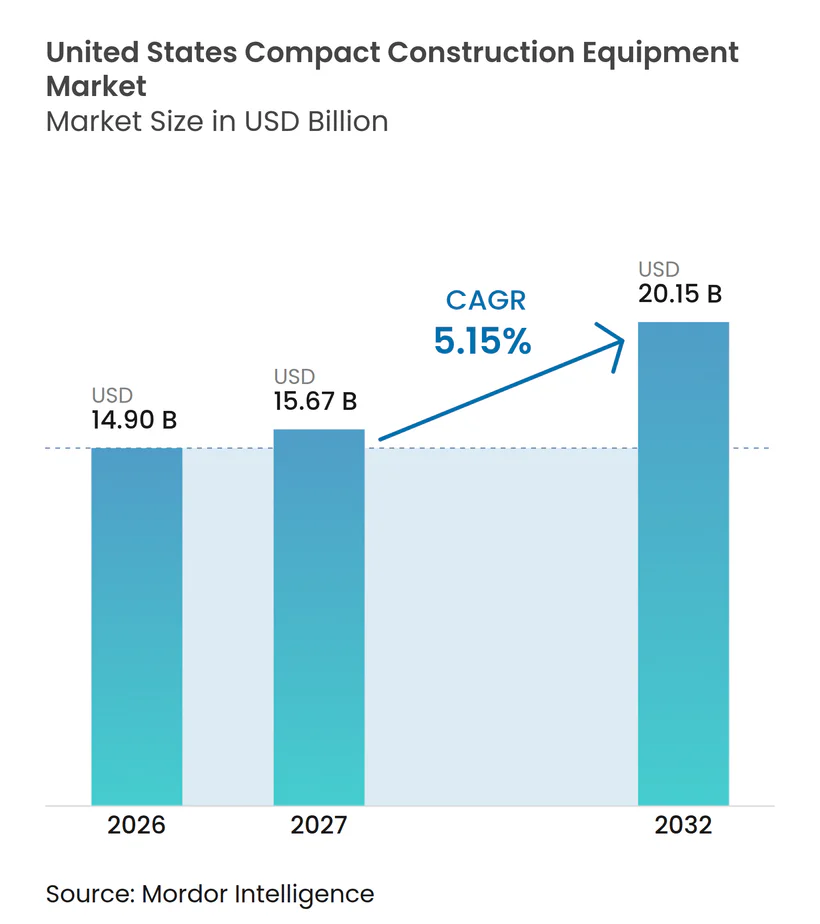
| Base Year Market Size (2026) | USD 14.90 Billion |
| Market Size (2027) | USD 15.67 Billion |
| Market Size (2032) | USD 20.15 Billion |
| Growth Rate (2027 - 2032) | 5.15 % |
| Market Concentration | Medium |
Major Players *Disclaimer: Major Players sorted in no particular order Image © Mordor Intelligence. Reuse requires attribution under CC BY 4.0. | |
United States Compact Construction Equipment Market Analysis by Mordor Intelligence
The United States compact construction equipment market size was valued at USD 14.90 billion in 2026 and is expected to grow from USD 15.67 billion in 2027 to USD 20.15 billion by 2032, at a CAGR of 5.15% during 2027-2032. Public infrastructure work, residential infill, remodeling activity, and contractor labor constraints support demand for machines that can work in limited spaces. Compact equipment can replace several manual tasks across excavation, grading, loading, demolition, and restoration, which helps contractors raise output with smaller crews. The current funding cycle favors utility corridors, bridge preservation, lead service line replacement, stormwater work, and broadband trenching, where full-size machines are often impractical. Rental fleets are also becoming more important because contractors can obtain modern equipment without making a large upfront purchase. Competition is shifting toward attachment compatibility, dealer support, machine connectivity, and electric models for urban and indoor applications.
Key Report Takeaways
- By equipment type, compact track loaders held 33.15% of the United States compact construction equipment market share in 2026 and are forecast to grow at a 7.36% CAGR through 2032.
- By operating weight, the 2-to-5-ton class held a 45.03% share in 2026 and is projected to grow at a 6.12% CAGR through 2032.
- By propulsion, internal combustion engine models held 94.11% market share in 2026, while battery-electric models are projected to grow at a 22.04% CAGR through 2032.
- By power output, the 61-to-100 HP band held 43.28% market share in 2026 and is forecast to grow at a 6.10% CAGR through 2032.
- By end user, construction contractors held a 54.18% market share in 2026, while equipment rental companies are expected to grow at a 6.75% CAGR through 2032.
Note: Market numbers in this report are based on Mordor Intelligence's proprietary estimation framework, which combines nine months of actuals with Q4 projections for base year 2026.
Market Trends and Insights
Drivers Impact Analysis of United States Compact Construction Equipment Market*
| Driver | (~) % Impact on CAGR Forecast | Geographic Relevance | Impact Timeline |
|---|---|---|---|
| Bipartisan Infrastructure Law and Public-Works Investment | +1.2% | National, with the highest dollar exposure in California, Texas, New York, Florida, and Pennsylvania | Short term (≤ 2 years) |
| Residential Infill, Remodeling, and Smaller-Site Construction | +0.9% | National, concentrated in Sun Belt metros across Texas, Florida, Georgia, and the Carolinas | Medium term (2–4 years) |
| Labor Shortages Increasing Equipment Productivity Requirements | +0.7% | National, most acute in high-growth metros with data center and semiconductor construction | Medium term (2–4 years) |
| Contractor Preference for Rental-Based Equipment Access | +0.6% | National, with early gains in Texas, the Southeast, and the Mountain West | Medium term (2–4 years) |
| Narrow-Site Battery-Electric Equipment | +0.4% | Urban markets nationwide, led by California under its nonroad equipment regulation pathway | Long term (≥ 4 years) |
| Attachment Standardization Increasing Utilization | +0.3% | National | Medium term (2–4 years) |
| Source: Mordor Intelligence | |||
Bipartisan Infrastructure Law and Public-Works Investment
The United States compact construction equipment market benefits from the spend-out of federal infrastructure funds. The Infrastructure Investment and Jobs Act authorized USD 550 billion in new spending over five years (FY2022-FY2026), and obligated funds continue to reach projects as surface transportation reauthorization is debated. The Federal Highway Administration identifies funding across roads, bridges, water systems, broadband, and resilience projects [1]. Bridge preservation, lead service line replacement, stormwater upgrades, and broadband trenching commonly require work in narrow rights-of-way and active traffic environments. Compact excavators and loaders are useful in these locations because operators can work near homes, curbs, utility lines, and finished surfaces. California, Texas, and New York are important locations because their high infrastructure allocations align with large installed compact equipment fleets. This project mix creates demand that is linked to local repair and restoration work instead of only large greenfield construction.
Residential Infill, Remodeling, and Smaller-Site Construction
The United States compact construction equipment market also draws support from residential work on constrained sites. Housing starts reached a seasonally adjusted annual rate of 1,487,000 units in January 2026, while single-family starts reached an annual rate of 895,000 units in June 2026[2]. Builders working on infill parcels, accessory dwelling units, and townhome projects need machines that can move around nearby structures with limited surface damage. Compact units suit basement excavation, utility connection, grading, and landscape work where access is restricted. Remodeling, demolition, and yard improvements provide another source of equipment use because these projects are usually completed within established neighborhoods.
Labor Shortages Increasing Equipment Productivity Requirements
Labor availability remains a direct operating issue for contractors purchasing compact machines. Associated Builders and Contractors stated that the construction sector needed to attract 349,000 additional workers in 2026 and 456,000 in 2027 to meet demand[3]. The Associated General Contractors workforce survey found that 42% of respondents reported project delays related to shortages among their own workers or subcontractors. Contractors therefore have a clear reason to use machines that support several attachments and reduce manual handling. Equipment with remote diagnostics and location tracking can also limit avoidable idle time across scattered job sites. This operating environment favors compact machines that offer hydraulic capability without requiring a large transport crew. The benefit is especially relevant in high-growth metros with data center, utility, and advanced manufacturing projects competing for the same labor pool.
Contractor Preference for Rental-Based Equipment Access
Rental access changes how smaller contractors participate in the United States compact construction equipment market. A rental fleet lets a contractor select a compact excavator, compact track loader, or skid steer for the job duration rather than financing a machine for several years. This approach is useful when project schedules are irregular, attachment needs vary, or available capital must be reserved for payroll and materials. Rental companies can refresh fleets more frequently than many owner-operators, which creates repeat demand for current models. That cycle encourages suppliers to focus on durable configurations, simple controls, attachment versatility, and telematics that help rental branches manage utilization. The rental channel also gives contractors an opportunity to test electric equipment before making an ownership decision.
Restraints Impact Analysis of United States Compact Construction Equipment Market*
| Restraint | (~) % Impact on CAGR Forecast | Geographic Relevance | Impact Timeline |
|---|---|---|---|
| High Acquisition and Financing Costs | -0.9% | National, most acute in high-cost metropolitan areas and among small fleet contractors | Medium term (2–4 years) |
| Tier 4 Compliance and After-Treatment Complexity | -0.6% | National, with a greater effect on aftermarket service providers | Medium term (2–4 years) |
| Compact Track Undercarriage Wear and Lifecycle Costs | -0.4% | National, intensified in abrasive soil regions across the Southwest and Rocky Mountain states | Medium term (2–4 years) |
| Charging and Residual-Value Uncertainty for Electric Machines | -0.3% | Urban markets nationwide | Long term (≥ 4 years) |
| Source: Mordor Intelligence | |||
High Acquisition and Financing Costs
Purchase and financing costs limit direct ownership for some buyers in the United States compact construction equipment market. A 3-to-6-ton compact excavator typically costs about USD 55,000 to USD 90,000, depending on its configuration and attachments. Smaller contractors must balance a machine purchase against working capital, labor, transportation, and project costs. Higher-specification models with telematics and multiple attachments can improve output but also raise the initial outlay. This gap can lead small crews to delay a purchase, buy used equipment, or rent a newer model. As a result, demand remains divided between well-capitalized owner fleets and rental-ready machines for shorter-term access.
Tier 4 Compliance and After-Treatment Complexity
Federal emissions standards add cost and service requirements to diesel compact machines. The Environmental Protection Agency regulates emissions from nonroad compression ignition engines under 40 CFR Part 1039 [4]. Diesel particulate filters, diesel oxidation catalysts, selective catalytic reduction systems, and diesel exhaust fluid requirements can be more difficult to package and service in smaller equipment. A missed regeneration cycle or a maintenance delay can affect machine availability on an active job site. The restriction is more noticeable in compact equipment because underhood space is limited and operators often work away from a full service facility. California requirements add another compliance consideration for buyers that operate in the state.
*Our forecasts treat driver/restraint impacts as directional, not additive. The impact forecasts reflect baseline growth, mix effects, and variable interactions.
United States Compact Construction Equipment Market Segment Analysis
By Equipment Type:
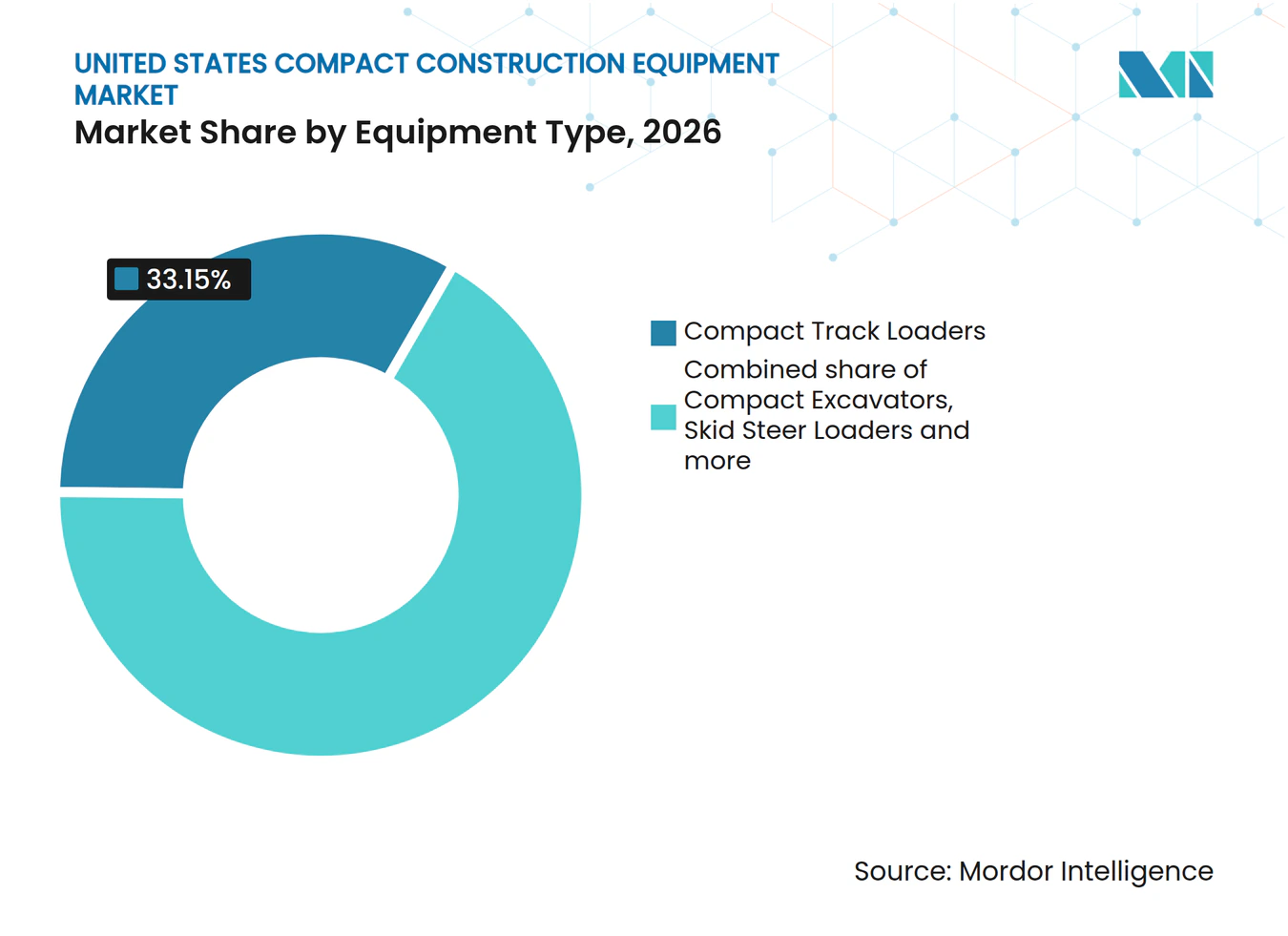
Compact Track Loaders Lead Revenue And Maintain Strong GrowthCompact track loaders held 33.15% of the United States compact construction equipment market share in 2026 and are forecast to grow at a 7.36% CAGR through 2032. Their wide fit with site preparation, material handling, landscaping, utility work, and residential grading supports this position. Rubber tracks spread weight across soft ground and can reduce damage to lawns and finished surfaces. Contractors can use buckets, forks, augers, trenchers, and mulchers with the same base machine. This combination gives contractors a practical way to complete several short tasks in one workday.
Compact excavators remain essential for digging, trenching, and precise work near utility lines. Skid steer loaders retain value on hard-packed ground and in indoor demolition, while compact wheel loaders serve specialized material-handling work. Compact backhoe loaders remain useful for utility maintenance and rural infrastructure when buyers need loader and excavator functions. The United States compact construction equipment market can support several equipment categories because soil conditions, site access, tasks, and transport needs vary. Manufacturers compete through better visibility, attachment changes, stability, and service access, not only engine output.



By Operating Weight:
The 2-to-5-Ton Class Remains the Structural CoreThe 2-to-5-ton class held 45.03% of the United States compact construction equipment market share in 2026 and is expected to grow at a 6.12% CAGR through 2032. It combines practical digging depth with transportability for residential and utility work. The class suits basement excavation, drainage work, utility trenching, landscape construction, and local road repairs. It also fits many established neighborhoods and small commercial sites with limited access. Buyers value a balance between reach, lifting capability, operating cost, and ease of movement.
Below-2-ton machines serve interior demolition, plumbing trenching, landscaping, and spaces with tight height or access limits. The 5-to-8-ton and 8-to-13-ton classes serve deeper excavation and heavier lifting requirements. These larger compact machines can compete with full-size equipment when maneuverability remains important. Zero-tail-swing designs are gaining relevance within the 2-to-5-ton class because the upper structure turns within the track width. This design reduces contact risk near walls, traffic lanes, and landscaping on dense sites.
By Propulsion:
Internal Combustion Engines Retain Scale While Electric Models Gain Use CasesInternal combustion engine models held 94.11% of market value in 2026, showing that diesel remains standard for full-day outdoor construction use. Diesel machines have an established refueling network, familiar service procedures, and a broad installed base. They remain practical for multiple shifts and for jobs far from fixed power supply. Federal nonroad engine rules continue to shape diesel design and maintenance requirements. The United States compact construction equipment market will continue to rely on internal combustion engines across most heavy-use work.
Battery-electric compact equipment is projected to grow at a 22.04% CAGR through 2032 from a smaller base. Doosan Bobcat unveiled the S7X all-electric skid-steer loader at CONEXPO-CON/AGG in March 2023. Wacker Neuson introduced electric excavators, including the EZ26e and EZ10e, at Bauma 2025. Electric machines fit work where local emissions, noise, and ventilation requirements limit diesel use. Hybrid models are a transition option, while rental companies can offer customers a lower-risk route to test electric equipment.
By Power Output:
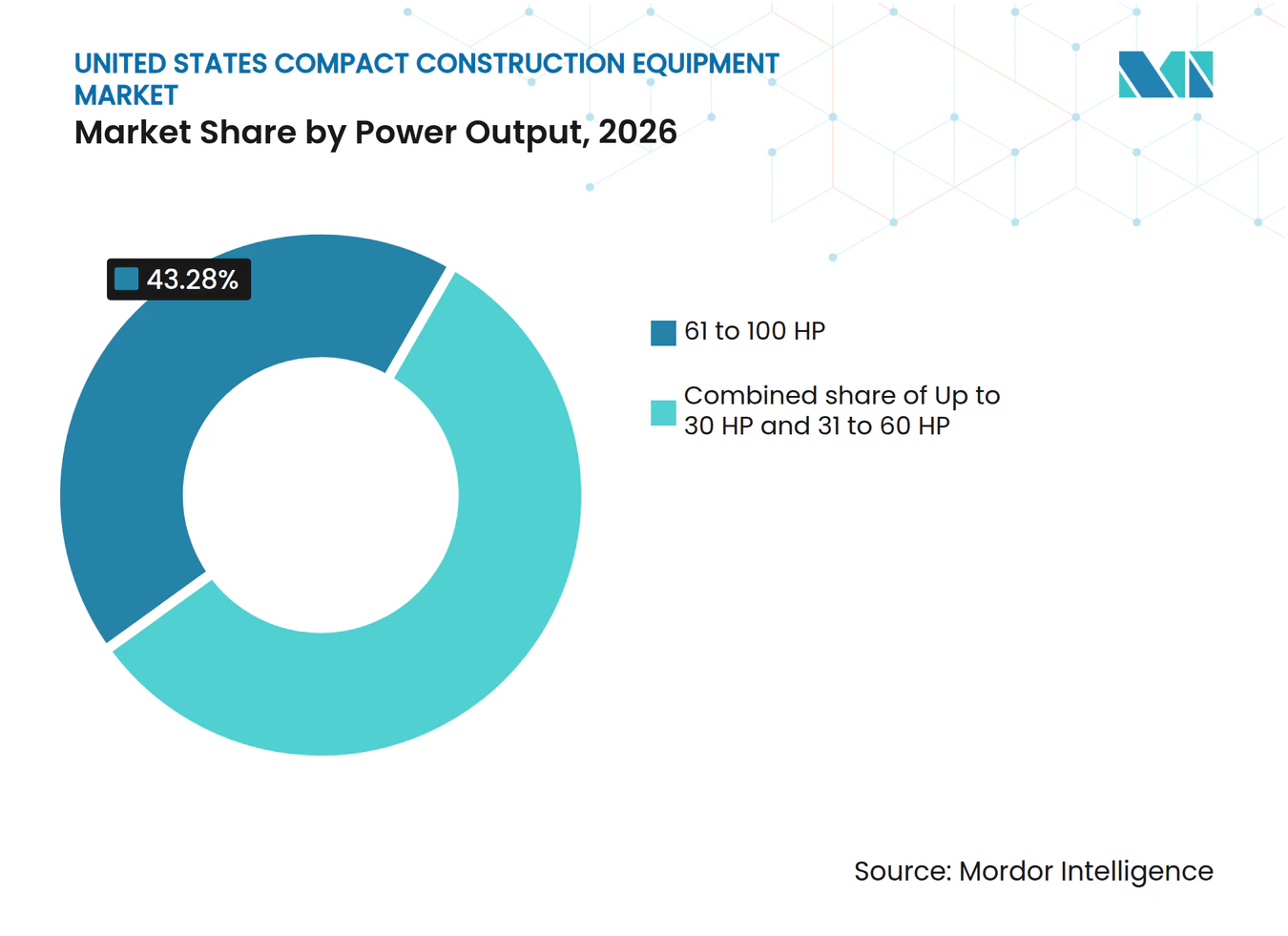
The 61-to-100 HP Range Supports Attachment-Intensive WorkThe 61-to-100 HP band held 43.28% of market value in 2026 and is forecast to grow at a 6.10% CAGR through 2032. This range supplies the hydraulic flow needed for breakers, augers, mulchers, planers, and other demanding attachments. It supports longer work cycles without the transport demands of higher-power equipment. Rental branches can use this range to serve several customer types with a broadly capable fleet specification. The balance of output and versatility supports its position in the United States compact construction equipment market.
The up-to-30 HP category serves micro-sites, interiors, rooftops, basement finishing, and other locations where clearance is the main need. Battery-electric propulsion can be more feasible in this class because smaller machines have lower energy requirements. The 31-to-60 HP range remains important for residential excavation, light utility work, and general contracting. Buyers compare hydraulic output, machine weight, and attachment requirements rather than power alone. Dealers can match each power range to job duration, site access, and transport rules.

By End User:
Contractors Hold The Largest Base While Rental Fleets ModernizeConstruction contractors held 54.18% of market value in 2026 because compact machines support residential, commercial, industrial, utility, and public works projects. They use equipment for site preparation, grading, trenching, loading, demolition, and final restoration. Direct ownership is attractive for firms with regular equipment use across several projects. Larger contractors can invest in attachments, service capacity, and machine data systems. These factors support contractors’ leading position in the United States compact construction equipment market.
Equipment rental companies are forecast to grow at a 6.75% CAGR through 2032, making them the fastest-growing end-user group. Rental fleets provide newer machines to contractors with limited capital or short-duration requirements. They also introduce customers to battery-electric units and attachment packages. Agriculture, landscaping, utility, energy, municipal, and government users provide further demand for compact equipment. Their recurring needs include soil conditioning, drainage, water and grid trenching, snow removal, pothole repair, and parks maintenance.
Geography Analysis
The United States compact construction equipment market is concentrated across the South and Southwest because these areas combine residential construction, infrastructure spending, long operating seasons, and broad rental activity. Texas is one of the largest state markets for compact track loaders and mini excavators. Florida, Georgia, and North Carolina also benefit from population movement, housing activity, and year-round construction conditions. These states provide strong demand for site preparation, drainage, utilities, landscaping, and light civil work. Industrial facilities, data centers, and local infrastructure projects also broaden equipment use across the region.
The Northeast has higher acquisition costs and a shorter outdoor construction season, but it has substantial need for bridge work, lead service line replacement, and other public infrastructure projects. Building permits in the Northeast were significantly higher year-to-date by mid-2026, compared with the Midwest and West. This supports equipment use in dense communities where access and surface protection matter. Kubota’s investment in Salina, Kansas, strengthens Midwest production capacity and supports its North American compact equipment supply chain.
California has one of the largest IIJA formula allocations and has a different equipment profile because its air quality rules can favor lower-emission equipment. The state’s nonroad requirements create a stronger reason for public-works contractors to assess electric and hybrid compact machines. Washington and Colorado also offer early use cases because urban infill and municipal procurement policies can support lower-emission equipment. Rental companies in these states can place electric machines with customers before ownership economics are fully proven. The regional mix means suppliers need different product, charging, service, and dealer approaches rather than one national offering.
Competitive Landscape
Market Concentration
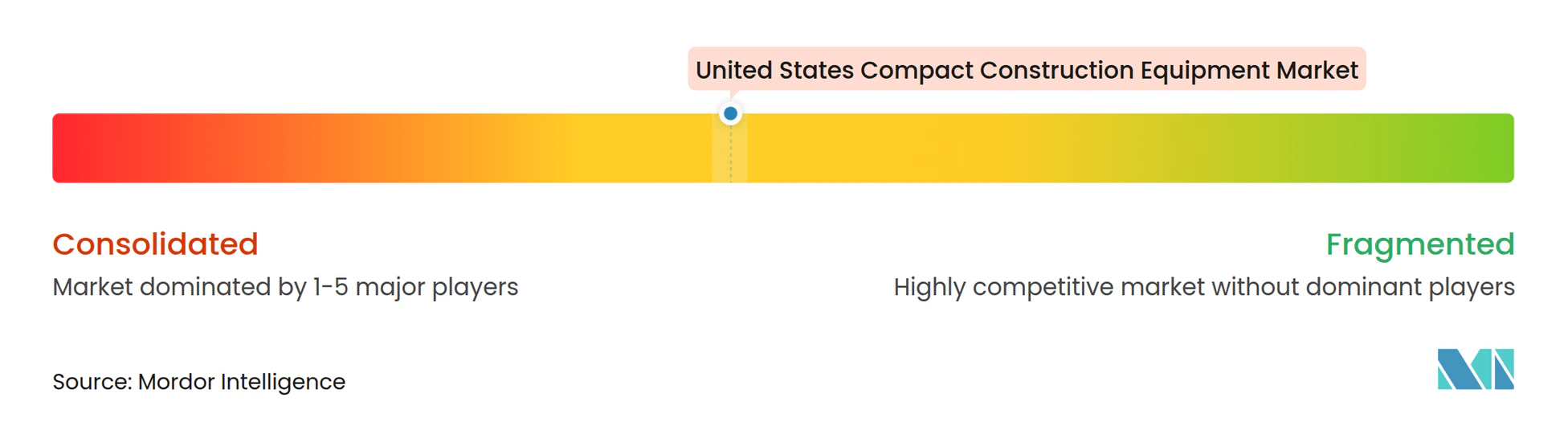
The United States compact construction equipment market has moderate concentration among Caterpillar, Kubota, Doosan Bobcat, and Deere, while a broad group of other suppliers competes across specialized categories. Komatsu, Case Construction Equipment, JCB, Wacker Neuson, Takeuchi, Yanmar, ASV, Hitachi, and HD Hyundai each add choice in selected machine types or applications. Buyers assess dealer location, parts availability, financing, attachments, and service response alongside product quality. Leading suppliers can support fleets across several states and machine categories. Mid-tier brands compete through a clear price, feature, or dealer-service advantage.
Caterpillar announced a USD 1 billion investment in a Sanford, North Carolina manufacturing facility in September 2026 to expand Cat Compact production capacity. Kubota began assembling the SVL75-3 compact track loader in Salina, Kansas, in August 2026 as part of its North American investment program. Wacker Neuson has continued to extend its electric compact equipment offering, which supports its position in lower-emission work applications. These actions show that manufacturing capacity, local supply chain support, and electric product development are active competitive priorities. Suppliers are also using connectivity and packaged service offers to reduce the operating burden for smaller contractors.
Yanmar, SANY, and HD Hyundai compete in lower-priced compact equipment for landscaping, plumbing, agriculture, and small construction firms that might otherwise rent. Attachment compatibility can increase the value of the installed machine base. Autonomous compact machines remain in field trials for repetitive grading and trenching work. Their future relevance will depend on labor, safety, and productivity gains on active sites.
United States Compact Construction Equipment Industry Leaders
-
Caterpillar Inc.
-
Deere & Company
-
Kubota Corporation
-
CNH Industrial N.V.
-
Doosan Bobcat Inc.
- *Disclaimer: Major Players sorted in no particular order
United States Compact Construction Equipment Market Companies Covered in this Report
- Caterpillar Inc.
- Deere & Company
- Kubota Corporation
- CNH Industrial N.V.
- Doosan Bobcat Inc.
- J C Bamford Excavators Ltd.
- Komatsu Ltd.
- Wacker Neuson SE
- Takeuchi Mfg. Co., Ltd.
- Yanmar Holdings Co., Ltd.
- SANY Heavy Industry Co., Ltd.
- HD Hyundai Construction Equipment Co., Ltd.
- Hitachi Construction Machinery Co., Ltd.
- Kobelco Construction Machinery Co., Ltd.
- Manitou Group
- ASV Holdings Inc.
- Liebherr-International AG
Recent Industry Developments in United States Compact Construction Equipment Market
- October 2026: John Deere launched the 40 P-Tier compact excavator, which weighs under 10,000 pounds and can be transported without a commercial driver’s license, at the Equip Exposition in Louisville, Kentucky.
- September 2026: Caterpillar Inc. announced an approximately USD 1 billion investment in a new manufacturing facility in Sanford, North Carolina, designed to increase production of compact track loaders and telehandlers.
- August 2026: Kubota began assembling the SVL75-3 compact track loader alongside the SVL65-2 at its Great Plains Manufacturing facility in Salina, Kansas.
- July 2026: New Holland Construction added the W70D, W80D, and W80D Long Reach models to its D-Series compact wheel loader lineup.
United States Compact Construction Equipment Market Report Scope
The United States compact construction equipment market report is segmented by equipment type (compact excavators, compact wheel loaders, compact track loaders, skid steer loaders, and compact backhoe loaders), operating weight (below 2 ton, 2 to 5 ton, 5 to 8 ton, and 8 to 13 ton), propulsion (internal combustion engine, battery-electric, and hybrid electric), power output (up to 30 HP, 31 to 60 HP, and 61 to 100 HP), end user (construction contractors, equipment rental companies, agriculture and landscaping operators, mining and quarrying operators, utility and energy companies, and municipalities and government agencies), and geography (Northeast, Midwest, South, and West). Machines rated above 100 HP are excluded from the scope. The market forecasts are provided in terms of value (USD) and volume (units).
Segmentation Overview
| Compact Excavators |
| Compact Wheel Loaders |
| Compact Track Loaders |
| Skid Steer Loaders |
| Compact Backhoe Loaders |
| Below 2 Ton |
| 2 to 5 Ton |
| 5 to 8 Ton |
| 8 to 13 Ton |
| Internal Combustion Engine |
| Battery-Electric |
| Hybrid Electric |
| Up to 30 HP |
| 31 to 60 HP |
| 61 to 100 HP |
| Construction Contractors |
| Equipment Rental Companies |
| Agriculture and Landscaping Operators |
| Mining and Quarrying Operators |
| Utility and Energy Companies |
| Municipalities and Government Agencies |
| Northeast |
| Midwest |
| South |
| West |
| Equipment Type by Operating Weight |
| Equipment Type by Propulsion |
| Equipment Type by Power Output |
| Equipment Type by End User |
| By Equipment Type | Compact Excavators |
| Compact Wheel Loaders | |
| Compact Track Loaders | |
| Skid Steer Loaders | |
| Compact Backhoe Loaders | |
| By Operating Weight | Below 2 Ton |
| 2 to 5 Ton | |
| 5 to 8 Ton | |
| 8 to 13 Ton | |
| By Propulsion | Internal Combustion Engine |
| Battery-Electric | |
| Hybrid Electric | |
| By Power Output | Up to 30 HP |
| 31 to 60 HP | |
| 61 to 100 HP | |
| By End User | Construction Contractors |
| Equipment Rental Companies | |
| Agriculture and Landscaping Operators | |
| Mining and Quarrying Operators | |
| Utility and Energy Companies | |
| Municipalities and Government Agencies | |
| By Geography | Northeast |
| Midwest | |
| South | |
| West | |
| Cross-Segmentation Analysis | Equipment Type by Operating Weight |
| Equipment Type by Propulsion | |
| Equipment Type by Power Output | |
| Equipment Type by End User |
Key Questions Answered in the Report
What is the size of the United States compact construction equipment market?
The United States compact construction equipment market is estimated at USD 14.90 billion in 2026 and is projected to reach USD 20.15 billion by 2032, at a 5.15% CAGR from 2027 to 2032.
Which equipment type leads demand in the United States?
Compact track loaders lead with 33.15% market share in 2026 and are forecast to grow at a 7.36% CAGR through 2032.
Which operating weight class is most widely used?
The 2-to-5-ton class leads with a 45.03% share in 2026 because it balances digging capability, transportability, and access on small sites.
How quickly are electric compact machines growing?
Battery-electric models are projected to grow at a 22.04% CAGR through 2032, led by urban, indoor, and lower-emission work applications.