
United States Coin-Operated Laundry Machines Market Size and Share
Market Overview
| Study Period | 2021 - 2031 |
|---|---|
| Forecast Data Period | 2026 - 2031 |
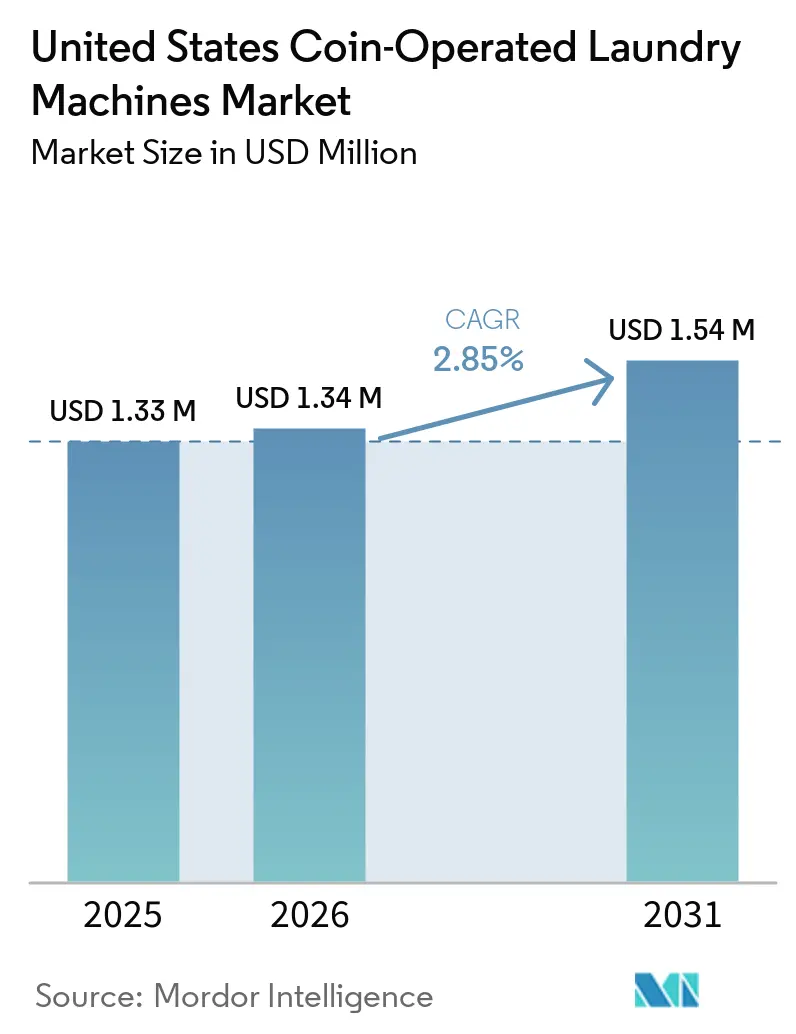
| Base Year Market Size (2025) | USD 1.33 Million |
| Market Size (2026) | USD 1.34 Million |
| Market Size (2031) | USD 1.54 Million |
| Growth Rate (2026 - 2031) | 2.85 % |
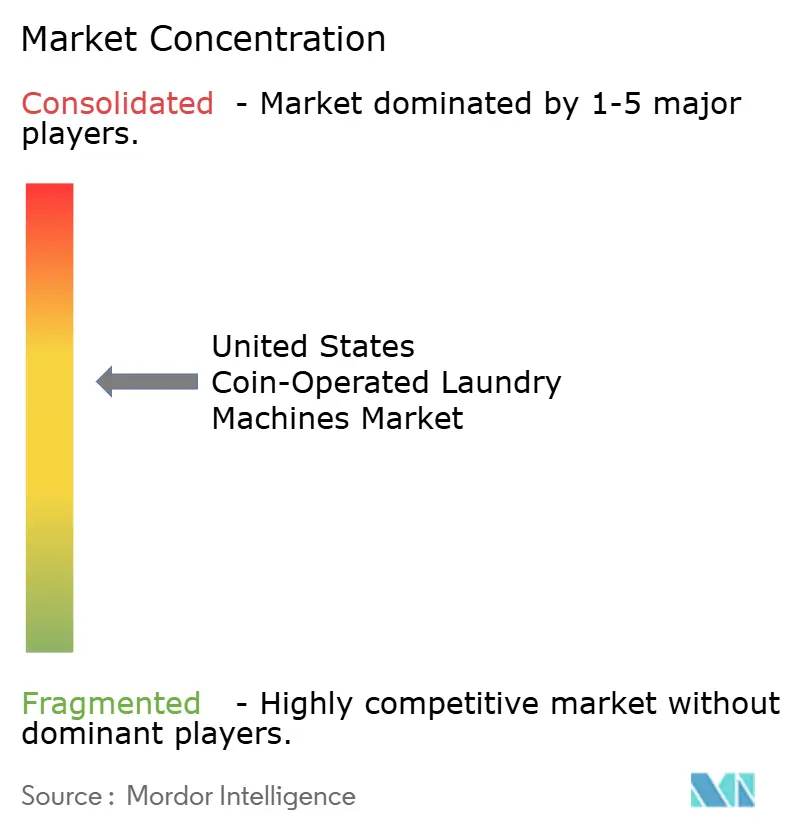
| Market Concentration | Medium |
Major Players *Disclaimer: Major Players sorted in no particular order Image © Mordor Intelligence. Reuse requires attribution under CC BY 4.0. | |
United States Coin-Operated Laundry Machines Market Analysis by Mordor Intelligence
The United States coin-operated laundry machines market size was USD 1.33 billion in 2025 and is expected to reach USD 1.34 billion, and is forecast to reach USD 1.54 billion by 2031, growing at a CAGR of 2.85% from 2026 to 2031. The United States coin-operated laundry machines market is supported by the need to replace commercial machines installed between 2008 and 2013. Rental households without in-unit washers provide a durable base of users for shared laundry facilities. The 2024 Residential Energy Consumption Survey recorded 16.01 million renter households without an in-unit washer, which supports demand for paid laundry access[1]. Equipment suppliers are focusing on larger machines, remote management, and cashless payment options as operators seek more efficient store operations. The United States coin-operated laundry machines market also faces higher utility costs and competition from in-unit laundry in newer apartment buildings.
Key Report Takeaways
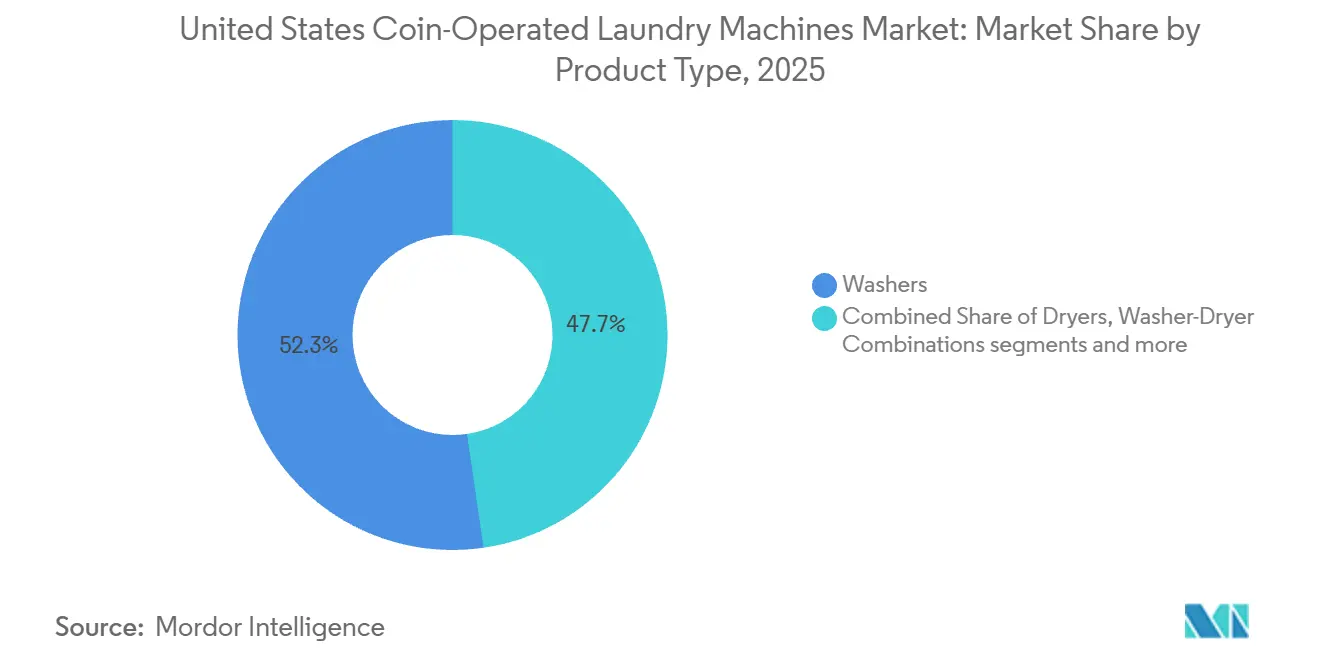
- By product type, washers held 52.31% of revenue in 2025, while washer-dryer combinations are forecast to register a 4.11% CAGR through 2031.
- By capacity range, the Above 15 kg to 30 kg category accounted for 44.51% of revenue in 2025, while the Above 30 kg to 50 kg category is forecast to register a 4.06% CAGR through 2031.
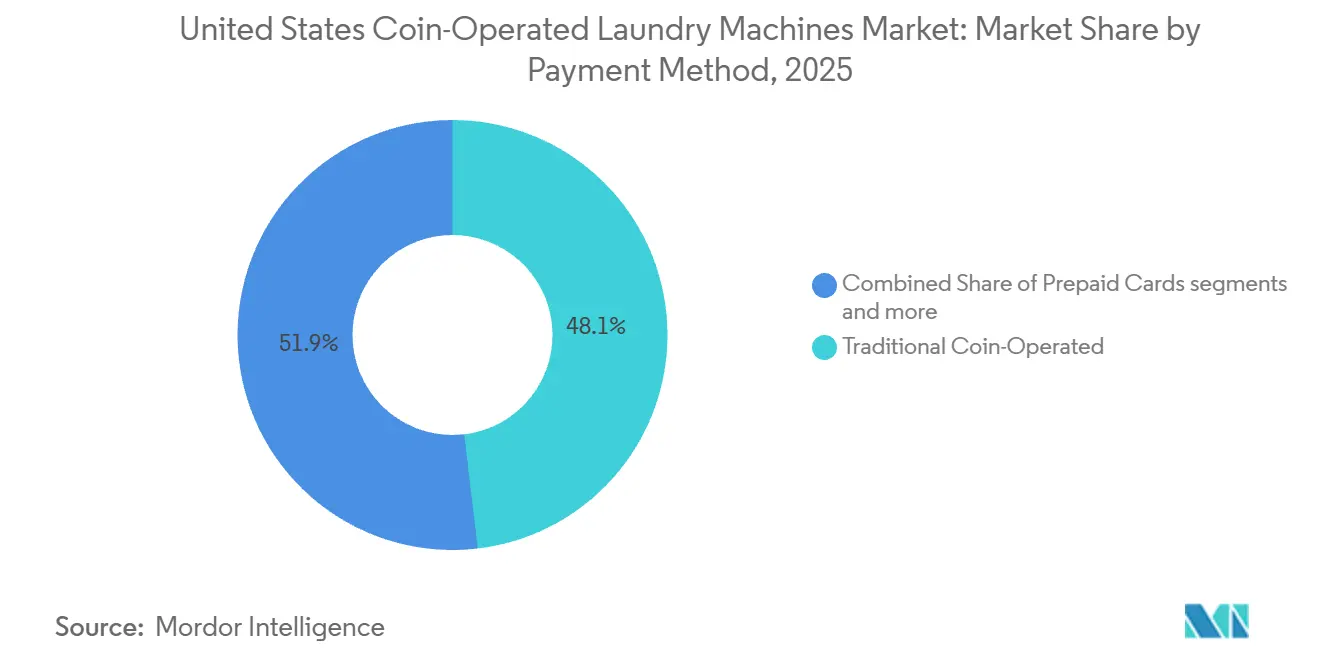
- By payment method, traditional coin-operated systems held 48.12% of revenue in 2025, while mobile wallet and app-based payment are forecast to register a 3.88% CAGR through 2031.
- By end user, laundromats remained the largest category in 2025, while multifamily housing is forecast to register a 3.70% CAGR through 2031.
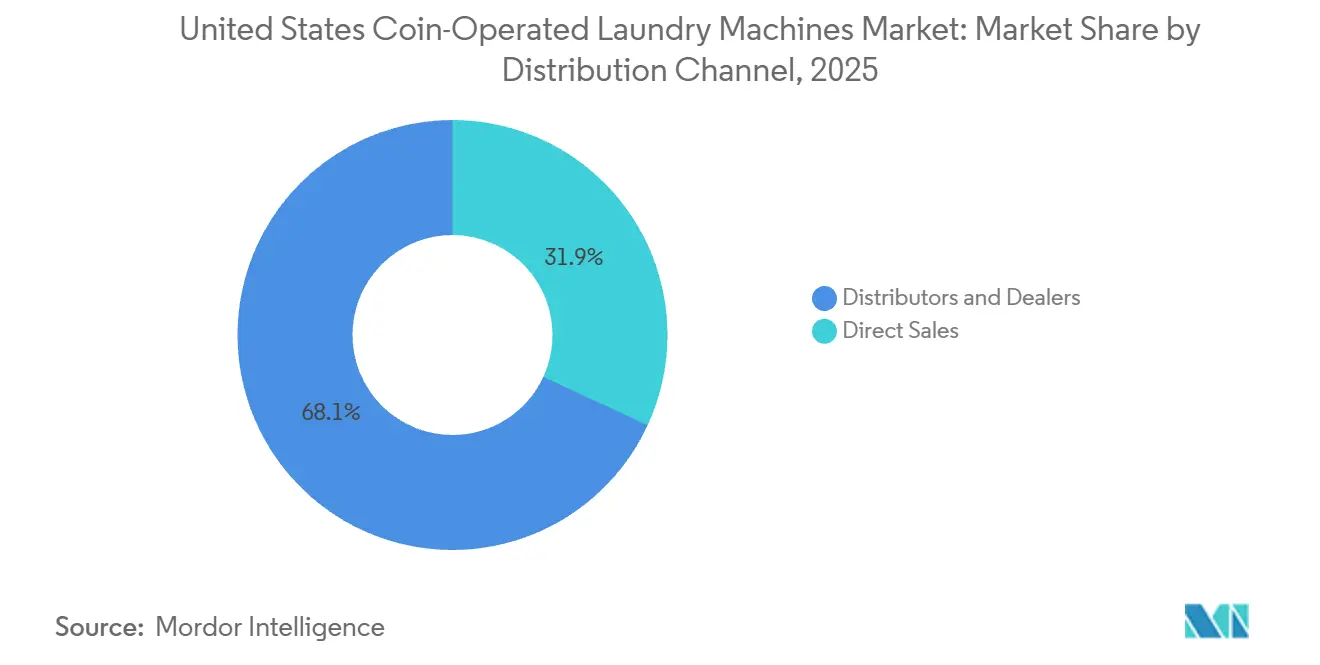
- By distribution channel, distributors and dealers held 68.11% of revenue in 2025, while direct sales are forecast to register a 3.53% CAGR through 2031.
- By geography, the Northeast held 28.23% of revenue in 2025, while the Southwest is forecast to grow at a 3.16% CAGR through 2031.
Note: Market size and forecast figures in this report are generated using Mordor Intelligence’s proprietary estimation framework, updated with the latest available data and insights as of January 2026.
United States Coin-Operated Laundry Machines Market Trends and Insights
Drivers Impact Analysis*
| Driver | (~) % Impact on CAGR Forecast | Geographic Relevance | Impact Timeline |
|---|---|---|---|
| High Renter Concentration and Limited In-Unit Laundry Access | +0.7% | National, with the highest intensity in dense Northeast and Midwest urban areas | Long term (≥ 4 years) |
| Replacement of Aging Commercial Laundry Equipment | +0.6% | National, with a replacement wave in the Sun Belt and the Midwest, 2008 to 2013 equipment cohorts | Medium term (2-4 years) |
| Utility-Efficiency and High-G-Force Equipment Upgrades | +0.5% | National, with particular relevance in California, Hawaii, and the Northeast corridor | Medium term (2-4 years) |
| Growth of Mobile, Card, and Contactless Payments | +0.4% | National, with faster adoption in the Northeast, West Coast, and dense urban laundromat clusters | Short term (≤ 2 years) |
| Multi-Store Operator Professionalization and Remote Management | +0.3% | National, concentrated in Sun Belt route-operator consolidation corridors | Medium term (2-4 years) |
| Conversion of Underused Retail and Multifamily Spaces into Laundry Facilities | +0.2% | Northeast, Southeast, and West Coast urban areas, with spillover into secondary Midwest cities | Long term (≥ 4 years) |
| Source: Mordor Intelligence | |||
High Renter Concentration and Limited In-Unit Laundry Access
The United States coin-operated laundry machines market relies on a clear difference between renter and owner access to in-unit appliances. The 2024 Residential Energy Consumption Survey found that 16.01 million renter households lacked an in-unit washer. Those households need either common-area machines or local self-service laundromats for routine laundry. This demand is less dependent on discretionary spending than many other commercial appliance purchases. Older multifamily buildings remain important because adding hookups can require extensive plumbing and electrical work. The resulting access gap gives operators a recurring customer base in rental-heavy areas.
Replacement of Aging Commercial Laundry Equipment
The United States coin-operated laundry machines market is also supported by replacement demand from equipment installed between 2008 and 2013. Commercial washer-extractors and tumble dryers generally operate for 10 to 14 years before replacement becomes more compelling. Coin-O-Matic notes that operators must weigh repairs, replacement, and upgrades across a machine’s operating life[2. Older machines can require more service while using more electricity and drying time. Newer high-spin equipment can reduce residual moisture before the drying stage. This can make replacement decisions more attractive where utility charges are high.
Growth of Mobile, Card, and Contactless Payments
Cashless options are changing operating practices across the United States coin-operated laundry machines market. Digital payments can reduce the labor associated with collecting coins and changing prices across multiple sites. CSC ServiceWorks announced a long-term PayRange agreement in June 2025 for connected payment capabilities across its fleet[3]. Alliance Laundry Systems introduced Scan-Pay-Wash in August 2025, allowing customers to pay through a QR code without downloading an app[4]. The approach can serve users who prefer cards or mobile wallets while retaining access for users who still use coins. It also gives larger operators more consistent information on equipment use and price changes.
Utility-Efficiency and High-G-Force Equipment Upgrades
Energy and water efficiency are central to equipment decisions in the United States coin-operated laundry machines market. High-spin washer-extractors can shorten drying requirements by removing more moisture from laundry. Electrolux Professional states that its Line 6000 heat pump dryers can reduce energy consumption by up to 65% compared with vented dryers. The U.S. Environmental Protection Agency proposed updated commercial washer criteria in January 2025 through its ENERGY STAR specification process. Efficiency improvements can reduce operating costs throughout the life of the equipment. They can also encourage operators to replace machines before a complete mechanical failure.
Restraints Impact Analysis*
| Restraint | (~) % Impact on CAGR Forecast | Geographic Relevance | Impact Timeline |
|---|---|---|---|
| High Utility Costs and Volatile Water, Gas, and Electricity Prices | -0.5% | National, with stronger pressure in California, Hawaii, the Northeast, and drought-prone western areas | Long term (≥ 4 years) |
| High Equipment, Fit-Out, and Plumbing Infrastructure Costs | -0.4% | National, with a heavier burden on new stores in high-rent urban areas | Medium term (2-4 years) |
| Competition from In-Unit Washers and Dryers | -0.3% | Southwest and Southeast new apartment completions, with a lower effect on older Northeast housing | Long term (≥ 4 years) |
| Site Constraints, Lease Commitments, and Local Permitting Complexity | -0.1% | Dense Northeast and West Coast urban areas, plus secondary markets absorbing commercial vacancy | Short term (≤ 2 years) |
| Source: Mordor Intelligence | |||
High Utility Costs and Volatile Water, Gas, and Electricity Prices
Utility costs can limit returns for operators in the United States coin-operated laundry machines market. Electricity, water, sewer, and gas expenses directly affect the cost of each wash and dry cycle. State electricity prices differed widely in 2024, according to the U.S. Energy Information Administration. Operators cannot always adjust vend prices as quickly as utility bills increase. Coin-operated equipment may require physical changes when a price is adjusted. Water and sewer charges create further pressure in western areas with constrained supplies. These conditions favor equipment that reduces water use, drying time, and energy consumption.
High Equipment, Fit-Out, and Plumbing Infrastructure Costs
New facilities and major upgrades require substantial capital before they produce revenue. A project can require plumbing changes, 220V or 240V electrical work, dryer venting, and water-resistant flooring. These requirements can extend the period between site selection and opening. The Internal Revenue Service explains that Section 179 may permit qualifying businesses to deduct eligible equipment costs in the year the equipment is placed in service. The deduction can improve project economics but does not remove the initial financing need. Route-operator leasing and revenue-sharing arrangements can lower the direct capital burden for multifamily property owners.
*Our forecasts treat driver/restraint impacts as directional, not additive. The impact forecasts reflect baseline growth, mix effects, and variable interactions.
Segment Analysis
By Product Type: Washers Anchor Revenue, Combinations Signal a Shift
Washers held 52.31% of the United States coin-operated laundry machines market share within the product segment in 2025. Each customer visit begins with a wash cycle, which makes washer capacity and cycle availability central to store economics. Washer-extractors, therefore, remain the core asset in most self-service locations. Dryers are normally installed in relation to washer throughput. Their demand follows the volume created by the washer base. Larger stack dryers can still change equipment layouts in sites with limited space. The product mix is shaped by machine reliability, capacity, and the time required for each cycle. Operators also evaluate how an installation will support future payment and monitoring upgrades. These factors keep washers at the center of purchasing decisions.
Washer-dryer combinations are forecast to expand at a 4.11% CAGR through 2031. The category is relevant where separate units would use too much of the available floor area. Boutique multifamily rooms, extended-stay properties, and converted retail units can face these constraints. Combination units offer one way to place laundry capability within a smaller footprint. They do not displace the central role of separate commercial washers and dryers in high-volume laundromats. Ancillary equipment also remains tied to the core machine fleet. Payment kiosks, folding stations, and management hardware can improve the usability of a store. The United States coin-operated laundry machines market develops with both core machine replacement and supporting equipment upgrades. The product pattern reflects the different needs of large stores and constrained installations.

By Capacity Range: Larger Drums Maximize Revenue Per Footprint
The Above 15 kg to 30 kg category held 44.51% of capacity-segment revenue in 2025. This range is the established workhorse category across many laundromats. It serves common household loads while fitting standard store layouts. The installed base in this category creates a sizable replacement opportunity. Operators often consider throughput, utilities, and floor space when replacing these machines. Smaller units can suit boutique locations and rural facilities with tighter installation limits. Machines above 50 kg are more relevant to specialized settings such as military housing, campgrounds, and large hospitality facilities. Capacity choices, therefore, vary with customer volume and site conditions. The United States coin-operated laundry machines market retains demand across several capacity tiers.
The Above 30 kg to 50 kg tier is forecast to grow at a 4.06% CAGR through 2031. Larger drums can increase the volume handled in one cycle. This matters to route operators serving multifamily and dormitory locations. It can also reduce waits during high-use periods. Alliance Laundry Systems introduced its Stack 55 tumbler in August 2025 with two 55-pound pockets in the footprint of the prior Stack 45. The company stated that the model offered 10% more capacity than the nearest competitor. Such releases show why equipment makers are pursuing capacity gains without requiring larger stores. Larger machines can support revenue generation per available square foot. The United States coin-operated laundry machines industry is therefore moving toward equipment that serves denser operating environments.
By Payment Method: Coin Holds Ground, Digital Channels Reshape Operator Economics
Traditional coin-operated systems held 48.12% of payment-method revenue in 2025. The share reflects the depth of existing coin infrastructure across independent laundromats and multifamily contracts. Many operators have not yet replaced coin mechanisms in functioning machines. Coin payments remain familiar to customers who do not use digital payment methods. Existing route contracts may also slow a full conversion to new systems. These factors maintain a large installed base for traditional equipment. At the same time, newly installed machines increasingly include more than one payment option. Hybrid systems can support coins, cards, and mobile payments together. This flexibility reduces the need to choose a single customer group.
Mobile wallet and app-based payment are forecast to grow at a 3.88% CAGR through 2031. Digital payment systems can offer operators remote price changes and usage information. They can also reduce the cash-handling burden at multi-site operations. CSC ServiceWorks’ 2025 PayRange agreement centered on connected payment and pricing features. Prepaid cards remain relevant in student housing, military bases, and workplace facilities. These settings can use closed-loop systems to simplify billing. The shift does not mean coins will disappear during the forecast period. Instead, the United States coin-operated laundry machines market is moving toward payment systems that accommodate both cash-dependent and digital-first users. Operator economics, rather than convenience alone, support this transition.
By End User: Laundromats Lead Volume, Multifamily Drives Forward Momentum
Laundromats remained the largest end-user category in 2025. They serve renters, households with limited in-home equipment, and customers who need higher-capacity machines. Their performance depends on reliable equipment and convenient locations. A laundromat also needs capacity that can manage periods of concentrated demand. The format remains important in dense urban areas with older rental housing. Equipment replacement can improve service reliability and reduce utility use at these locations. Digital payment and remote monitoring can also help larger laundromat operators manage several sites. These needs support continuing equipment demand from self-service operators. The United States coin-operated laundry machines market continues to depend heavily on this established customer base.
Multifamily housing is forecast to grow at a 3.70% CAGR through 2031. Shared laundry rooms can help property managers provide an amenity without adding appliances to every unit. The format can also generate ancillary income under route-operator agreements. The affordable housing sector has studied opportunities to improve efficiency in common-area laundry facilities. Student housing and dormitories remain recurring users of card and app-based systems. Military housing can involve long-term service arrangements and government procurement schedules. Hotels, gyms, and workplace housing represent smaller applications with different utilization patterns. These end users create demand beyond the public laundromat setting. The United States coin-operated laundry machines market serves each setting through different payment, service, and capacity requirements.
By Distribution Channel: Dealer Networks Dominant, Direct Sales Gaining
Distributors and dealers held 68.11% of distribution-channel revenue in 2025. Commercial laundry purchases often require an on-site review before equipment is selected. Water pressure, gas supply, drainage, electrical capacity, and venting affect the final configuration. Dealers can connect these technical requirements with financing, training, installation, and service. This bundled role helps explain their leading position. Independent operators may rely on local distributors for advice during a replacement project. Local service availability can also influence a purchase decision. Dealer relationships remain especially important where operators need ongoing maintenance support. The channel, therefore, remains central to the United States coin-operated laundry machines market.
Direct sales are forecast to grow at a 3.53% CAGR through 2031. Manufacturers are expanding their owned distribution assets to gain closer access to customers. Alliance Laundry Systems acquired Metropolitan Laundry Machinery Sales in August 2025 and established a New York Metro direct distribution office. The company also expanded its direct distribution network through acquisitions in California, Utah, and Tennessee during 2024. Direct ownership can give manufacturers more control over product rollout and aftermarket service. It does not remove the value of independent local dealers. Established customer relationships and local service capability remain important in many markets. The channel structure is likely to retain both models during the forecast period. The United States coin-operated laundry machines industry includes both manufacturer-owned and independent routes to market.
Geography Analysis
The Northeast held 28.23% of the United States coin-operated laundry machines market share in 2025. The region has a large base of older multifamily homes, where in-unit hookups can be difficult to add. Shared facilities and nearby laundromats, therefore, remain necessary for many renters. Older rental housing supports recurring demand for commercial laundry equipment. The Northeast also faces high utility costs in many locations. These costs increase the value of efficient washer-extractors and dryers. Operators in the region must balance equipment upgrades with the cost of operating older facilities.
The Midwest and Southeast have different demand patterns within the United States coin-operated laundry machines market. The Midwest includes university towns and industrial-worker housing that support steady use of laundromats. The Coin Laundry Association’s 2024 survey identified a larger share of top-load washers and 24-hour operations in the Midwest. The Southeast has dense urban renter populations and a growing coastal hospitality base. New apartment construction with in-unit laundry can moderate demand from newly completed multifamily buildings. The West is also divided between markets. California’s water-efficiency requirements support lower-water equipment upgrades, while Seattle and Portland show greater use of wash-fold services on existing coin-operated infrastructure.
The Southwest is forecast to grow at a 3.16% CAGR through 2031. Population inflows and multifamily construction in Texas and Arizona support equipment deployment opportunities. New buildings can add common-area machines where properties use shared laundry rooms. At the same time, many new units include in-unit laundry equipment. Operators, therefore, need to focus on existing facilities as well as new development. Higher-efficiency equipment can be relevant in locations with utility and water constraints. This balance defines the regional opportunity for the United States coin-operated laundry machines market.
Competitive Landscape
The United States coin-operated laundry machines market has different competitive structures in equipment manufacturing and route operations. Equipment manufacturing is more concentrated than the operator base. Alliance Laundry Systems competes through the Speed Queen, Huebsch, and UniMac brands. Its strategy includes acquiring regional distribution assets and expanding direct customer access. The company reported the acquisition of Bestway Laundry Solutions in California during 2024. Owned distribution can support service, parts availability, and faster product commercialization. Dexter Laundry remains a relevant domestic equipment supplier with a distinct product and service position.
Dexter Laundry launched its X-Series commercial washers and dryers in September 2024. The line included touchscreens, multilingual interfaces, DexterPay cashless integration, and DexterLive remote management. These features address the need for connected equipment among larger operators. Alliance Laundry Systems also introduced Scan-Pay-Wash in August 2025. The payment option allows a customer to scan a QR code and pay without downloading an app. Its Stack 55 launch in the same month focused on greater dryer capacity within an established footprint. These moves show that payment flexibility, capacity, and connected management are important areas of product competition. Equipment suppliers are seeking to address multi-site operators as well as independent owners.
Route operators compete through service coverage, payment systems, equipment access, and operating scale. CSC ServiceWorks’ PayRange agreement illustrates the importance of connected payment capability in the route-operator segment. Small-footprint equipment remains relevant in high-rent urban locations where space is limited. Water-efficient machines are also relevant in western states where utility costs can affect returns. Independent operators continue to matter because local relationships and on-site service remain important. The United States coin-operated laundry machines market is not defined by a single operating model. Large networks and local operators can each address different property types and customer needs.
United States Coin-Operated Laundry Machines Industry Leaders
-
Alliance Laundry Systems LLC
-
Dexter Laundry, Inc.
-
Electrolux Professional AB
-
Whirlpool Corporation
-
Laundrylux, Inc.
- *Disclaimer: Major Players sorted in no particular order
Recent Industry Developments
- August 2026: Alliance Laundry Systems extended its ProCapture lint collection system to the T55 stack tumbler, the industry’s largest stack unit with two 55-pound drying pockets, completing a full-store lint solution across its commercial dryer lineup.
- June 2026: Alliance Laundry Systems opened its enhanced STAR Lab innovation center at its Thailand factory, showcasing next-generation commercial laundry equipment production across its five family brands and reinforcing its smart and high-efficiency product R&D pipeline for North America and Asia Pacific markets.
- August 2025: Alliance Laundry Systems launched Scan-Pay-Wash at Clean Show 2025, the industry’s first no-download cashless payment, allowing customers to scan a QR code, pay via credit card or mobile wallet, and activate the cycle immediately, available on Speed Queen Insights and Huebsch Command platforms.
- August 2025: Alliance Laundry Systems launched the Stack 55 tumbler, the industry’s largest commercial stack dryer, offering two 55-pound capacity pockets at 10% greater capacity than the nearest competitor within the same physical footprint.
United States Coin-Operated Laundry Machines Market Report Scope
| Washers |
| Dryers |
| Washer-Dryer Combinations |
| Ancillary Laundry Equipment and Services |
| Up to 15 kg |
| Above 15 kg to 30 kg |
| Above 30 kg to 50 kg |
| Above 50 kg |
| Traditional Coin-Operated |
| Prepaid Cards |
| Mobile Wallet and App-Based |
| Contactless Credit and Debit Cards |
| Hybrid Systems |
| Standalone Laundromats |
| Multifamily Housing |
| Student Housing and Dormitories |
| Military Housing and Base Facilities |
| Campgrounds, Marinas and Recreational Facilities |
| Hotels, Motels and Extended-Stay Properties |
| Gyms, Spas and Fitness Centers |
| Workplace and Staff Housing |
| Direct Sales |
| Distributors and Dealers |
| Northeast |
| Southeast |
| Midwest |
| Southwest |
| West |
| By Product Type | Washers |
| Dryers | |
| Washer-Dryer Combinations | |
| Ancillary Laundry Equipment and Services | |
| By Capacity Range | Up to 15 kg |
| Above 15 kg to 30 kg | |
| Above 30 kg to 50 kg | |
| Above 50 kg | |
| By Payment Method | Traditional Coin-Operated |
| Prepaid Cards | |
| Mobile Wallet and App-Based | |
| Contactless Credit and Debit Cards | |
| Hybrid Systems | |
| By End-User | Standalone Laundromats |
| Multifamily Housing | |
| Student Housing and Dormitories | |
| Military Housing and Base Facilities | |
| Campgrounds, Marinas and Recreational Facilities | |
| Hotels, Motels and Extended-Stay Properties | |
| Gyms, Spas and Fitness Centers | |
| Workplace and Staff Housing | |
| By Distribution Channel | Direct Sales |
| Distributors and Dealers | |
| By Geography | Northeast |
| Southeast | |
| Midwest | |
| Southwest | |
| West |
Key Questions Answered in the Report
What is the forecast growth rate for United States coin-operated laundry machines?
The sector is forecast to grow at a 2.85% CAGR from 2026 to 2031 and reach USD 1.54 billion by 2031.
Which product category generated the most revenue in 2025?
Washers led product revenue with a 52.31% share in 2025.
Which equipment capacity is growing the fastest?
The Above 30 kg to 50 kg capacity tier is forecast to grow at a 4.06% CAGR through 2031.
Why do cashless laundry payments matter to operators?
Cashless systems can reduce coin collection work and support remote pricing and usage management across multiple locations.