
United States Bathtub Market Size and Share
Market Overview
| Study Period | 2021 - 2032 |
|---|---|
| Forecast Data Period | 2027 - 2032 |
| Base Year Market Size (2026) | USD 2.97 Billion |
| Market Size (2027) | USD 3.02 Billion |
| Market Size (2032) | USD 3.64 Billion |
| Growth Rate (2027 - 2032) | 3.78 % |
| Market Concentration | Medium |
Major Players *Disclaimer: Major Players sorted in no particular order Image © Mordor Intelligence. Reuse requires attribution under CC BY 4.0. | |
United States Bathtub Market Analysis by Mordor Intelligence
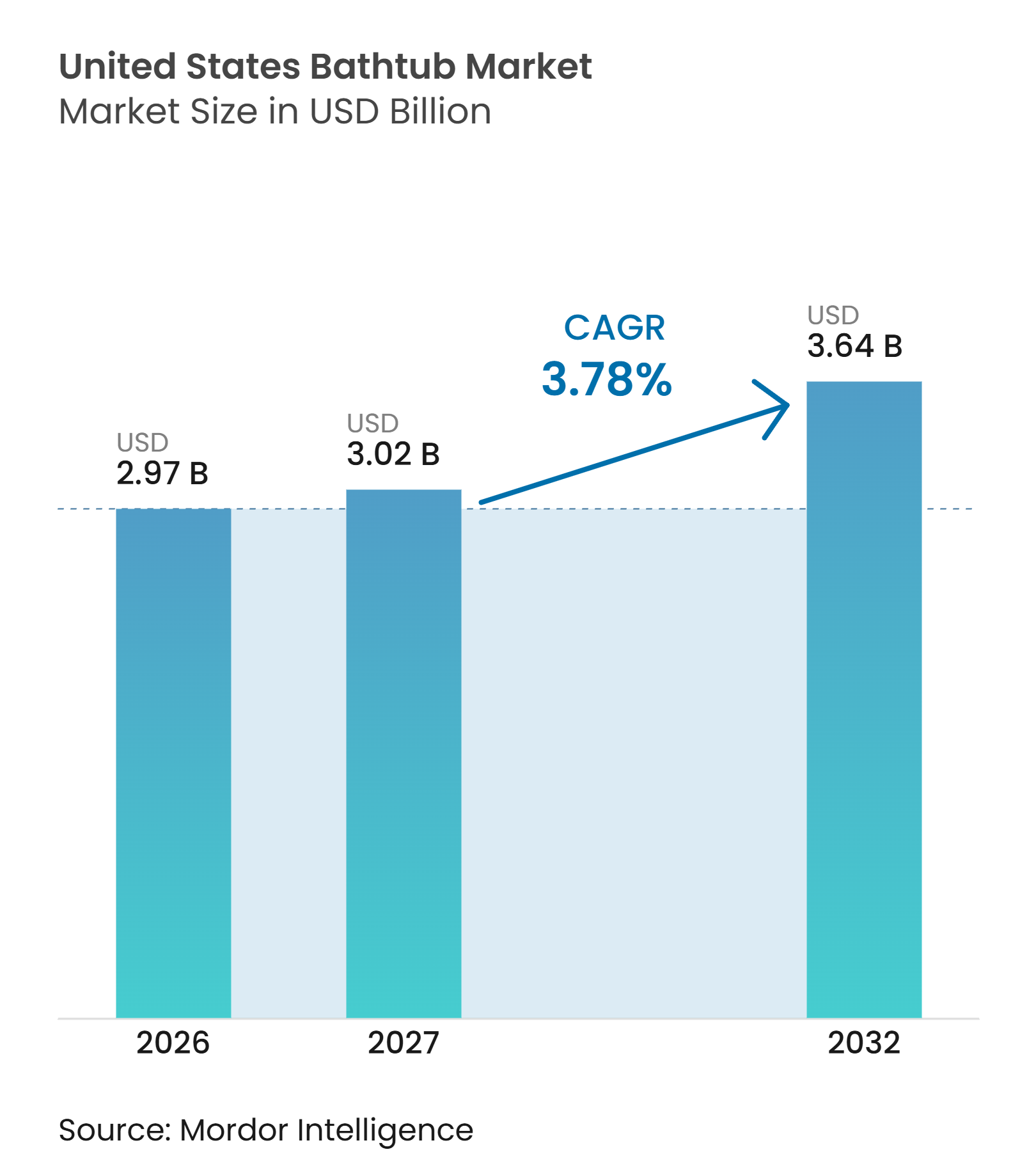
The United States bathtub market size was valued at USD 2.97 billion in 2026 and is estimated to grow from USD 3.02 billion in 2027 to USD 3.64 billion by 2032, at a CAGR of 3.78% during the forecast period (2027-2032). Bathroom replacement work supports demand because repair and remodeling spending in the wider kitchen and bath category grew in 2025 while new-construction spending declined, according to the National Kitchen and Bath Association. The United States bathtub market therefore relies increasingly on existing-home projects rather than on new housing alone. Standard alcove products remain important in construction, while higher-priced freestanding and therapeutic products support value in renovation work. Manufacturers are responding through product design, wellness features, and access to professional and retail channels. The United States bathtub market also faces pressure from larger shower installations, higher remodeling costs, and household water-use concerns.
Key Report Takeaways
• By product type, alcove bathtubs held 35.45% of the United States bathtub market share in 2026, while freestanding bathtubs are projected to grow at a 4.95% CAGR through 2032.
• By material, acrylic held 48.15% of revenue in 2026, while solid surface and stone resin are forecast to grow at a 5.16% CAGR through 2032.
• By end-user, residential users accounted for 72.36% of revenue in 2026 and are projected to grow at a 4.73% CAGR through 2032.
• By distribution channel, B2C and retail accounted for 73.11% of revenue in 2026 and are projected to grow at a 4.23% CAGR through 2032.
• By geography, the Southeast held 24.51% of revenue in 2026, while the Southwest is forecast to grow at a 5.12% CAGR through 2032.
Note: Market numbers in this report are based on Mordor Intelligence's proprietary estimation framework, which combines nine months of actuals with Q4 projections for base year 2026.
Market Trends and Insights
Drivers Impact Analysis of United States Bathtub Market*
| Driver | (~) % Impact on CAGR Forecast | Geographic Relevance | Impact Timeline |
|---|---|---|---|
| Residential Bathroom Renovation and Replacement Demand | +1.0% | National, with higher intensity in the Southeast and Northeast | Medium term (2-4 years) |
| Premiumization and Spa-Like Bathroom Demand | +0.8% | National, with early gains in coastal and Sun Belt metros | Long term (≥ 4 years) |
| Walk-In Bathtubs for Aging in Place | +0.7% | National, concentrated in the Southeast, Midwest, and Northeast | Medium term (2-4 years) |
| E-Commerce Adoption and Wider Product Availability | +0.5% | National | Short term (≤ 2 years) |
| Builder Preference for Modular, Efficient Systems | +0.4% | Southwest and Southeast | Medium term (2-4 years) |
| Demand for Water-Efficient, Sustainable Designs | +0.3% | National, with higher sensitivity in Western and drought-affected states | Long term (≥ 4 years) |
| Source: Mordor Intelligence | |||
Residential Bathroom Renovation and Replacement Demand
Bathroom renovation remains a major spending category for United States homeowners. The 2026 Houzz & Home Study found that 25% of respondents renovated a primary bathroom and 23% renovated a guest bathroom during 2025, compared with 26% who undertook kitchen projects[1]. Median spending on primary bathroom projects reached USD 15,000 in 2025, up 15.4% from the prior year. Homes built from the late 1980s through the early 2000s are reaching the stage at which plumbing and fixtures require major renewal. The National Kitchen and Bath Association projected 2.6% growth in repair and remodeling spending during 2025, while new-construction kitchen and bath spending was projected to decline 1.1% across single-family and multifamily projects[2]. This contrast makes renovation work a more durable source of demand than new residential construction, especially for products that fit existing bathroom layouts and reduce replacement complexity.
Premiumization and Demand for Spa-Like Bathroom Experiences
Wellness features are changing the role of the bathtub in higher-value bathroom renovations. The 2025 United States Houzz Bathroom Trends Study found that 36% of renovated bathrooms included wellness-focused features, and soaking tubs or spa baths appeared in 18% of the renovated bathrooms surveyed[3]. Kohler expanded Heated BubbleMassage technology to Ceric and Evok freestanding baths in August 2026. This product direction positions the bathtub as an in-home hydrotherapy product rather than only as a plumbing fixture. Renovation budgets can support fewer units with higher specifications when the bathtub is a visual focal point. Freestanding forms, mineral composite materials, and air or bubble systems can lift average unit value even where entry-level volumes are limited.
Growth of Walk-In Bathtubs for Aging in Place
The population aged 65 and older grew 3.1% to 61.2 million between 2023 and 2024, representing 18.0% of the United States population in 2024. Houzz found that 68% of homeowners considered accessibility needs during bathroom renovation projects, and aging household members were the leading focus in 41% of those cases. A Richmond Federal Reserve review, citing 2024 AARP survey data, reported that 75% of seniors prefer to remain in their homes as they age[4]. The review also found that homeownership among adults aged 65 and older increased to 79% in 2022, while institutional living declined to 3.0%. These conditions support residential demand for walk-in products, lower step-in configurations, grab-bar integration, and accessible layouts.
E-Commerce Adoption and Wider Product Availability
Digital channels give consumers and contractors access to a wider range of bathtub designs, especially from specialty manufacturers that cannot support broad showroom coverage. Product images, technical specifications, and installation information allow buyers to compare design-led offerings before purchase. Online research can influence a purchase completed through a store or local contractor. Builders can also compare availability and specifications without relying only on a limited local distributor base. This can increase competition in contractor-specified products and help developers source standard products for large projects more efficiently. The channel shift favors suppliers that provide accurate product information and dependable fulfillment.
Restraints Impact Analysis of United States Bathtub Market*
| Restraint | (~) % Impact on CAGR Forecast | Geographic Relevance | Impact Timeline |
|---|---|---|---|
| High Installation, Plumbing, and Remodeling Costs | -0.6% | National, most acute in Northeast and West coastal markets | Medium term (2-4 years) |
| Limited Bathroom Space and Shower-Only Conversions | -1.0% | National, with greater intensity in urban and multifamily markets | Long term (≥ 4 years) |
| High Water Consumption and Utility Costs | -0.4% | Western and Sun Belt states with water stress | Long term (≥ 4 years) |
| Maintenance, Leakage, and Durability Concerns | -0.3% | National | Medium term (2-4 years) |
| Source: Mordor Intelligence | |||
Limited Bathroom Space and Conversion Toward Shower-Only Configurations
A move toward shower-only configurations is a significant constraint on bathtub demand. The National Kitchen and Bath Association reported that 53% of homeowners renovating a primary bathroom removed a bathtub to increase shower space. A standard 60-inch alcove product can be replaced by a walk-in shower with more room for seating, dual showerheads, or steam features. Wet rooms accounted for 16% of renovated bathrooms, up 3% from the prior year, and 50% of adopters cited space optimization as their main reason. Jacuzzi’s May 2026 Valdosta facility closure also reflected a long-term move toward shower-focused demand. Full-size alcove products in smaller or secondary bathrooms are the most exposed, while premium freestanding and therapeutic products can only partly offset this demand pressure.
High Installation, Plumbing, and Remodeling Costs
Bathroom project costs can delay discretionary replacement of a bathtub. Major primary bathroom remodels had a median cost of USD 22,000 in the 2025 Houzz survey, compared with USD 21,000 in the previous year, while plumbing rough-in work can add USD 3,000 to USD 10,000 when layouts change. Wall surround removal, plumbing changes, and subfloor inspection can make installation costs substantial even for a mid-priced acrylic product. The National Kitchen and Bath Association projected 2.9% growth in professionally led kitchen and bath remodels during 2025, compared with 0.6% for DIY projects. Houzz found that planned median renovation spending for 2026 was USD 15,000, 25% below 2025 actual spending. Products that fit existing footprints and simplify installation can reduce this barrier, but cost sensitivity still constrains replacement demand.
*Our forecasts treat driver/restraint impacts as directional, not additive. The impact forecasts reflect baseline growth, mix effects, and variable interactions.
United States Bathtub Market Segment Analysis
By Product Type:
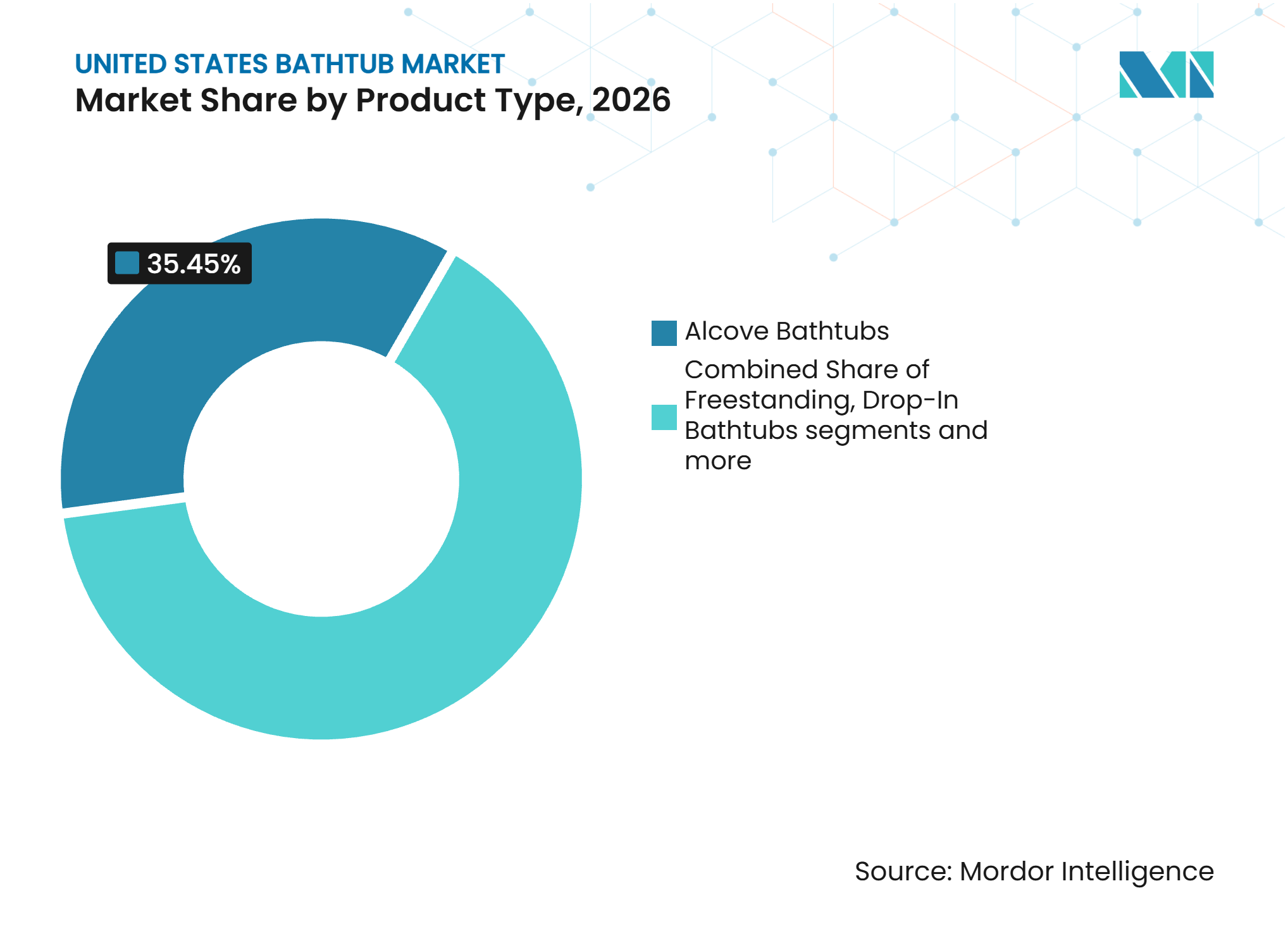
Alcove Products Retain Volume While Freestanding Formats Gain ValueAlcove bathtubs held 35.45% of the United States bathtub market share in 2026. Their position reflects compatibility with standard 60-inch North American bathroom rough-ins and common use in new multifamily projects and entry-level renovations. The format is familiar to builders and homeowners, which supports its use in standardized layouts. Drop-in and corner products remain relevant in deck-mounted custom projects and smaller bathrooms where placement can make better use of available floor area. Walk-in products are tied more closely to accessibility requirements than to a design preference.
The 2025 Houzz bathroom study reported that 61% of accessibility-focused renovations included grab bars. Freestanding bathtubs are projected to expand at a 4.95% CAGR through 2032, the highest growth rate among product types. The United States bathtub market size for freestanding formats is supported by renovation projects in which the tub serves as a visible focal point. The National Kitchen and Bath Association identified soaking and freestanding tubs as popular options in design-driven projects. ADA Section 607 influences bathtub specifications in accessible and commercial residential projects, including the engineering of walk-in formats for targeted applications.



By Material:
Acrylic Holds the Broadest Base While Composites Gain PreferenceAcrylic held 48.15% of revenue in 2026, giving it the leading material position. Its use is supported by low weight, thermal comfort, flexible shaping, and accessible pricing. These characteristics make acrylic suitable for both standard and more styled bathtub formats. MAAX Bath offers a 25-year residential warranty for applicable acrylic products, helping address lifecycle risk. Fiberglass remains a value-oriented material, while cast iron retains demand in premium applications where heat retention and acoustic properties matter.
Solid surface and stone resin are expected to grow at a 5.16% CAGR through 2032. This material responds to interest in matte finishes and organic-looking surfaces in primary bathroom renovations. The United States bathtub industry also uses composite materials to create premium forms with a more substantial feel. On 25th July 2025, MTI Baths introduced the Emi, a Japanese-style compact soaking tub made from SculptureStone mineral composite. Cultured marble and ceramic or other materials remain relevant to selected regional and commercial installations.
By End User:
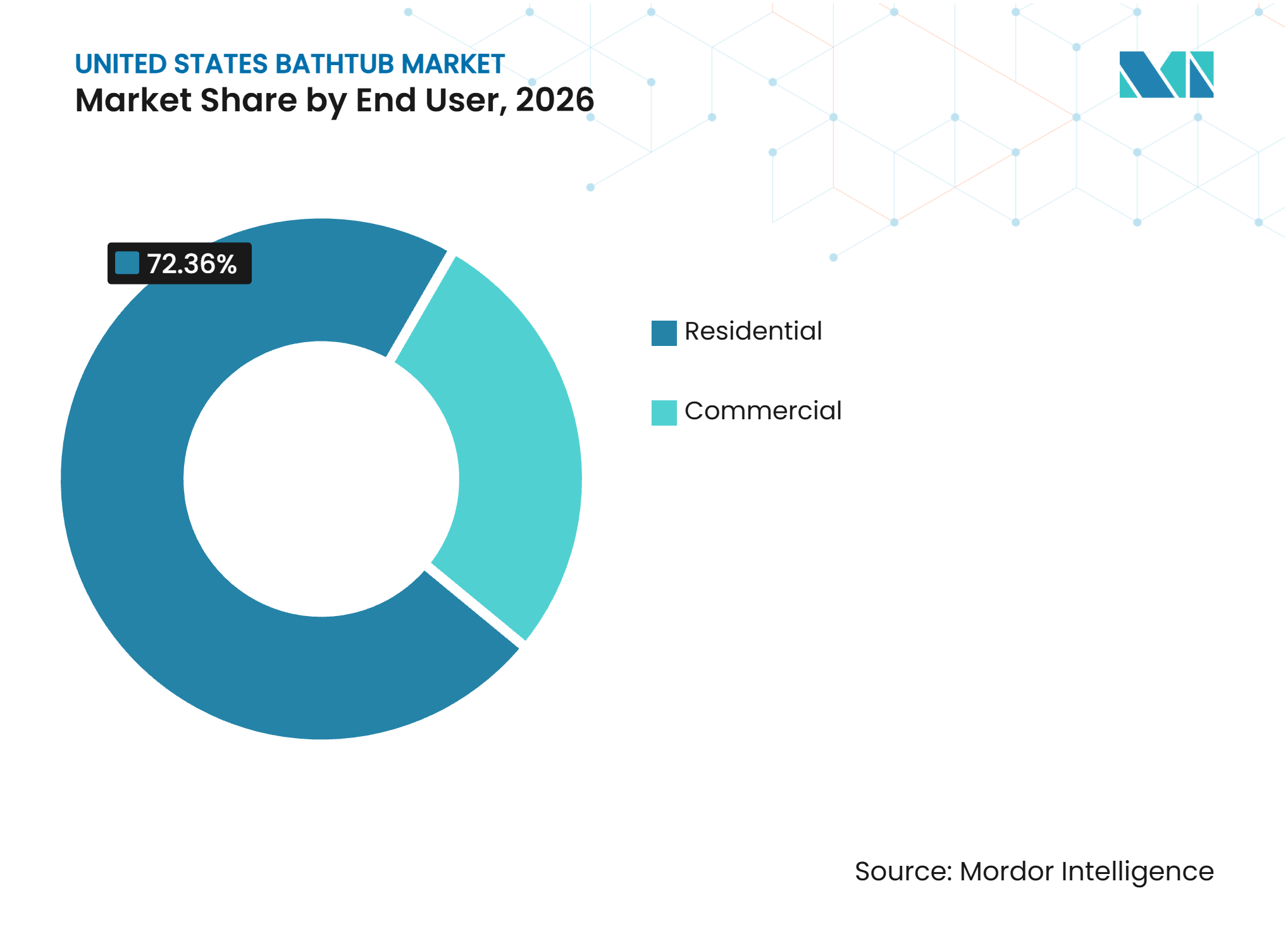
Residential Demand Combines Renovation and Construction NeedsResidential users accounted for 72.36% of revenue in 2026. The segment has 2 demand streams: replacement during existing-home renovations and initial specification in new single-family or multifamily construction. These streams react differently to changes in housing activity. Repair and remodeling spending grew in 2025 even as new-construction kitchen and bath spending declined. This balance gives the residential segment support when new housing becomes less active.
Higher-spending renovation households have a greater role in premium product demand. The 2026 Houzz data showed that the top decile of small primary bathroom renovation spenders invested USD 45,000 or more in 2025. This activity supports unit values even when total unit volumes remain measured. Commercial buyers include hotels, resorts, spas, healthcare facilities, senior living projects, gyms, and other facilities. Their share is smaller, but their specifications can influence product development in hydrotherapy, accessibility, and finish selection.

By Distribution Channel:
Retail Leads Revenue While Direct Channels Remain ImportantB2C and retail channels accounted for 73.11% of revenue in 2026. Big-box home improvement stores remain important purchase points for middle-market bathtub buyers. Retail also includes specialty stores and online channels that serve design-led purchases. Buyers can view products in person through stores while using online information to compare dimensions and features. This combination keeps retail important for homeowners who are managing their own renovation choices.
B2B and direct-from-manufacturer channels accounted for 26.89% of revenue in 2026. These channels serve builders and contractors who purchase specified products in volume and at negotiated prices. They are efficient for standardized or near-standardized products because suppliers can reduce the marketing expense associated with consumer retail. Digital ordering can broaden the choice of products available to professional buyers. It can also allow mid-tier manufacturers to reach builder networks outside their traditional distributor areas.
Geography Analysis
Southeast
The Southeast accounts for 24.51% of revenue in 2026, representing the largest regional share of the United States bathtub market. Florida, Georgia, the Carolinas, and Tennessee continue to experience active single-family housing development, supporting demand across product categories, while population growth drives household formation and future renovation demand. Homes built between 2000 and 2015 in parts of the region are approaching their first major plumbing renewal cycle, creating replacement demand as homeowners update bathrooms. Florida’s building requirements influence bathtub installation in new construction and replacement projects, reinforcing the role of licensed contractors and specified products. Homeowners must also match replacement products with existing room dimensions and plumbing locations. Although the market remains exposed to shower conversions, demand for accessible products may increase as homeowners modify properties for aging household members. Suppliers that offer standardized alcove products alongside accessible and premium options are better positioned to meet the region’s diverse demand.
Southwest
The Southwest is projected to grow at a CAGR of 5.12% through 2032, the fastest rate among the United States regions. Housing construction remains a major source of bathtub demand, as new housing units require initial bathroom fixture specifications and large developments create opportunities for suppliers that can fulfill repeat orders and meet consistent delivery requirements. Large-scale development activity favors products that reduce installation time and fit common layouts, while builders use standardized alcove specifications to manage labor availability and project schedules. The region has a younger population profile than the Northeast and Midwest, placing its peak replacement cycle further into the future and making construction demand more significant than renovation-related replacement demand. However, the existing construction base may generate replacement demand as properties age. Water conditions remain relevant across western and Sun Belt locations and may influence household attitudes toward bathtub use. Suppliers that combine installation efficiency with water-conscious positioning can address this regional context while maintaining required performance and style attributes.
Northeast, West, and Midwest
The Northeast has an older housing stock, dense urban areas, and higher renovation spending, supporting demand for walk-in and accessible formats among homeowners with established home equity, as well as higher-priced mineral composite freestanding products and wellness-focused formats. The West demonstrates strong interest in design-led freestanding products, although water stress can make water use an important household purchasing consideration, while the EPA WaterSense program and California Title 20 water-efficiency rules influence fixture choices in relevant projects. The Midwest is a stable, renovation-oriented region where population aging supports demand for accessible bathing products and home modifications that enable older adults to age in place. Although the Northeast, West, and Midwest have distinct demand conditions, each presents opportunities for products beyond basic standard tubs. Suppliers must align accessible features with the requirements of older households, design-focused products with premium renovation projects, and efficiency considerations with local conditions. These regional differences prevent suppliers from effectively serving the United States bathtub market through a single product and channel strategy.
Competitive Landscape
Market Concentration
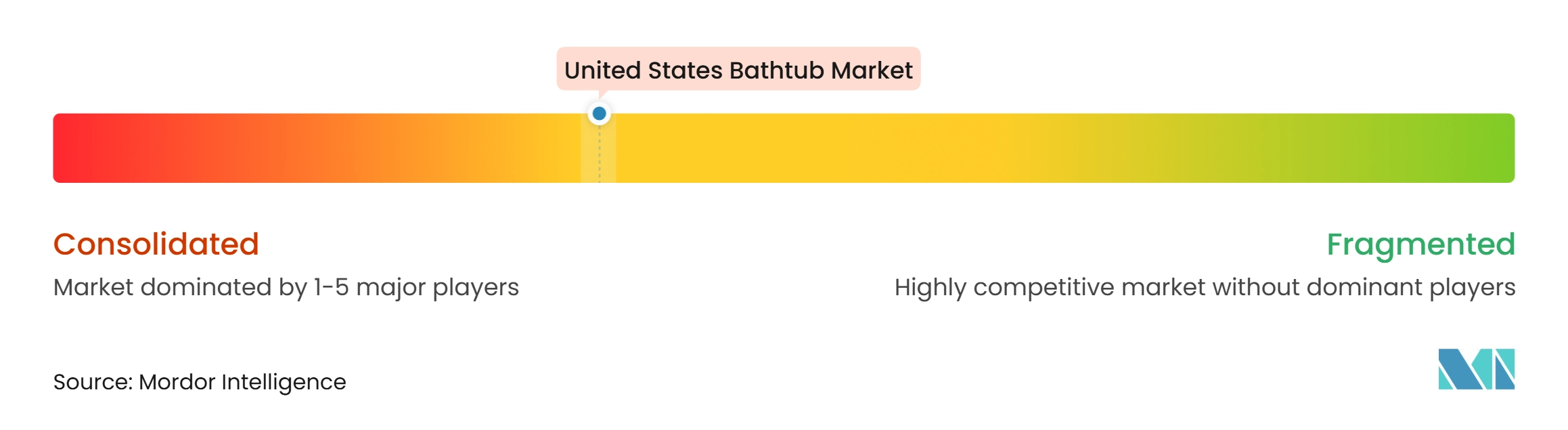
The United States bathtub market has a mix of large manufacturers, specialty producers, retail brands, and contractor-oriented suppliers. Kohler, LIXIL Corporation through American Standard, GROHE, and MAAX Bath hold major volume positions in contractor-specified and retail-distributed products. MTI Baths, Aquatica Plumbing Group, and BainUltra focus more heavily on design differentiation and material innovation. This creates a competitive setting in which scale matters for standard products and product distinction matters for premium products.
On 20 May 2026, Kohler launched the Claude collection with Studio McGee, including a freestanding bath with a 17-inch soaking depth and a coordinated bathroom suite. The company also opened a 9,584-square-foot retail showroom in Salt Lake City, featuring 10 immersive suites and 23 curated vignettes. On 4 August 2026, its introduction of Heated BubbleMassage technology across the Ceric and Evok collections brought warm-air hydrotherapy to these freestanding bathtub lines. Together, these initiatives highlight how design collaborations, immersive retail experiences, and wellness-oriented features can strengthen premium positioning and support higher price points.
MTI Baths differentiates its products through United States-based manufacturing, a limited lifetime warranty, extensive customization options, and proprietary materials. Launched on 25 July 2025, the Emi bathtub incorporated SculptureStone mineral composite and was manufactured to order in Georgia. In contrast, Jacuzzi’s closure of its Valdosta facility on 14 May 2026 highlights the operational pressures facing traditional, high-volume bathtub manufacturing. Meanwhile, direct-to-consumer brands can leverage detailed digital product information and contractor partnerships to streamline distribution and reduce associated costs. Overall, the United States bathtub market is likely to favor manufacturers offering compact freestanding designs and wellness-enhancing features at price points below the ultra-luxury segment.
United States Bathtub Industry Leaders
-
Kohler Co.
-
LIXIL Corporation
-
Jacuzzi Brands LLC
-
Mansfield Plumbing Products LLC
-
MAAX Bath Inc.
- *Disclaimer: Major Players sorted in no particular order
United States Bathtub Market Companies Covered in this Report
- Kohler Co.
- LIXIL Corporation
- Jacuzzi Group
- MAAX Bath Inc.
- Mansfield Plumbing Products LLC
- Bootz Industries, LLC
- Lasco Bathware
- Roca USA
- MTI Baths, Inc.
- The Swan Corporation
- Americh, Inc.
- BainUltra
- Aquatica Plumbing Group
- Victoria + Albert Baths
- Duravit USA
- Jason International
- Sterling Plumbing
- Fleurco Inc.
- Mirabelle
- Wyndham Collection
Recent Industry Developments in United States Bathtub Market
- August 2026: Kohler expanded its Heated BubbleMassage portfolio to include the Ceric and Evok freestanding bath collections, bringing warm-air hydrotherapy to two of its most design-visible freestanding lines. The Ceric is offered in 60-inch and 65-inch configurations, and the Evok is offered in a 66-inch model. Both feature a remote blower and heater assembly with automatic purge cycles for long-term maintenance.
- May 2026: Kohler launched the Claude collection in partnership with Studio McGee, a full bathroom suite including a freestanding bath with a 17-inch soaking depth, and simultaneously opened its first retail store in Salt Lake City, Utah. The 9,584-square-foot store includes 10 immersive suites and 23 curated vignettes to showcase coordinated Kohler and Kallista products.
- May 2026: Jacuzzi announced the closure of its Valdosta, Georgia, bathtub manufacturing facility, affecting more than 100 workers. The company cited a long-term shift in consumer demand toward shower-focused solutions as the primary reason for consolidating manufacturing.
- July 2025: MTI Baths introduced the Emi, a Japanese-style compact soaking tub crafted from SculptureStone mineral composite. The product is available in 3 sizes with matte or gloss finishes and is made to order in Georgia.
United States Bathtub Market Report Scope
Segmentation Overview
| Freestanding Bathtubs |
| Alcove Bathtubs |
| Drop-In Bathtubs |
| Corner Bathtubs |
| Walk-In Bathtubs |
| Whirlpool Bathtubs |
| Other Product Types |
| Acrylic |
| Fiberglass |
| Cast Iron |
| Porcelain-Enameled Steel |
| Solid Surface and Stone Resin |
| Cultured Marble |
| Ceramic and Other Materials |
| Residential | |
| Commercial | Hotels and Resorts |
| Spas and Wellness Centers | |
| Healthcare and Senior Living | |
| Gyms and Other Commercial Facilities |
| B2C/Retail | Big-Box & Home-Improvement Stores |
| Specialty Retail Stores | |
| Online | |
| Other Distribution Channels | |
| B2B/Direct From Manufacturers |
| Northeast |
| Southwest |
| West |
| Southeast |
| Midwest |
| By Product Type | Freestanding Bathtubs | |
| Alcove Bathtubs | ||
| Drop-In Bathtubs | ||
| Corner Bathtubs | ||
| Walk-In Bathtubs | ||
| Whirlpool Bathtubs | ||
| Other Product Types | ||
| By Material | Acrylic | |
| Fiberglass | ||
| Cast Iron | ||
| Porcelain-Enameled Steel | ||
| Solid Surface and Stone Resin | ||
| Cultured Marble | ||
| Ceramic and Other Materials | ||
| By End User | Residential | |
| Commercial | Hotels and Resorts | |
| Spas and Wellness Centers | ||
| Healthcare and Senior Living | ||
| Gyms and Other Commercial Facilities | ||
| By Distribution Channel | B2C/Retail | Big-Box & Home-Improvement Stores |
| Specialty Retail Stores | ||
| Online | ||
| Other Distribution Channels | ||
| B2B/Direct From Manufacturers | ||
| By Geography | Northeast | |
| Southwest | ||
| West | ||
| Southeast | ||
| Midwest | ||
Key Questions Answered in the Report
What is the projected growth rate for bathtubs in the United States?
The United States bathtub market is projected to grow at a 3.78% CAGR from 2027 to 2032, reaching USD 3.64 billion by 2032.
Which bathtub type is growing fastest in the United States?
Freestanding bathtubs are the fastest-growing product type, with a projected 4.95% CAGR through 2032.
What material leads bathtub sales in the United States?
Acrylic led revenue with a 48.15% share in 2026 because it combines low weight, thermal comfort, flexible shaping, and accessible pricing.
Why are walk-in bathtubs gaining attention?
Population aging and the preference to remain at home support demand for accessible products. Adults aged 65 and older represented 18.0% of the United States population in 2024.
Which United States region has the strongest bathtub demand?
The Southeast held 24.51% of revenue in 2026, while the Southwest is projected to have the fastest regional growth at a 5.12% CAGR through 2032.