
United Kingdom Wire and Cable Market Size and Share
Market Overview
| Study Period | 2020 - 2031 |
|---|---|
| Forecast Data Period | 2026 - 2031 |
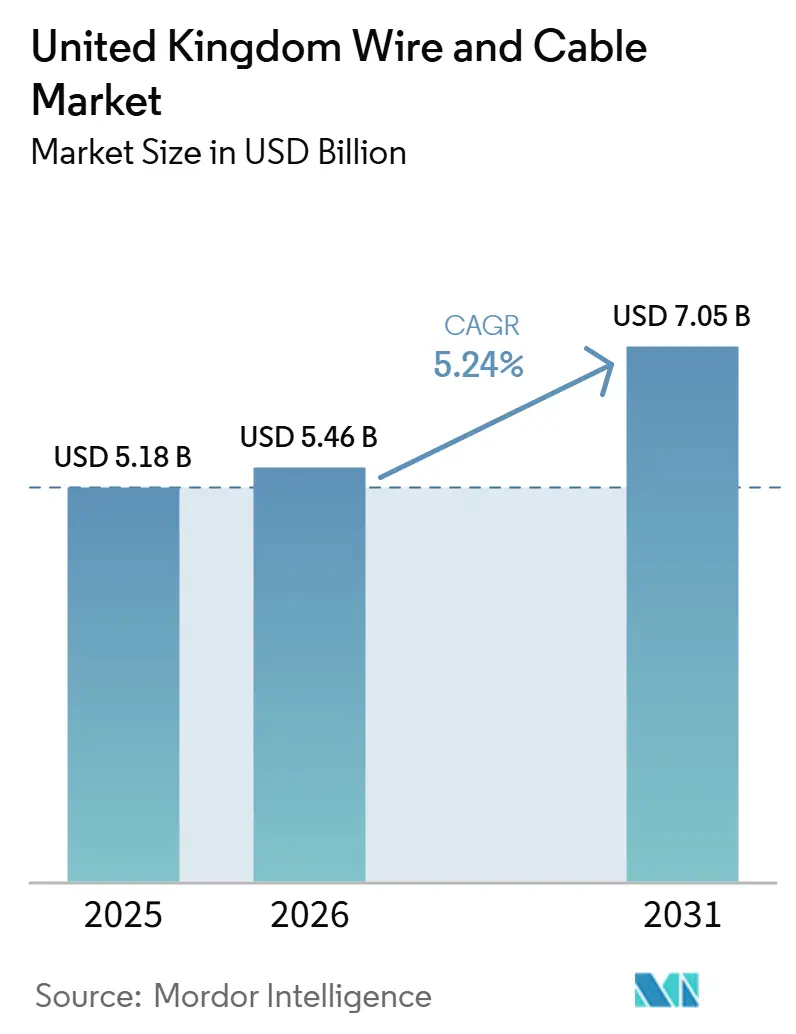
| Base Year Market Size (2025) | USD 5.18 Billion |
| Market Size (2026) | USD 5.46 Billion |
| Market Size (2031) | USD 7.05 Billion |
| Growth Rate (2026 - 2031) | 5.24 % |
| Market Concentration | Medium |
Major Players *Disclaimer: Major Players sorted in no particular order Image © Mordor Intelligence. Reuse requires attribution under CC BY 4.0. | |
United Kingdom Wire and Cable Market Analysis by Mordor Intelligence
The United Kingdom Wire and Cable Market size is projected to expand from USD 5.18 billion in 2025 and USD 5.46 billion in 2026 to USD 7.05 billion by 2031, registering a CAGR of 5.24% from 2026 to 2031. The UK wire and cable market is supported by simultaneous investment in electricity transmission, full-fiber networks, transport electrification, and building upgrades. Grid programs provide a long order horizon, while digital infrastructure adds demand for optical cable and high-density power systems. Offshore wind connections and interconnectors place greater importance on suppliers that can deliver certified high-voltage direct current, or HVDC, cable systems. This combination favors suppliers with established manufacturing capacity, technical approvals, and installation capabilities. Material costs and constrained HVDC capacity remain the main limits on project delivery and supplier margins.
Key Report Takeaways
- By voltage, low-voltage (less than 1 kV) cables held 53.12% of revenue share in the United Kingdom wire and cable market in 2025, while extra- and high-voltage (greater than 35 kV) cables are projected to expand at a 6.42% CAGR through 2031.
- By cable type, power cables accounted for 61.84% of revenue share in the United Kingdom wire and cable market in 2025, while fiber-optic cable is expected to grow at a 5.86% CAGR through 2031.
- By conductor material, copper held 65.25% of revenue share in the United Kingdom wire and cable market in 2025, while optical glass/polymer is projected to record a 5.91% CAGR through 2031.
- By installation, underground systems accounted for 54.31% of revenue share in the United Kingdom wire and cable market in 2025, while submarine systems are expected to grow at a 6.98% CAGR through 2031.
- By end-user vertical, construction held 31.35% of revenue share in the United Kingdom wire and cable market in 2025, while power infrastructure, including utilities and renewables, is projected to grow at a 6.54% CAGR through 2031.
- By insulation type, insulated cables accounted for 92.42% of revenue share in the United Kingdom wire and cable market in 2025 and are expected to expand at a 5.31% CAGR through 2031.
Note: Market size and forecast figures in this report are generated using Mordor Intelligence’s proprietary estimation framework, updated with the latest available data and insights as of January 2026.
United Kingdom Wire and Cable Market Trends and Insights
Drivers Impact Analysis*
| Driver | (~) % Impact on CAGR Forecast | Geographic Relevance | Impact Timeline |
|---|---|---|---|
| Grid Modernization and Renewable Power Integration | +2.0% | National, with highest intensity in Scotland and Northern England | Medium term (2-4 years) |
| Offshore Wind, Interconnector, and HVDC Cable Deployment | +1.5% | North Sea, Scottish coast, and Anglo-European subsea routes | Long term (≥ 4 years) |
| Full-Fiber Broadband and 5G Backhaul Expansion | +0.8% | National, with deepest rural impact in England, Scotland, and Wales | Medium term (2-4 years) |
| Electrification of Transport, Buildings, and Industry | +0.7% | National, with early concentration in urban England and the Midlands | Long term (≥ 4 years) |
| AI Data Center Fiber Density and Power Redundancy Requirements | +0.5% | London, Thames Valley, Manchester, and AI growth zones | Medium term (2-4 years) |
| Undergrounding for Urban Resilience and Planning Acceptance | +0.3% | Major United Kingdom urban centers, including London, Birmingham, and Bristol | Short term (≤ 2 years) |
| Source: Mordor Intelligence | |||
Grid Modernization and Renewable Power Integration
National Grid’s RIIO-T3 plan committed up to GBP 35 billion (USD 44.45 billion) between April 2026 and March 2031 for transmission upgrades and expansion.[1]National Grid, “The Great Grid Upgrade,” National Grid, nationalgrid.com This program gives the UK wire and cable market a regulated source of long-term demand. BEAMA stated that electrifying heat and transport will require more than 300,000 km of additional distribution cable, with total distribution cable needs exceeding 1 million km by 2035. Replacement demand also rises as oil-impregnated paper cables and early cross-linked polyethylene, or XLPE, installations approach their design limits. Ofgem price controls and network-output incentives encourage distribution network operators to replace assets while building new capacity. The parallel need to renew aging assets and add new capacity broadens procurement across transmission, distribution, installation, and testing work.
Offshore Wind, Interconnector, and HVDC Cable Deployment
The United Kingdom had 16,061 MW of operational offshore wind capacity at the end of 2025, and 9 projects totaling 11,500 MW were under construction.[2]RenewableUK, “UK Wind Energy Pipeline in 2025: A Year in Review,” RenewableUK, renewableuk.com Great Britain had 10.3 GW of operational interconnector capacity, with NeuConnect’s 1.4 GW connection under construction and 6.05 GW of approved development projects. The work also requires long planning periods because route design, factory allocation, marine installation, and regulatory delivery commitments must be coordinated before commissioning. These projects require HVDC systems that a limited group of certified suppliers can produce and install. Separate procurement for individual offshore developers puts them in competition for the same factory slots, which can raise prices and extend lead times. The January 2026 North Sea Summit commitment to 100 GW of offshore hybrid assets by 2050 provides a durable basis for future subsea cable requirements.
Full-Fiber Broadband and 5G Backhaul Expansion
BT Openreach reached 23 million premises with fiber-to-the-premises (FTTP) by the year ended March 31, 2026, after passing 4.8 million new premises during the year.[3]BT Group, “Results for the Full Year to 31 March 2026,” BT Group, bt.com Ofcom reported that full-fiber was available to 24.9 million residential premises, or 82% of UK homes, in January 2026. Project Gigabit targets 99% gigabit coverage by 2032 and is backed by GBP 5 billion (USD 6.35 billion) in funding for premises where commercial investment is less likely to reach. Rural deployment, therefore, continues to support access-network cable demand after many urban areas have been passed. Higher 5G coverage also requires additional fiber connections between mobile sites and the core network. This adds a separate backhaul requirement alongside household broadband, particularly as more sites adopt distributed network architectures and need resilient high-capacity links.
Electrification of Transport, Buildings, and Industry
The government expects electricity demand to at least double by 2050 as heating, transport, and industrial activity become more electrified. Peak-demand management capacity may need to rise from 58 GW to 130-190 GW by 2050. Commercial building conversions from gas heating to heat pumps can require upgrades to connections, internal rewiring, and electric-vehicle charging equipment. Those separate activities broaden cable demand across the building stock. Rail projects, including the Transpennine Route Upgrade and Midland Main Line work, add requirements for medium-voltage traction and signaling cables. The resulting demand is tied to infrastructure programs and is less dependent on short-term construction cycles. It also spreads cable procurement across grid connections, building wiring, charging equipment, rail systems, and industrial facilities, rather than relying on a single customer group.
Restraints Impact Analysis*
| Restraint | (~) % Impact on CAGR Forecast | Geographic Relevance | Impact Timeline |
|---|---|---|---|
| Copper and Aluminum Price Volatility | -1.4% | Global, with direct cost pass-through to United Kingdom cable buyers and end users | Short term (≤ 2 years) |
| HVDC Component Bottlenecks and Long Project Lead Times | -0.8% | North Sea and Anglo-European interconnector corridors | Long term (≥ 4 years) |
| Shortage of Cable Jointers, Test Engineers, and Marine Installation Capacity | -0.5% | National, with marine capacity concentrated in United Kingdom North Sea port regions | Medium term (2-4 years) |
| Brexit-Related Trade Friction and Fragmented Compliance Documentation | -0.3% | United Kingdom-Europe trade corridors, concentrated in specialty and low-volume cable imports | Medium term (2-4 years) |
| Source: Mordor Intelligence | |||
Copper and Aluminum Price Volatility
Three-month copper futures exceeded USD 11,400 per metric ton in 2025 and rose above USD 13,000 in early 2026. UK copper wire costs increased by more than 18% year over year through the second quarter of 2026. Higher input prices reduce suppliers' margins under fixed-price tenders. The copper-to-aluminum price ratio reached 4.3 in January 2026, which supports greater use of aluminum in appropriate distribution and overhead applications. This substitution does not relieve cost pressure in high-current transmission systems, where copper remains important. Commodity price changes affect processors, manufacturers, installers, and end users simultaneously, limiting each participant's ability to absorb the increase. Suppliers may therefore face pressure to shorten tender validity periods, review escalation clauses, and adjust product design where technical and regulatory requirements allow.
HVDC Component Bottlenecks and Long Project Lead Times
Major HVDC cable factories were fully booked through 2028-2029, and export-grade cable lead times extended to 4-5 years. The government’s 2026 supply-chain update identified substantial HVDC gaps in 2025-2026 that will continue through 2030. Eastern Green Link 1 experienced a 16-month delay linked in part to supply constraints. Regulated transmission owners face delivery obligations under Ofgem’s strategic investment framework, which encourages early procurement and increases competition for capacity. Cable-lay vessels are also booked well in advance, creating a second limit on project schedules. These conditions can defer commissioning even where project finance and regulatory approvals are already in place. A shortage of qualified jointers, test engineers, and marine installation capacity can further extend the period between cable delivery and an operational connection.
*Our forecasts treat driver/restraint impacts as directional, not additive. The impact forecasts reflect baseline growth, mix effects, and variable interactions.
Segment Analysis
By Voltage: High-Voltage Infrastructure Reshapes the UK Grid
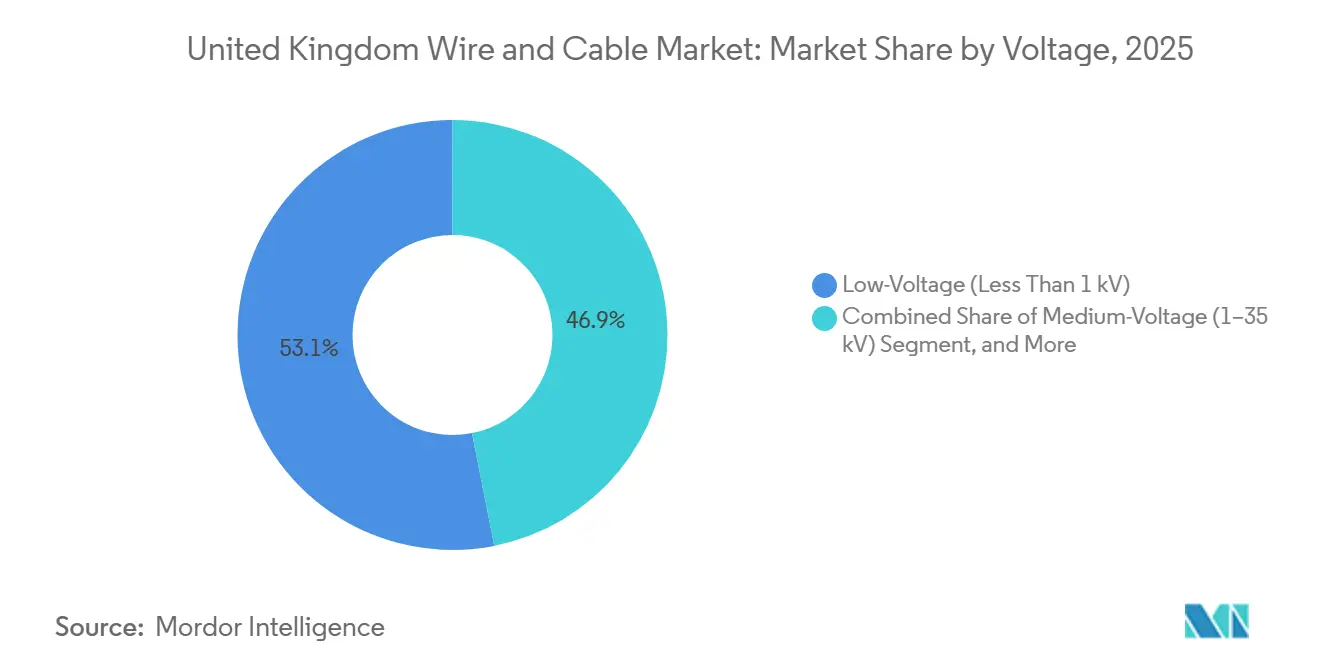
Low-voltage (less than 1 kV) cables held 53.12% of the UK wire and cable market share in 2025. Residential wiring, commercial fit-outs, and ongoing distribution-network upgrades support this leading position. Distribution network operators require dependable low-voltage systems for last-mile connections and local reinforcement. Medium-voltage (1-35 kV) products serve substations, industrial connections, rail electrification, and other distribution applications. The Transpennine Route Upgrade supports traction-cable demand that is separate from general building activity. These uses give medium-voltage cable demand a broad operating base. They also depend on project-specific approvals, fire performance requirements, and installation conditions that can favor suppliers with established local distribution and technical support.
Extra- and high-voltage (greater than 35 kV) cables are projected to grow at a 6.42% CAGR through 2031. Offshore wind export links, interconnectors, and the Great Grid Upgrade are the main sources of this growth. Contracts for Eastern Green Link 3 and Eastern Green Link 4 exceeded EUR 4.5 billion (USD 5.09 billion) in 2026. New offshore projects increasingly use 66 kV inter-array cables as turbine ratings exceed 15 MW and array strings extend beyond 10 km. Ofgem’s strategic transmission framework provides visibility into capital recovery for regulated high-voltage assets. The UK wire and cable market, therefore, has different pricing and procurement conditions for regulated high-voltage systems and for commercially purchased low- and medium-voltage products. High-voltage projects require extensive type testing, route planning, and coordination with converter stations, while lower-voltage purchases are generally linked to local project schedules and distributor availability.



By Cable Type: Power Cables Dominate, Fiber Closes the Gap
Power cables accounted for 61.84% of the UK wire and cable market in 2025. They are used from local distribution networks through submarine HVDC export systems. This wide role gives power-cable suppliers direct exposure to both grid investment and building activity. Signal and control cable supports industrial automation, process control, and railway signaling. Coaxial and data cables remain relevant for legacy broadband access and satellite backhaul. These categories serve specialized applications with varying replacement cycles and technical specifications. Their demand is distributed across factory modernization, rail upgrades, legacy communications assets, security systems, and industrial sites, which reduces reliance on a single purchasing pattern.
Fiber-Optic Cable is projected to expand at a 5.86% CAGR through 2031. BT Openreach’s FTTP footprint of 23 million premises supports demand for access-network fiber. The UK wire and cable industry also benefits from data center construction, which requires fiber, power, and fire-rated control cables. More remote data-center locations can increase fiber demand outside the established London and Slough corridor. Standards such as BS EN 50173 and IEEE 802.3 support upgrades from legacy multimode systems to single-mode fiber in high-capacity installations. That transition raises both cable density and the specification level of new connections. As data workloads are placed closer to available power, access, and interconnection routes in regional locations, these routes can gain importance alongside the established digital corridors of southern England.
By Conductor Material: Copper Dominates, Optical Fiber Gains Ground
Copper-conductor cables accounted for 65.25% of demand in 2025. Copper’s electrical conductivity supports its use in demanding applications, including EV charging and high-current transmission circuits. Established product specifications also make it the benchmark conductor for many power-cable uses. Aluminum is used in overhead transmission, medium-voltage trunking, and building distribution, where lower weight and cost can be important. The record copper-to-aluminum price ratio in January 2026 encouraged greater consideration of aluminum in suitable applications. Selection still depends on current rating, conductor size, connection design, installation setting, and the applicable engineering standard, which limits direct substitution in many high-performance uses.
Optical Glass/Polymer is expected to post a 5.91% CAGR through 2031. FTTP buildout, data-center interconnects, and fiber sensing in composite power-cable designs support this rate. High-capacity data centers use 400G and 800G connections that require dense optical networks. Composite designs can bundle optical fiber and power conductors into a single cable jacket. These products can support real-time thermal monitoring of transmission conductors. Their use is relevant to underground HVDC systems, where asset monitoring and lifecycle management carry high value. The combination of communications and power functions can also simplify certain installation layouts, although it requires suppliers to meet both optical and electrical performance specifications.
By Installation: Underground Leads, Submarine Sets the Pace
Underground systems represented 54.31% of demand in 2025. Buried networks are favored in urban areas where obtaining overhead-line planning consent is difficult. They also support resilience objectives where weather-related outages are a concern. Overhead lines remain important in rural and upland areas of Scotland, Wales, and Northern England. Terrain, access limitations, and route economics can still support aerial installation. Visual-impact reviews and local opposition, however, can restrict the construction of new overhead routes in populated areas. This can shift projects toward underground alternatives that need more civil works, higher material volumes, and specialized cable-jointing capability.
Submarine cable installation is projected to grow at a 6.98% CAGR through 2031. Offshore wind export systems, HVDC interconnectors, and hybrid offshore assets drive this requirement. The January 2026 North Sea Summit reinforced the longer-term need for offshore electricity links. This requires long planning periods because marine installation, route design, factory allocation, and regulatory delivery commitments must be coordinated before commissioning. Eastern Green Link 3 involves a combined onshore and offshore route of 680 km, while Eastern Green Link 4 covers more than 640 km. Submarine systems are designed for 50-year service lives and require protection against trawling activity and seabed movement. Improved burial tools and cable plows can reduce vessel time and improve installation performance in difficult marine conditions. Developers also assess water depth, seabed conditions, landfall design, route congestion, and the availability of repair vessels before finalizing procurement requirements.
By End-User Vertical: Construction Holds Share, Utilities Drive Growth
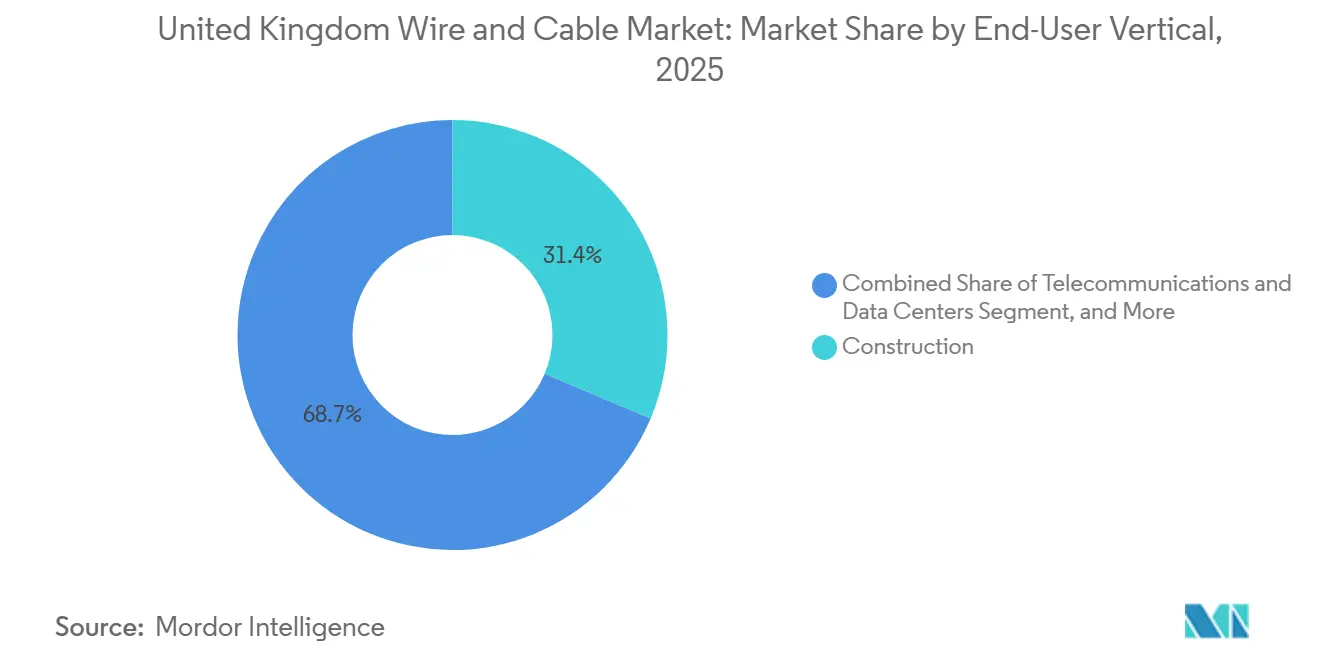
The construction accounted for 31.35% of demand in 2025. Residential, commercial, and institutional projects support recurring low-voltage and medium-voltage requirements. Fire-rated low-smoke, halogen-free, or LSHF, cable specifications add value to building projects. The Building Safety Act supports the use of appropriate safety-focused cable solutions in relevant refurbishments and new installations. Automotive and Mobility, Oil and Gas, Petrochemicals, and Industrial Manufacturing provide additional demand. EV charging installations use high-ampacity direct-current cable and power-management wiring across commercial and fleet locations. Building projects also require product selection that reflects occupancy, fire safety, environmental exposure, and the requirements of the electrical installation design.
Power Infrastructure, including Utilities and Renewables, is projected to grow at a 6.54% CAGR through 2031. National Grid, ScottishPower Transmission, and SSEN Transmission are executing extensive transmission upgrades. The UK wire and cable market for this end-user group is supported by transmission construction and renewable connections, rather than by routine replacement alone. Data-center projects also require fiber and copper power cables, as well as fire-rated control systems. Battery energy storage systems require high-ampacity direct-current cable and power-electronics interconnections at each site. These applications add demand that conventional utility-cable forecasts can understate. Their procurement includes collector systems, inverters, transformers, control equipment, and grid connections, creating multiple cable requirements within a single energy-storage project.
By Insulation: Insulated Cables Define Market Breadth and Growth
Insulated cables held 92.42% of demand in 2025. Engineered insulation is required across domestic wiring, commercial installation, and 525 kV HVDC submarine systems. Insulation selection varies by voltage, operating environment, and certification requirement. Non-Insulated products include bare conductors and overhead earth wires used in rural transmission applications. Their growth outlook is limited because many planned grid additions are underground or submarine. Planning resistance also constrains the expansion of overhead networks. The remaining non-insulated applications are therefore concentrated in specific transmission, earthing, and rural network uses rather than in the full range of new infrastructure projects.
Insulated cables are expected to grow at a 5.31% CAGR through 2031. This means the leading insulation category is also the fastest-growing category. XLPE is used in underground and submarine transmission systems, while LSHF is used in public buildings and rail settings. Ethylene-propylene rubber (EPR) serves selected submarine applications. IEC 60502 and BS EN 50618 define performance requirements for relevant medium- and high-voltage power-cable applications. Rising conductor costs and energy-intensive polymer feedstocks can increase insulated cable prices from both material components. Suppliers must balance electrical performance, mechanical protection, smoke and halogen characteristics, thermal limits, and installation practicality when choosing insulation systems.
Geography Analysis
England accounts for the largest share of UK wire and cable demand, with digital infrastructure and grid construction forming distinct demand centers. London and the Southeast include the Thames Valley and Slough data center corridor. Culham in Oxfordshire and Blyth/Cobalt Park in Northeast England are designated AI Growth Zones. These locations require fiber-optic, dense power, and fire-rated cable systems. England’s digital projects generally demand higher-value products than routine building-cable installations. BT Openreach passed 4.8 million new premises during FY2026, supporting continuing fiber demand in urban and suburban areas.
Scotland is central to the UK wire and cable market size because it hosts major origins for high-value transmission routes. Eastern Green Link 2, 3, and 4 connect Scottish locations to demand centers in England. SSEN Transmission committed GBP 22 billion (USD 27.94 billion) over 5 years to upgrade Highland and island transmission infrastructure. Sumitomo Electric’s Port of Nigg facility is expected to start 525 kV HVDC production in 2027. Scotland’s ScotWind and Celtic Sea licensing rounds, together with transmission reinforcement, create a long offshore and onshore procurement pipeline. The region, therefore, has an outsized role in the highest-value cable programs through the 2030s.
Wales and Northern Ireland contribute smaller but steady volumes for broadband completion, industrial connections, and network reinforcement. Wales has Great Grid Upgrade projects at Pentir to Trawsfynydd, Swansea to Pembroke, and Dinorwig to Pentir. These projects support medium-voltage and high-voltage cable purchases beyond the mid-2020s. Northern Ireland reached 97.37% gigabit coverage in January 2026. Its incremental demand is shifting from broad broadband rollout toward industrial electrification and renewable connections. Scottish offshore generation also routes through English connection points, extending the effects of Scottish energy projects into the Midlands distribution network.
Competitive Landscape
The UK wire and cable market is concentrated in transmission and submarine cable, where Prysmian, NKT, and Nexans have certified 525 kV HVDC platforms, specialized vessels, and committed manufacturing capacity. Competition is more fragmented in mid-voltage and low-voltage products. British Cables Company, Tratos UK, JDR Cable Systems, Hellenic Cables, and regional distributors compete on lead times, compliance documentation, and proximity to contractors. National Grid’s GBP 59 billion (USD 74.93 billion) HVDC supply-chain framework includes positions for 6 suppliers and covers GBP 21.3 billion (USD 27.05 billion) in cable supply. Framework agreements provide qualifying suppliers with longer revenue visibility and restrict access to the highest-value programs for suppliers without equivalent approvals. This structure strengthens the importance of UK-specific type testing and delivery records. It also gives transmission owners a way to coordinate cable supply with converter stations, civil works, route access, and commissioning milestones, while manufacturers gain more predictable demand than they receive from individual spot purchases.
Prysmian uses submarine cable burial tools operated from its marine base in Middlesbrough, which combines installation capability with its manufacturing position. NKT signed its record EUR 2.2 billion (USD 2.49 billion) Eastern Green Link 3 contract in March 2026, covering design, manufacture, and installation of a 525 kV HVDC system. Prysmian signed a EUR 2.3 billion (USD 2.60 billion) Eastern Green Link 4 contract in February 2026 for more than 640 km of 525 kV HVDC cable. NKT then signed final contracts worth EUR 2 billion (USD 2.26 billion) in July 2026 for the Western Isles and Spittal-to-Peterhead cable systems. These awards show that certified capacity and turnkey execution remain decisive in HVDC procurement. They also make it difficult for smaller suppliers to quickly enter the premium transmission segment. A new entrant must demonstrate suitable manufacturing processes, product performance, installation capability, finance, safety systems, and long-term service support before it can compete for the largest projects, which takes time even when demand conditions are favorable.
Opportunities remain in medium-voltage direct-current cable for EV charging, LSHF building cable, and fiber-composite sensing products for smart-grid monitoring. JDR Cable Systems is expanding its Hartlepool facility into inter-array cable manufacturing. This could allow the company to pursue offshore wind orders that have traditionally gone to larger European suppliers. The planned tightening of IEC 62067 requirements for 500 kV-plus XLPE systems and IEC 60228 conductor requirements could increase entry barriers. Suppliers with active type-test programs and established approvals are better placed to qualify for high-voltage projects. The broader UK wire and cable industry remains diverse because construction, distribution, telecommunications, and industrial applications use different purchasing channels. This balance explains why the premium transmission segment is concentrated while the wider supplier base remains fragmented. It also leaves room for specialized suppliers that can respond quickly to local installers, serve smaller lot sizes, and provide documentation or technical assistance for construction, rail, industrial, and distribution projects. These suppliers can secure positions in applications that do not require a dedicated cable-lay vessel or 525 kV qualification, although they must still meet project quality, safety, and delivery requirements.
United Kingdom Wire and Cable Industry Leaders
Prysmian S.p.A.
Nexans S.A.
NKT A/S
Sumitomo Electric Industries, Ltd.
Leoni AG
- *Disclaimer: Major Players sorted in no particular order


Recent Industry Developments
- May 2026: Ofcom published its Connected Nations Spring 2026 update, confirming full-fiber availability at 24.9 million UK residential premises, or 82% of UK homes, as of January 2026. Gigabit-capable broadband reached 89% of UK homes, and standalone 5G coverage expanded across all 3 UK mobile network operators deploying the technology.
- May 2026: BT Group’s FY2026 annual results, for the year to March 31, 2026, confirmed that BT Openreach passed 4.8 million new FTTP premises during the year. The result brought the total footprint to 23 million premises and kept the 25 million target by December 2026 on track.
- March 2026: NKT signed a firm contract for the Eastern Green Link 3 HVDC power cable system with a joint venture of National Grid Electricity Transmission and SSEN Transmission. The contract was valued at more than EUR 2.2 billion (USD 2.49 billion) and covered the design, manufacture, and installation of a 525 kV HVDC cable system with a route length of 680 km. Commissioning is targeted for 2033.


United Kingdom Wire and Cable Market Report Scope
The United Kingdom wire and cable market revenue is generated through the sale of low-, medium-, and high-voltage wires and cables, including power, fiber-optic, signal and control, and coaxial/data cables with copper, aluminum, or optical glass/polymer conductors, along with associated value-added products and installation-specific solutions for overhead, underground, and submarine network deployments.
The United Kingdom wire and cable market report is segmented by voltage (extra- and high-voltage (greater than 35 kV), medium-voltage (1-35 kV), and low-voltage (less than 1 kV)), cable type (power cable, fiber-optic cable, signal and control cable, and coaxial and data cable), conductor (copper, aluminum, and optical glass/polymer), installation (overhead, underground, and submarine), end-user vertical (construction (residential and commercial), power infrastructure (utilities and renewables), telecommunications and data centers, oil and gas and petrochemicals, automotive and mobility, and industrial manufacturing), and insulation (insulated and non-insulated). The market forecasts are provided in terms of value (USD).
| Extra- and High-Voltage (Greater Than 35 kV) |
| Medium-Voltage (1-35 kV) |
| Low-Voltage (Less Than 1 kV) |
| Power Cable |
| Fiber-Optic Cable |
| Signal and Control Cable |
| Coaxial and Data Cable |
| Copper |
| Aluminum |
| Optical Glass/Polymer |
| Overhead |
| Underground |
| Submarine |
| Construction | Residential |
| Commercial | |
| Power Infrastructure (Utilities and Renewables) | |
| Telecommunications and Data Centers | |
| Oil and Gas and Petrochemicals | |
| Automotive and Mobility | |
| Industrial Manufacturing |
| Insulated |
| Non-Insulated |
| By Voltage | Extra- and High-Voltage (Greater Than 35 kV) | |
| Medium-Voltage (1-35 kV) | ||
| Low-Voltage (Less Than 1 kV) | ||
| By Cable Type | Power Cable | |
| Fiber-Optic Cable | ||
| Signal and Control Cable | ||
| Coaxial and Data Cable | ||
| By Conductor Material | Copper | |
| Aluminum | ||
| Optical Glass/Polymer | ||
| By Installation | Overhead | |
| Underground | ||
| Submarine | ||
| By End-User Vertical | Construction | Residential |
| Commercial | ||
| Power Infrastructure (Utilities and Renewables) | ||
| Telecommunications and Data Centers | ||
| Oil and Gas and Petrochemicals | ||
| Automotive and Mobility | ||
| Industrial Manufacturing | ||
| By Insulation | Insulated | |
| Non-Insulated | ||


Key Questions Answered in the Report
What is the current size of the UK wire and cable market?
The UK wire and cable market was valued at USD 5.18 billion in 2025 and is estimated at USD 5.46 billion in 2026. It is forecast to reach USD 7.05 billion by 2031.
What is driving demand for wire and cable in the United Kingdom?
Grid modernization, offshore wind connections, full-fiber deployment, transport electrification, and building upgrades are supporting demand. These demand sources span transmission networks, distribution upgrades, data networks, building systems, and mobility infrastructure.
Which voltage category leads UK demand?
Low-Voltage (less than 1 kV) cable led with a 53.12% share in 2025. Extra- and High-Voltage (greater than 35 kV) cable is projected to grow fastest at a 6.42% CAGR through 2031.
Why are submarine cable systems growing quickly in the United Kingdom?
Offshore wind export projects, HVDC interconnectors, and hybrid offshore assets are expected to support a 6.98% CAGR for submarine systems through 2031.
Which end-user group is expected to expand most rapidly?
Power Infrastructure, including Utilities and Renewables, is projected to grow at a 6.54% CAGR through 2031 as transmission and renewable-connection work advances.
What limits delivery of UK HVDC cable projects?
Factory capacity was constrained through 2028-2029, while export-grade HVDC lead times extended to 4-5 years and vessel availability remained limited. These restrictions can delay delivery even where project finance and approvals are in place.
Page last updated on:





