
United Kingdom Microgreens Market Size and Share
Market Overview
| Study Period | 2021 - 2031 |
|---|---|
| Forecast Data Period | 2026 - 2031 |
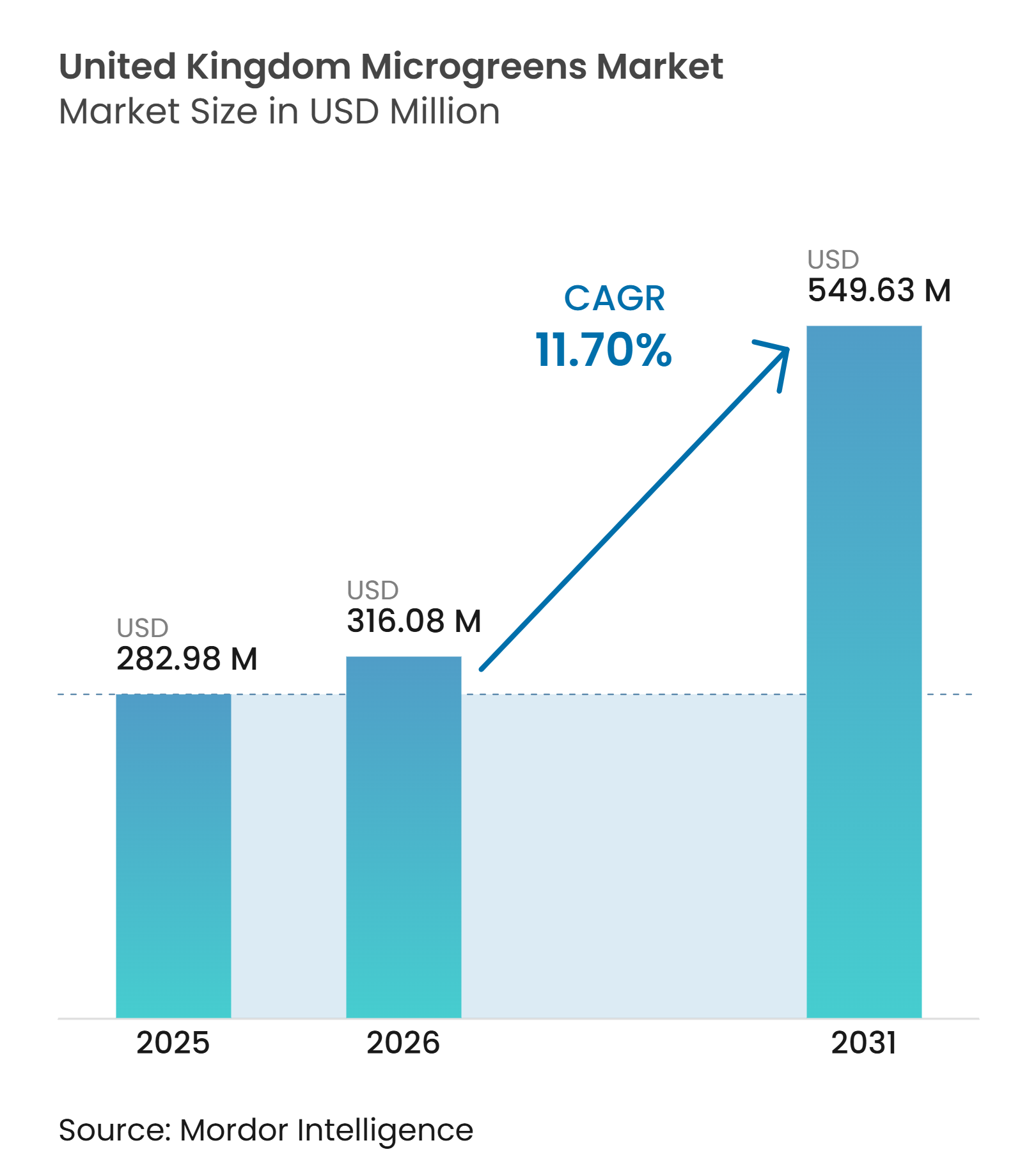
| Base Year Market Size (2025) | USD 282.98 Million |
| Market Size (2026) | USD 316.08 Million |
| Market Size (2031) | USD 549.63 Million |
| Growth Rate (2026 - 2031) | 11.70 % |
| Market Concentration | Low |
Major Players *Disclaimer: Major Players sorted in no particular order Image © Mordor Intelligence. Reuse requires attribution under CC BY 4.0. | |
United Kingdom Microgreens Market Analysis by Mordor Intelligence
The United Kingdom microgreens market was valued at USD 282.98 million in 2025 and is projected to grow from USD 316.08 million in 2026 to USD 549.63 million by 2031, registering a CAGR of 11.70% during the forecast period 2026–2031. The market is supported by high urban demand, an established chilled-produce retail network, and foodservice buyers incorporating microgreens into premium dishes. Local production reduces dependence on imported produce and enables shorter delivery routes. However, higher electricity standing charges present a significant cost challenge for larger controlled-environment agriculture (CEA) facilities. This cost pressure favors operators that improve energy efficiency, develop retail relationships, and utilize nearby production sites. The market also has potential for broader everyday consumption, provided suppliers maintain a balance between freshness, price, and consistent availability.
Key Report Takeaways
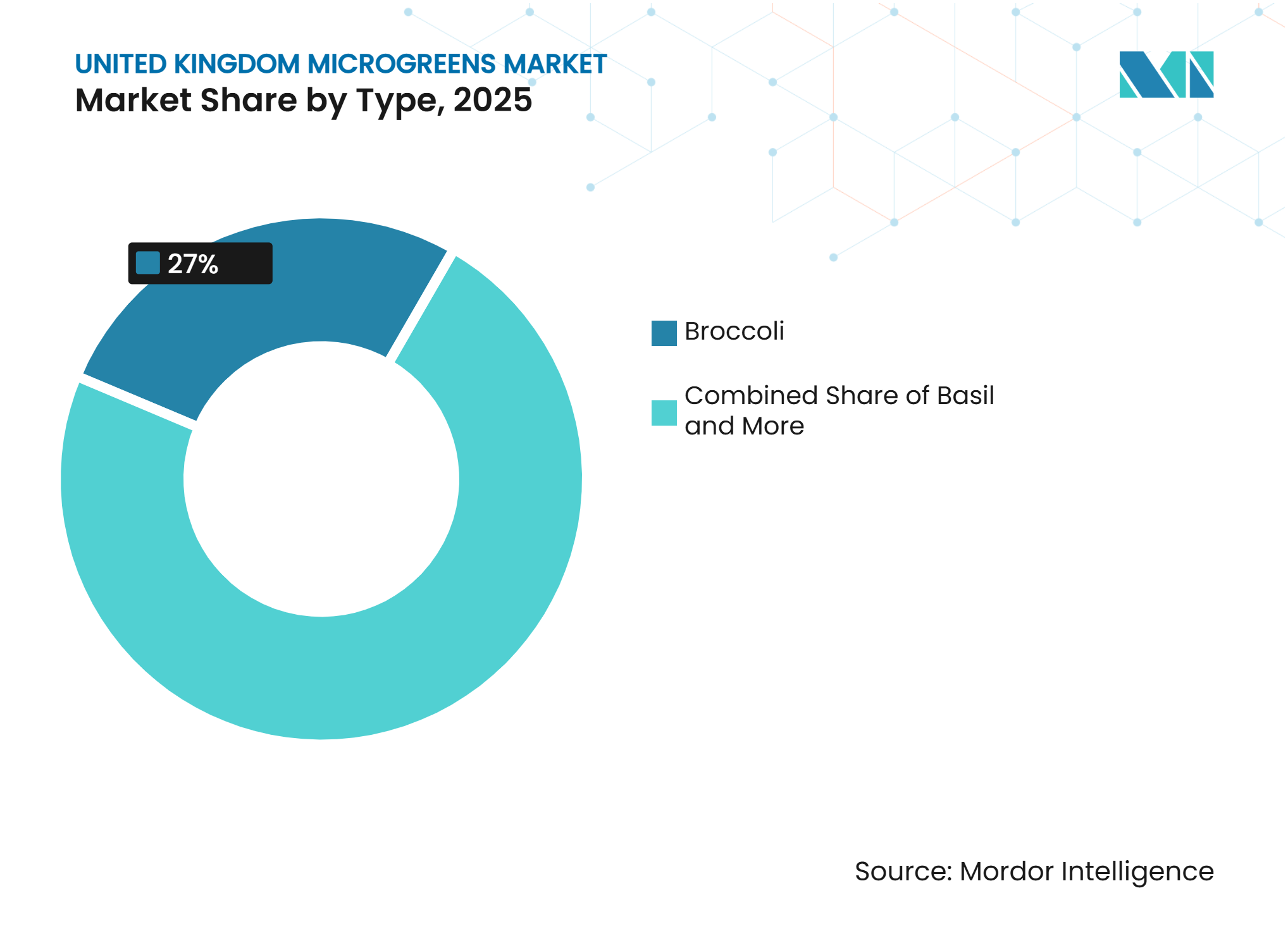
- By type, broccoli was the largest segment and held 27.0% of the United Kingdom microgreens market share in 2025, while basil is the fastest-growing segment and is forecasted to expand at an 11.9% CAGR between 2026 and 2031.
- By farming method, commercial greenhouses were the largest segment and held 43.5% of the United Kingdom microgreens market size in 2025, while vertical farming is the fastest-growing segment and is forecasted to expand at a 14.8% CAGR between 2026 and 2031.
- By growth medium, peat moss was the largest segment and held 33.2% of the market share in 2025, while coconut coir is the fastest-growing segment and is forecasted to expand at a 12.6% CAGR between 2026 and 2031.
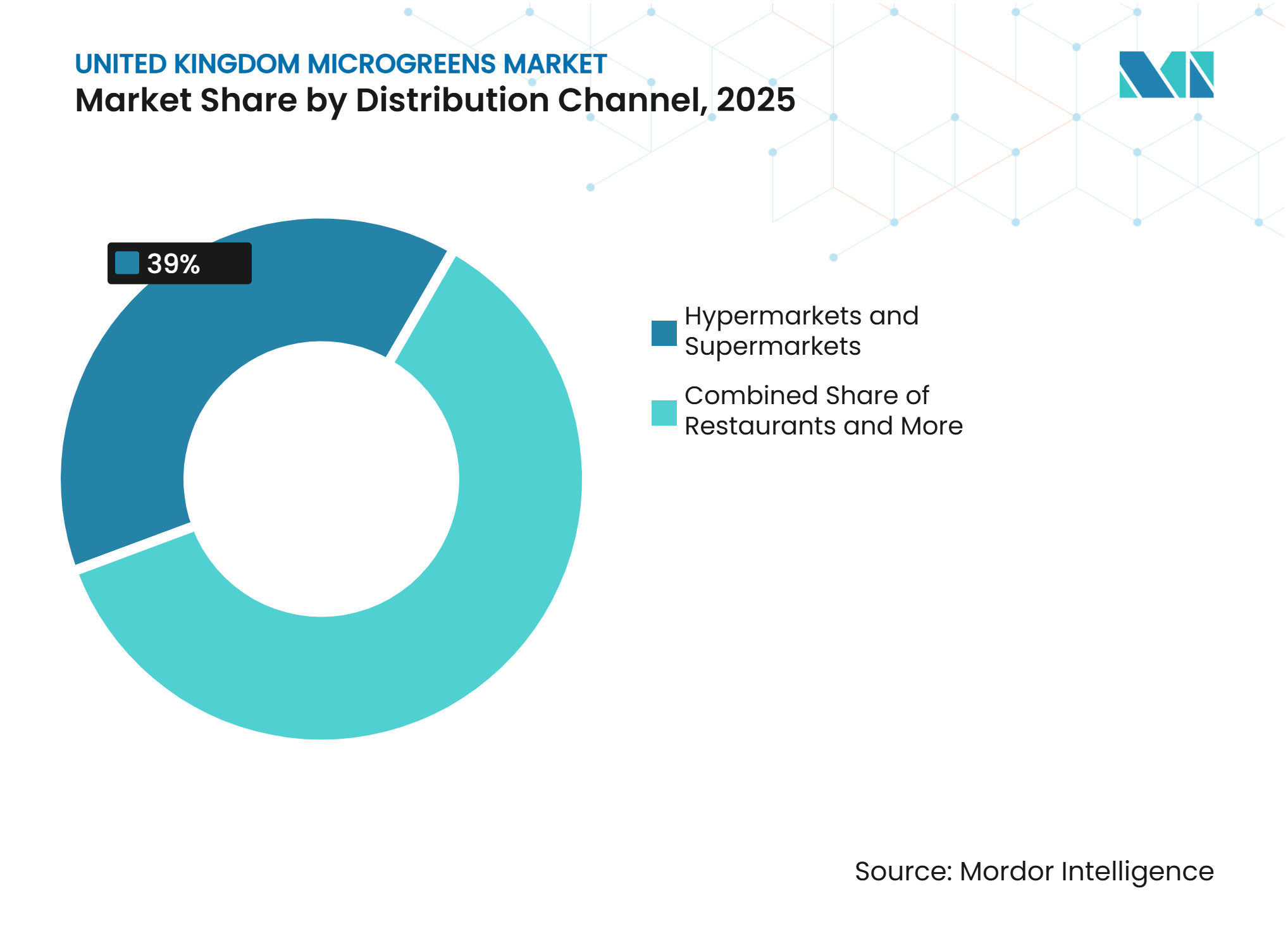
- By distribution channel, hypermarkets and supermarkets were the largest segment and held 39.0% of the market share in 2025, while other channels is the fastest-growing segment and are forecasted to expand at a 14.1% CAGR between 2026 and 2031.
Note: Market size and forecast figures in this report are generated using Mordor Intelligence’s proprietary estimation framework, updated with the latest available data and insights as of January 2026.
Market Trends and Insights
Drivers Impact Analysis of United Kingdom Microgreens Market*
| Driver | (~) % Impact on CAGR Forecast | Geographic Relevance | Impact Timeline |
|---|---|---|---|
| Plant-based meal preparation and functional-food adoption | +2.8% | England and Scotland, with United Kingdom-wide spillover | Short term (≤ 2 years) |
| Demand for locally sourced and sustainable produce | +2.2% | United Kingdom-wide, strongest in South England and Wales | Medium term (2-4 years) |
| Retail chilled-produce merchandising and convenience packs | +1.8% | United Kingdom-wide, anchored in major retail hubs | Short term (≤ 2 years) |
| Foodservice distributor integration into regional hospitality supply | +1.5% | United Kingdom-wide, concentrated in London and major urban centers | Medium term (2-4 years) |
| Two-hour harvest-to-plate radius models | +1.2% | Urban centers including London, Manchester, and Edinburgh | Medium term (2-4 years) |
| Urban-farm social-value procurement and community distribution | +0.9% | England and Wales, local authority-driven | Long term (≥ 4 years) |
| Source: Mordor Intelligence | |||
Plant-Based Meal Preparation and Functional-Food Adoption
Growing adoption of plant-based diets and health-oriented meal preparation is supporting demand for nutrient-dense fresh ingredients in the United Kingdom microgreens market. The United Kingdom Government’s 2025 Food Security Digest reports that 27% of respondents in England, Wales and Northern Ireland currently consume meat alternatives, with 30% of these consumers eating them frequently, at least two to three times a week[1]. This increasing integration of plant-based foods into regular diets creates opportunities for microgreens to be incorporated into salads, sandwiches, wraps, smoothies, and other everyday meals, while their concentrated nutrients and bioactive compounds can appeal to consumers seeking functional-food benefits. Consequently, retailers and foodservice operators can position microgreens as convenient, fresh, and nutrient-rich additions to mainstream plant-based meal preparation rather than limiting them to specialist health-food segments.
Demand for Locally Sourced and Sustainable Produce
Demand for locally sourced and sustainably produced fresh food is gaining importance in the United Kingdom as retailers seek to strengthen domestic supply relationships and improve supply resilience. The United Kingdom Government’s Horticulture Statistics 2025 reports that home-produced vegetables increased 8.0% in volume to 2.6 million metric tons in 2025, raising the domestic share of total United Kingdom vegetable supply from 54% in 2024 to 56% in 2025[2]. This increasing domestic production, alongside retailer initiatives to expand British-grown fresh produce and growing emphasis on sustainable cultivation practices, creates a favourable environment for locally produced microgreens. Microgreens can particularly benefit from domestic and controlled-environment production because their short production cycles and proximity to consumers can support freshness, consistent supply, and reduced dependence on imported fresh produce. Consequently, retailers, foodservice operators, and specialist growers can position locally produced microgreens around freshness, traceability, supply reliability, and sustainable production, strengthening their appeal within the United Kingdom microgreens market.
Retail Chilled-Produce Merchandising and Convenience Packs
The expansion of supermarkets, online grocery, and convenience-led food retail is creating more opportunities for microgreens to reach consumers through chilled, ready-to-use formats. According to the United Kingdom Government’s Food Statistics in Your Pocket 2026, total consumer expenditure on food and alcoholic drinks reached GBP 303.3 billion (USD 410.1 billion) in 2025, increasing 1.1% in real terms from 2024, indicating continued consumer spending across the food retail ecosystem. At the same time, major retailers are expanding premium fresh-produce and controlled-environment offerings, including vertically farmed products and ready-to-eat salad ranges, increasing consumer familiarity with convenient, packaged fresh produce. Microgreens can benefit from this merchandising environment through small chilled packs, salad toppings, meal-preparation packs, and ready-to-eat formats, allowing retailers to position them alongside premium salads and fresh herbs rather than as specialist products. The combination of established supermarket distribution, convenience-oriented food purchasing, and greater visibility of controlled-environment produce therefore supports repeat purchasing and wider mainstream adoption of microgreens in the United Kingdom.
Two-Hour Harvest-to-Plate Radius Models
Short delivery routes are becoming an important commercial model in urban areas of the United Kingdom microgreens market, particularly because microgreens are highly perishable and benefit from rapid movement from cultivation to consumption. Early Greens in Islington supplies London foodservice and retail customers within two hours of harvest, using edible bamboo paper media and linking its local supply model with community health. GrowSpec supplied pea microgreens to the Hilton Hotel at Heathrow in April 2026 from a FarmCube Ultra located near the consuming kitchen, demonstrating the potential for production close to end users. Compass Group has also explored on-site growing walls to reduce supply-chain risk. These short-radius models can reduce transportation time while helping preserve the freshness, texture, appearance, and traceability of microgreens. As retailers, hotels, restaurants, and institutional foodservice operators seek reliable local sourcing, hyperlocal production combined with rapid harvest-to-delivery models can strengthen the commercial viability and differentiation of microgreens in the United Kingdom market.
Restraints Impact Analysis of United Kingdom Microgreens Market*
| Restraint | (~) % Impact on CAGR Forecast | Geographic Relevance | Impact Timeline |
|---|---|---|---|
| Short post-harvest shelf life and cold-chain requirements | -1.8% | United Kingdom-wide, most acute in rural and remote areas | Short term (≤ 2 years) |
| High energy, labor, and controlled-environment production costs | -1.5% | United Kingdom-wide | Short term (≤ 2 years) |
| Exposure of indoor farms to United Kingdom electricity-price volatility | -1.2% | United Kingdom-wide, most severe for large-scale Controlled Environment Agriculture (CEA) operators | Short term (≤ 2 years) |
| Regulatory ambiguity between microgreens and sprouts and limited substantiation of health claims | -0.8% | United Kingdom-wide | Medium term (2-4 years) |
| Source: Mordor Intelligence | |||
Short Post-Harvest Shelf Life and Cold-Chain Requirements
The short post-harvest shelf life of microgreens creates a significant operational restraint in the market, as maintaining product quality requires rapid distribution, temperature-controlled storage, and careful handling throughout the supply chain. The Food Standards Agency (FSA) requires food businesses to establish and validate appropriate shelf-life periods as part of food safety management procedures, while chilled ready-to-eat foods require appropriate temperature control throughout storage and distribution. The FSA also highlights the importance of maintaining effective temperature control for chilled ready-to-eat foods across the supply chain. For microgreens, where freshness, texture, colour, and appearance can deteriorate quickly after harvest, additional logistics stages can reduce the commercially saleable window and increase the risk of spoilage and wastage. Although technologies such as aeroponic cultivation and improved packaging can extend shelf life, these solutions require additional investment in production, refrigeration, packaging, and quality-control capabilities. Consequently, producers serving distant retail and foodservice markets may face higher cold-chain and distribution costs, making localised production, rapid delivery, and proximity to consumption centres important for maintaining product quality and market competitiveness in the United Kingdom microgreens market.
Exposure of Indoor Farms to UK Electricity-Price Volatility
High electricity requirements for lighting and environmental control can constrain the profitability and scalability of indoor microgreens production in the United Kingdom. A 2025 study by researchers at the University of Birmingham, published in Energy Science & Engineering, estimated average annual energy consumption of 160.86 kilowatt-hours per square metre for a benchmark urban vertical farm in Birmingham, with HVAC accounting for 52% and lighting for 28% of total energy consumption[3]. This high energy intensity exposes indoor growers to fluctuations in electricity costs and increases the importance of energy-efficient lighting, climate-control systems, and facility design. Although technologies such as efficient LEDs, improved building insulation, renewable energy generation, and energy-management systems can reduce energy requirements, they involve additional capital investment. Consequently, high energy consumption and exposure to electricity costs remain key restraints on operating margins and large-scale expansion of indoor microgreens farms in the United Kingdom, particularly for facilities that depend extensively on artificial lighting and Heating, Ventilation, and Air Conditioning (HVAC) systems.
*Our forecasts treat driver/restraint impacts as directional, not additive. The impact forecasts reflect baseline growth, mix effects, and variable interactions.
United Kingdom Microgreens Market Segment Analysis
By Type:
Broccoli Holds the Leading Position and Basil Has the Highest Growth RateBroccoli held 27.0% of the United Kingdom microgreens market share by type in 2025. Its culinary flexibility and nutritional density supported demand from retail, foodservice, and subscription buyers. A 2025 Journal of Agricultural and Food Chemistry study found that far-red light increased total glucosinolates in broccoli microgreens compared with standard white light. This gives controlled environment agriculture (CEA) growers a way to improve crop composition without adding growing space. Radish remains useful for visual contrast in fine dining, while peas fit subscription boxes due to their mild flavor and tray yield. Sunflower, fennel, carrots, and other types continued to serve artisan and farmers market channels.
Basil is forecast to expand at an 11.9% CAGR between 2026 and 2031, supported by Italian and Mediterranean casual dining and hydroponic compatibility. Health-claim regulations shape how broccoli producers can use nutrition evidence in the United Kingdom microgreens market. Retained Regulation (EC) 1924/2006 limits the health-related statements that can appear in consumer marketing. This restricts how packaged products communicate sulforaphane-related benefits at retail. Direct clinical or institutional relationships allow producers to make better use of the available research base. The United Kingdom microgreens market therefore places value on evidence-backed supply relationships alongside consumer packaging. Producers serving hospitals and specialist nutrition programs can use product quality and consistency as part of their supply offer. This framework supports institutional relationships over unsupported consumer health claims and keeps regulatory compliance central to product communication in the United Kingdom microgreens market.



By Farming Method:
Commercial Greenhouses Lead While Vertical Farming Expands FastestCommercial greenhouses accounted for 43.5% of the United Kingdom microgreens market share by farming method in 2025. Established agronomic practices and retail buyer relationships support their dominant position. Indoor farming and vertical farming are growing as alternatives for year-round production. In March 2026, Fischer Farms partnered with Dawndew Salad to supply British-grown salad, cresses, and micro leaf to business-to-business (B2B), foodservice, and wholesale buyers. The partnership combines Fischer Farms' controlled-environment agriculture (CEA) production with Dawndew's buyer network. Hybrid greenhouse systems and open-field plots remain smaller options for rural diversification in England and Wales.
Vertical farming is forecast to expand at a 14.8% CAGR between 2026 and 2031. Leaf Marque certification is becoming increasingly relevant to retailer supplier requirements in the United Kingdom microgreens market. The Agriculture and Horticulture Development Board (AHDB) framework covers soil health, biodiversity, water, and energy management, establishing a clearer compliance baseline for professional growers. Traceable controlled systems can help growers document their practices for retail customers, while informal suppliers may find it harder to meet the same evidence requirements. The United Kingdom microgreens market therefore favors operators that combine controlled production systems with documented practices and dependable supply. Energy-efficiency improvements can further strengthen this position by reducing the impact of electricity costs, although larger indoor systems remain exposed to energy-cost risks.
By Growth Medium:
Peat Moss Leads but Coconut Coir Gains From Peat ReductionPeat moss held 33.2% of the United Kingdom microgreens market share by growth medium in 2025, supported by its moisture retention properties and an established horticultural supply base. However, Department for Environment, Food & Rural Affairs (DEFRA) policy to end peat sales in horticulture limits the long-term role of peat in professional production, while retailer sustainability requirements increasingly encourage peat-free specifications. Soil remains relevant for artisan and outdoor growers in Wales and rural England, particularly for small-scale production models that do not require fully controlled systems. Tissue paper and edible paper also have a role in premium subscription offerings, where their zero-waste presentation can support higher input costs through differentiated positioning.
Coconut coir is forecast to expand at a 12.6% CAGR between 2026 and 2031. It offers high water-holding capacity, pH-neutral root support, resistance to soil-borne diseases, and compostability. A Frontiers in Plant Science study reported comparable nutritional quality between coir and peat-perlite mixtures for pea and radish microgreens, while radish grown with coconut coir recorded a 39.8% increase in fresh yield. These characteristics make coconut coir an increasingly viable alternative for commercial growers transitioning away from peat. The United Kingdom microgreens market is moving toward growing media that meet both production requirements and retailer sustainability expectations. Coconut coir provides growers with an alternative to peat while maintaining suitable production performance, although adoption will depend on material availability, grower familiarity, production requirements, and buyer specifications. This transition makes growing medium selection increasingly important to the commercial positioning of microgreens producers.
By Distribution Channel:
Supermarkets Lead While Other Channels Expand FastestHypermarkets and supermarkets held 39.0% of the United Kingdom microgreens market share by distribution channel in 2025, supported by their broad consumer reach, established fresh-produce infrastructure, and growing availability of locally grown and vertically farmed products. Tesco, Waitrose, and Sainsbury's have expanded access to controlled-environment and British-grown produce, strengthening the role of mainstream retail in microgreens distribution. Restaurants and hospitality remain relevant because microgreens are used in premium food presentation, while farmers markets and farm shops serve rural and peri-urban consumers seeking local producer provenance.
Other channels are forecast to expand at a 14.1% CAGR between 2026 and 2031. These channels include online-to-door delivery, subscriptions, direct sales, and specialist outlets, which allow producers to establish closer relationships with consumers and offer differentiated products. Recurring-order models can support more predictable demand, enabling producers to plan harvest volumes and improve customer retention. However, insulated packaging and last-mile delivery requirements can increase fulfilment costs, making delivery density and proximity to customers important to channel economics. Foodservice distributors provide another route for growers seeking regular commercial demand, while direct-to-consumer channels allow differentiation through freshness, variety, and local provenance. The United Kingdom microgreens market therefore combines established supermarket distribution with faster-growing direct and specialist channels, allowing producers to balance broad market reach with recurring demand and closer customer relationships.

Geography Analysis
England was the largest market in 2025, accounting for 82.0% of the United Kingdom microgreens market, supported by its much larger population, concentration of foodservice operators, extensive retail distribution, urban farming activity, and investment in controlled-environment agriculture. Greater London represents a major demand centre within England because of its dense concentration of restaurants, hotels, retailers, and high-income consumers, while the Southeast also benefits from its proximity to major consumption centres and commercial horticultural infrastructure. These conditions support both large-scale controlled production and hyperlocal microgreens supply models across England.
Northern Ireland is forecast to be the fastest-growing market, expanding at an estimated 13.1% CAGR between 2026 and 2031. The high growth rate is supported by its smaller starting base, localized food supply opportunities, hospitality demand, and scope for expansion in controlled-environment farming. Indoor and vertical production can help growers provide year-round supplies to restaurants, hotels, retailers, and local consumers while reducing dependence on longer supply routes. The region's relatively concentrated population and foodservice network also create opportunities for direct and regional distribution models as commercial microgreens production expands.
Scotland and Wales represent smaller but distinct regional markets, with demand supported by local growers, foodservice operators, farm shops, and direct-to-consumer channels. Scotland has a developing base of indoor and vertical micro-farms supplying restaurants and hotels, particularly around Edinburgh and other urban centres, while Wales has a stronger local and rural production profile. These markets can benefit from short harvest-to-delivery routes, local provenance, and direct relationships with buyers. Overall, the geographic structure of the United Kingdom microgreens market combines England's dominant commercial scale with faster expansion opportunities in Northern Ireland and localized production models across Scotland and Wales.
Competitive Landscape
Market Concentration
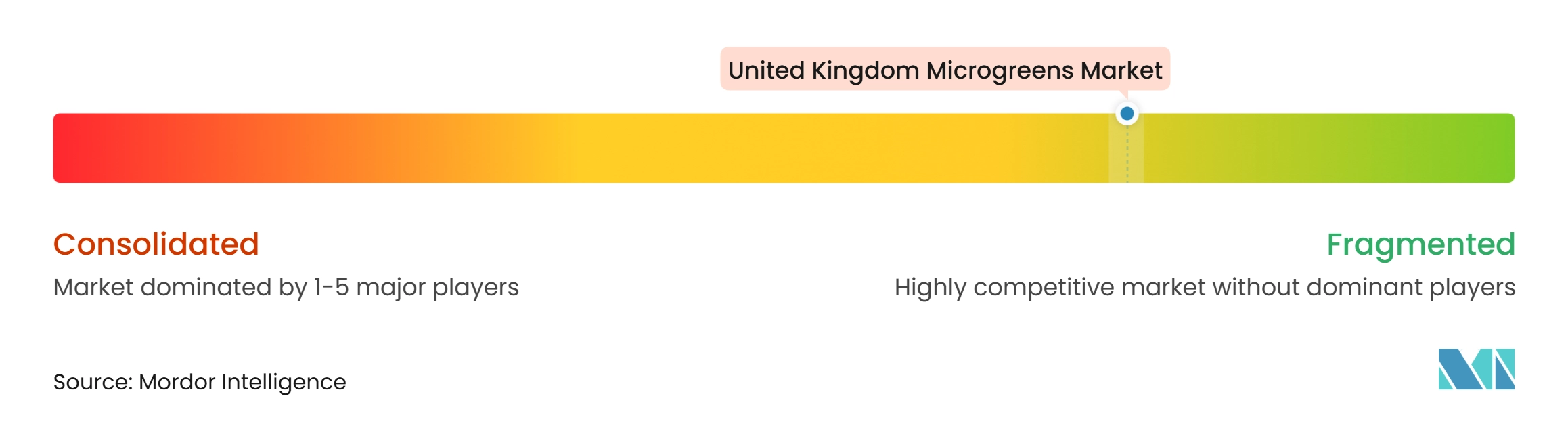
The United Kingdom microgreens market is fragmented, with competition distributed among established commercial growers, controlled-environment agriculture operators, and smaller regional producers. Enriched Being Ltd, W.S. Bentley (Growers) Limited, Green Up Farm Limited, Cofton Greens Ltd, and Micro Acres Ltd are among the companies operating in the market. W.S. Bentley Limited combines glasshouse production with supermarket and foodservice distribution, supplying microgreens, pea shoots, and salad cress in multiple formats. Its microgreens are available through Waitrose, Morrisons, SPAR, and Booths, while its foodservice operation supplies businesses ranging from smaller caterers to nationwide hotel and pub chains. Green Up Farm Limited focuses on hospitality customers in Wales through hydroponic vertical farming and direct delivery, while Cofton Greens Ltd. uses a climate-controlled vertical farm and local delivery model focused on restaurants in South Birmingham. The market therefore accommodates both broad-distribution growers and regional specialists competing through freshness, consistency, product variety, and proximity to customers.
Technology, product differentiation, and commercial partnerships are also shaping competitive positioning. In March 2026, Fischer Farms partnered with Dawndew Salad to supply salad, cresses, and micro leaf to B2B, foodservice, and wholesale customers, combining controlled-environment agriculture with Dawndew's produce-industry network. In March 2024, Ro-Gro launched Vitamin B12-biofortified pea shoots developed in collaboration with the John Innes Centre, Quadram Institute, and LettUs Grow, using ultrasonic aeroponic technology at its vertical farm in Kent. Ro-Gro stated that the product had a 14-day guaranteed shelf life, providing an example of nutritional and technical differentiation within the category. Planet Farms has also entered mainstream retail with its Fresh Everleaf range becoming the first vertically farmed salad range stocked by Waitrose in May 2025, demonstrating how controlled-environment producers are using retail partnerships to expand consumer access to indoor-grown produce.
The competitive structure is therefore divided between commercial growers with established retail and foodservice relationships, technology-led vertical farms, and smaller local operators serving hospitality and direct customers. Larger suppliers can compete through controlled production, consistent quality, certification, packaging, and distribution capabilities. W.S. Bentley Limited, for example, holds Red Tractor, BRCGS AA, and LEAF Marque credentials and offers flexible formats and delivery for foodservice customers. Smaller operators remain competitive through local delivery, harvest-to-order models, specialist varieties, and close relationships with chefs. Micro Acres Wales supplies chefs, restaurants, hotels, delis, and farm shops, while Green Up Farm provides bespoke microgreen and micro-herb solutions for hospitality customers. Consequently, the United Kingdom microgreens market remains open to regional specialists and new controlled-environment producers, although competing for larger retail and foodservice accounts increasingly requires dependable year-round supply, documented food-safety controls, consistent product quality, and efficient distribution.
United Kingdom Microgreens Industry Leaders
-
Enriched Being Ltd
-
W.S. Bentley (Growers) Limited
-
Green Up Farm Limited
-
Cofton Greens Ltd
-
Micro Acres Ltd
- *Disclaimer: Major Players sorted in no particular order
United Kingdom Microgreens Market Companies Covered in this Report
- Enriched Being Ltd
- W.S. Bentley (Growers) Limited
- Cofton Greens Ltd
- Micro Acres Ltd
- Crate To Plate Limited
- Greens Made Easy Ltd
- Green Up Farm Limited
- Heaven's Microgreens Ltd
- Ingle's Dawndew Salad Limited
- Fischer Farms Ltd
- Microgreens of Nottingham Ltd
Recent Industry Developments in United Kingdom Microgreens Market
- March 2026: Fischer Farms partnered with Dawndew Salad. The partnership combines Fischer Farms' controlled-environment agriculture technology with Dawndew Salad's produce-industry expertise and buyer network to supply British-grown salad, cresses, and microgreens to B2B, foodservice, and wholesale customers.
- January 2026: Fischer Farms launched New Eden on Ocado. Fischer Farms launched three bagged salad products—Burger Lettuce, Zesty Mixed Salad, and Pea Shoot Salad—under its New Eden brand on Ocado. The products are grown at its vertical farm in Norwich.
- January 2025: Micro Acres Wales expanded production with Welsh Government-funded support. Technical support through Project HELIX helped the company move from a domestic garage to a dedicated vertical-farming unit, improve its HACCP system and increase microgreens output by 50%, with potential to more than double production.
United Kingdom Microgreens Market Report Scope
Microgreens are young, edible plants harvested shortly after germination, typically after the development of the cotyledon leaves and, in some species, the first true leaves. They are produced from the seeds of vegetables, herbs, grains, and other edible plants and are generally harvested at an early growth stage, before reaching maturity.
The United Kingdom Microgreens Market Report is Segmented by Type (Broccoli, Lettuce and Chicory, Arugula, Basil, Fennel, and More), by Farming Method (Indoor Farming, Vertical Farming, and More), by Growth Medium (Peat Moss, Soil, Coconut Coir, and More), and by Distribution Channel (Hypermarkets/Supermarkets, Restaurants, and More). The Market Forecasts are Provided in Terms of Value (USD).
Segmentation Overview
| Broccoli |
| Lettuce and Chicory |
| Arugula |
| Basil |
| Fennel |
| Carrots |
| Sunflower |
| Radish |
| Peas |
| Other Types |
| Indoor Farming |
| Vertical Farming |
| Commercial Greenhouses |
| Other Farming Methods |
| Peat Moss |
| Soil |
| Coconut Coir |
| Tissue Paper |
| Other Growth Media |
| Hypermarkets and Supermarkets |
| Restaurants |
| Other Channels |
| By Type | Broccoli |
| Lettuce and Chicory | |
| Arugula | |
| Basil | |
| Fennel | |
| Carrots | |
| Sunflower | |
| Radish | |
| Peas | |
| Other Types | |
| By Farming Method | Indoor Farming |
| Vertical Farming | |
| Commercial Greenhouses | |
| Other Farming Methods | |
| By Growth Medium | Peat Moss |
| Soil | |
| Coconut Coir | |
| Tissue Paper | |
| Other Growth Media | |
| By Distribution Channel | Hypermarkets and Supermarkets |
| Restaurants | |
| Other Channels |
Key Questions Answered in the Report
What is the United Kingdom microgreens market size in 2026?
The United Kingdom microgreens market size is USD 316.1 million in 2026 and is forecasted to reach USD 549.6 million by 2031 at an 11.7% CAGR.
Which microgreen type has the largest share in the United Kingdom?
Broccoli was the largest type with 27% share in 2025, while basil is forecasted to grow at an 11.9% CAGR between 2026 and 2031.
Which production method is growing fastest for United Kingdom microgreens?
Vertical farming is forecasted to expand at a 14.8% CAGR between 2026 and 2031, while commercial greenhouses held 43.5% share in 2025.
What food safety rules apply to United Kingdom microgreens suppliers?
Suppliers must apply Hazard Analysis and Critical Control Points (HACCP)-based food safety management and set shelf life under the retained food hygiene framework.