
United Kingdom Hydroponics Market Size and Share
Market Overview
| Study Period | 2021 - 2031 |
|---|---|
| Forecast Data Period | 2026 - 2031 |
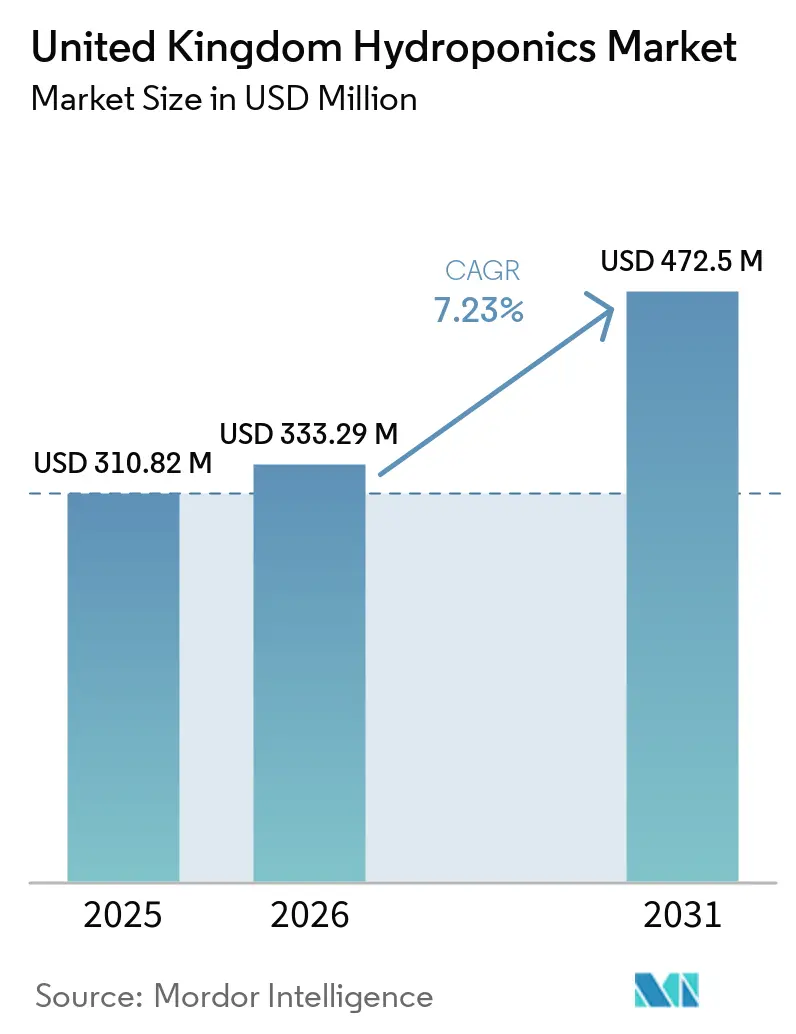
| Base Year Market Size (2025) | USD 310.82 Million |
| Market Size (2026) | USD 333.29 Million |
| Market Size (2031) | USD 472.5 Million |
| Growth Rate (2026 - 2031) | 7.23 % |
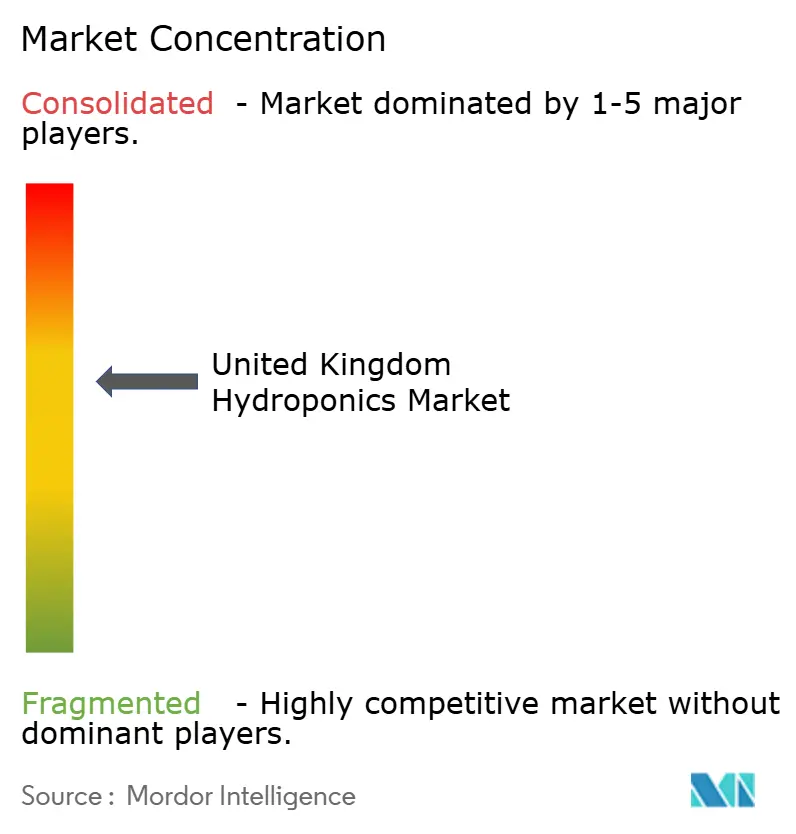
| Market Concentration | Medium |
Major Players *Disclaimer: Major Players sorted in no particular order Image © Mordor Intelligence. Reuse requires attribution under CC BY 4.0. | |
United Kingdom Hydroponics Market Analysis by Mordor Intelligence
The United Kingdom hydroponics market size was valued at USD 310.8 million in 2025 and is estimated to grow from USD 333.3 million in 2026 to reach USD 472.5 million by 2031, at a CAGR of 7.23% during the forecast period (2026-2031). A persistent gap between domestic produce supply and national consumption supports the United Kingdom hydroponics market. Domestic horticulture supplied 55% of fresh vegetables and 17% of fruit consumed nationally, leaving retailers exposed when imports face weather or logistics disruptions in 2024. The government has committed GBP 80 million (USD 103 million) from 2026 to grow the fruit and vegetable sector and has identified controlled-environment agriculture as a policy priority. This funding direction favors systems that can raise output without relying on additional field area. The United Kingdom hydroponics market also benefits when operators combine controlled growing conditions with automation, traceability, and flexible energy use.
Key Report Takeaways
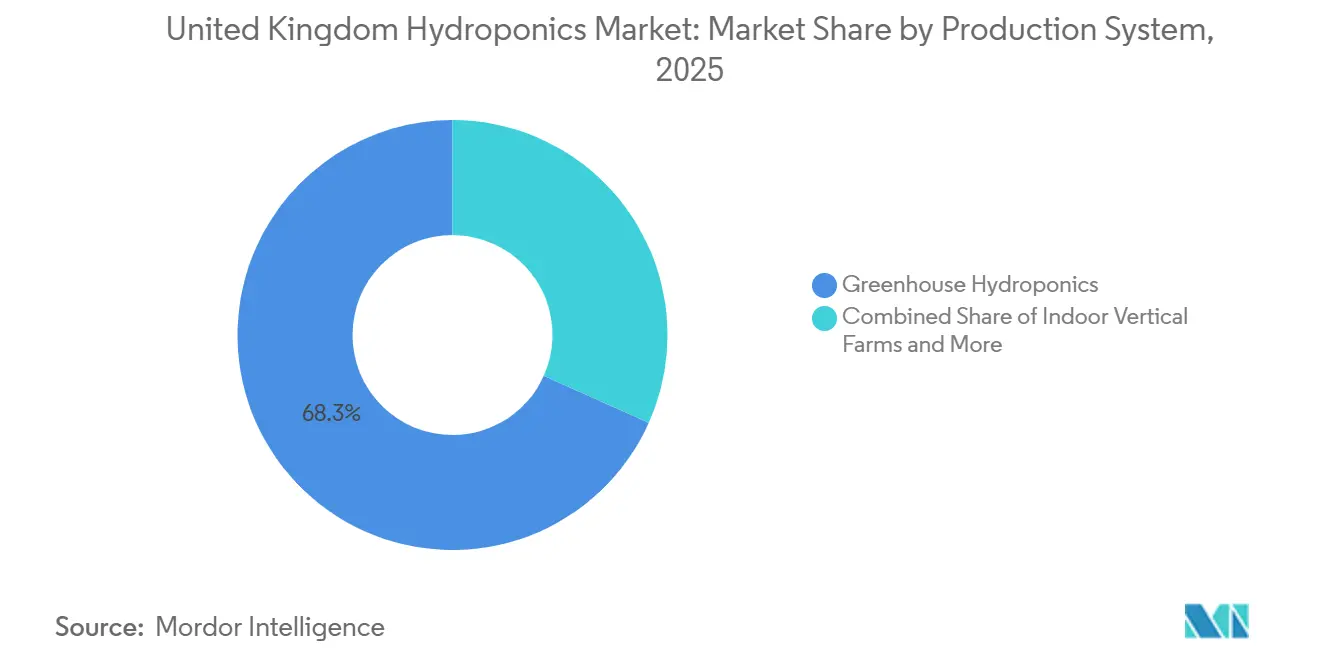
- By production system, greenhouse hydroponics was the largest segment, holding 68.3% of the United Kingdom hydroponics market share in 2025, while indoor vertical farms are the fastest-growing segment at a 9.4% CAGR through 2031.
- By crop type, leafy greens were the largest segment, accounting for 47.2% of the United Kingdom hydroponics market size in 2025, while herbs and microgreens are the fastest-growing segment, at an 8.6% CAGR through 2031.
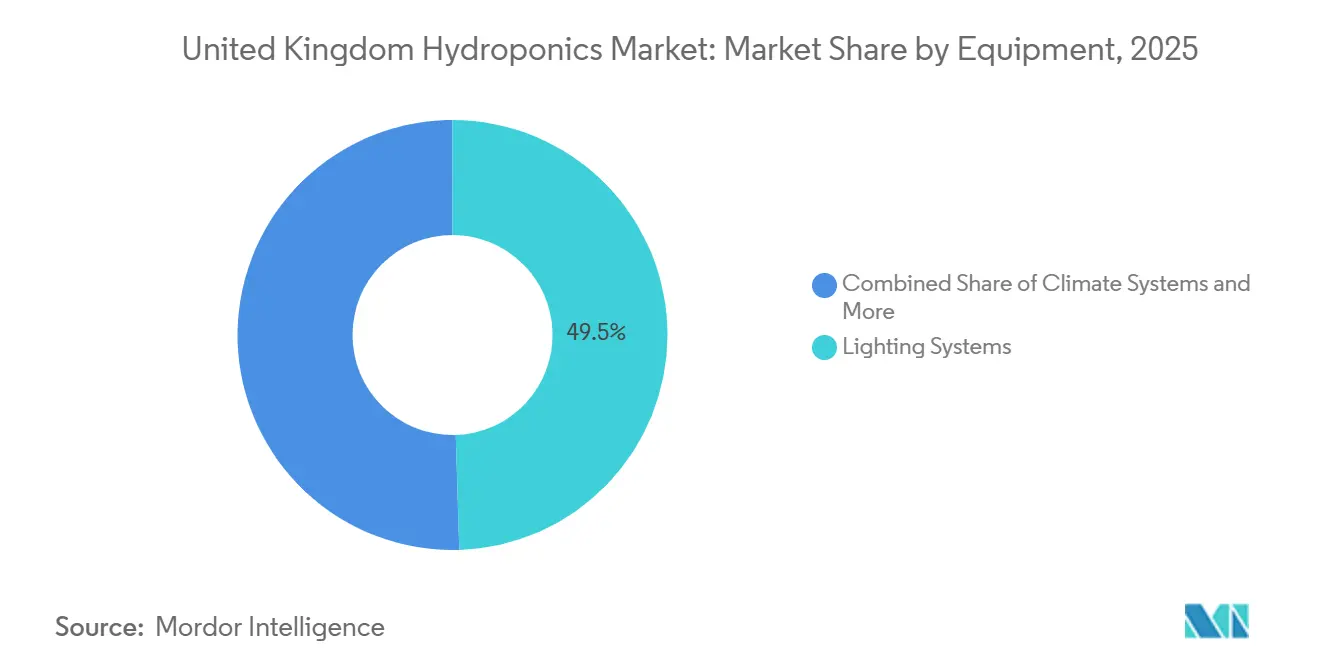
- By equipment, lighting systems were the largest segment with a 49.5% share in 2025, while climate systems are the fastest-growing segment at a 7.8% CAGR through 2031.
- By production scale, large operations were the largest segment with a 55.8% share in 2025, while small operations are the fastest-growing segment at an 8.3% CAGR through 2031.
Note: Market size and forecast figures in this report are generated using Mordor Intelligence’s proprietary estimation framework, updated with the latest available data and insights as of January 2026.
Market Trends and Insights
Drivers Impact Analysis of United Kingdom Hydroponics Market*
| Driver | (~) % Impact on CAGR Forecast | Geographic Relevance | Impact Timeline |
|---|---|---|---|
| Controlled-environment food security initiatives | +1.2% | United Kingdom-wide, with investment concentrated in Southeast England and East Anglia | Long term (≥ 4 years) |
| Vertical farming and limited urban growing space | +1.4% | Greater London, the Midlands, and major metropolitan centers | Medium term (2-4 years) |
| Agricultural labor shortages and automation adoption | +1.0% | United Kingdom-wide, most acute in Kent, Lincolnshire, and Herefordshire | Medium term (2-4 years) |
| Retail demand for traceable, pesticide-reduced produce | +1.3% | United Kingdom-wide, led by supermarket procurement decisions | Short term (≤ 2 years) |
| Year-round local produce demand | +0.8% | United Kingdom-wide, with winter supply gaps visible in Scotland and Northern England | Short term (≤ 2 years) |
| Renewable-energy integration with hydroponic production | +0.9% | United Kingdom-wide, with early activity in Scotland, Wales, and East Anglia | Long term (≥ 4 years) |
| Source: Mordor Intelligence | |||
Controlled-Environment Food Security Initiatives
The United Kingdom hydroponics market benefits from public support for protected horticulture. The 2024 Horticulture Blueprint committed USD 103 million starting in 2026 and expanded eligibility beyond the Producer Organization model[1]. Up to GBP 50 million (USD 64 million) was allocated to packhouse automation under the program. This focus prioritizes consistent output over the expansion of cultivated land. A 2025 study found that protected horticulture, particularly high-technology greenhouse production, could strengthen the United Kingdom's food security by reducing dependence on imports and improving year-round availability of fresh produce. Hydroponic production aligns with these objectives, as it is independent of soil quality, requires less land, and can operate under controlled conditions, making it well-suited for urban and peri-urban environments.
Vertical Farming and Limited Urban Growing Space
The United Kingdom hydroponics market is gaining from the limited availability of suitable land near population centers. Vertical systems increase usable growing area by stacking crop layers within a single building. This approach can place production closer to retail and food-service demand. Rivenhall Greenhouse Limited received planning approval in April 2026 for a 100-acre low-carbon greenhouse and vertical farming complex in North Essex[2]. The project will use heat and electricity from a co-located waste management facility, addressing both land and energy constraints. This approach reduces reliance on external energy sources while making use of existing infrastructure. These projects indicate that site design and local infrastructure are increasingly integrated into commercial planning, with developers placing greater emphasis on resource efficiency in the early stages of project development.
Agricultural Labor Shortages and Automation Adoption
The United Kingdom hydroponics market is supported by the need to reduce exposure to seasonal labor shortages. The sector depends on 70,000 seasonal workers each year, 95% of whom are sourced internationally. This dependency creates supply chain vulnerabilities, particularly during peak growing seasons when labor demand is highest. The 2025 seasonal worker visa allocation of 43,000 did not meet industry demand, leaving a significant gap that has prompted growers to explore alternative production methods, including hydroponics, which require less manual labor than traditional field-based agriculture. The government has also outlined support for automation through its horticulture and agri-innovation programs, thereby further encouraging the adoption of controlled-environment agriculture technologies. Hydroponic sites offer regular layouts and repeatable crop cycles that can simplify robotic handling. The SCARLETT project demonstrated robotic transplanting and harvesting in a 1.1-hectare deep-water culture lettuce operation[3].
Retail Demand for Traceable, Pesticide-Reduced Produce
The United Kingdom hydroponics market is supported by retailer interest in traceable produce with lower pesticide use. The Soil Association Certification reported that 83% of households bought organic products in 2025, and major retail organic sales grew 7% during that year. Retailers are increasingly requiring suppliers to demonstrate transparency in growing practices, which hydroponic operations are well positioned to provide. Hydroponic operations can document nutrient use and growing conditions for individual production batches, and can avoid soil-borne herbicides while managing inputs precisely. This level of traceability allows retailers to verify product quality at each stage of the supply chain. This information supports supplier qualification and own-label quality processes.
Restraints Impact Analysis of United Kingdom Hydroponics Market*
| Restraint | (~) % Impact on CAGR Forecast | Geographic Relevance | Impact Timeline |
|---|---|---|---|
| High capital requirements for commercial systems | -1.5% | United Kingdom-wide, most severe for new entrants outside established growing regions | Long term (≥ 4 years) |
| Electricity-cost sensitivity of artificial lighting | -1.2% | United Kingdom-wide, most acute for indoor vertical farms without renewable co-location | Short term (≤ 2 years) |
| Nutrient-runoff and water-discharge compliance | -0.6% | England and Wales, especially nutrient-sensitive catchments | Medium term (2-4 years) |
| Limited hydroponic crop genetics and agronomic expertise | -0.5% | United Kingdom-wide, with expertise concentrated around research clusters | Long term (≥ 4 years) |
| Source: Mordor Intelligence | |||
High Capital Requirements for Commercial Systems
Commercial hydroponic systems require substantial capital expenditure before the first crop is sold. A full vertical facility requires lighting, heating, ventilation, and air conditioning systems, nutrient delivery equipment, automation, structural work, and grid capacity. These upfront costs accumulate quickly and often reach tens of millions of dollars before any revenue is generated. These requirements limit entry by smaller operators without access to patient capital, and even well-funded operators face pressure to scale revenue fast enough to justify their cost base. GrowUp Group Limited entered administration on December 16, 2025. GrowUp Farms Limited continued operating following the sale. Despite the scale of funding, the company was unable to achieve the operational efficiency needed to sustain its business. Its operating business was subsequently acquired for GBP 1.85 million (USD 2.4 million) in a pre-packaged transaction. This case demonstrates that capital deployment must be matched with a sustainable operating model, and that access to funding alone does not guarantee commercial viability in the hydroponics market.
Electricity-Cost Sensitivity of Artificial Lighting
High energy consumption remains a major restraint on the United Kingdom hydroponics market, particularly for vertical farms dependent on artificial lighting and controlled-environment systems. A December 2025 University of Birmingham study found that heating, ventilation, and air conditioning (HVAC) accounted for 52% of building energy consumption in a modeled urban vertical farm, while lighting represented another 28%. These energy requirements increase operating costs and make profitability sensitive to energy efficiency and facility design. Although renewable energy, efficient lighting, and advanced climate-control systems can reduce energy expenses, their installation requires additional capital investment, potentially limiting the expansion and commercial adoption of hydroponic farming.
*Our forecasts treat driver/restraint impacts as directional, not additive. The impact forecasts reflect baseline growth, mix effects, and variable interactions.
United Kingdom Hydroponics Market Segment Analysis
By Production System:
Greenhouse Infrastructure Supports Scale, Vertical Formats Are FastestGreenhouse Hydroponics was the largest production system and accounted for 68.3% of United Kingdom hydroponics market share in 2025. Its position reflects established glasshouse capacity in Kent, Norfolk, and Essex. These locations are close to major transport corridors and retail distribution routes. Indoor Vertical Farms are the fastest production system, with a 9.4% CAGR from 2026 to 2031. They allow year-round production within a small physical footprint. Container Farms remain the smallest format but can serve rooftops, defense sites, and rural locations where permanent structures are harder to secure approval for.
The United Kingdom hydroponics market size for greenhouse operations is supported by access to daylight. Natural light reduces the need for artificial lighting during much of the year. Greenhouses still require supplementary light during the low-light months. Indoor vertical sites eliminate dependence on weather and daylight but rely on fully artificial lighting. Their economics improve where light-emitting diode efficiency, flexible energy contracts, or renewable co-location lower power costs. Hybrid systems can start young plants in vertical units before completing growth in a greenhouse. This model may reduce energy use per kilogram while maintaining more control over early crop development.

By Crop Type:
Leafy Greens Are Largest, Herbs and Microgreens Are FastestLeafy Greens were the largest crop type, accounting for 47.2% of the United Kingdom hydroponics market share in 2025. They suit the nutrient film technique and deep-water culture systems. Their 14- to 21-day growing cycles can support regular harvesting and retail supply. Tomatoes and Cucumbers were the second- and third-largest crop categories. They are mainly grown in greenhouse systems where daylight reduces the energy burden. Peppers had the smallest crop share but can provide higher returns for specialized operations with suitable energy costs.
Herbs and Microgreens are the fastest crop type, with an 8.6% CAGR from 2026 to 2031. Their 7- to 14-day growing cycles allow for several harvests from the same installation each year. Restaurants and specialty retailers can support premium pricing for these crops. The United Kingdom hydroponics industry can use this category to build shorter supply chains for perishable products. Batch-level records also support traceability requirements across crop categories. Crop diversification remains constrained by the availability of proven cultivars and reliable commercial protocols.
By Equipment:
Lighting Systems Are Largest, Climate Systems Are FastestLighting Systems were the largest equipment category, accounting for 49.5% of spending in 2025. They are major capital items and principal electricity loads on enclosed farms. The United Kingdom hydroponics market size for lighting is shifting from high-intensity discharge systems toward full-spectrum light-emitting diodes. The United Kingdom Agri-Tech Center reported energy savings of 21–25%, along with crop-yield and control-system improvements from real-time, plant-data-led light adjustment. Lighting schedules that respond to variable power prices can also lower illumination costs. These changes place more value on systems that combine plant data with energy management.
Climate Systems is the fastest equipment category, growing at a 7.8% CAGR through 2031. Temperature, humidity, and carbon dioxide management affect yield consistency in controlled facilities. Improved climate control can also reduce heating demand associated with intensive lighting. Irrigation Components and Pumps were the second-largest equipment category. They provide the nutrient delivery architecture used in nutrient film technique, deep-water culture, and ebb-and-flow systems. Automation and Control Systems are gaining relevance as labor costs rise and sensor systems become more accessible. Priva Group B.V. and Signify N.V. serve this equipment tier with climate-control and horticultural-lighting technologies.
By Production Scale:
Large Operations Are Largest, Small Operations Are FastestLarge operations were the largest production-scale segment, accounting for 55.8% of the United Kingdom hydroponics market in 2025. They can spread cold storage, packaging, logistics, and site overhead across larger volumes. This scale can help farms meet the volume and continuity requirements of major retailers. Fischer Farms Limited operates a 25,000 square-meter facility in Norfolk. GrowUp Farms Limited operated a Kent site that was approved for expansion from 90,000 to 200,000 square feet following a restructuring. Medium operations serve regional food-service accounts and subscription services that need greater flexibility.
Small operations are the fastest-growing production-scale segment, with an 8.3% CAGR from 2026 to 2031. Community food projects, schools, hospitals, care homes, and micro-farms support this demand. Lower costs for light-emitting diodes and control systems have also improved access for smaller sites. The United Kingdom hydroponics industry receives additional support through grants for precision-growing equipment. These schemes can reduce the initial funding requirement for smaller businesses. CambridgeHOK Limited provides design and engineering services for small and medium controlled-environment installations. Small sites still need to manage energy costs, technical skills, and compliance requirements carefully.
Geography Analysis
England held the largest share of the United Kingdom's hydroponics market activity, with major clusters in Kent, Norfolk, Essex, and Lincolnshire. The Southeast benefits from access to the Port of Dover and motorway links to retail distribution centers. This proximity can reduce delivery times and post-harvest quality loss. Kent includes the GrowUp Farms Limited Pepperness facility in Sandwich. Norfolk includes Fischer Farms Limited’s 25,000 square-meter vertical farm. Essex gained a major new project in April 2026 when Rivenhall Greenhouse Limited received planning approval for a 100-acre greenhouse and vertical farming complex. England’s nutrient rules strengthen the case for closed-loop systems near sensitive waterways.
Scotland is a smaller but technically important location in the United Kingdom hydroponics market. Intelligent Growth Solutions Ltd is based in Inverkeithing, Fife, and develops Growth Tower systems for international deployments. In June 2026, the company reported construction progress at the Dubai GigaFarm, where the completed site is planned to contain 200 Growth Towers and produce more than 3 million kilograms annually. Scotland’s total renewable electricity generation was 113% of domestic electricity consumption in 2022. This capacity can support future energy arrangements for lighting-intensive operations. The regional opportunity depends on whether generation capacity can translate into commercially workable electricity contracts.
The Southwest of England includes LettUs Grow Limited, which develops Advanced Aeroponics technology for greenhouse partnerships. Its research on vitamin B12-fortified pea shoots demonstrates how regional research can broaden crop options. Wales and Northern Ireland have smaller hydroponic communities, mainly at small and medium production scales. Welsh sustainability and rural innovation grants support local activity. Northern Ireland also benefits from links with fresh-produce supply chains in the Republic of Ireland. Geographic growth will depend on energy access, planning decisions, retail routes, and the availability of specialist skills.
Competitive Landscape
The United Kingdom hydroponics market is moderately consolidated among commercial producers and system integrators in 2025. The field includes technology suppliers, integrated farm operators, and businesses that license systems to third-party growers. Signify N.V. provides horticultural lighting, while Priva Group B.V. provides climate and process automation. Fischer Farms Limited and GrowUp Farms Limited grow and brand their own produce. Intelligent Growth Solutions Ltd and LettUs Grow Limited develop systems used by other growers.
GrowUp Group Limited entered administration in December 2025 after pursuing further equity funding. Its operating business, brand portfolio, and intellectual property were acquired for GBP 1.85 million (USD 2.4 million). The transaction showed that cost discipline and cash generation are central to competitive survival. Rivenhall Greenhouse Limited obtained approval in April 2026 for a project that pairs production with the use of recovered heat and electricity. Intelligent Growth Solutions Ltd reached a construction milestone at the Dubai GigaFarm in June 2026. These moves show the importance of energy integration, proven delivery capability, and scalable system design.
Phytoponics Ltd develops hydroponic growing bag systems for operators seeking lower-cost, scalable operations. Vertical Future Ltd combines vertical farming hardware with modular data infrastructure. Intelligent Growth Solutions Ltd uses digital twins to assess Growth Tower climate settings before construction. These capabilities can help operators assess cost and yield before committing capital. Orbia Advance Corporation, S.A.B. de C.V., through Netafim, provides precision irrigation and nutrient delivery capabilities. Competitive advantage is likely to depend on integrated systems, stable energy access, and the ability to meet retailer quality requirements.
United Kingdom Hydroponics Industry Leaders
-
HydroGarden Limited
-
Signify N.V.
-
Priva Holding B.V.
-
GroWell Horticulture Ltd
-
Netafim UK Ltd
- *Disclaimer: Major Players sorted in no particular order
United Kingdom Hydroponics Market Companies Covered in this Report
- HydroGarden Limited
- (Netafim UK Ltd) Orbia Advance Corporation, S.A.B. de C.V.
- Signify N.V.
- Priva Group B.V.
- Hydrohobby Hydroponics Limited
- GroWell Horticulture Ltd
- Nutriculture UK Ltd
- LettUs Grow Limited
- Phytoponics Ltd
- Intelligent Growth Solutions Ltd
- Vertical Future Ltd
- GrowUp Farms Limited
- Fischer Farms Limited
- Harvest London Limited
- CambridgeHOK Limited
Recent Industry Developments in United Kingdom Hydroponics Market
- June 2026: Intelligent Growth Solutions Ltd (IGS) reached a major construction milestone at Dubai's GigaFarm in June 2026, with the first 20 Growth Towers moving toward operational readiness within tower facility. The project demonstrates the scalability of UK-developed vertical farming technology, supporting international opportunities for UK suppliers of hydroponic and controlled-environment growing systems.
- April 2026: Rivenhall Greenhouse Limited received planning approval in April 2026 for a 40-hectare (approximately 100-acre) low-carbon greenhouse complex in North Essex, incorporating closed-loop hydroponic systems and a vertical farming unit. The proposed development is planned to utilize energy and carbon dioxide (CO₂) from the adjacent Indaver waste-management facility, creating an integrated resource-recovery model for greenhouse operations. This project highlights the potential for industrial energy integration and resource-efficient hydroponic production to support the expansion of controlled-environment agriculture in the United Kingdom.
- April 2025: Planet Farms and Swiss Life Asset Managers established a joint venture with up to €200 million (USD 218 million) in initial capital to develop controlled-environment agriculture facilities across EMEA, including projects under development in the United Kingdom. The investment supports the expansion of automated indoor farming and related hydroponic technologies, strengthening demand for advanced soilless growing systems.
United Kingdom Hydroponics Market Report Scope
Hydroponics is a soilless cultivation method in which plants are grown in a nutrient-rich water solution, often using substrates such as coco coir or rockwool for support. It enables precise control over water, nutrients, and growing conditions, improving resource efficiency and crop productivity.
United Kingdom hydroponics market report is segmented by production system (greenhouse hydroponics, indoor vertical farms, and container farms), by crop type (leafy greens, tomatoes, cucumbers, peppers, and herbs and microgreens), by equipment (lighting systems, irrigation components and pumps, climate systems, automation and control systems, and structural components), and by production scale (large, medium, and small). The market forecasts are provided in terms of value (USD).
Segmentation Overview
| Greenhouse Hydroponics |
| Indoor Vertical Farms |
| Container Farms |
| Leafy Greens |
| Tomatoes |
| Cucumbers |
| Peppers |
| Herbs and Microgreens |
| Lighting Systems |
| Irrigation Components and Pumps |
| Climate Systems |
| Automation and Control Systems |
| Structural Components |
| Large |
| Medium |
| Small |
| By Production System | Greenhouse Hydroponics |
| Indoor Vertical Farms | |
| Container Farms | |
| By Crop Type | Leafy Greens |
| Tomatoes | |
| Cucumbers | |
| Peppers | |
| Herbs and Microgreens | |
| By Equipment | Lighting Systems |
| Irrigation Components and Pumps | |
| Climate Systems | |
| Automation and Control Systems | |
| Structural Components | |
| By Production Scale | Large |
| Medium | |
| Small |
Key Questions Answered in the Report
What is the projected value of United Kingdom hydroponics by 2031?
The value is forecast to reach USD 472.50 million by 2031, from USD 333.29 million in 2026, at a 7.23% CAGR. The outlook reflects the need for reliable domestic production under controlled conditions.
Which production system has the highest share in United Kingdom hydroponics?
Greenhouse Hydroponics was the largest production system, with 68.3% share in 2025. Its established glasshouse base gives it an advantage in supplying volume to retail channels.
Which crop is expanding fastest in controlled hydroponic production?
Herbs and Microgreens were the fastest crop type, with an 8.6% CAGR forecast through 2031. Short crop cycles and specialty demand support the projected expansion.
Why are controlled farms adopting automation?
Seasonal labor shortages and the regular layouts of hydroponic facilities support greater use of automated handling and monitoring. Robotics can work more consistently where crop layouts and production cycles are standardized.
What is the main operating challenge for indoor vertical farms?
Electricity use for artificial lighting is a major operating cost, particularly for sites without renewable energy or flexible power arrangements. The risk is more pronounced in fully enclosed vertical farms than in daylight-supported greenhouses.
How can renewable energy support controlled farming?
Flexible lighting, solar power, battery backup, and waste-heat co-location can reduce dependence on conventional grid electricity. These measures can also support more predictable operating conditions across the year.